
Life, 1885-09-17 · page 6 of 16
Life — September 17, 1885 — page 6: what you’re looking at
What you’re looking at
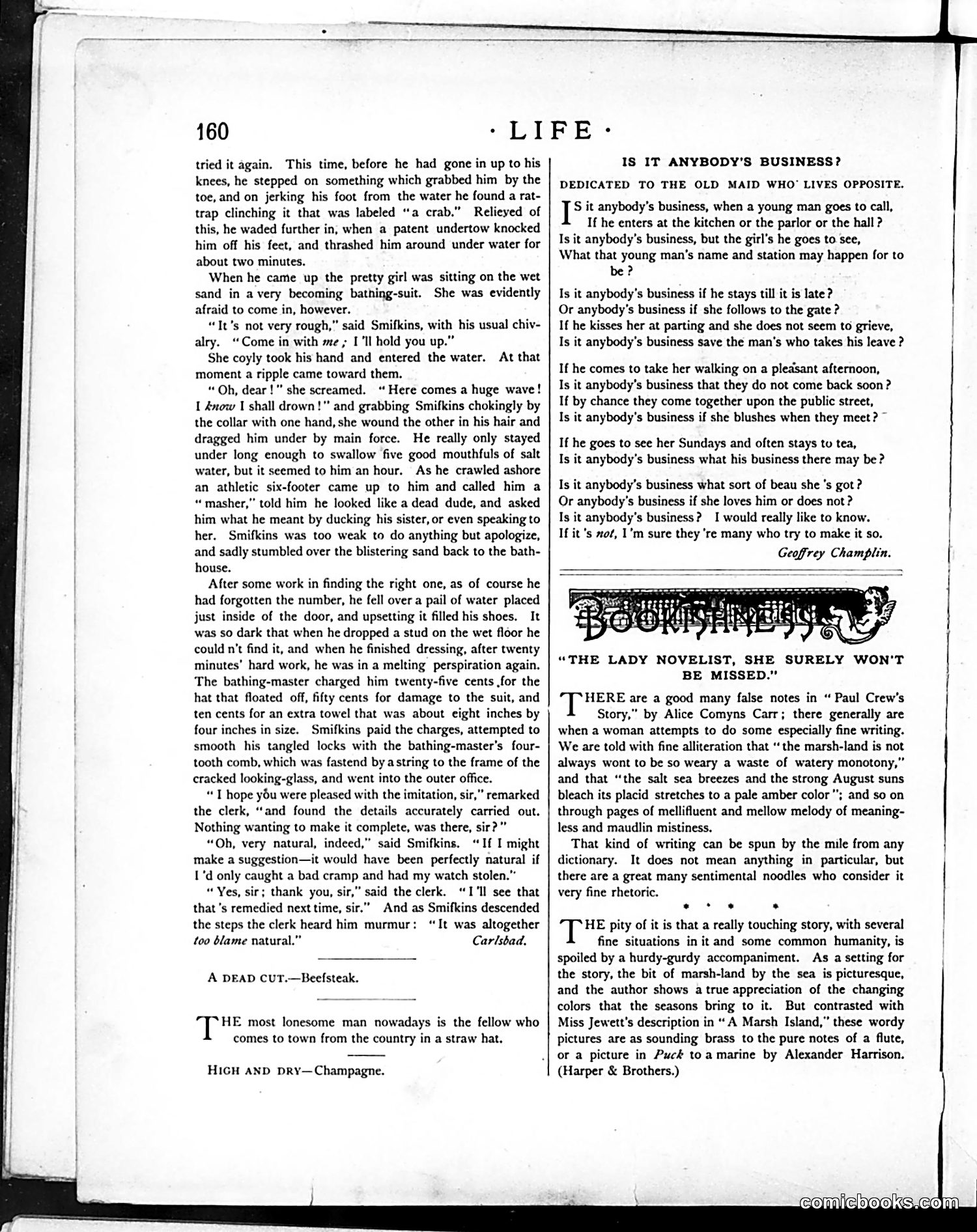
This page contains three distinct pieces of humor rather than political cartoons: 1. **"A Dead Cut"** (bottom left): A brief anecdote mocking a clerk's pompous response to a customer complaint, ending with the pun "too damn natural." 2. **"Is It Anybody's Business?"** (center): A poem by Geoffrey Champlin satirizing social etiquette and propriety—specifically, the question of whether it's acceptable to publicly comment on a young couple's courtship. The repeated refrain playfully challenges Victorian-era social conventions about what counts as "anybody's business." 3. **Book review** (right): Critical commentary on "Paul Crew's Story" by Alice Comyns Carr, critiquing overly sentimental, melodramatic writing as "watery" and rhetorically excessive. The page reflects early 20th-century Life magazine's focus on social satire and literary critique rather than political cartooning.
📄 Transcribed text from this page (OCR, searchable)
Machine-transcribed from the original scan — historical spelling and the odd misread are preserved.
160 ‘LIFE: tried it again. This time, before he had gone in up to his knees, he stepped on something which grabbed him by the toe, and on jerking his foot from the water he found a rat- trap clinching it that was labeled “a crab.” Relieyed of this, he waded further in, when a patent undertow knocked him off his feet, and thrashed him around under water for about two minutes. When he came up the pretty girl was sitting on the wet sand in avery becoming bathing-suit. She was evidently afraid to come in, however. “It’s not very rough,” said Smifkins, with his usual chiv- alry. “Come in with me ; I'll hold you up.” She coyly took his hand and entered the water. At that moment a ripple came toward them. “Oh, dear!" she screamed. “Here comes a huge wave! I £now I shall drown!" and grabbing Smifkins chokingly by the collar with one hand, she wound the other in his hair and dragged him under by main force. He really only stayed under long enough to swallow five good mouthfuls of salt water, but it seemed to him an hour. As he crawled ashore an athletic six-footer came up to him and called him a “masher,” told him he looked like a dead dude, and asked him what he meant by ducking his sister, or even speaking to her. Smifkins was too weak to do anything but apologize, and sadly stumbled over the blistering sand back to the bath- house. After some work in finding the right one, as of course he had forgotten the number, he fell over a pail of water placed just inside of the door, and upsetting it filled his shoes. It was so dark that when he dropped a stud on the wet floor he could n't find it, and when he finished dressing, after twenty minutes’ hard work, he was in a melting perspiration again. The bathing-master charged him twenty-five cents for the hat that floated off, fifty cents for damage to the suit, and ten cents for an extra towel that was about eight inches by four inches in size. Smifkins paid the charges, attempted to smooth his tangled locks with the bathing-master’s four- tooth comb, which was fastend by a string to the frame of the cracked looking-glass, and went into the outer office. “ T hope yéu were pleased with the imitation, sir,” remarked the clerk, “‘and found the details accurately carried out. Nothing wanting to make it complete, was there, sir?” “Oh, very natural, indeed,” said Smifkins. “If I might make a suggestion—it would have been perfectly natural if 1d only caught a bad cramp and had my watch stolen.” “Yes, sir; thank you, sir,” said the clerk. “I'll see that that 's remedied next time, sir.” And as Smifkins descended the steps the clerk heard him murmur: “It was altogether too blame natural.” Carlsbad. A DEAD CUT.—Beefsteak. HE most lonesome man nowadays is the fellow who comes to town from the country in a straw hat. HIGH AND DRY—Champagne. IS IT ANYBODY’S BUSINESS? DEDICATED TO THE OLD MAID WHO’ LIVES OPPOSITE. S it anybody’s business, when a young man goes to call, If he enters at the kitchen or the parlor or the hall ? Is it anybody’s business, but the girl's he goes to see, What that young man’s name and station may happen for to be? Is it anybody's business if he stays till it is late? Or anybody's business if she follows to the gate ? If he kisses her at parting and she does not seem to grieve, Is it anybody's business save the man’s who takes his leave ? If he comes to take her walking on a pleasant afternoon, Is it anybody's business that they do not come back soon? If by chance they come together upon the public street, Is it anybody's business if she blushes when they meet ? ~ If he goes to see her Sundays and often stays to tea, Is it anybody's business what his business there may be ? Is it anybody’s business what sort of beau she 's got? Or anybody's business if she loves him or does not? Is it anybody's business? I would really like to know. If it 's xof, 1’m sure they ‘re many who try to make it so. Geoffrey Champlin. “THE LADY NOVELIST, SHE SURELY WON'T BE MISSED.” HERE are a good many false notes in “ Paul Crew's Story,” by Alice Comyns Carr; there generally are when a woman attempts to do some especially fine writing. We are told with fine alliteration that “the marsh-land is not always wont to be so weary a waste of watery monotony,” and that “the salt sea breezes and the strong August suns bleach its placid stretches to a pale amber color”; and so on through pages of mellifluent and mellow melody of meaning- less and maudlin mistiness. That kind of writing can be spun by the mile from any dictionary. It does not mean anything in particular, but there are a great many sentimental noodles who consider it very fine rhetoric. s+ 8 . HE pity of it is that a really touching story, with several fine situations in it and some common humanity, is spoiled by a hurdy-gurdy accompaniment. As a setting for the story, the bit of marsh-land by the sea is picturesque, and the author shows a true appreciation of the changing colors that the seasons bring to it. But contrasted with Miss Jewett's description in “ A Marsh Island,” these wordy pictures are as sounding brass to the pure notes of a flute, or a picture in Puck toa marine by Alexander Harrison. (Harper & Brothers.)