
Life, 1885-09-17 · page 10 of 16
Life — September 17, 1885 — page 10: what you’re looking at
What you’re looking at
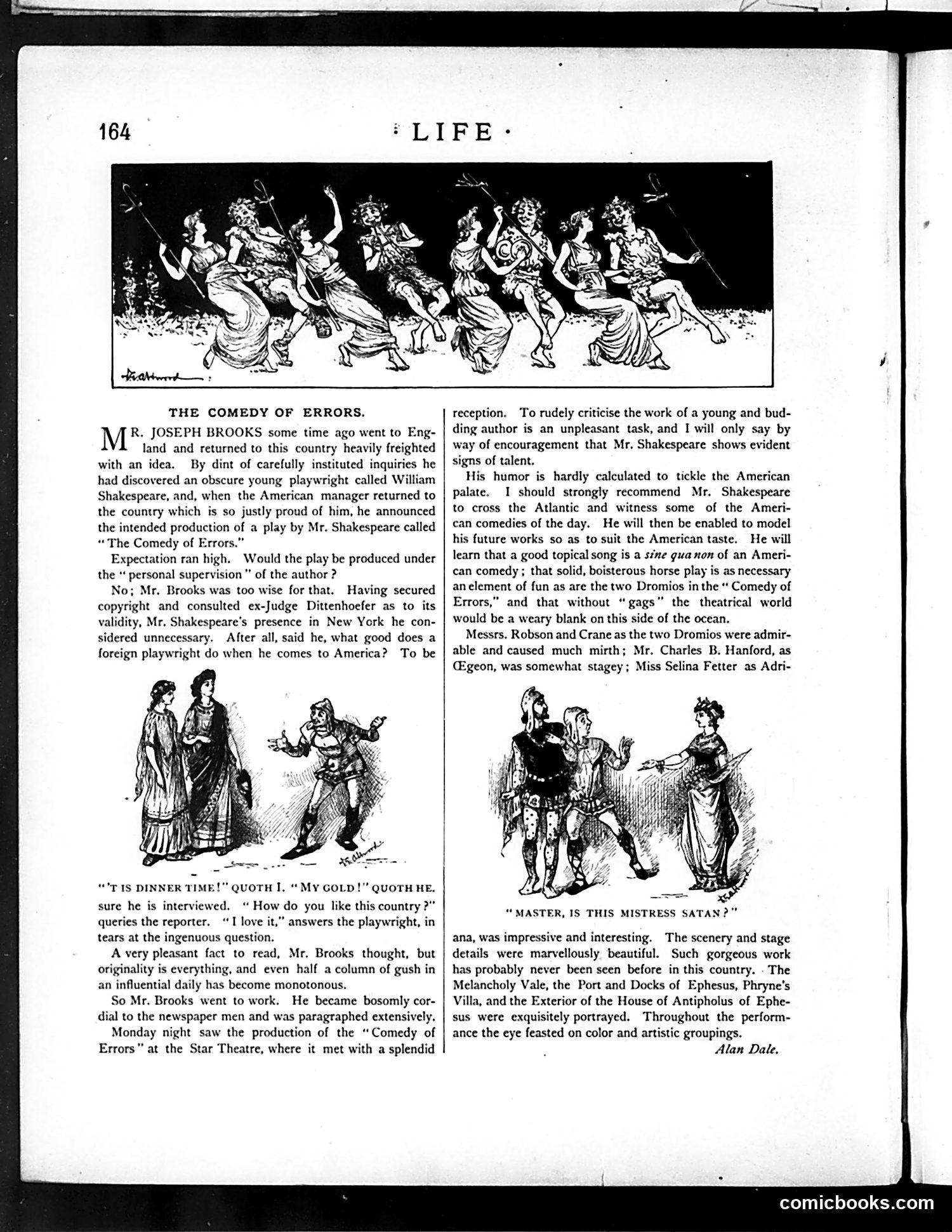
This is a theatrical review-satire, not a political cartoon. Critic Alan Dale mocks American producer Joseph Brooks for bringing Shakespeare's *Comedy of Errors* to New York while excluding Shakespeare himself—then making the production "American" through sensationalism rather than artistic merit. The satire's targets: **Brooks's strategy**: securing copyright, consulting lawyers about validity, then promoting the show through aggressive newspaper courting rather than letting Shakespeare's name speak for itself. **American theatrical taste**: Dale suggests Americans prefer "topical songs" and "boisterous horse play" over Shakespeare's wit—they need "gags" to be entertained. The production's gorgeous scenery and actual talented cast (Robson, Crane, Hanford, Fetter) apparently couldn't overcome the fundamental problem: Shakespeare doesn't suit American audiences. **The irony**: An obscure English playwright is "rediscovered," brought to America under corporate control, and then criticized for not being American *enough*. The accompanying illustrations show theatrical characters, likely from the actual production.
📄 Transcribed text from this page (OCR, searchable)
Machine-transcribed from the original scan — historical spelling and the odd misread are preserved.
THE COMEDY OF ERRORS. R. JOSEPH BROOKS some time ago went to Eng- land and returned to this country heavily freighted with an idea. By dint of carefully instituted inquiries he had discovered an obscure young playwright called William Shakespeare, and, when the American manager returned to the country which is so justly proud of him, he announced the intended production of a play by Mr. Shakespeare called “ The Comedy of Errors.” Expectation ran high. Would the play be produced under the “ personal supervision" of the author ? No; Mr. Brooks was too wise for that. Having secured copyright and consulted ex-Judge Dittenhoefer as to its validity, Mr. Shakespeare's presence in New York he con- sidered unnecessary. After all, said he, what good does a foreign playwright do when he comes to America? To be “'T 1S DINNER TIME!" QUOTH I. ** My GOLD!" QUOTH HE, sure he is interviewed. ‘“ How do you like this country ?” queries the reporter. ‘I love it,” answers the playwright, in tears at the ingenuous question. A very pleasant fact to read, Mr. Brooks thought, but originality is everything, and even half a column of gush in an influential daily has become monotonous. So Mr. Brooks went to work. He became bosomly cor- dial to the newspaper men and was paragraphed extensively. Monday night saw the production of the “Comedy of Errors" at the Star Theatre, where it met with a splendid reception. To rudely criticise the work of a young and bud- ding author is an unpleasant task, and I will only say by way of encouragement that Mr, Shakespeare shows evident signs of talent. His humor is hardly calculated to tickle the American palate. I should strongly recommend Mr. Shakespeare to cross the Atlantic and witness some of the Ameri- can comedies of the day. He will then be enabled to model his future works so as to suit the American taste. He will learn that a good topical song is a sze guanon of an Ameri- can comedy ; that solid, boisterous horse play is as necessary an element of fun as are the two Dromios in the “ Comedy of Errors,” and that without “gags” the theatrical world would be a weary blank on this side of the ocean. Messrs. Robson and Crane as the two Dromios were admir- able and caused much mirth; Mr. Charles B. Hanford, as (Egeon, was somewhat stagey; Miss Selina Fetter as Adri- “MASTER, IS THIS MISTRESS SATAN?" ana, was impressive and interesting. The scenery and stage details were marvelously beautiful. Such gorgeous work has probably never been seen before in this country. . The Melancholy Vale, the Port and Docks of Ephesus, Phryne’s Villa, and the Exterior of the House of Antipholus of Ephe- sus were exquisitely portrayed. Throughout the perform- ance the eye feasted on color and artistic groupings. Alan Dale. comicbooks.com