
A complete issue · 16 pages · 1885
Life — September 10, 1885
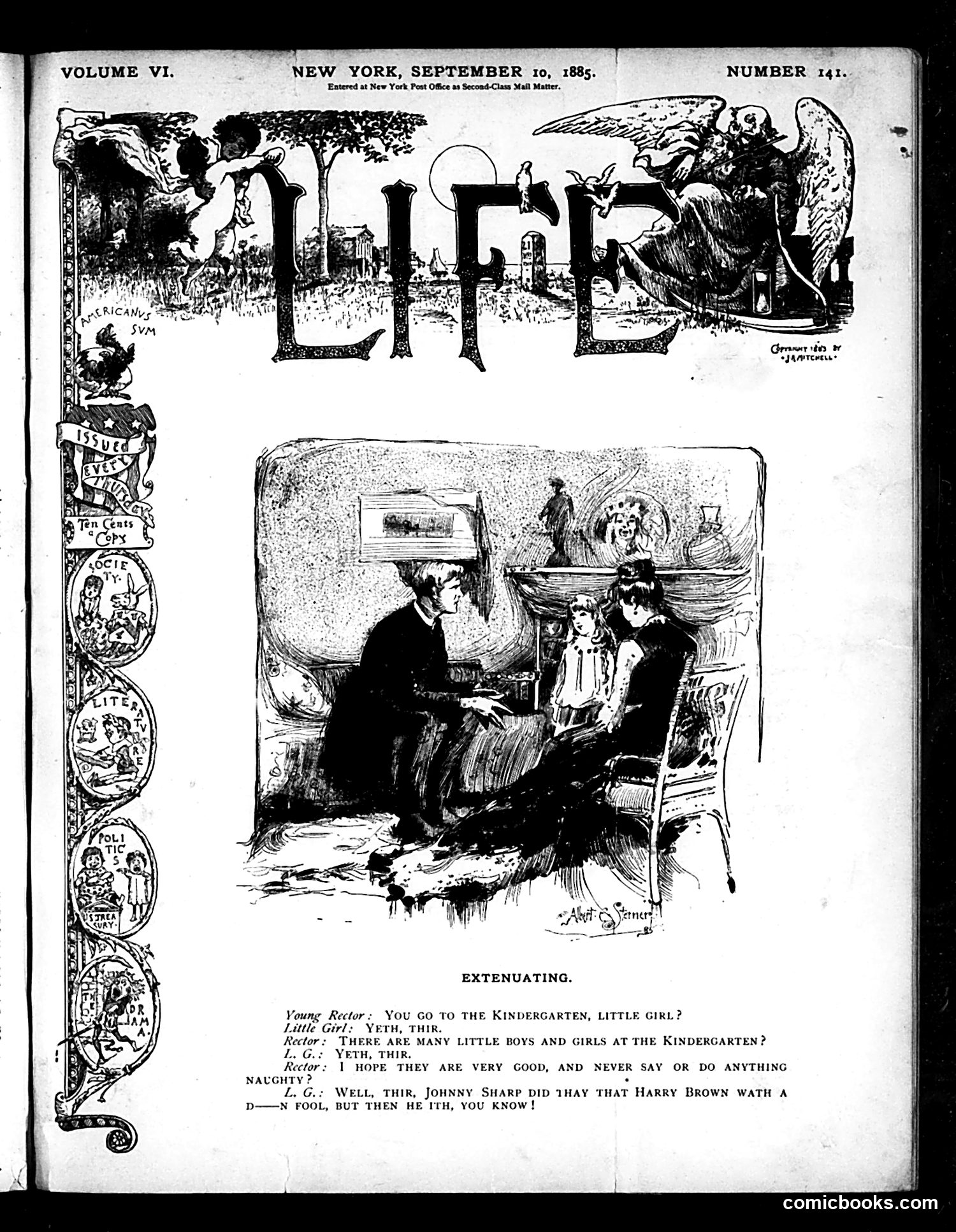
This cartoon satirizes parental attitudes toward children's misbehavior. A stern rector (clergyman) questions a little girl about kindergarten attendance, asking if the children behave well. When she mentions that "Johnny Sharp" and "Harry Brown" misbehaved, the rector expresses hope they're "very good" and "never say or do anything naughty." The humor lies in the rector's obvious hypocrisy and the girl's candid response: she reports the boys weren't foolish—they were deliberately rude. The title "Extenuating" suggests the rector is making excuses for bad behavior rather than condemning it, likely reflecting Victorian-era class anxieties about which children's misconduct could be overlooked or excused based on social standing.
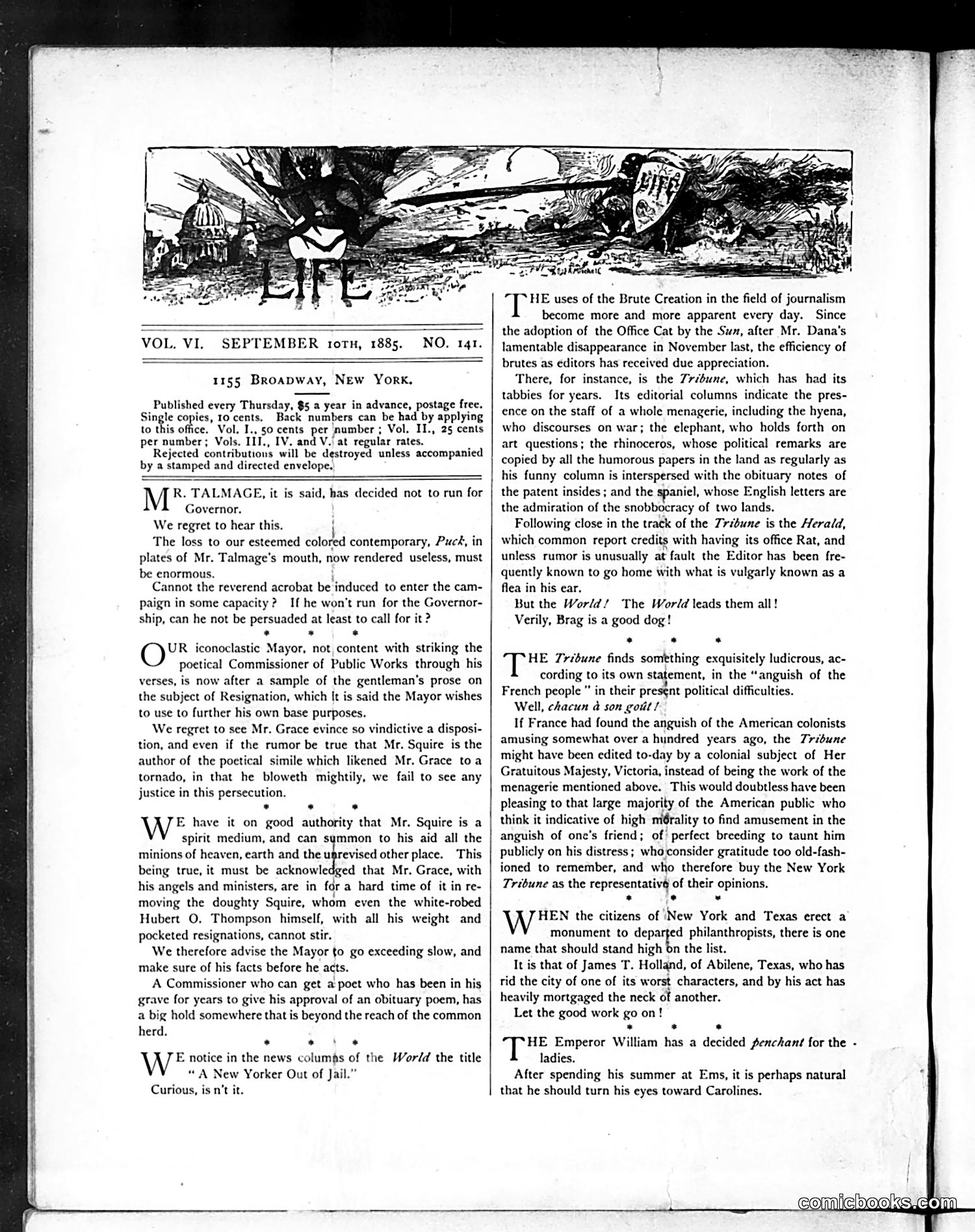
This page contains political commentary rather than a cartoon. The main topics include: **Mr. Talmage for Governor**: Life sarcastically opposes a potential gubernatorial run, questioning whether this reverend "acrobat" has the capacity. **Mayor Grace and Mr. Squire**: The piece criticizes Mayor Grace's "vindictive disposition" regarding a poetical commissioner of Public Works named Squire. Life suggests Grace, despite his angelic appearance, is actually bullying Squire out of office. **The Tribune vs. French colonial anguish**: Life mocks the *Tribune* newspaper for finding humor in France's colonial difficulties, suggesting this reflects poorly on American morality. The overall tone satirizes local New York politics and press behavior rather than featuring visual cartoons.
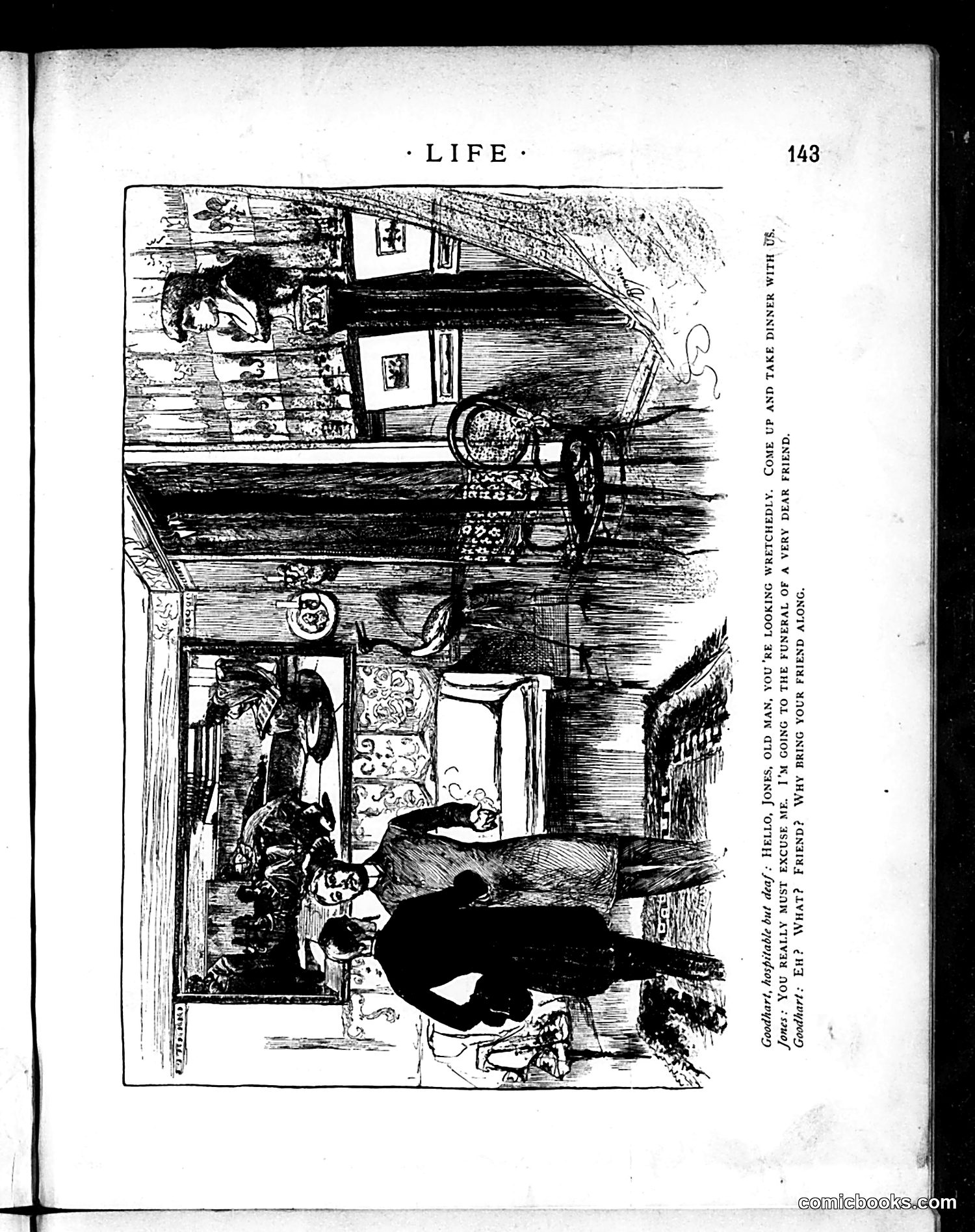
This appears to be a satirical cartoon titled "Gobbled up before I heard, 'pose old man, you're looking one up and take dinner with us. I can't stop to the turnip of a very dear friend. With bring your friends along." The image depicts a domestic interior scene with what appears to be a well-dressed man in dark clothing as the central figure. The setting shows period furnishings and architectural details typical of late 19th or early 20th-century America. Without clearer visibility of specific identifying details or captions, I cannot definitively identify the particular political figures or specific historical event being satirized. The cartoon appears to mock social pretension or insincere hospitality through the contrast between formal invitation language and casual circumstances, but the exact satirical target remains unclear from this reproduction.
This page consists entirely of brief satirical commentary on contemporary news and public figures, with no visible cartoon illustrations despite the decorative header. The notes mock various targets: Mark Twain picking chestnuts; Henry James and Oscar Wilde; religious paperette fiction; newspaper editorial performance; and military/political matters including a jab at Cyrus W. Field ("second Columbus") for laying telegraph cable. Several items appear to reference specific 1880s-90s events—an epidemic in Lowell, Republican Party prospects, and Congressional wheat-related scandals involving Mr. Pulitzer—though without dates, precise identification remains uncertain. The humor relies on brief, punchy observations about public figures' pretensions and current events' absurdities, typical of Life's satirical approach to American politics and culture.
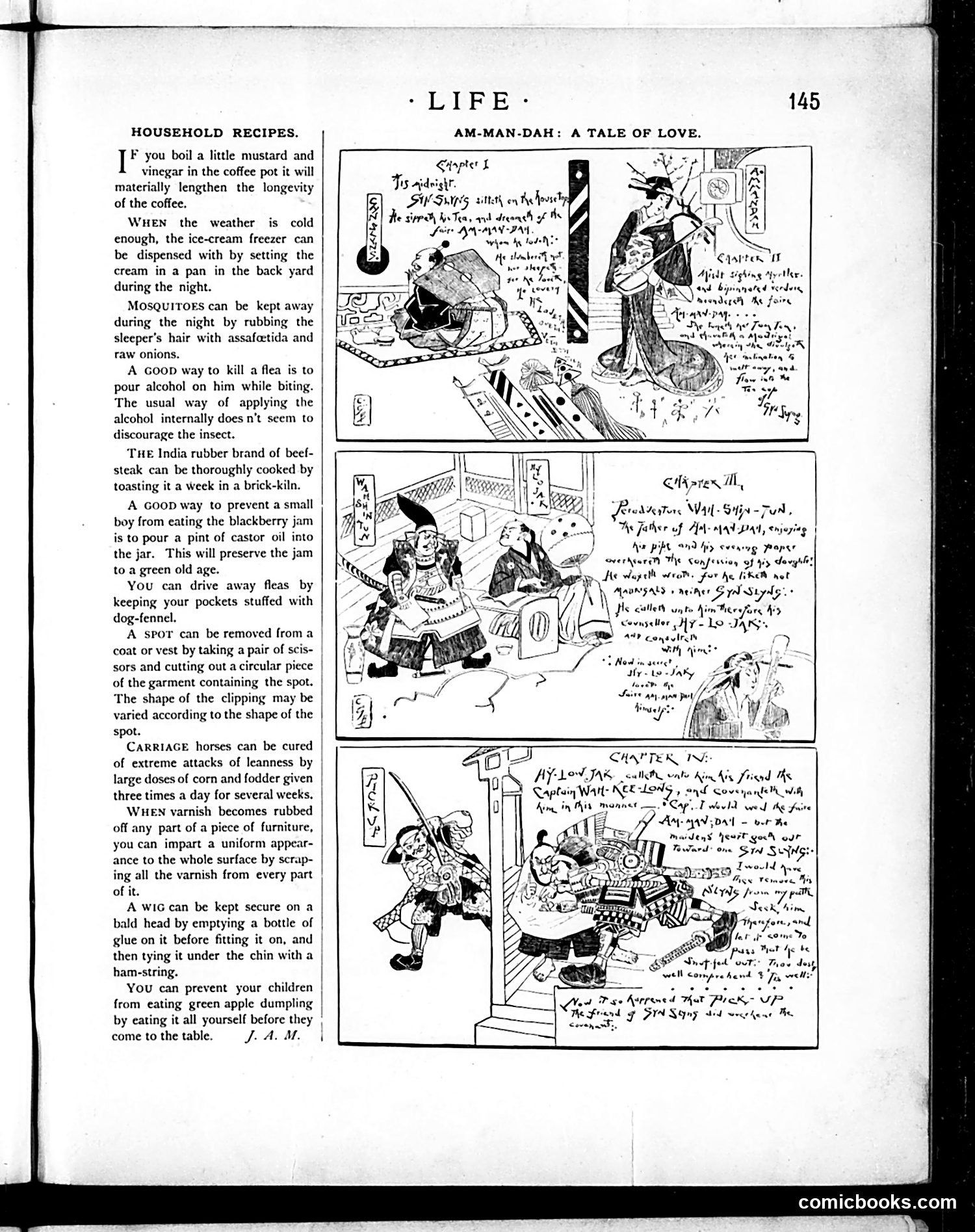
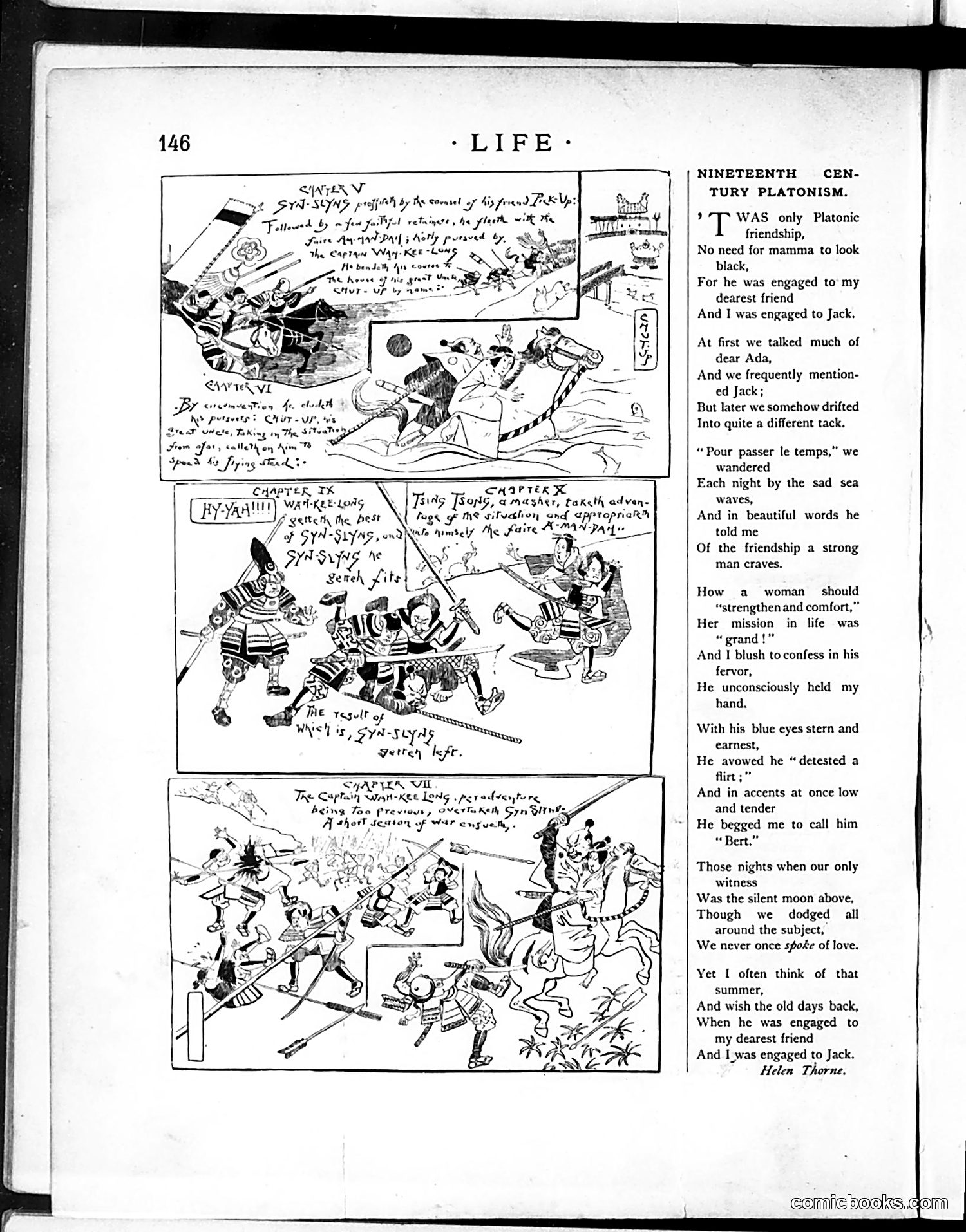
This appears to be a multi-panel comic strip with Japanese aesthetic elements (visible in the art style and calligraphy). The narrative involves what seems to be a romantic or adventure storyline with characters in traditional dress interacting across three scenes—possibly depicting courtship, domestic life, and conflict or resolution. The handwritten text accompanying each panel is largely illegible in this reproduction, making specific plot details unclear. However, the overall composition suggests a humorous take on cross-cultural or "exotic" romance narratives that were popular in early 20th-century American humor magazines. The "Am-Man-Dah" title appears to be a playful romanization of Japanese or pseudo-Oriental phrasing, typical of period satire about Asian cultures.
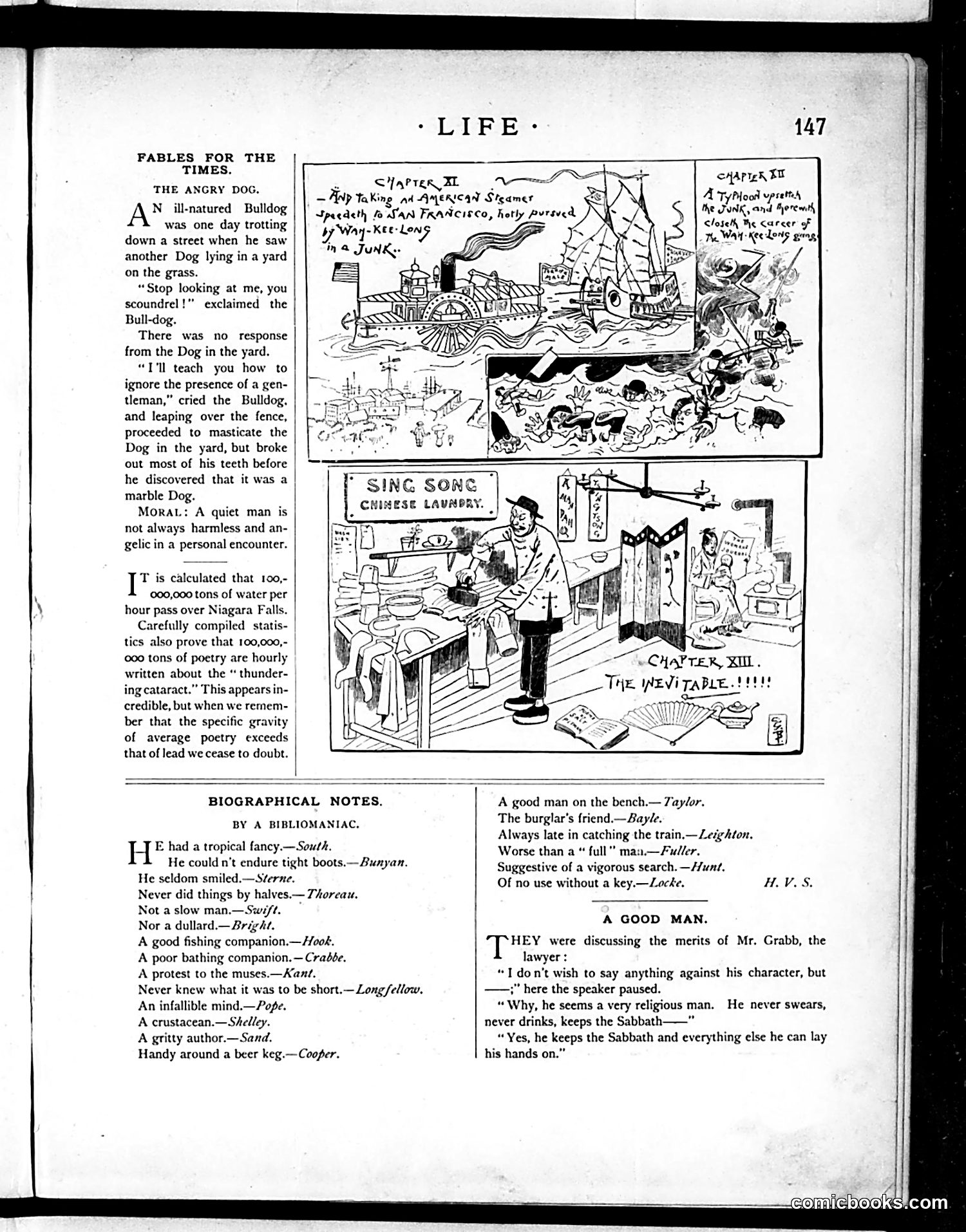
This page contains satirical fables and biographical humor typical of early Life magazine. The cartoons appear to mock stereotypes and social pretensions: **Top panels**: Chapter XI depicts a steamship "Way-Kee-Long" in a junk, seemingly mocking Chinese vessels and immigration. Chapter XII shows chaos, likely satirizing Chinese laundry operations. **Middle panel**: "Sing Song Chinese Laundry" depicts the stereotype of Chinese laundry workers, a common target of American satire in this era. **Bottom section**: "Biographical Notes" contains witty character sketches of recognizable types (lawyers, fishermen, etc.), typical of Life's humor format. **"A Good Man"**: A brief dialogue mocking religious hypocrisy—the lawyer defends Grabb as "religious" while suggesting his piety masks opportunistic behavior ("keeps the Sabbath and everything else he can lay his hands on"). The page reflects Period American attitudes toward Chinese immigrants and social criticism through satire.
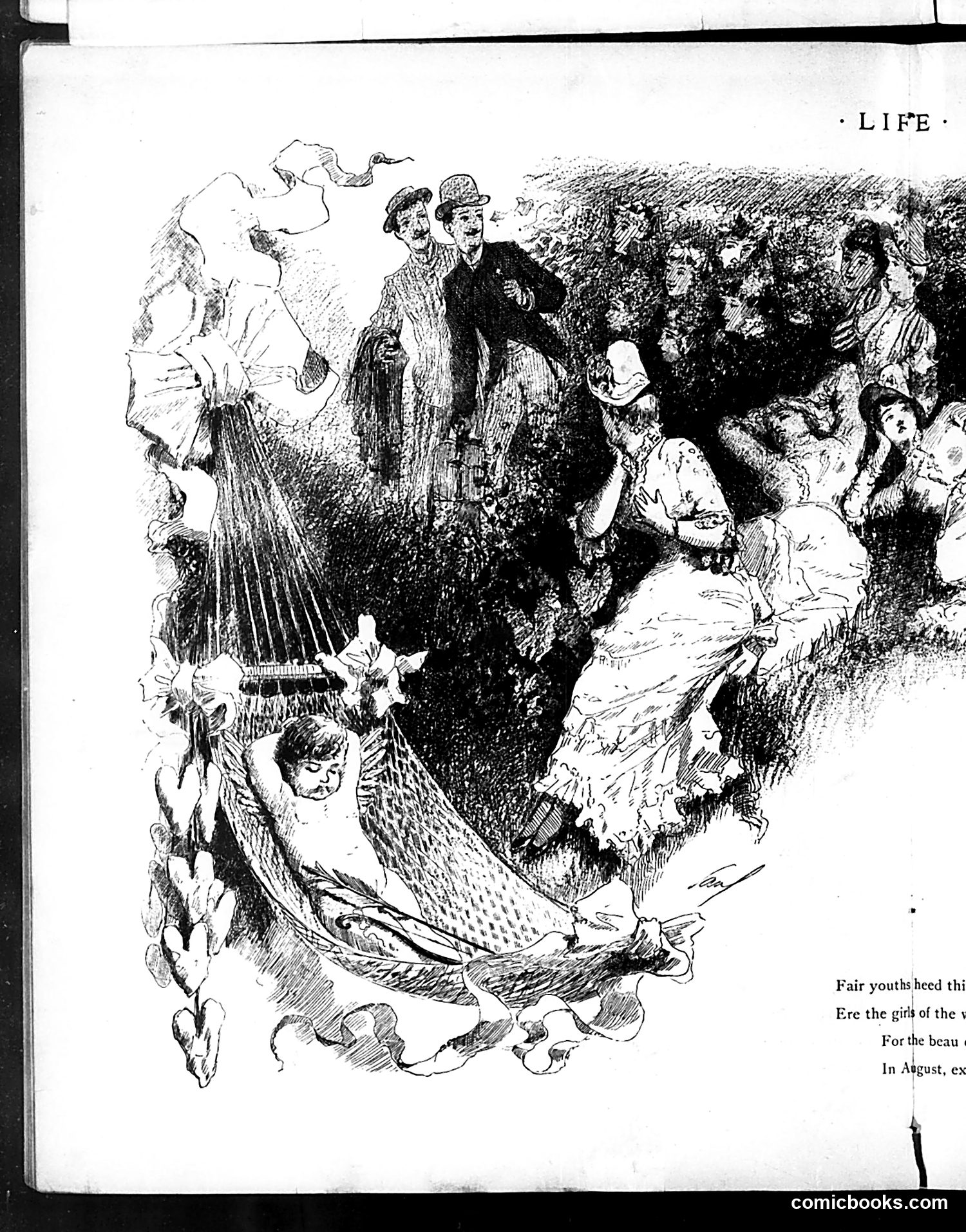
This is a satirical illustration from *Life* magazine depicting a social gathering, likely from the late 19th or early 20th century based on the artistic style and clothing. The image shows well-dressed figures in what appears to be an outdoor garden or park setting, with women in elaborate dresses and men in formal attire. The visible text fragment mentions "Fair youths heed thi[s]" and references "the girls of the v[...]" and "August," suggesting romantic or courtship themes. The decorative border framing the scene—featuring floral or vine motifs—emphasizes the pastoral, romantic setting. Without complete text, the specific satirical target remains unclear, though the composition suggests commentary on courtship rituals, social pretense, or seasonal leisure activities among the wealthy classes—common *Life* magazine subjects.
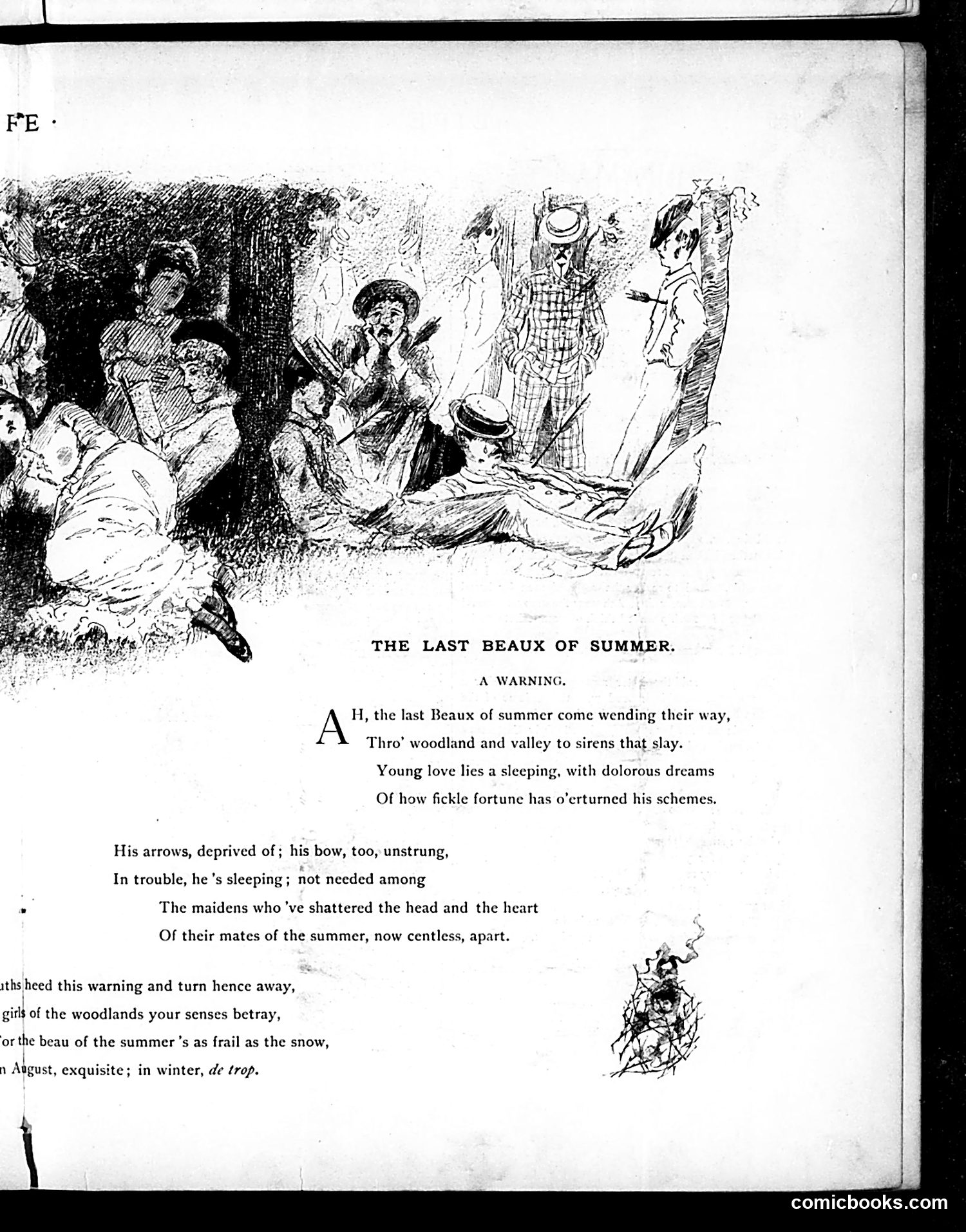
This page presents a poem warning young women about the dangers of summer romance. The illustration shows a group of men and women in late 19th-century dress gathered outdoors—likely a summer social scene. The poem personifies Cupid as worn out ("His arrows, deprived of; his bow, too, unstrung"), suggesting summer love is exhausted and unreliable. The warning addresses "girls of the woodlands"—young women—cautioning them that summer beaux are "as frail as the snow," meaning their affections are temporary and will disappear come winter ("de trop" = excessive/unwanted). The satire mocks the fickleness of summer romance and cautions women against taking seasonal suitors seriously, as their attention inevitably fades when the season ends.
This page satirizes theatrical producers James C. Duff and John Stetson, who staged popular productions of *The Mikado* (Gilbert & Sullivan's 1885 opera). A visiting Japanese gentleman from Yokohama critiques their versions as inauthentic—pointing out that the scenery is actually Chinese, the choreography is Parisian (referencing dancer Jarbeau), and the staging relies on stereotypes rather than genuine Japanese aesthetics. The satire mocks both the producers' pretensions to authenticity and their shallow appropriation of Japanese culture. The joke hinges on the irony that these supposedly authoritative productions of "Japan" are actually hodgepodges of European and Asian elements, particularly Chinese influences (dismissively referenced as "Mott street"—NYC's Chinatown). The visiting expert's withering commentary exposes their ignorance and vanity, ultimately uniting the competing managers in shared embarrassment.
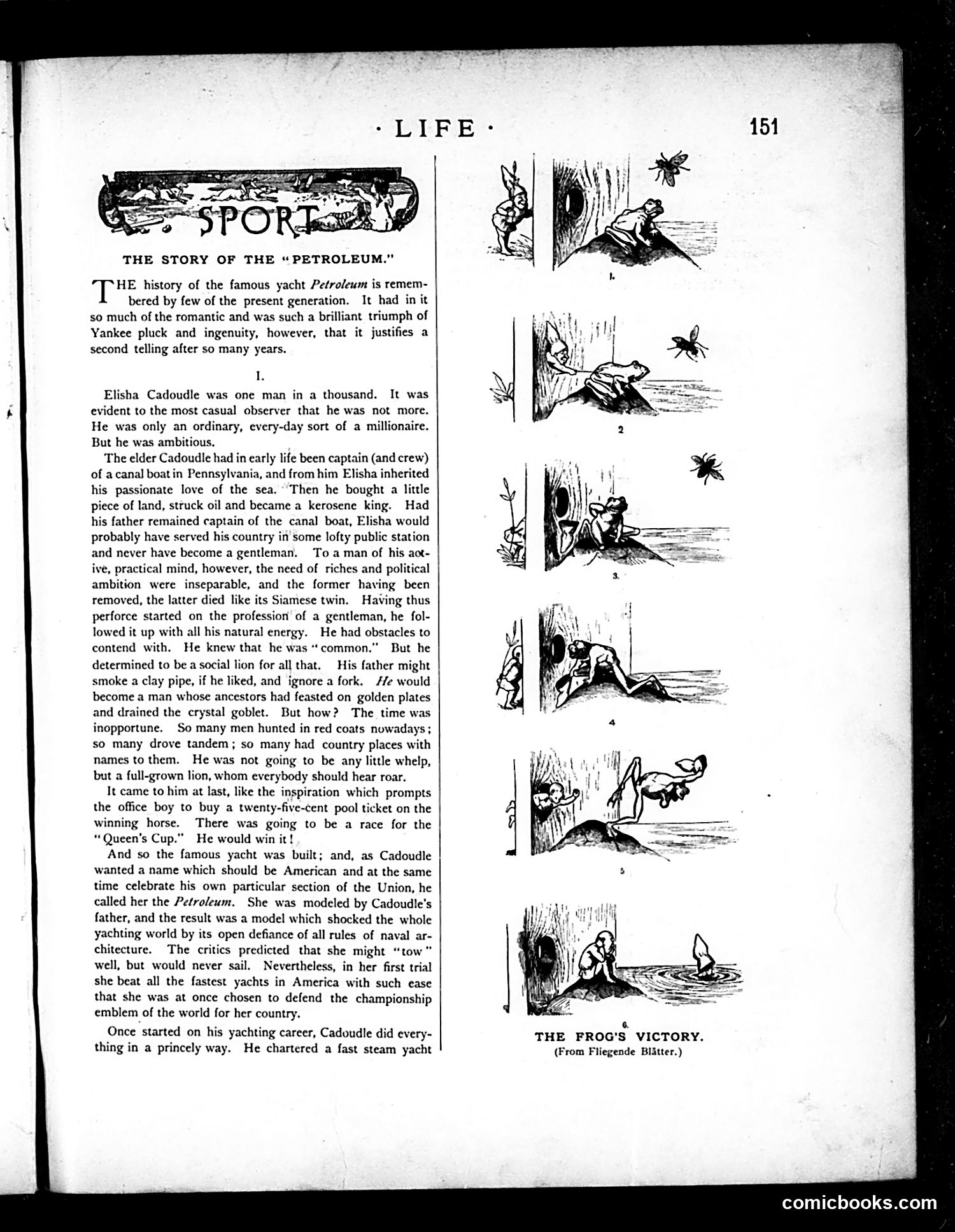
This page contains two distinct elements: the beginning of a fictional narrative about a self-made millionaire named Elisha Cadoudle who builds a yacht called the *Petroleum* to win the "Queen's Cup" racing competition, and an unrelated comic strip titled "The Frog's Victory" (credited to a German publication). The Cadoudle story satirizes American social climbing and nouveau-riche ambition. A kerosene magnate (oil being a new source of wealth in the era) attempts to become a gentleman and social lion by entering yacht racing—then considered an elite pursuit. The satire mocks both his "ordinariness" and his presumption that winning a race will secure his social status. The accompanying comic strip (panels 1-6) appears to depict a frog's humorous misadventures, though the specific narrative is unclear without caption text. The page number indicates this is page 151.
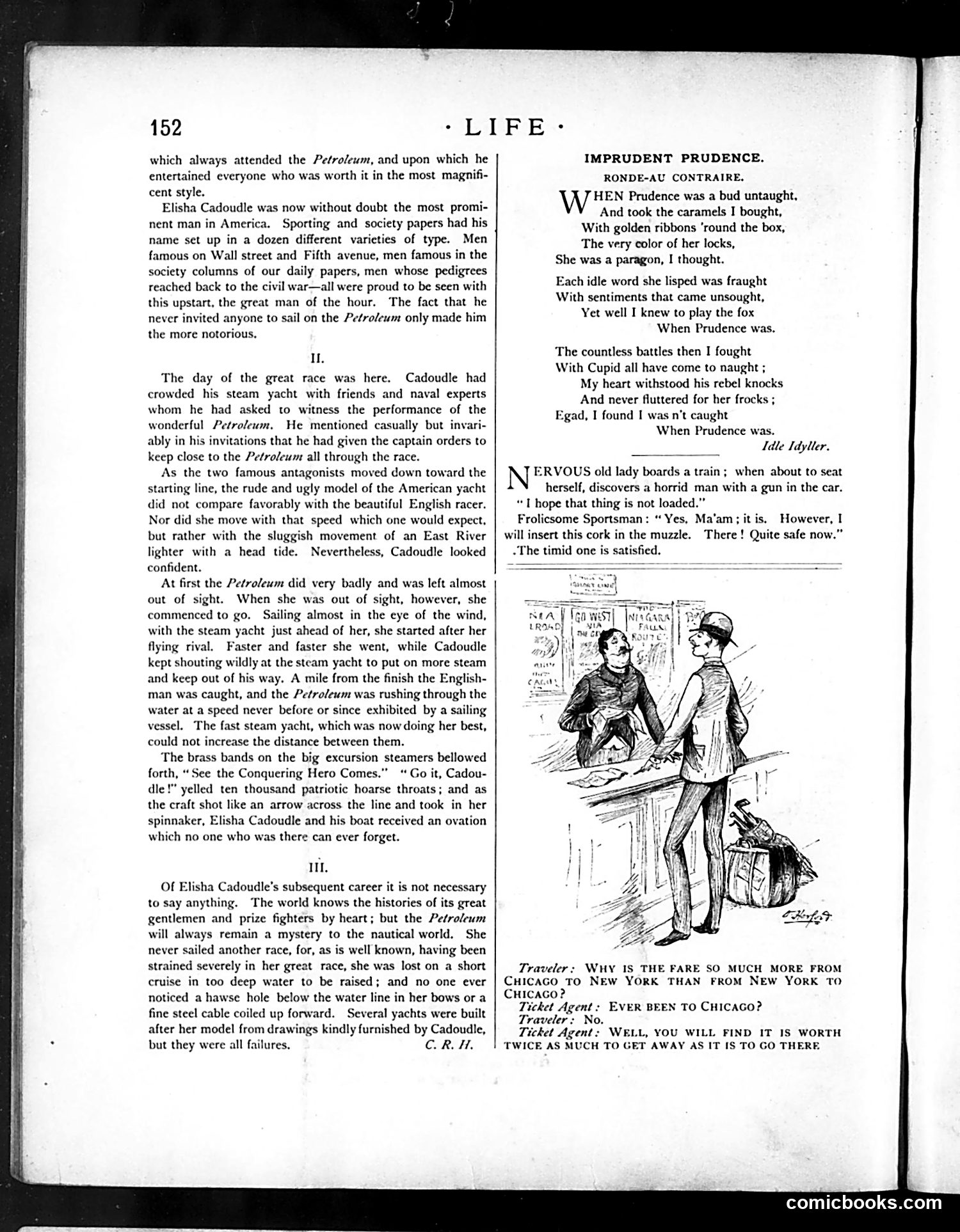
This page contains two distinct pieces of satirical content: **The Main Story (Left):** A serialized narrative mocking the newly wealthy "robber baron" class. Elisha Cadoudle, a petroleum tycoon, achieves prominence through ostentatious wealth rather than breeding or character. The satire peaks when his steam yacht "Petroleum" wins a race against an English sailing vessel through what's heavily implied to be cheating (the mysterious "hawse hole" and cable suggest sabotage). The story ridicules both Cadoudle's vulgar social climbing and American society's eager acceptance of him. **Right Side Content:** Two lighter pieces—a poem about romantic rejection ("Imprudent Prudence") and a brief joke about a nervous elderly woman discovering a gun in a train compartment. These provide comic relief. The overall target is Gilded Age excess and the corruption of old social hierarchies by new industrial wealth.
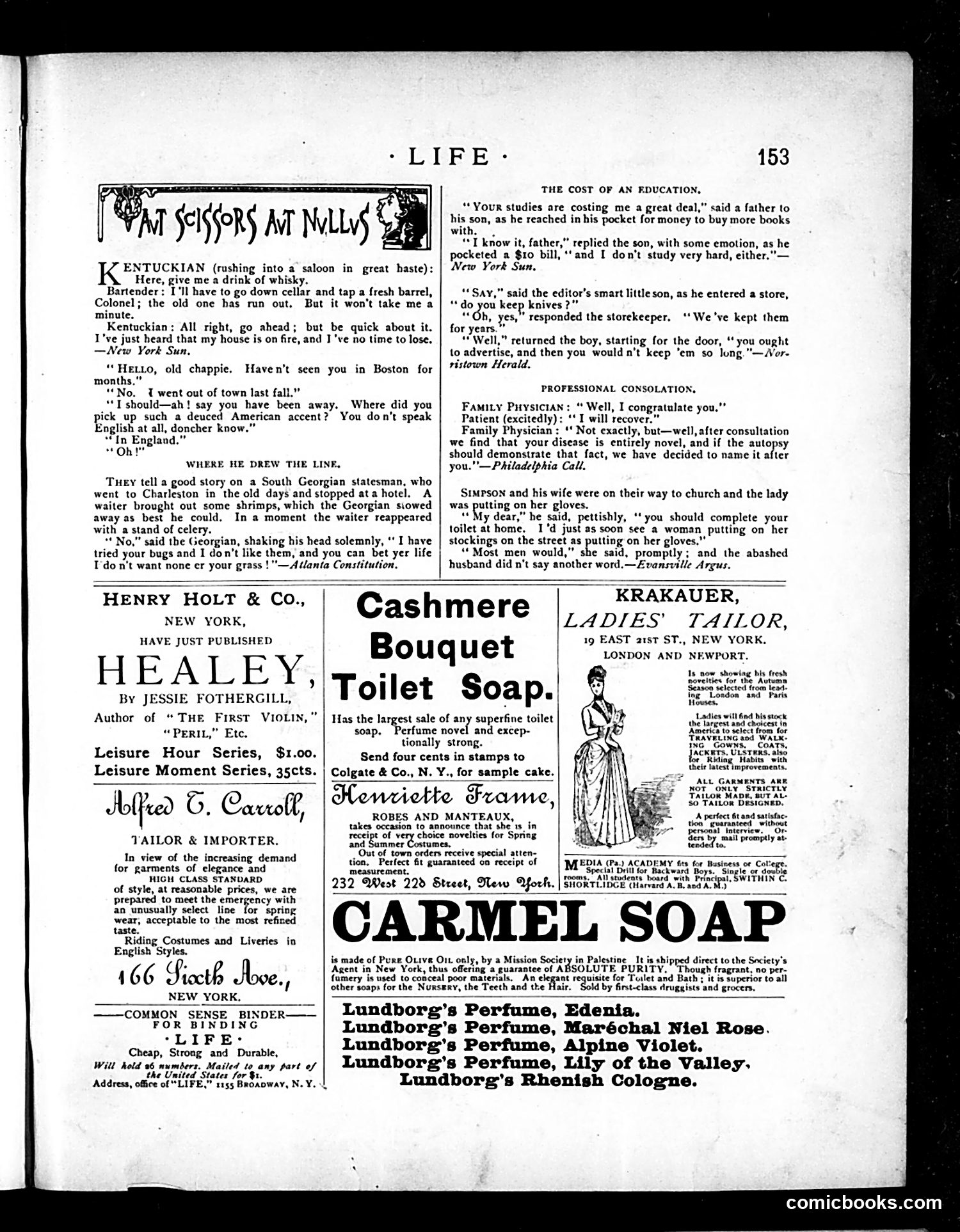
This page contains four brief humorous anecdotes typical of *Life* magazine's satirical humor from the late 19th century: 1. **"At Scissors at Nulls"**: A Kentucky gentleman rushes into a saloon requesting whisky, explaining his house is on fire—but doesn't want to wait for a fresh barrel. The joke plays on Southern stereotypes about whiskey consumption and priorities. 2. **"Where He Drew the Line"**: A Southern aristocrat happily eats shrimp at a Charleston hotel but refuses celery, calling it "bugs" and "grass." The humor mocks regional unfamiliarity with certain foods. 3. **"The Cost of an Education"**: A student receives money from his father for books but admits he doesn't study hard—the irony being education costs money while the student contributes minimal effort. 4. **"Professional Consolation"**: A doctor tells a patient his disease is novel enough to be named after him—a dark joke about terminal illness disguised as honor. The remaining content is advertisements for books, clothing, and toiletries, typical of period magazines. The cartoons rely on period stereotypes and gentle domestic/professional humor rather than political commentary.
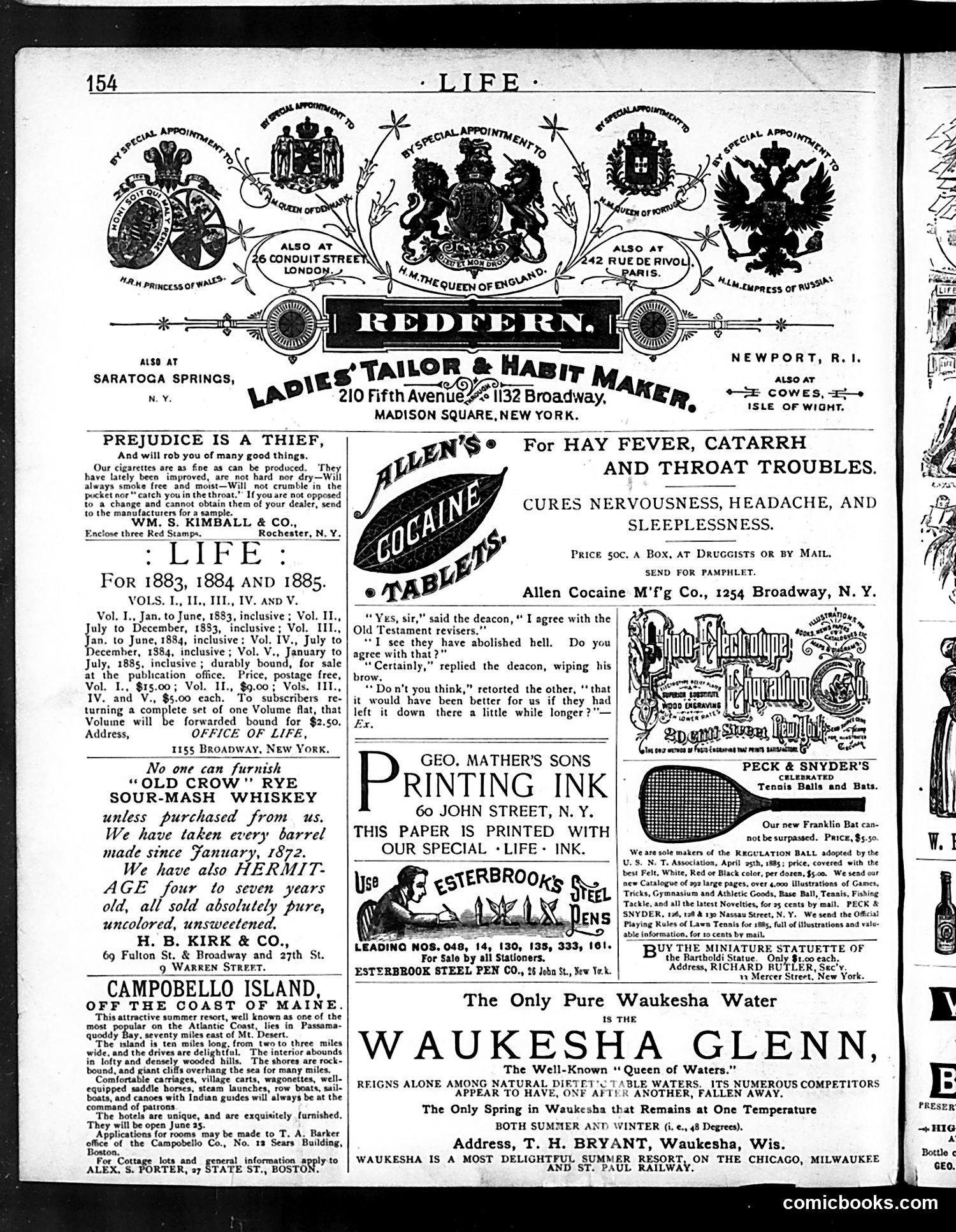
This is primarily an **advertising page** from Life magazine (1880s), containing minimal editorial content beyond a brief joke. ## The Humor The only narrative cartoon is a short **dialogue between a deacon and another man** about Biblical revision. The Old Testament revisers had removed references to hell from their updated translation. When asked if he agrees with abolishing hell, the deacon says yes—but the other man sarcastically suggests they should have "left it down there a little while longer," implying the deacon deserves damnation. ## Context This reflects **1880s Protestant anxieties** about biblical scholarship. The "Old Testament revisers" were scholars producing updated Bible translations based on newer manuscript evidence. Conservative religious figures viewed these revisions with suspicion, seeing them as modernizing challenges to traditional doctrine. The joke pokes fun at hypocritical piety—the deacon's eagerness to dismiss hell until confronted with the suggestion he might need it. The remainder of the page is **period advertising**: cigarettes, whiskey, printing ink, tennis equipment, summer resorts, and notably **Allen's Cocaine tablets** for hay fever and nervousness—then a legal, marketed pharmaceutical product.
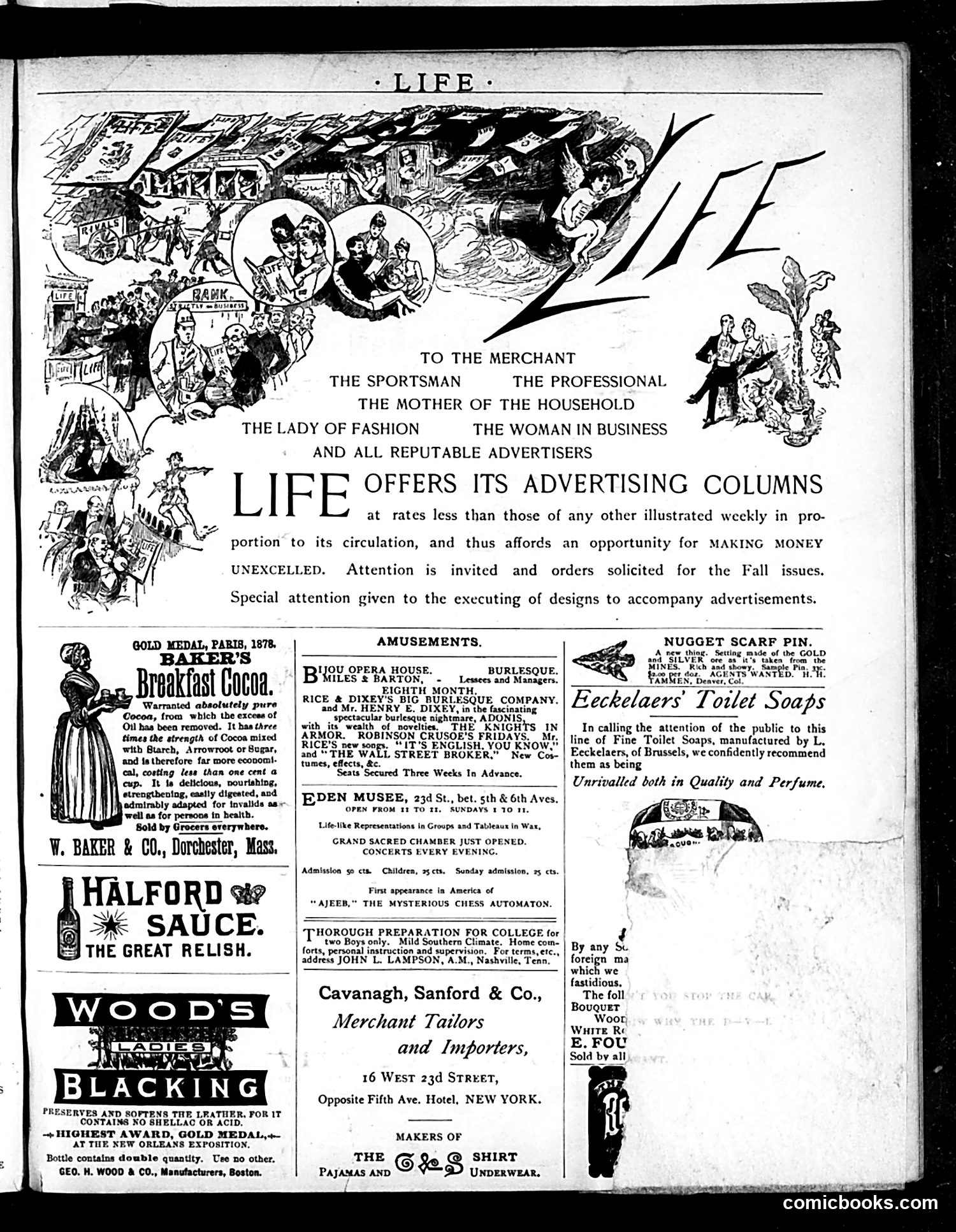
This is primarily an **advertising section**, not a political cartoon. The page showcases Life magazine's pitch to potential advertisers, targeting diverse demographics: merchants, sportsmen, professionals, mothers, fashionable women, and businesswomen. The decorative header illustration depicts various scenes of daily life and commerce—crowds, activities, transportation—establishing Life's broad appeal and circulation reach. The central message promises advertisers competitive rates and effective reach. The remainder features product advertisements typical of the 1870s-80s era: Baker's Breakfast Cocoa (with a Gold Medal award), Halford Sauce, Wood's Blacking shoe polish, Eeckelaers' Toilet Soaps, and various theatrical amusements (burlesque, wax museum, chess automaton). This reflects the magazine's business model: attracting affluent, literate readers through humor and satire, then selling advertising space to manufacturers and services seeking that audience. No specific political satire appears on this page.
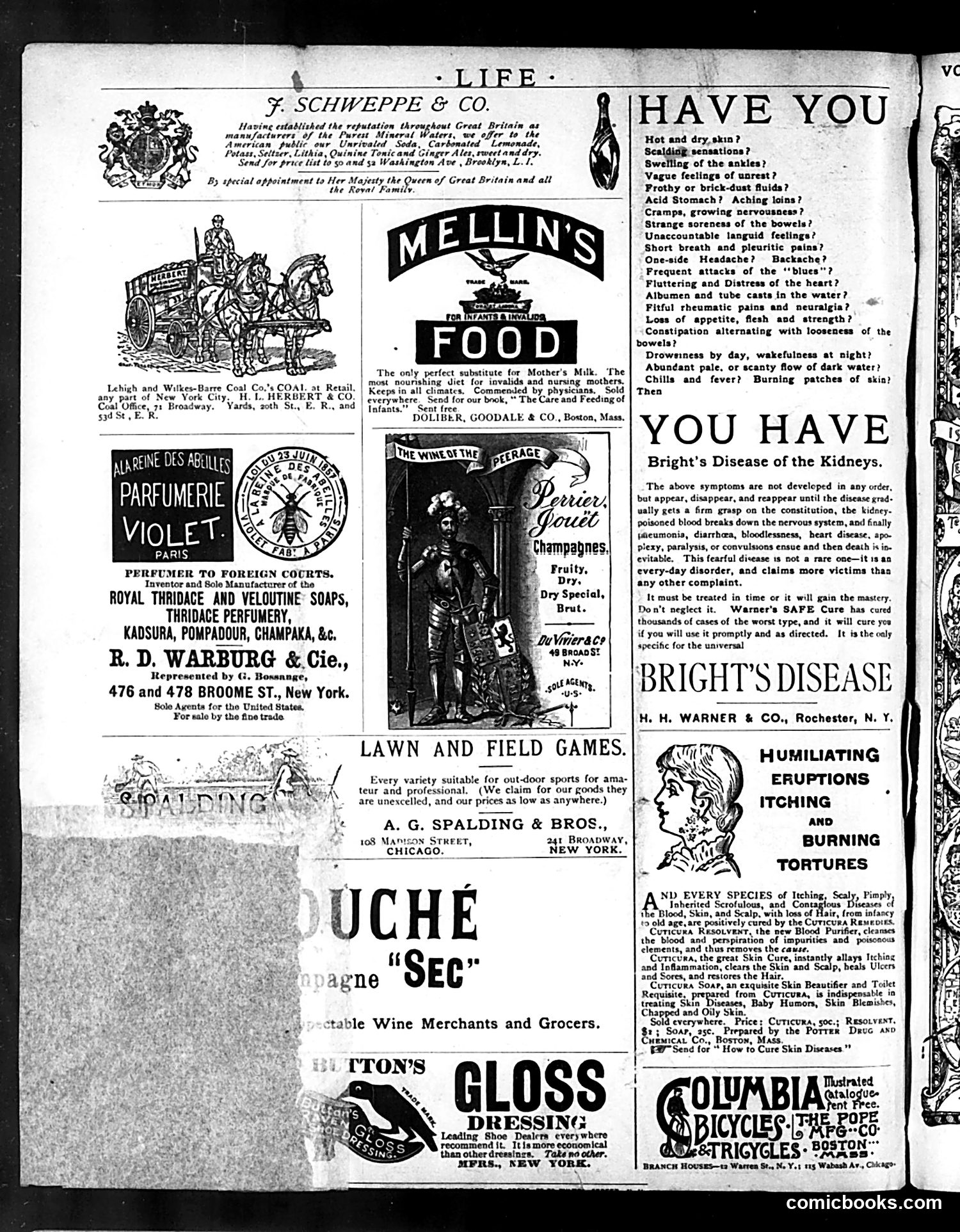
This page is primarily **advertising**, not editorial or satirical content. It's a collection of late 19th-century product advertisements typical of *Life* magazine's revenue model. The ads promote patent medicines and consumer goods common to the era: - **Mellin's Food**: infant formula marketed as a "perfect substitute for Mother's Milk" - **Warner's Safe Cure**: a dubious patent medicine claiming to treat Bright's Disease (kidney ailment), using a symptom checklist designed to convince readers they were sick - **Cuticura products**: remedies for skin diseases and "scrofulous" conditions - Standard commercial goods: perfumes, champagne, coal, sporting equipment, shoe polish **The satirical angle** (if any) lies in the page's *implicit* social commentary: these ads preyed on health anxieties and promised miraculous cures for serious diseases with unproven treatments—a common practice *Life* might mock editorially elsewhere. The exhaustive symptom lists were manipulative marketing tactics. No identifiable political figures or events appear. This is simply a window into Gilded Age consumer culture and the patent-medicine industry's aggressive advertising practices.