
Life, 1885-09-10 · page 11 of 16
Life — September 10, 1885 — page 11: what you’re looking at
What you’re looking at
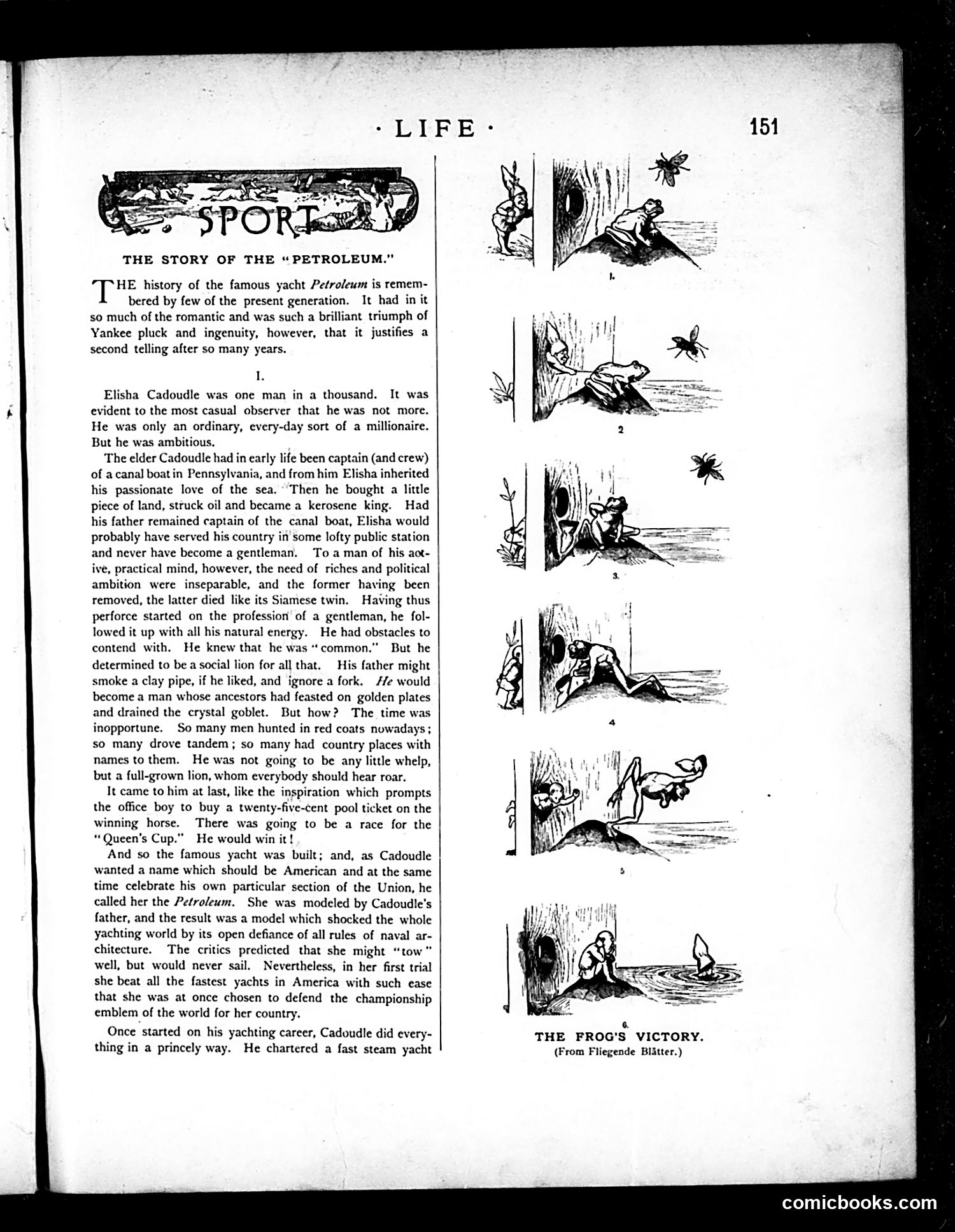
This page contains two distinct elements: the beginning of a fictional narrative about a self-made millionaire named Elisha Cadoudle who builds a yacht called the *Petroleum* to win the "Queen's Cup" racing competition, and an unrelated comic strip titled "The Frog's Victory" (credited to a German publication). The Cadoudle story satirizes American social climbing and nouveau-riche ambition. A kerosene magnate (oil being a new source of wealth in the era) attempts to become a gentleman and social lion by entering yacht racing—then considered an elite pursuit. The satire mocks both his "ordinariness" and his presumption that winning a race will secure his social status. The accompanying comic strip (panels 1-6) appears to depict a frog's humorous misadventures, though the specific narrative is unclear without caption text. The page number indicates this is page 151.
📄 Transcribed text from this page (OCR, searchable)
Machine-transcribed from the original scan — historical spelling and the odd misread are preserved.
THE STORY OF THE “PETROLEUM.” HE history of the famous yacht Petroleum is remem- bered by few of the present generation. It had in it so much of the romantic and was such a brilliant triumph of Yankee pluck and ingenuity, however, that it justifies a second telling after so many years. I. Elisha Cadoudle was one man in a thousand. It was evident to the most casual observer that he was not more. He was only an ordinary, every-day sort of a millionaire. But he was ambitious. The elder Cadoudle had in early life been captain (and crew) of a canal boat in Pennsylvania, and from him Elisha inherited his passionate love of the sea. “Then he bought a little piece of land, struck oil and became a kerosene king. Had his father remained captain of the canal boat, Elisha would probably have served his country in'some lofty public station and never have become a gentleman. To a man of his aot- ive, ctical mind, however, the need of riches and political ambition were inseparable, and the former having been removed, the latter died like its Siamese twin. Having thus perforce started on the profession of a gentleman, he fol- lowed it up with all his natural energy. He had obstacles to contend with. He knew that he was “common.” But he determined to be a social lion for all that, His father might smoke a clay pipe, if he liked, and ignore a fork. //e would become a man whose ancestors had feasted on golden plates and drained the crystal goblet. But how? The time was inopportune. So many men hunted in red coats nowadays; so many drove tandem; so many had country places with names to them. He was not going to be any little whelp, but a full-grown lion, whom everybody should hear roar. It came to him at last, like the inspiration which prompts the office boy to buy a twenty-five-cent pool ticket on the winning horse. There was going to be a race for the “Queen's Cup.” He would win it! And so the famous yacht was built; and, as Cadoudle wanted a name which should be American and at the same time celebrate his own particular section of the Union, he called her the Petroleum. She was modeled by Cadoudle’s father, and the result was a model which shocked the whole yachting world by its open defiance of all rules of naval ar- chitecture. The critics predicted that she might “tow” well, but would never sail. Nevertheless, in her first trial she beat all the fastest yachts in America with such ease that she was at once chosen to defend the championship emblem of the world for her country. Once started on his yachting career, Cadoudle did every- thing in a princely way. He chartered a fast steam yacht 6 THE FROG'S VICTORY. (From Fliegende Blitter.) comicbooks.com