
A complete issue · 16 pages · 1885
Life — August 13, 1885
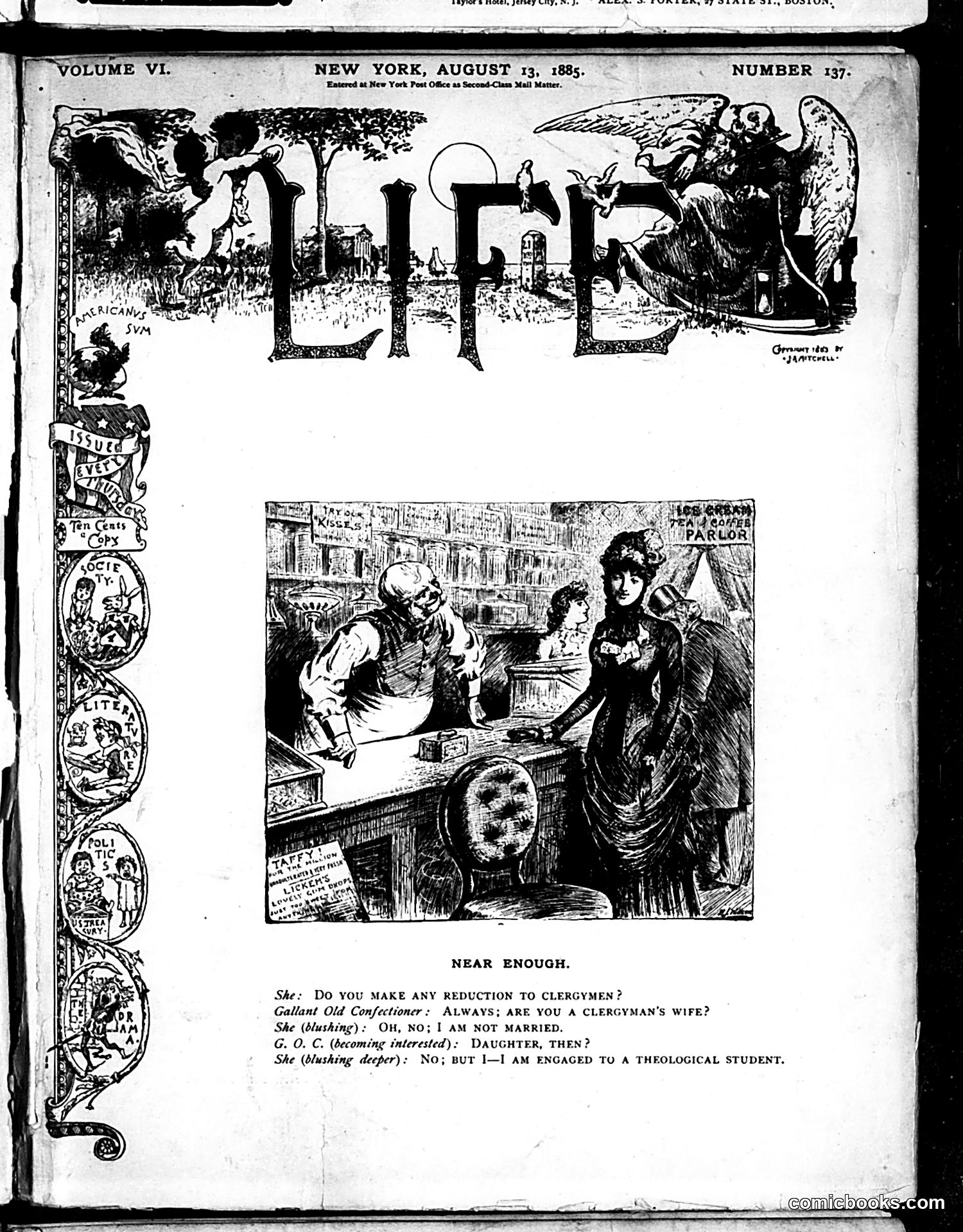
This cartoon satirizes clergy discount practices. A woman asks a confectioner if he offers reductions for clergymen. When he says yes, she claims eligibility because she's engaged to a theological student—close enough to clergy status, she implies. The joke targets two things: (1) the commercial practice of giving discounts to clergy, treating religious status as a commodity, and (2) the woman's absurd logic in stretching "clergyman" to include a mere student. The caption "Near Enough" mocks how loosely such benefits could be claimed or interpreted. The cartoon reflects 19th-century American skepticism toward both religious privilege and female opportunism, presenting the scene as a candy shop transaction where spiritual credentials become mere bargaining chips.
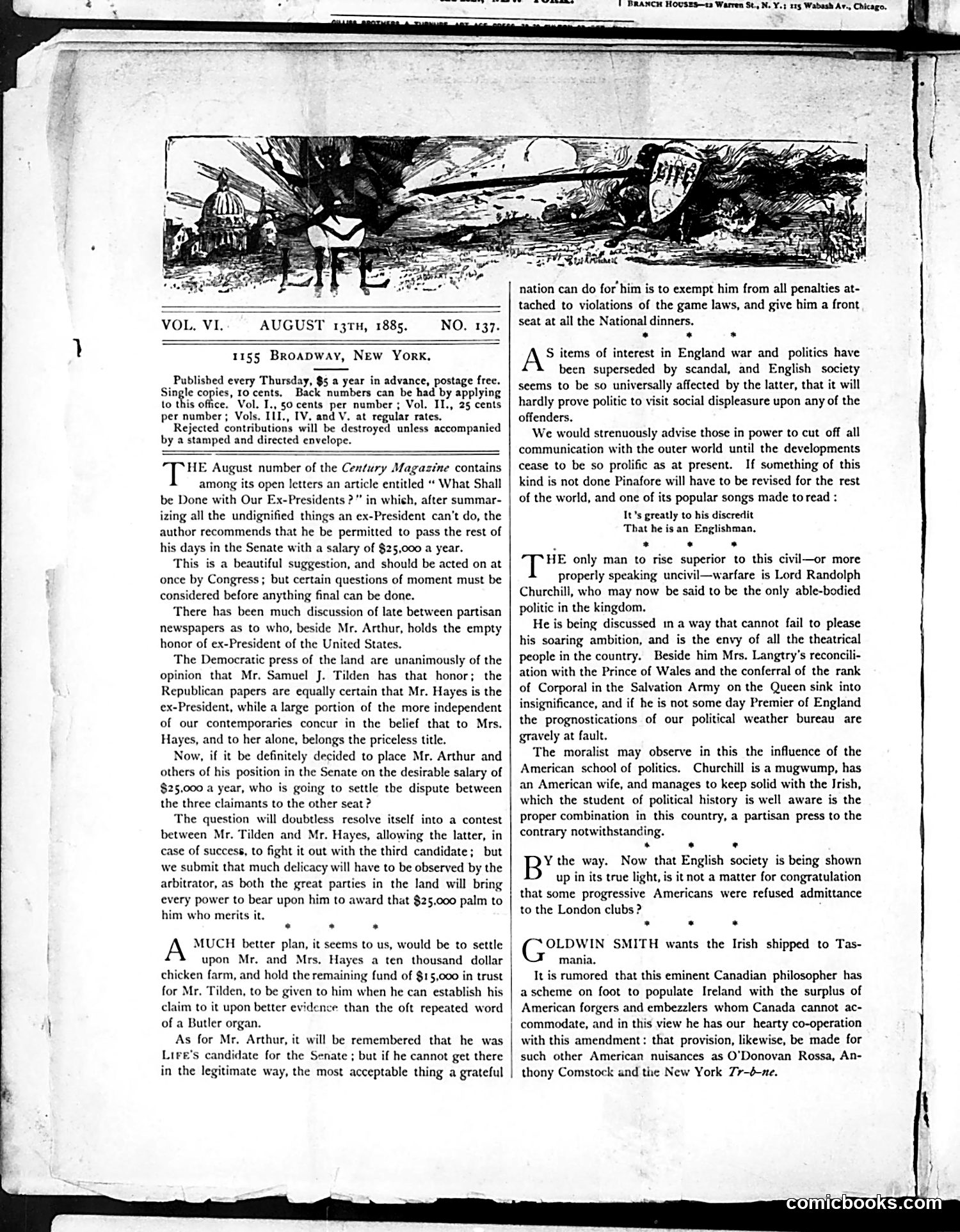
The prominent cartoon at the top of the page appears to depict a figure labeled "LIFE" in a dramatic scene, though the specific reference is unclear from this reproduction quality. The text discusses American political figures, particularly ex-Presidents. It mentions Samuel Tilden and suggests giving ex-Presidents a $25,000 annual salary, positioning this as resolving disputes over honors. The piece also discusses Lord Randolph Churchill's influence in English society, noting his American wife and Irish political connections. The final section references "Goldwin Smith" wanting Irish immigrants shipped to Tasmania, criticizing a Canadian philosopher's scheme to populate Ireland with American "forgers and embezzlers." The overall tone is satirical commentary on American politics, ex-presidential status, and international political figures of the mid-1880s.
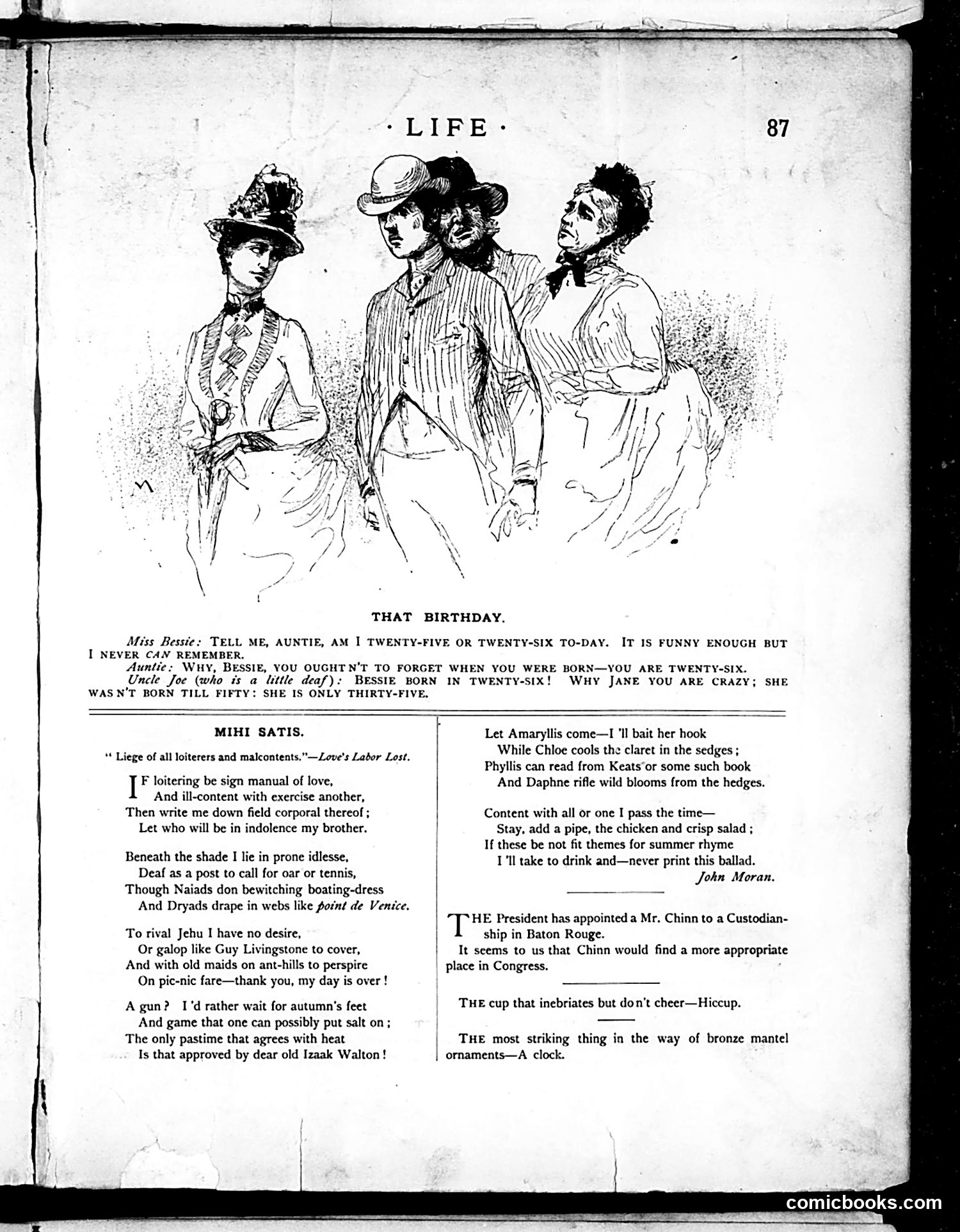
The cartoon depicts three women discussing age in a humorous domestic scene. Miss Bettie complains she can't remember if she's twenty-five or twenty-six. Auntie corrects her: Uncle Joe says Bessie was born in twenty-six and is only thirty-five; Jane shouldn't claim to be crazy since she's also thirty-five; and Bettie wasn't born until fifty—making her only thirty-five as well. The joke satirizes women's tendency to lie about their ages and the contradictions that arise when multiple women claim the same age. It reflects early-twentieth-century social anxiety about aging and women's vanity regarding appearance, a common theme in period humor. The cartoon mocks the absurdity of women's coordinated deception about birthdays.
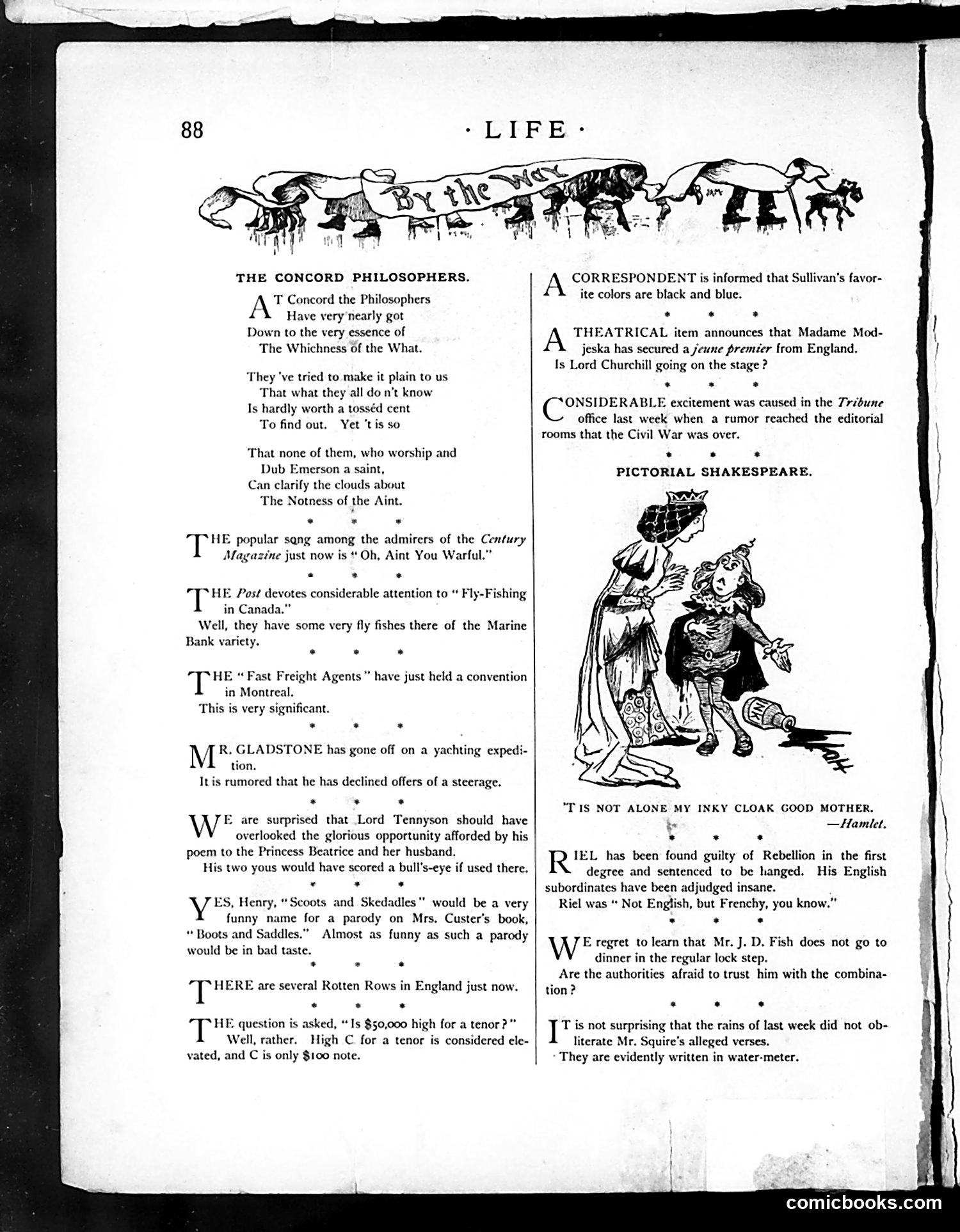
This page from *Life* magazine contains satirical commentary rather than political cartoons. The "Pictorial Shakespeare" illustration depicts a scene from *Hamlet* with period costume detail—likely a contemporary theatrical production reference. The text snippets mock various subjects: Concord philosophers ("The Whiteness of the What"), Lord Tennyson's missed opportunity with a poem about Princess Beatrice, and contemporary news items (Mr. Gladstone's yachting, Civil War rumors). One joke references tenor pricing ("Is $50,000 high for a tenor?"), and another mocks Mr. Squire's "verses" as being "written in water-meter"—a pun on Keats's epitaph. The humor relies on recognizing contemporary figures (Gladstone, Tennyson) and events familiar to 19th-century readers. Without that context, most references remain opaque to modern audiences.
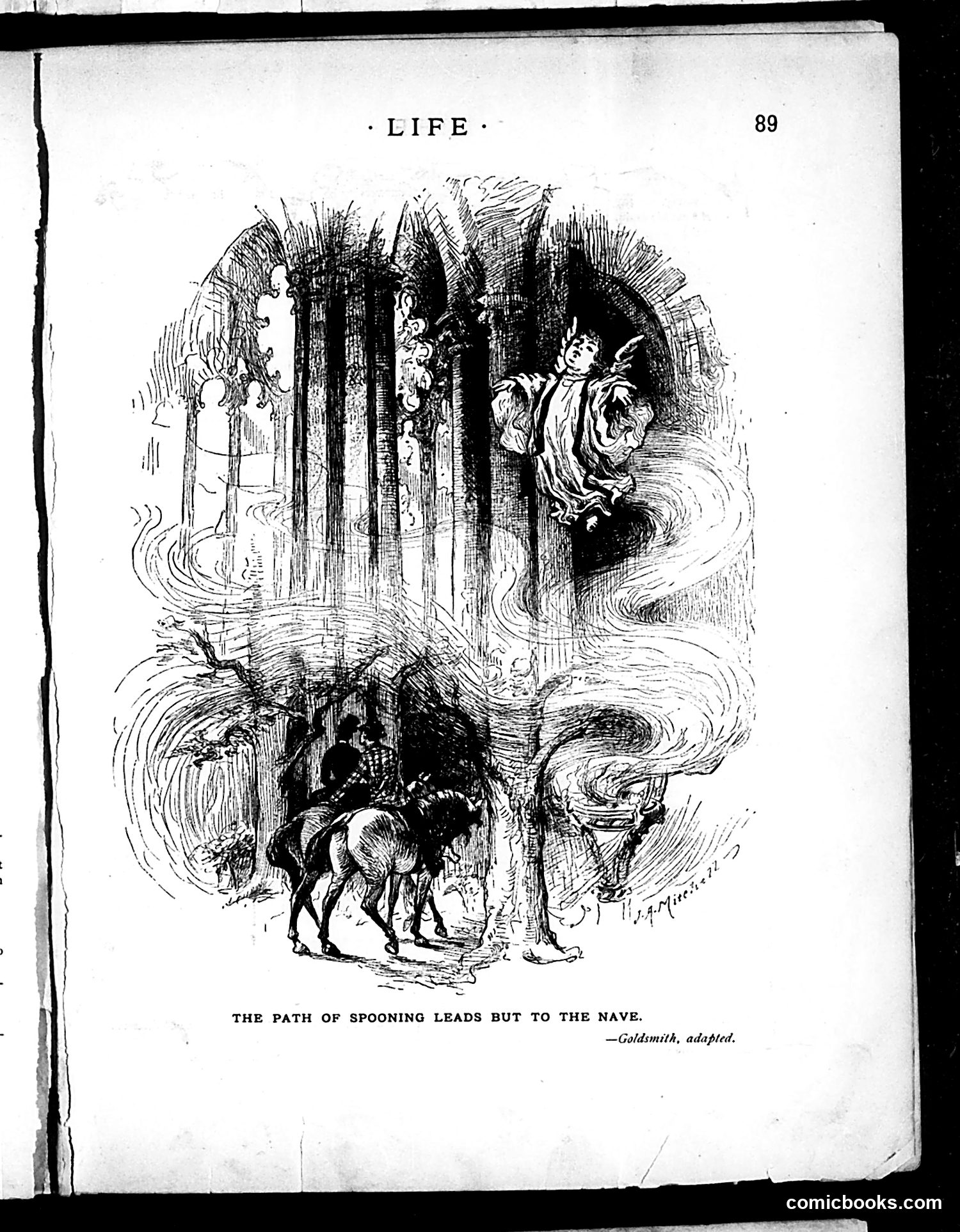
This is a satirical cartoon from *Life* magazine (page 89) illustrating the saying "The path of spooning leads but to the nave" — a pun adapting Goldsmith's line. The image depicts a romantic couple "spooning" (courting/embracing) inside a church, progressing toward the altar (nave). At the bottom, a dog observes them, likely representing a commentary on instinctual behavior or faithfulness. The satire mocks the inevitable trajectory of courtship: young romance naturally leads to marriage and the church. The dog's presence suggests either mockery of human predictability or ironic commentary on loyalty in romance. The Goldsmith attribution indicates this adapts a literary quote for humorous effect, typical of *Life's* sophisticated wit targeting educated readers.
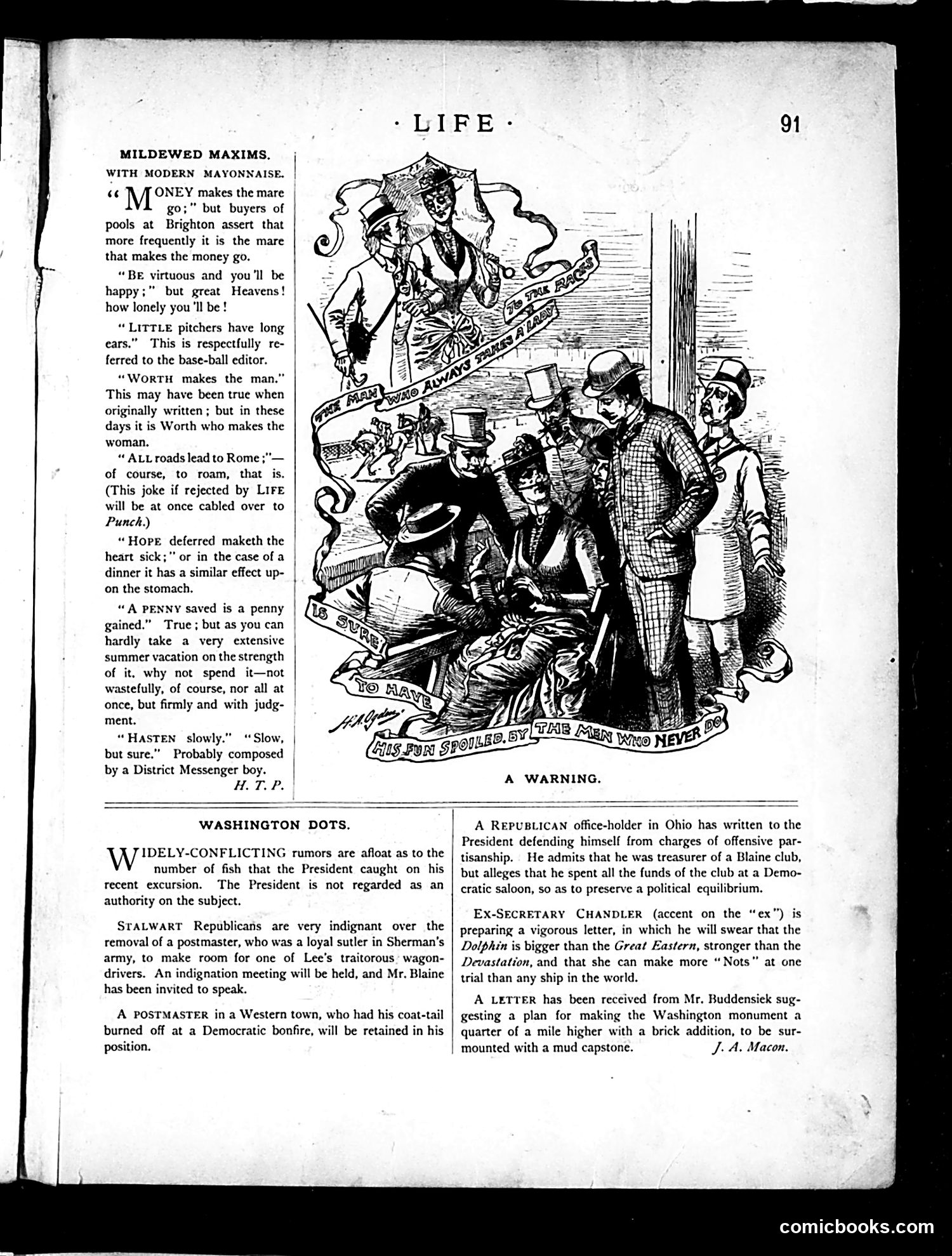
The main cartoon titled "A Warning" satirizes the spoils system in American politics. It depicts a figure (likely a political appointee or office-holder) riding atop a vessel labeled "The Man Always Goes With The Spoils By The Man Who Never Got Any," while various well-dressed men in hats stand below watching. The accompanying text in "Washington Dots" section mocks Republican and Democratic political corruption: an Ohio Republican defends misusing club funds; Ex-Secretary Chandler boasts the Dolphin ship surpasses others; and someone proposes raising the Washington Monument higher with a mud capstone—all satirizing political waste, nepotism, and incompetence. The overall message: political appointments reward loyalists rather than merit, and public resources are squandered for partisan gain.
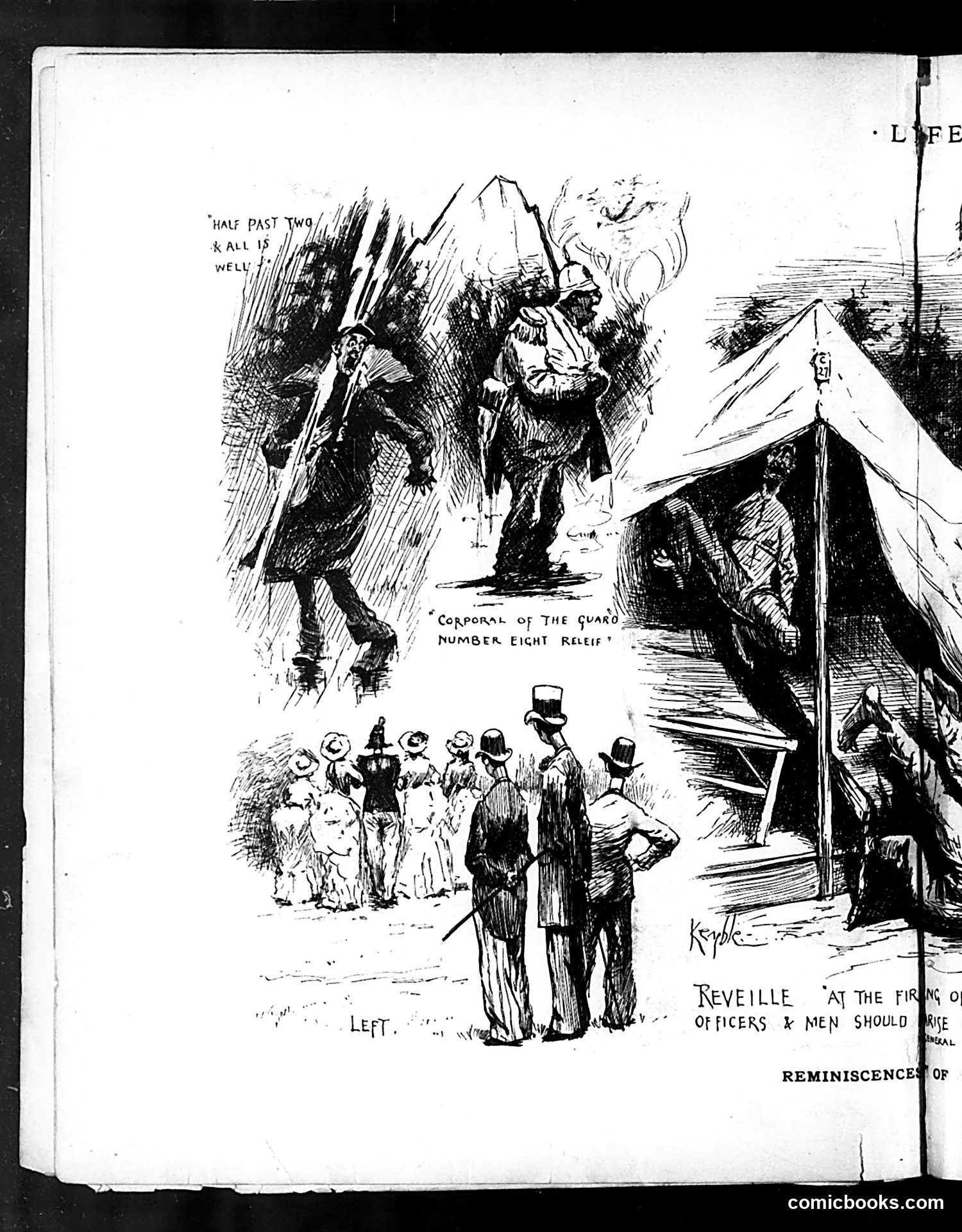
This page contains sketch illustrations satirizing military life, likely from WWI era based on the tent encampment and uniform styles. The top scene shows soldiers in apparent distress or complaint ("Half past two and all is well"), with a corporal of the guard addressing them. The humor appears to target military routine and the tedium of guard duty. The bottom illustration labeled "Reveille" depicts officers and men at dawn, with text suggesting commentary on military hierarchy and how "officers & men should rise" differently—likely satirizing class distinctions within the military structure. The artist's signature reads "Kemble" (likely Edward Windsor Kemble, a well-known Life cartoonist). The overall tone mocks military bureaucracy, daily routines, and social divisions between officers and enlisted personnel—common themes in wartime satirical publications.
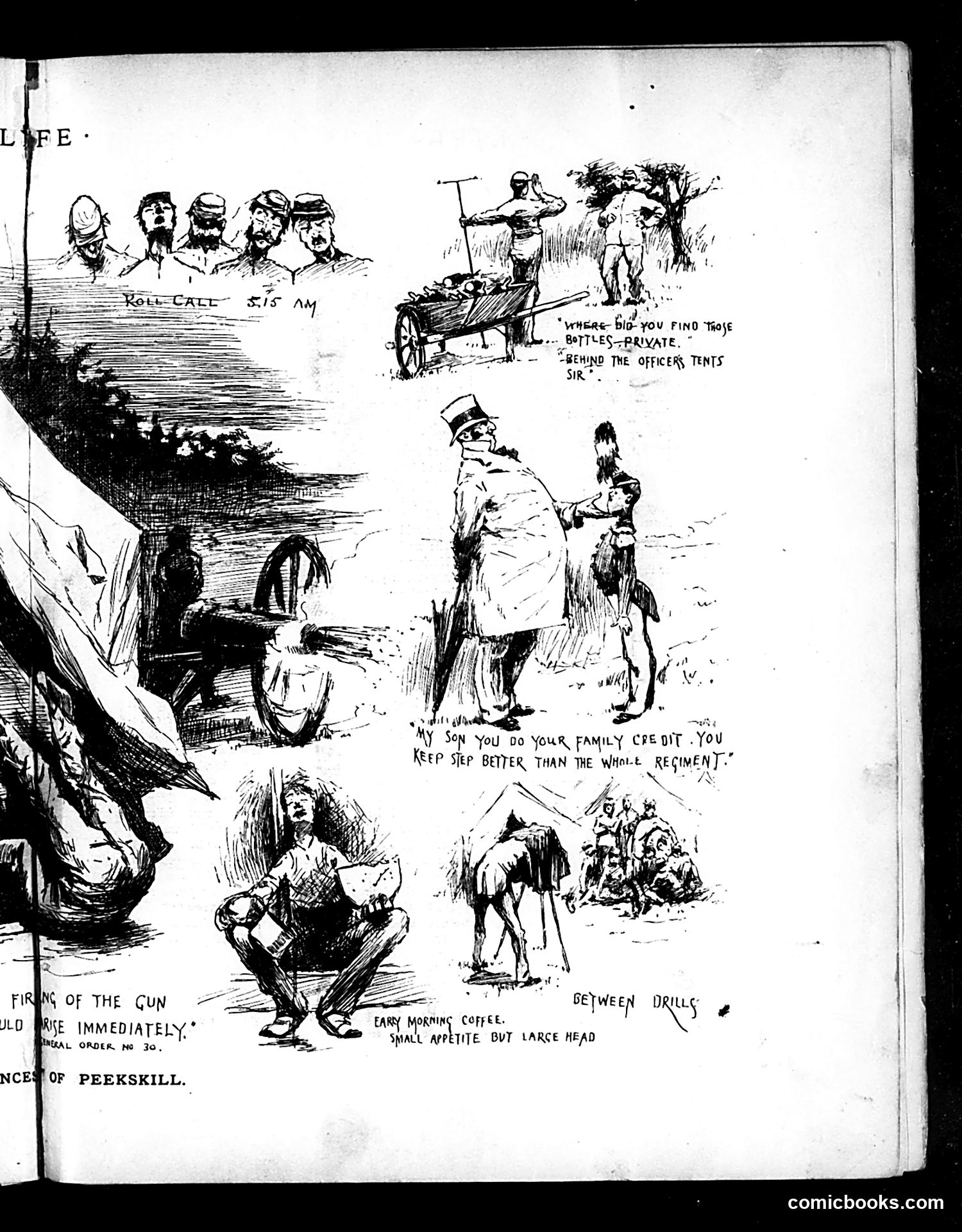
This page depicts scenes from the **Battle of Peekskill**, a 1919 incident during post-WWI demobilization. The sketches show military camp life with satirical commentary on soldiers' experiences. The captions mock various aspects of army routine: - "Roll call" showing soldiers at dawn - An officer asking where a private found "those battles" (suggesting fabricated war stories) - Commentary on family pride in military service versus actual regiment conditions - Soldiers complaining about "early morning coffee, small appetite but large head" - References to drilling and military discipline The satire targets the gap between military ideology and soldiers' actual lived experiences—poor conditions, tedious routines, and questionable officer behavior. The cartoon style emphasizes the absurdity of military life during the transition from active warfare to peacetime.
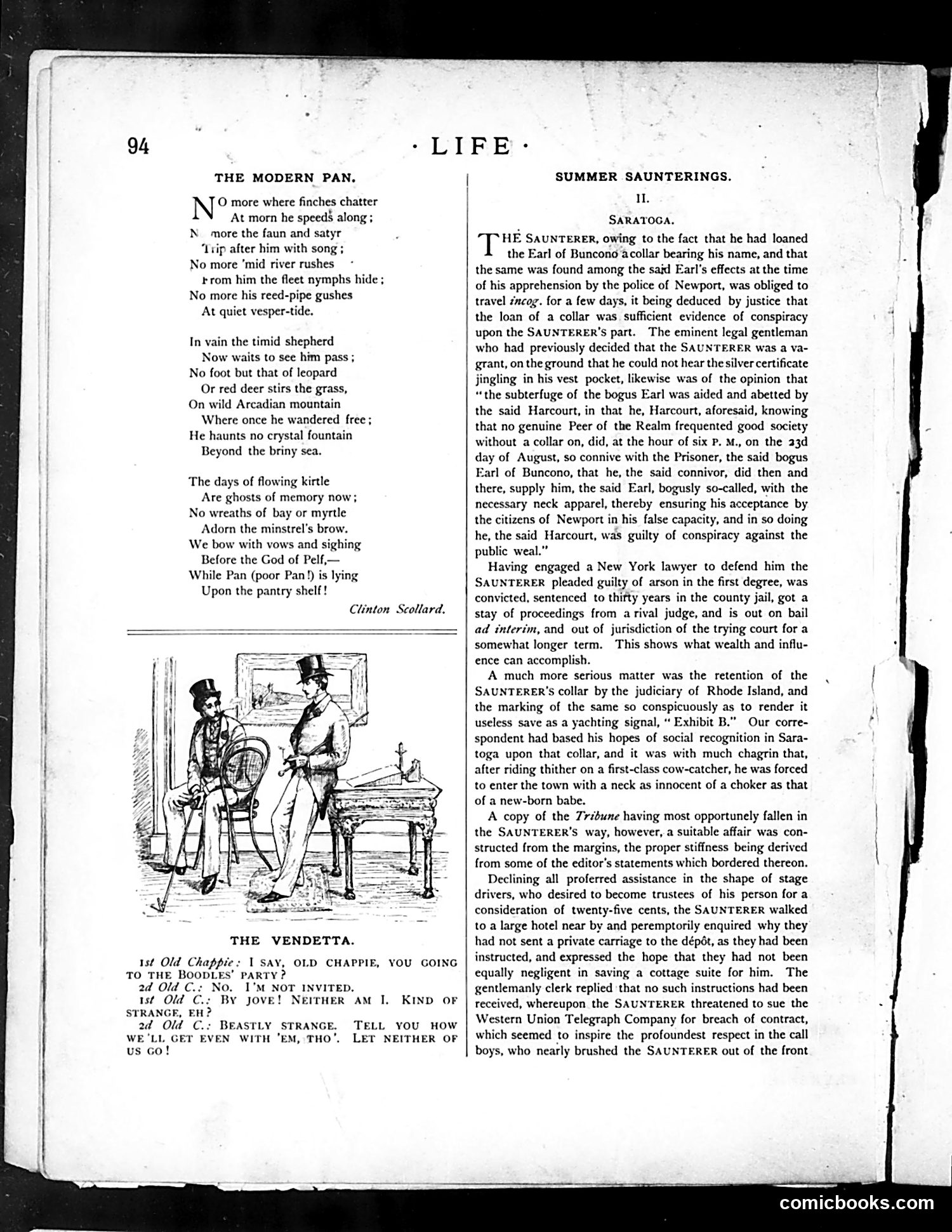
This page contains two unrelated satirical pieces: **"The Modern Pan"** is a nostalgic poem lamenting the death of classical mythology—Pan and nature spirits no longer haunt the world. Instead, modern society worships only money ("the God of Pelf"), leaving Pan abandoned "upon the pantry shelf." **"The Vendetta"** (cartoon) shows two wealthy men plotting petty revenge: excluded from the Boodles' party, they'll punish the hosts by simply *not attending*—presented as though it's a serious retaliation. **"Summer Saunterings II"** is absurdist satire about a gentleman (the Saunterer) who loaned a collar to a fake "Earl of Buncono." When the earl is arrested, the collar becomes "evidence of conspiracy," and the Saunterer is sentenced to thirty years—only to escape on bail through wealth and legal maneuvering. The punchline: his confiscated collar prevents his social acceptance in Saratoga, so he fashions a replacement from *newspaper margins*. The humor relies on class anxiety, legal absurdity, and the Victorian obsession with visible markers of respectability (collars).
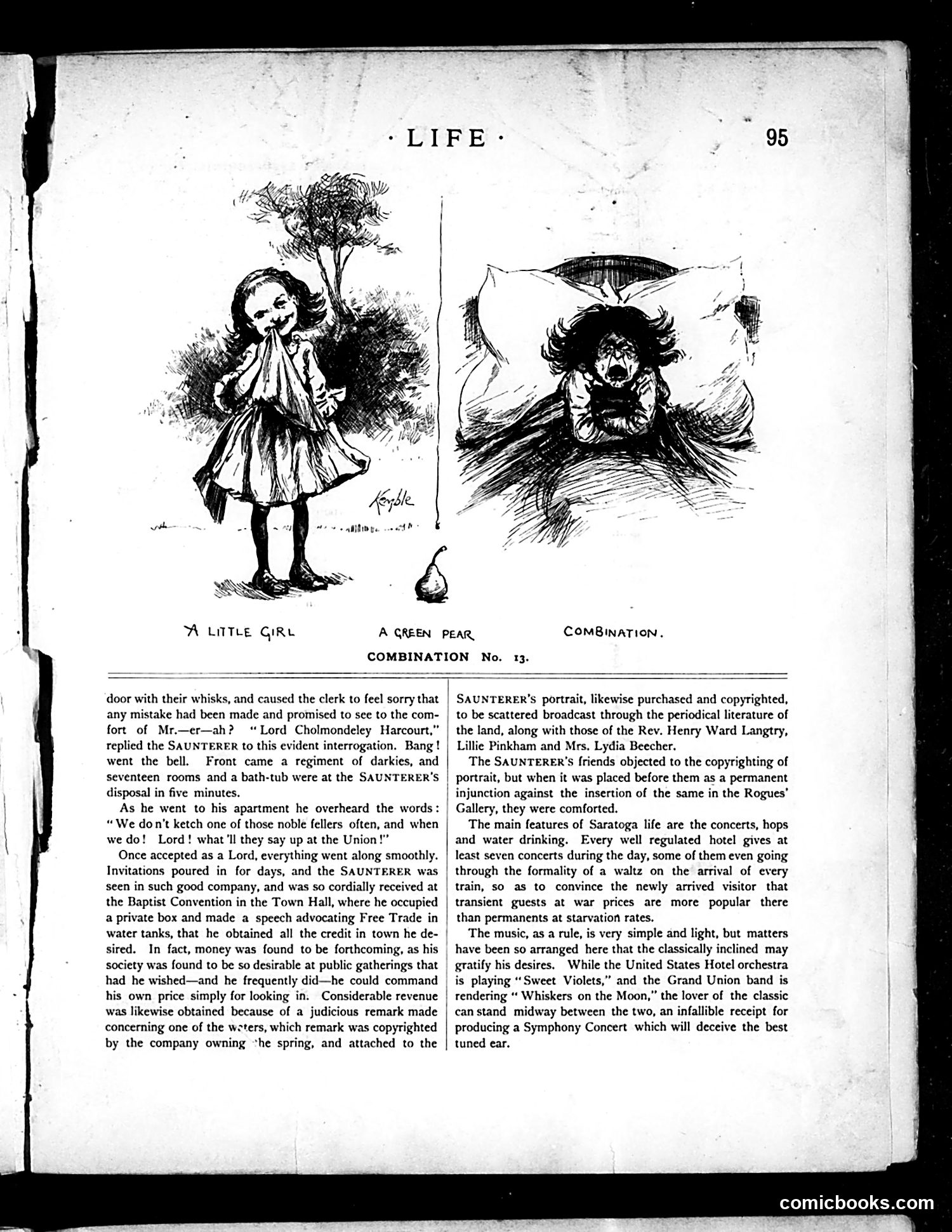
This page satirizes social pretension and class fraud at Saratoga Springs, a wealthy resort destination. The cartoon shows "Combination No. 13"—a "little girl" paired with a "green pear," likely a visual pun on unripe or immature things. The text describes "the Saunterer" (the magazine's recurring satirical character) posing as an English aristocrat ("Lord Cholmondeley Harcourt") at a hotel. Hotel staff immediately defer to him, assuming nobility grants social superiority. The satire mocks how easily wealth and pretense fool people—he gains credit, speaking invitations, and even gets his portrait copyrighted for advertising alongside famous personalities. The piece ridicules Saratoga's shallow culture: endless concerts, water-drinking obsession, and status-conscious society that treats transient wealthy guests better than permanent residents. The final joke about orchestras playing lowbrow songs ("Sweet Violets," "Whiskers on the Moon") highlights the gap between the resort's pretended sophistication and its actual entertainment quality.
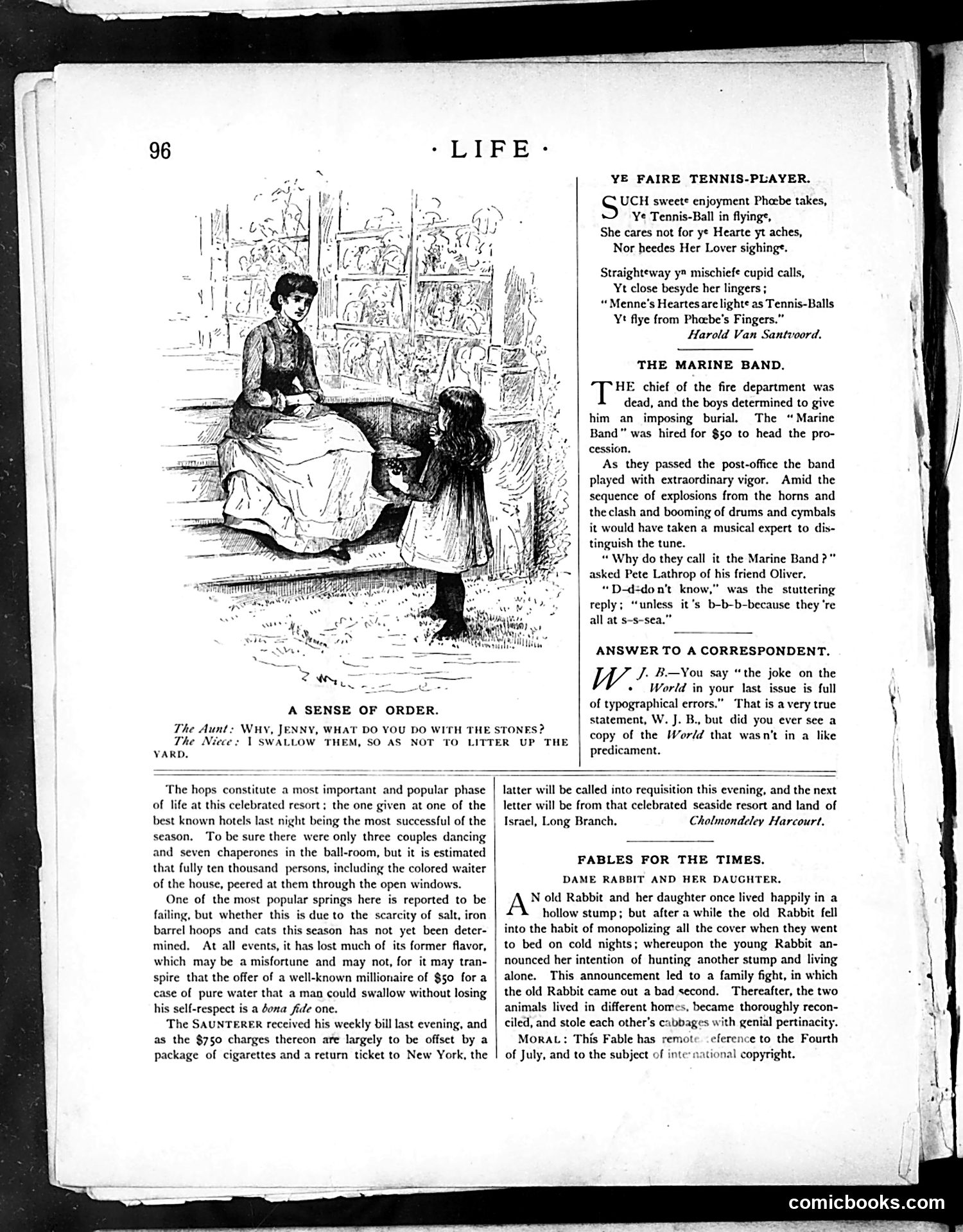
This page from Life magazine contains several satirical pieces typical of the publication's humor: **"A Sense of Order"** depicts an aunt and niece discussing what to do with stones—a simple domestic joke about tidiness. **"Ye Faire Tennis-Player"** is a mock-Elizabethan poem by Harold Van Santvoord, playfully comparing women's hearts to tennis balls batted about by Cupid. **"The Marine Band"** is a humorous anecdote about a fire chief's funeral where a band hired to lead the procession plays so loudly that the tune is indistinguishable. The punchline involves a stutter joke: the band is called "Marine" because its members are "all at sea" (confused/lost). **"Fables for the Times"** offers a mock-moralistic story about rabbits that references Fourth of July and international copyright issues—contemporary political topics wrapped in animal fable form. The page also includes a brief editor's response defending typographical errors in a rival publication (*the World*). Throughout, the humor relies on wordplay, puns, and topical references familiar to late-19th-century readers.
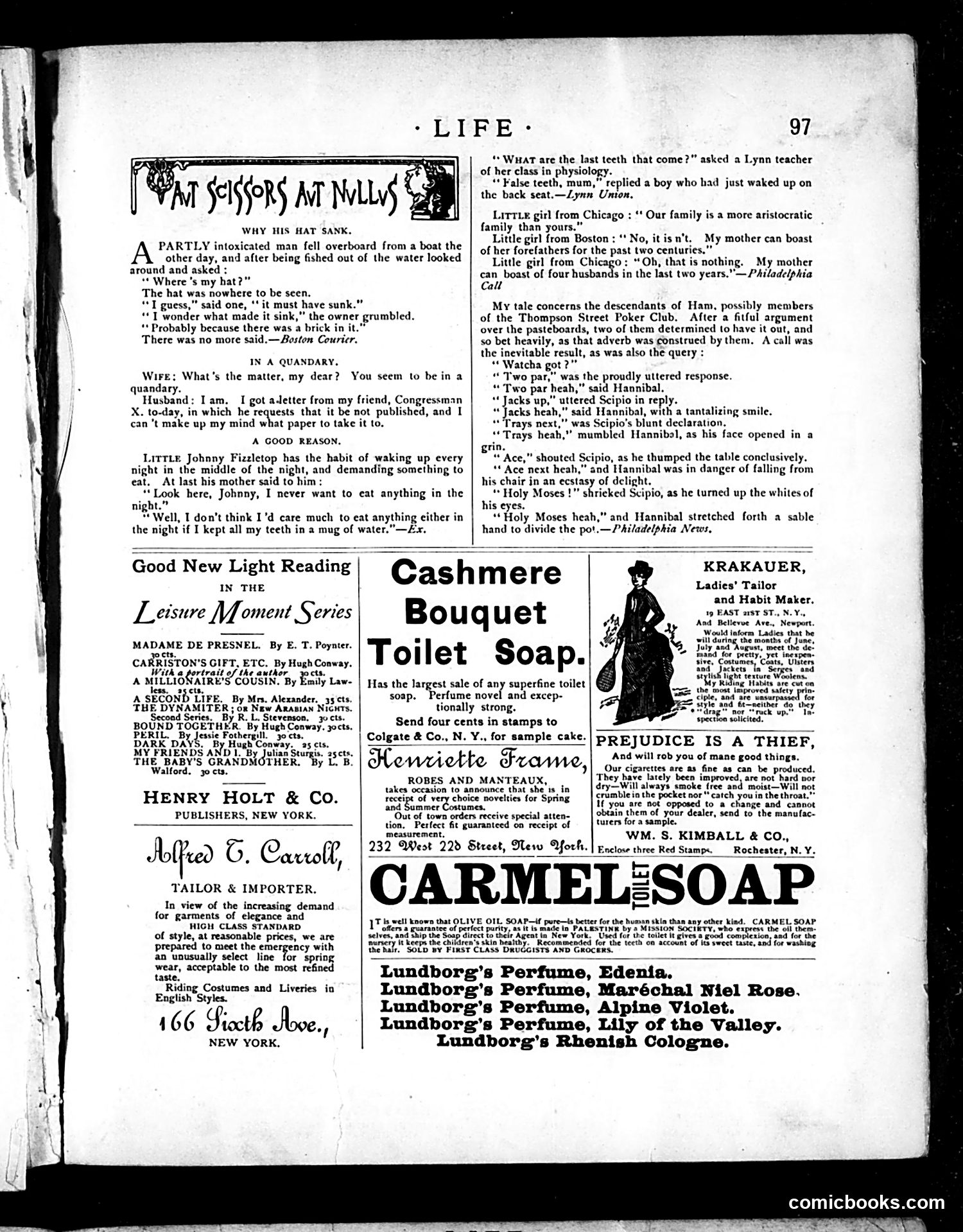
This page (97) from the satirical magazine *Life* contains several short humorous anecdotes rather than political cartoons. The main jokes target: 1. **"Why His Hat Sank"**: A drunk man loses his hat overboard; the punchline is that it contained a brick—suggesting he was stupid ("brick" as slang for a foolish person). 2. **"In a Quandary"**: A congressman sends an unpublishable letter to a friend, who jokes he can't decide which newspaper to leak it to—satirizing political corruption and media complicity. 3. **"A Good Reason"**: A child keeps his false teeth in water at night, explaining why he won't eat before bed. 4. **The poker game**: Appears to feature African American characters (names like "Hannibal" and "Scipio") in a comedic card game where one player beats another—reflecting period stereotyping. The rest is primarily **advertising** for soaps, perfumes, tailoring services, and book recommendations typical of 1890s *Life* magazine content.
This page is primarily **advertisements** with no political cartoons or satirical content visible in the image. The top features decorative royal crests and seals advertising "Redfern," a ladies' tailor and habit maker with locations in London, Paris, and New York—targeting wealthy clientele. Below are various consumer advertisements typical of 1880s Life magazine: printing ink, perfume, rice powder, patent medicines, resort destinations (Saratoga Springs, Campobello Island, Newport), champagne, whiskey, spring water, and hotels. A small note advertises a "Miniature Statuette" available for purchase. The advertisements reflect Gilded Age consumer culture and luxury goods marketed to affluent readers. No cartoon, satire, or political commentary is discernible on this particular page—it's essentially a revenue-generating advertising section.
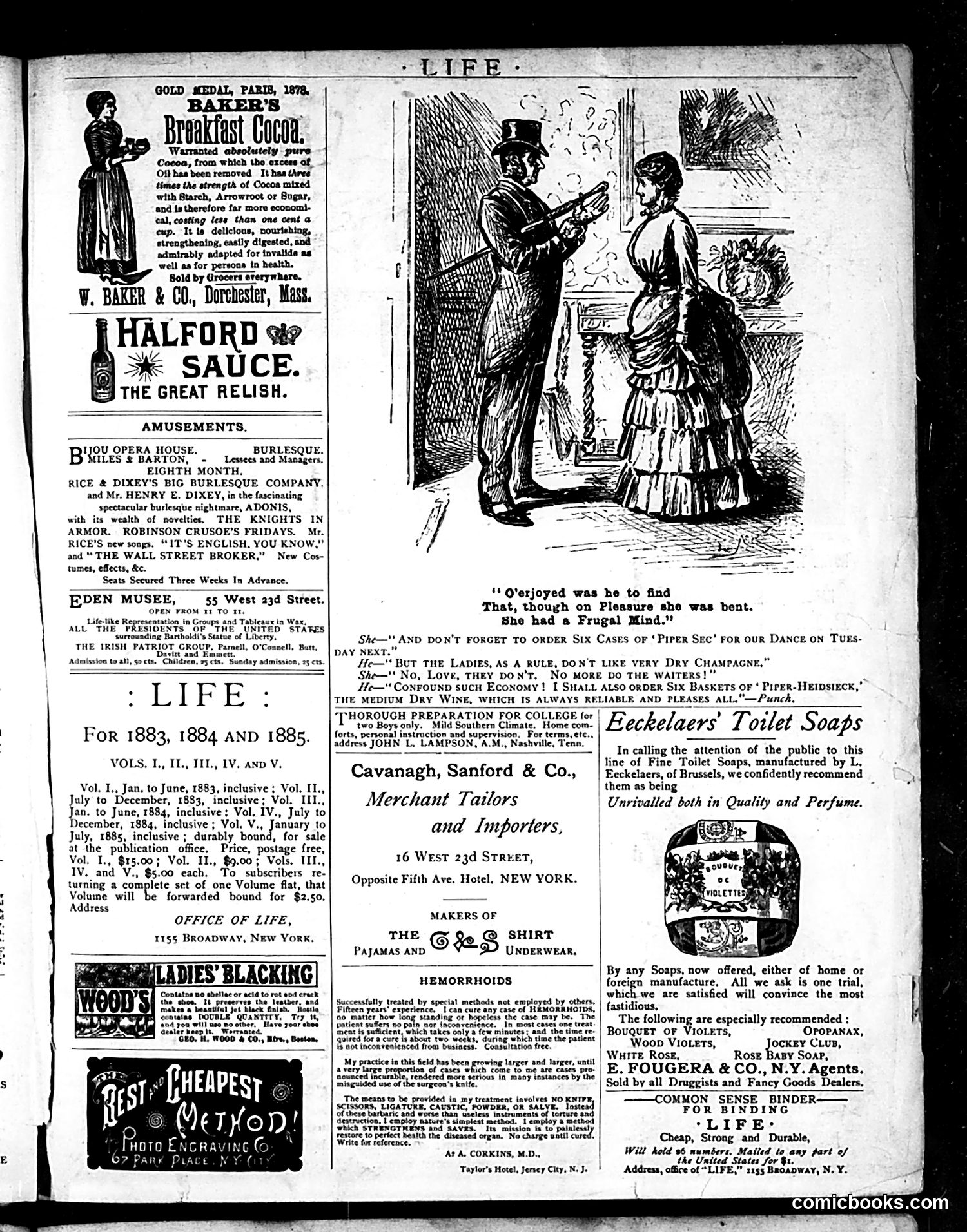
The central illustration depicts a social interaction between a well-dressed man in a top hat and a young woman. The caption reads: "O'erjoyed was he to find / That, though on Pleasure she was bent, / She had a Frugal Mind." The joke satirizes Victorian gender expectations and courtship. The man is pleased to discover that his romantic interest, despite enjoying pleasures (implied: entertainment, social outings), maintains fiscal responsibility—a valued trait in potential wives. The accompanying dialogue (from *Punch* magazine) humorously continues this theme: the couple debates champagne purchases, with the woman advocating economy while the man initially resists, eventually agreeing to buy the cheaper "Piper-Heidsieck" wine rather than premium options. The satire mocks both male expectations of female frugality and the contradiction between enjoying social pleasures while maintaining strict financial discipline—a tension central to middle-class Victorian courtship rituals.
This page is primarily **advertising**, not political satire. It contains product advertisements from the 1880s-1890s era, including mineral waters, infant formula, perfume, tennis equipment, and shoe polish. The most notable content is a large **medical advertisement for Bright's Disease treatment** by H.H. Warner & Co. This presents a checklist of symptoms (swelling, fatigue, urinary changes, etc.) claiming to diagnose kidney disease, then offering "Warner's SAFE Cure" as treatment. By modern standards, this represents **patent medicine fraud**—the ad uses scare tactics and vague symptoms to convince readers they have a serious illness, then sells an unproven "cure." Such deceptive medical advertising was common and legal in this era, before FDA regulation. The page also advertises "Allen's Cocaine Tablets" for hay fever and nervousness—reflecting the era when cocaine was marketed as a legitimate pharmaceutical before its dangers were recognized and it was regulated. This reflects the **unregulated, often exploitative advertising landscape** of 19th-century American commerce.