
A complete issue · 17 pages · 1885
Life — June 25, 1885
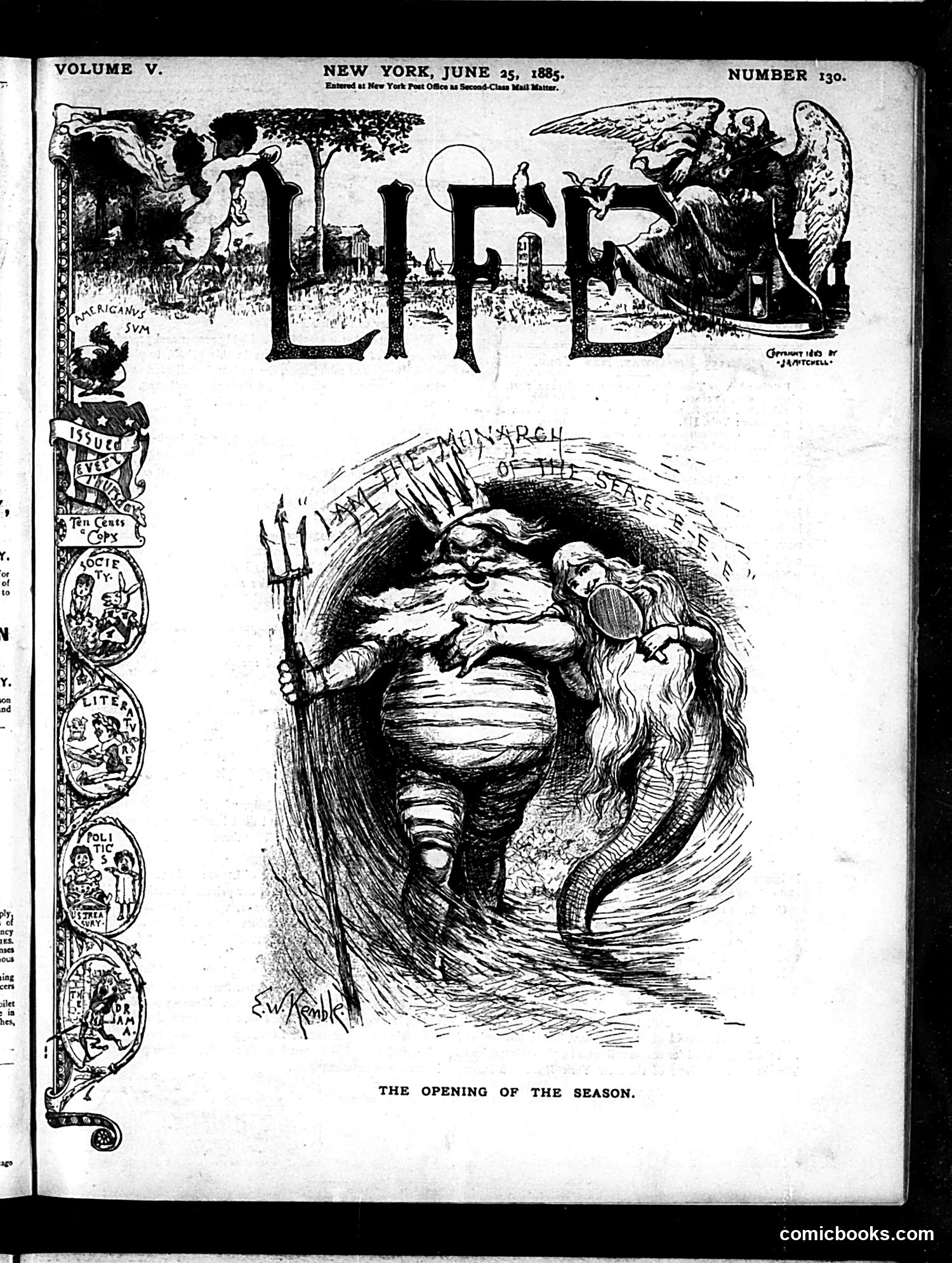
This is the cover of *Life* magazine (Volume V, Number 130), dated June 25, 1885. The main illustration, titled "The Opening of the Season," depicts Neptune—the Roman god of the sea, identifiable by his trident and crown—seated on his throne. A woman (likely representing summer or a sea nymph) attends him. The cartoon appears to satirize the opening of summer social season, using Neptune as a humorous device to represent seasonal transition and maritime leisure activities. The classical mythological imagery suggests the *Life* magazine's sophisticated, educated readership. The ornamental left border contains various emblematic designs typical of the magazine's decorative style.
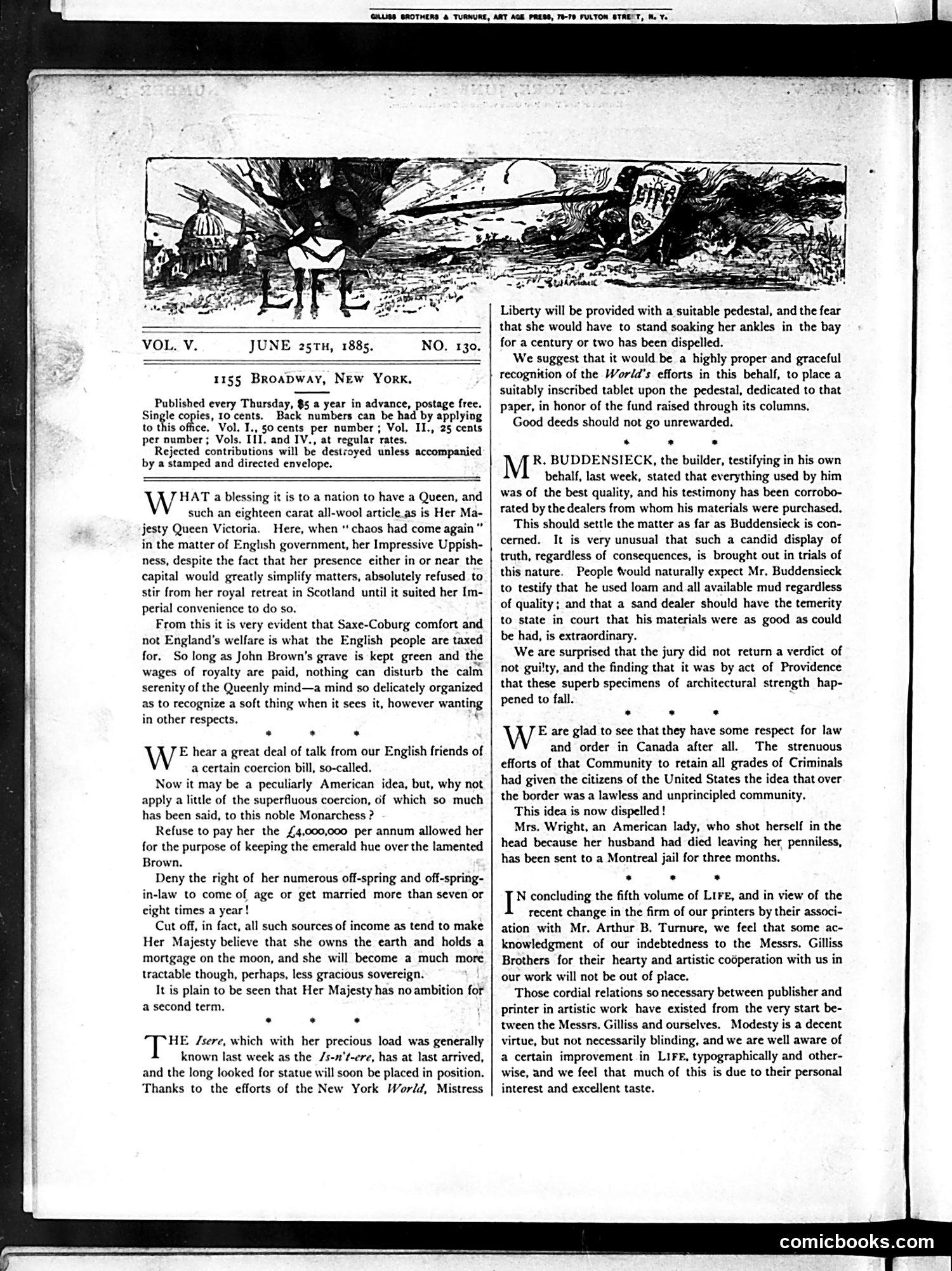
The page is primarily editorial text rather than political cartoon. The visible illustration at the top appears to be a decorative header featuring the Statue of Liberty (then newly erected), though the image quality makes specific details unclear. The editorials discuss several topics: Queen Victoria's wool article, criticism of coercion bills in England, the Statue of Liberty's pedestal inscription, and testimony from builder Buddensieck about construction materials. There's also commentary on Canadian law enforcement and a brief note about an American woman imprisoned in Montreal. The magazine's overall tone is satirical commentary on contemporary political and social issues, though the specific cartoons (if present below the visible area) cannot be analyzed from this page fragment.
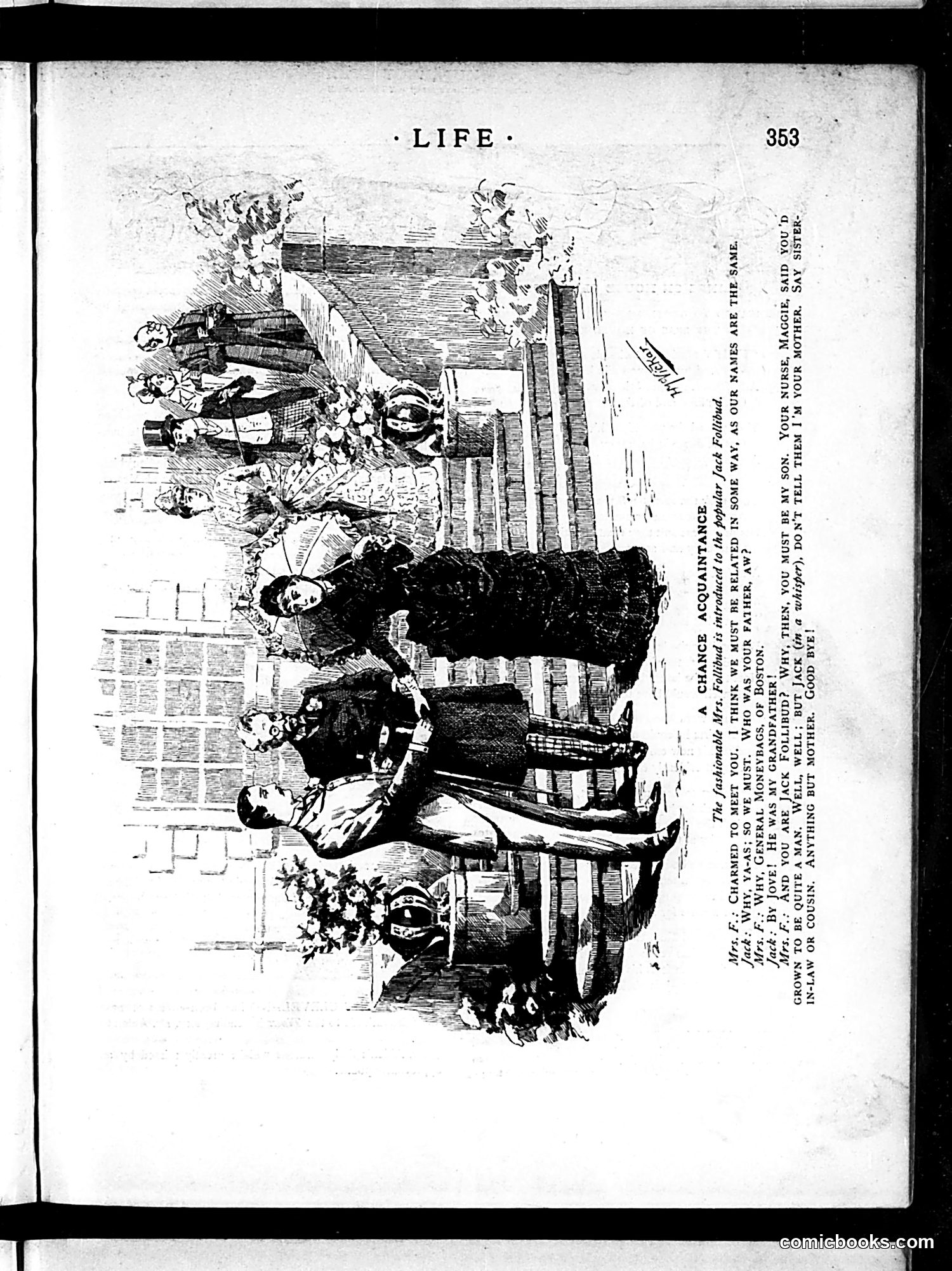
This satirical cartoon appears from *Life* magazine (page 353) and depicts a social scene where a woman in dark clothing stands prominently in the center, with various figures around her in what appears to be a formal or public setting. The caption references "a change acquaintances" and mentions someone "called to preside" over gatherings. The text alludes to a woman who "was a power" in certain circles, with commentary about her influence changing when circumstances shifted. There are references to her receiving "greetings" and her former social status. Without clearer identification of the specific historical figures or dating context visible in the image, I cannot definitively identify which social scandal or political situation this satirizes. The cartoon appears to mock shifting social hierarchies and the transient nature of social power among the elite.
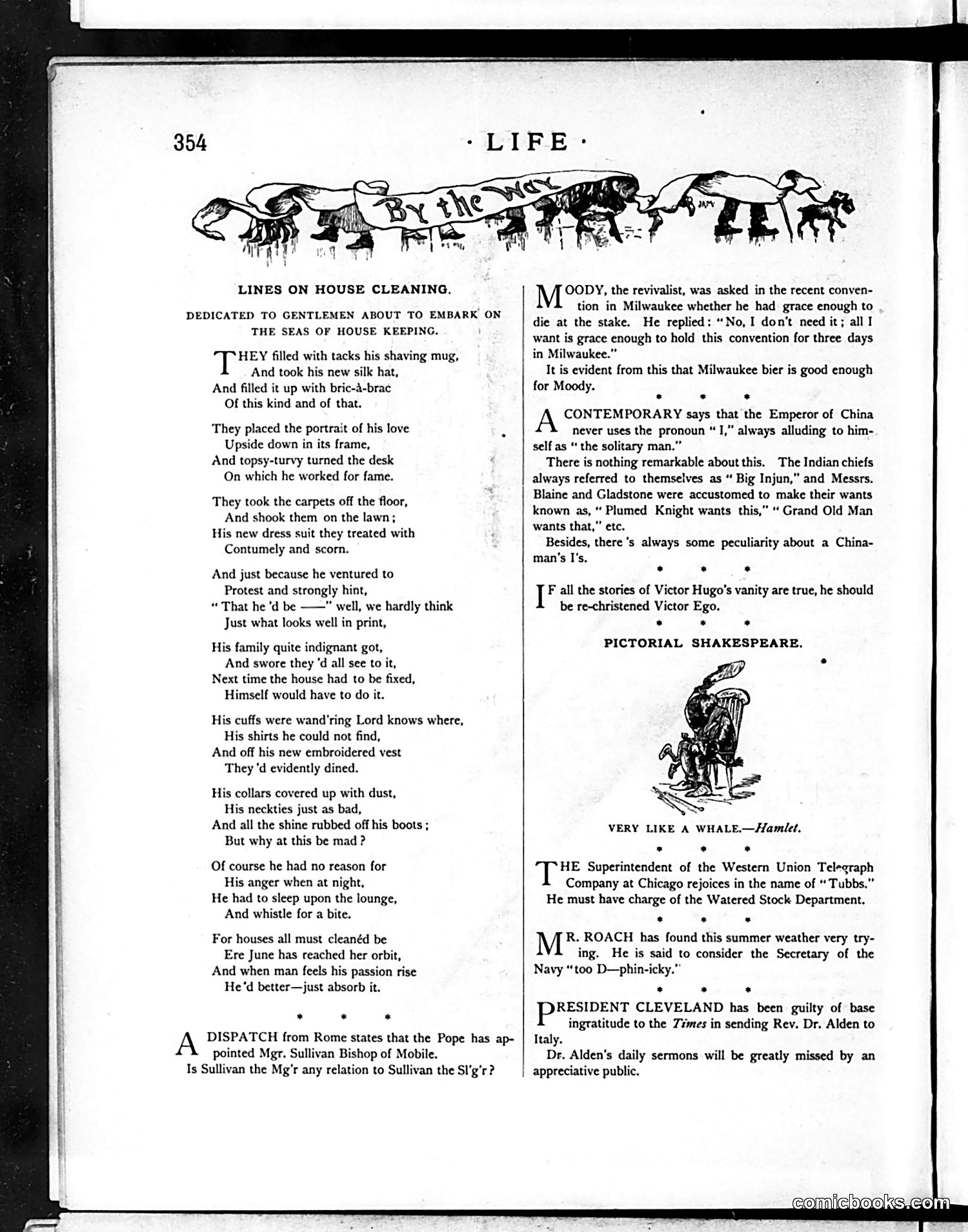
This page contains satirical commentary rather than political cartoons. The "Lines on House Cleaning" poem mocks a gentleman preparing for sea travel while his household falls into disarray—his wife cleans obsessively, destroying his possessions and workspace in the process. The satire targets domestic dynamics and the chaos of spring cleaning. The right column offers brief witty observations: Moody's supposed unsuitability for a religious convention; Chinese emperors' pronoun usage; Victor Hugo's vanity; and jabs at various public figures including President Cleveland for base ingratitude toward the *Times* newspaper and the Western Union Telegraph Company superintendent. These are light satirical observations typical of Life's humor—social commentary rather than serious political critique.
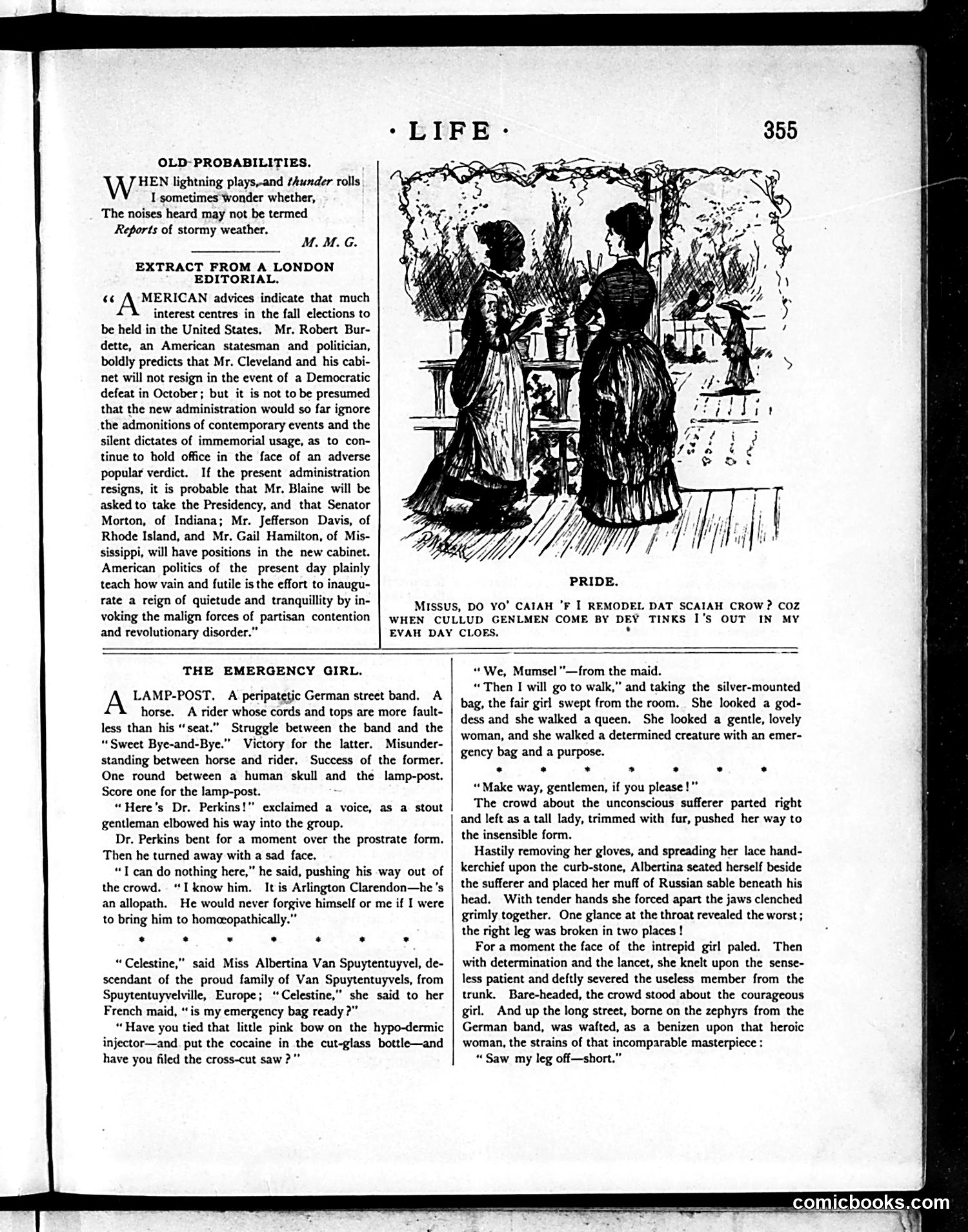
This page contains several short pieces rather than a unified political cartoon: **"Old Probabilities"** is a brief poem about thunder and lightning, with no clear satirical intent. **"Extract from a London Editorial"** discusses American politics, referencing Mr. Cleveland and predictions about cabinet positions under a potential new administration, mentioning Senator Morton, Mr. Jefferson Davis, and Mr. Gail Hamilton. This appears to comment on 1880s political speculation, though the specific context is unclear without more historical detail. **"The Emergency Girl"** is a humorous story about a woman (Miss Albertina Van Spuytentuyvei) who amputates her own injured leg with a saw during a street emergency, drawing a crowd's amazement. **"Pride"** is a brief dialogue piece with unclear satirical meaning. The page appears primarily literary/humorous rather than visually satirical.
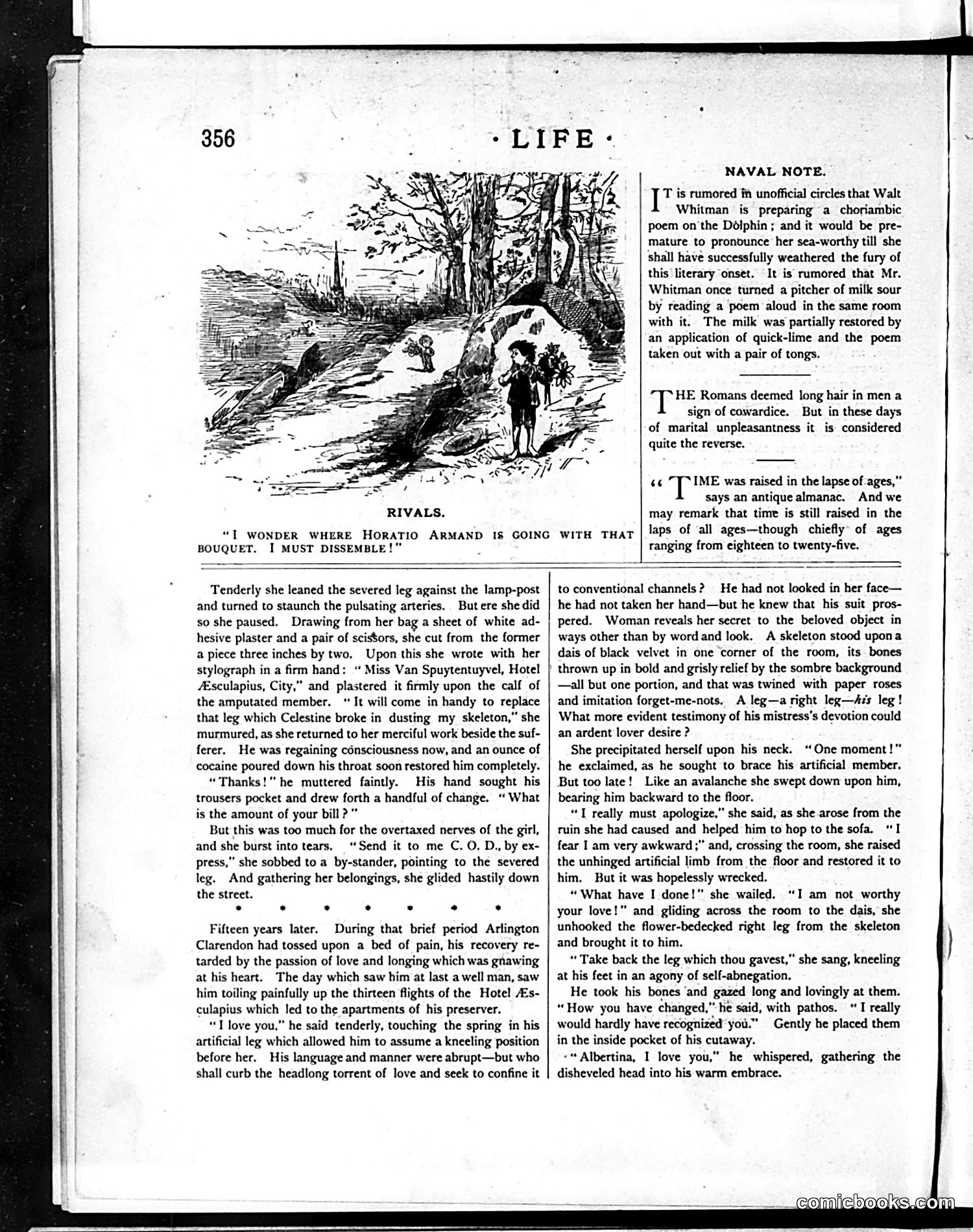
This page contains a serialized short story titled "Rivals" rather than political satire. The illustration depicts a romantic melodrama set in what appears to be the 19th century. The story concerns Arlington Clarence, a man who lost his leg and was fitted with an artificial one. Fifteen years later, he reunites with a woman named Albertina. The narrative emphasizes their emotional reunion and his concern that she'll reject him due to his disability. The "Naval Note" sidebar humorously discusses Walt Whitman's poetry allegedly damaging objects and long hair as a sign of cowardice according to Roman standards—light cultural observations unrelated to the main story. This appears to be entertainment fiction rather than political commentary.
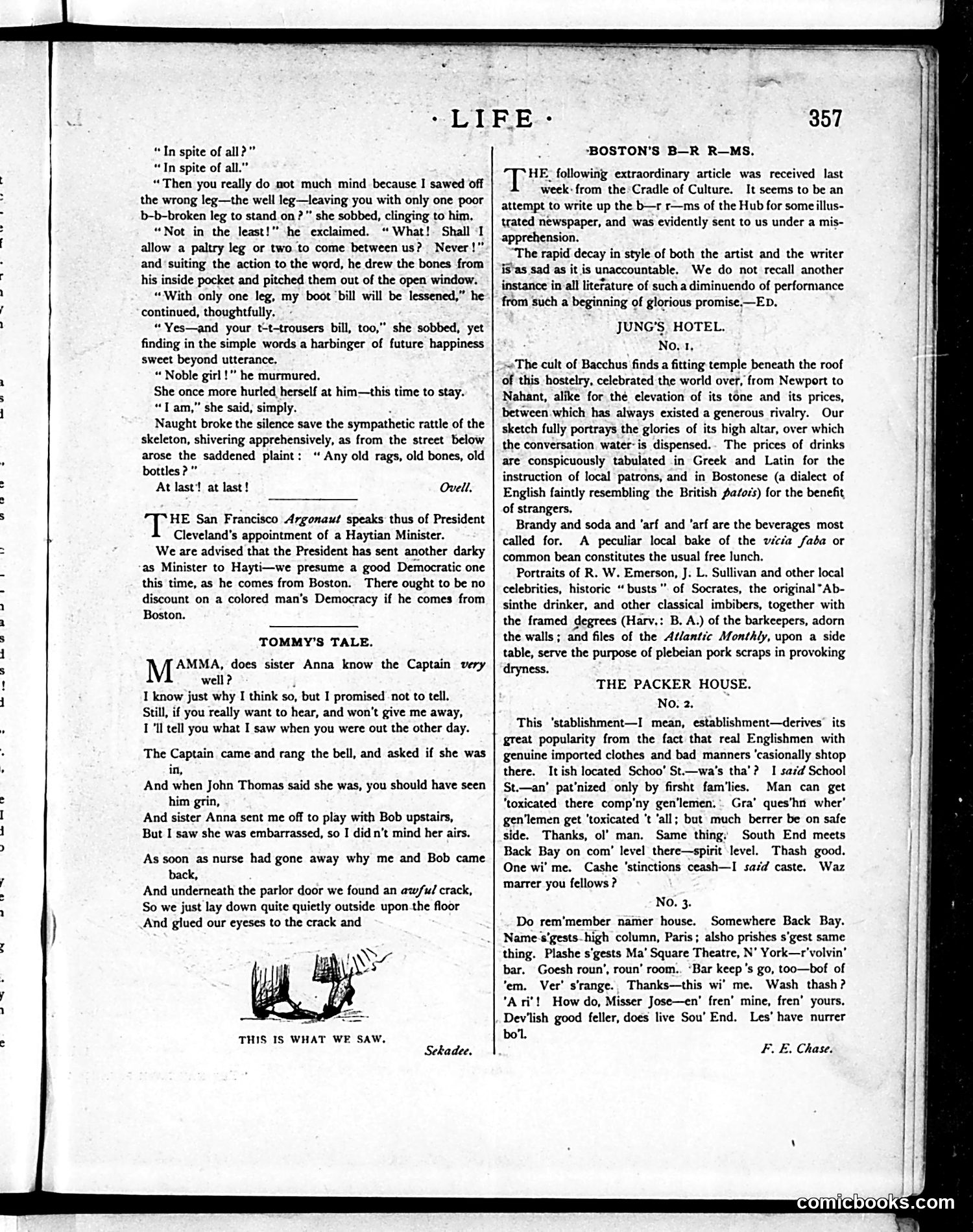
This page contains three separate satirical pieces rather than a single unified cartoon: 1. **"In spite of all?"** - A narrative poem about a man with a wooden leg, likely satirizing disability or misfortune with dark humor typical of the era. 2. **"Boston's B-R R-MS"** - Editorial commentary mocking what appears to be a poorly-written submission from a Boston newspaper about the Hub (Boston's nickname), criticizing both the artist's and writer's declining quality. 3. **"Tommy's Tale"** and subsequent numbered pieces - Humorous anecdotes and social observations, including references to servants, household scandals, and local establishments like Jung's Hotel and the Packer House—likely poking fun at Boston society and English pretensions among the wealthy. The page reflects *Life* magazine's characteristic irreverent approach to American social commentary.
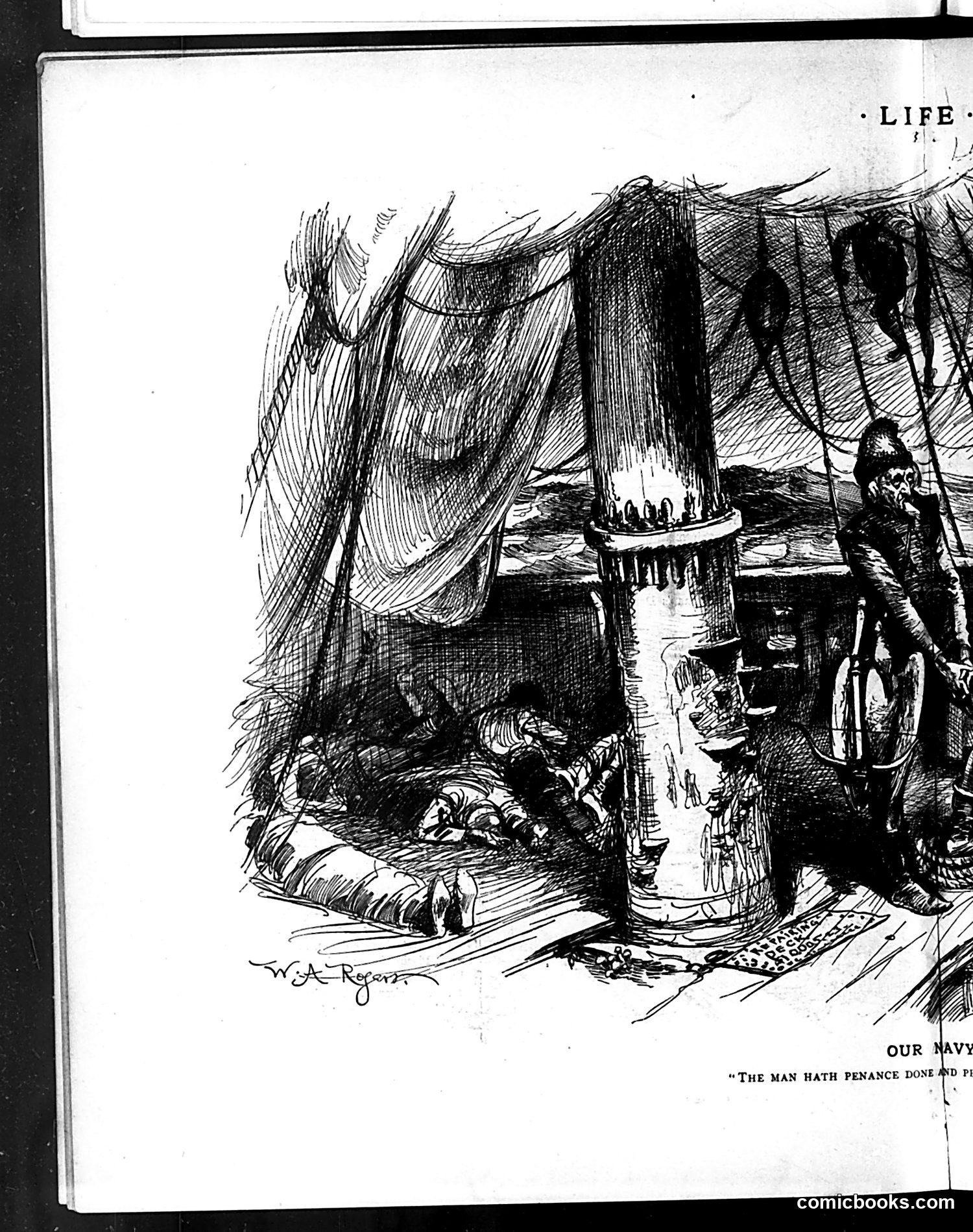
This page features a naval-themed illustration titled "The Man Hath Penance Done and Paid," signed by W.A. Rogers (a prominent Life cartoonist). The sketch depicts sailors in what appears to be a ship's interior, with hanging nets or rigging and barrel-like structures typical of naval vessels. The caption references penance and payment, suggesting the cartoon comments on sailor discipline or punishment aboard ship. The classical allusion in the title implies a moral reckoning. Without additional context or visible date, the specific historical naval incident or policy being satirized remains unclear, though the detailed maritime setting and Rogers' style suggest it critiques actual naval practices or a contemporary naval controversy.
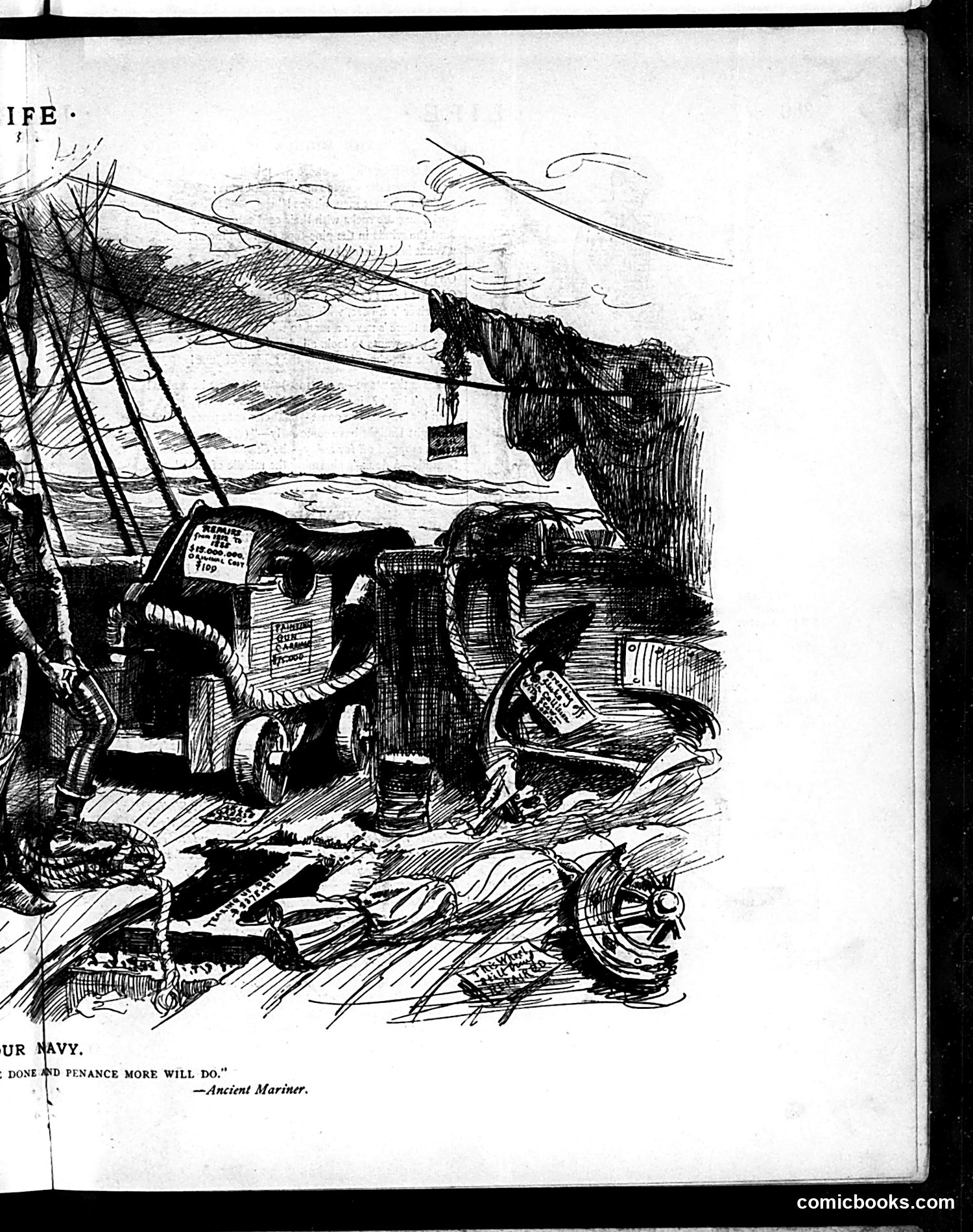
This appears to be a satirical illustration about the U.S. Navy. The sketch shows a naval ship's deck cluttered with various items and equipment in disarray. The visible text references "OUR NAVY" and includes a quote attributed to "Ancient Mariner": "DONE AND PENANCE MORE WILL DO." The cartoon likely satirizes naval readiness, budget issues, or maintenance problems—the scattered, cluttered state of the ship's deck suggesting inefficiency or neglect. The "Ancient Mariner" reference (evoking Coleridge's poem about maritime misfortune) reinforces a theme of naval trouble or struggle. Without clearer OCR text or additional context about Life magazine's publication date, I cannot identify the specific historical naval situation being critiqued, but the satire targets American naval operations or administration.
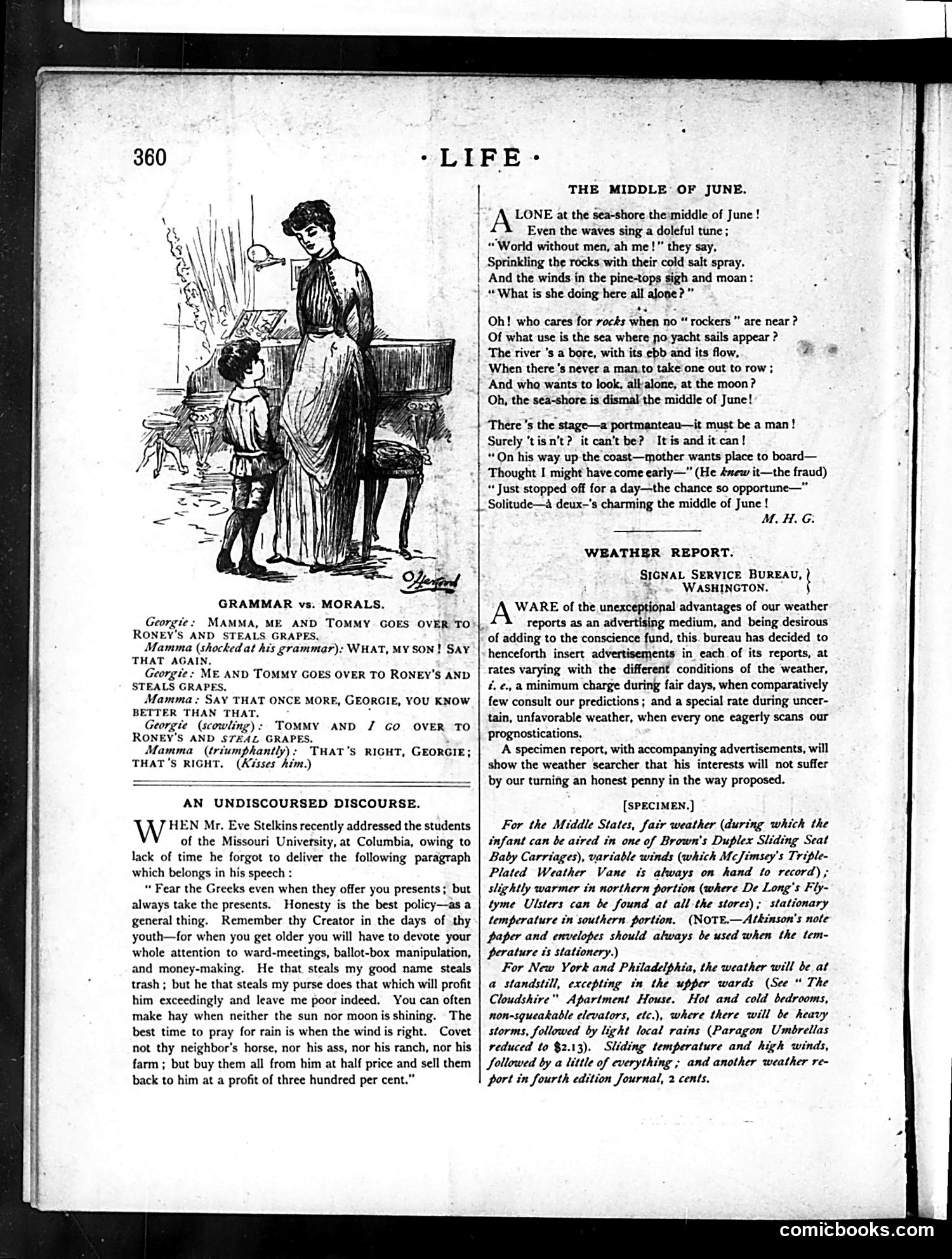
The cartoon satirizes misplaced parental priorities. A mother corrects her son Georgie's grammar—insisting he say "Tommy and I go" instead of "Me and Tommy goes"—but fails to address the actual moral problem: the child has just confessed to stealing grapes from someone named Roney. The joke is that the mother celebrates his corrected grammar with a kiss, treating proper speech as more important than honesty or theft. This reflects turn-of-the-century anxieties about education emphasizing form over substance, and social pretension overriding ethical values. # Weather Report Section This is satirical commentary on commercialism. The Signal Service Bureau proposes inserting paid advertisements into official weather reports at varying rates—charging less during fair weather (when few consult predictions) and more during uncertain weather (when everyone seeks forecasts). A specimen report follows, with tongue-in-cheek product placements embedded in weather descriptions. The satire mocks the era's creeping commercialization and the willingness to monetize public services.
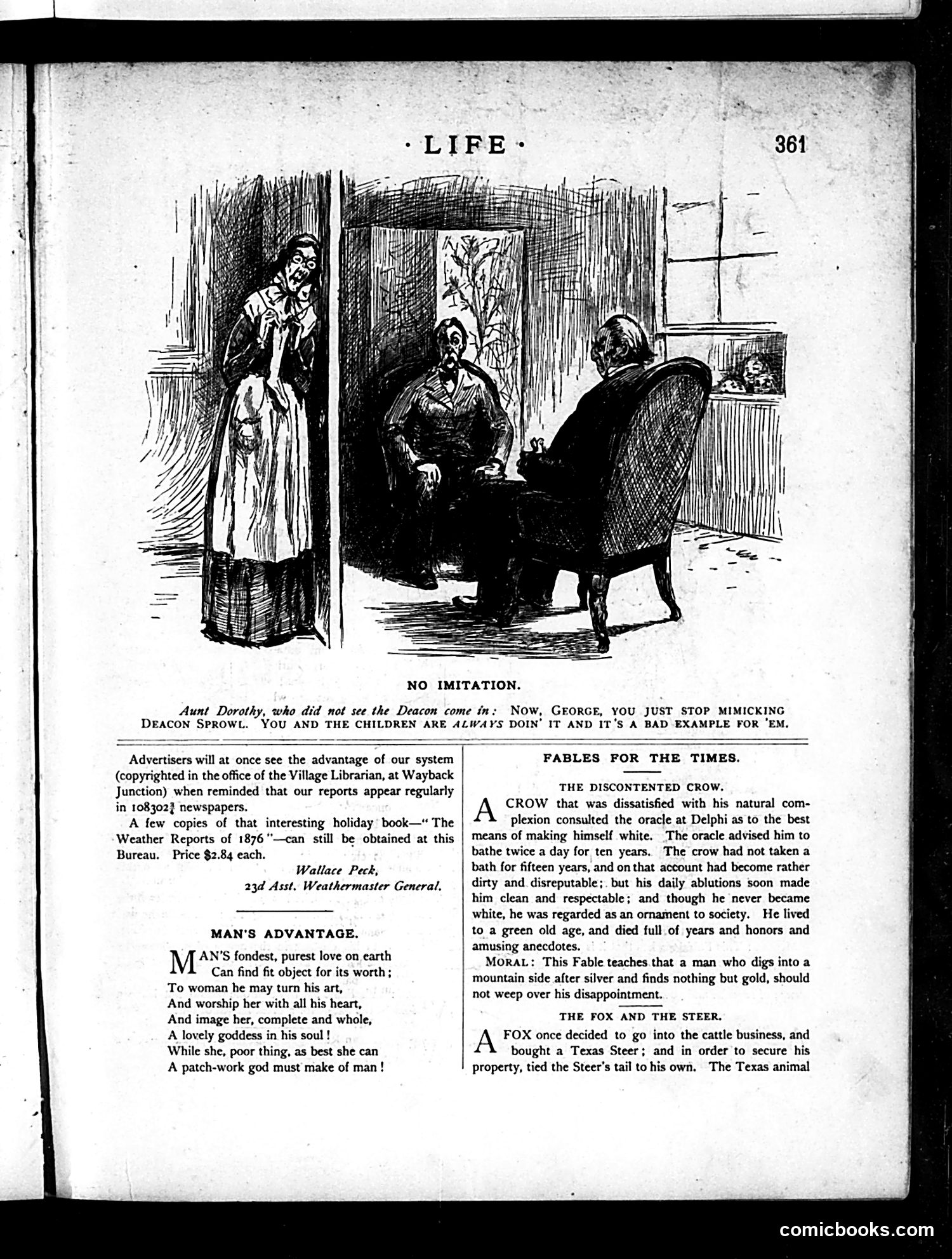
**The Main Cartoon ("No Imitation"):** depicts Aunt Dorothy scolding young George for mimicking Deacon Sprowl. The humor lies in the irony: she's angrily correcting him *while he's mimicking her*—she doesn't realize the person she's addressing isn't actually George but Deacon Sprowl doing an impression. It's a classic setup for mistaken identity comedy common to turn-of-century humor magazines. **The Poetry and Fables:** The page includes satirical verse ("Man's Advantage") mocking gender dynamics, and "Fables for the Times"—mock-serious tales with absurd morals. "The Discontented Crow" parodies Aesop's fables with a deliberately nonsensical conclusion. These appear designed to gently mock contemporary social pretensions and self-help culture through exaggerated, pointless "wisdom." The advertisements scattered throughout are part of Life's satirical format, sometimes poking fun at advertising itself.
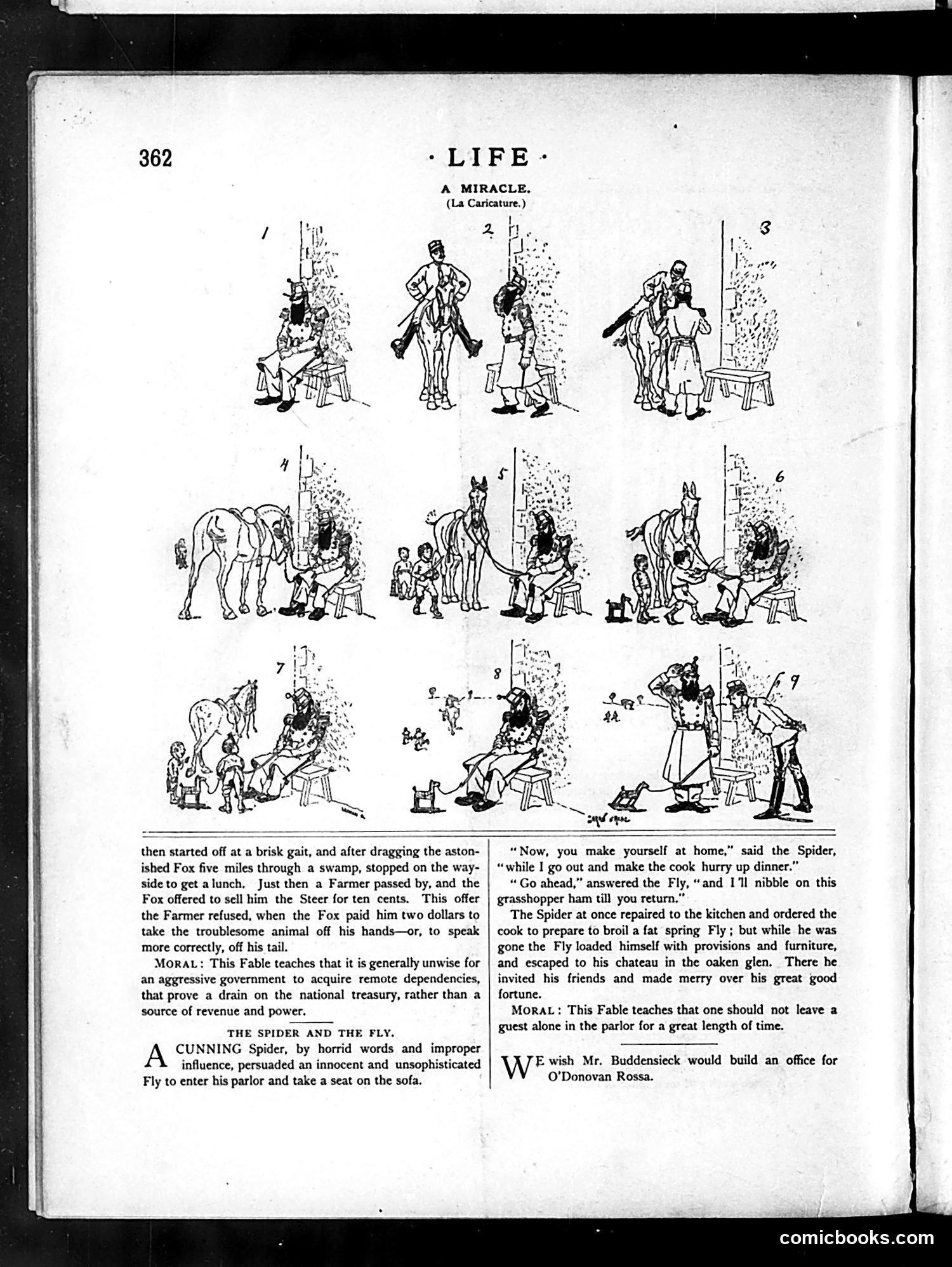
This page presents two Aesop's-fable-style cartoons with political morals, typical of American satirical magazines. **"The Fox and the Steer"** allegorically critiques imperial expansion. A cunning Fox manipulates a Farmer into acquiring a troublesome Steer, ultimately costing him money. The moral explicitly warns against aggressive governments acquiring remote colonies—dependencies that drain national treasuries rather than generate profit. This likely references contemporary American or European imperial overreach. **"The Spider and the Fly"** uses domestic metaphor to mock carelessness. A Spider's hospitality backfires when he leaves his guest unattended; the Fly steals provisions and escapes. The final line—"We wish Mr. Buddensieck would build an office for O'Donovan Rossa"—appears to be a separate satirical jab, though the specific reference remains unclear without additional historical context about these figures.
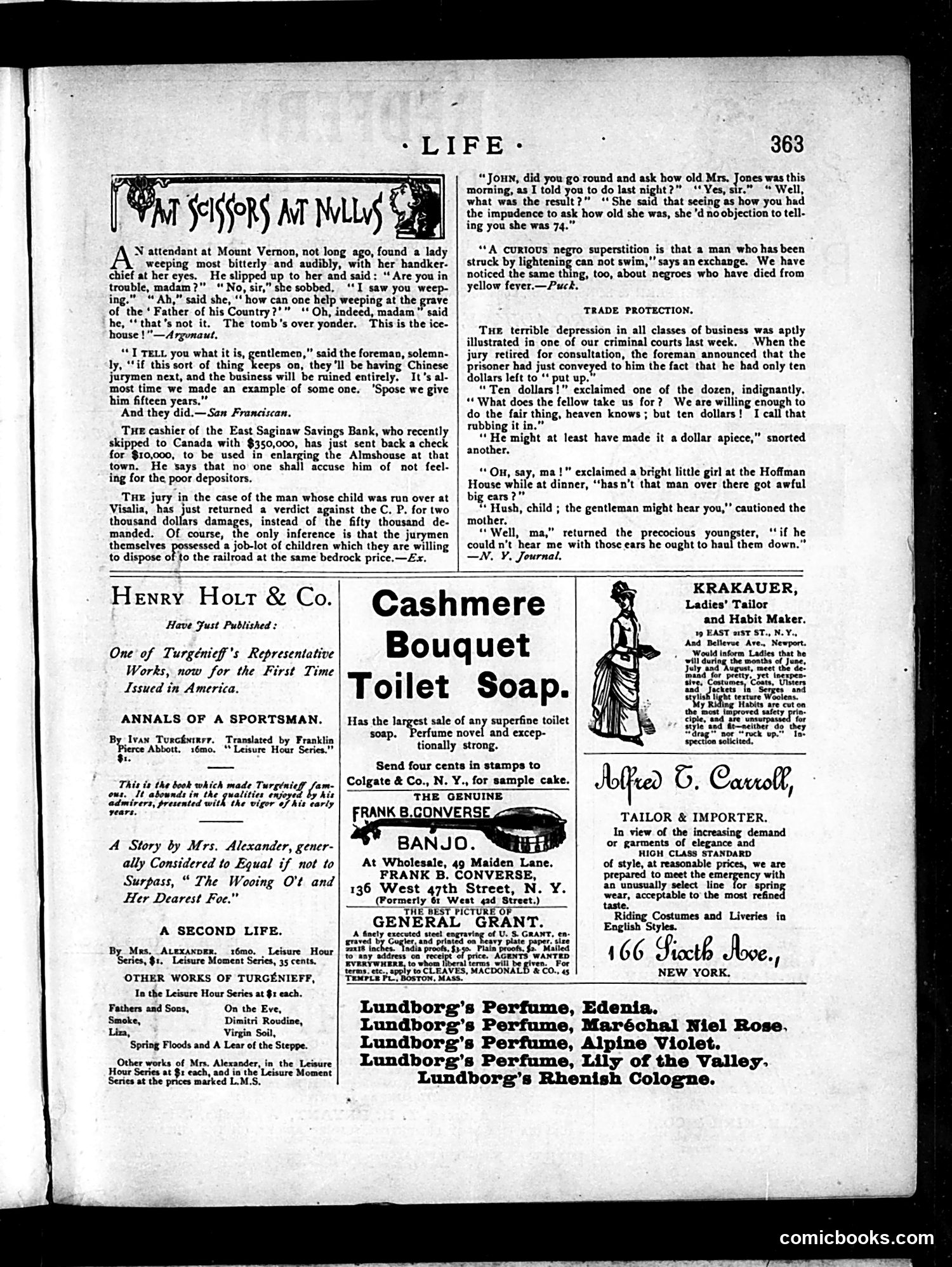
This page from *Life* magazine contains several short humorous anecdotes satirizing American society and institutions. The main jokes target institutional incompetence and dark humor about contemporary issues. "Scissors at Nulls" mocks overly emotional tourists at Mount Vernon, mistaking an icehouse for Washington's tomb. Another piece ridicules railroad juries: when a child is struck by a train, jurymen demand only $2,000 instead of $50,000, implying they value human life cheaply—satirizing how railroads dominated American courts. A "Trade Protection" joke critiques economic depression: criminals negotiating bail offer only $10, insulting the corrupt jury system's expectations. The final anecdote depicts a precocious child at the Hoffman House commenting on a man's large ears, mocking both urban dining culture and genteel social pretense. These pieces reflect *Life's* satirical focus on American legal corruption, class pretension, and institutional failures of the Gilded Age era.
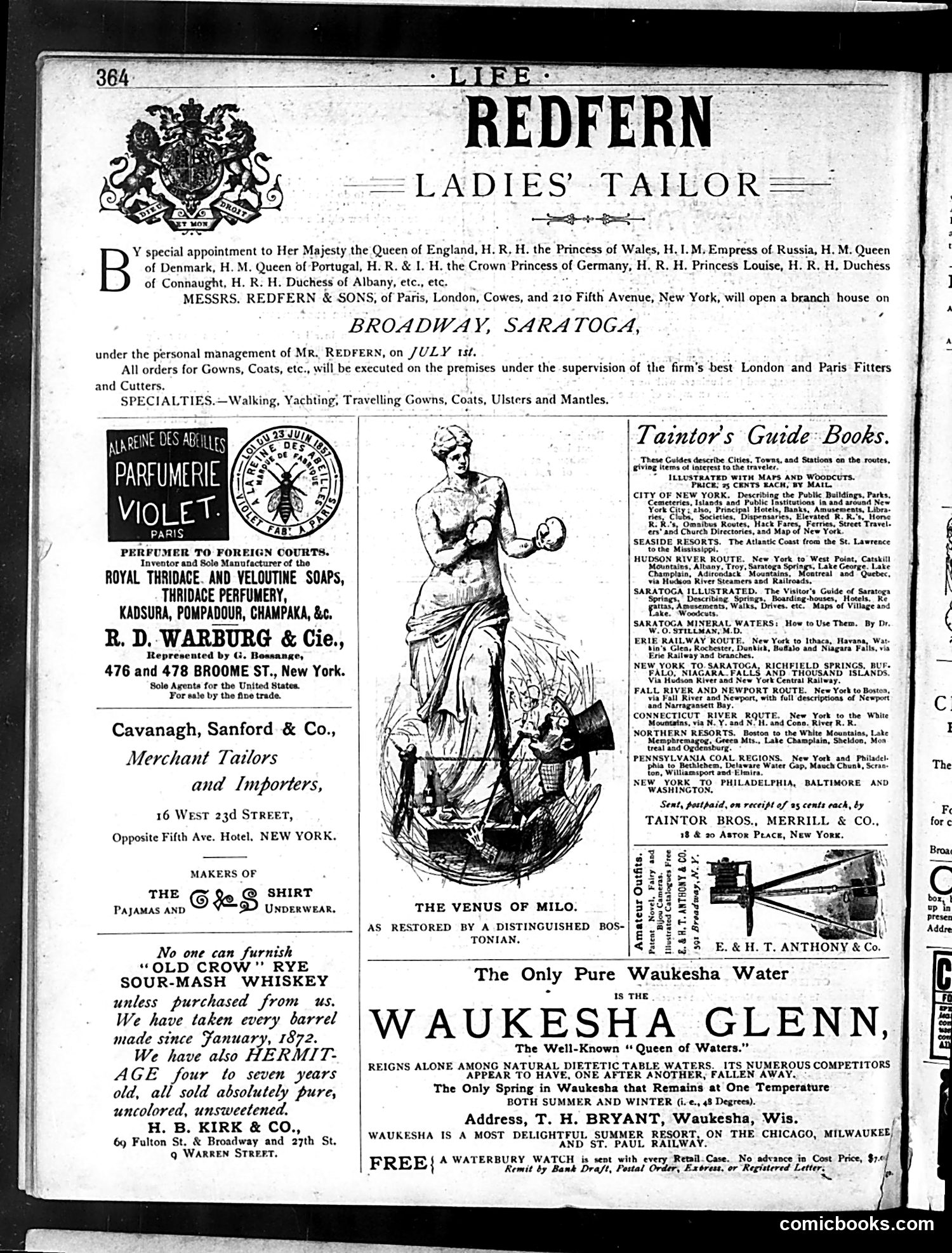
This is primarily an **advertising page** rather than satirical content. The central image—a classical engraving of the Venus de Milo—appears ironic only in its caption: "THE VENUS OF MILO, AS RESTORED BY A DISTINGUISHED BOSTONIAN." The joke likely references **19th-century debates over restoring classical sculptures**. The "restoration" mentioned suggests someone (humorously identified as a Bostonian, implying American pretension to classical taste) attempted to "improve" or alter the famous armless Greek statue. This plays on anxieties about wealthy Americans acquiring and modifying European masterworks. The surrounding advertisements feature luxury goods—Redfern ladies' tailoring, perfumes, fine soaps—targeting wealthy clientele who would appreciate the satirical jab at ostentatious cultural acquisition. The humor is subtle: mocking American millionaires who bought European art while lacking refined judgment to leave masterworks untouched.
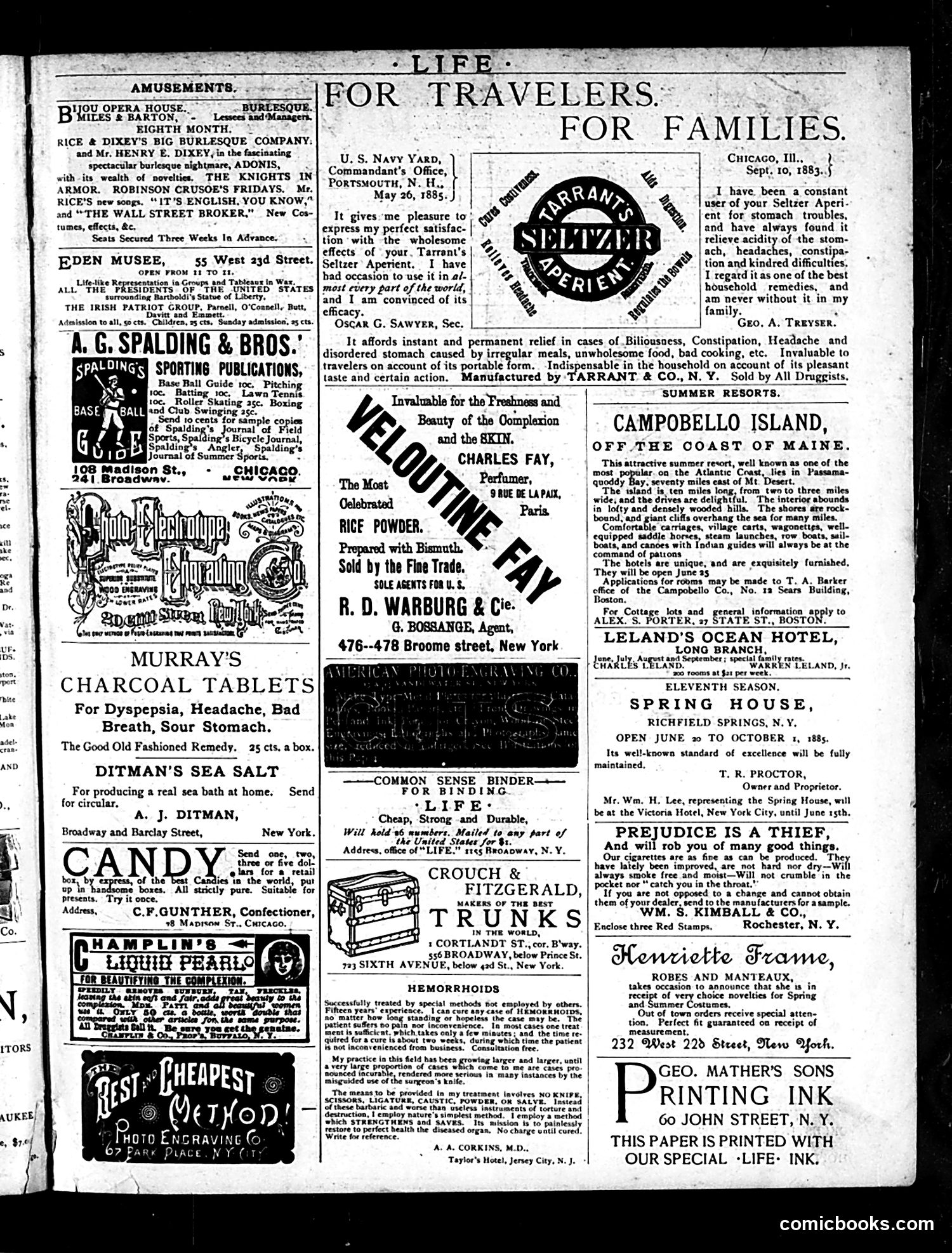
This page is **primarily advertisements** with testimonials rather than satirical cartoons. The ads promote patent medicines and consumer goods typical of 1880s America: Tarrant's Seltzer Aperient (a digestive aid), Murray's Charcoal Tablets, Beloutine Fan (cosmetic), printing ink, and trunks. Two Navy and civilian testimonials endorse Tarrant's product, claiming it relieves stomach ailments—reflecting the era's widespread marketing of medicinal tonics with often-exaggerated health claims. The "Common Sense Binder" allows readers to collect and bind Life magazine issues. There are no prominent political cartoons visible on this particular page. The page exemplifies how 19th-century magazines intermingled editorial content with extensive advertising, often featuring pseudo-scientific health products marketed to travelers and families seeking convenient remedies for common complaints.
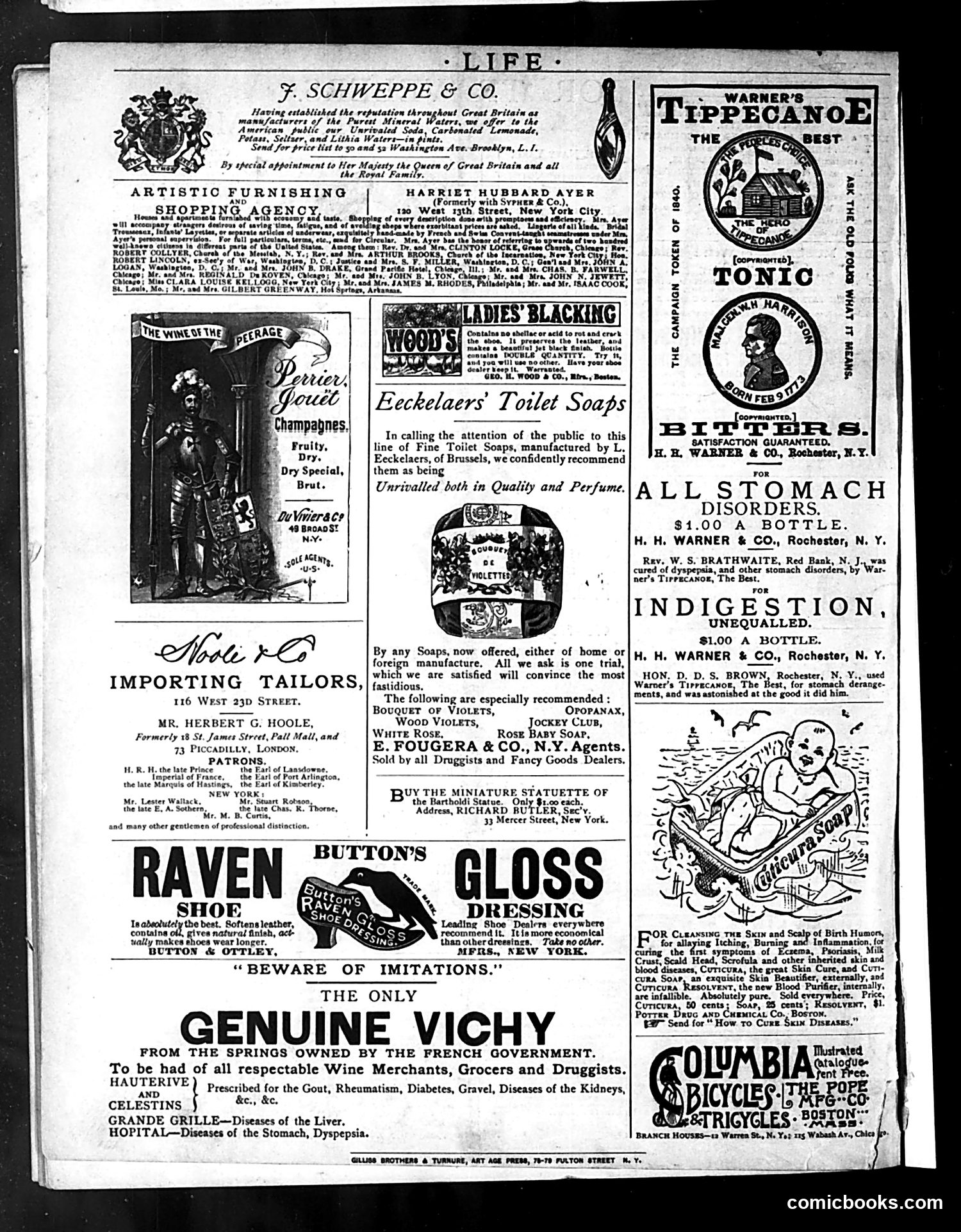
This is primarily an **advertising page** from a late 19th-century Life magazine, containing no political cartoons or satire requiring historical context. The page features commercial advertisements for luxury goods targeting wealthy consumers: imported French mineral water (Schweppe), high-end tailoring services, fine Belgian toilet soaps, shoe polish, and patent medicines. Notable is the repeated emphasis on **European prestige**—French springs, Brussels soaps, London tailors—reflecting Victorian-era American aspirations toward Old World sophistication. The medical advertisements (Warner's remedies for stomach disorders and indigestion) are typical of the era's patent medicine boom, making broad health claims without modern regulation. One ad includes an ornate "Campaign Token of 1840" image, though its relevance is unclear from context. The page primarily documents **consumer culture and marketing strategies** of the Gilded Age rather than containing satirical commentary.
I can see this is a page from Life magazine, but the image is almost entirely black with only minimal visible content—a small light spot near the center and some barely discernible markings along the edges. The OCR text only shows "comicbooks.com," which appears to be a watermark rather than actual page content. I cannot reliably identify any cartoons, figures, caricatures, or satirical content from this image. The page is too dark and degraded to read text, make out illustrations, or analyze political or social references. To provide accurate analysis per your guidelines, I would need a clearer or better-exposed version of this page.