
Life, 1885-06-25 · page 7 of 17
Life — June 25, 1885 — page 7: what you’re looking at
What you’re looking at
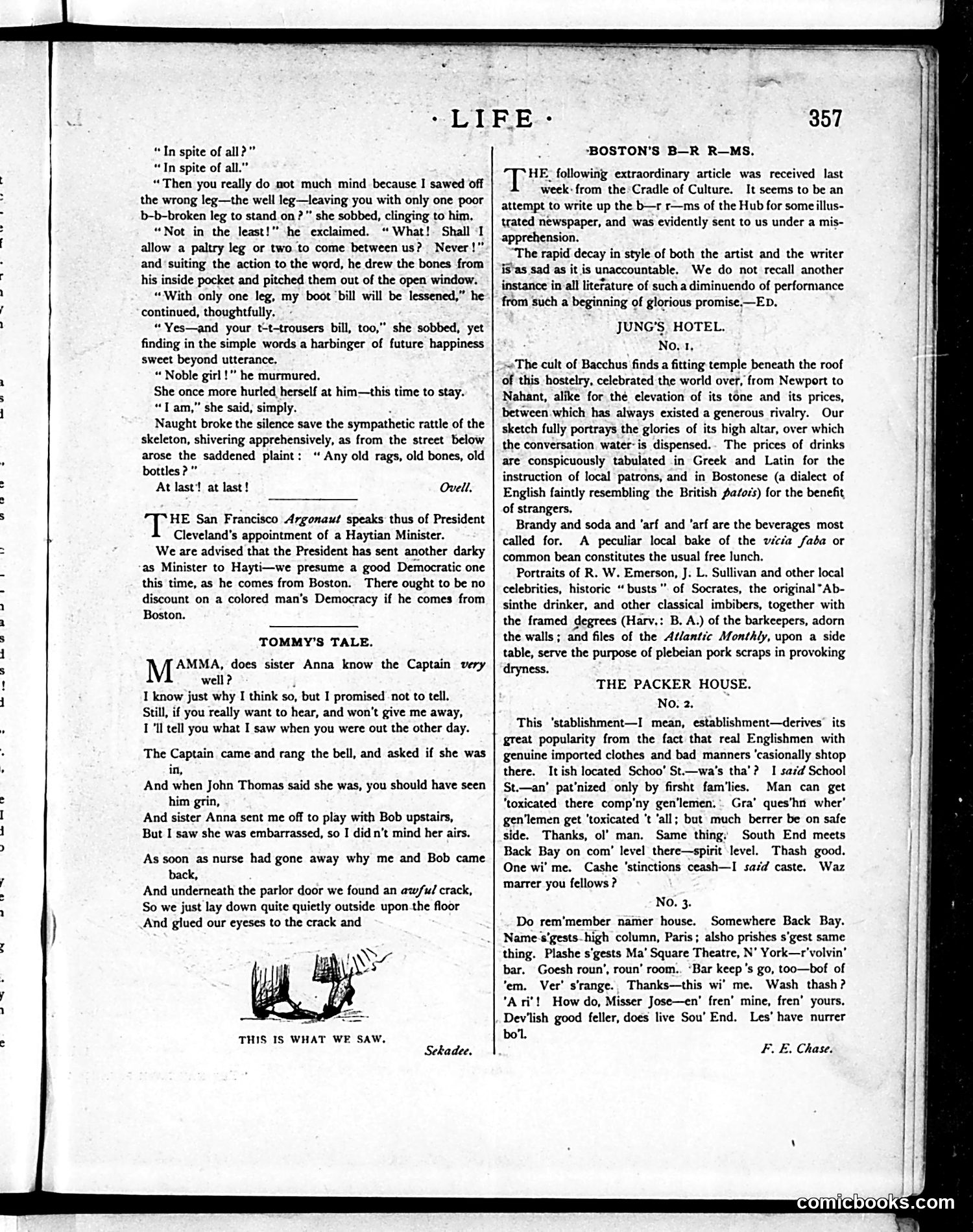
This page contains three separate satirical pieces rather than a single unified cartoon: 1. **"In spite of all?"** - A narrative poem about a man with a wooden leg, likely satirizing disability or misfortune with dark humor typical of the era. 2. **"Boston's B-R R-MS"** - Editorial commentary mocking what appears to be a poorly-written submission from a Boston newspaper about the Hub (Boston's nickname), criticizing both the artist's and writer's declining quality. 3. **"Tommy's Tale"** and subsequent numbered pieces - Humorous anecdotes and social observations, including references to servants, household scandals, and local establishments like Jung's Hotel and the Packer House—likely poking fun at Boston society and English pretensions among the wealthy. The page reflects *Life* magazine's characteristic irreverent approach to American social commentary.
📄 Transcribed text from this page (OCR, searchable)
Machine-transcribed from the original scan — historical spelling and the odd misread are preserved.
“In spite of all?” “In spite of all.” “Then you really do not much mind because I sawed off the wrong leg—the well leg—leaving you with only one poor b-b-broken leg to stand on?” she sobbed, clinging to him, “Not in the least!" he exclaimed. “ What! Shall ‘1 allow a paltry leg or two to come between us? Never!” and suiting the action to the word, he drew the bones from his inside pocket and pitched them out of the open window. “With only one leg, my boot ‘bill will be lessened,” he continued, thoughtfully. “Yes—and your t-t-trousers bill, too,” she sobbed, yet finding in the simple words a harbinger of future happiness sweet beyond utterance, “ Noble girl!” he murmured. She once more hurled herself at him—this time to stay. “Tam,” she said, simply. a Naught broke the silence save the sympathetic rattle of the skeleton, shivering apprehensively, as from the street below arose the saddened plaint: “ Any old rags, old bones, old bottles?” At last at last! Ovell. HE San Francisco Argonaut speaks thus of President Cleveland’s appointment of a Haytian Minister. We are advised that the President has sent another darky as Minister to Hayti—we presume a good Democratic one this time, as he comes from Boston. There ought to be no discount on a colored man’s Democracy if he comes from Boston. TOMMY’S TALE. AMMA, does sister Anna know the Captain very well? j I know just why I think so, but I promised not to tell. Still, if you really want to hear, and won't give me away, I'll tell you what I saw when you were out the other day. The Captain came and rang the bell, and asked if she was in, And when John Thomas said she was, you should have seen him grin, And sister Anna sent me off to play with Bob upstairs, But I saw she was embarrassed, so I didn’t mind her airs. As soon as nurse had gone away why me and Bob came back, And underneath the parlor door we found an aw/u/ crack, So we just lay down quite quietly outside upon.the floor And glued our eyeses to the crack and THIS IS WHAT WE SAW. ‘BOSTON’'S B—R R—MS. HE. following extraordinary article was received last week: from the Cradle of Culture. It seems to be an attempt to write up the b—r r—ms of the Hub for some illus- trated newspaper, and was evidently sent to us under a mis- apprehension. “The rapid decay in style of both the artist and the writer is'as sad as it is unaccountable. We do not recall another instance in all litefature of such a diminuendo of performance from such a beginning of glorious promise —Eb. JUNG'S, HOTEL. No.1, ~~The cult of Bacchus finds a fitting temple beneath the roof of this hostelry, celebrated the world over, from Newport to Nahant, alike for thé elevation of its tone and its prices, between which has always existed a generous rivalry. Our sketch fully portrays the glories of its high altar, over which the conversation water-is dispensed.. The prices of drinks are conspicuously tabulated in Greek and Latin for the instruction of local patrons, and in Bostonese (a dialect of English faintly resembling the British fafors) for the benefit of strangers, Brandy and soda and ‘arf and ‘arf are the beverages most called for. A peculiar local bake of the vicia faba or common bean constitutes the usual free lunch. Portraits of R. W. Emerson, J. L. Sullivan and other local celebrities, historic “ busts" of Socrates, the original "Ab- sinthe drinker, and other classical imbibers, together with the framed degrees (Harv.: B. A.) of the barkeepers, adorn the walls; and files of the Aé/antic Monthly, upon a side table, serve the purpose of plebeian pork scraps in provoking dryness. THE PACKER HOUSE. No. 2. This ‘stablishment—I mean, establishment—derives’ its great popularity from the fact that real Englishmen with genuine imported clothes and bad manners ‘casionally shtop there. It ish located Schoo’ St.—wa’s tha’? I sard School St.—an’ pat'nized only by firsht fam'lies. Man can get ‘toxicated there comp'ny gen'lemen.:. Gra’ ques’hn wher’ gen'lemen get ‘toxicated 't ‘all; but much berrer be on safe side. Thanks, ol’ man. Same thing: South End meets Back Bay on com’ level there—spirit level. Thash good. One wi’ me. Cashe ‘stinctions ceash—I saéd caste. Waz marrer you fellows ? No. 3. Do rem’member namer house. Somewhere Back Bay. Name’s'gests-high column, Paris; alsho prishes s‘gest same thing. Plashe s’gests Ma’ Square Theatre, N’ York—r'volvin’ bar. Goesh roun’, roun’ room.. ‘Bar keeps go, too—bof of ‘em. Ver’ s'range.. Thanks—this wi’ me. Wash thash? ‘Ari’! How do, Misser Jose—en’ fren’ mine, fren’ yours. Devilish good feller, does live Sou’ End. Les’ have nurrer bo’. F. E. Chase.