
A complete issue · 16 pages · 1885
Life — June 11, 1885
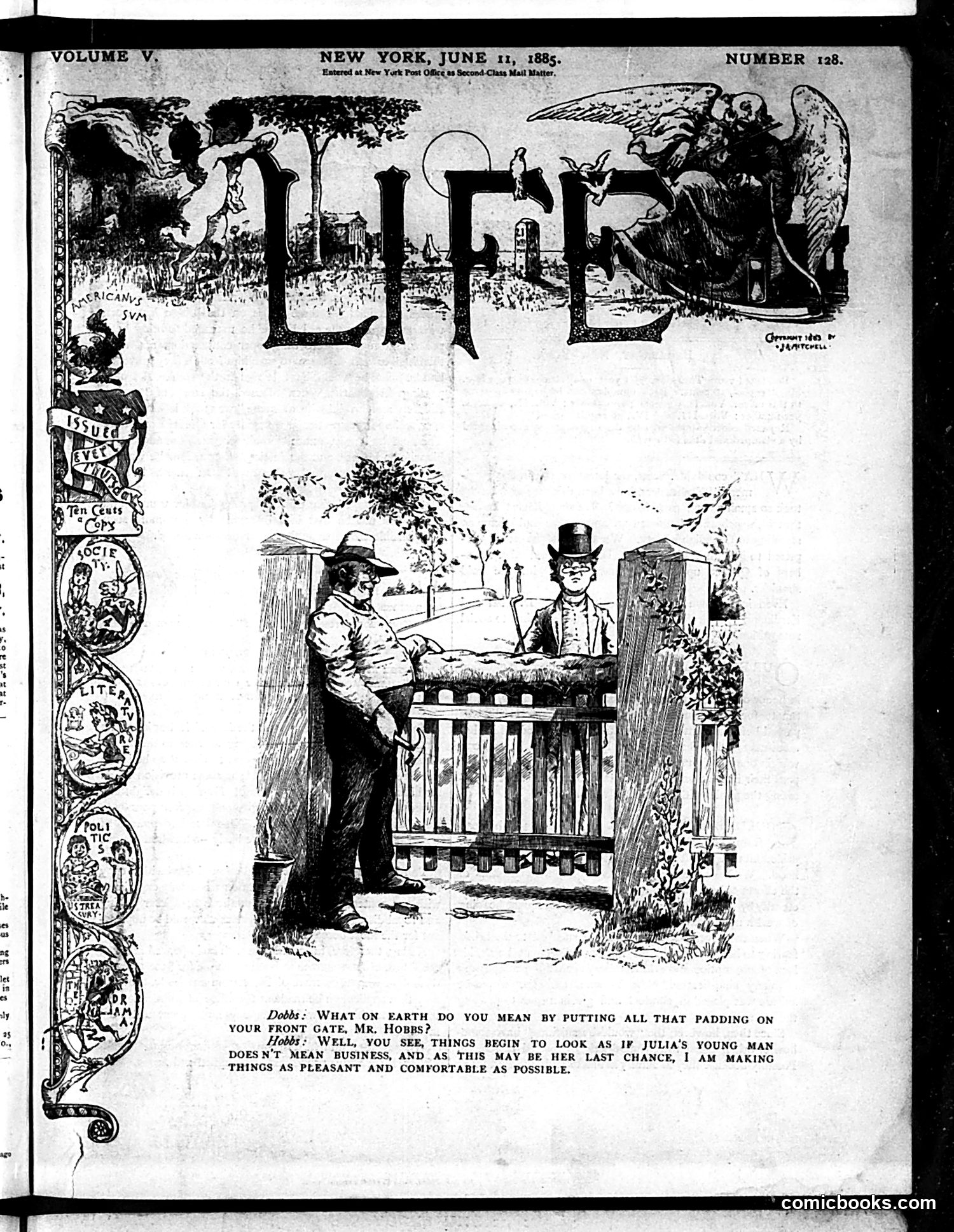
The cartoon depicts a domestic scene with two men at a gate. One man (labeled "Dobbs") questions another (labeled "Hobbs") about excessive padding on a front gate. Hobbs explains he's added the padding because "things begin to look as if Julia's young man does n't mean business, and as this may be her last chance, I am making things as pleasant and comfortable as possible." The satire targets parental desperation about unmarried daughters. It mocks the idea that a father would literally cushion his gate—presumably to make courtship more comfortable—hoping to secure a marriage proposal for his daughter Julia. The joke reflects late-Victorian anxiety about women's marriageability and a father's willingness to go to absurd lengths to facilitate romantic outcomes.
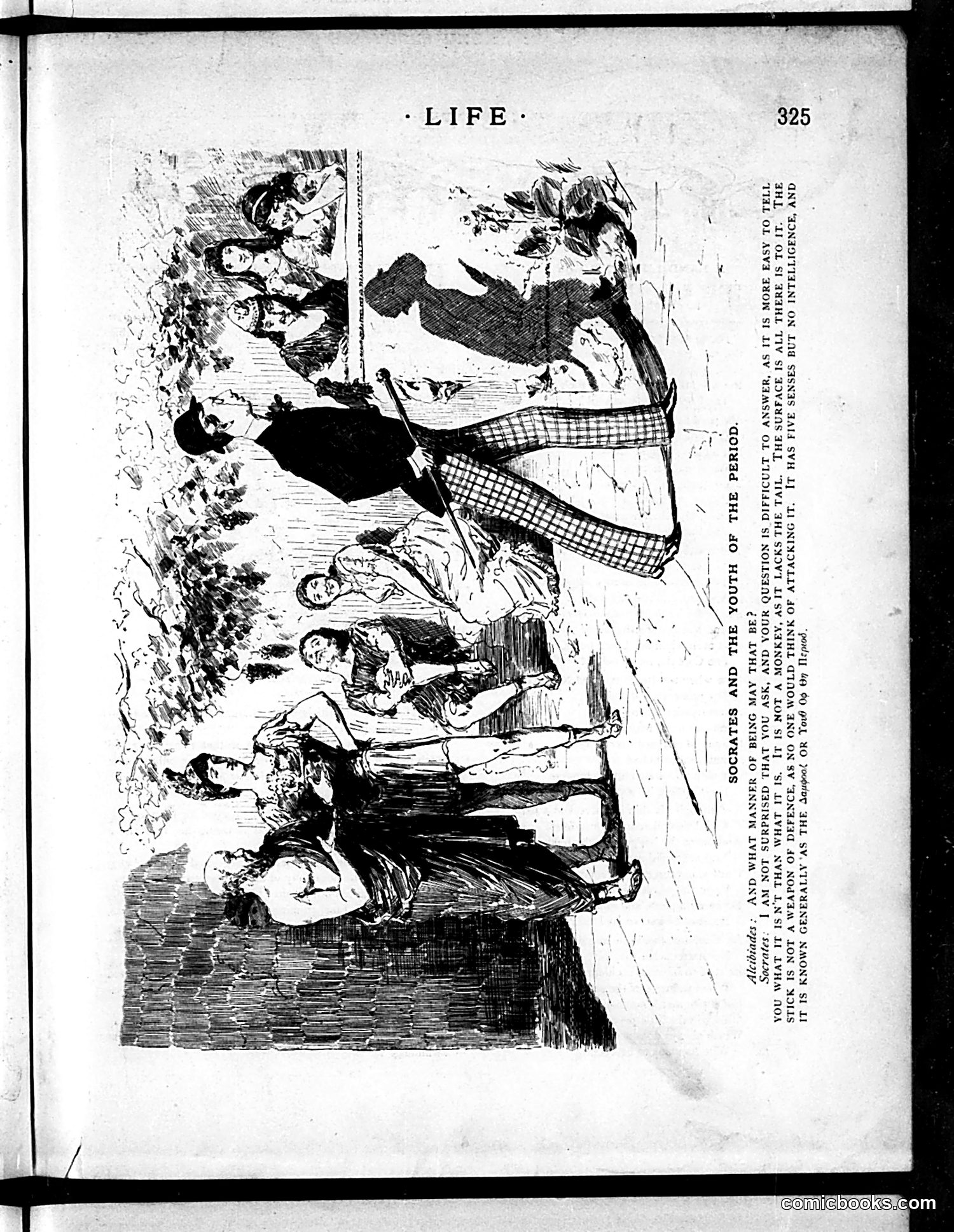
This satirical cartoon appears to depict social commentary about cricket and British culture, though the image quality and rotation make precise identification difficult. The title references "Crickets and the Period," suggesting commentary on how cricket reflects or responds to contemporary social conditions. The sketch shows multiple figures in various poses, likely caricatured to mock particular social types or attitudes. The OCR'd text mentions "anybody manifest bosses of birth," "surprise," and references to "five senses," suggesting the satire addresses class distinctions, social pretension, or changing cultural values during whatever period *Life* magazine published this. Without clearer visibility or more complete text, the specific targets remain unclear, but the format is typical of *Life's* social and political satire.
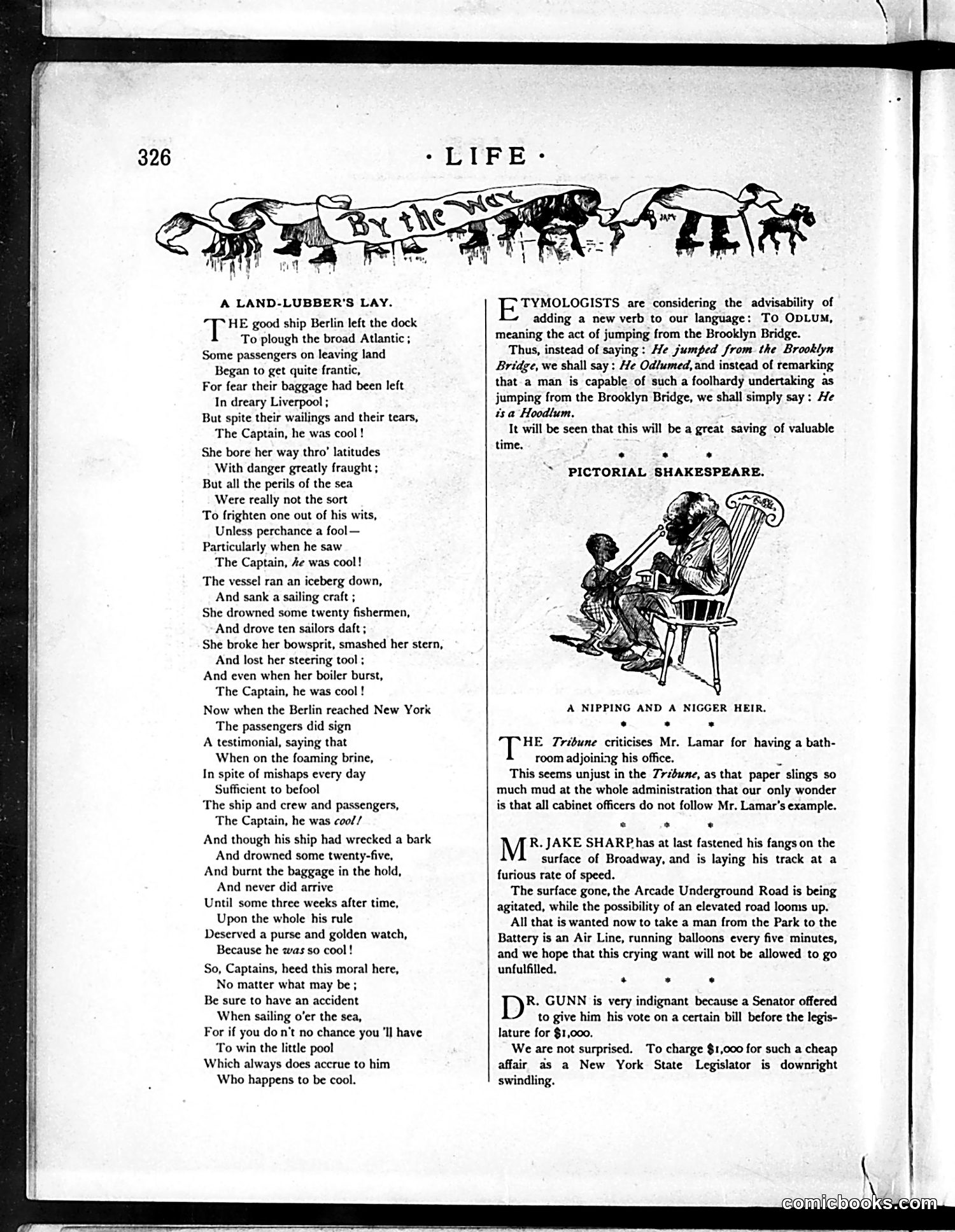
**"A Land-Lubber's Lay"** (left column): A narrative poem satirizing the captain of the ship *Berlin*, who remained composed ("cool") during a maritime disaster—the vessel sank after colliding with another ship, losing cargo and passengers. The satire mocks the captain's unflappable demeanor as he receives commendation, suggesting ironic commentary on misplaced heroism during negligence or failure. **Right column items**: Brief satirical notes on contemporary issues—a proposed verb "Odium" referencing Brooklyn Bridge suicides; criticism of Mr. Lamar's office bathroom; and complaints about proposed elevated transit and Air Line balloons. The final item mocks a senator demanding payment for legislative votes, characterizing New York politicians as corrupt. The page exemplifies *Life*'s role as a social and political satirist of early 20th-century America.
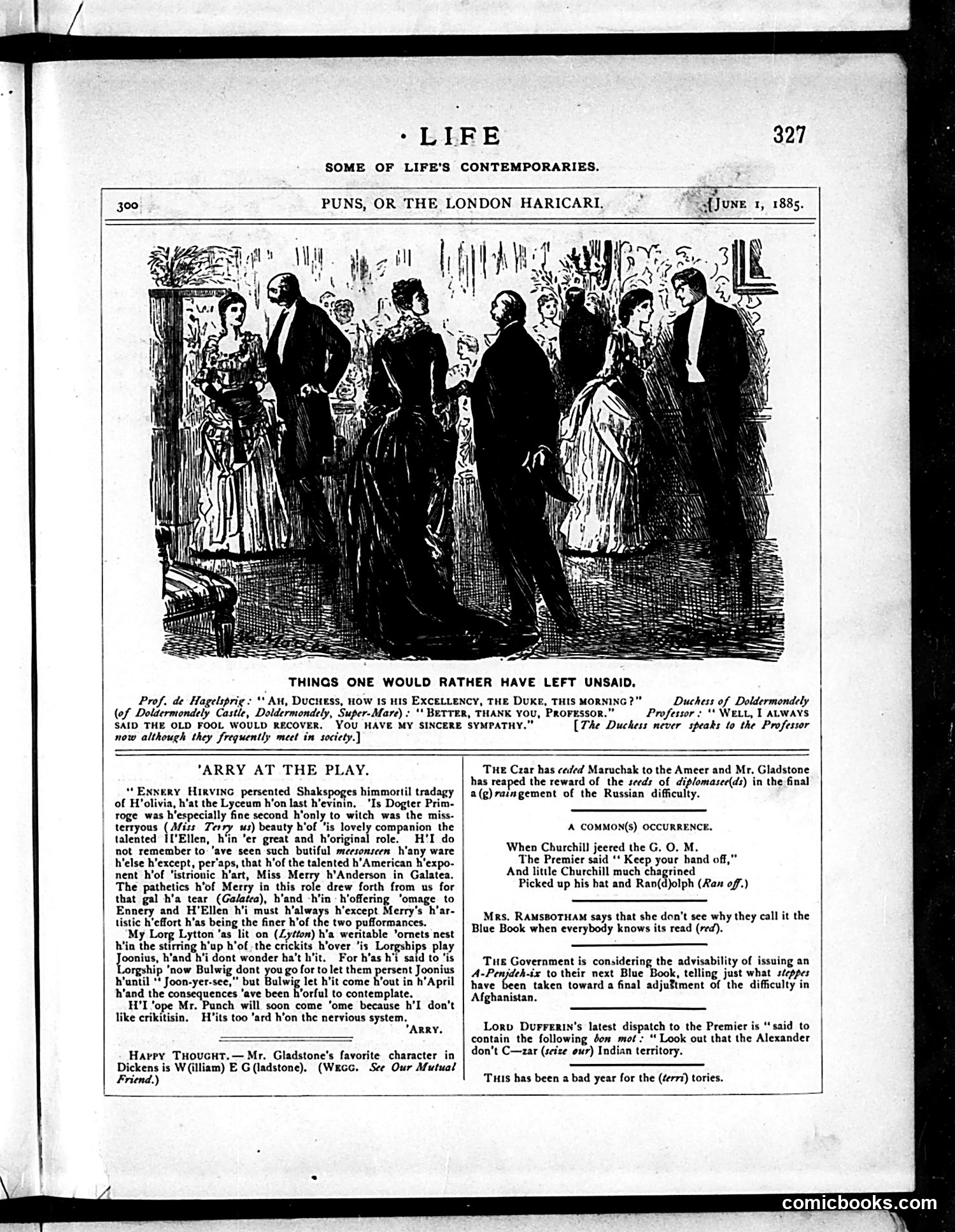
This cartoon satirizes awkward social moments at a formal Victorian gathering. The caption identifies specific embarrassing remarks: - A Professor addressing a Duchess about "his Excellency, the Duke, this morning" - Someone mentioning the Duchess of Doldrumosity's "Super-May" appearance - A Professor told "Better, thank you, Professor" - A comment about sincere sympathy that was "never allowed they Frequently meet here" The humor derives from Victorian social conventions—the gap between what polite society *should* say versus tactless, inappropriate comments that breach etiquette. The formal dress and interior setting emphasize this is about upper-class propriety. The illustration captures guests' discomfort with these verbal missteps, making it a gentle mockery of rigid social rules and the anxiety of saying the wrong thing in elite circles.
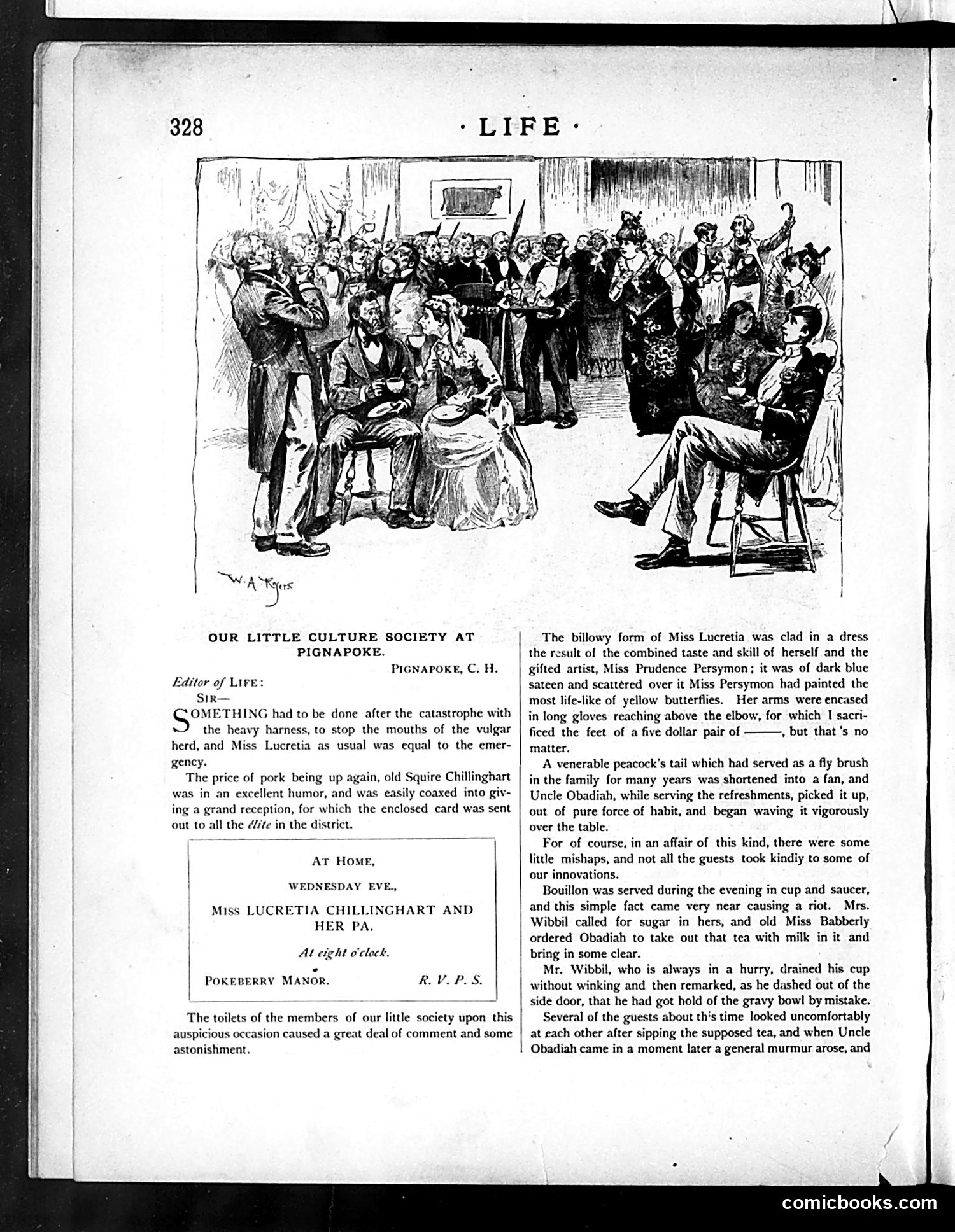
This satirical piece mocks a provincial social gathering in Pignapoke, C.H. (likely a fictional small town). The cartoon depicts an awkward "at home" reception hosted by Miss Lucretia Chillinghart, where guests attempt cultural sophistication with comical results. The satire targets pretentious rural society: Miss Lucretia wears an elaborately decorated dress with yellow butterfly patterns, while a peacock's tail serves as a fly brush. The humor centers on social mishaps—Mrs. Wibbell demands sugar in her tea, and Uncle Obadiah accidentally waves the peacock tail over the table, nearly causing a riot when he spills gravy. The joke is that these rustic characters mistake ostentation for genuine culture, creating chaos while trying to appear refined.
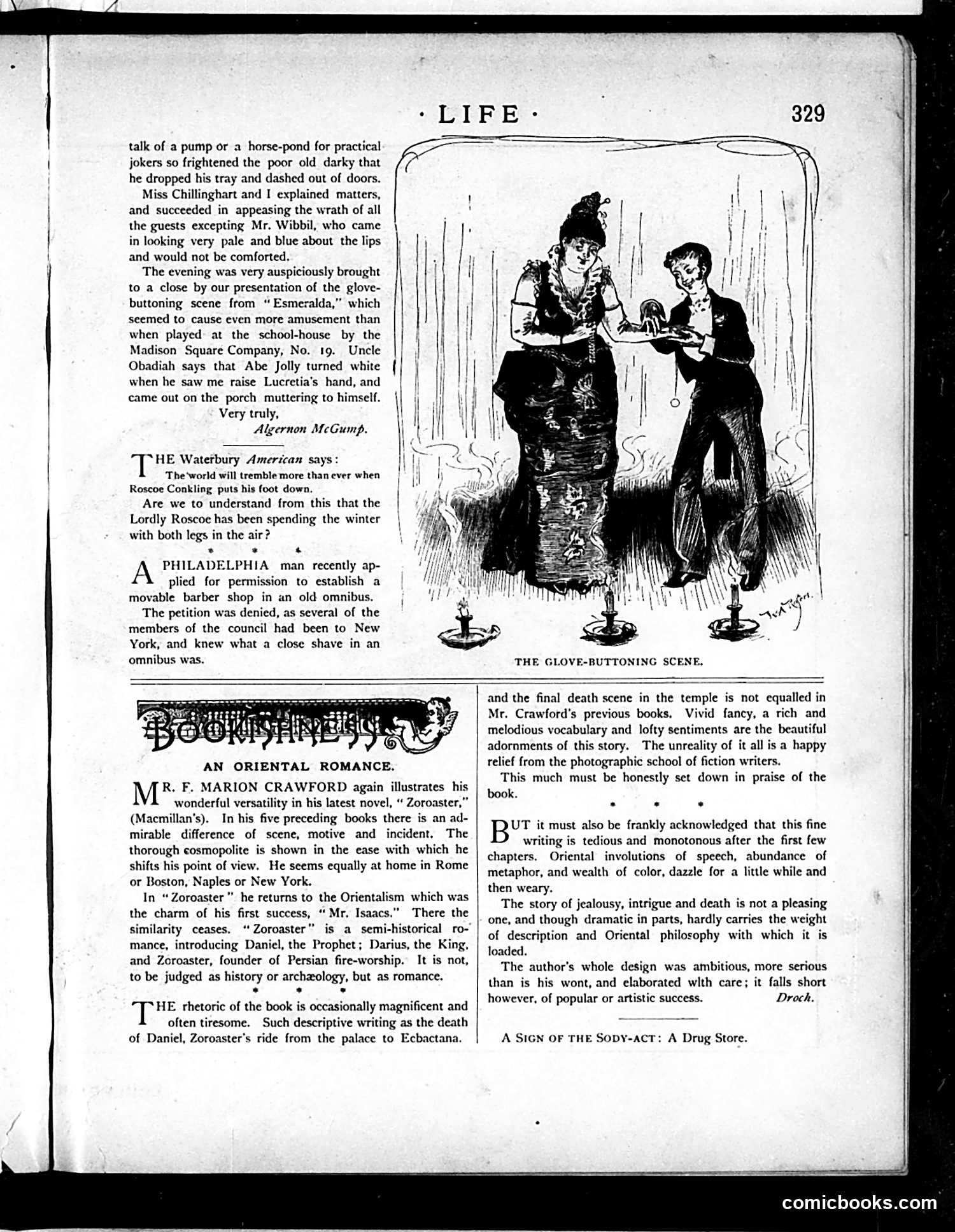
This illustration depicts a Victorian-era social scene with two figures engaged in the delicate task of buttoning gloves—likely a moment from a theatrical production or serialized story. The cartoon's humor appears to center on the elaborate formality and physical awkwardness of period dress and etiquette. The caption "THE GLOVE-BUTTONING SCENE" suggests this was a recognizable comedic moment, possibly from the theatrical production "Esmeralda" mentioned in the surrounding text. The exaggerated body language and careful positioning likely satirizes the rigid social conventions and physical constraints of Victorian fashion, particularly women's restrictive clothing and the formal codes governing polite interaction between men and women. The joke relies on contemporary readers' familiarity with these social rituals.
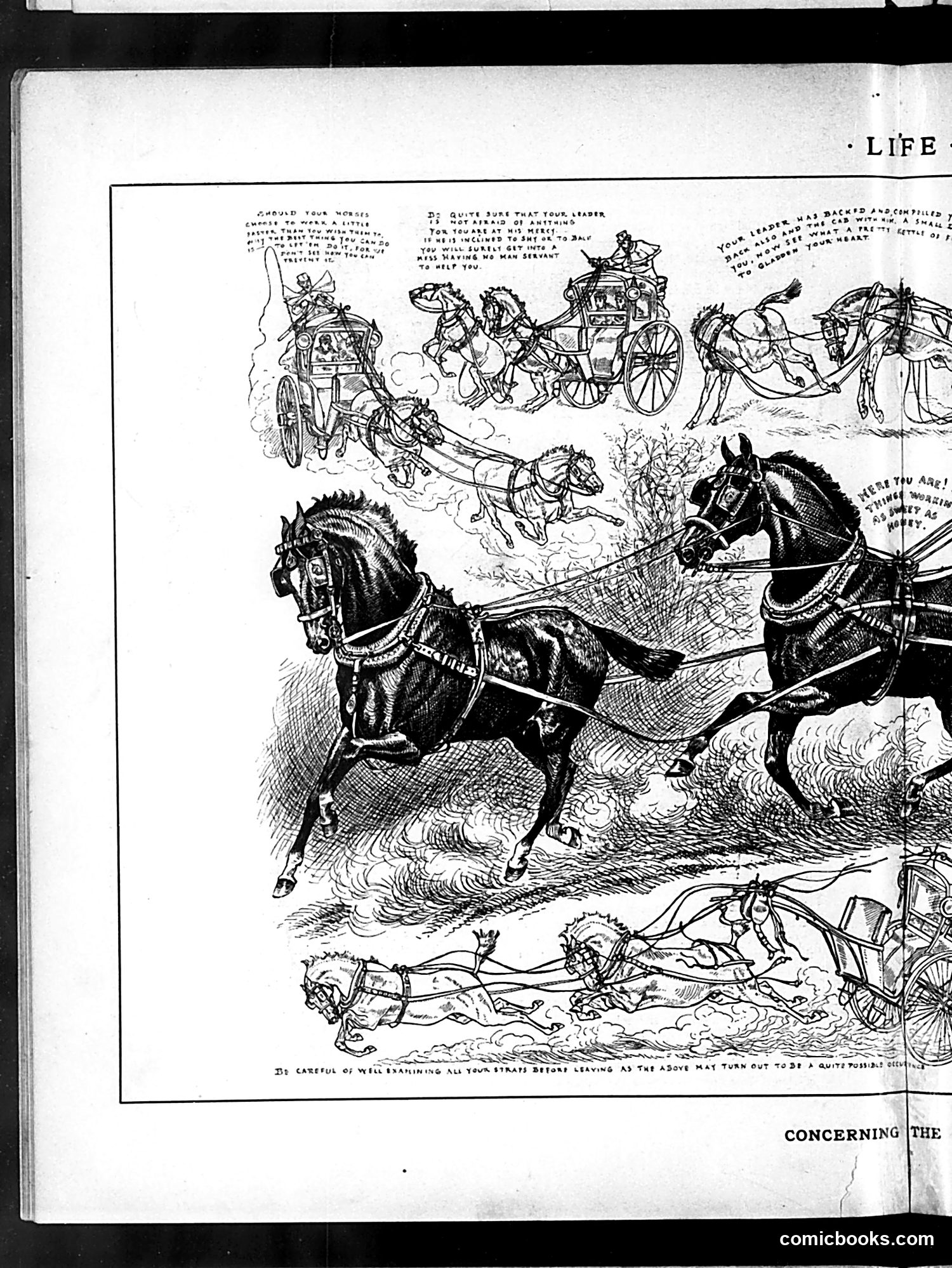
This appears to be a satirical cartoon from *Life* magazine depicting a chaotic scene of horse-drawn carriages and riders in apparent disarray or collision. The illustration shows multiple vehicles and horses in disorganized motion, with some figures tumbling or falling. The text bubbles contain dialogue (though difficult to read clearly in the OCR), and the bottom caption references "careful" examination of "two straps" before leaving, suggesting this is satirizing careless driving practices or traffic safety violations of the era. The satire likely mocks reckless drivers or poor vehicle management during the early automobile/horse-drawn carriage transition period. Without clearer text or identifying captions, the specific political figures or events referenced remain unclear, though the overall message appears to be cautionary commentary on traffic negligence.
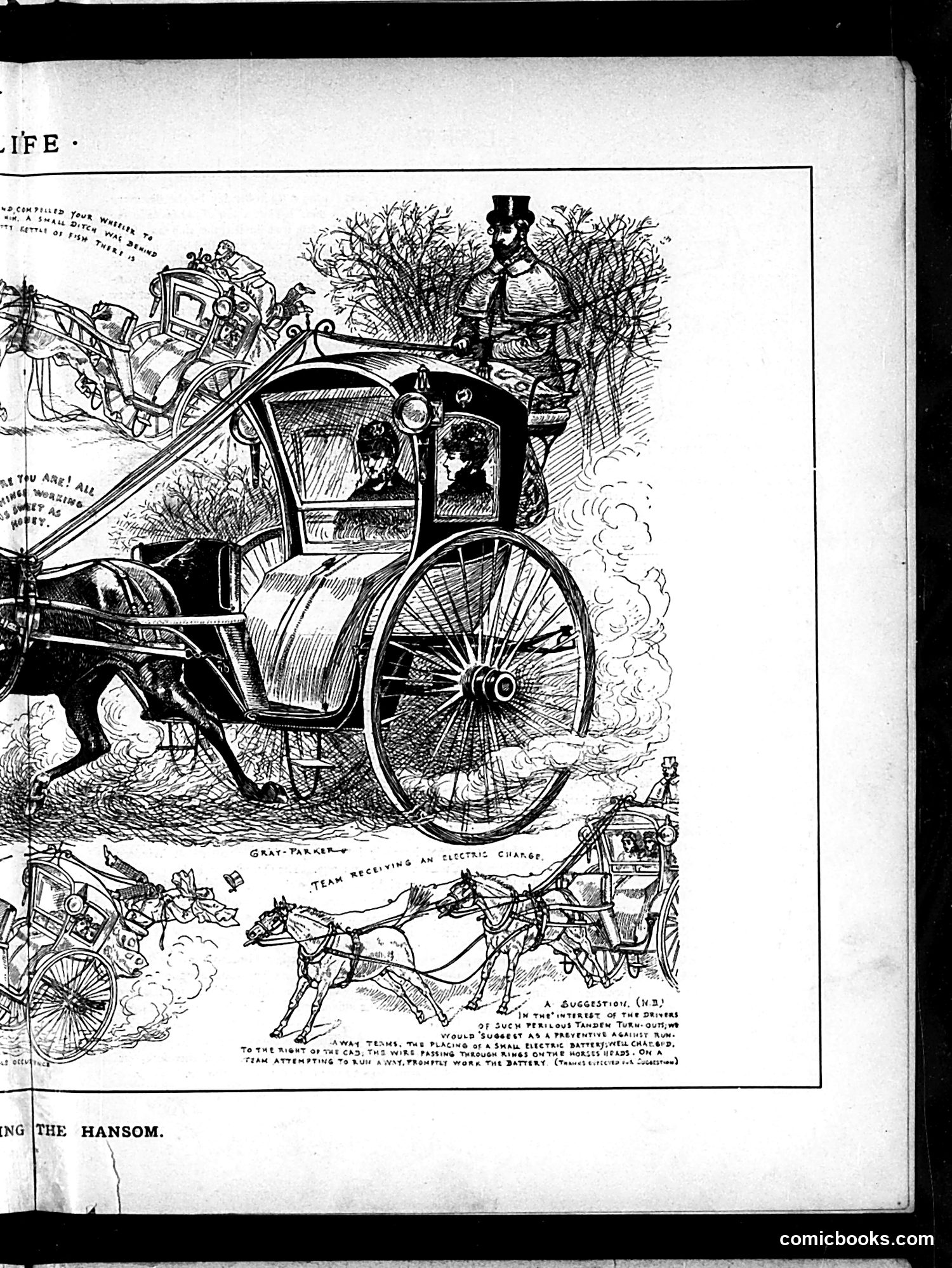
This page shows a satirical cartoon about an electric cab (hansom) receiving a charge from a team of horses. The humor lies in a role reversal: instead of horses powering the cab, they're now providing electrical energy to it. The cartoon suggests early skepticism about electric vehicle technology. The caption mentions "team receiving an electric charge," playing on the double meaning—both literally powering the vehicle and figuratively shocking the horses. This appears to mock the transition from horse-drawn to electric transportation during the early automotive era, suggesting the new technology still relied on traditional horse power in some form, or ironically commenting on how electric vehicles were still dependent on older systems. The date and publication context would help clarify the specific technological debate referenced.
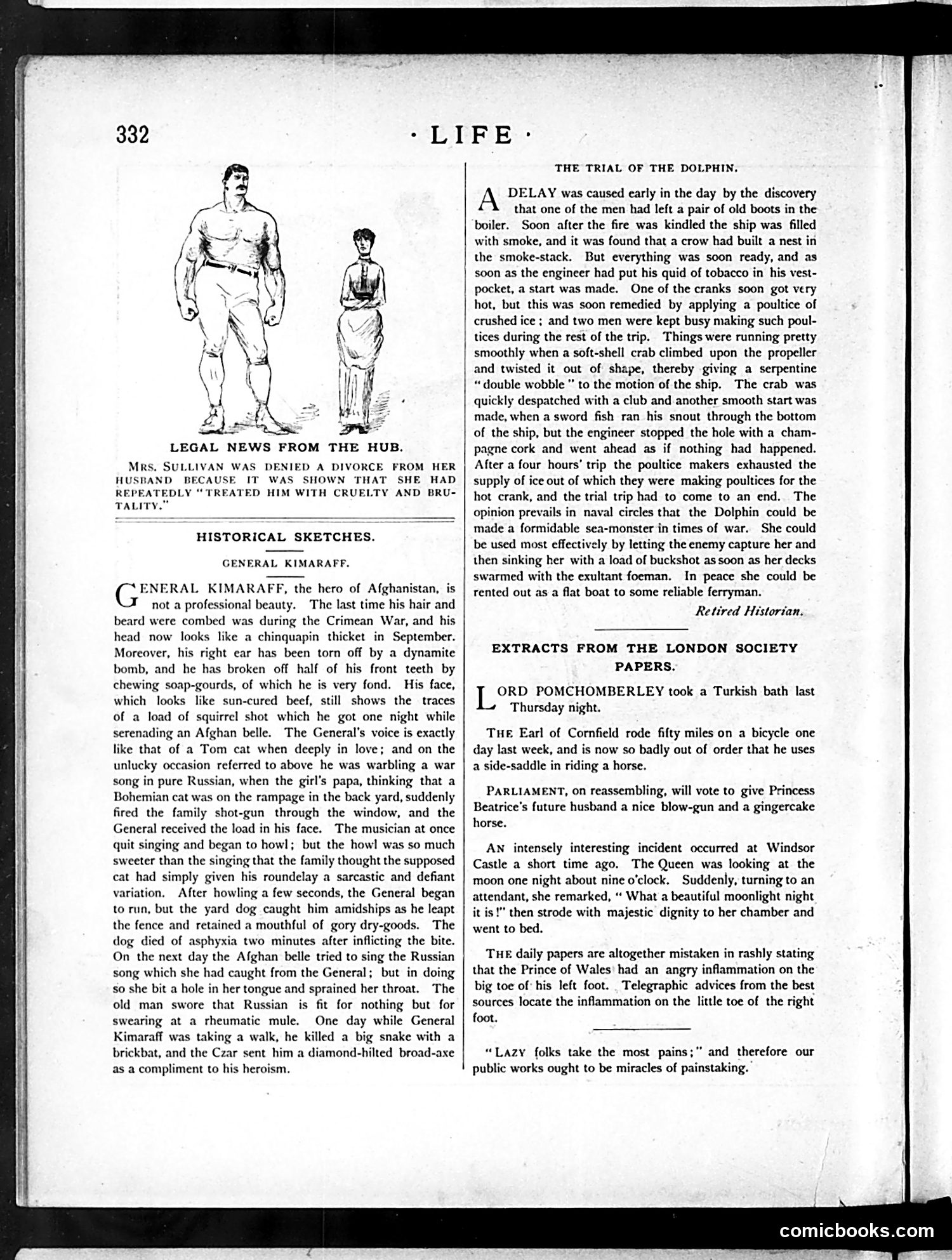
This page contains three satirical pieces from *Life* magazine: 1. **"Legal News from the Hub"**: A brief joke about a Boston divorce case where a woman's cruelty claim was denied—likely poking fun at legal absurdities or Massachusetts court decisions. 2. **"General Kimaraff"**: A mock-heroic biography of a fictional Russian general from Afghanistan. The satire exaggerates his appearance and misadventures (shot in the face while serenading, attacked by a dog) to ridicule military figures or Russian military pretensions. References to the Crimean War and the Czar suggest this targets Russian imperial ambitions. 3. **"The Trial of the Dolphin"**: A humorous account of a ship's maiden voyage plagued by absurd obstacles (boots in boiler, crow in smokestack, crab damaging propeller, sword fish puncturing hull). The satirical suggestion that the ship could be weaponized by letting enemies capture it, then sinking it, mocks naval incompetence or strategic foolishness. All three pieces use exaggeration and absurdist humor typical of 19th-century American satirical journalism.
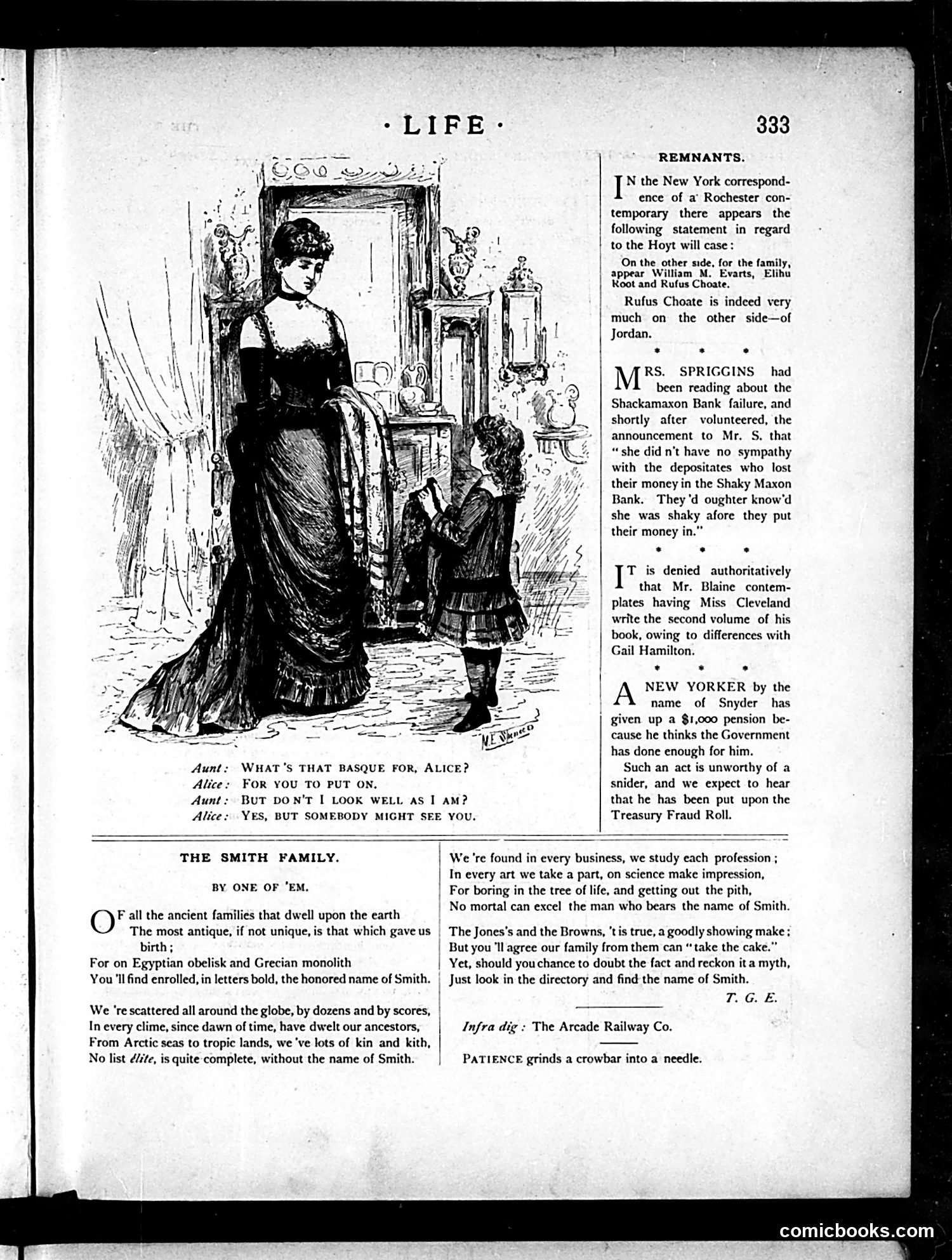
This page from Life magazine (a 19th-century satirical publication) contains several short satirical pieces: **The Main Cartoon** depicts a woman and child with the caption about a "basque" (corset). The joke plays on vanity—the aunt insists the woman look proper despite discomfort, warning "somebody might see you," mocking social pretension over comfort. **The "Remnants" Section** collects brief satirical notes: - A joke about lawyer Rufus Choate being "on the other side—of Jordan" (dead), poking fun at his involvement in the Hoyt will case - Mrs. Spriggins mocking bank depositors for trusting the "Shaky Maxon Bank," satirizing poor judgment - References to political figures Blaine and Cleveland - A New Yorker giving up a pension, deemed unpatriotic **"The Smith Family"** is a humorous poem celebrating how common the surname Smith is globally, playing on the ubiquity of this "ancient" family name. The overall tone mocks human vanity, foolishness, and social pretension through brief, pointed jabs at contemporary figures and situations.
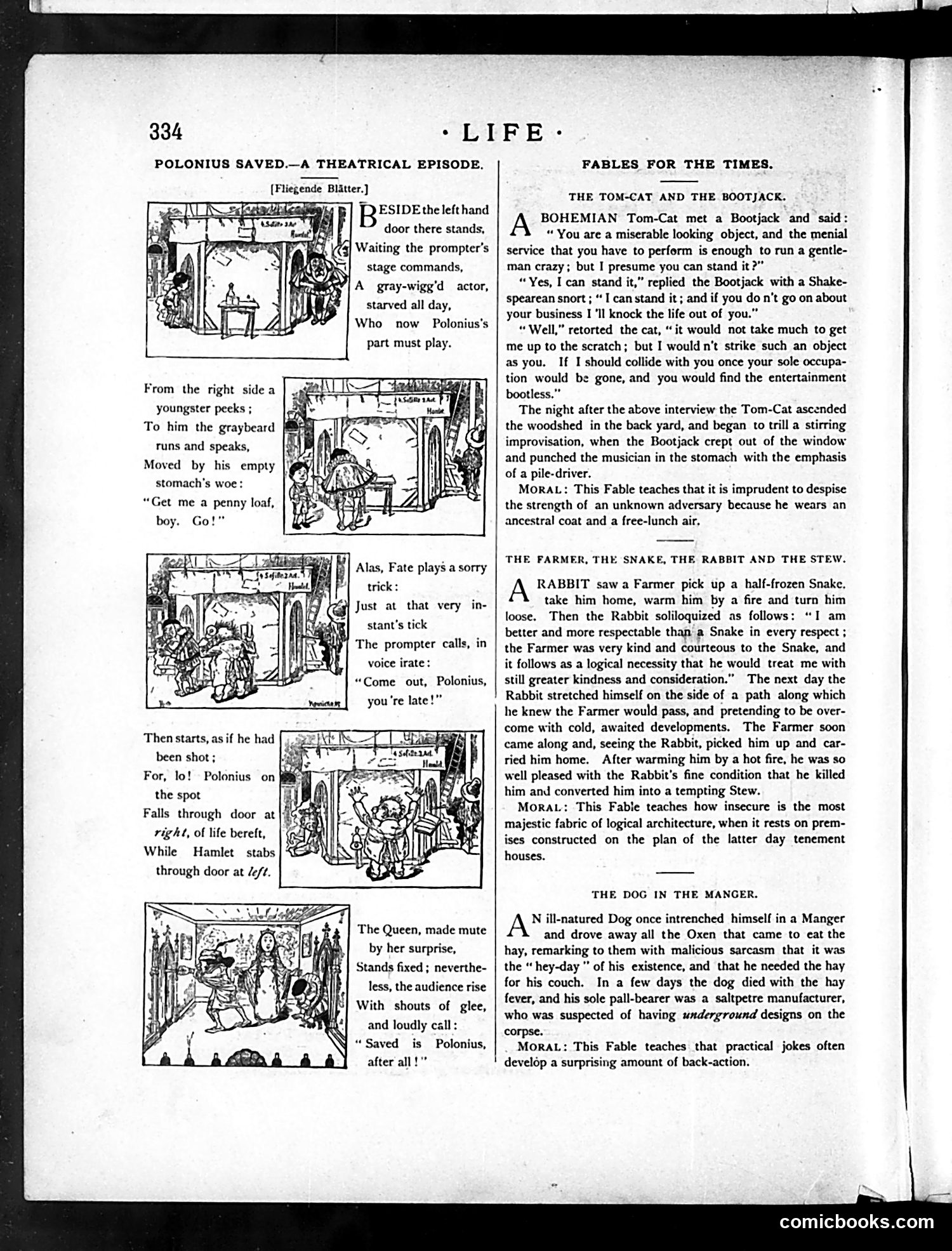
**Left side ("Polonius Saved"):** A comic strip sequence mocking theatrical mishaps. A starving actor playing Polonius in what appears to be a Shakespeare production is accidentally summoned by the prompter at the exact moment when the script calls for his character to be stabbed and killed onstage. He literally exits through the stage door as actors playing Hamlet stab through it, creating an unintended "rescue." The audience, thinking this is intentional, cheers "Saved is Polonius, after all!"—the humor lies in the accidental theatrical success born from the prompter's poor timing. **Right side ("Fables for the Times"):** Three illustrated moral fables with satirical twists: 1. **Tom-Cat and Bootjack:** A proud cat underestimates a humble bootjack's strength; gets beaten for his arrogance. 2. **Farmer, Snake, Rabbit, Stew:** A rabbit reasons he'll receive kindness like a snake did, but the farmer kills and cooks him instead—mocking flawed logic. 3. **Dog in the Manger:** An ill-natured dog dies from hay fever while hoarding hay—practical jokes backfire. All mock human pretension and faulty reasoning through animal characters.
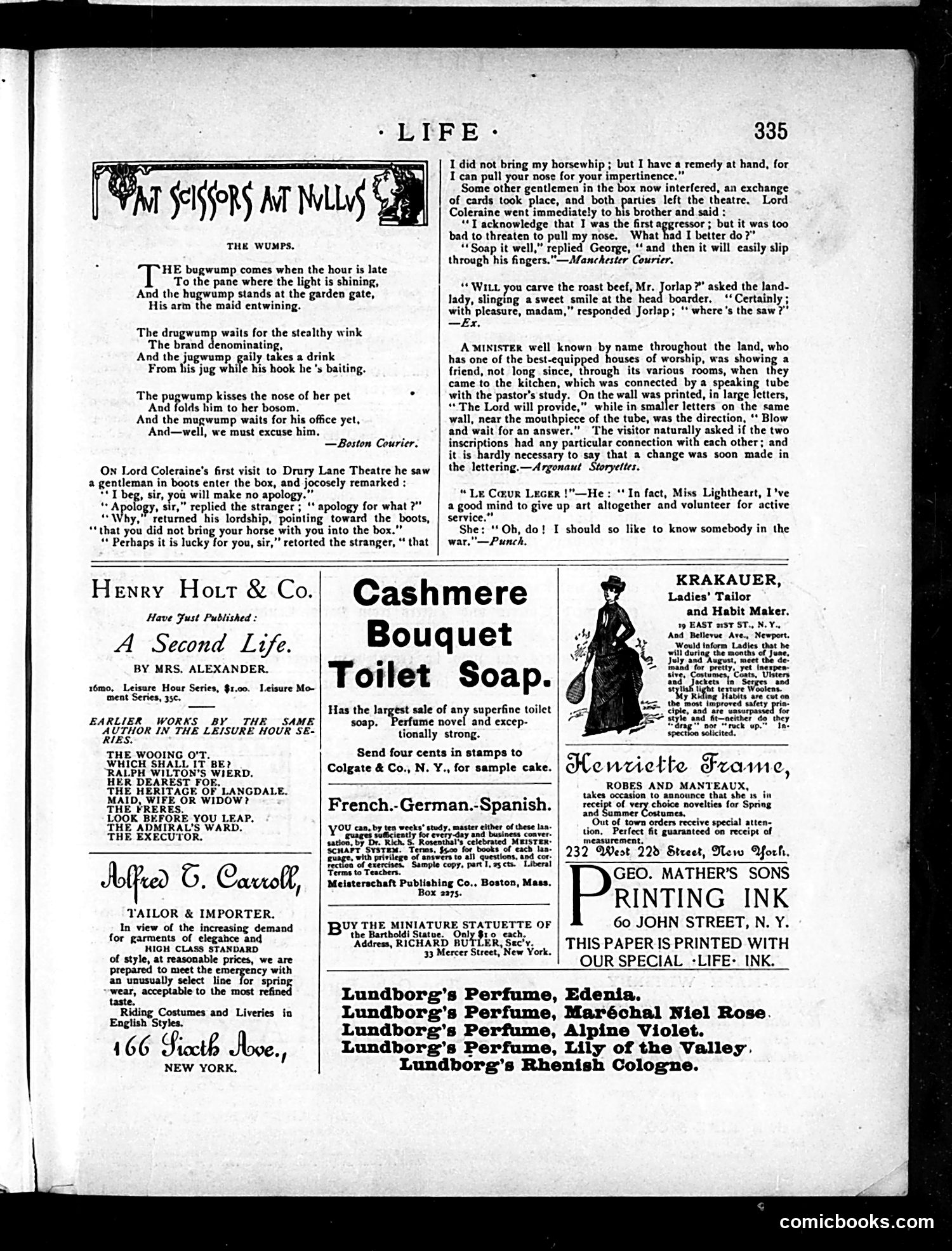
This page contains brief comic anecdotes satirizing social pretension and absurdity rather than political commentary. The main cartoon section, "Wit Scissors at Nulls," presents humorous verses about various types of people (bugwump, pugwump, etc.)—likely satirizing minor social types and their foibles. Below are three prose anecdotes mocking gentlemen's behavior: 1. **Lord Coleraine at the Theatre**: A nobleman insults a booted gentleman by suggesting he should have brought his horse into the theater box. When threatened, Coleraine admits fault but receives the witty retort that it's "lucky" he had no horsewhip. 2. **The Carving Joke**: A boarder asks about carving roast beef, then requests a "saw"—implying the meat is tough and inedible. 3. **The Minister's Contradiction**: A preacher displays "The Lord will provide" in his church kitchen while posting nearby instructions to "blow and wait for an answer" at a speaking tube—absurdly contradicting his faith message. The satire targets pompous gentlemen, poor hospitality, and religious hypocrisy.
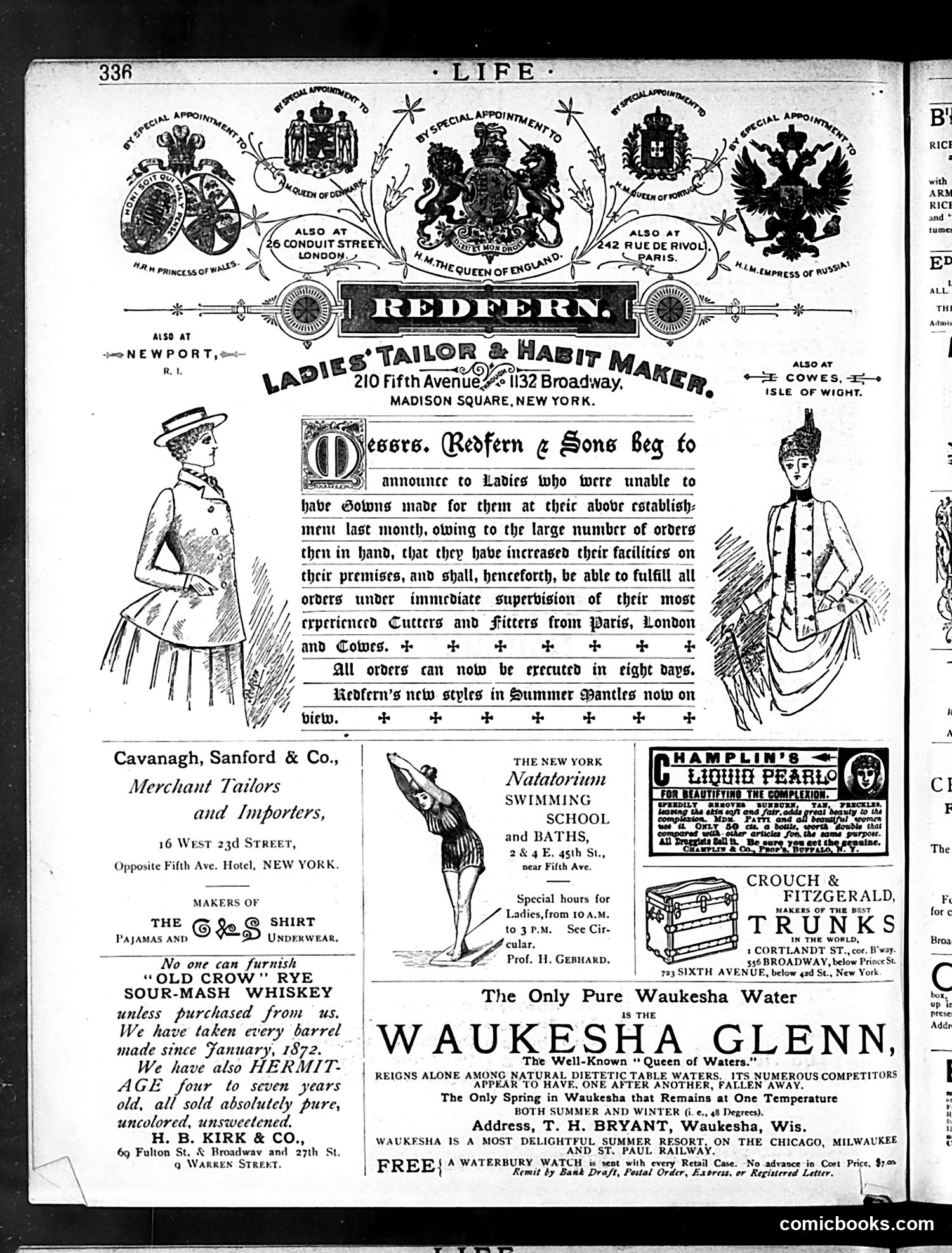
This page is primarily **advertising**, not political satire. The central feature is a large advertisement for Redfern & Sons, a high-end ladies' tailor shop with locations in London, Paris, New York, Newport, Cowes, and the Isle of Wight. The ornamental header displays royal coats of arms, emphasizing the shop's prestigious clientele and royal appointments. The text announces that Redfern has expanded their facilities to meet demand, now able to fulfill orders in eight days with experienced cutters and fitters from Paris, London, and Cowes. The page also contains numerous other period advertisements for men's clothing, whiskey, swimming instruction, luggage, and mineral water—typical of *Life* magazine's commercial content. The fashion illustrations on either side show the elegant silhouettes typical of 1880s-90s women's wear. **This appears to be a commercial page rather than satirical content.**
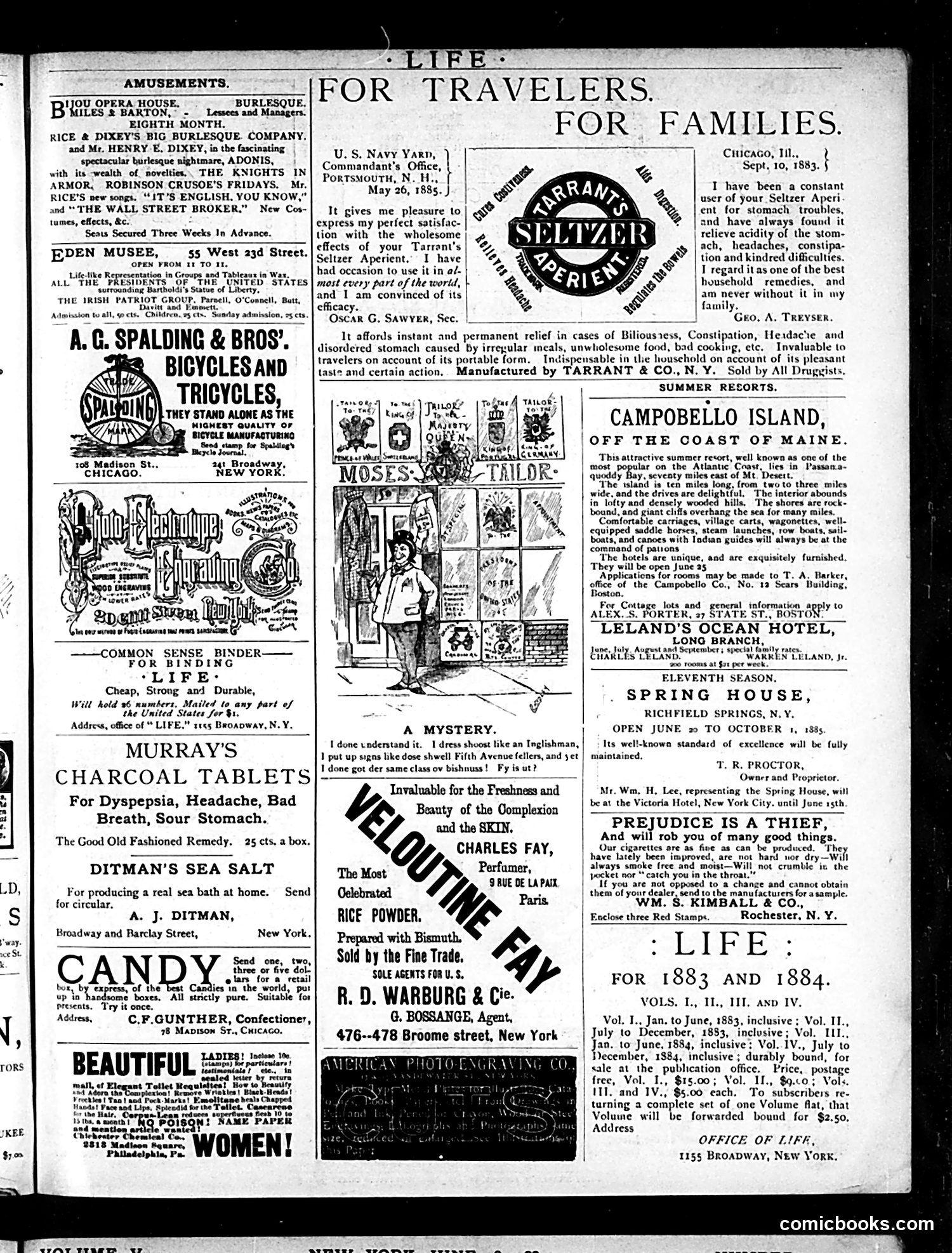
This page is primarily **advertising and announcements** rather than political satire. It represents Life magazine's revenue model during this era. **Key content:** - **Top section**: Testimonial letters praising Tarrant's Seltzer Aperient (a digestive remedy), featuring endorsements from a Chicago resident and a U.S. Navy commandant - **Left side**: Advertisements for theatrical productions (burlesque shows), museums, bicycles, patent medicines (charcoal tablets, sea salt), and candy - **Right side**: Summer resort listings and subscription information for Life volumes 1883-1884 **No political cartoon appears here.** The page shows how 19th-century magazines financed operations through extensive paid advertising mixed with editorial content. The testimonial letters, while appearing editorial, are actually advertisements disguised as reader endorsements—a common marketing practice of the era that modern readers might find deceptive. The diverse products advertised (digestive aids, bicycles, theatrical entertainment) reflect 1880s consumer interests and health concerns.
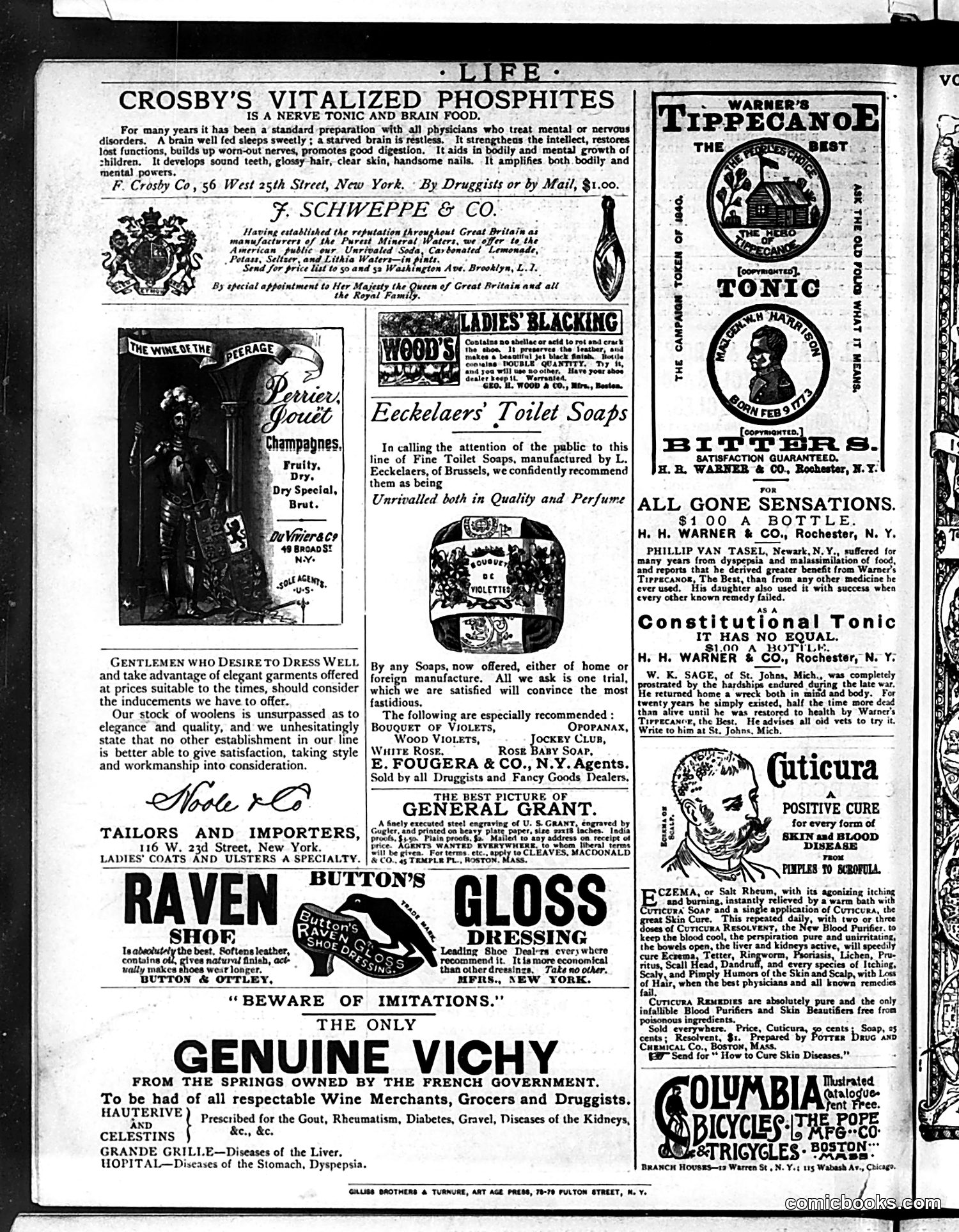
This is primarily a **advertisements page** from Life magazine, not a political cartoon. The page contains various patent medicine and consumer product ads typical of the late 19th century. Notable elements include: **Medical "Tonics"**: Crosby's Vitalized Phosphites, Warner's "All Gone Sensations" and "Constitutional Tonic," and Cuticura treatments promise to cure nervous disorders, dyspepsia, and skin diseases—standard snake-oil remedies of the era making extravagant health claims. **Shoe Products**: Raven Gloss shoe dressing and Button's Ottley products. **Luxury Goods**: Schweppe mineral waters, Vichy water (French springs), fine tailoring. **Cultural Reference**: An advertisement mentions "The Best Picture of General Grant," likely capitalizing on Grant's fame. The page reflects **Gilded Age consumer culture** and the largely unregulated patent medicine industry, where manufacturers made unsubstantiated medical claims directly to consumers. Modern readers would recognize this as exploitative marketing targeting vulnerable populations seeking cures.