
Life, 1885-06-11 · page 7 of 16
Life — June 11, 1885 — page 7: what you’re looking at
What you’re looking at
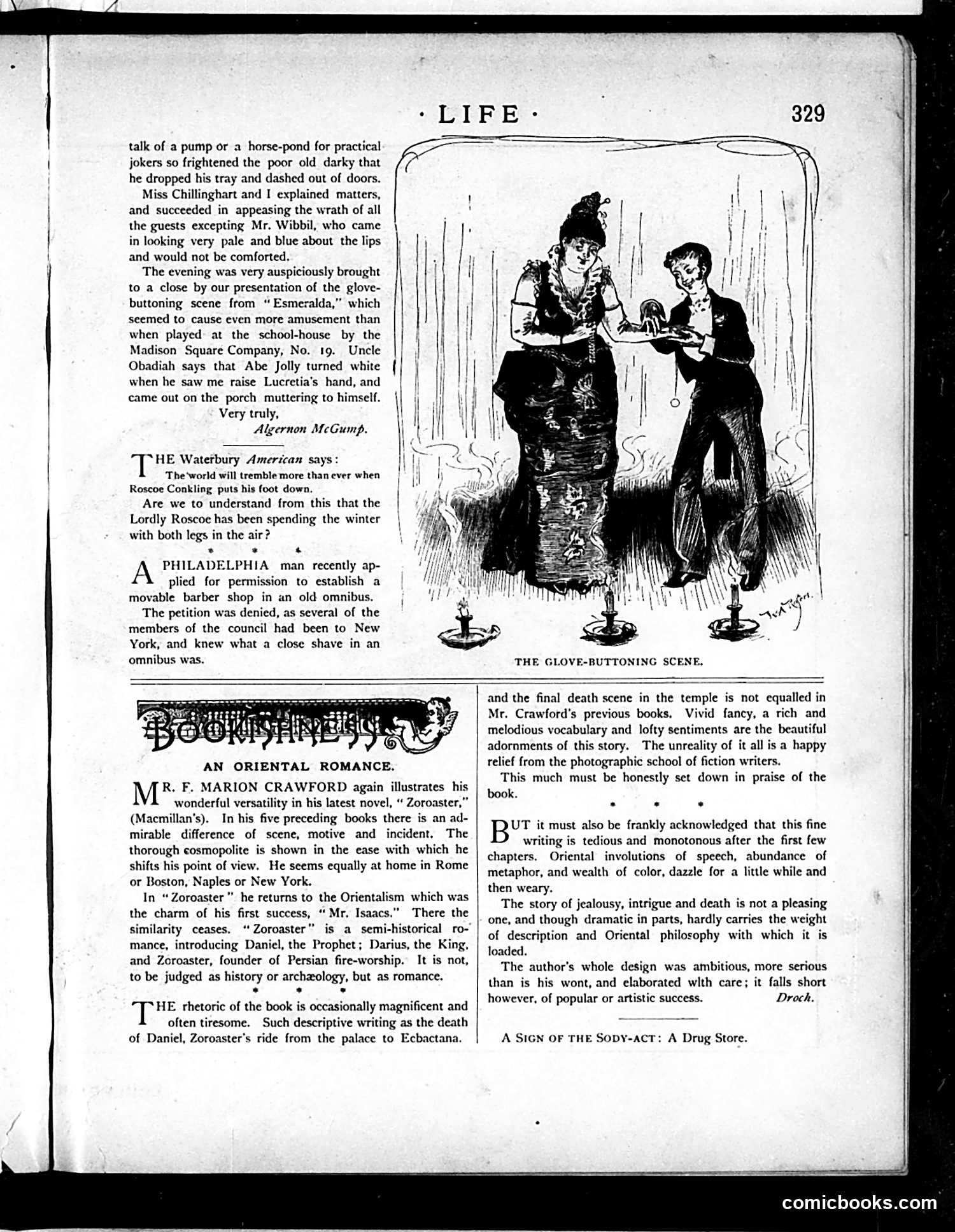
This illustration depicts a Victorian-era social scene with two figures engaged in the delicate task of buttoning gloves—likely a moment from a theatrical production or serialized story. The cartoon's humor appears to center on the elaborate formality and physical awkwardness of period dress and etiquette. The caption "THE GLOVE-BUTTONING SCENE" suggests this was a recognizable comedic moment, possibly from the theatrical production "Esmeralda" mentioned in the surrounding text. The exaggerated body language and careful positioning likely satirizes the rigid social conventions and physical constraints of Victorian fashion, particularly women's restrictive clothing and the formal codes governing polite interaction between men and women. The joke relies on contemporary readers' familiarity with these social rituals.
📄 Transcribed text from this page (OCR, searchable)
Machine-transcribed from the original scan — historical spelling and the odd misread are preserved.
talk of a pump or a horse-pond for practical jokers so frightened the poor old darky that he dropped his tray and dashed out of doors. Miss Chillinghart and I explained matters, and succeeded in appeasing the wrath of all the guests excepting Mr. Wibbil, who came in looking very pale and blue about the lips and would not be comforted. The evening was very auspiciously brought to a close by our presentation of the glove- buttoning scene from “Esmeralda,” which seemed to cause even more amusement than when played at the school-house by the Madison Square Company, No. 19. Uncle Obadiah says that Abe Jolly turned white when he saw me raise Lucretia’s hand, and came out on the porch muttering to himself. Very truly, | Algernon McGump. | g Rees Waterbury American says: | The‘world will tremble more than ever when Roscoe Conkling puts his foot down, Are we to understand from this that the Lordly Roscoe has been spending the winter with both legs in the air? . . ‘ PHILADELPHIA man recently ap- plied for permission to establish a movable barber shop in an old omnibus. The petition was denied, as several of the members of the council had been to New York, and knew what a close shave in an omnibus was. THE GLOVE-BUTTONING SCENE. AN ORIENTAL ROMANCE. wonderful versatility in his latest novel, “ Zoroaster,” (Macmillan’s). In his five preceding books there is an ad- mirable difference of scene, motive and_ incident. thorough cosmopolite is shown in the ease with which he shifts his point of view. He seems equally at home in Rome or Boston, Naples or New York. In “Zoroaster” he returns to the Orientalism which was the charm of his first success, “ Mr. Isaacs.” similarity ceases. ‘ Zoroaster" is a semi-historical ro- mance, introducing Daniel, the Prophet; Darius, the King, and Zoroaster, founder of Persian fire-worship. It is not, to be judged as history or archxology, but as romance. . . ° HE rhetoric of the book is occasionally magnificent and often tiresome. Such descriptive writing as the death of Daniel, Zoroaster's ride from the palace to Ecbactana. R. F. MARION CRAWFORD again illustrates his | The | There the | | of description and Oriental philosophy with which it is and the final death scene in the temple is not equalled in Mr. Crawford's previous books, Vivid fancy, a rich and melodious vocabulary and lofty sentiments are the beautiful adornments of this story. The unreality of it all is a happy relief from the photographic school of fiction writers. This much must be honestly set down in praise of the book. UT it must also be frankly acknowledged that this fine writing is tedious and monotonous after the first few chapters. Oriental involutions of speech, abundance of metaphor, and wealth of color, dazzle for a little while and then weary. The story of jealousy, intrigue and death is not a pleasing one, and though dramatic in parts, hardly carries the weight loaded. The author’s whole design was ambitious, more serious than is his wont, and elaborated wlth care; it falls short however, of popular or artistic success. Droch. A SIGN OF THE SoDy-acT: A Drug Store. comicbooks.com