
A complete issue · 16 pages · 1885
Life — April 16, 1885
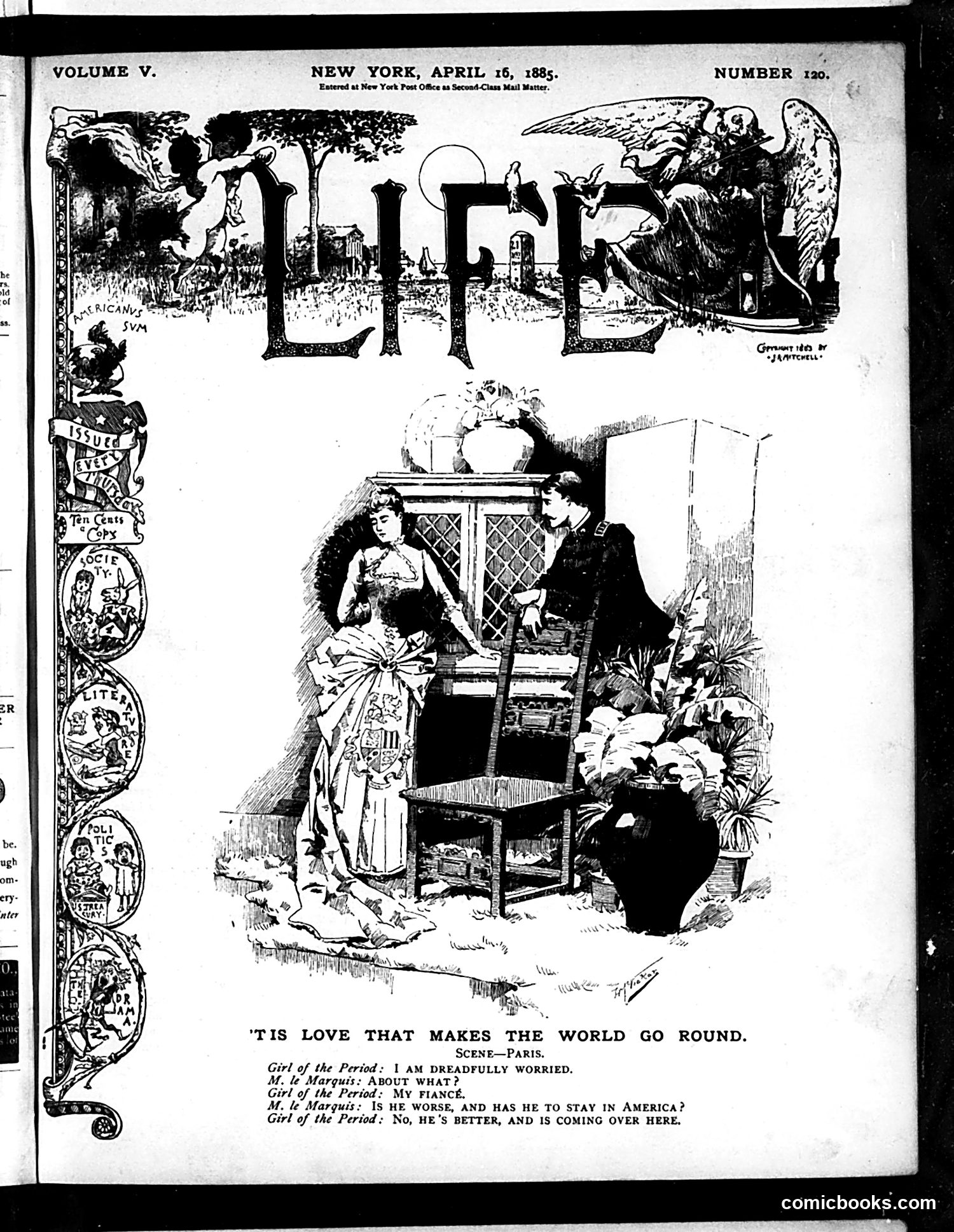
This page features a romantic illustration titled "'Tis Love That Makes the World Go Round," depicting a scene set in Paris. The dialogue shows a "Girl of the Period" expressing worry to M. le Marquis about her fiancé, who is apparently staying in America but will be coming to France. The cartoon satirizes the social anxieties of upper-class courtship in the 1880s, particularly regarding transatlantic romance and marriage prospects. The "Girl of the Period" was a common satirical figure in Victorian periodicals, typically representing modern young women with contemporary concerns. The elaborate decorative border on the left suggests this was a featured piece in the magazine, emphasizing the romantic/comedic subject matter typical of Life's humor at that time.
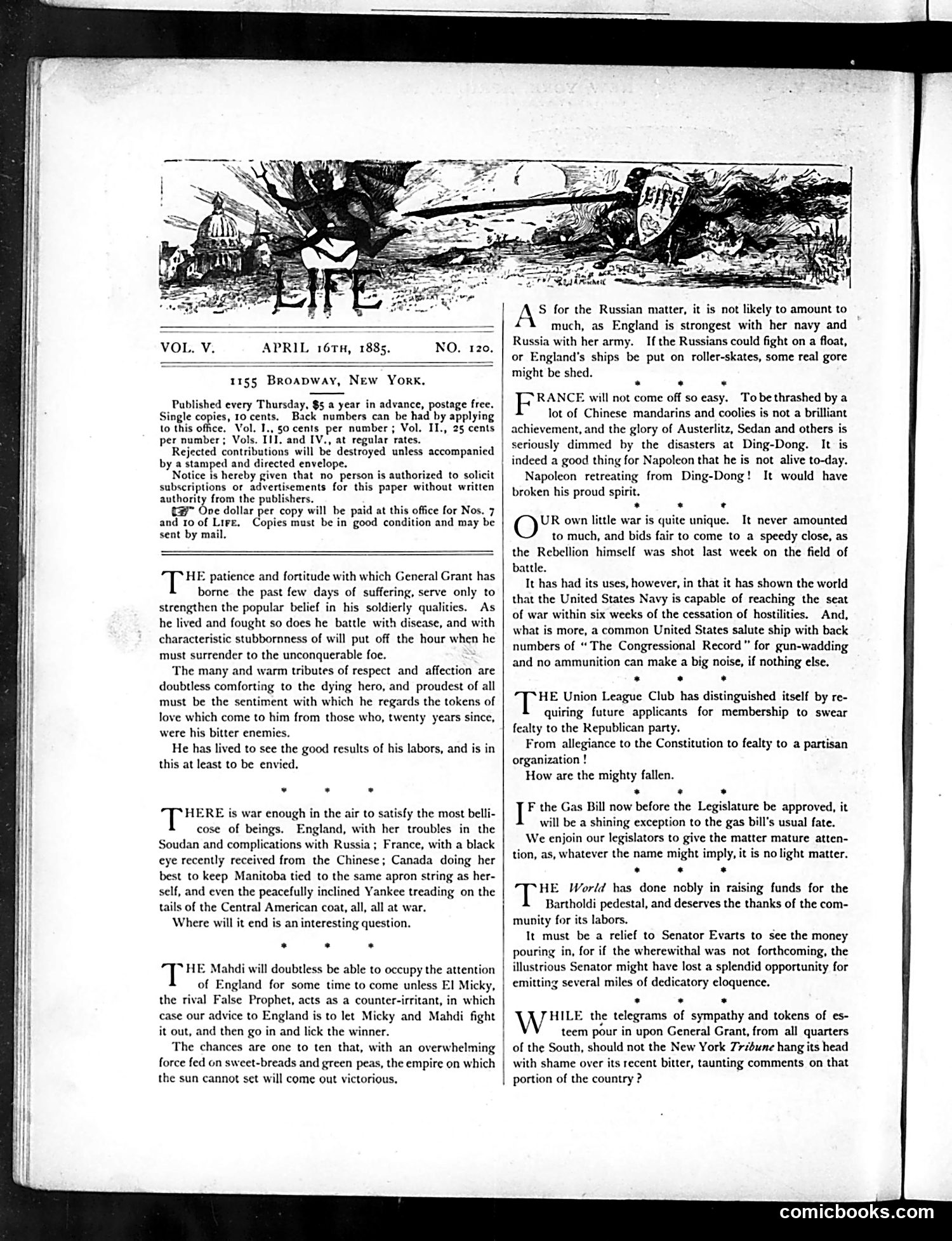
The masthead cartoon shows a figure labeled "LIFE" - the magazine's personification - depicted as a skeletal or death-like character among ruins and destruction. The editorial content discusses contemporary political and military events: General Grant's recent suffering (likely his illness), ongoing tensions between England and Russia over colonial matters, the Mahdi rebellion in Sudan, and American naval capabilities demonstrated during the recent Rebellion. A notable item criticizes the Union League Club for requiring new members to pledge loyalty to the Republican party rather than the Constitution—satirizing partisan excess disguised as patriotism. The magazine also mocks the *New York Tribune* for shameful commentary regarding the American South, and praises Senator Evarts for fundraising efforts for the Bartholdi pedestal (the Statue of Liberty's base).
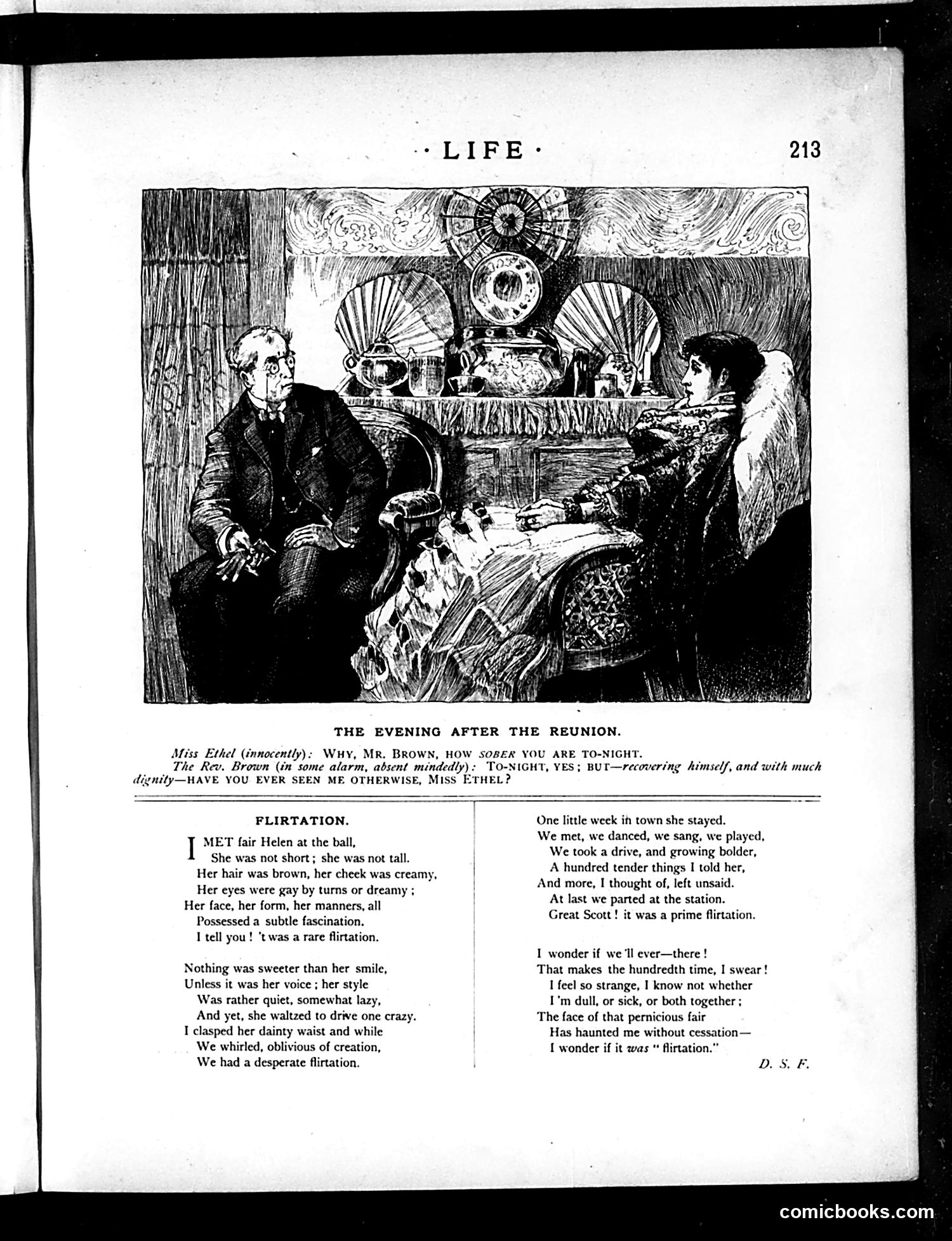
**The Cartoon:** "The Evening After the Reunion" depicts a domestic scene with a man and woman in conversation. The caption indicates a comedic dialogue where the man (appearing disheveled) claims he hasn't been seen "otherwise" by Miss Ethel, while the woman questions his whereabouts with obvious skepticism. **The Satire:** This appears to be social satire about post-reunion behavior and marital suspicion. The humor relies on the contrast between the man's weak denial and the woman's knowing skepticism—a classic domestic comedy trope about infidelity or flirtation. **The Poem Below:** "Flirtation" narrates a brief romantic encounter at a ball, exploring ambiguity about whether the interaction constituted genuine flirtation or something more meaningful. The page satirizes early 20th-century courtship conventions and marriage anxieties through both visual and literary means.
This page contains several brief satirical commentary pieces rather than a single cartoon. The decorative header shows a parade of animals in silhouette. Key items include: 1. **Gas meter suicide**: Dark humor about a depressed gas meter that "exploded premeditated" from conscience over serving the company poorly. 2. **"Onion Club" name change**: Satirizes a club's complaint about being associated with onions, suggesting renaming to the "Onion Club" anyway—mocking pretentious social organizations. 3. **Church choir satire**: An extended piece mocking the self-importance and dramatic behavior of church choir members, depicting them as vain performers rather than humble musicians. The text reflects typical early 20th-century American satirical humor: poking fun at social pretension, organizational absurdity, and human vanity through brief, witty commentary rather than visual cartoons.
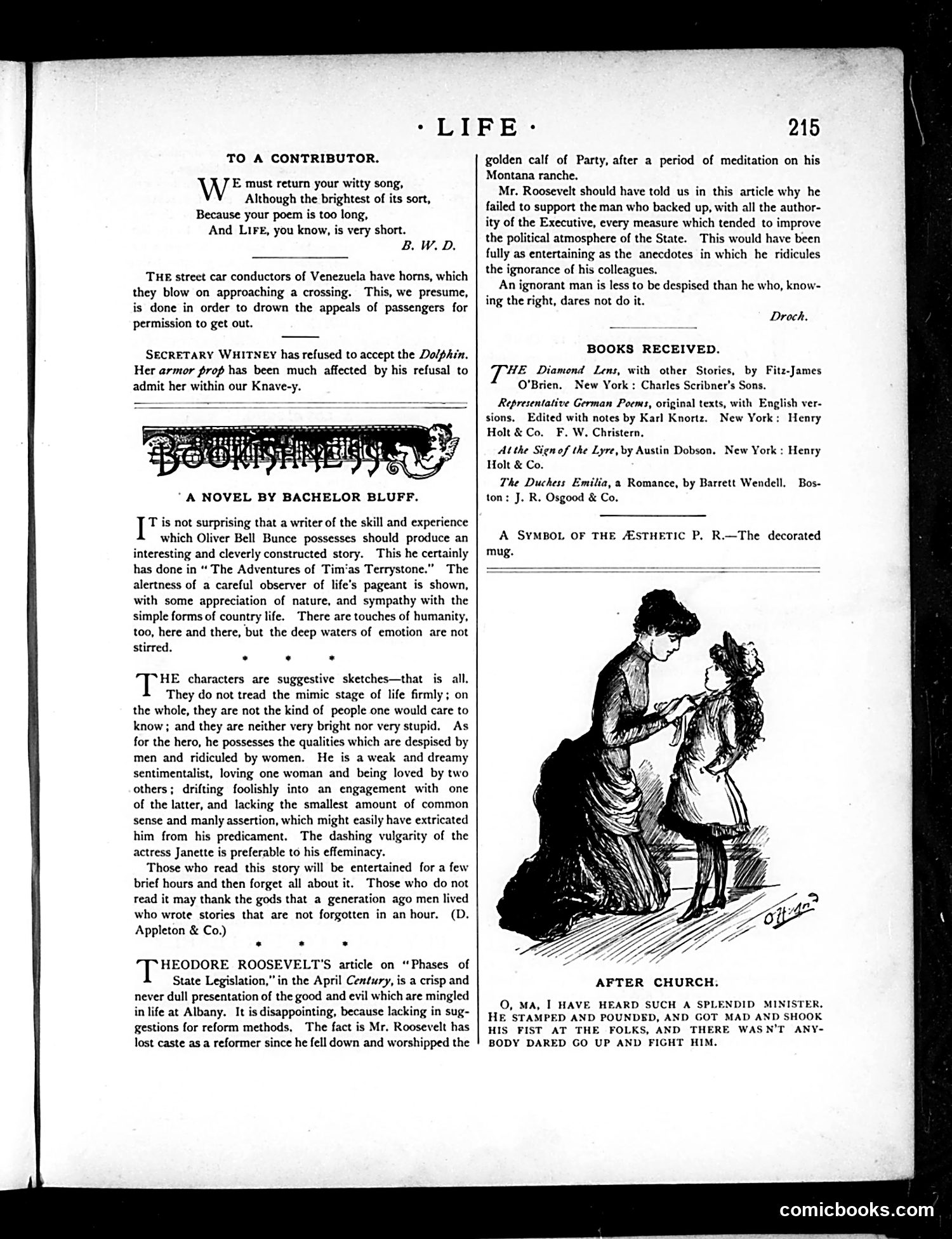
This page contains literary reviews and social commentary rather than political cartoons. The main content includes: **"To a Contributor"** — a short satirical poem rejecting a submitted work, suggesting the piece is too long and of poor quality. **Book reviews** discussing works by Fitz-James O'Brien and others. **"After Church"** — A caption-cartoon (bottom right) depicting a splendid minister who "stamped and pounded" while preaching, yet no parishioner dared challenge him physically. This satirizes both ministerial pomposity and congregational meekness during this era, suggesting clergy could behave aggressively toward their flocks with impunity. The page primarily mocks literary mediocrity and religious hypocrisy through written commentary rather than visual satire.
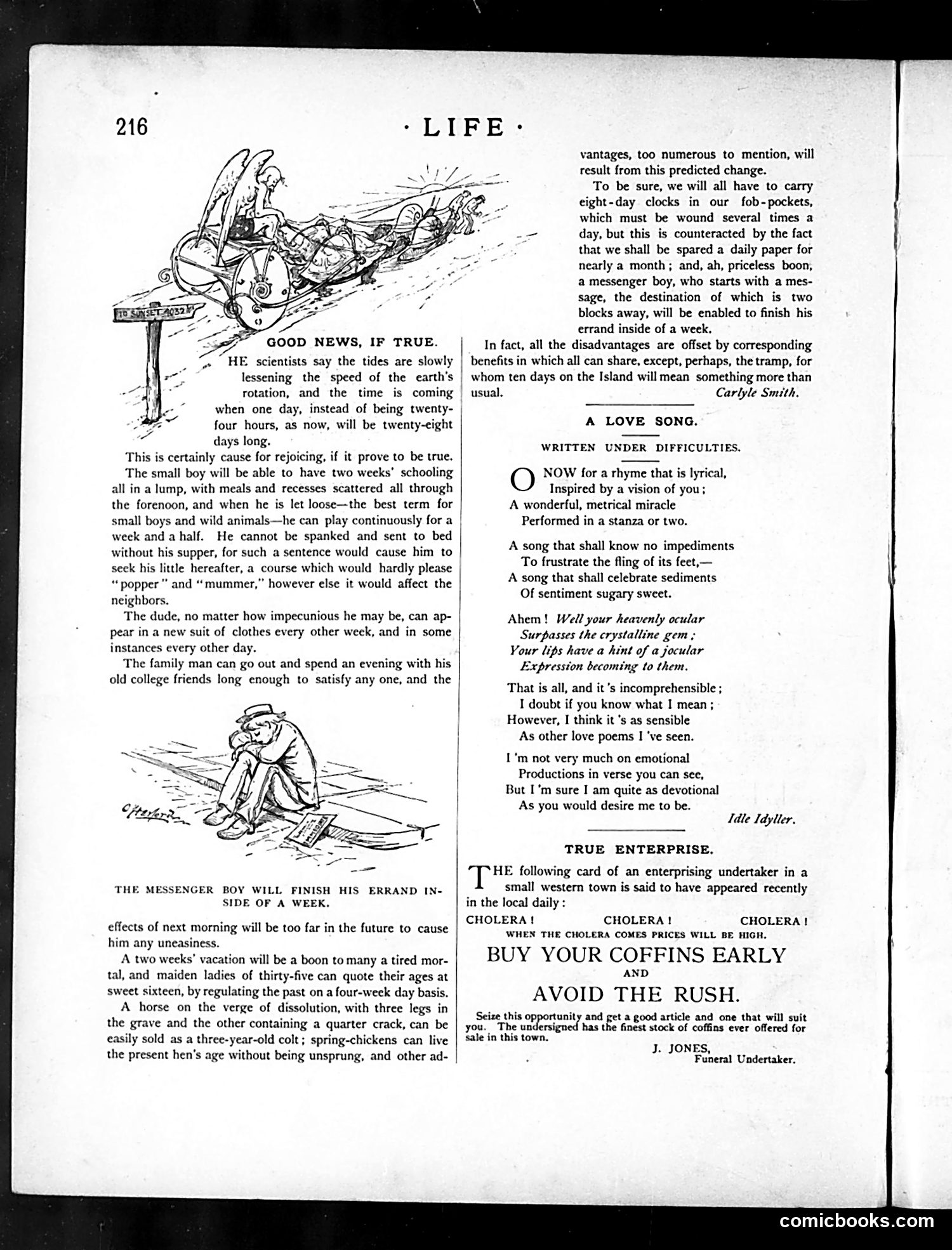
**Main Cartoon ("Good News, If True"):** The top illustration depicts a futuristic flying machine or early aircraft. The accompanying text references scientists' claims that Earth's rotation is slowing, meaning a day will eventually last 28 hours instead of 24. The satire mocks this prediction's impracticality: while a longer day sounds beneficial (more schooling, leisure time for families), the text humorously catalogs absurd consequences—boys playing continuously without rest, families unable to manage the extra hours, and exhausted messenger boys completing errands in a week instead. **Lower Content:** Includes an unrelated love poem ("A Love Song") and a darkly comedic funeral undertaker's advertisement exploiting a cholera outbreak, offering coffins at low prices "before the rush." The page exemplifies Life's characteristic blend of scientific satire and gallows humor.
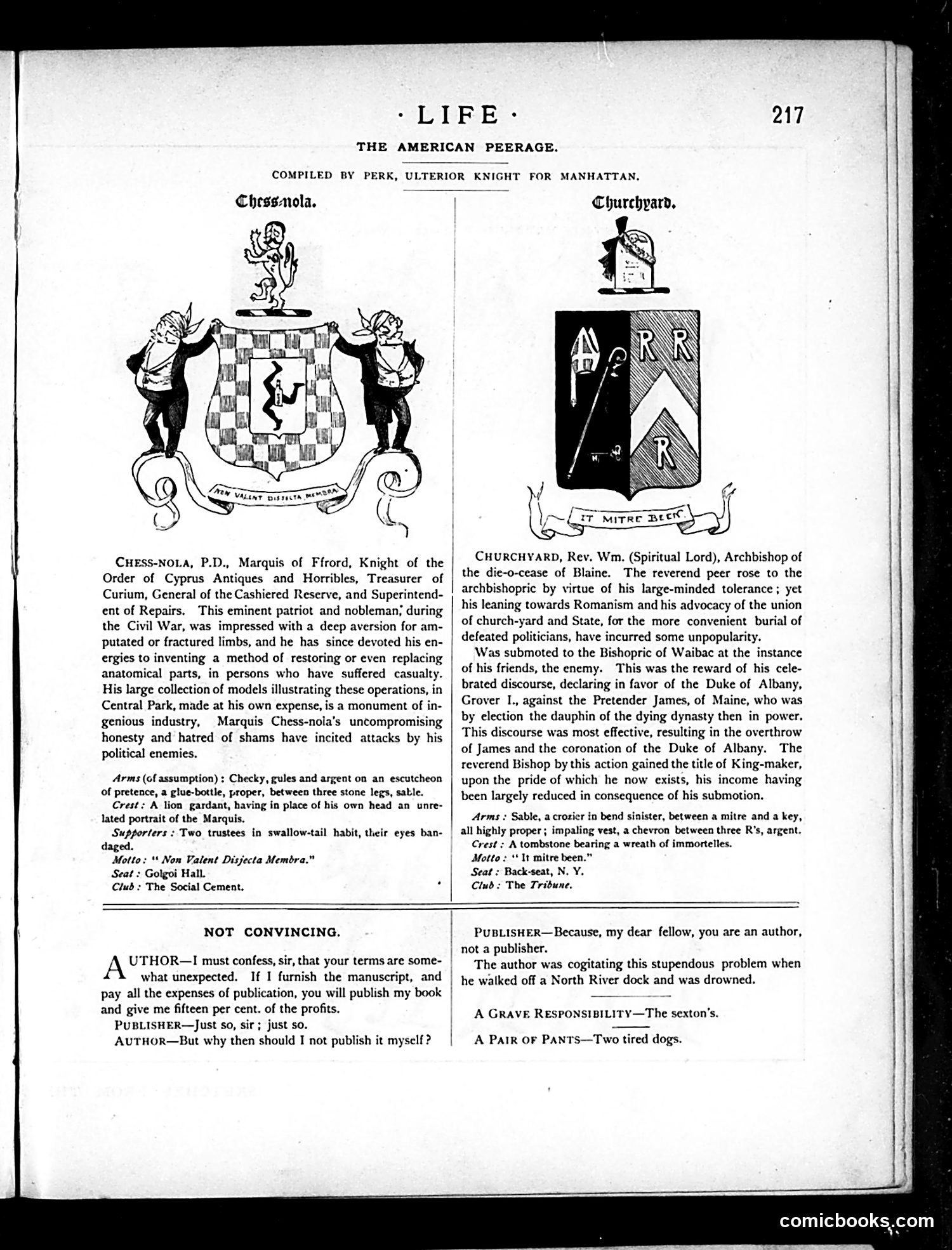
This page from *Life* magazine presents two heraldic coat-of-arms designs mocking American "aristocracy"—a satirical critique of wealth and pretension in America. **Chess-nola** (left): A Marquis of Fiford is described as devoted to anatomical restoration of amputees. The heraldry mockingly depicts him as a gentleman-scientist with dubious credentials, his shield featuring checkerboard patterns. **Churchyard** (right): An Archbishop figure, described as spiritually tolerant yet politically compromised regarding burials of defeated politicians, suggesting religious hypocrisy about state power. Both entries ridicule how wealthy Americans adopted European aristocratic titles and pretensions while their actual accomplishments or moral positions were questionable. The format parodies *genuine* heraldry to expose American social climbing as absurd.
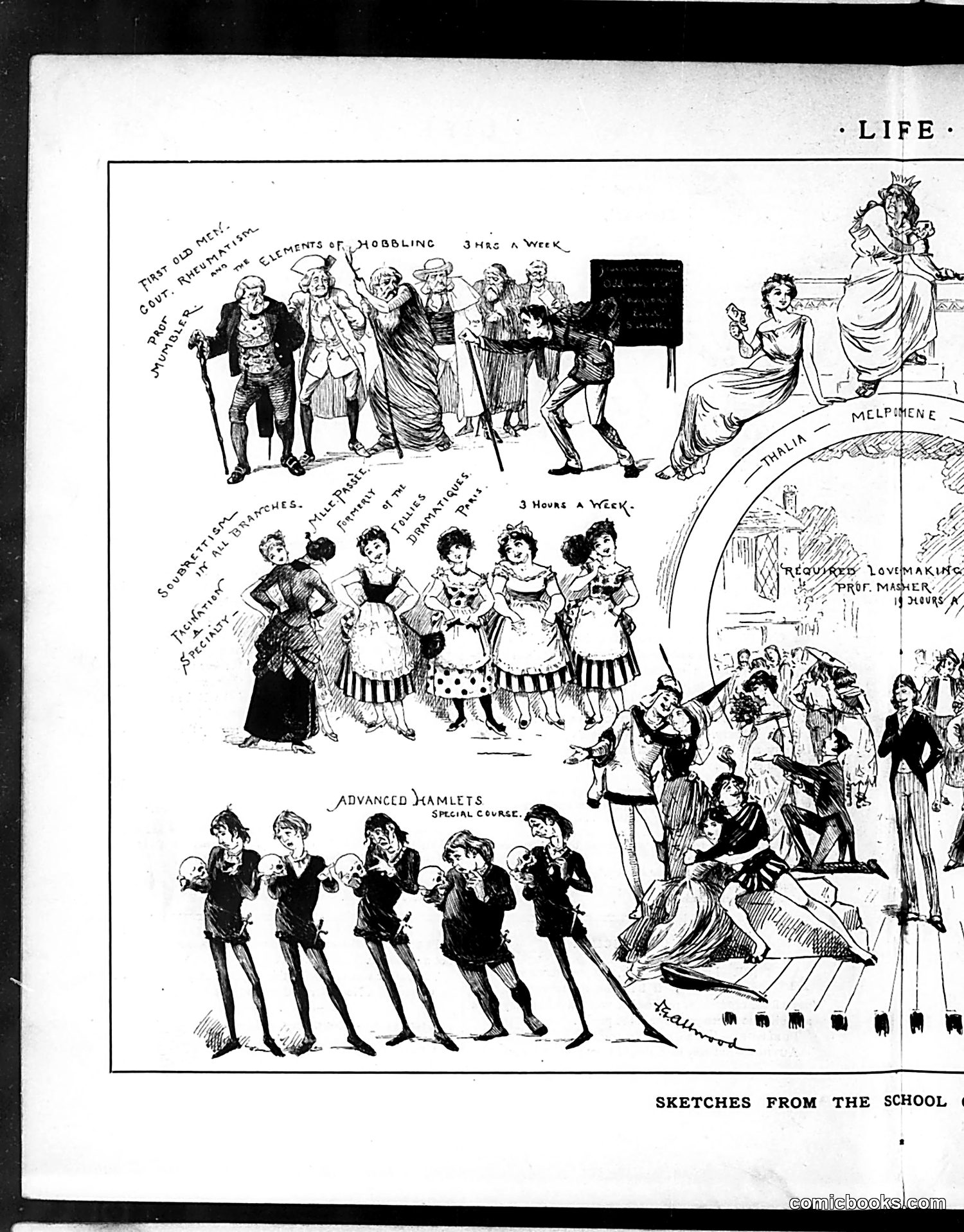
This page satirizes a theatrical or educational institution through exaggerated character sketches. The top section shows "Elements of Hobbling" and "3 Hrs a Week" instruction, depicting various elderly and middle-aged figures in awkward poses. Below, "Southern Patches" shows women in servants' or housemaids' uniforms. The bottom panel, labeled "Advanced Hamlets," depicts thin, gaunt male figures in theatrical poses, suggesting mockery of dramatic training or Shakespearean instruction. The overall satire appears to ridicule either drama school instruction or some form of physical training program as ineffective or absurd. The exaggerated, skeletal figures and awkward postures suggest the instruction produces comical rather than competent results. Without the full title visible, the exact institution being mocked is unclear.
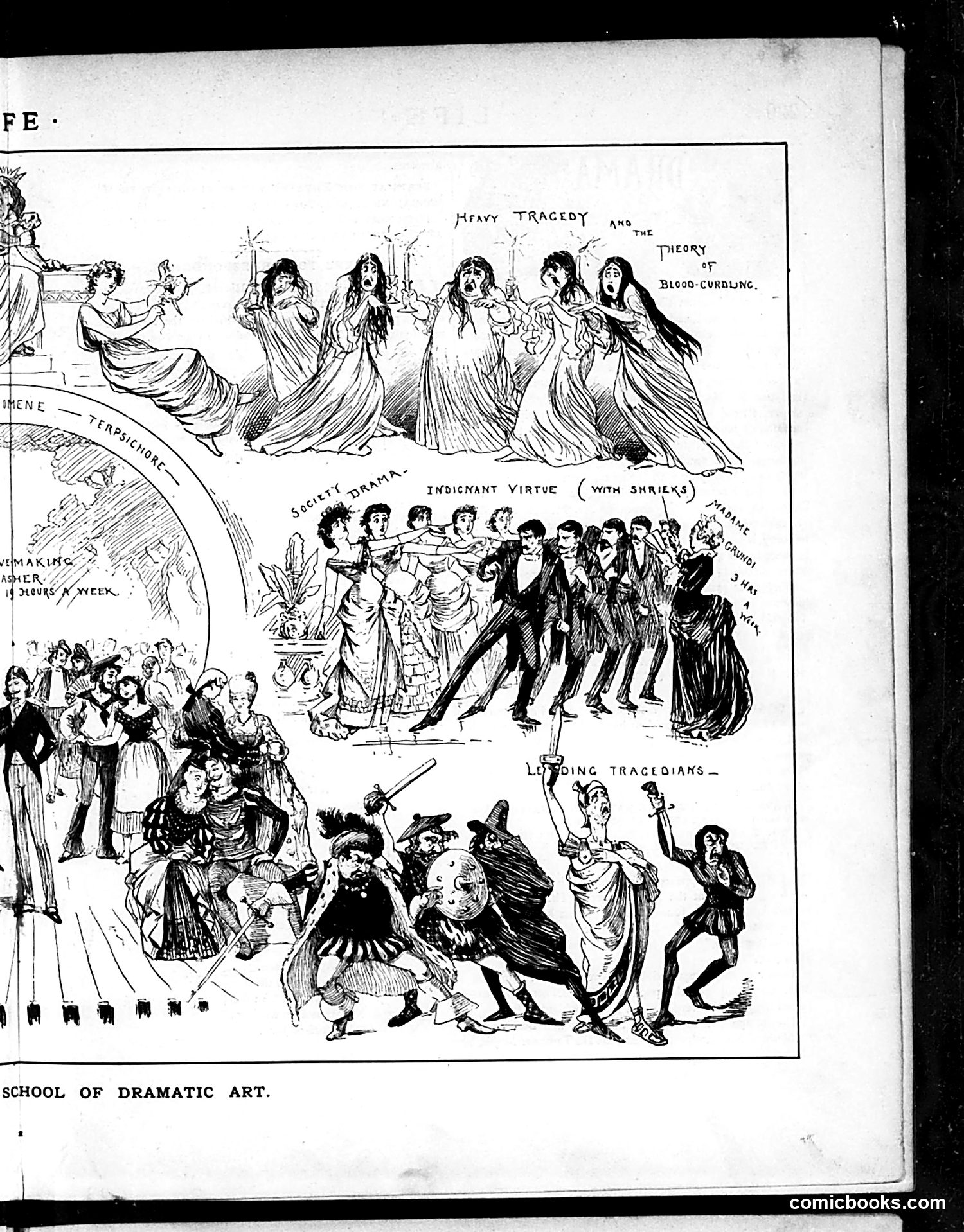
This page satirizes Victorian-era theatrical conventions and melodramatic performance styles. The three labeled sections mock different dramatic genres: 1. **"Heavy Tragedy and the Theory of Blood-Curdling"** (top): Women in classical robes strike exaggerated, anguished poses with torches, parodying overwrought tragic performances. 2. **"Society Drama: Indignant Virtue (with Shrieks)"** (middle): Well-dressed men and women in drawing-room poses, satirizing contrived upper-class theatrical scenarios. 3. **"Ludicrous Tragedians"** (bottom): Comic villains and comedic figures in absurd physical poses, mocking hammy, over-the-top performance styles. The cartoon critiques the theatrical establishment's reliance on exaggerated gesture, artificial emotion, and predictable stock characters rather than naturalistic acting. It suggests contemporary theater had become ridiculous through excessive melodrama and formulaic performances.
This page from *Life* magazine satirizes theater ticket scalping, a practice already common in the late 19th century. The repeated phrase "SEATS AT THIS THEATRE MAY BE PURCHASED FROM OBNOXIOUS SPECULATORS AT $2 EACH" (contrasted with regular box office prices of $1.50) mockingly highlights how scalpers profited by reselling tickets at inflated prices. The satire targets the gap between what theaters publicly offered and what audiences actually paid. By calling speculators "obnoxious" while reporting their practices matter-of-factly alongside legitimate theater reviews, *Life* exposes the parasitic middlemen exploiting popular demand for seats—a complaint as old as theater itself. The rest of the page reviews new theatrical productions and answers reader correspondence, but the ticket markup criticism is the satirical barb here.
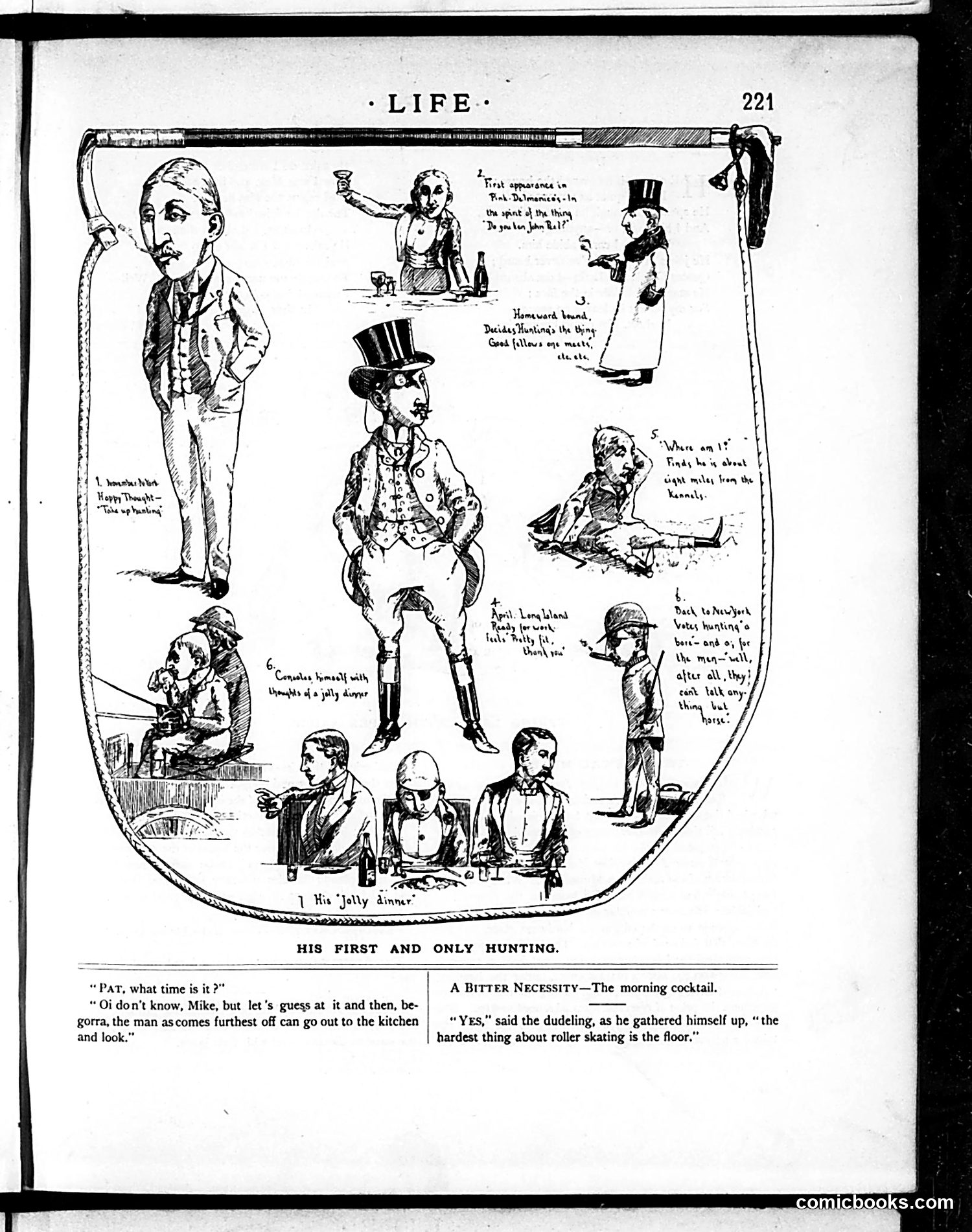
This page satirizes a wealthy, incompetent man's attempt at hunting. The large central figure is an upper-class gentleman with an exaggerated nose, positioned as if holding a rifle. The sequential vignettes around him mock his bumbling: He arrives fashionably dressed but clueless ("Oi don't know, Mike"); becomes increasingly disheveled; ends up lost and exhausted ("Where am I?"); and finally returns home defeated, deciding hunting isn't for him. The satire targets **upper-class pretension**—wealthy men who dabble in "sporting" activities without genuine competence or commitment. The title's emphasis on "first and **only**" hunting underscores the joke: this gentleman will never try again. Two unrelated humor bits appear below: one mocking Irish laborers' timekeeping, another joking about roller-skating injuries and the "morning cocktail" as necessary recovery. The artwork style and *Life* magazine context (Gilded Age satirical publication) suggest this ridicules wealthy dilettantes playing at rural pursuits.
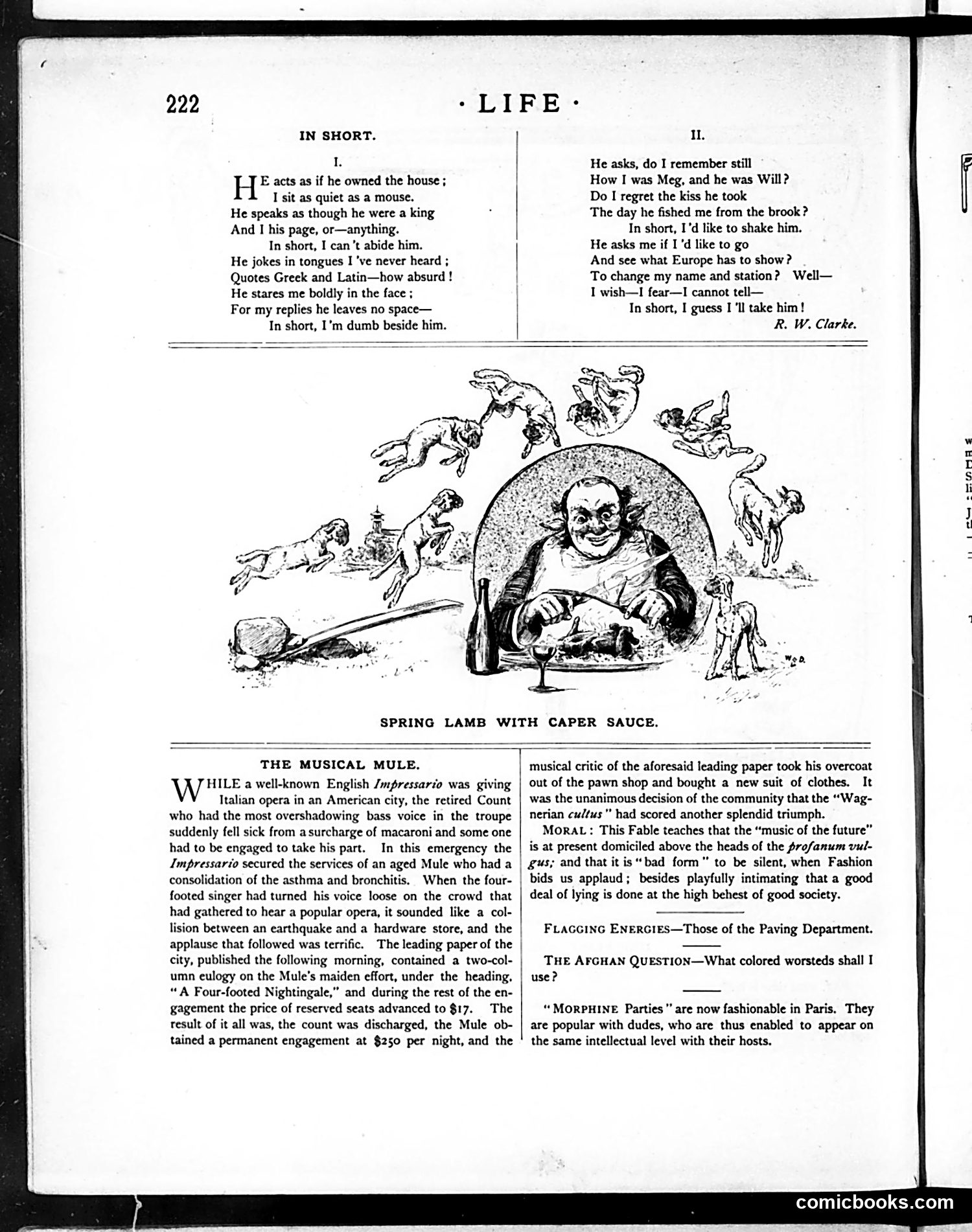
This page contains two satirical pieces and humorous shorts targeting 1890s American society. **"In Short"** (poem by R.W. Clarke): A comedic dialogue about courtship, likely referencing Shakespeare's *The Taming of the Shrew* ("Meg" and "Will" allude to characters). Part I shows a woman's frustration with an arrogant, domineering suitor. Part II reveals her conflicted acceptance despite reservations—satire on women's limited marriage options and resignation to social expectations. **"Spring Lamb with Caper Sauce"** (illustration): A grotesque caricature of a rotund man dining, surrounded by frolicking cherubs/putti. The exaggerated features and self-satisfied expression mock either wealthy gluttony or possibly a specific public figure (unclear from image alone). **"The Musical Mule"**: Satirizes both operatic snobbery and fraudulent artistic criticism. When a mule substitutes for an absent opera singer and produces terrible sounds, critics praise it as "Wagner" and the public applauds—mocking how fashion, not merit, drives cultural acceptance. The moral: people follow social convention over honest judgment.
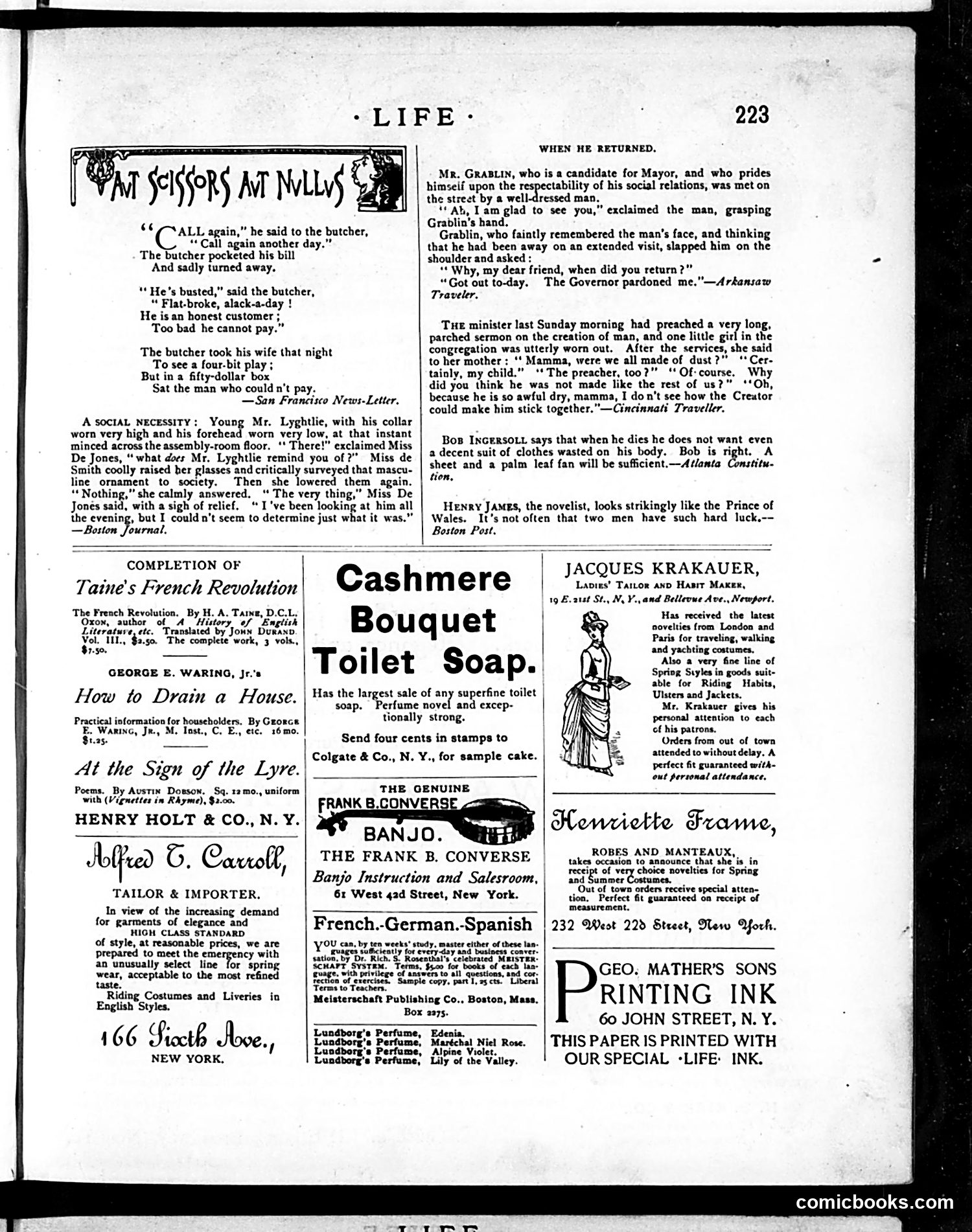
This page contains **four satirical anecdotes** typical of Life magazine's humor: 1. **"Scissors at Mully's"**: A butcher extends credit to an "honest customer" who can't pay, then sees that same man at an expensive theater in a premium box seat. The satire mocks hypocrisy and false poverty claims. 2. **"A Social Necessity"**: Two women at a social gathering discuss Mr. Lyghtlie's appearance—his collar worn high, forehead worn low (suggesting pretension or poor grooming). One can't identify what he resembles; the other says "the very thing," implying he resembles *nothing* of value. Social mockery of affected behavior. 3. **The Grablin anecdote**: A mayoral candidate is embarrassed when greeting a well-dressed man who reveals he was just released from prison after a gubernatorial pardon—satirizing the candidate's awkward social predicament and perhaps commenting on political patronage. 4. **The child and preacher**: A girl, after a long dry sermon, suggests the preacher must not be made of dust like humans—he's too dry to hold together. Satire of boring preachers. The page is primarily **humorous commentary on social pretense and hypocrisy**.
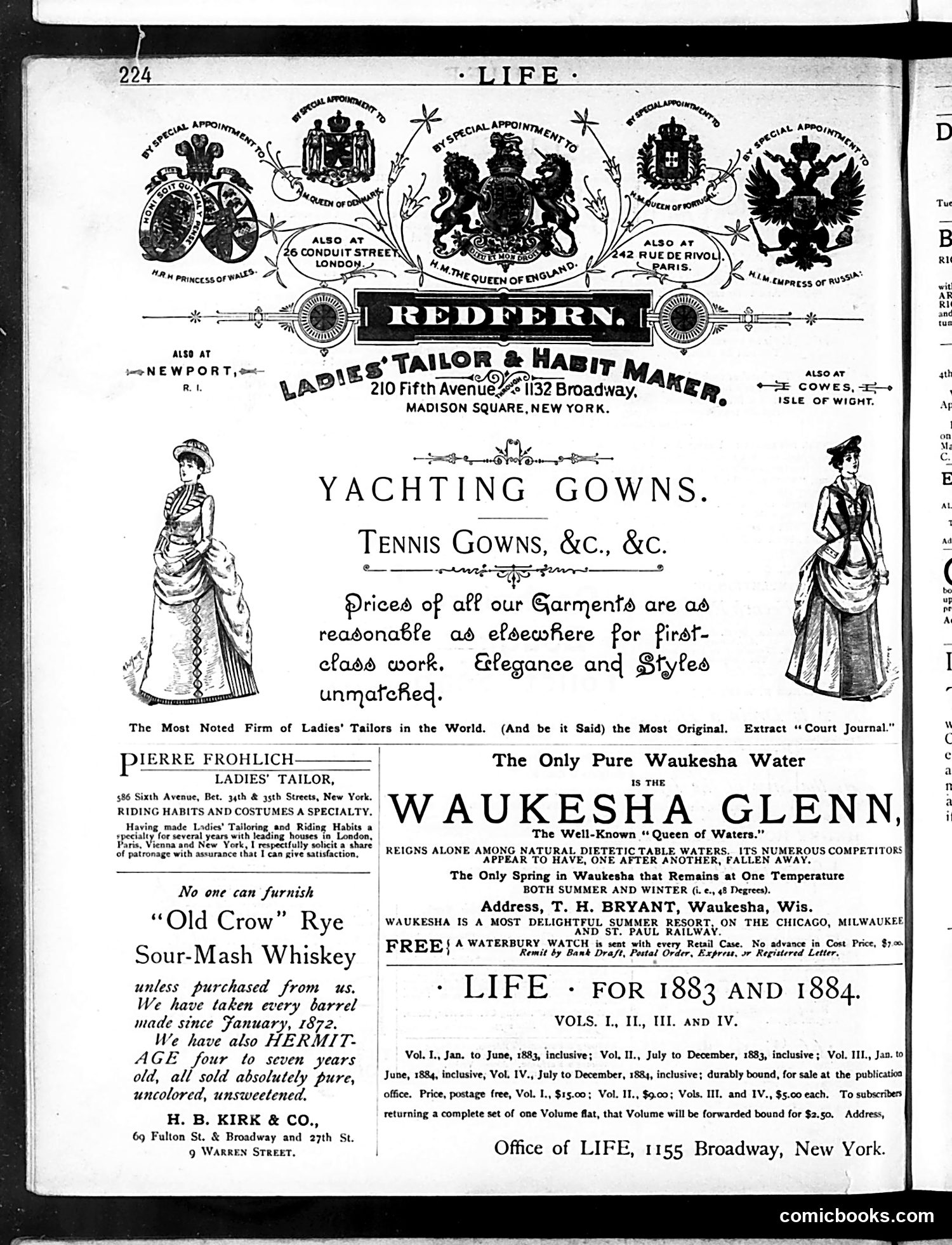
This page is primarily **advertisements**, not political cartoons. The decorative header shows royal coats of arms from Britain and Russia, establishing prestige for the featured advertiser: **Redfern**, a ladies' tailor with locations in London, Paris, Newport, and New York. Below are ads for: - **Yachting and tennis gowns** by Redfern and Pierre Fröhlich (tailors) - **Waukesha Glenn water**, promoted as "the Only Pure Waukesha Water" and the "Queen of Waters"—competing mineral water brands apparently made false claims - **"Old Crow" whiskey** by H.B. Kirk & Co., emphasizing purity and age - A subscription offer for bound volumes of *Life* magazine itself (1883-1884) The page reflects Gilded Age consumer culture: expensive imported fashion, health-conscious mineral water consumption, and premium spirits marketed to wealthy readers.
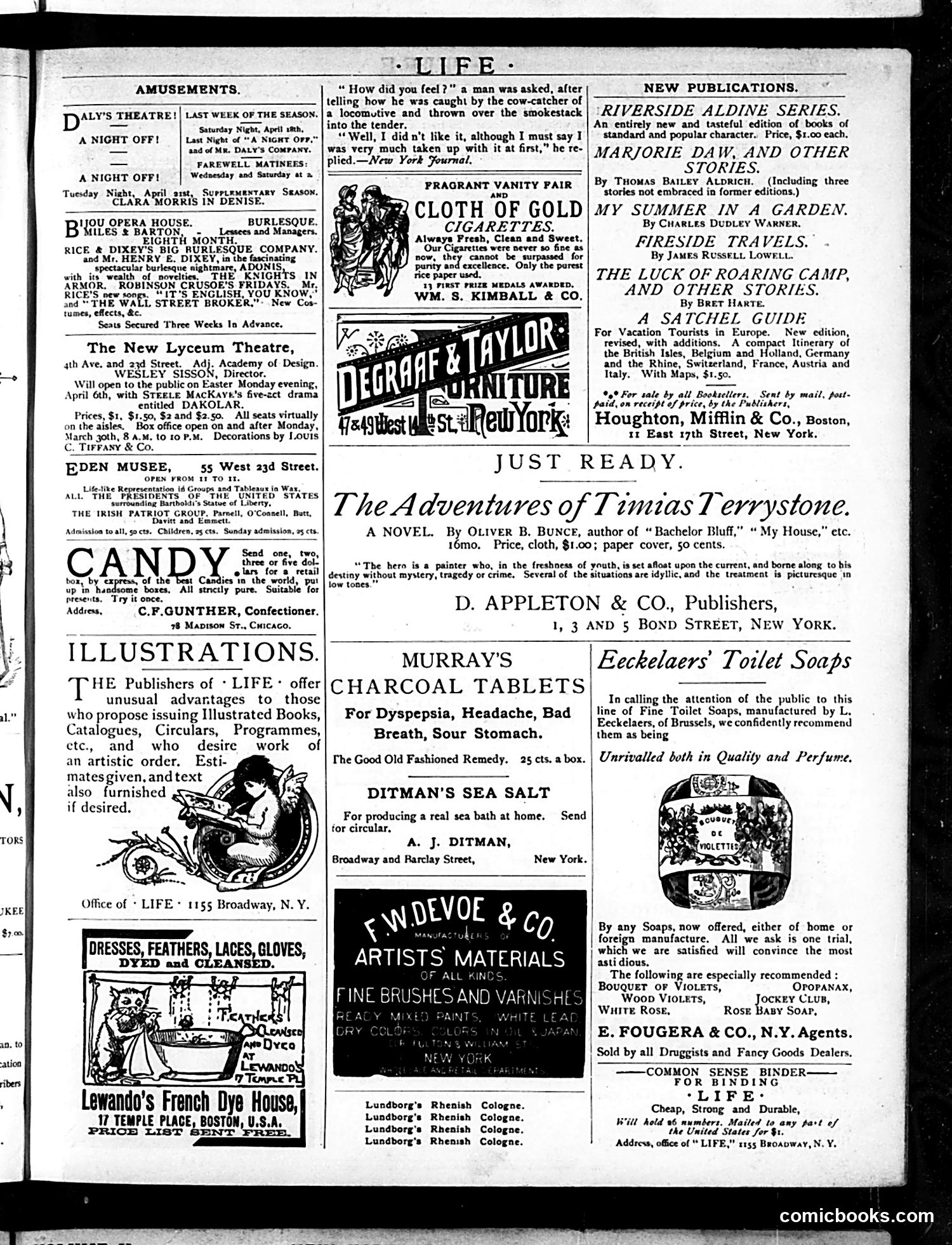
This page is primarily **advertisements and notices**, not political cartoons or satire requiring historical context. The content consists of: **Theater announcements** for New York venues (Daly's Theatre, Opera House, Eden Musee, Lyceum Theatre) advertising final performances and upcoming shows. **Product advertisements** for commercial goods: cigarettes ("Cloth of Gold"), candy, dyes, furniture, toiletries, and artist materials. **Book advertisements** announcing new publications from major publishers like Houghton Mifflin and D. Appleton & Co., featuring works by contemporary American authors (Bret Harte, James Russell Lowell, Thomas Bailey Aldrich). **A brief joke** at the top about a man caught by a locomotive's cow-catcher, which is simply humorous anecdote. There are no political cartoons, caricatures, or satirical commentary visible on this page. It represents typical late-19th-century *Life* magazine advertising content.
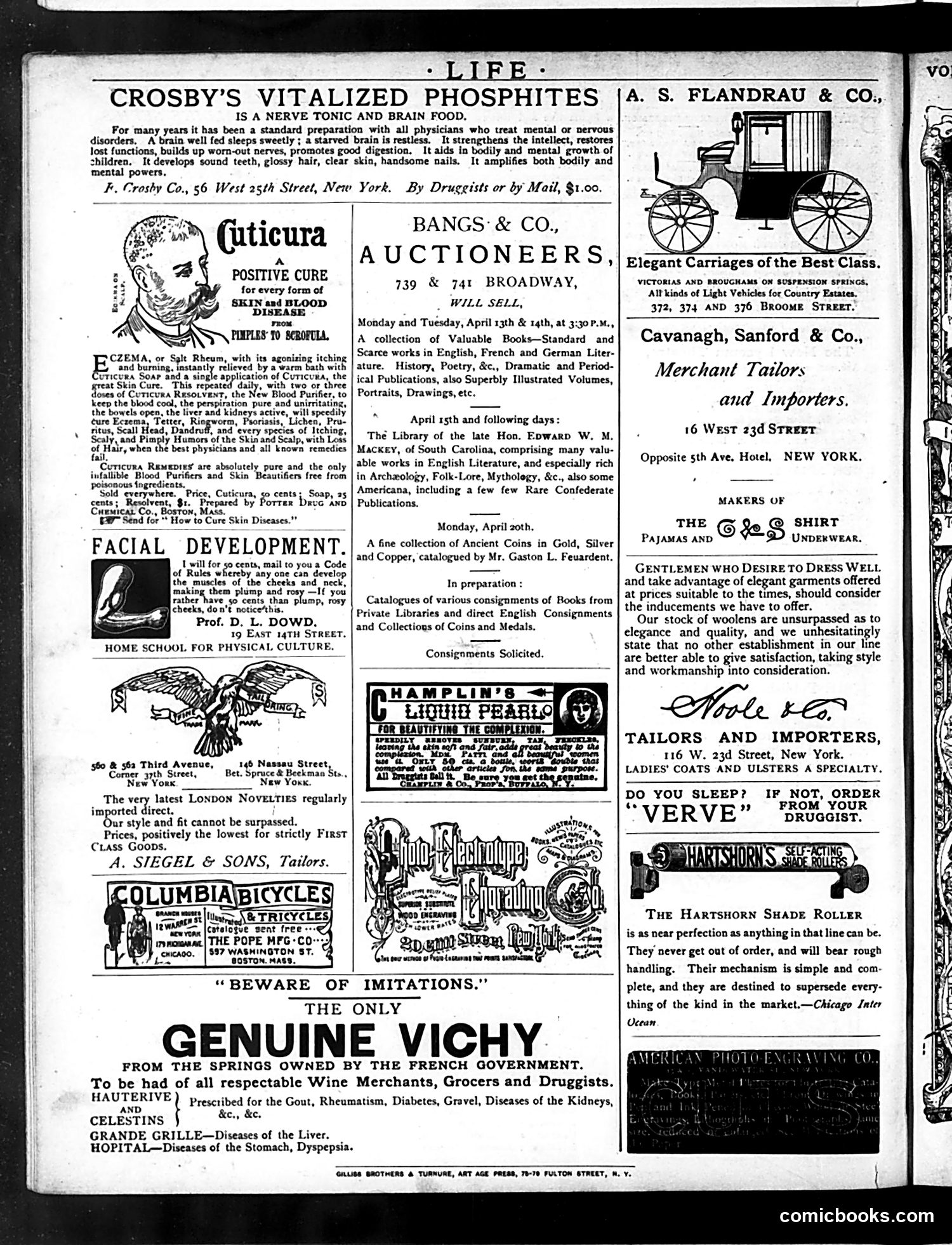
This is primarily an **advertising page** with no political cartoons or satirical content—it's a collection of late 19th-century patent medicines and commercial services. The ads reveal period attitudes about health and appearance: - **Crosby's Phosphites** and **Cuticura** promise to cure nerve disorders, skin diseases, and hair loss—reflecting contemporary anxieties about urban stress and physical appearance. - **Prof. D.L. Dowd's "Facial Development"** offers to enlarge cheeks and neck via mail for 50 cents, targeting insecurity about facial features. - **Vichy water** (from French springs) is marketed as a cure-all for gout, rheumatism, diabetes, and kidney disease—typical of the era's faith in mineral water remedies. - **Genuine Vichy** includes a warning: "BEWARE OF IMITATIONS," suggesting widespread counterfeiting of popular products. The page exemplifies how turn-of-the-century Americans sought quick commercial solutions to health and vanity concerns, often based on dubious science.