
Life, 1885-04-16 · page 5 of 16
Life — April 16, 1885 — page 5: what you’re looking at
What you’re looking at
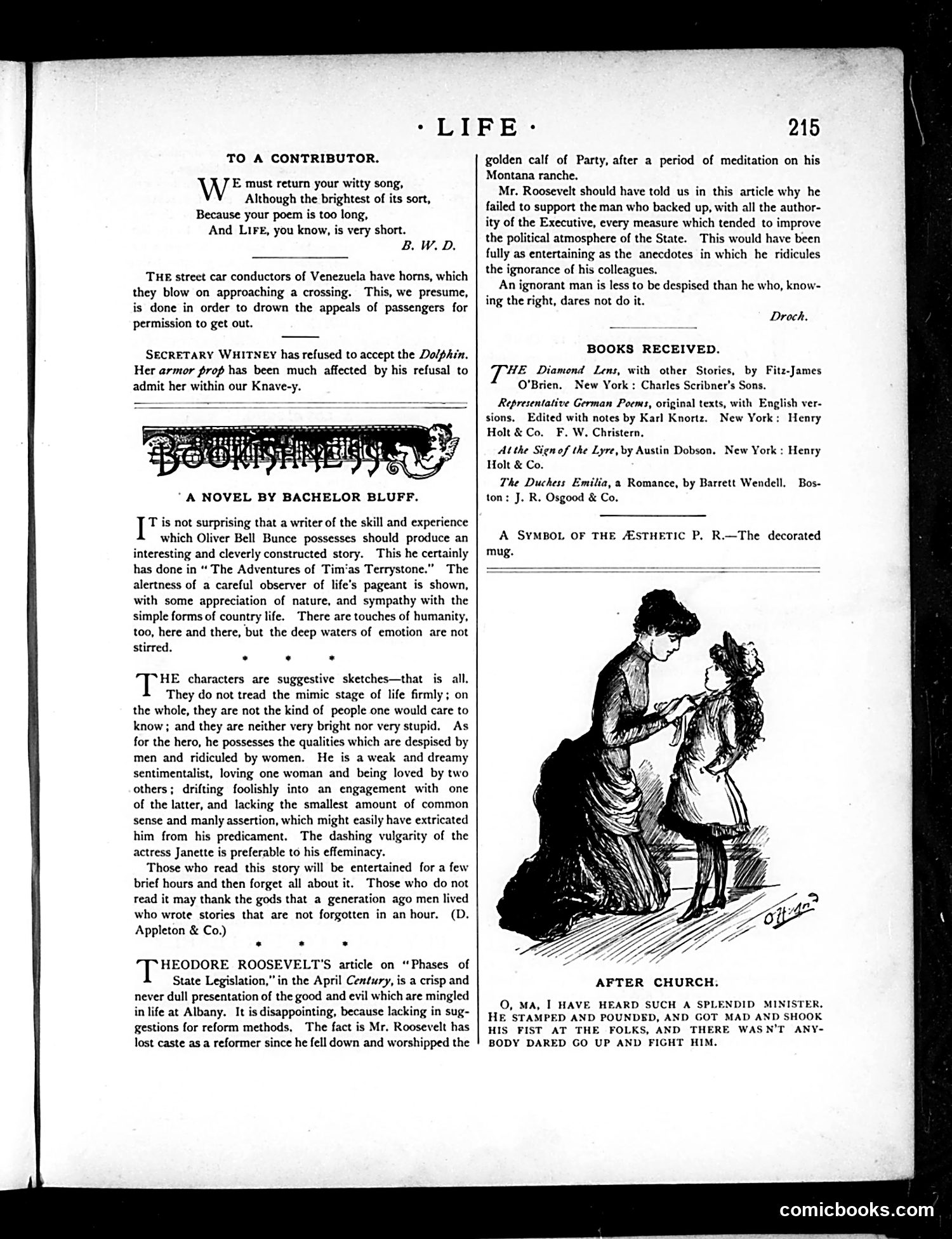
This page contains literary reviews and social commentary rather than political cartoons. The main content includes: **"To a Contributor"** — a short satirical poem rejecting a submitted work, suggesting the piece is too long and of poor quality. **Book reviews** discussing works by Fitz-James O'Brien and others. **"After Church"** — A caption-cartoon (bottom right) depicting a splendid minister who "stamped and pounded" while preaching, yet no parishioner dared challenge him physically. This satirizes both ministerial pomposity and congregational meekness during this era, suggesting clergy could behave aggressively toward their flocks with impunity. The page primarily mocks literary mediocrity and religious hypocrisy through written commentary rather than visual satire.
📄 Transcribed text from this page (OCR, searchable)
Machine-transcribed from the original scan — historical spelling and the odd misread are preserved.
- LIFE: 215 TO A CONTRIBUTOR. E must return your witty song, Although the brightest of its sort, Because your poem is too long, And LiFe, you know, is very short. B.W.D. THE street car conductors of Venezuela have horns, which they blow on approaching a crossing. This, we presume, is done in order to drown the appeals of passengers for permission to get out. SECRETARY WHITNEY has refused to accept the Dolphin. Her armor prop has been much affected by his refusal to admit her within our Knave-y. ‘A NOVEL BY BACHELOR BLUFF. T is not surprising that a writer of the skill and experience which Oliver Bell Bunce possesses should produce an interesting and cleverly constructed story. This he certainly has done in “ The Adventures of Tim‘as Terrystone.” The alertness of a careful observer of life's pageant is shown, with some appreciation of nature, and sympathy with the simple forms of country life. There are touches of humanity, too, here and there, but the deep waters of emotion are not stirred. . . . HE characters are suggestive sketches—that is all. They do not tread the mimic stage of life firmly; on the whole, they are not the kind of people one would care to know ; and they are neither very bright nor very stupid. As for the hero, he possesses the qualities which are despised by men and ridiculed by women. He is a weak and dreamy sentimentalist, loving one woman and being loved by two others; drifting foolishly into an engagement with one of the latter, and lacking the smallest amount of common sense and manly assertion, which might easily have extricated him from his predicament. The dashing vulgarity of the actress Janette is preferable to his effeminacy. Those who read this story will be entertained for a few brief hours and then forget all about it. Those who do not read it may thank the gods that a generation ago men lived who wrote stories that are not forgotten in an hour. (D. Appleton & Co.) . * . HEODORE ROOSEVELT'’S article on “Phases of State Legislation,” in the April Century, is a crisp and never dull presentation of the good and evil which are mingled in life at Albany. It is disappointing, because lacking in sug- gestions for reform methods, The fact is Mr. Roosevelt has lost caste as a reformer since he fell down and worshipped the golden calf of Party, after a period of meditation on his Montana ranche. Mr. Roosevelt should have told us in this article why he failed to support the man who backed up, with all the author- ity of the Executive, every measure which tended to improve the political atmosphere of the State. This would have been fully as entertaining as the anecdotes in which he ridicules the ignorance of his colleagues. An ignorant man is less to be despised than he who, know- ing the right, dares not do it. Droch. BOOKS RECEIVED. THE Diamond Lens, with other Stories, by Fitz-James O'Brien, New York : Charles Scribner's Sons. Representative German Poems, original texts, with English ver- sions, Edited with notes by Karl Knortz. New York: Henry Holt & Co. F. W. Christern. Al the Signof the Lyre, by Austin Dobson. New York : Henry Holt & Co. The Duchess Emilia, a Romance, by Barrett Wendell. Bos- ton: J. R. Osgood & Co. A SYMBOL OF THE AESTHETIC P, R.—The decorated mug. AFTER CHURCH. O, MA, I HAVE HEARD SUCH A SPLENDID MINISTER. HE STAMPED AND POUNDED, AND GOT MAD AND SHOOK HIS FIST AT THE FOLKS, AND THERE WASN'T ANY- BODY DARED GO UP AND FIGHT HIM. comicbooks.com