
A complete issue · 16 pages · 1885
Life — March 5, 1885
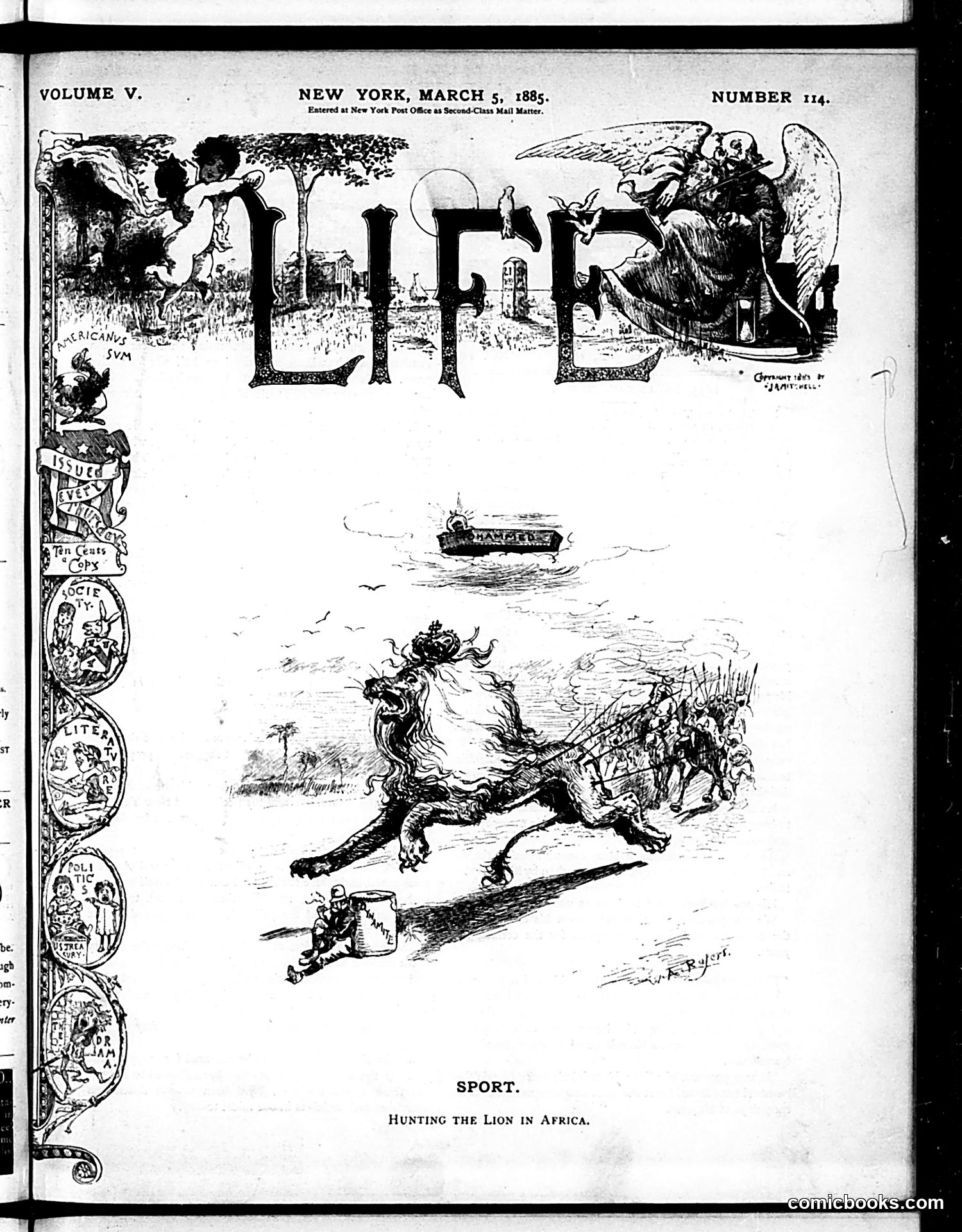
This satirical illustration depicts a lion hunt, labeled as "Sport." The image shows a massive, fierce lion being pursued by armed hunters and what appears to be a military or colonial force on the right side. The cartoon likely satirizes European colonial hunting practices in Africa during the 1880s—a period of intense imperial expansion. The "sport" framing suggests mockery of how colonial powers justified their presence and resource extraction in Africa as leisurely adventure rather than exploitation. The ornate left border contains various emblematic designs typical of Life's decorative style. The overall composition contrasts the wild, dangerous lion with organized human forces, possibly critiquing the imbalance of colonial military power against African resistance or wildlife.
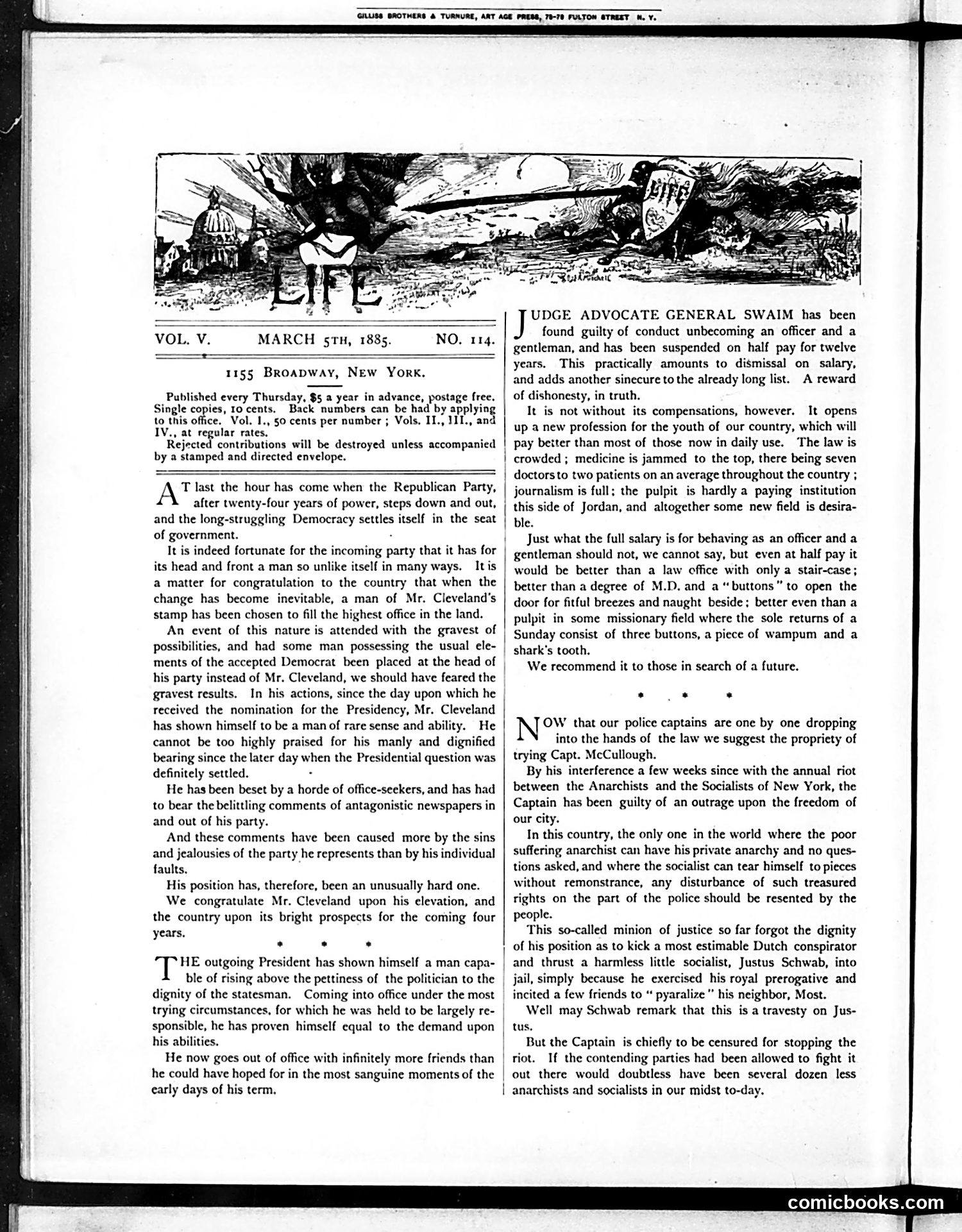
The header illustration shows "LIFE" personified as a classical figure overlooking a landscape—standard masthead artwork for the era. The editorial content discusses President Cleveland's incoming administration following the Republican Party's 24-year hold on power. The writers congratulate Cleveland on his selection and character while noting he faces pressure from office-seekers and partisan antagonism. A second section critiques Police Captain McCullough for his heavy-handed response to recent riots between Anarchists and Socialists in New York, arguing his suppression of the disturbance—including jailing socialist Justus Schwab—violated civil liberties. The satirists suggest that allowing organized groups to fight it out might have been preferable to police intervention that prioritized order over individual rights.
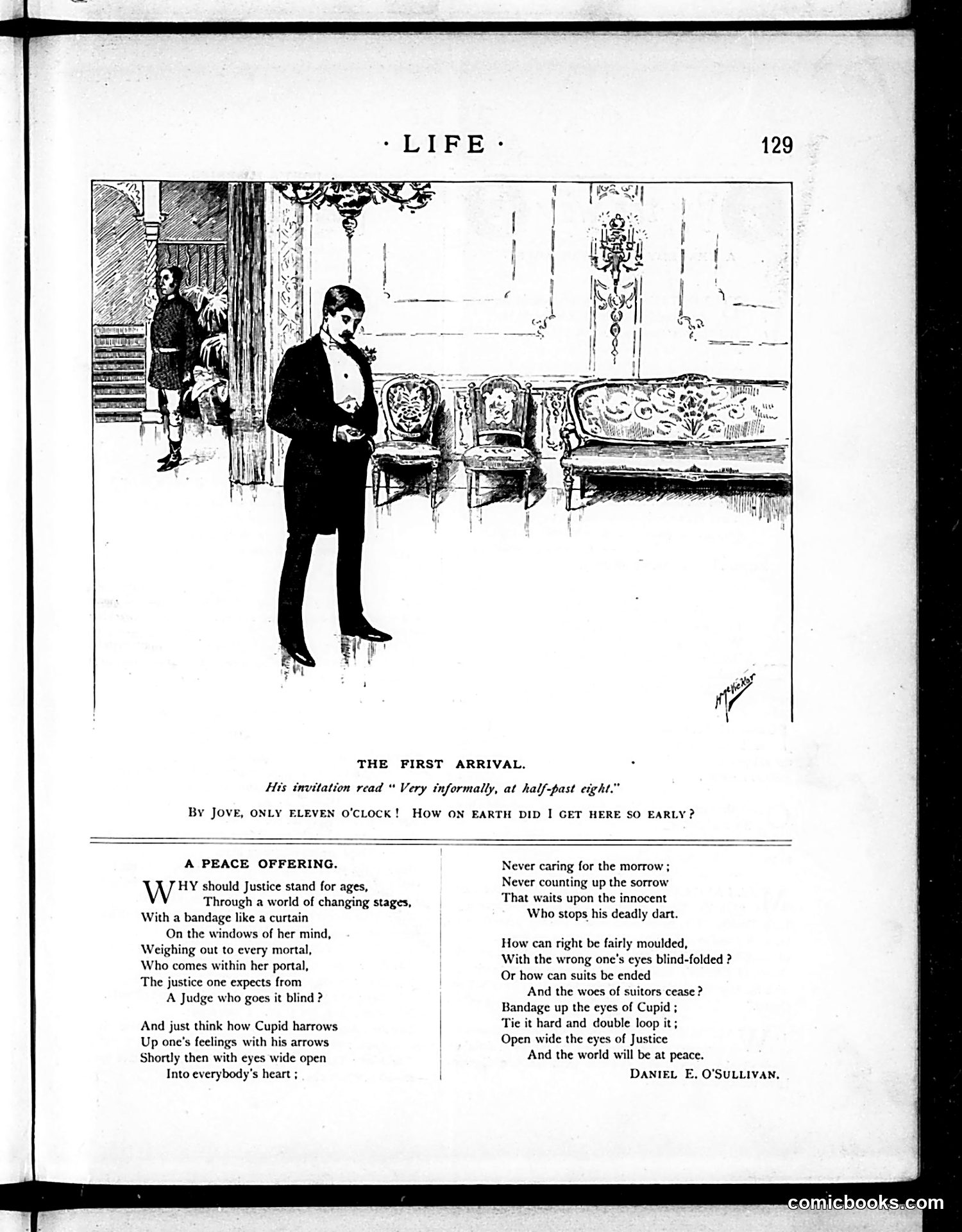
**The Cartoon:** "The First Arrival" depicts a formally-dressed man arriving at an elegant parlor at "half-past eight," when his invitation read "very informally, at half-past eight." His exclamation—"By Jove, only eleven o'clock! How on earth did I get here so early?"—satirizes social anxiety about punctuality and arriving at parties. The humor lies in the mismatch between his careful timing and actual clock-reading. **The Poem:** "A Peace Offering" by Daniel E. O'Sullivan addresses Justice abstractly, invoking metaphors of blindfolds, Cupid, and moral righteousness. It advocates for Justice to "open wide" her eyes to resolve societal wrongs and "suits"—likely referring to legal disputes or injustices of the era. Together, the page mixes light social comedy with serious philosophical verse about justice.
This is a satirical piece mocking *Life* magazine itself and newspaper editorial practices. The satire works through three voices: **Act I** criticizes *Life* for publishing odd, fantastical content—questioning why a "funny paper" publishes such material rather than serious journalism. **Act II** responds defensively, suggesting *Life* prints what readers want and that critics seize on minor errors to dismiss the whole publication. **Act III** concludes that such complaints are easy targets for papers claiming moral seriousness, but that *Life* has "sealed it"—presumably meaning the publication stands by its approach. The piece is essentially *Life* defending its satirical, humorous approach against criticism that it lacks substance or contains errors. It's meta-commentary on journalism and editorial philosophy circa this publication's era.
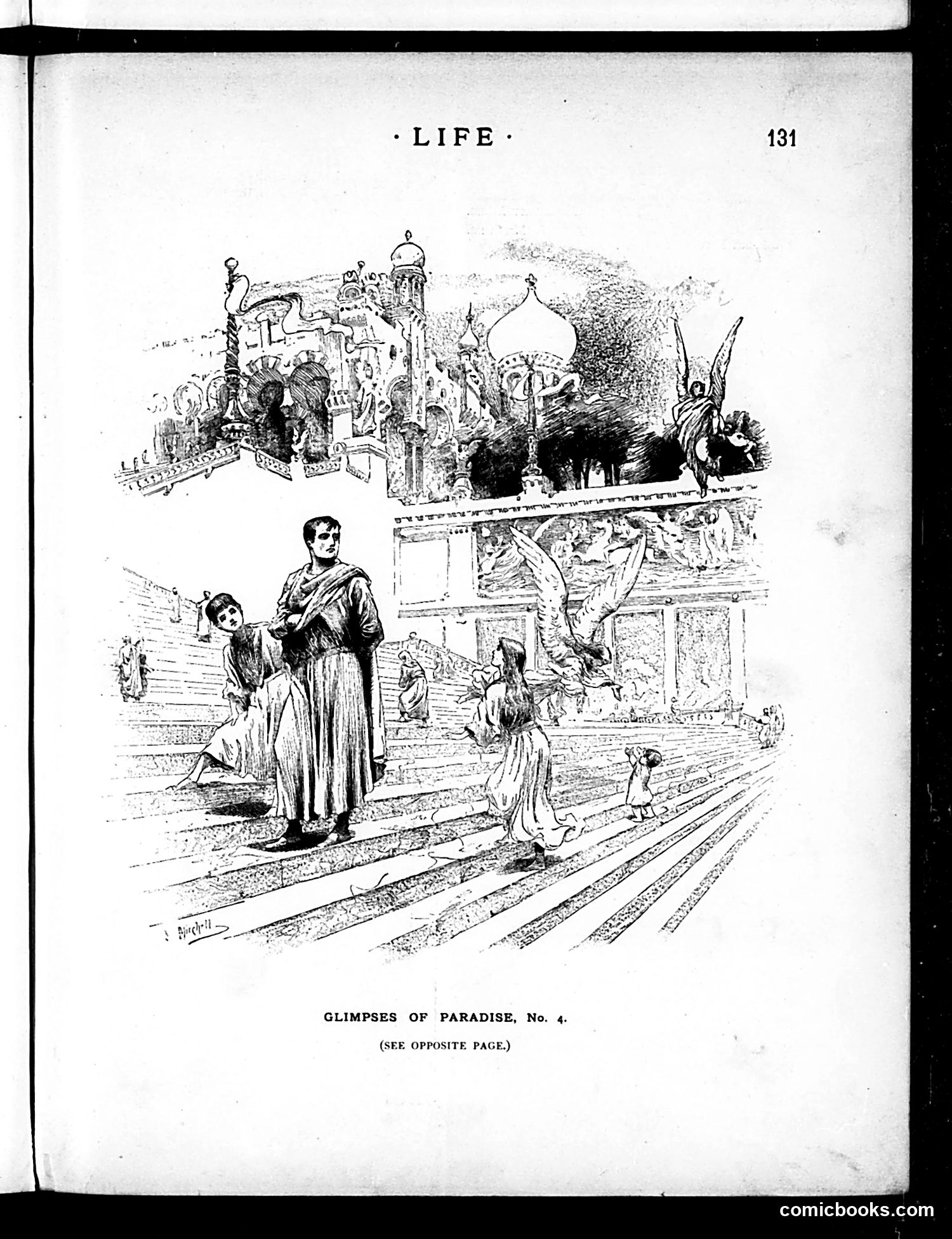
This satirical illustration depicts an idyllic domestic scene set against an exotic Eastern palace backdrop. A man in ornate clothing stands with children in a peaceful courtyard setting, with flying cherubs visible in the architectural details above. The satire likely critiques romanticized Western fantasies about Eastern or Oriental life—presenting an idealized "paradise" that contrasts sharply with reality. The title suggests this is part of a series examining such fantasies. The juxtaposition of the serene domestic arrangement against the elaborate, somewhat fantastical architecture implies commentary on how Western audiences consumed orientalist imagery, often depicting colonized regions as exotic utopias rather than complex societies. Without additional context from the opposite page (referenced in the caption), the specific social or political target remains unclear, though the overall effect mocks sentimental orientalism.
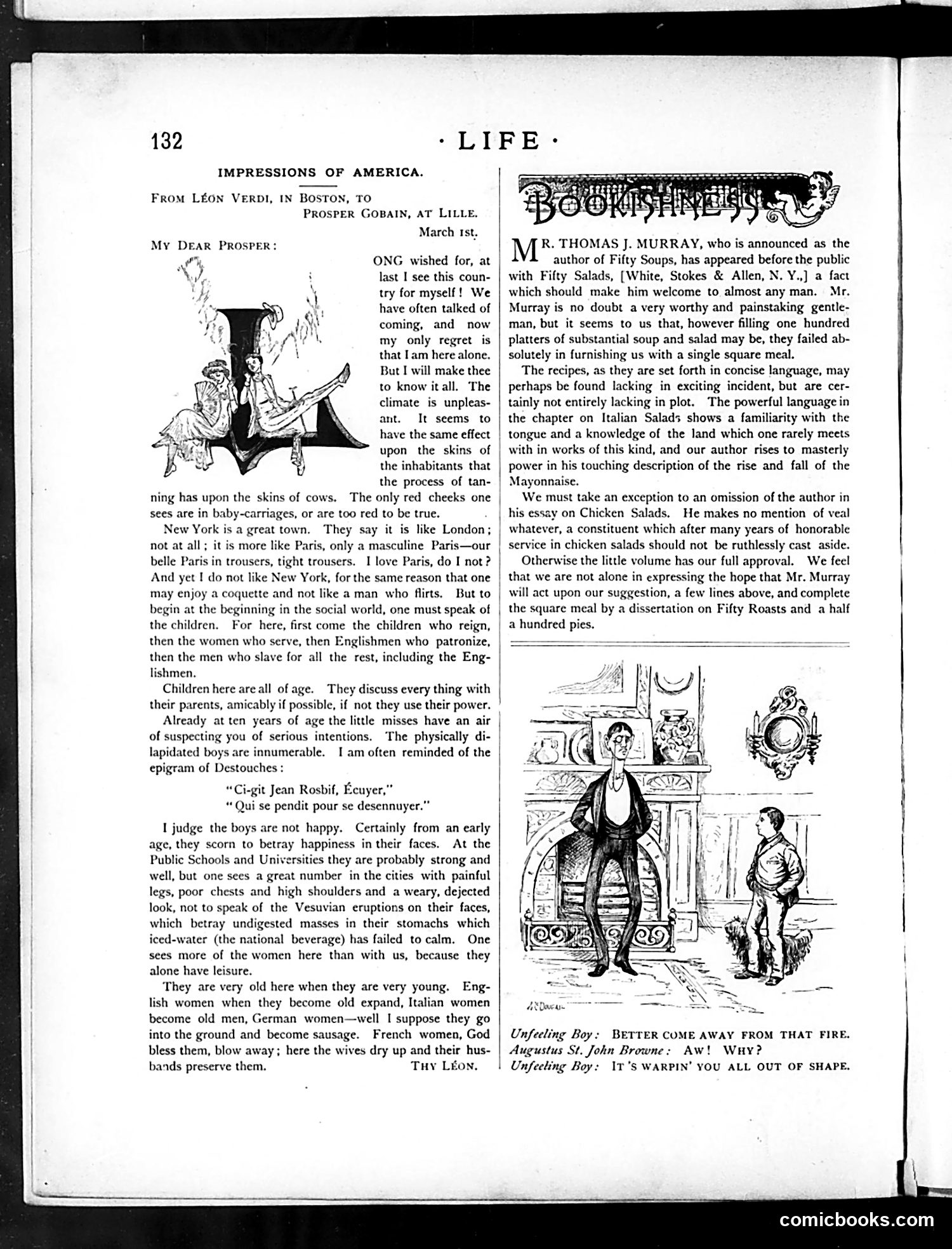
This page contains two sections: a letter from Léon Verdi in Boston describing American society, and a book review of "Fifty Soups" by Thomas J. Murray. The illustrated cartoon depicts a domestic scene with an adult (appearing to be a woman in Victorian dress) and a child near a fireplace. The captions reference "Unfeeling Boy" and dialogue between characters, with mentions of "Augustus St. John Browne" and warnings about fire safety. The satire appears to target children's indifference to parental concern and household dangers. The exaggerated, uncomfortable posture of the adult figure suggests physical distress or dramatic parental worry—mocking both anxious Victorians and unresponsive youth. The letter's commentary on American children's precocious behavior and questioning of authority complements this theme, positioning the cartoon as social criticism of generational conflict in late 19th-century America.
This satirical piece covers President Cleveland's inauguration ball. The main cartoon mocks the event's pretensions and chaos. **Key figures identified:** - President Cleveland (referenced as "President-elect") - The Mahdi (a religious/political figure whose presence is noted as significant) - Mr. Gladstone (British politician offering Sudan policy advice) - Mr. Rossa and Mr. Kelli (musicians) **The satire targets:** The crowded, chaotic ball where prominent figures jostle for attention. The text mocks Cleveland receiving unsolicited advice from Gladstone on Sudan policy, suggesting the President is beleaguered by opinions. The Mahdi's presence at an American inauguration is treated as an oddity worthy of comment. The overall tone ridicules the pretense and disorder of the inaugural festivities, where dignitaries compete for relevance and influence.
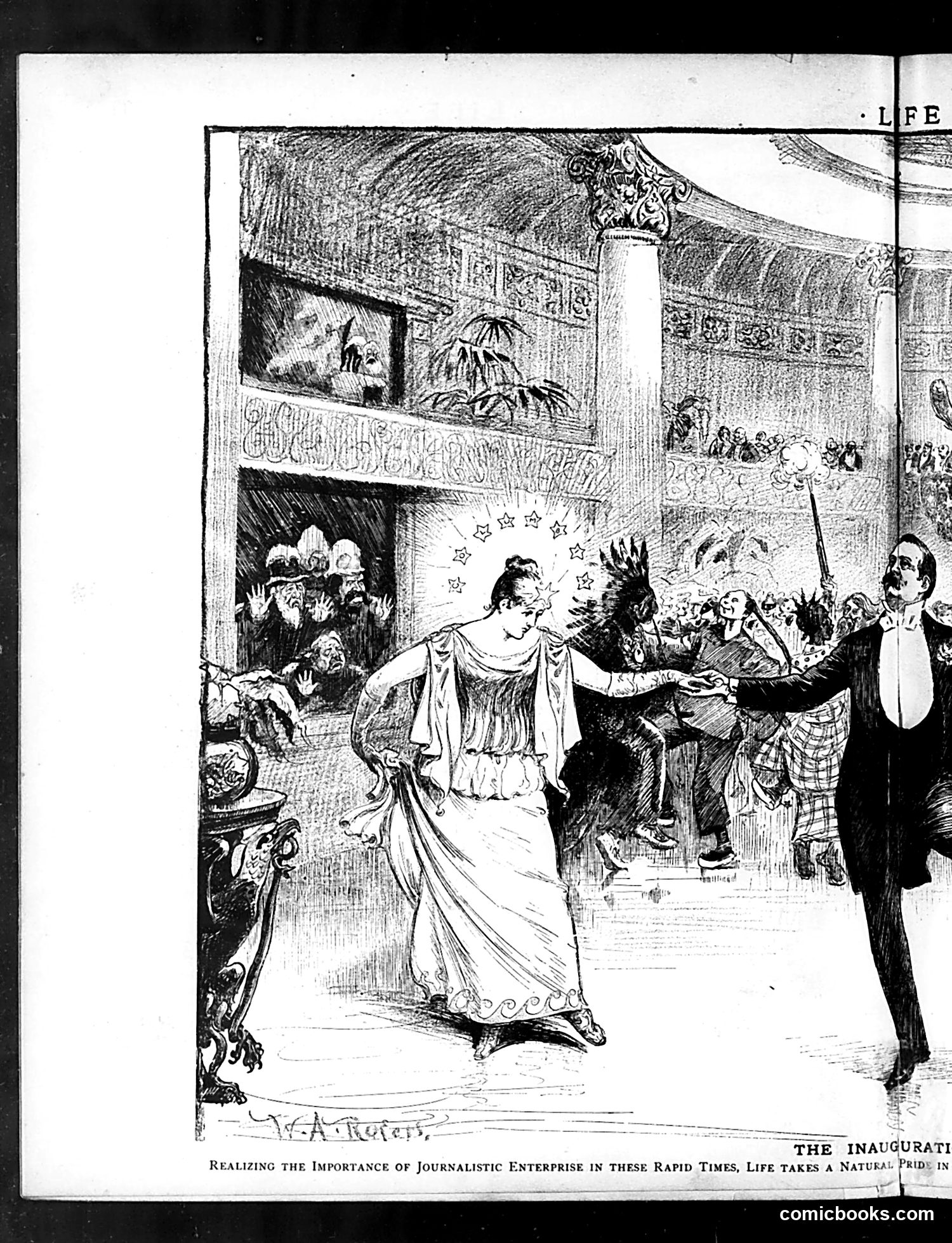
This Life magazine cartoon satirizes journalistic sensationalism around a presidential inauguration. The caption reads: "Realizing the Importance of Journalistic Enterprise in These Rapid Times, Life Takes a Natural Pride in..." The scene depicts an elaborate theatrical inaugural ceremony with multiple tiers of spectators and ornate architecture. A central female figure (likely representing "Columbia" or the nation itself) stands amid the pageantry, surrounded by formally dressed men and crowded galleries. The satire targets how newspapers and magazines like Life treat inaugurations as major spectacles requiring elaborate coverage. The theatrical staging suggests the event itself has become a media production rather than a genuine civic ceremony—mocking both the press's breathless reporting and the theatrical nature of political pageantry in the Gilded Age or Progressive Era.
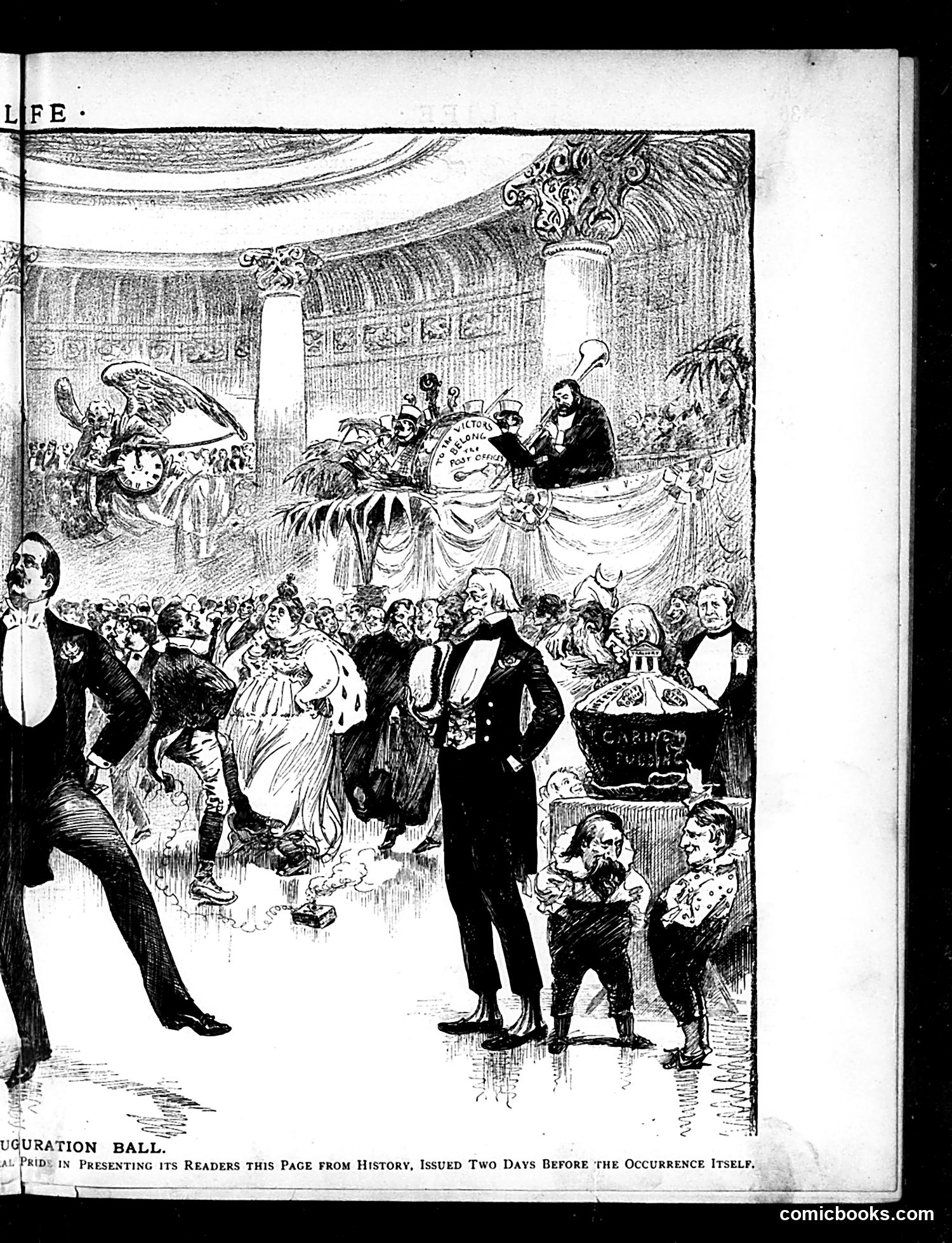
This satirical cartoon depicts an elaborate formal ball, likely celebrating a presidential inauguration. The caption notes it was "issued two days before the occurrence itself"—suggesting Life magazine was publishing this imaginary preview of the event. The satire mocks the extravagance and pageantry of the occasion: ornate columned architecture, elaborate decorations (including what appears to be a drum labeled "Cabinet Politics"), formally dressed aristocratic figures, and cherubs overhead. The crowd includes well-dressed elites alongside common observers. The joke appears to be about the disconnect between the grandeur of official ceremonies and political reality—presenting readers with a somewhat absurd, over-the-top vision of what the actual event might entail. The text's reference to "pride in presenting" suggests mild mockery of the proceedings' pomposity.
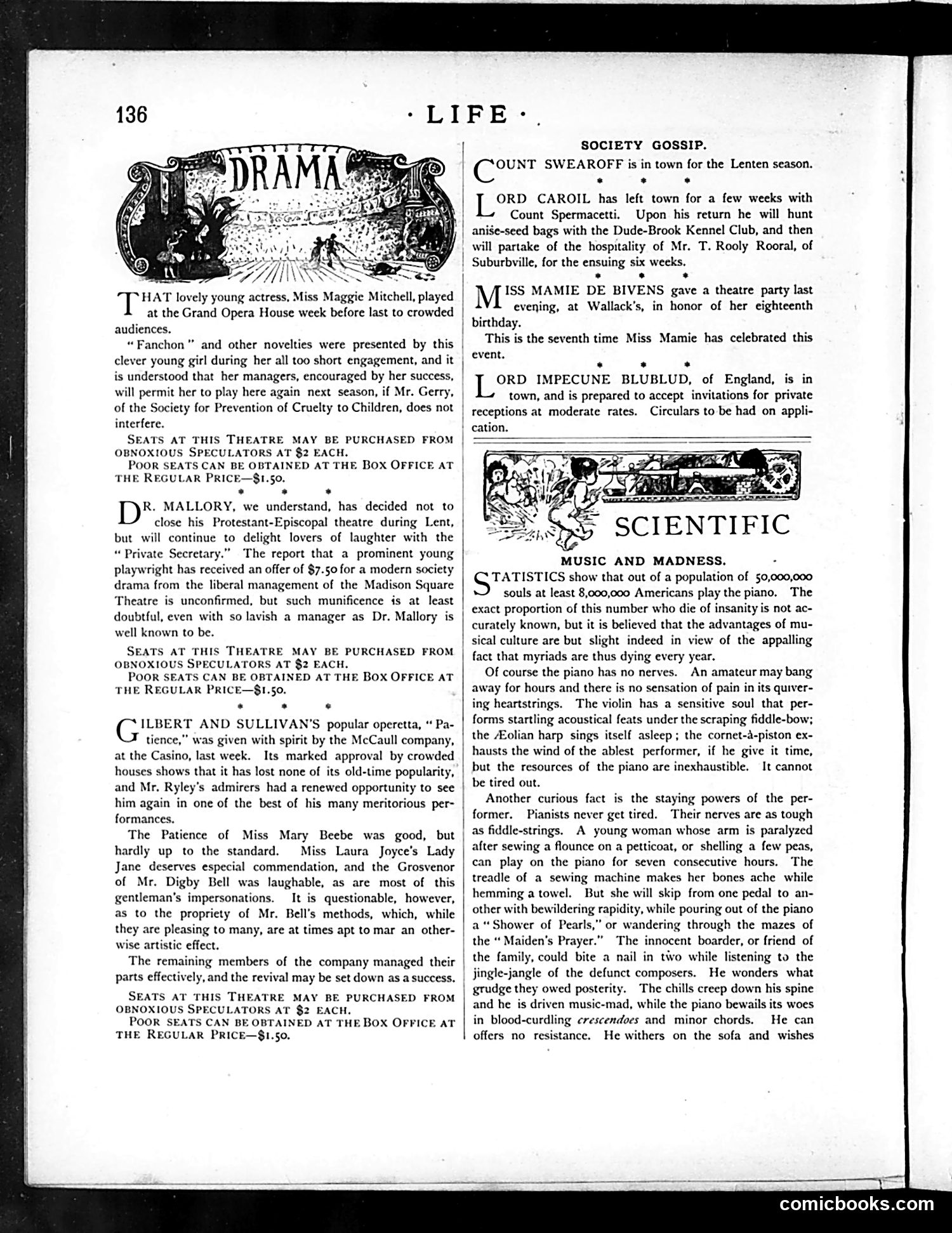
This page contains **society gossip and theater reviews** rather than political cartoons. The satire is social, mocking upper-class pretension and theatrical culture. The gossip section ridicules wealthy socialites through absurdly invented names ("Count Spermacetti," "Lord Impecune Blublud") and ridiculous activities (hunting "anise-seed bags"). A key joke: Miss Mamie de Bivens has celebrated her eighteenth birthday seven times—satirizing society women's vanity about age. The theater section critiques both performances and ticket-scalping. A pointed jab: the joke about Dr. Mallory receiving "$7.50 for a modern society drama" is clearly absurd, mocking both the low value placed on new playwriting and the theater's financial priorities. The "Music and Madness" section uses mock-scientific statistics to joke that eight million piano-playing Americans are slowly going insane from the instrument's relentless demands—a satirical comment on genteel culture's expectation that women master piano as a social accomplishment.
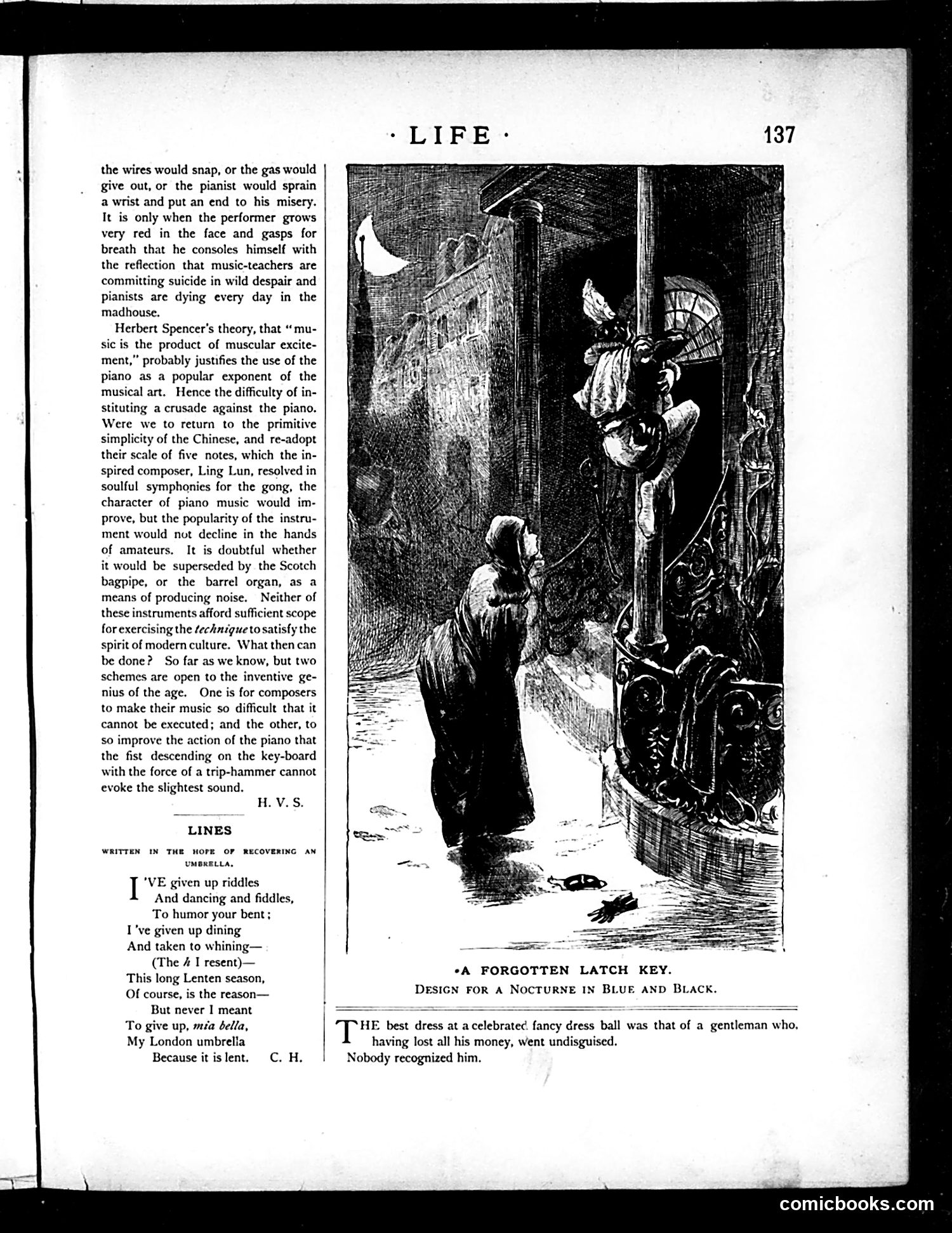
**The Main Cartoon:** "A Forgotten Latch Key" depicts a woman in ragged clothes standing outside a grand townhouse at night, apparently locked out. The illustration's title—"Design for a Nocturne in Blue and Black"—is a sardonic art-world reference. **The Satire:** This is social commentary on poverty and class. The woman's shabby appearance contrasts sharply with the ornate architecture, suggesting she's been reduced to destitution. The joke's dark humor hinges on the irony that her forgotten key is literally her only problem—implying a more fundamental homelessness or displacement. **Supporting Content:** The page includes prose mocking amateur pianists and their noise, plus a poem about lending an umbrella—light satirical commentary on domestic inconveniences and social obligations typical of Life magazine's humor. **Context:** Life was known for biting social satire beneath humorous surfaces. This addresses Edwardian-era concerns about economic precarity and class visibility.
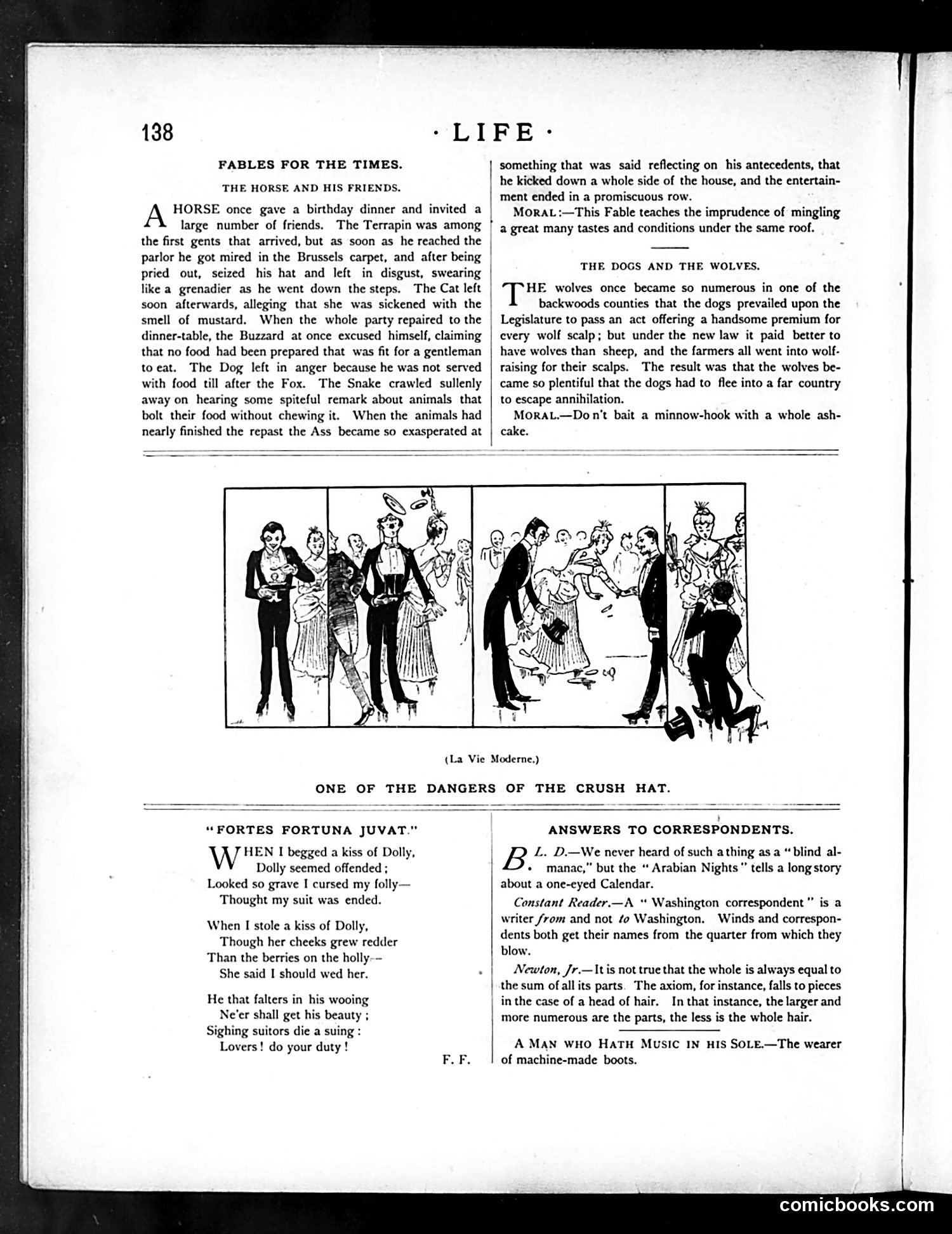
This page contains satirical fables and humor pieces typical of Life magazine's social commentary. **"The Horse and His Friends"** uses animal characters to mock mixed social gatherings. A horse's dinner party descends into chaos when diverse guests—terrapin, cat, buzzard, dog, snake, and ass—each complain about conditions reflecting their different natures and social standings. The moral criticizes attempting to unite people of vastly different "tastes and conditions" under one roof, likely satirizing contemporary class tensions or failed social integration efforts. **"The Dogs and the Wolves"** appears to satirize perverse incentives: when a government offers bounties for wolf scalps, farmers abandon sheep-raising to profit from wolf-raising instead, defeating the law's purpose. This likely comments on poorly designed legislation that backfires. The remaining content includes a cartoon about crush hats causing social mishaps, a flirtatious poem, and humorous "answers to correspondents"—a regular Life feature providing witty, absurd responses to reader questions, using wordplay and logical paradoxes for comedic effect.
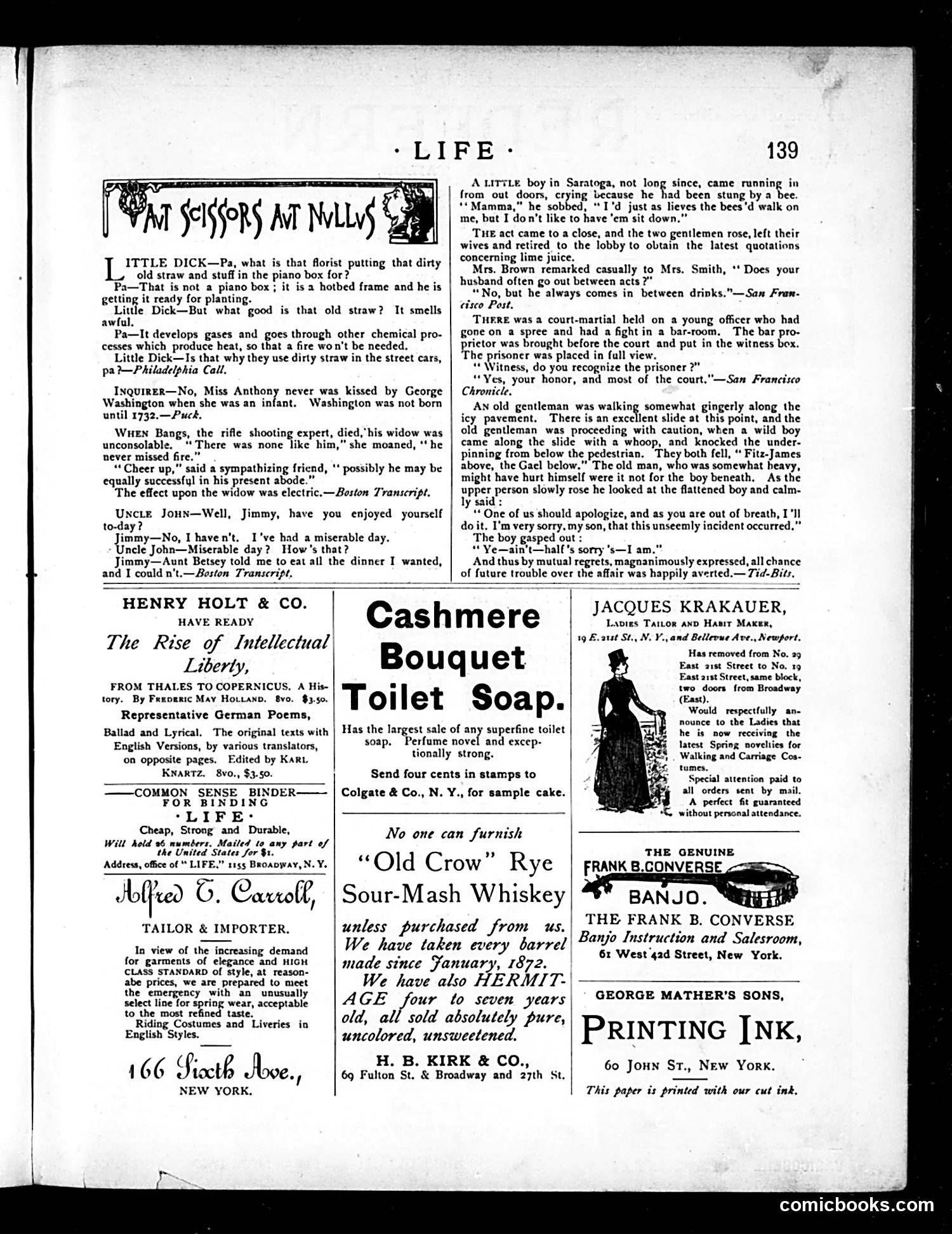
This page from *Life* magazine consists primarily of **humorous anecdotes and advertisements** rather than political cartoons. The jokes mock everyday absurdities: a child complaining about bees "sitting down" rather than walking on him; a wife's casual comment that her husband "always comes in between drinks" during theater intermissions; a bar-room brawl witness who recognizes "most of the court" (implying heavy drinking among authority figures); and an elderly man and boy exchanging exaggerated apologies after colliding on ice. The **social satire** targets Victorian propriety and genteel excess—particularly **alcohol consumption among respectable society**. The repeated references to drinking suggest *Life* was mocking the hypocrisy of the upper classes who engaged in drunkenness while maintaining formal manners. The advertisements (soap, whiskey, tailoring services, printing ink) are period-typical. The page number (139) indicates this is mid-issue content. Overall, this represents *Life*'s characteristic style of satirizing social behavior through brief, pithy jokes rather than illustrated cartoons.
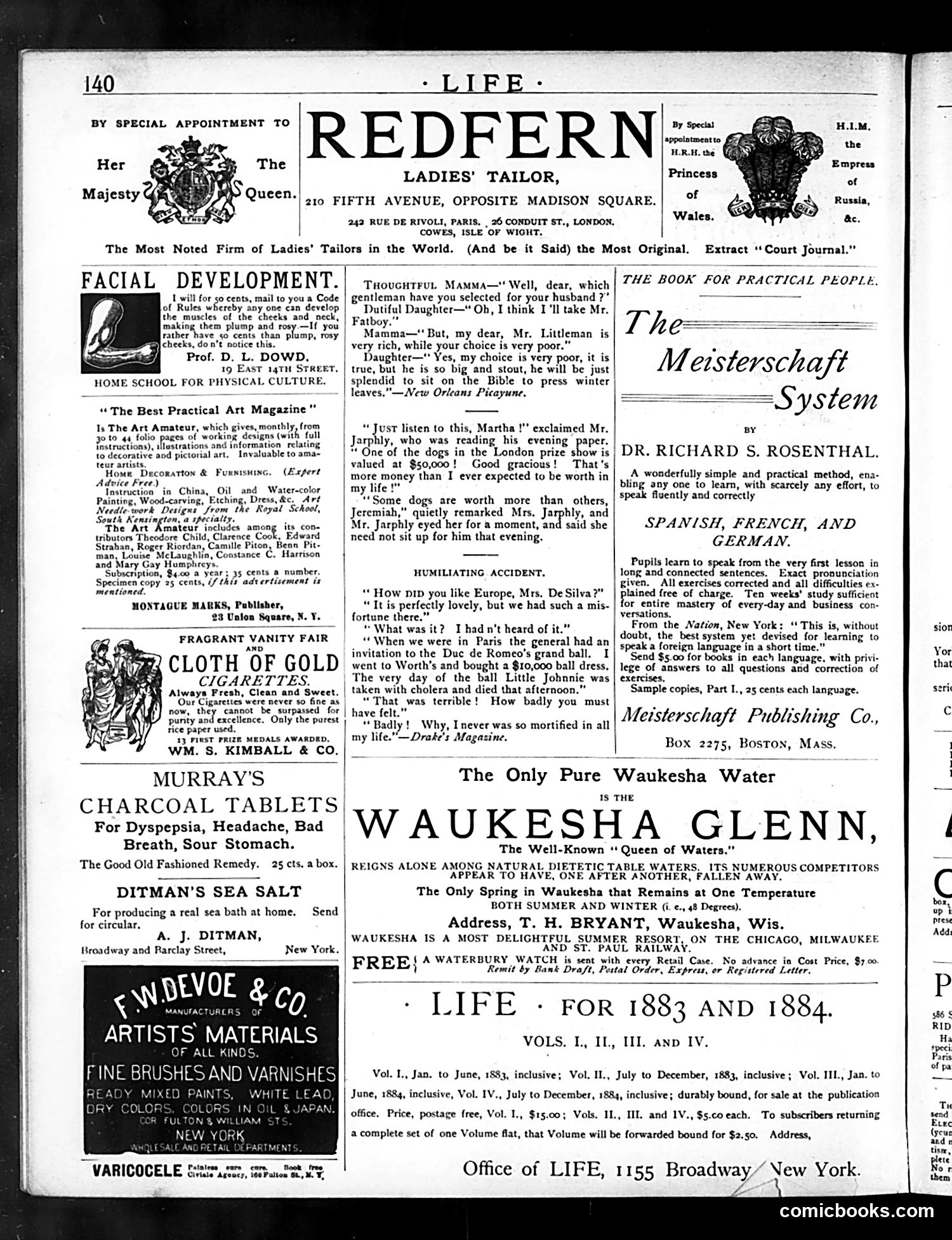
This page is primarily advertisements and humor pieces, not political cartoons. The small comic anecdotes include: **"Thoughtful Mamma"** jokes about a daughter choosing a poor but obese suitor because he's large enough to press winter leaves on a Bible—humor based on absurd reasoning and class anxiety about marrying down. **"One of the Dogs in London"** satirizes wealthy vanity: a man is shocked a dog is worth $50,000 while he's worth less, prompting his wife's tart comment that some dogs *are* worth more than others. **"Humiliating Accident"** mocks upper-class pretension: a woman spent $10,000 on a ball gown in Paris, then her son died—she's mortified not about the death but about *wasting the dress*. These reflect period preoccupations with wealth, status-seeking, and conspicuous consumption, with gentle mockery of materialistic values. The rest is commercial advertising.
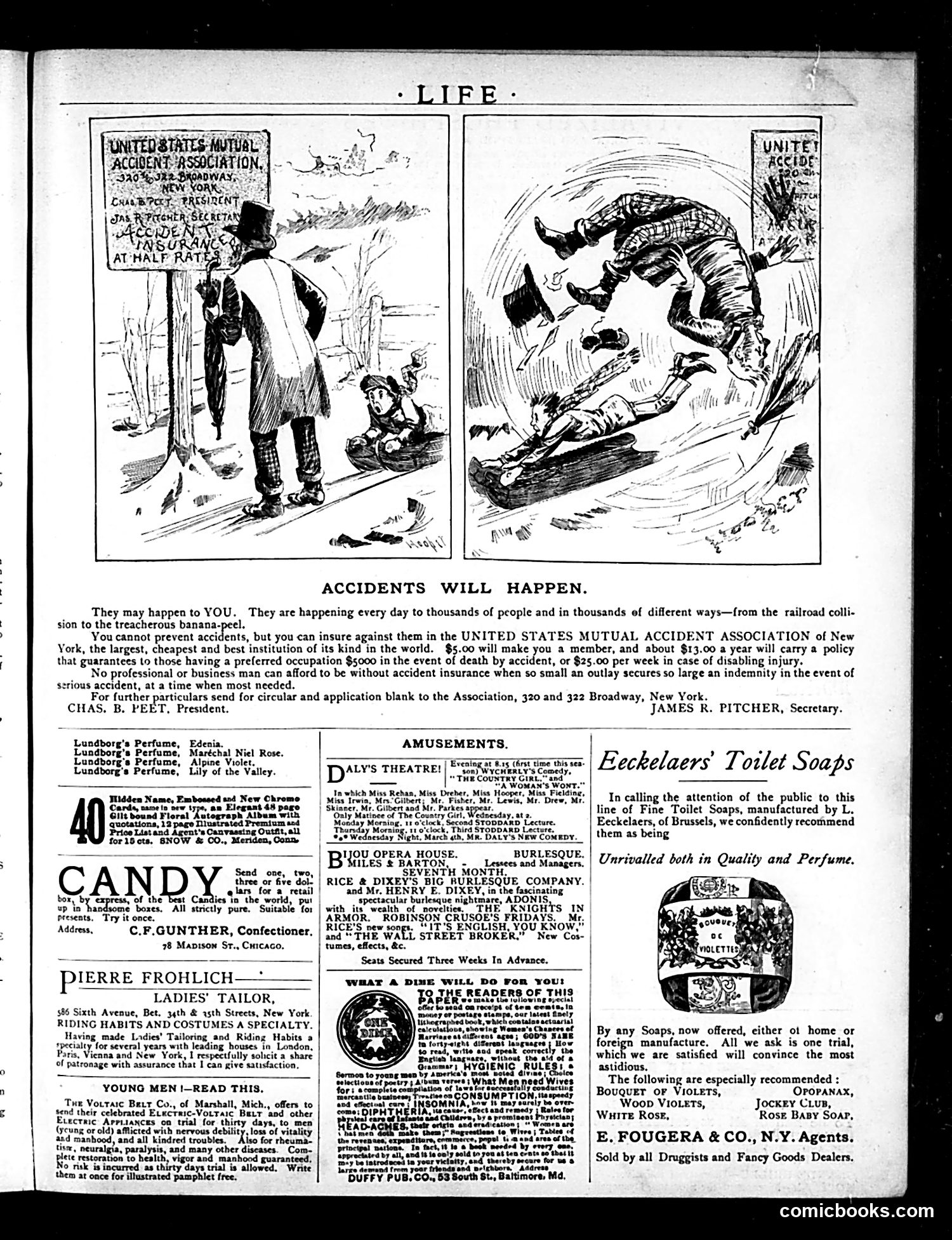
This page features an advertisement-as-cartoon for the United States Mutual Accident Association. The left panel shows a well-dressed businessman viewing a sign advertising accident insurance while children play nearby—depicting everyday accident risks. The right panel illustrates a man tumbling down an embankment, emphasizing the unpredictability of accidents. The satire targets the emerging insurance industry. The headline "ACCIDENTS WILL HAPPEN" presents accident insurance as essential, implying that without it, financial ruin follows injury. This reflects late 19th-century anxieties about industrial accidents and workplace dangers. The low membership cost ($5) and weekly disability benefits ($25/week) suggest the policy targets middle-class professionals who couldn't afford lost income. The "treacherous banana-peel" reference was contemporary comedy—slipping on banana peels was a well-known comedic trope and genuine hazard in urban streets. The pitch exploits fear while normalizing commercial insurance as a necessity.
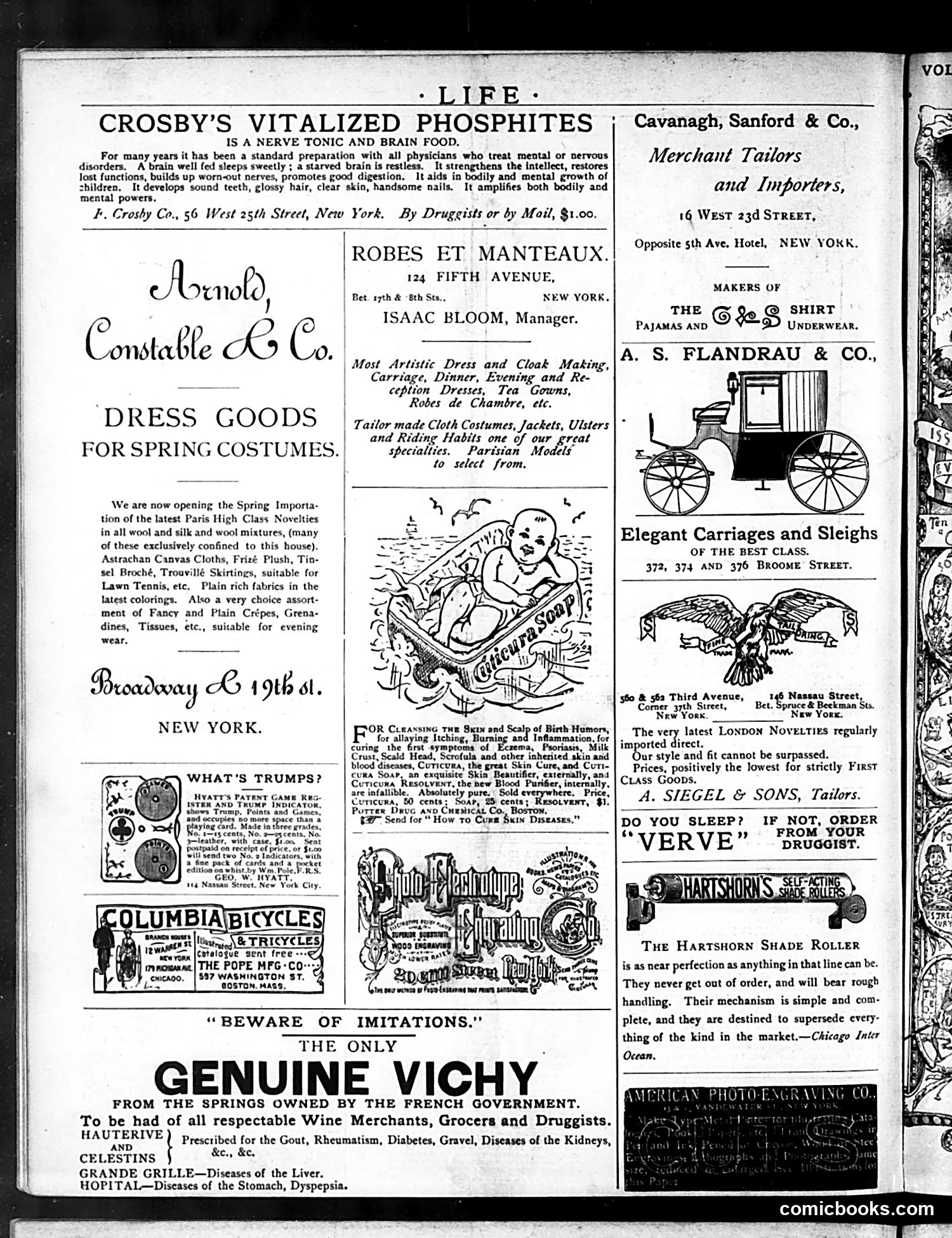
This is primarily an **advertising page** from Life magazine, not a political cartoon. The page contains various commercial advertisements typical of late 19th-century American publications. The largest visual element is an **illustrated advertisement for Lactopeptine** (a digestive aid), featuring a cherubic infant in a cradle with the product name. This uses sentimental imagery common to patent medicine marketing of the era. Other notable ads include: - **Crosby's Vitalized Phosphites**: a "nerve tonic" claiming to strengthen intellect and promote mental growth - **Vichy water**: marketed as a cure-all for gout, rheumatism, and various ailments - **Columbia Bicycles**: promoting tricycles and bicycles - **Hartshorn Shade Rollers**: window shade mechanisms The page reflects the **patent medicine culture** of the 1880s-90s, when unregulated medicinal products made broad health claims without scientific substantiation. The advertising targets middle-class consumers with products promising mental vigor, digestive health, and modern convenience items.