
Life, 1885-03-05 · page 6 of 16
Life — March 5, 1885 — page 6: what you’re looking at
What you’re looking at
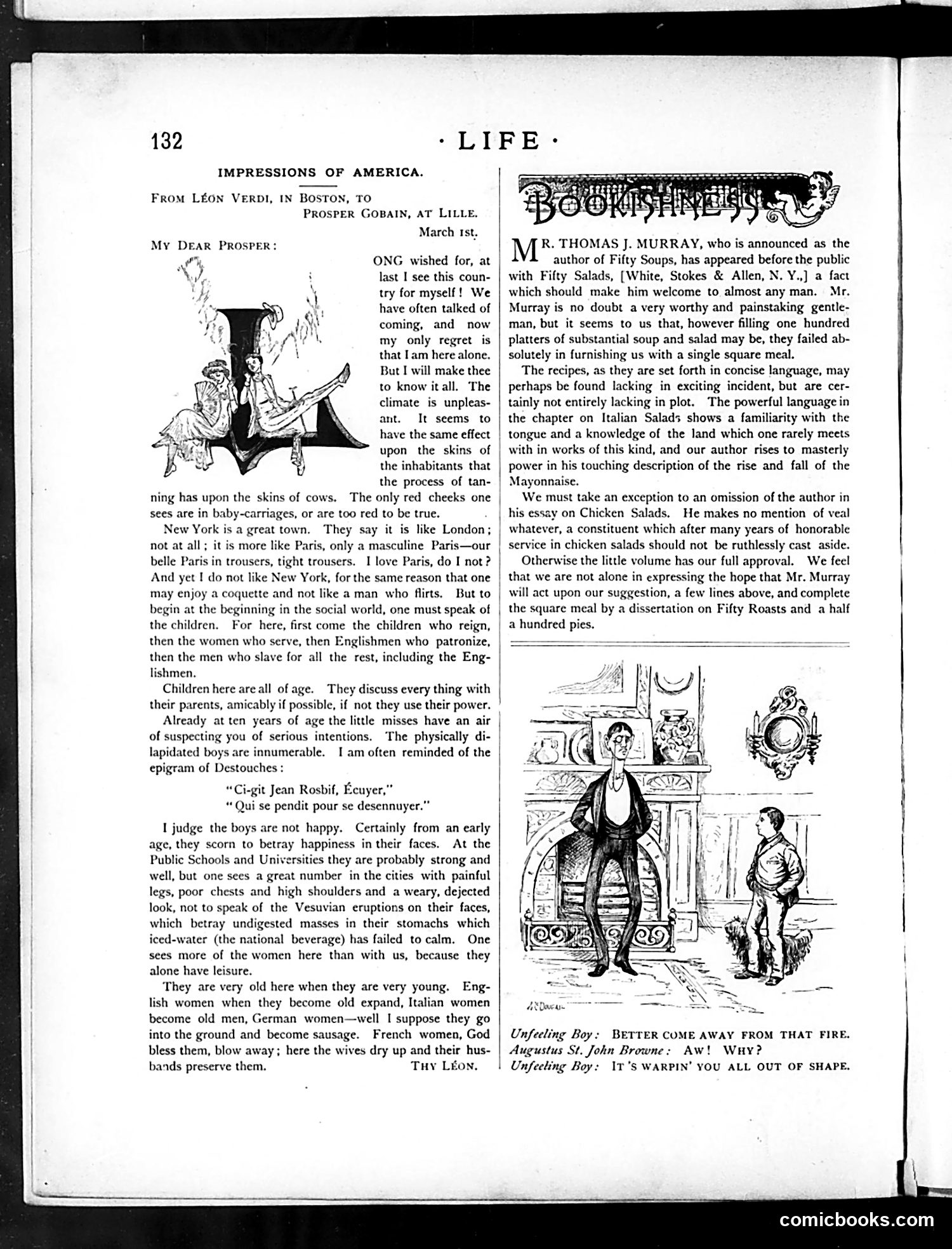
This page contains two sections: a letter from Léon Verdi in Boston describing American society, and a book review of "Fifty Soups" by Thomas J. Murray. The illustrated cartoon depicts a domestic scene with an adult (appearing to be a woman in Victorian dress) and a child near a fireplace. The captions reference "Unfeeling Boy" and dialogue between characters, with mentions of "Augustus St. John Browne" and warnings about fire safety. The satire appears to target children's indifference to parental concern and household dangers. The exaggerated, uncomfortable posture of the adult figure suggests physical distress or dramatic parental worry—mocking both anxious Victorians and unresponsive youth. The letter's commentary on American children's precocious behavior and questioning of authority complements this theme, positioning the cartoon as social criticism of generational conflict in late 19th-century America.
📄 Transcribed text from this page (OCR, searchable)
Machine-transcribed from the original scan — historical spelling and the odd misread are preserved.
132 IMPRESSIONS OF AMERICA. From LEON VERDI, IN BOSTON, TO PROSPER GOBAIN, AT LILLE. March tst. My DEAR PROSPER: " ONG wished for, at last I see this coun- try for myself! We have often talked of coming, and now my only regret is that Iam here alone. But I will make thee to know it all. The climate is unpleas- ant. It seems to have the same effect upon the skins of the inhabitants that the process of tan- ning has upon the skins of cows. The only red cheeks one sees are in baby-carriages, or are too red to be true. New York is a great town. They say it is like London; not at all ; it is more like Paris, only a masculine Paris—our belle Paris in trousers, tight trousers. And yet I do not like New York, forthe same reason that one may enjoy a coquette and not like a man who flirts. begin at the beginning in the social world, one must speak of the children. For here, first come the children who reign, then the women who serve, then Englishmen who patronize, then the men who slave for all the rest, including the Eng- lishmen. Children here are all of age. They discuss every thing with their parents, amicably if possible, if not they use their power. Already atten years of age the little misses have an air of suspecting you of serious intentions. The physically di- lapidated boys are innumerable. I am often reminded of the epigram of Destouches : “Ci-git Jean Rosbif, Ecuyer,” “ Qui se pendit pour se desennuyer.” I judge the boys are not happy. Certainly from an early age, they scorn to betray happiness in their faces. At the Public Schools and Universities they are probably strong and well, but one sees a great number in the cities with painful legs, poor chests and high shoulders and a weary, dejected look, not to speak of the Vesuvian eruptions on their faces, which betray undigested masses in their stomachs which iced-water (the national beverage) has failed to calm. One sees more of the women here than with us, because they alone have leisure. ‘They are very old here when they are very young. Eng- lish women when they become old expand, Italian women become old men, German women—well I suppose they go into the ground and become sausage. French women, God bless them, blow away; here the wives dry up and their hus- bands preserve them, Tuy LEon, I love Paris, do I not? | But to | R. THOMAS J. MURRAY, who is announced as the author of Fifty Soups, has appeared before the public with Fifty Salads, [White, Stokes & Allen, N. Y.,] a fact which should make him welcome to almost any man. Mr. Murray is no doubt a very worthy and painstaking gentle- man, but it seems to us that, however filling one hundred platters of substantial soup and salad may be, they failed ab- solutely in furnishing us with a single square meal. The recipes, as they are set forth in concise language, may perhaps be found lacking in exciting incident, but are cer- tainly not entirely lacking in plot. The powerful language in the chapter on Italian Salads shows a familiarity with the tongue and a knowledge of the land which one rarely meets with in works of this kind, and our author rises to masterly | power in his touching description of the rise and fall of the Mayonnaise. We must take an exception to an omission of the author in his essay on Chicken Salads. He makes no mention of veal whatever, a constituent which after many years of honorable | service in chicken salads should not be ruthlessly cast aside. Otherwise the little volume has our full approval. We feel that we are not alone in expressing the hope that Mr. Murray will act upon our suggestion, a few lines above, and complete | the square meal by a dissertation on Fifty Roasts and a half a hundred pies. Unfeeling Boy: BETTER COME AWAY FROM THAT FIRE. | Augustus St. John Browne: AW! Wy? | Unfeeling Boy: \1'S WARPIN’ YOU ALL OUT OF SHAPE. comicbooks.com |