A complete issue · 16 pages · 1885
Life — February 26, 1885
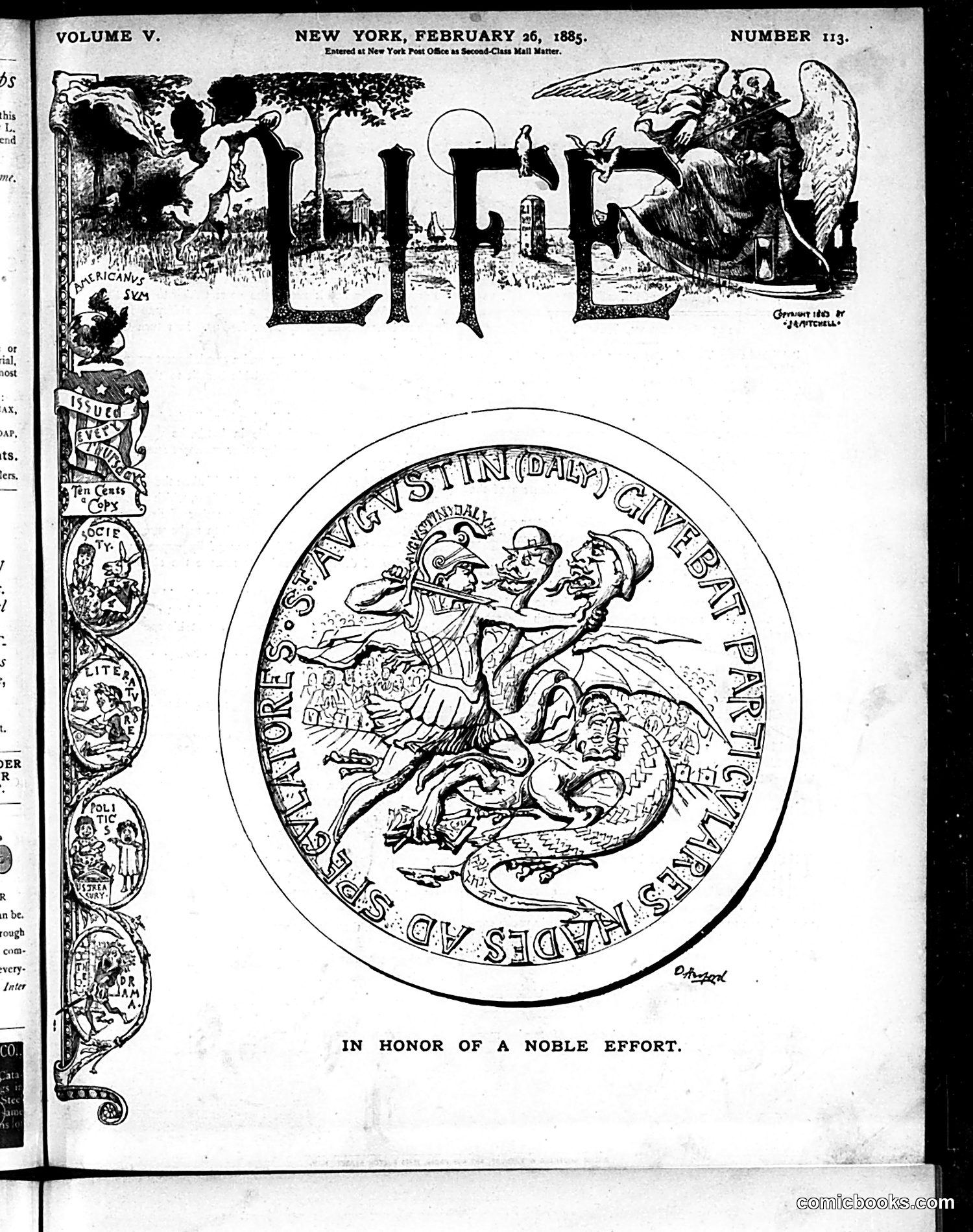
**Main Image:** A circular medallion depicts a mounted knight (St. George) slaying a dragon, with text reading "S. GEORGIUS AUGUSTIN DAILY CHIEFLY PART[?]" around the border. **Title:** "IN HONOR OF A NOBLE EFFORT" **Context:** The cartoon likely commemorates a specific recent event or political action from early 1885, though the exact reference isn't immediately clear from the visible text. The St. George/dragon imagery traditionally symbolizes good triumphing over evil or defending against threats. The decorative border on the left contains various small emblems and vignettes, typical of Life's ornamental design. Without additional context about what specific "noble effort" occurred in February 1885, the precise satirical target remains unclear, though the reverential tone suggests celebrating a contemporary political or social achievement.
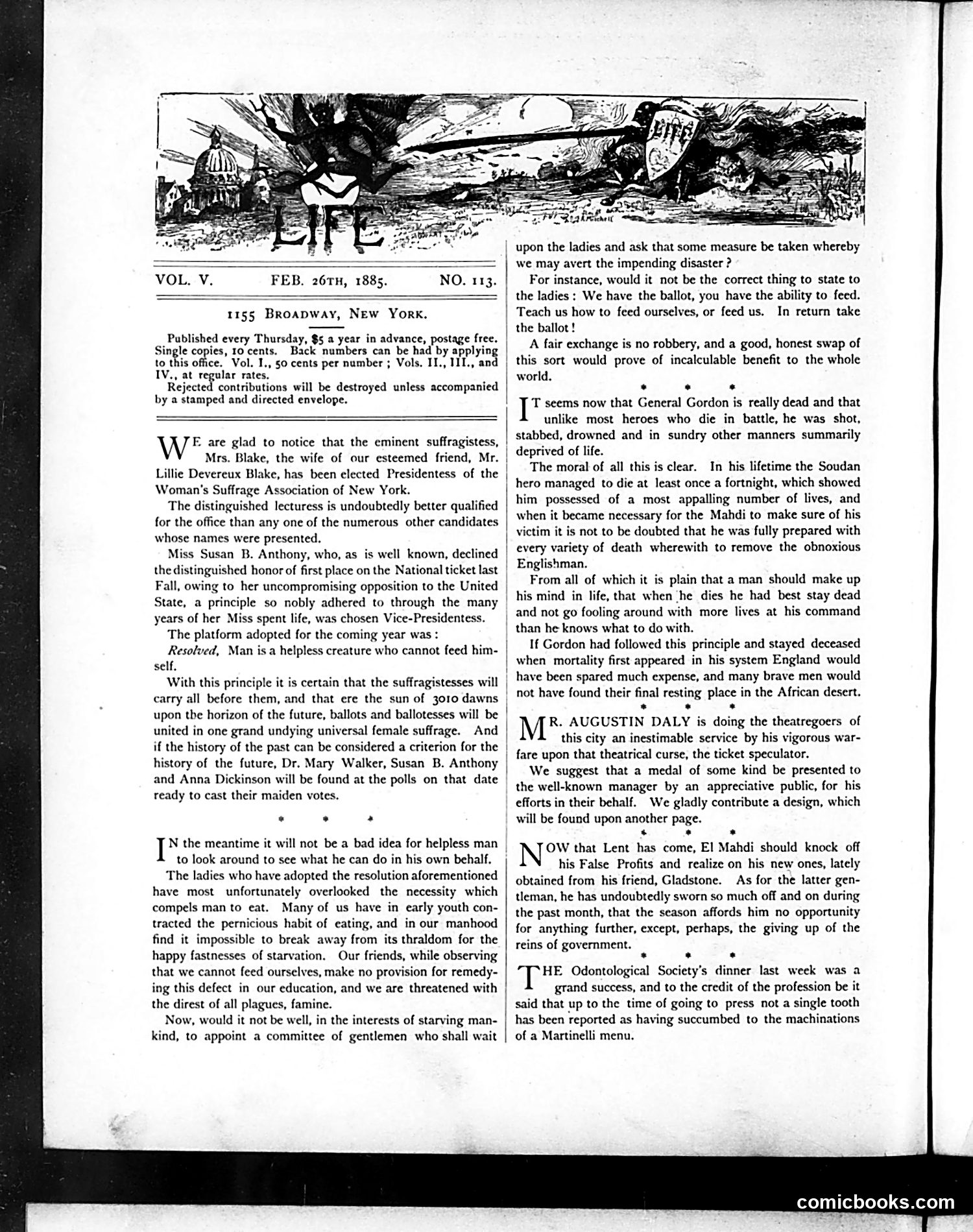
The masthead illustration depicts a chaotic scene with "LIFE" prominently displayed, showing figures in apparent distress or conflict—typical of the magazine's satirical style. The text discusses **women's suffrage**, praising Mrs. Blake's election as President of the Woman's Suffrage Association of New York. It sarcastically notes that Susan B. Anthony declined the honor, having already served as "Vice-Presidentess." The piece mocks anti-suffrage arguments by proposing that starving men should be fed by women—suggesting the absurdity of denying women political voice while expecting their domestic labor. References to **General Gordon** (likely the British general killed in Sudan in 1885) and **El Mahdi** indicate contemporary colonial conflicts. The satire advocates women's suffrage through ironic inversions of contemporary gender arguments.
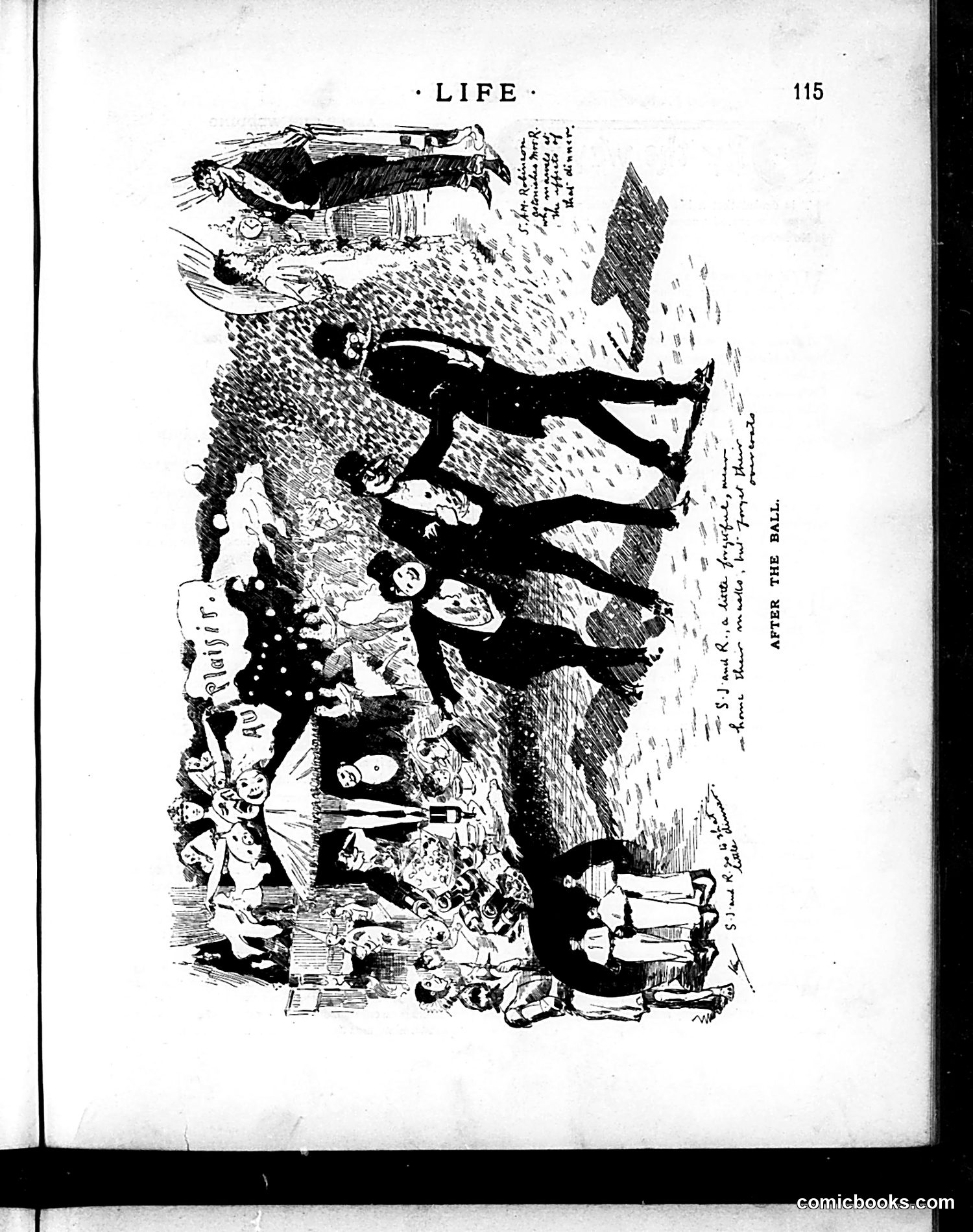
This page from *Life* magazine appears to be a satirical illustration titled "After the Ball," though the OCR text is largely illegible. The image depicts a chaotic scene that's been rotated 90 degrees, showing multiple figures in what appears to be a social gathering or event aftermath. The composition suggests social satire—possibly mocking high society behavior, excess, or the consequences of a formal event. The crowded, jumbled arrangement of figures and the title's reference to "after the ball" implies commentary on how people behave once propriety's constraints are removed. Without clearer text or identification of specific caricatured figures, the exact political or social target remains unclear, though the style is consistent with *Life*'s tradition of lampooning American society's pretensions.
This page contains miscellaneous satirical items rather than a unified cartoon. "By the Way" features brief social commentary, including: - A note about a proverb amendment bill in Congress regarding "A Fair Exchange Is No Bribery" - An announcement of Anna Dickinson performing in *Hamlet* - Satire on Paris fashion trends (women's "Chimney Sweepers' Costume") - A joke about Cleveland's lack of trade skills in cabinetmaking - Commentary on a German histologist's claim about brain regeneration - A reference to ex-Governor St. John and accusations of bribery involving the steamer *St. John* The right column contains poems and "Pocket Biographies" of actors John Lester Wallack and Edgar Fawcett. This is a typical miscellaneous humor/society page rather than political satire.
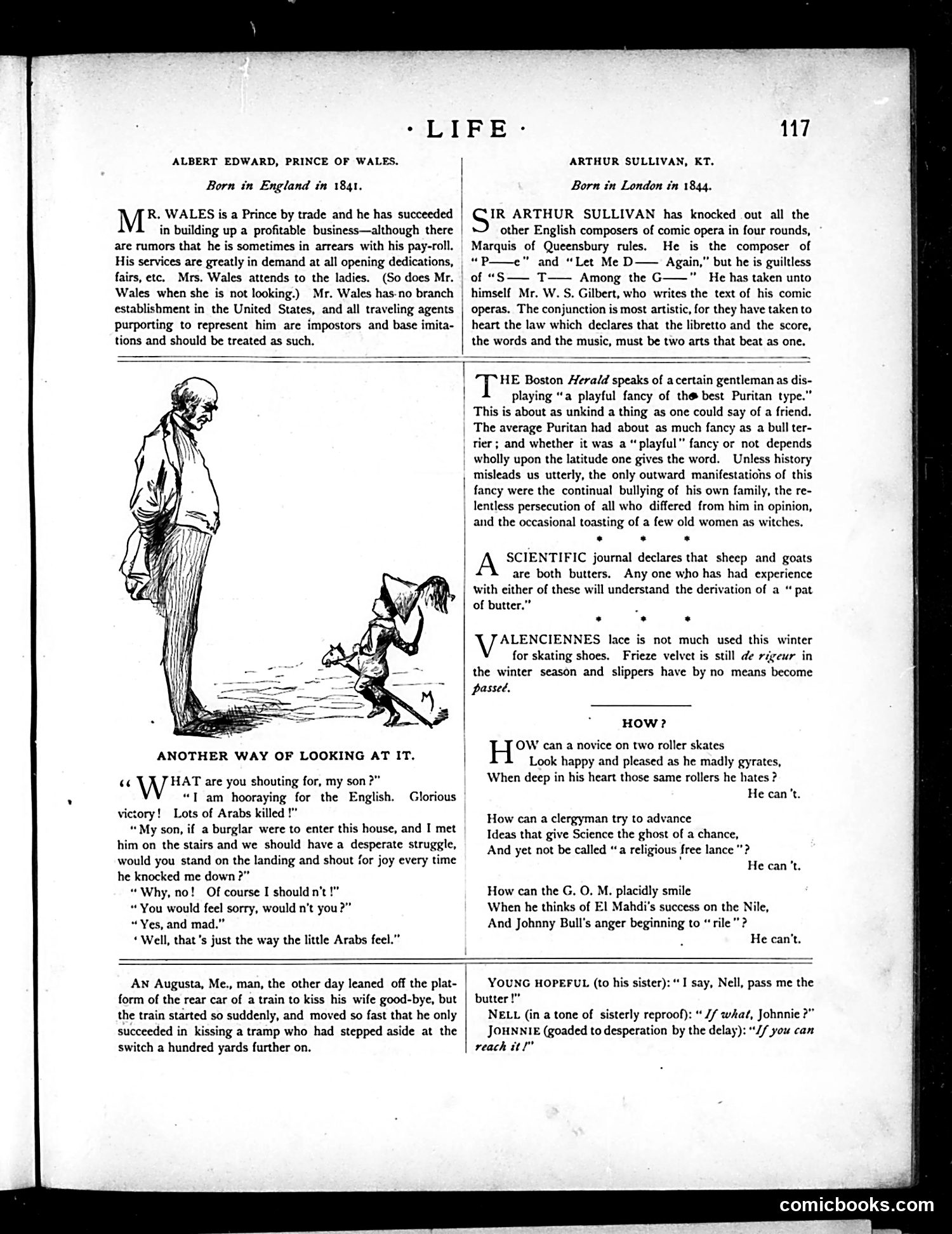
The left side features a cartoon titled "Another Way of Looking at It," depicting a tall man and small child. The accompanying dialogue satirizes British imperial attitudes: a father boasts about Arabs killed in colonial victories, while his young son innocently suggests that if a burglar entered their home, they'd struggle on the stairs—implying the father's martial prowess wouldn't help in actual combat. The humor mocks the disconnect between imperial swagger and practical reality. The right side contains miscellaneous satirical pieces about social absurdities (sheep as butter, skating fashion, roller skates, religious hypocrisy). The "How?" section uses impossible scenarios for comedic effect, highlighting societal contradictions and pretensions. Overall, this page blends Victorian-era social commentary with gentle mockery of period attitudes and fashions.
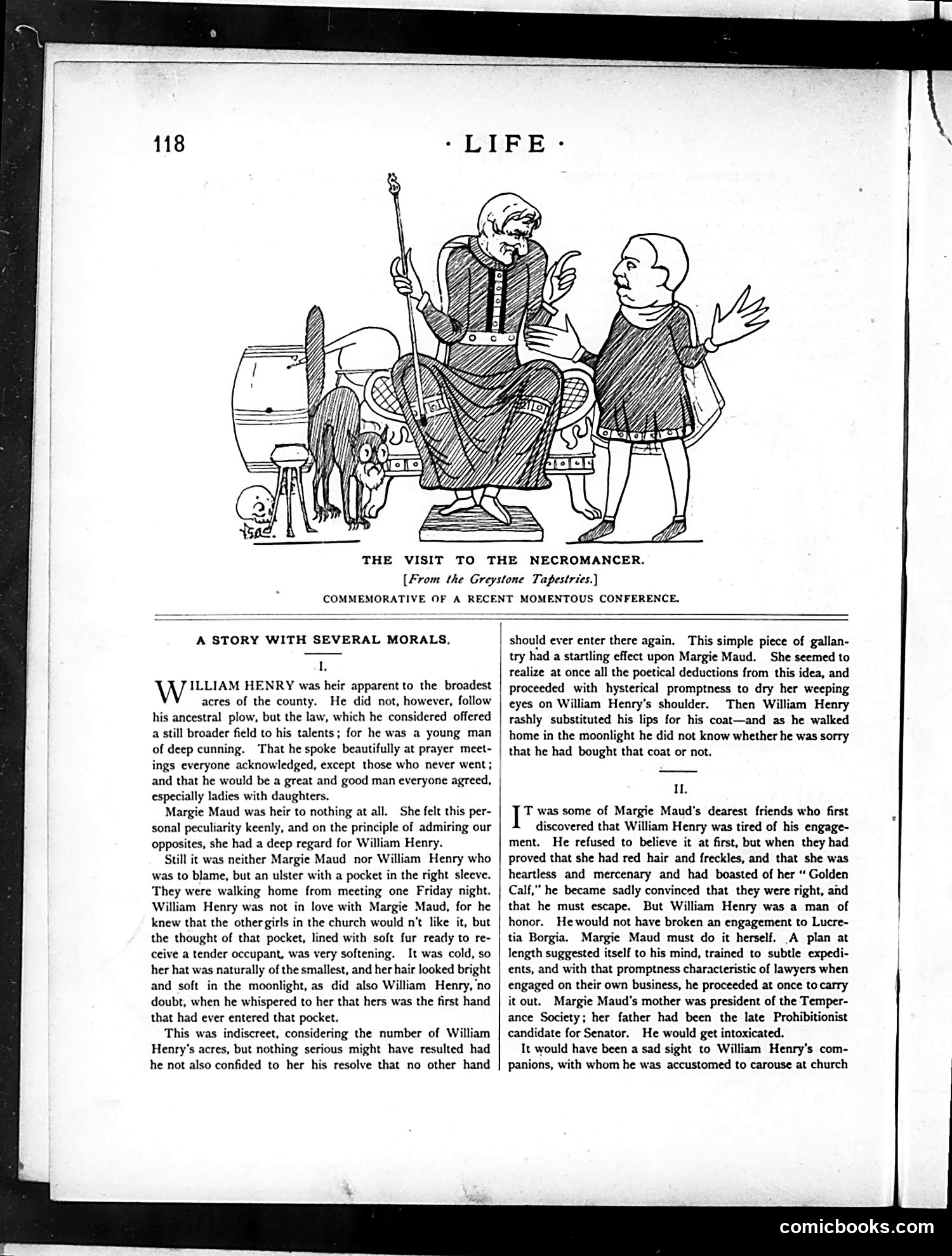
The main illustration, titled "The Visit to the Necromancer," appears to be a satirical commentary on a recent political conference, though the specific event is not identified in the visible text. The cartoon depicts a figure in medieval dress (representing a "necromancer" or spiritualist) consulting with what appear to be political figures. The satire likely mocks either spiritualism's popularity among elites or a specific politician's alleged consultation with occult practices—a common taunt in early 20th-century American politics. The accompanying story, "A Story with Several Morals," concerns William Henry and Margie Maud's relationship troubles, using their romantic drama to illustrate social commentary about honor, engagement, and character. The narrative appears moralistic rather than overtly political. Without additional context identifying the specific conference referenced, the full satirical target remains unclear.
This page consists primarily of **text rather than political cartoons**. The main content includes: 1. **A serialized story** (sections III and IV) about William Henry, apparently a character involved in courtroom drama and asylum commitment. 2. **"Mark Twain's Blood-Curdling Humor"** — a sidebar promoting humorous content from Mark Twain's works, specifically highlighting his story about Huck Finn and various comedic episodes (a pig-killing scene, funeral descriptions, etc.). 3. **"Lines" poem** — verses by J.A. Macon about a railroad eating-house. 4. **"Books Received"** section listing recent publications. No political commentary or social satire is evident on this particular page. It appears to be a typical **literary and entertainment page** from Life magazine's satirical publication.
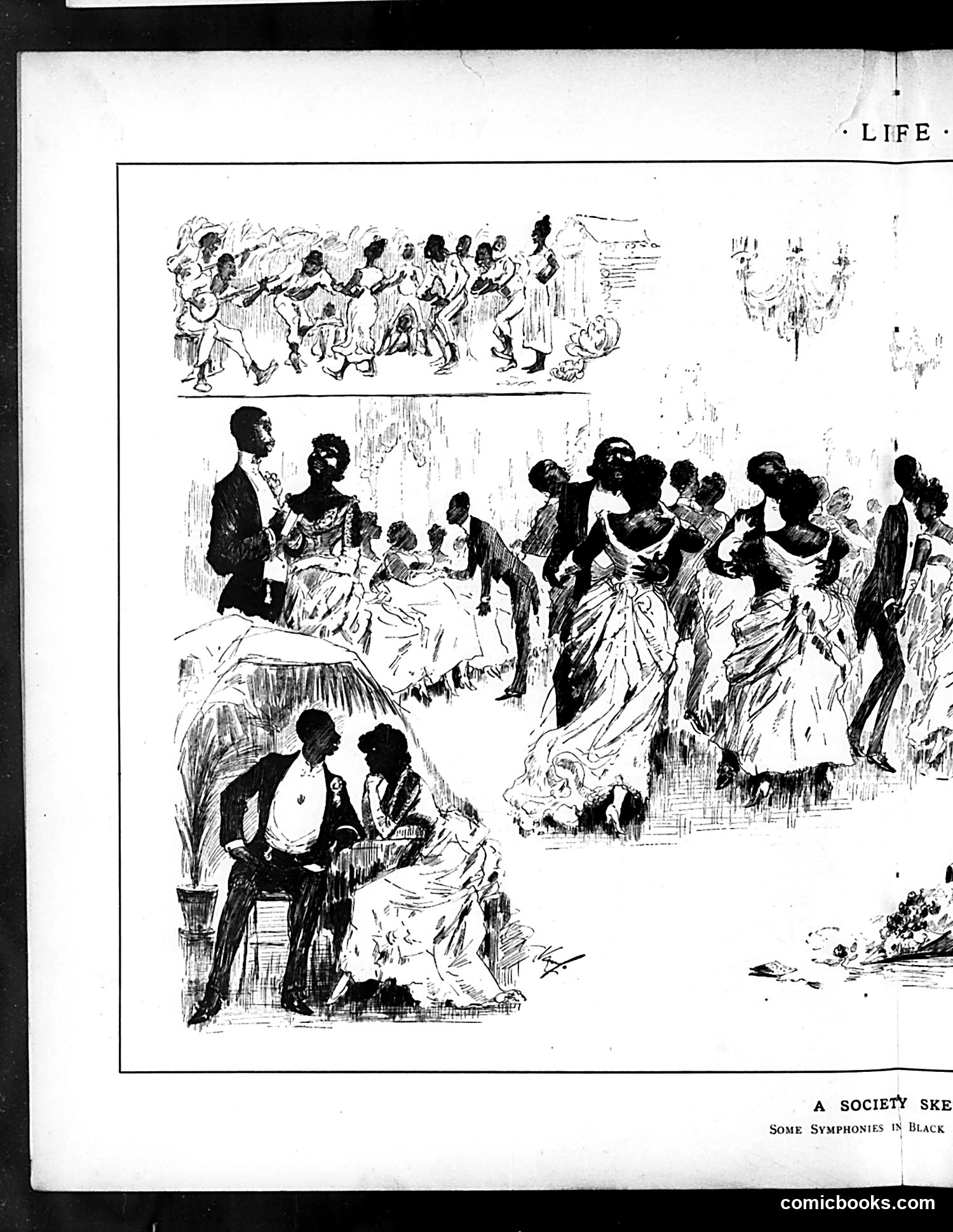
This satirical illustration mocks high society gatherings through three sketched scenes. The top panel shows lively, energetic figures in casual poses—likely depicting "vulgar" behavior. The middle scene portrays formally-dressed attendees at what appears to be an elegant social event, with a man and woman in conversation among gathered guests in gowns. The bottom panel shows an intimate moment between two figures under an umbrella. The title's reference to "symphonies in black" (suggesting orchestrated social performances) combined with the varying depictions suggests satire about class pretension—contrasting genuine liveliness with stiff formality. The cartoon likely criticizes how society events constrain natural human expression through rigid etiquette and artificial behavior, presenting societal rules as inauthentic "performances."
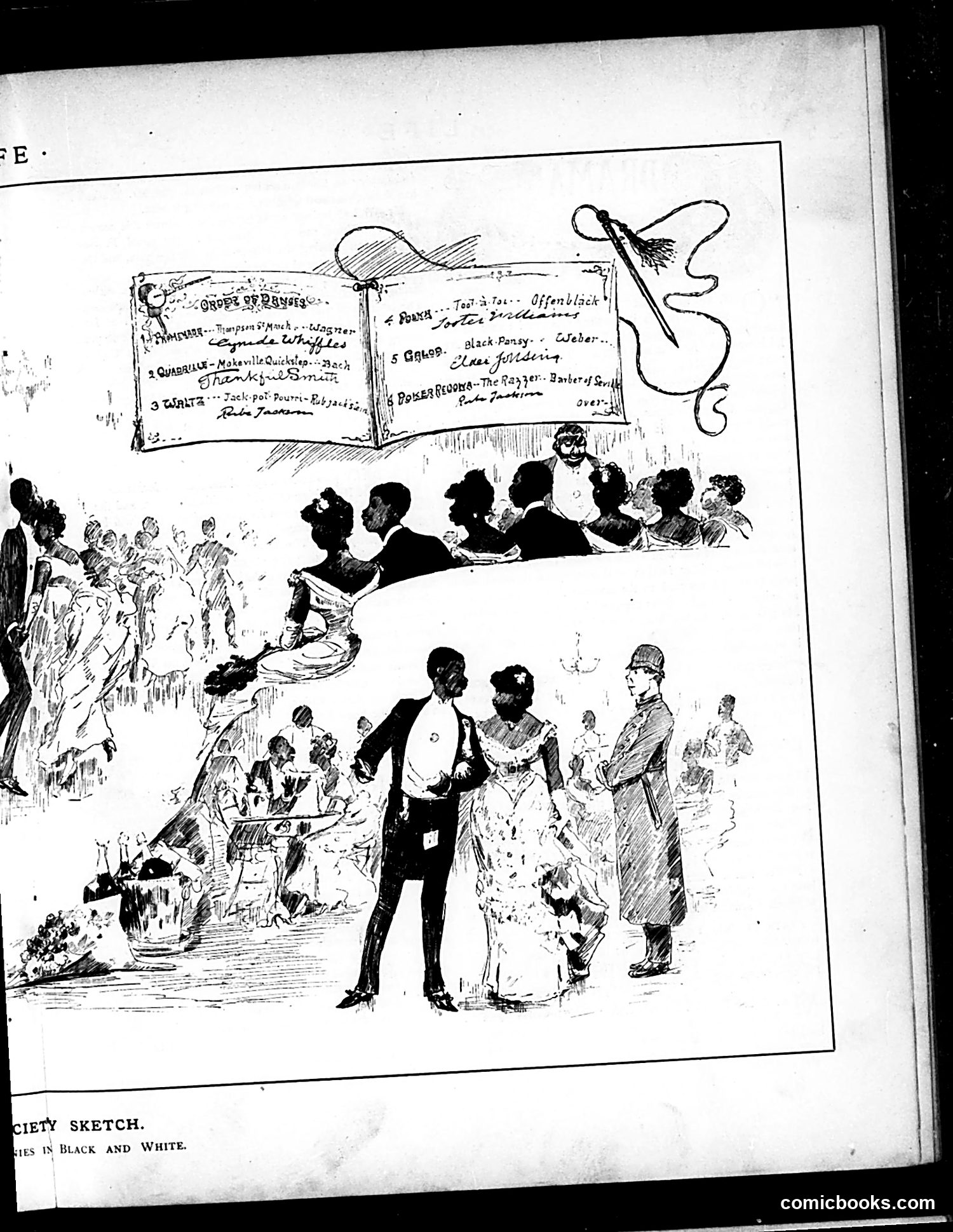
This is a satirical illustration titled "Society Sketch" depicting a fashionable social gathering. The sketch shows two distinct scenes: the upper portion displays what appears to be a menu or guest list (though the specific names are difficult to read clearly in this reproduction), while the lower scene depicts elegantly dressed men and women at what seems to be an upscale social event or party. The satire likely targets the pretensions and social conventions of wealthy society circles—the formality of dress, the importance placed on guest lists and menu selections, and the ritualistic nature of high-society gatherings. The exaggerated linework and caricatured figures are typical of Life magazine's approach to mocking the affectations of the upper classes during this era.
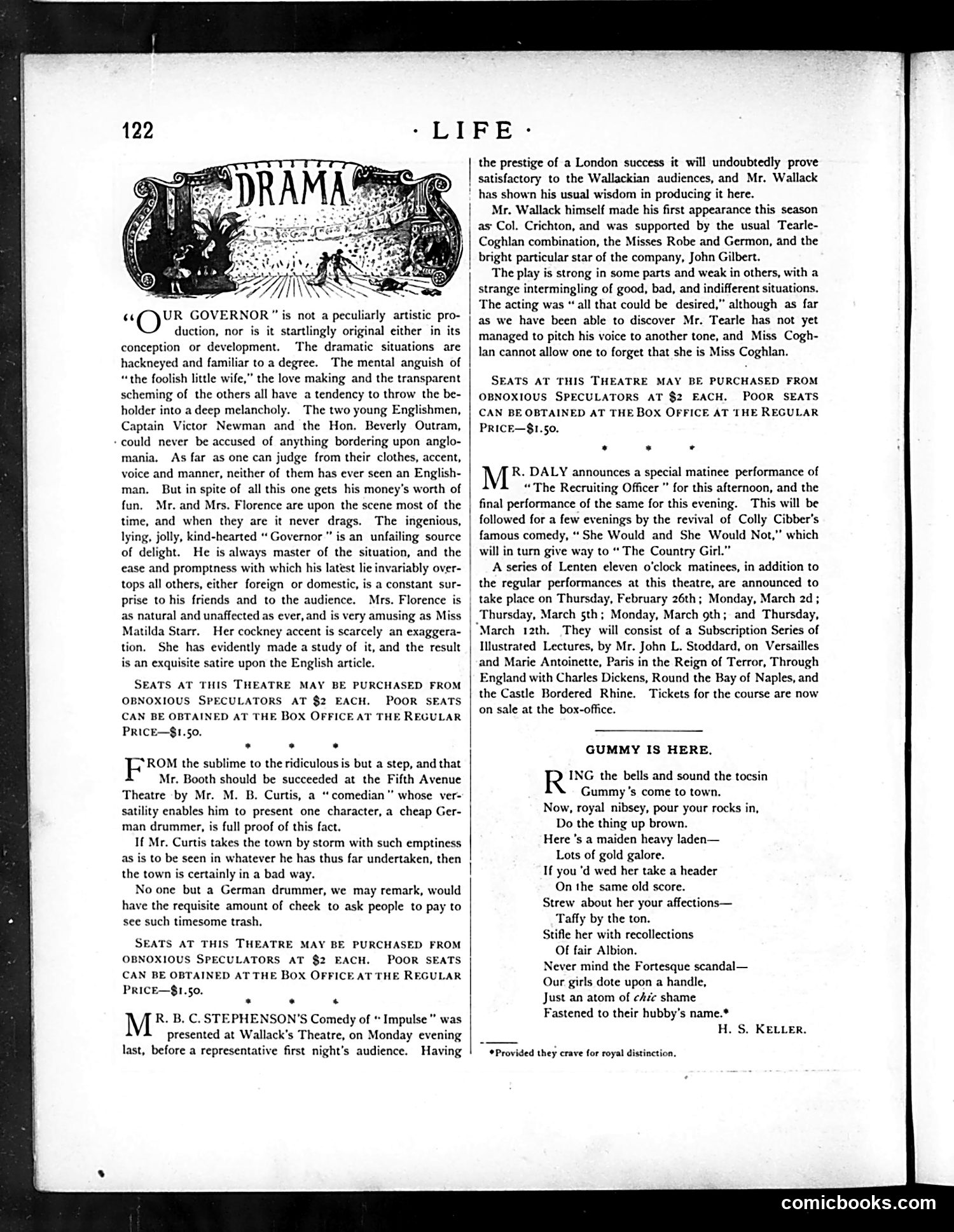
This is a theater criticism page with no political cartoons. Life magazine's editors savage theatrical productions with cutting satire: **"Our Governor"**: Praised despite hackneyed plot—the real appeal is the character actor playing the "Governor," who excels at rapid-fire lying and improvisational charm. Mrs. Florence's Cockney accent is noted as both exaggerated and expertly satirical of English mannerisms. **M.B. Curtis vehicle**: Viciously mocked. The critic compares Curtis unfavorably to his predecessor at the Fifth Avenue Theatre, calling his German-drummer character "timesome trash" and questioning why audiences pay to see such emptiness. This reflects period prejudice against ethnic stereotypes performed badly. **Wallack's Theatre**: Reviews B.C. Stephenson's imported London comedy "Impulse" favorably, though notes uneven performances and an actor (Tearle) who cannot vary his delivery. The repeated joke: scalpers charge $2 for good seats; legitimate box office sells poor seats at $1.50—satirizing theater ticket speculation.
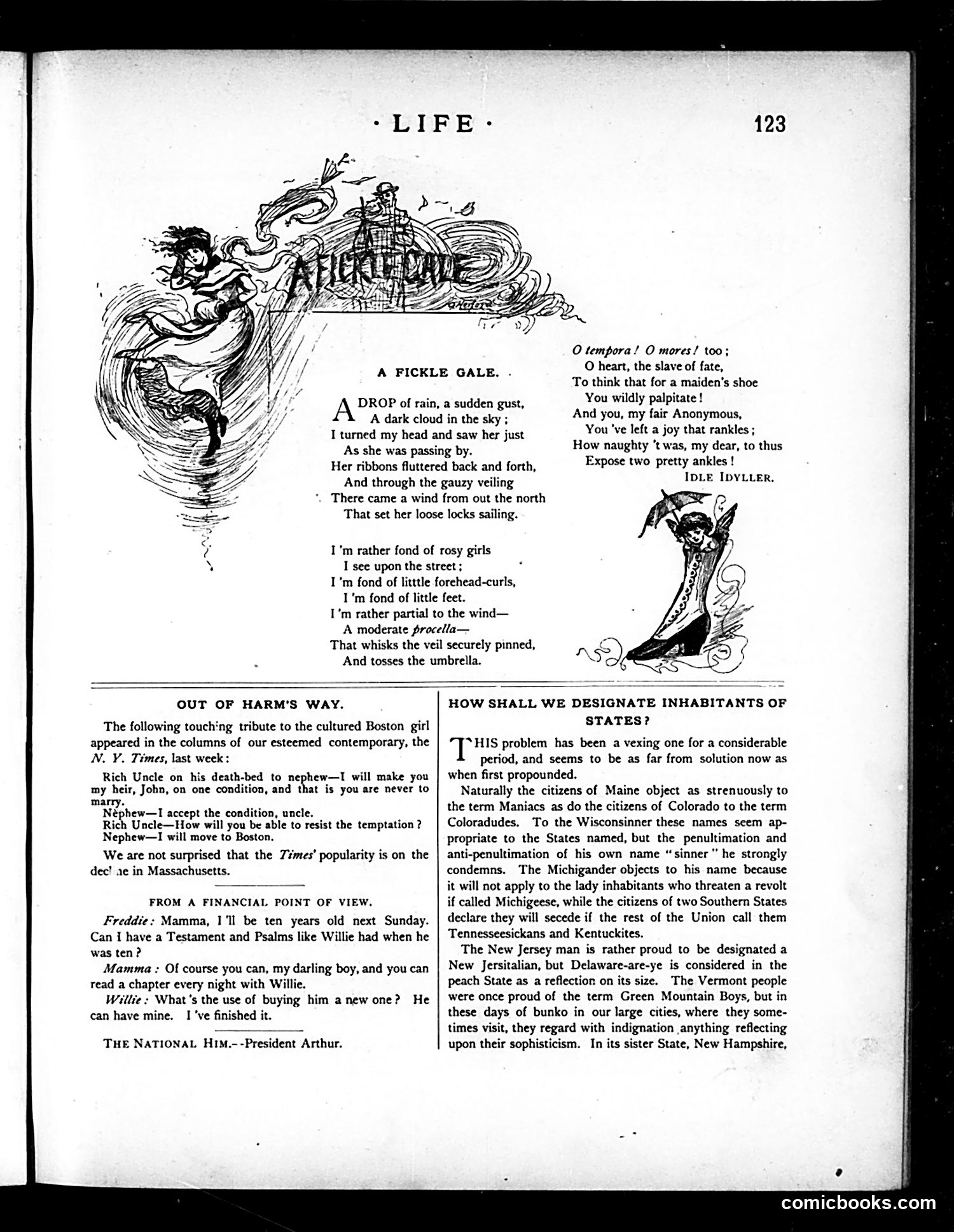
**The Main Cartoon**: An illustrated poem mocking a man's infatuation with a woman whose wind-blown skirts and loose hair briefly expose her ankles and legs. The "fickle gale" allows him a fleeting, accidental glimpse. The humor targets both his shallow attraction to physical exposure and the absurdity of Victorian propriety—where merely seeing a woman's ankles is scandalous enough to cause emotional turmoil ("wildly palpitate"). **The Surrounding Satire**: Three brief comic pieces mock social pretensions: Boston girls are so unappealing that moving there prevents marriage; a child asks for a Bible as a birthday gift only to receive his brother's already-finished copy (implying religious indifference); and state demonyms create ridiculous linguistic tangles (Coloradudes, Michigeese, Tennesseesickans). The overall tone is lighthearted social commentary on Victorian manners, religious hypocrisy, and naming conventions.
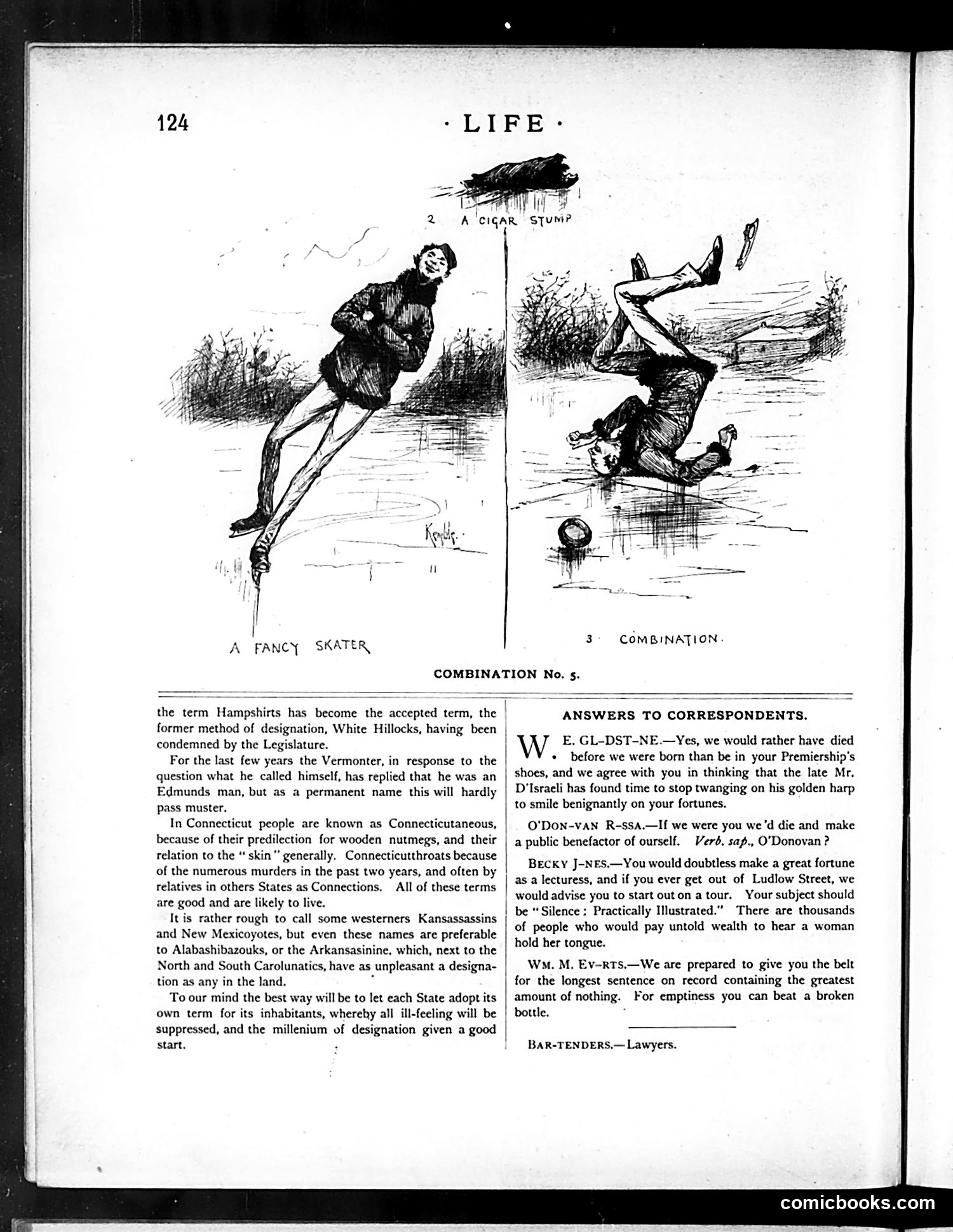
This page contains two sections: whimsical ice-skating illustrations and satirical text. **The Cartoons:** Two simple line drawings labeled "A Fancy Skater" and "Combination" depict people performing ice-skating tricks or falling. These appear to be lighthearted sport illustrations with no apparent political content. **The Main Text:** A lengthy article humorously proposes nicknames for residents of different U.S. states. It mocks state stereotypes—Connecticut residents as "Connecticutaneous" (referencing wooden nutmegs and murders), westerners as "Kansassassins," and states like Arkansas as "Arkansasinine." The piece satirizes both regional prejudices and awkward nomenclature, advocating that each state adopt its own self-chosen term. **The "Answers to Correspondents":** This section parodies advice columns with barbed, insulting responses to apparent readers—likely fictional. References to "D'Israeli" suggest late 19th-century context. The final quip equating "Bar-tenders" with "Lawyers" offers cynical social commentary. Overall, this represents typical 19th-century American satirical magazine humor: state-based stereotyping, wordplay, and sardonic social criticism.
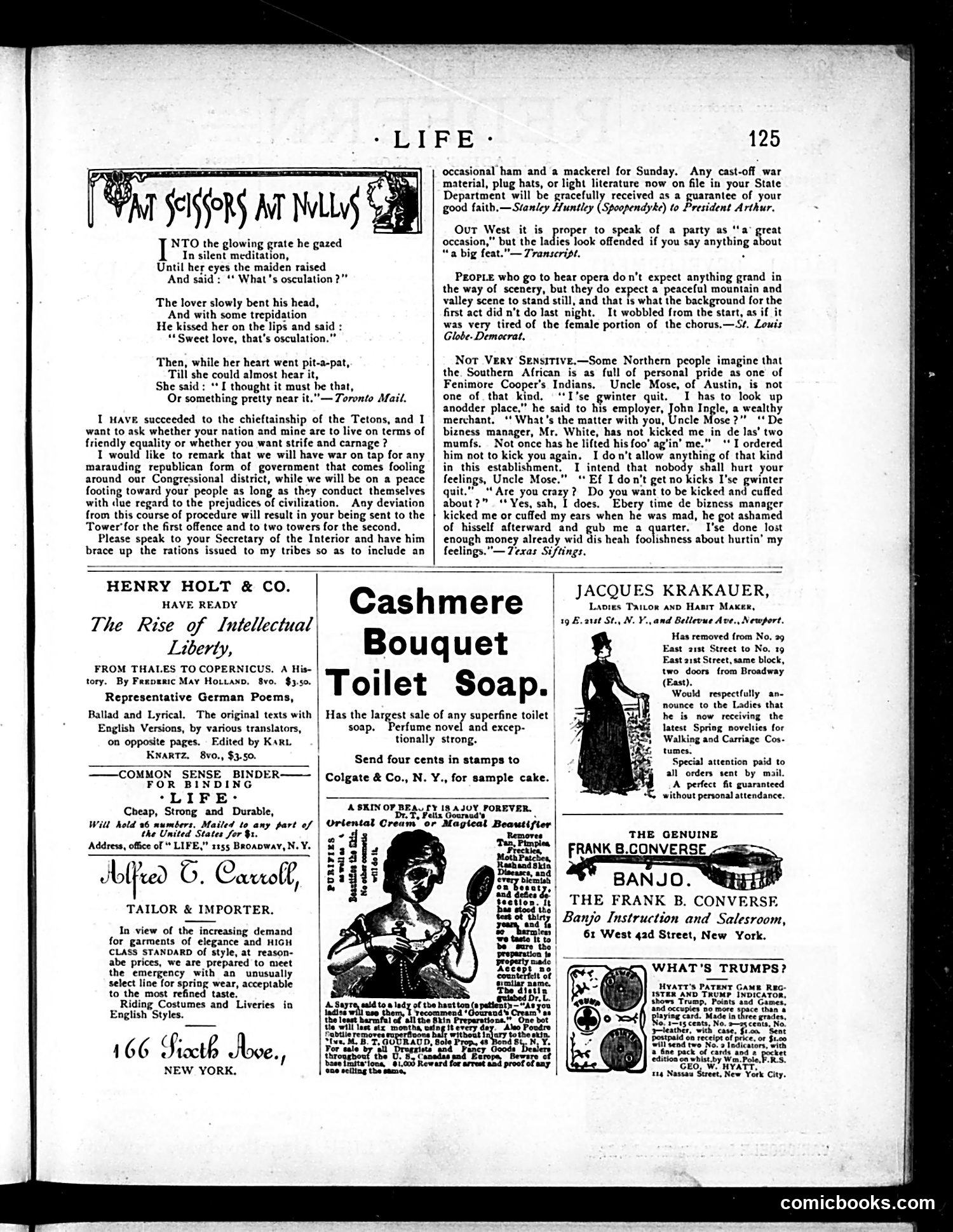
This page consists primarily of **humorous short anecdotes and advertisements** rather than political cartoons. The main humor pieces include: a romantic poem about a young couple where the man explains "osculation" (kissing) through demonstration; a satirical letter from a Native American ("Spoopendyke") claiming chieftainship of the Tetons and demanding rations from the federal government (likely mocking both Indian affairs policy and grandiose political language); and a joke about an African American worker in Texas who *wants* to be kicked by his boss because it results in guilt-money payments. The third piece relies on now-offensive racial stereotypes and dialect humor common to 1880s-era American publications. The satire targets workplace exploitation more than the worker himself, though the execution is deeply uncomfortable by modern standards. The rest is period advertising for books, soap, and tailoring services.
This page is predominantly **advertising**, typical of late-19th-century publications. The main satirical content appears in the "DID AND DIDN'T" section—a brief comedic dialogue about a street boy pestering a man carrying his own valise. **The Humor:** The joke mocks urban life and class dynamics. A persistent street urchin repeatedly offers to carry a man's baggage for a dime, despite refusals. When the man finally snaps "I don't want it carried," the boy delivers the punchline: "Well, mister, what the dickens are you carrying it for? Why don't you set it down?"—absurdist logic that exposes the man's illogical stubbornness. A secondary joke follows about "gloaming" (twilight)—a satire on furniture store marketing, pretending "gloaming" is a fashionable parlor piece one can purchase. **Context:** These are light, observational humor pieces rather than political commentary—typical of Life's satirical approach to everyday American social interactions and consumer culture of the 1880s.
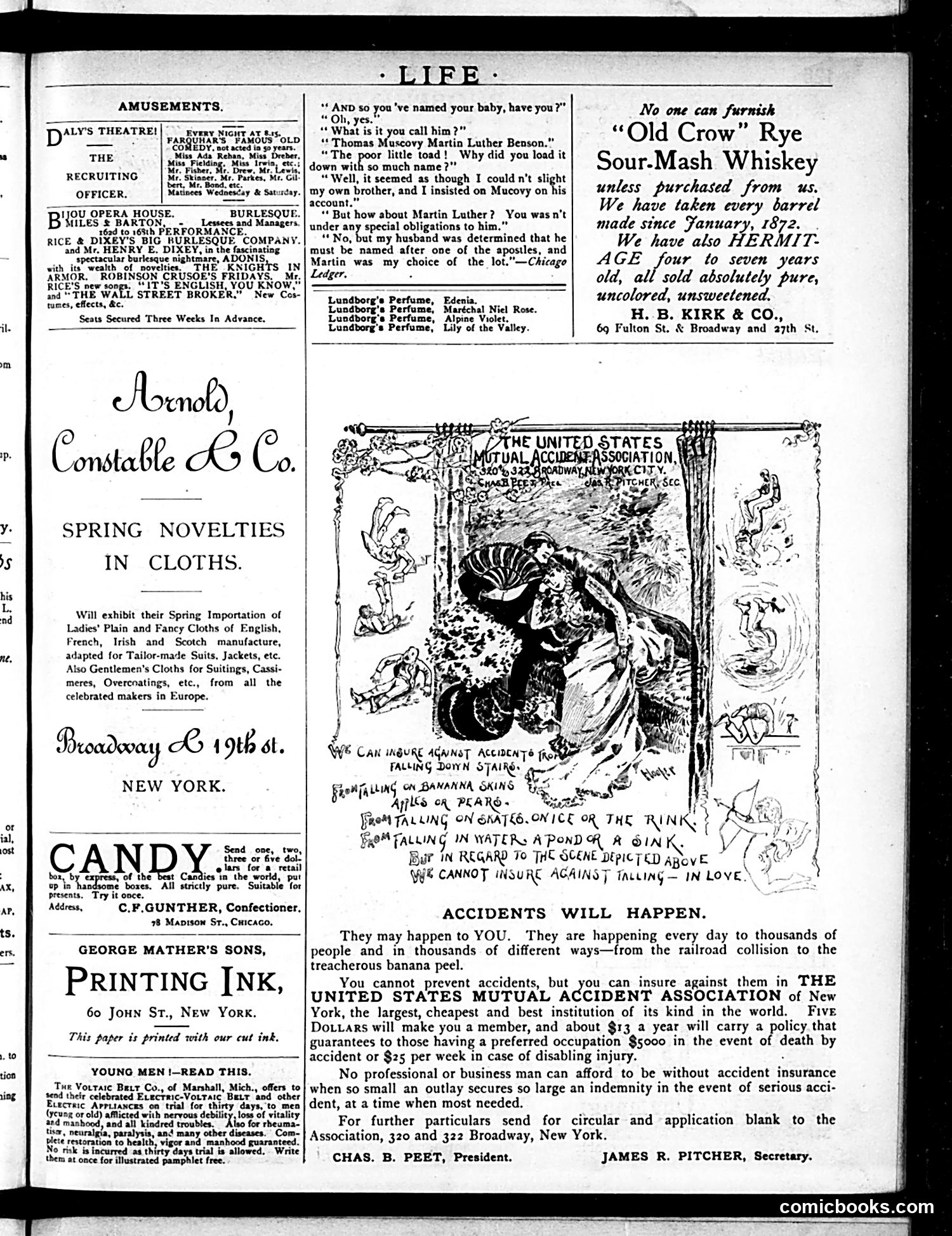
This page is primarily **advertisements and theatrical notices** with one satirical cartoon. **The Main Cartoon:** A large illustration from the United States Mutual Accident Association depicts various comedic mishaps—falling down stairs, slipping on banana peels, falling on ice, falling in water. The caption reads "we cannot insure against falling—in love," making a pun: the insurance company covers physical accidents but not romantic ones. **The Joke's Context:** This reflects Victorian-era assumptions that "falling in love" is as inevitable and potentially disastrous as physical accidents—treating romantic entanglement as a humorous misfortune. The banana peel reference was a stock comedy trope of the era. **Supporting Content:** A brief comedic dialogue about naming a baby "Thomas Muscovy Martin Luther Benson" satirizes excessive Victorian naming practices, where parents burdened children with multiple names honoring relatives or religious figures. The page otherwise contains theater advertisements, clothing retailers, candy sellers, and patent medicine ads typical of 1870s-80s Life magazine content.