
Life, 1885-02-26 · page 7 of 16
Life — February 26, 1885 — page 7: what you’re looking at
What you’re looking at
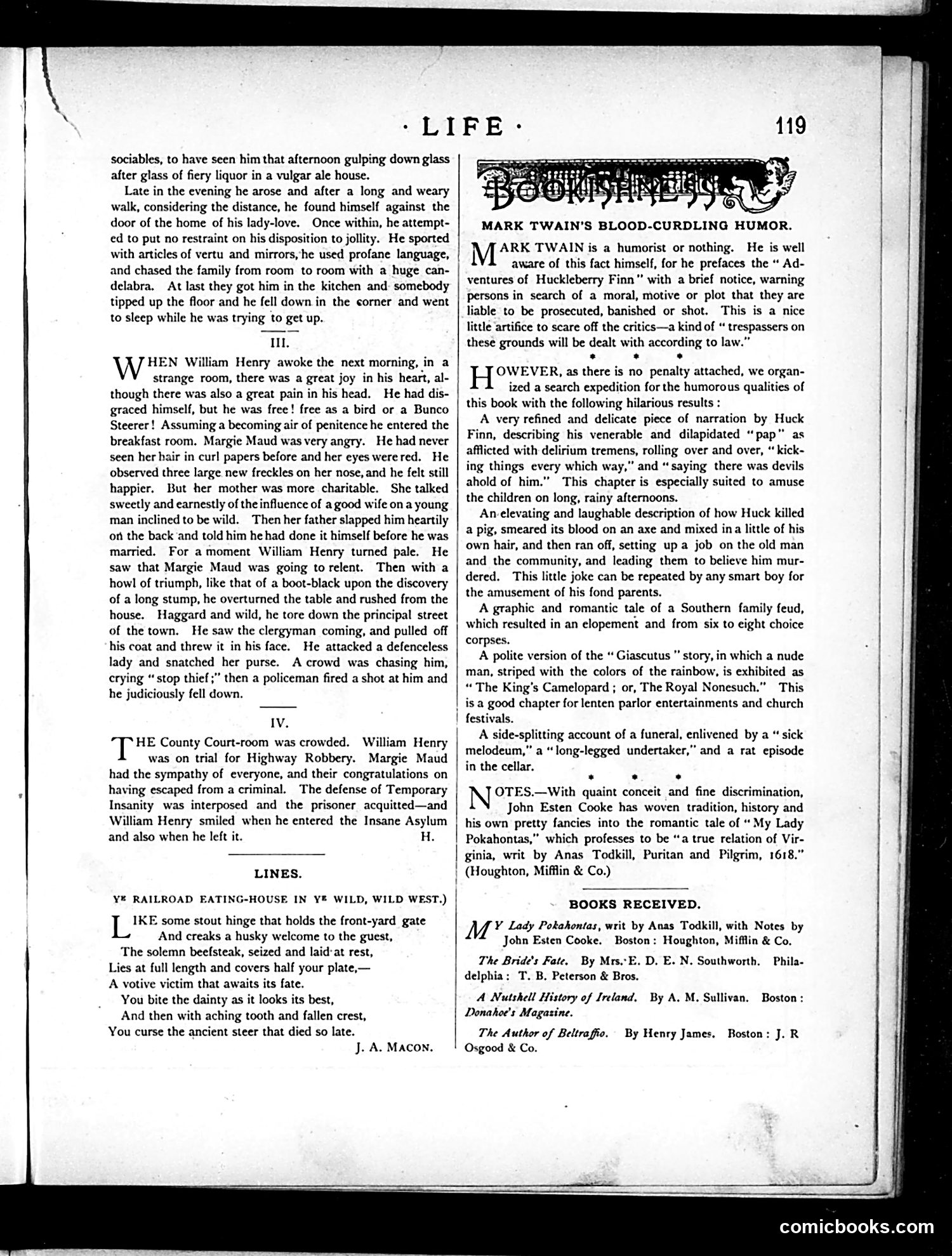
This page consists primarily of **text rather than political cartoons**. The main content includes: 1. **A serialized story** (sections III and IV) about William Henry, apparently a character involved in courtroom drama and asylum commitment. 2. **"Mark Twain's Blood-Curdling Humor"** — a sidebar promoting humorous content from Mark Twain's works, specifically highlighting his story about Huck Finn and various comedic episodes (a pig-killing scene, funeral descriptions, etc.). 3. **"Lines" poem** — verses by J.A. Macon about a railroad eating-house. 4. **"Books Received"** section listing recent publications. No political commentary or social satire is evident on this particular page. It appears to be a typical **literary and entertainment page** from Life magazine's satirical publication.
📄 Transcribed text from this page (OCR, searchable)
Machine-transcribed from the original scan — historical spelling and the odd misread are preserved.
sociables, to have seen him that afternoon gulping down glass after glass of fiery liquor in a vulgar ale house. Late in the evening he arose and after a long and weary walk, considering the distance, he found himself against the door of the home of his lady-love. Once within, he attempt- ed to put no restraint on his disposition to jollity. He sported with articles of vertu and mirrors,he used profane language, and chased the family from room to room with a huge can- delabra. At last they got him in the kitchen and: somebody tipped up the floor and he fell down in the corner and went to sleep while he was trying to get up. Il. HEN William Henry awoke the next morning, in a strange room, there was a great joy in his heart, al- though there was also a great pain in his head, He had dis- graced himself, but he was free! free as a bird or a Bunco Steerer! Assuming a becoming air of penitence he entered the breakfast room. Margie Maud was very angry. He had never seen her hair in curl papers before and her eyes werered. He observed three large new freckles on her nose, and he felt still happier. But her mother was more charitable. She talked sweetly and earnestly of the influence of a good wife on a young man inclined to be wild. Then her father slapped him heartily on the back and told him he had done it himself before he was married. For a moment William Henry turned pale. He saw that Margie Maud was going to relent. Then with a howl of triumph, like that of a boot-black upon the discovery of a long stump, he overturned the table and rushed from the house. Haggard and wild, he tore down the principal street of the town. He saw the clergyman coming, and pulled off his coat and threw it in his face. He attacked a defenceless lady and snatched her purse. A crowd was chasing him, crying “ stop thief ;” then a policeman fired a shot at him and he judiciously fell down. IV. HE County Court-room was crowded. William Henry was on trial for Highway Robbery. Margie Maud had the sympathy of everyone, and their congratulations on having escaped from a criminal. The defense of Temporary Insanity was interposed and the prisoner acquitted—and William Henry smiled when he entered the Insane Asylum and also when he left it. H. LINES. Y® RAILROAD EATING-HOUSE IN Y® WILD, WILD WEST.) IKE some stout hinge that holds the front-yard gate And creaks a husky welcome to the guest, The solemn beefsteak, seized and laid:at rest, Lies at full length and covers half your plate,— A votive victim that awaits its fate. You bite the dainty as it looks its best, And then with aching tooth and fallen crest, You curse the ancient steer that died so late. J. A. Macon. - LIFE: MARK TWAIN'S BLOOD-CURDLING HUMOR. ARK TWAIN is a humorist or nothing. He is well i aware of this fact himself, for he prefaces the “ Ad- ventures of Huckleberry Finn" with a brief notice, warning persons in search of a moral, motive or plot that they are liable to be prosecuted, banished or shot. This is a nice little ‘artifice to scare off the critics—a kind of “ trespassers on these grounds will be dealt with according to law.” . . . However: as there is no penalty attached, we organ- ized a search expedition for the humorous qualities of this book with the following hilarious results : A very refined and delicate piece of narration by Huck Finn, describing his venerable and dilapidated “pap” as afflicted with delirium tremens, rolling over and over, “ kick- ing things every which way,” and “saying there was devils ahold of him.” This chapter is especially suited to amuse the children on long, rainy afternoons. An-elevating and laughable description of how Huck killed a pig, smeared its blood on an axe and mixed ina little of his own hair, and then ran off, setting up a job on the old man and the community, and leading them to believe him mur- dered. This little joke can be repeated by any smart boy for the amusement of his fond parents. A graphic and romantic tale of a Southern family feud, which resulted in an elopement and from six to eight choice corpses, A polite version of the “ Giascutus " story, in which a nude man, striped with the colors of the rainbow, is exhibited as “ The King’s Camelopard ; or, The Royal Nonesuch.” This is a good chapter for lenten parlor entertainments and church festivals. A side-splitting account of a funeral, enlivened by a “ sick melodeum,” a “long-legged undertaker,” and a rat episode in the cellar. * . . OTES.—With quaint conceit and fine discrimination, John Esten Cooke has woven tradition, his own pretty fancies into the romantic tale of “ My Lady Pokahontas,” which professes to be “a true relation of Vir- ginia, writ by Anas Todkill, Puritan and Pilgrim, 1618.” (Houghton, Mifflin & Co.) BOOKS RECEIVED. MM’ Lady Pokahontas, writ by Anas Todkill, with Notes by John Esten Cooke. Boston: Houghton, Mifflin & Co, The Bride's Fate, By Mrs.E. D, E. N. Southworth. Phila- delphia: T. B, Peterson & Bros. A Nutshell History of Irland, By A. M. Sullivan, Boston: Donakoe's Magazine. The Author of Beltraffio. Osgood & Co. By Henry James, Roston: J. R comicbooks.com