
Life, 1885-02-26 · page 6 of 16
Life — February 26, 1885 — page 6: what you’re looking at
What you’re looking at
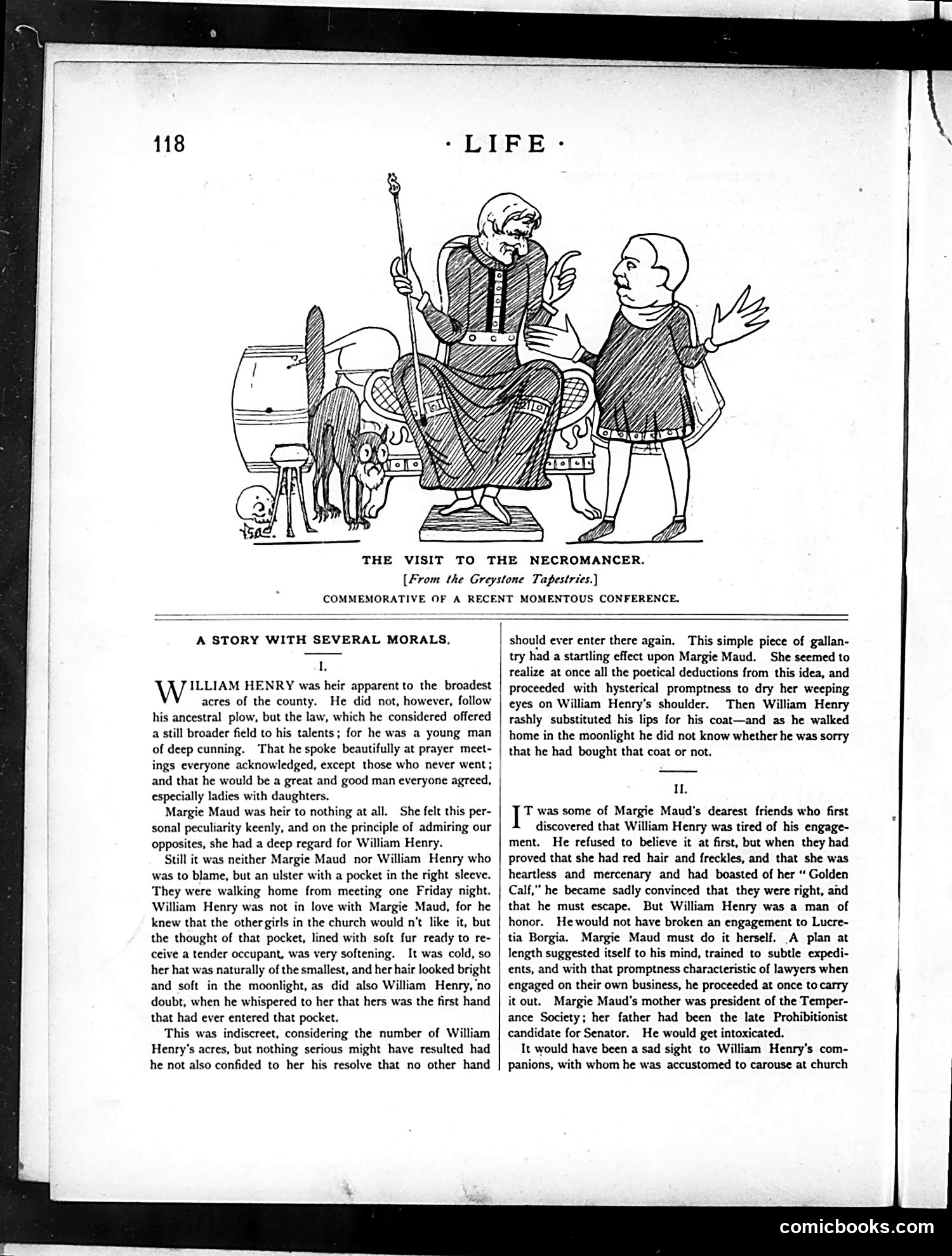
The main illustration, titled "The Visit to the Necromancer," appears to be a satirical commentary on a recent political conference, though the specific event is not identified in the visible text. The cartoon depicts a figure in medieval dress (representing a "necromancer" or spiritualist) consulting with what appear to be political figures. The satire likely mocks either spiritualism's popularity among elites or a specific politician's alleged consultation with occult practices—a common taunt in early 20th-century American politics. The accompanying story, "A Story with Several Morals," concerns William Henry and Margie Maud's relationship troubles, using their romantic drama to illustrate social commentary about honor, engagement, and character. The narrative appears moralistic rather than overtly political. Without additional context identifying the specific conference referenced, the full satirical target remains unclear.
📄 Transcribed text from this page (OCR, searchable)
Machine-transcribed from the original scan — historical spelling and the odd misread are preserved.
Y l oy Vidi. THE VISIT TO THE NECROMANCER. [From the Greystone Tapestries.) COMMEMORATIVE OF A RECENT MOMENTOUS CONFERENCE, A STORY WITH SEVERAL MORALS, Is ILLIAM HENRY was heir apparent to the broadest acres of the county. He did not, however, follow his ancestral plow, but the law, which he considered offered a still broader field to his talents; for he was a young man of deep cunning. That he spoke beautifully at prayer meet- ings everyone acknowledged, except those who never went; and that he would be a great and good man everyone agreed, especially ladies with daughters, Margie Maud was heir to nothing at all. She felt this per- sonal peculiarity keenly, and on the principle of admiring our opposites, she had a deep regard for William Henry. Still it was neither Margie Maud nor William Henry who was to blame, but an ulster with a pocket in the right sleeve. They were walking home from meeting one Friday night. William Henry was not in love with Margie Maud, for he knew that the other girls in the church would n't like it, but the thought of that pocket, lined with soft fur ready to re- ceive a tender occupant, was very softening. It was cold, so her hat was naturally of the smallest, and her hair looked bright and soft in the moonlight, as did also William Henry, ‘no doubt, when he whispered to her that hers was the first hand that had ever entered that pocket, This was indiscreet, considering the number of William Henry's acres, but nothing serious might have resulted had he not also confided to her his resolve that no other hand | should ever enter there again. This simple piece of gallan- try had a startling effect upon Margie Maud. She seemed to realize at once all the poetical deductions from this idea, and proceeded with hysterical promptness to dry her weeping eyes on William Henry's shoulder. Then William Henry rashly substituted his lips for his coat—and as he walked home in the moonlight he did not know whether he was sorry that he had bought that coat or not. T was some of Margie Maud's dearest friends who first discovered that William Henry was tired of his engage- ment. He refused to believe it at first, but when they had proved that she had red hair and freckles, and that she was heartless and mercenary and had boasted of her “ Golden Calf,” he became sadly convinced that they were right, and that he must escape. But William Henry was a man of honor. Hewould not have broken an engagement to Lucre- tia Borgia. Margie Maud must do it herself. A plan at length suggested itself to his mind, trained to subtle expedi- ents, and with that promptness characteristic of lawyers when engaged on their own business, he proceeded at once to carry it out. Margie Maud’s mother was president of the Temper- ance Society; her father had been the late Prohibitionist candidate for Senator. He would get intoxicated. It would have been a sad sight to William Henry's com- panions, with whom he was accustomed to carouse at church comicbooks.com