
A complete issue · 16 pages · 1885
Life — February 19, 1885
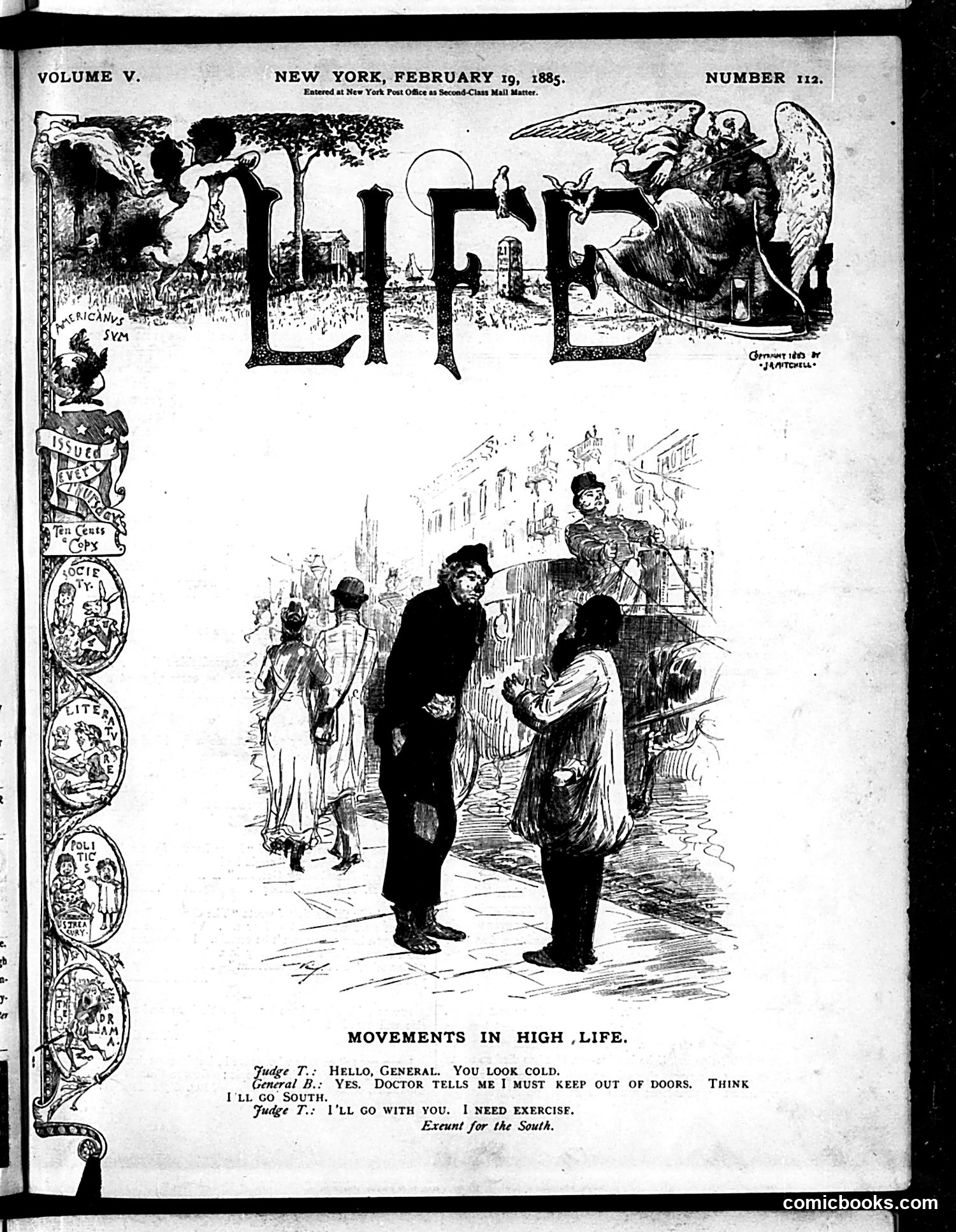
This cartoon satirizes the social pretensions of the wealthy during Reconstruction-era America. The central scene depicts two gentlemen ("Judge T.") in an urban setting, with one appearing ill or infirm. The dialogue reveals the joke: a wealthy Northerner visiting the South under the pretext of medical necessity ("doctor tells me I must keep out of doors"), when his actual motivation is escaping Northern winter for leisure. The caption "Escunt for the South" (likely "Excursion for the South") mocks how Northern elites justified pleasure trips South as health-related. The elaborate decorative border on the left contains vignettes, typical of Life's design. This reflects post-Civil War social dynamics where Northern wealth increasingly mingled with Southern society.
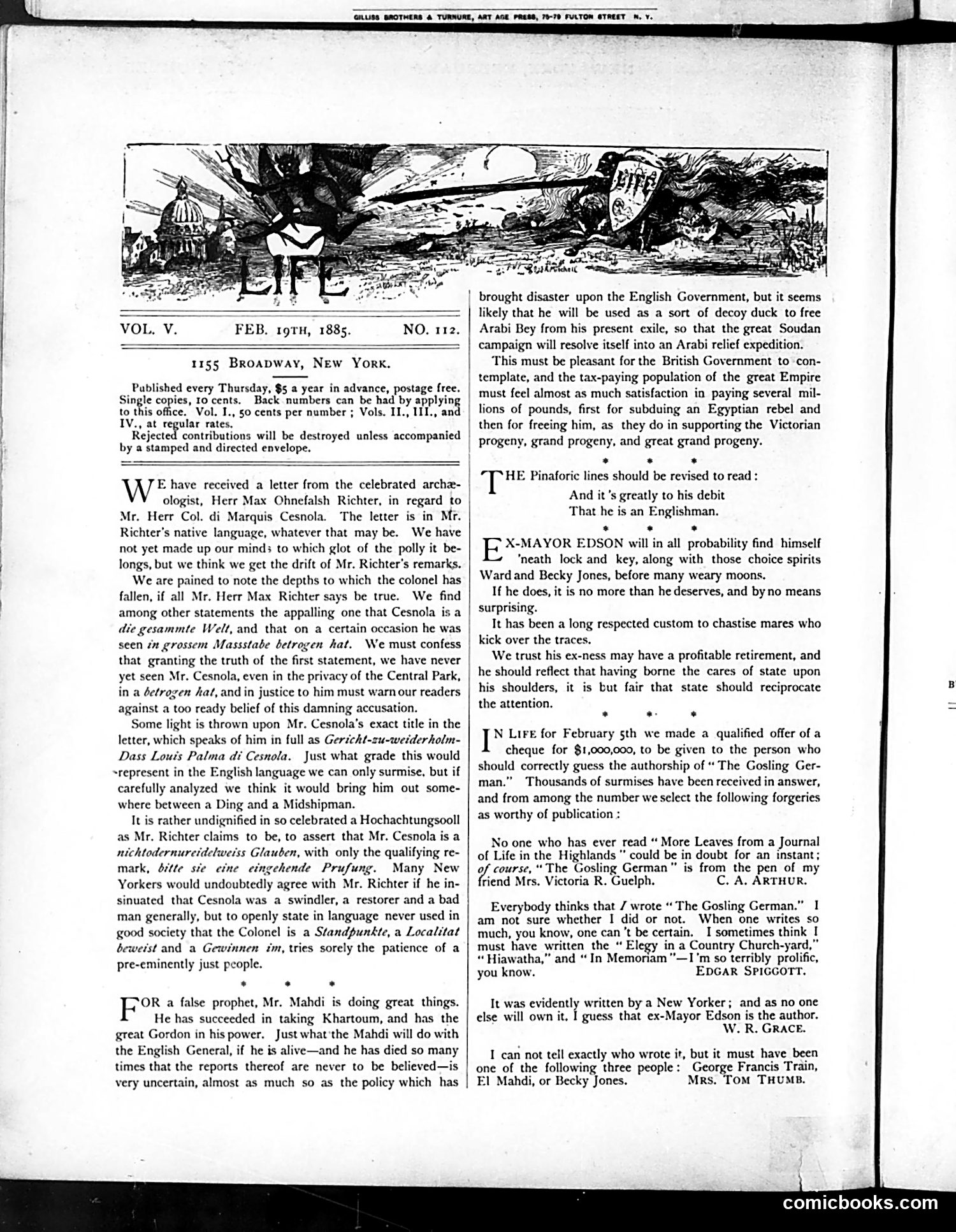
The masthead illustration shows a winged figure labeled "LIFE" overlooking a landscape with a church dome (likely St. Paul's Cathedral, London) and what appears to be a flag or banner on the right. The text on this page consists entirely of editorial commentary and reader letters—no political cartoons are visible. The articles discuss: 1. A letter from archaeologist Max Oberländer Richter regarding Colonel Cesnola's claims 2. Commentary on the Mahdi's military successes in Sudan against British forces 3. Reader submissions claiming authorship of "The Gosling German," a recent published piece This page functions as the magazine's opinion and correspondence section rather than featuring satirical illustrations. The humor is primarily textual and ironic rather than visual.
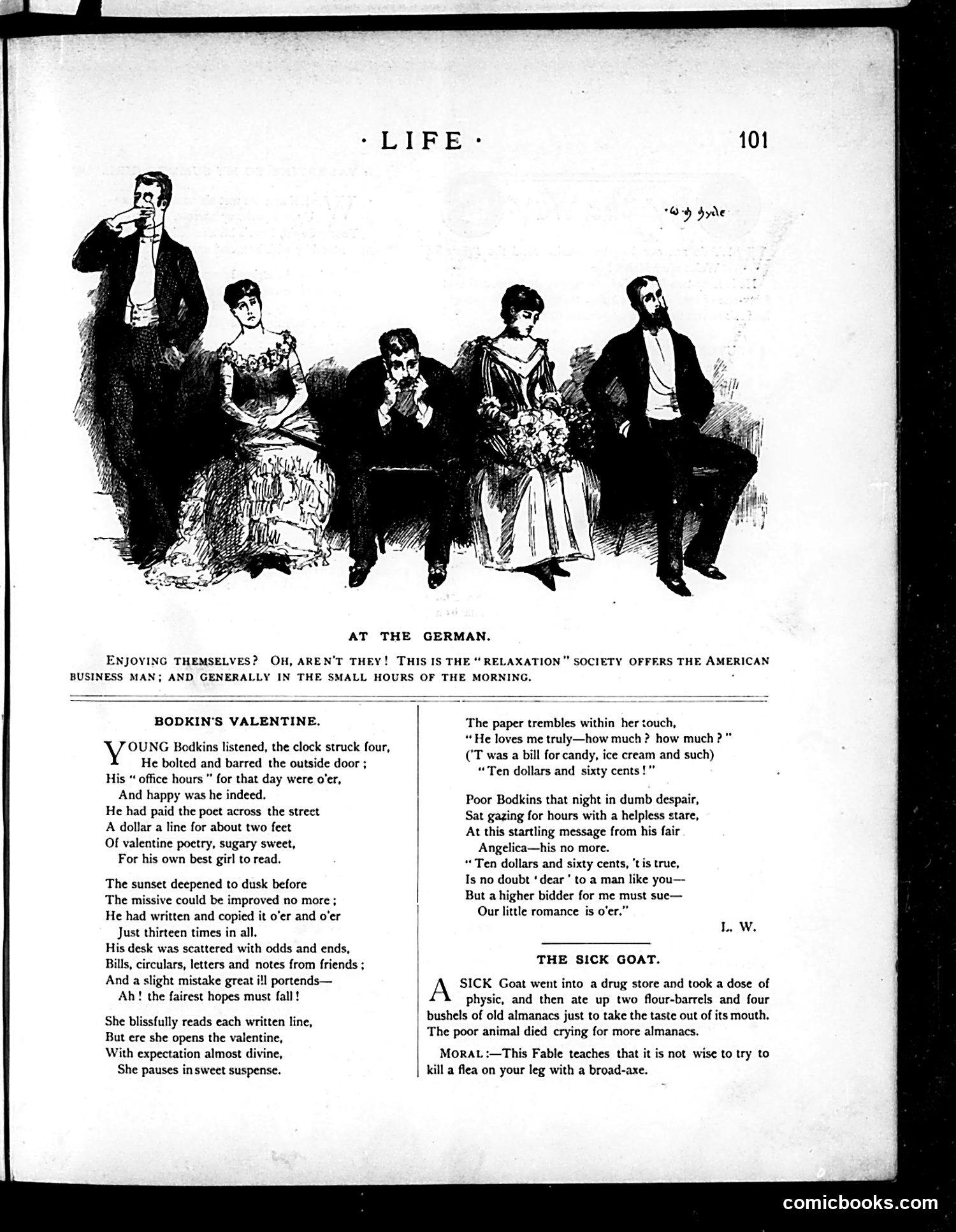
**"At the German"** cartoon depicts five well-dressed people at what appears to be a German restaurant or social establishment. The caption ironically celebrates this as a "relaxation society" that offers American businessmen leisure during morning hours—suggesting these men were shirking work responsibilities to socialize. The cartoon satirizes the emerging leisure culture and German-American social establishments popular in early 20th-century American cities, mocking businessmen who frequented such venues instead of working. Below are two literary pieces: "Bodkin's Valentine" tells a humorous story about a young man's rejected valentine to a girl, and "The Sick Goat" presents a moral fable about unwise actions. The page reflects period attitudes toward work ethic, immigrant social spaces, and romantic misadventure.
This page contains social commentary and gossip rather than political cartoons. The "By the Way" column offers satirical observations on contemporary American life: - **Prince of Wales reference**: Criticizes English cousins for not sending the Prince after the Mahdi (colonial military campaign) - **Boutonnieres**: Mocks the winter fashion trend of oversized boutonnieres renting for $3.50 nightly - **Undressed kids at opera**: Satirizes Philadelphia society's acceptance of improperly dressed children - **Defaulting cashier**: Notes ironically that a trusted Sunday School Superintendent embezzled and fled to Montreal The right column features a romantic poem "A Valentine to My Summer Girl" and society gossip about Avenue etiquette and weather reports. The overall tone is witty mockery of upper-class American and European society's pretensions and scandals.
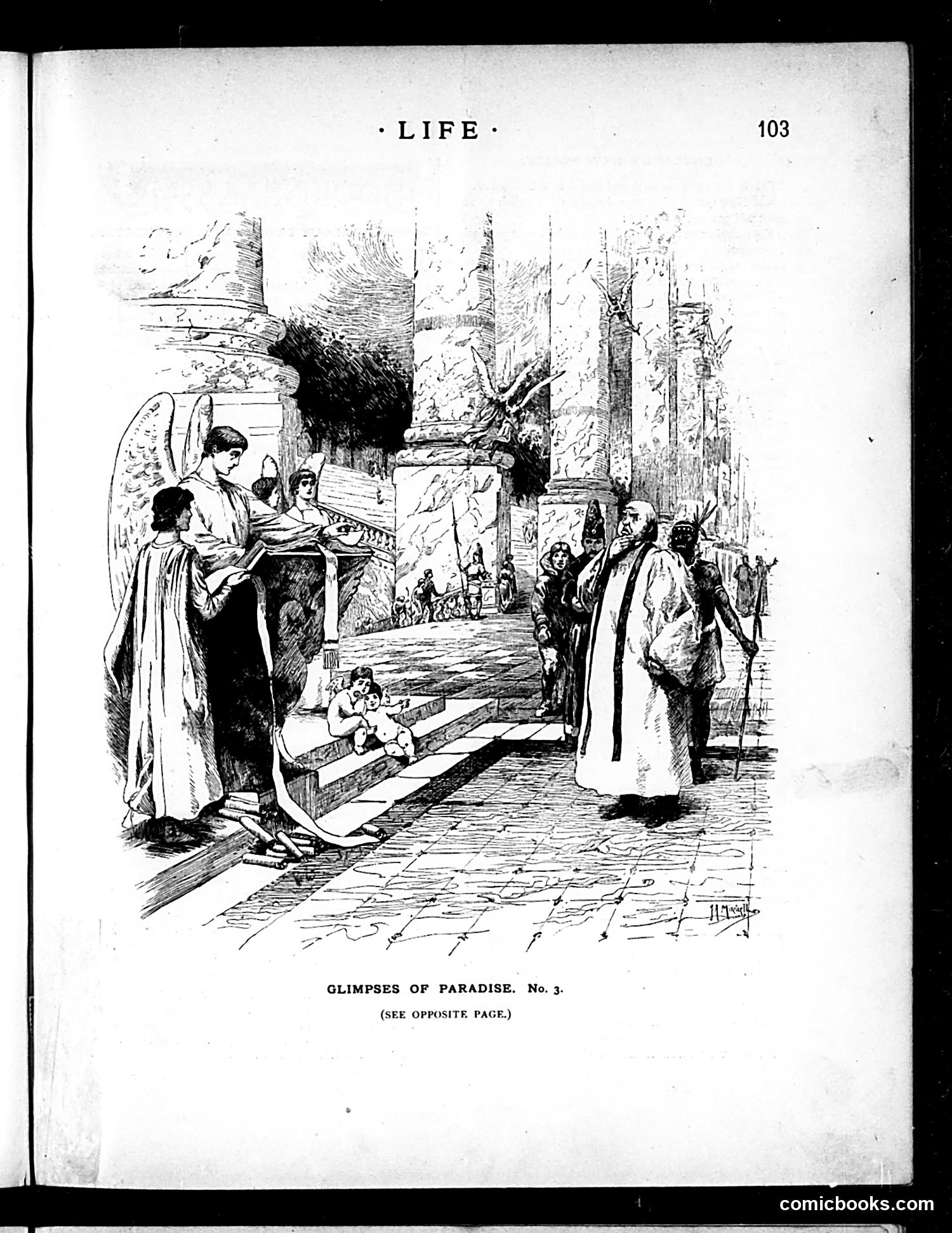
This is a satirical illustration depicting a religious or heavenly scene. An angel (left) appears to be guiding or teaching figures in what seems to be paradise or heaven. The composition includes clergy or religious figures (right), common people, and cherubs or children, arranged in a classical architectural setting with columns and arches. The title "Glimpses of Paradise" suggests social satire about religious hypocrisy or idealized versus actual morality. The specific targets are unclear without additional context, but Life magazine's satirical tradition suggests this critiques either religious institutions, clergy behavior, or societal pretensions about virtue and spirituality. The note "(See opposite page)" indicates accompanying text that would clarify the specific social commentary intended.
This page contains three distinct sections: **"England's New Policy"** (left column): Political satire about British policy toward Ireland, referencing a "Khalif" measure and Gordon's death. The text mockingly describes Parliament debating Irish policy while suggesting humorous (if grim) solutions like towing England into the Mediterranean. **"Mistakes About George Eliot Corrected"** (right column): A literary review praising a new biography of novelist George Eliot by J.W. Cross (her husband). It corrects misconceptions—that she was a "passionless thinking machine" or religious scoffer—and defends her marriage to Cross. **"Books Received"** (bottom right): A brief notice of *Representative American Orations*, an academic text on American political history. The page mixes political satire with literary criticism—typical of *Life* magazine's intellectual satirical approach of this era.
This page contains a satirical article titled "How We Do It—No. 3" by G. Washington Cable, dated December 25th from Ossawatomie Swamp, Louisiana. Cable humorously describes keeping Creole servants in separate log cabins at his swamp residence, controlling them with poles and tobacco rewards. The satire mocks both the author's patronizing attitude toward his Creole employees and broader racial stereotypes of the era. The piece appears designed to ridicule Cable's pseudo-benevolent approach to labor management while highlighting the absurdity and cruelty embedded in such arrangements. The accompanying illustration shows a caricatured figure, emphasizing the satirical intent. The page also includes unrelated items: "Music of the Future," "Profits of Sardine Fisheries," and a poem "Sainte Vallentyne, Hys Daye" by J.A. Macon.
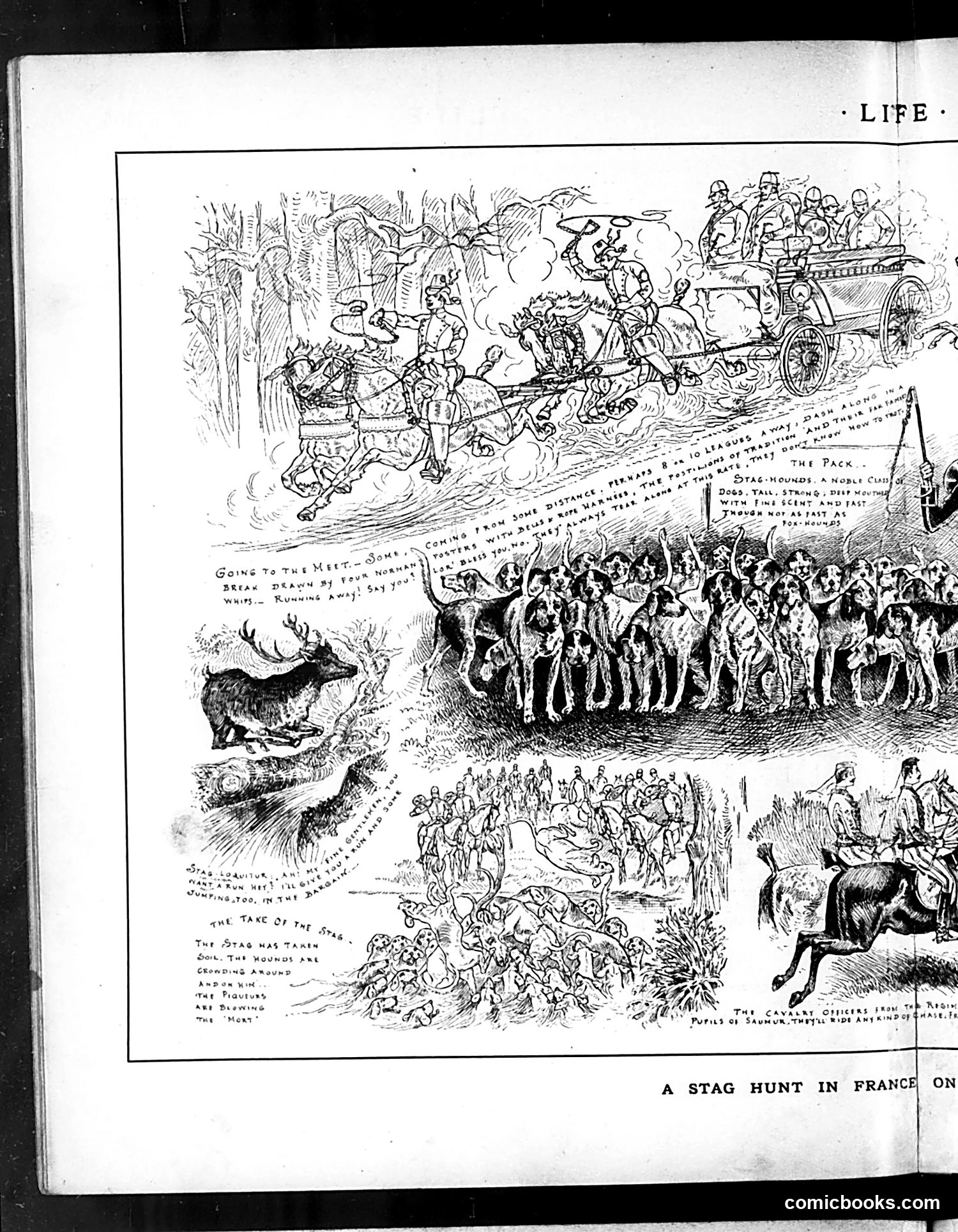
This satirical illustration depicts a chaotic hunting scene with multiple panels showing the progression of a stag hunt. The cartoon appears to be social satire about French hunting customs and aristocratic pursuits. The top panels show hunters on horseback and in carriages pursuing a stag through wooded terrain. Lower panels depict large crowds of people and dogs converging on the prey. The accompanying text (partially legible) describes the hunt's procedures and participants, including references to "stag-hounds," "noble" hunters, and "cavalry officers." The satire likely mocks the elaborate, inefficient nature of aristocratic European hunting traditions—the excessive pageantry, numerous participants, and chaotic coordination required for what should be a straightforward pursuit. The crowded, disorganized appearance emphasizes the absurdity of the spectacle.
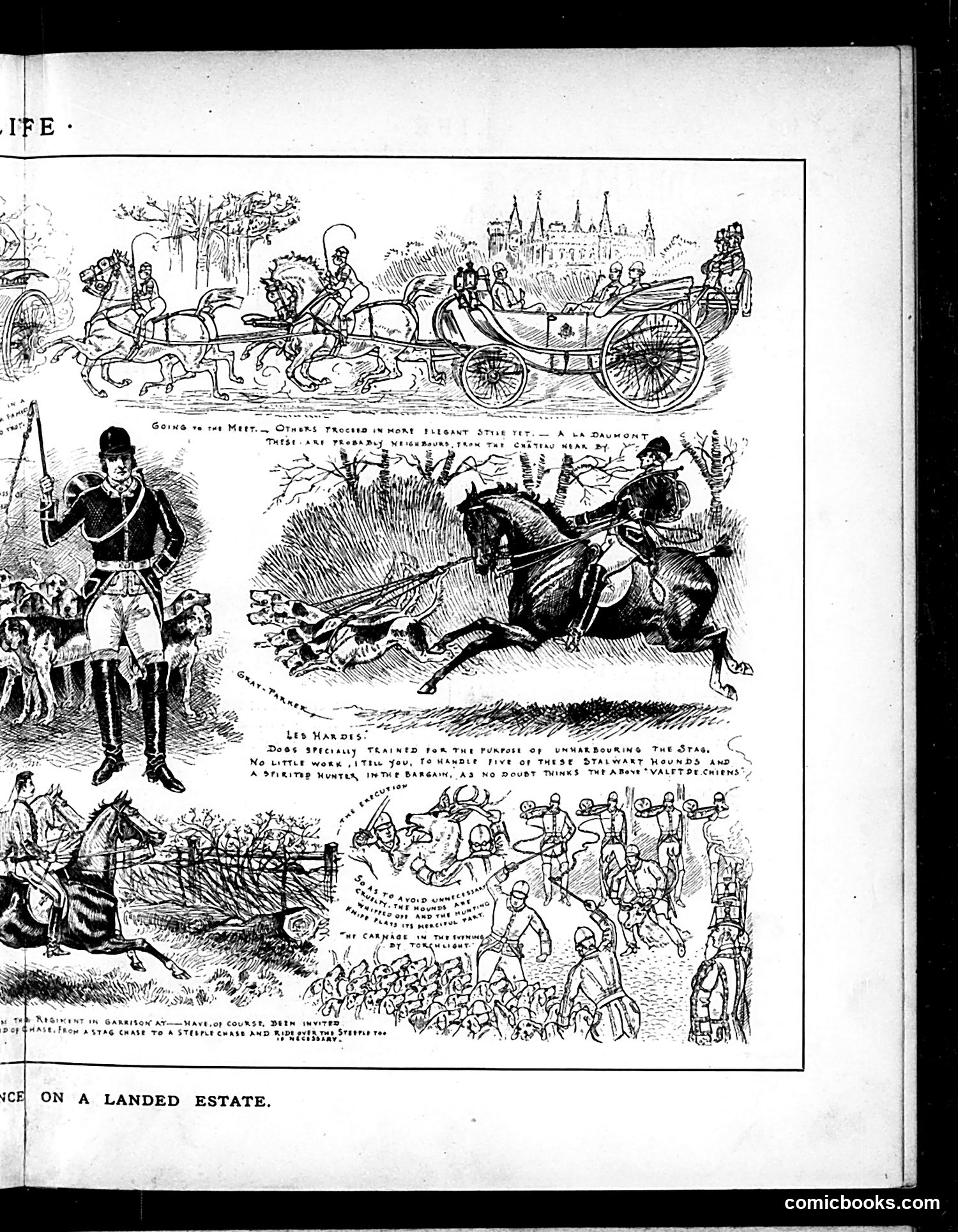
This page contains multiple satirical vignettes titled "ON A LANDED ESTATE," depicting aristocratic leisure activities. The top panel shows an elaborate carriage procession with elegantly dressed figures heading toward a grand castle—mocking the ostentatious display of wealthy landowners. The middle panels ridicule fox hunting, presenting it as absurd training ("Les Hardis" - "The Bold Ones"), with detailed captions suggesting the hunt requires stalwart hounds and skilled hunters despite being merely fashionable sport rather than necessary activity. The bottom panels appear to satirize military or garrison activities on estates, possibly critiquing the intersection of landed gentry authority and military power. The overall message mocks upper-class pretension, excessive leisure pursuits, and the performative nature of aristocratic pastimes during this period.
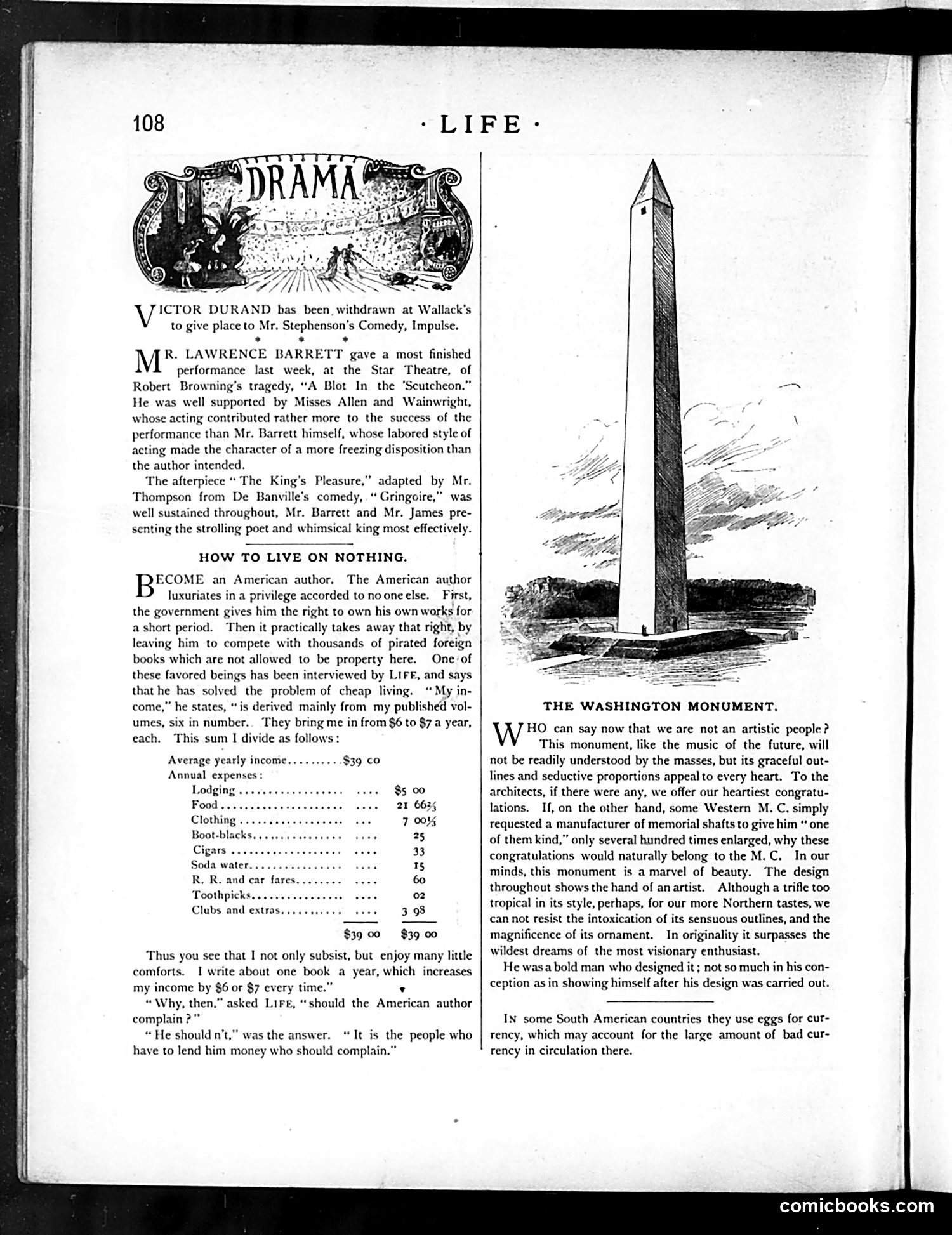
This page contains **theater reviews** and **satirical commentary** typical of Life's social humor. The **"How to Live on Nothing"** section mocks American authors' precarious finances. Life interviews an author earning $39 yearly from publications, then itemizes absurdly minimal expenses (lodging $5, food $21.65, cigars $33). The joke: the author claims comfort while admitting he survives only because people lend him money—satirizing both the author's delusion and publishers' exploitation of writers. The **Washington Monument section** is backhanded praise disguised as flattery. Life sarcastically calls it a "marvel of beauty" with "graceful outlines," then undermines this by suggesting it was commissioned casually by a Western congressman ("M.C.") who simply ordered "one of them kind" enlarged repeatedly. The satire targets American artistic pretension and rushed monumentalism—implying the nation values scale over genuine aesthetic achievement. Both pieces exemplify Life's trademark: puncturing American self-regard through exaggeration and ironic compliment.
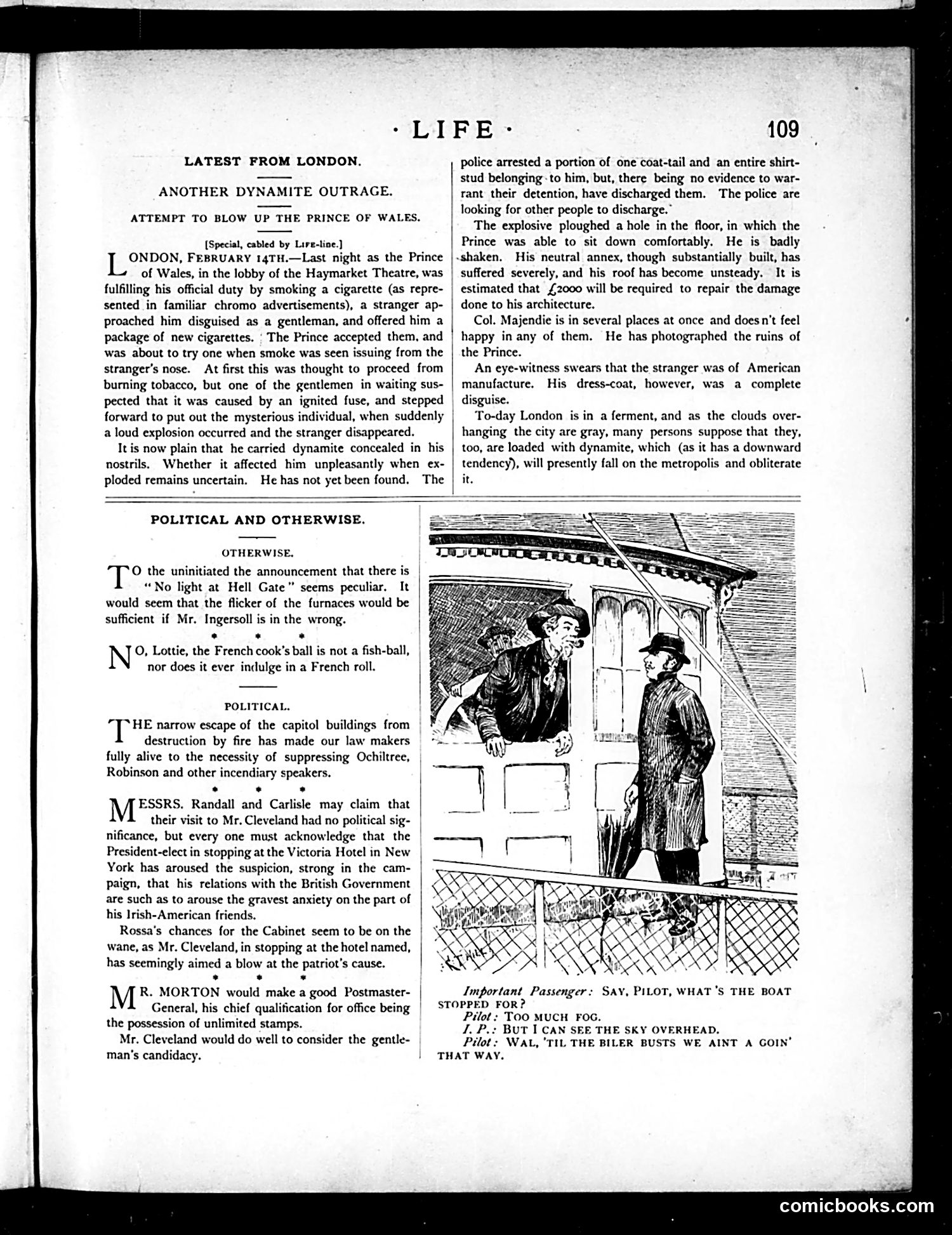
This page satirizes late 19th-century British anxieties about Irish-American dynamite terrorism. The main article describes a (fictional) assassination attempt on the Prince of Wales at London's Haymarket Theatre, where a disguised stranger offers him explosive-laden cigarettes. The satire lies in the absurdist details: dynamite hidden in the attacker's nostrils, the Prince calmly sitting in the bomb crater, and subsequent paranoia that London's gray clouds are "loaded with dynamite." The cartoon below depicts a ship captain and passenger—a commentary on nautical caution amid social unease. The "Political" section mocks American Irish nationalists' suspicions of President-elect Cleveland, sarcastically suggesting his hotel choice signals pro-British sympathies. References to "Ochiltree" and "incendiary speakers" appear to target specific contemporary political figures, though they're now obscure. The humor targets both Irish-American radicalism and British establishment fears of that radicalism during a period of actual bombings in London.
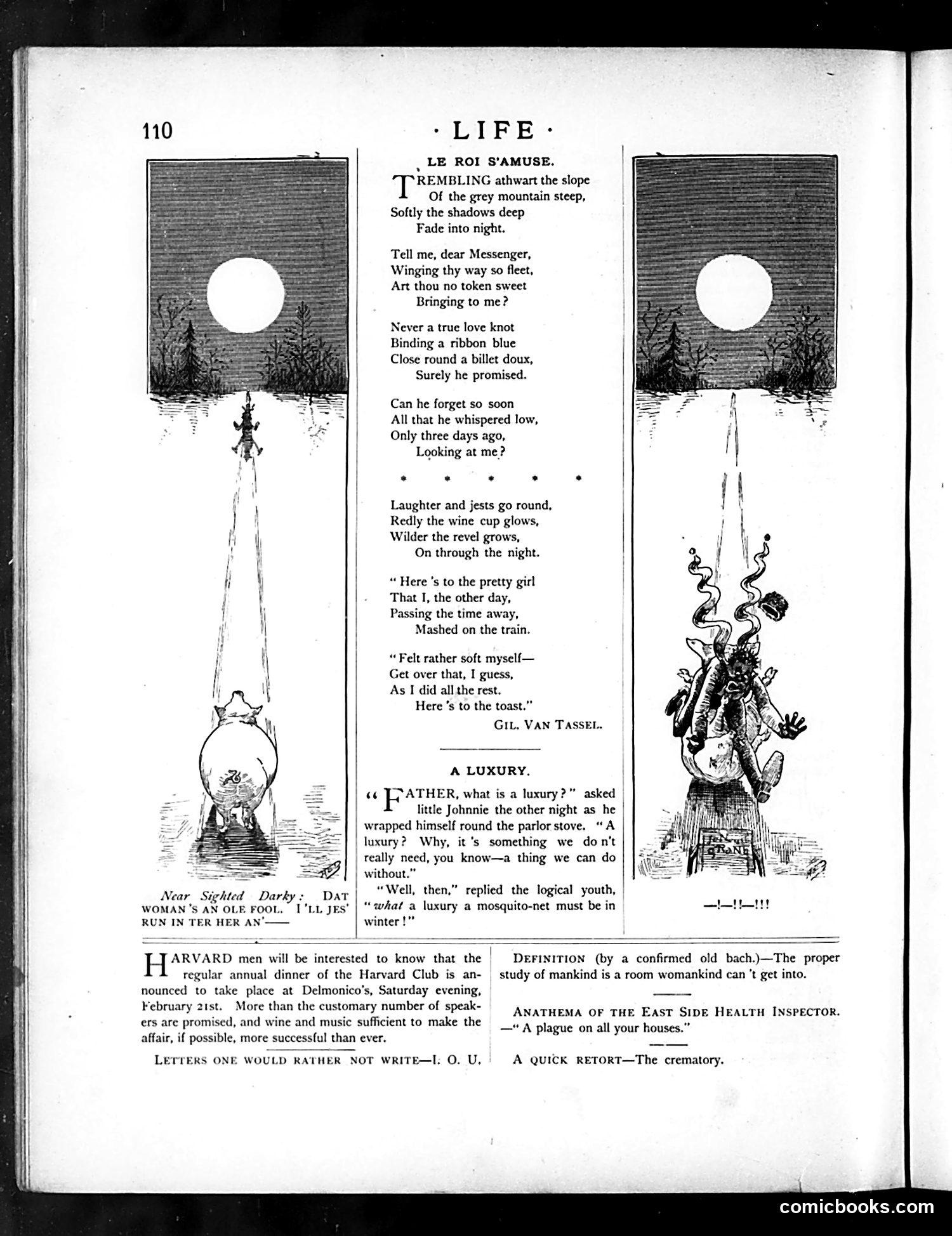
This page contains multiple satirical pieces typical of early Life magazine's humor: **"Le Roi S'Amuse"** (poem by Gil. Van Tassel): A romantic poem contrasting a lovesick woman awaiting her suitor's message with a man at a revel casually bragging about flirting with a woman on a train days prior, then forgetting her. The satire mocks male inconstancy and the disposability of romantic attention. **"A Luxury"** (dialogue): A child's logical rebuttal to his father's definition of luxury—if luxuries are things we don't need, then mosquito-nets in winter qualify, since mosquitoes don't exist then. It's gentle humor about faulty reasoning. **"Near Sighted Darky"** cartoon: Uses a racist caricature (typical of the era's offensive humor) for a visual punchline about mistaken identity. The page also includes brief quips mocking Harvard Club pretension, bachelorhood, and bureaucratic incompetence. The overall tone is light satirical commentary on courtship, class, and human folly.
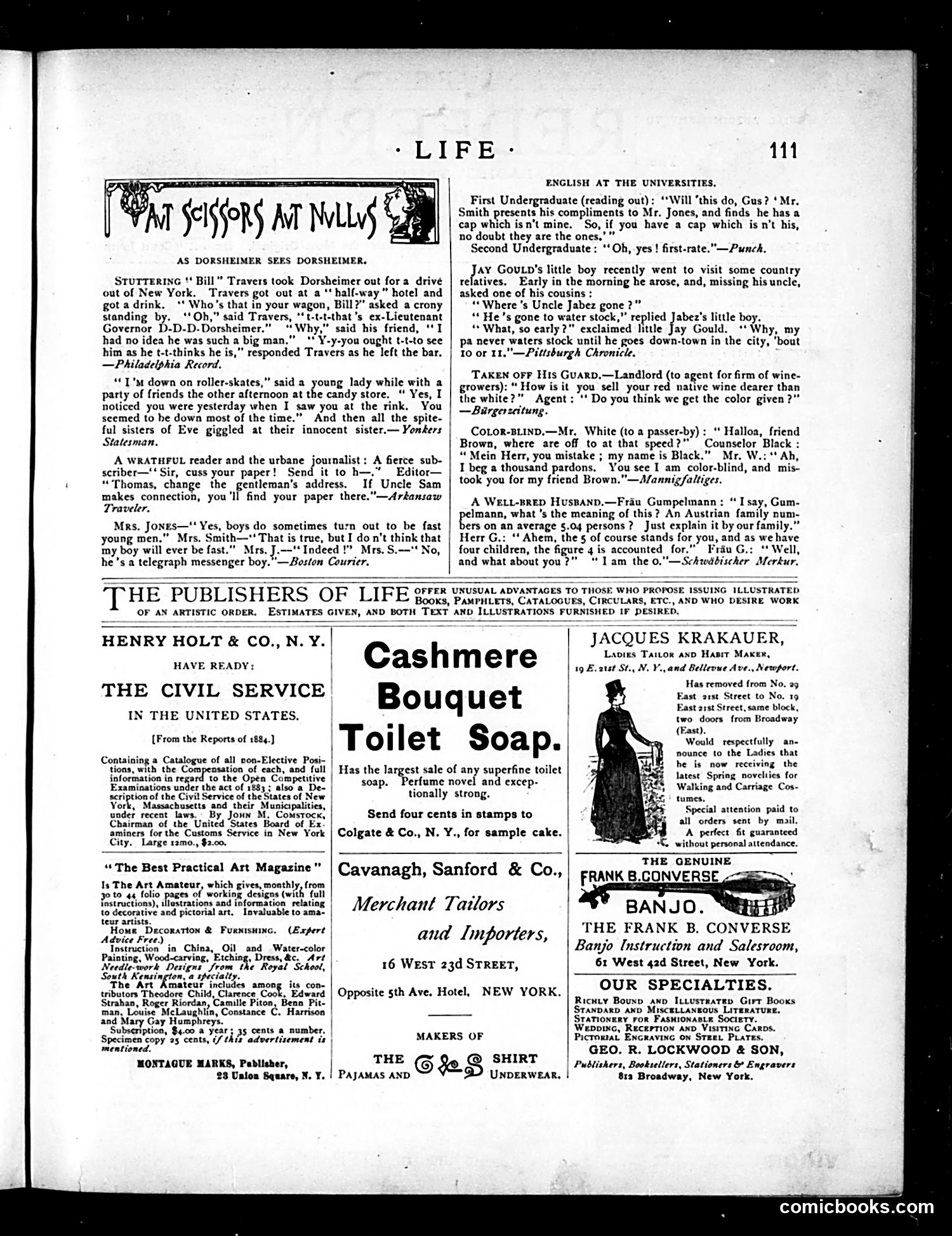
This page is primarily advertisements interspersed with brief satirical items and jokes. The humorous content includes: **"Stuttering Bill" on Dorsheimer**: A joke about ex-Lieutenant Governor Dorsheimer, where someone notes the amusing gap between how he presents himself to the world versus his actual self-importance. The joke relies on a stammer-rendered punchline about seeing him "as he t-t-thinks he is." **University joke (Punch)**: British humor about undergraduates parsing confusing sentence structure—poking fun at academic precision taken to absurd lengths. **Jay Gould joke**: A child of the famous financier innocently reveals his father's unethical "watering stock" practice (inflating company value), contrasting it with provincial relatives' honest interpretation. **"Color-blind" joke**: Wordplay where Mr. White encounters people with surnames Black and Brown, misidentifying them due to claimed color-blindness—pure pun humor. The remainder is advertisements for soap, tailors, books, and banjos. The page demonstrates 1880s Life magazine's mix of topical satire, gentle social humor, and commercial content.
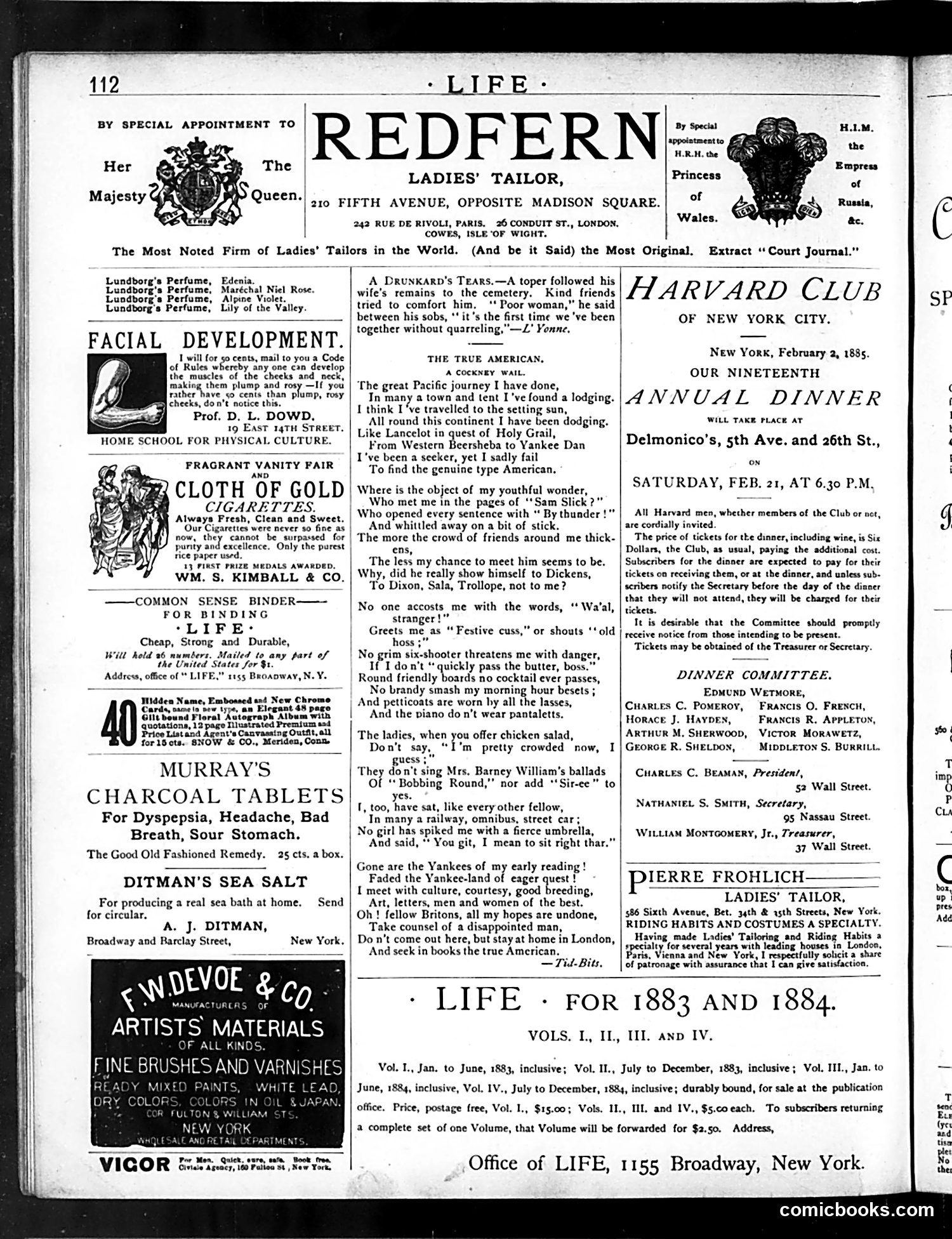
This page is primarily **advertising and miscellaneous content**, not political cartoons. The major elements are: 1. **Redfern advertisement**: A high-end ladies' tailor with royal appointments, emphasizing luxury fashion for wealthy clients. 2. **"The True American" poem**: A British visitor's satirical lament. A Cockney traveler describes disappointment finding the stereotypical American character he'd read about—the rough, loud "Sam Slick" type with guns, whittling, and colorful dialect. Instead, he encounters cultured, well-mannered people. The joke: reality contradicts romantic literary stereotypes. The poem mocks both exaggerated American caricatures and the disappointed British tourist expecting frontier clichés. 3. **"A Drunkard's Tears"**: A brief anecdote where a drunk widower ironically laments his wife's death because "it's the first time we've been together without quarreling." 4. **Various remedies and products**: Charcoal tablets, sea salt, cigarettes—typical period advertisements. The page reflects late 19th-century middle/upper-class culture and Anglo-American stereotypes.
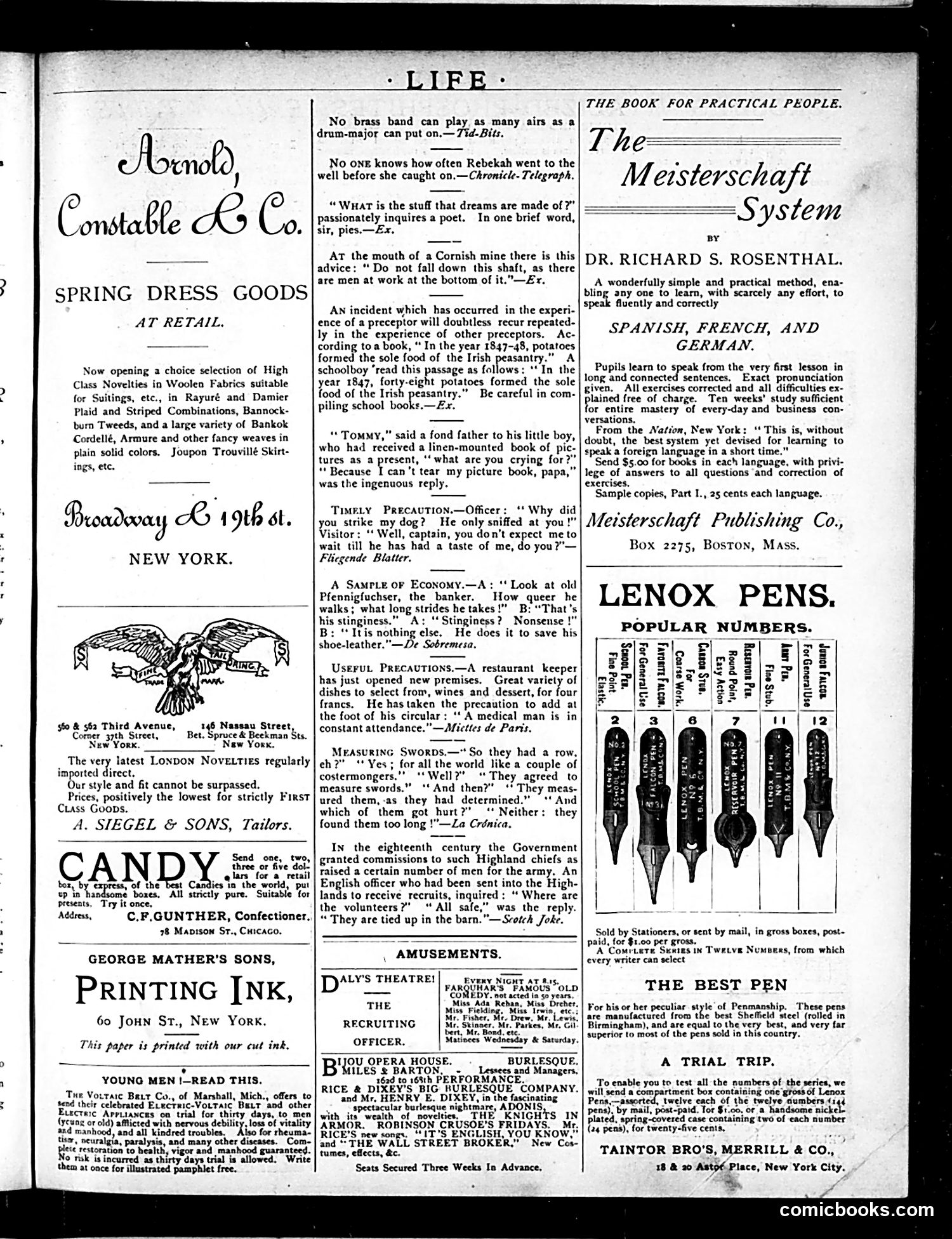
This page is **predominantly advertisements and humorous anecdotes** rather than political cartoons. There are no identifiable political figures or caricatures. The content consists of: 1. **Retail advertisements** (spring dress goods, tailoring, candy, printing ink, electric health devices) 2. **Humorous short jokes and anecdotes** in the center columns, typical of *Life* magazine's satirical format. These include: - Wordplay about drum majors and brass bands - A schoolboy misreading "1847-48 potatoes" as "forty-eight potatoes" (educational humor) - A child upset about not tearing his picture book - Puns about bankers, restaurant precautions, and measuring swords 3. **Language advertisements** for the "Meisterschaft System" teaching Spanish, French, and German These are genteel, Victorian-era jokes targeting everyday absurdities—not political satire. The humor relies on puns, mild domestic situations, and social observations rather than commentary on current events or public figures.
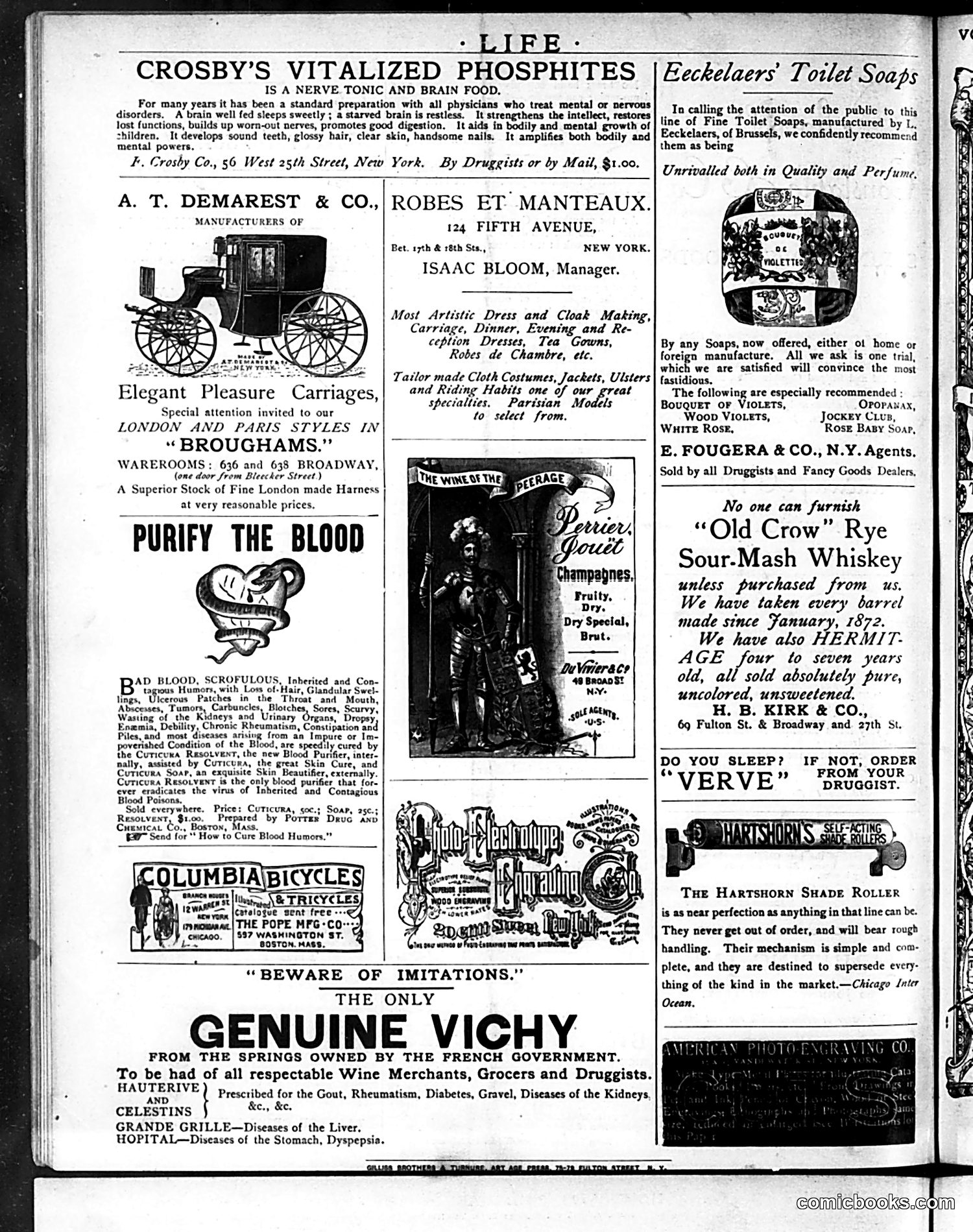
This is primarily a **commercial advertisement page** from Life magazine, not a political cartoon. The page contains no satire or social commentary—instead, it showcases patent medicines and luxury goods typical of the 1880s-90s era. Key products advertised include: - **Crosby's Vitalized Phosphites**: a "nerve tonic and brain food" claiming to cure mental disorders and strengthen intellect - **Cuticura products**: blood purifiers and skin treatments for diseases from "bad blood" - **Old Crow whiskey** and hermitage liquor - **Carriages, bicycles, and clothing** from upscale manufacturers - **Vichy water**: imported French mineral water for gout and kidney disease - **"Verve"**: a sleep aid The page reflects the period's medical quackery era, when such advertisements made extraordinary health claims without scientific basis. The "blood purification" products particularly reveal 19th-century misconceptions about disease causation. This represents commercial culture more than satire.