
Life, 1885-02-19 · page 6 of 16
Life — February 19, 1885 — page 6: what you’re looking at
What you’re looking at
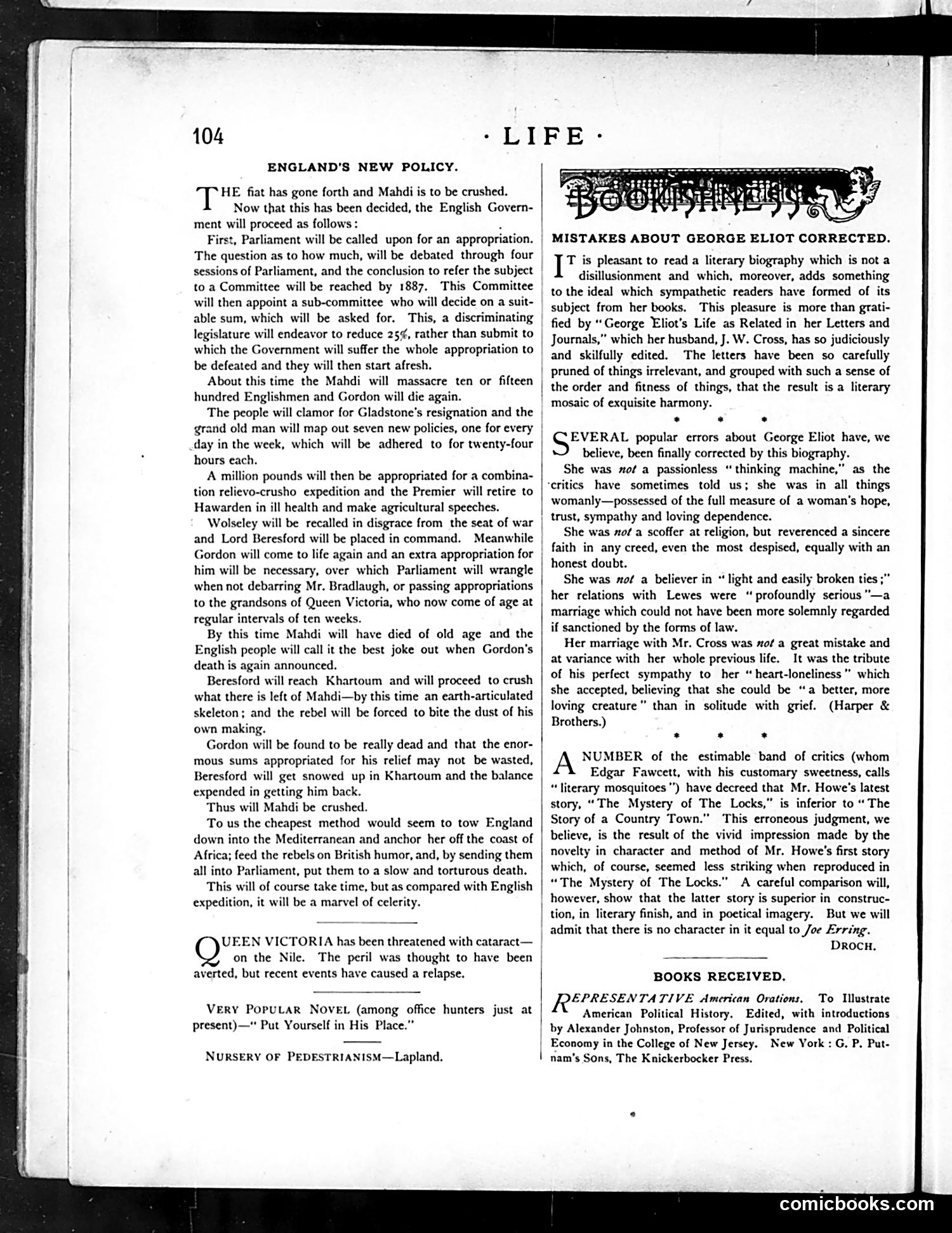
This page contains three distinct sections: **"England's New Policy"** (left column): Political satire about British policy toward Ireland, referencing a "Khalif" measure and Gordon's death. The text mockingly describes Parliament debating Irish policy while suggesting humorous (if grim) solutions like towing England into the Mediterranean. **"Mistakes About George Eliot Corrected"** (right column): A literary review praising a new biography of novelist George Eliot by J.W. Cross (her husband). It corrects misconceptions—that she was a "passionless thinking machine" or religious scoffer—and defends her marriage to Cross. **"Books Received"** (bottom right): A brief notice of *Representative American Orations*, an academic text on American political history. The page mixes political satire with literary criticism—typical of *Life* magazine's intellectual satirical approach of this era.
📄 Transcribed text from this page (OCR, searchable)
Machine-transcribed from the original scan — historical spelling and the odd misread are preserved.
104 ENGLAND'S NEW POLICY. id Rise fiat has gone forth and Mahdi is to be crushed. Now that this has been decided, the English Govern- ment will proceed as follows: J First, Parliament will be called upon for an appropriation. The question as to how much, will be debated through four sessions of Parliament, and the conclusion to refer the subject to a Committee will be reached by 1887. This Committee will then appoint a sub-committee who will decide on a suit- able sum, which will be asked for. This, a discriminating legislature will endeavor to reduce 25%, rather than submit to which the Government will suffer the whole appropriation to be defeated and they will then start afresh. About this time the Mahdi will massacre ten or fifteen hundred Englishmen and Gordon will die again. The people will clamor for Gladstone's resignation and the grand old man will map out seven new policies, one for every day in the week, which will be adhered to for twenty-four | hours each. A million pounds will then be appropriated for a combina- tion relievo-crusho expedition and the Premier will retire to Hawarden in ill health and make agricultural speeches. Wolseley will be recalled in disgrace from the seat of war and Lord Beresford will be placed in command. Meanwhile Gordon will come to life again and an extra appropriation for | him will be necessary, over which Parliament will wrangle | when not debarring Mr. Bradlaugh, or passing appropriations to the grandsons of Queen Victoria, who now come of age at | gr 4 regular intervals of ten weeks. By this time Mahdi will have died of old age and the English people will call it the best joke out when Gordon's death is again announced. Beresford will reach Khartoum and will proceed to crush what there is left of Mahdi—by this time an earth-articulated skeleton; and the rebel will be forced to bite the dust of his own making. Gordon will be found to be really dead and that the enor- mous sums appropriated for his relief may not be wasted, Beresford will get snowed up in Khartoum and the balance expended in getting him back. Thus will Mahdi be crushed. To us the cheapest method would seem to tow England down into the Mediterranean and anchor her off the coast of Africa; feed the rebels on British humor, and, by sending them all into Parliament, put them to a slow and torturous death. This will of course take time, but as compared with English expedition, it will be a marvel of celerity. UEEN VICTORIA has been threatened with cataract— on the Nile. The peril was thought to have been averted, but recent events have caused a relapse. VERY POPULAR NOVEL (among office hunters just at present)—" Put Yourself in His Place.” NURSERY OF PEDESTRIANISM—Lapland. MISTAKES ABOUT GEORGE ELIOT CORRECTED. T is pleasant to read a literary biography which is not a disillusionment and which, moreover, adds something to the ideal which sympathetic readers have formed of its subject from her books. This pleasure is more than grati- fied by “George Eliot's Life as Related in her Letters and Journals,” which her husband, J. W. Cross, has so judiciously and skilfully edited. The letters have been so carefully pruned of things irrelevant, and grouped with such a sense of the order and fitness of things, that the result is a literary | mosaic of exquisite harmony. . . . EVERAL popular errors about George Eliot have, we believe, been finally corrected by this biography. She was vot a passionless “thinking machine,” as the ‘critics have sometimes told us; she was in all things womanly—possessed of the full measure of a woman's hope, | trust, sympathy and loving dependence. She was not a scoffer at religion, but reverenced a sincere faith in any creed, even the most despised, equally with an | honest doubt. She was xof a believer in “ light and easily broken ties ;” her relations with Lewes were “ profoundly serious "—a marriage which could not have been more solemnly regarded if sanctioned by the forms of law. Her marriage with Mr. Cross was not a great mistake and at variance with her whole previous life. It was the tribute of his perfect sympathy to her “ heart-loneliness ” which she accepted, believing that she could be “a better, more loving creature” than in solitude with grief. (Harper & Brothers.) * * * NUMBER of the estimable band of critics (whom Edgar Fawcett, with his customary sweetness, calls “literary mosquitoes") have decreed that Mr. Howe's latest story, “The Mystery of The Locks,” is inferior to “ The Story of a Country Town.” This erroneous judgment, we believe, is the result of the vivid impression made by the novelty in character and method of Mr. Howe's first story which, of course, seemed less striking when reproduced in “The Mystery of The Locks.” A careful comparison will, | however, show that the latter story is superior in construc- | tion, in literary finish, and in poetical imagery. But we will admit that there is no character in it equal to Joe Erring. Drocn. BOOKS RECEIVED. EPRESENTATIVE American Orations, To Mlustrate American Political History. Edited, with introductions by Alexander Johnston, Professor of Jurisprudence and Political Economy in the College of New Jersey. New York: G. P. Put- | nam's Sons, The Knickerbocker Press. comicbooks.com