
A complete issue · 16 pages · 1884
Life — November 27, 1884
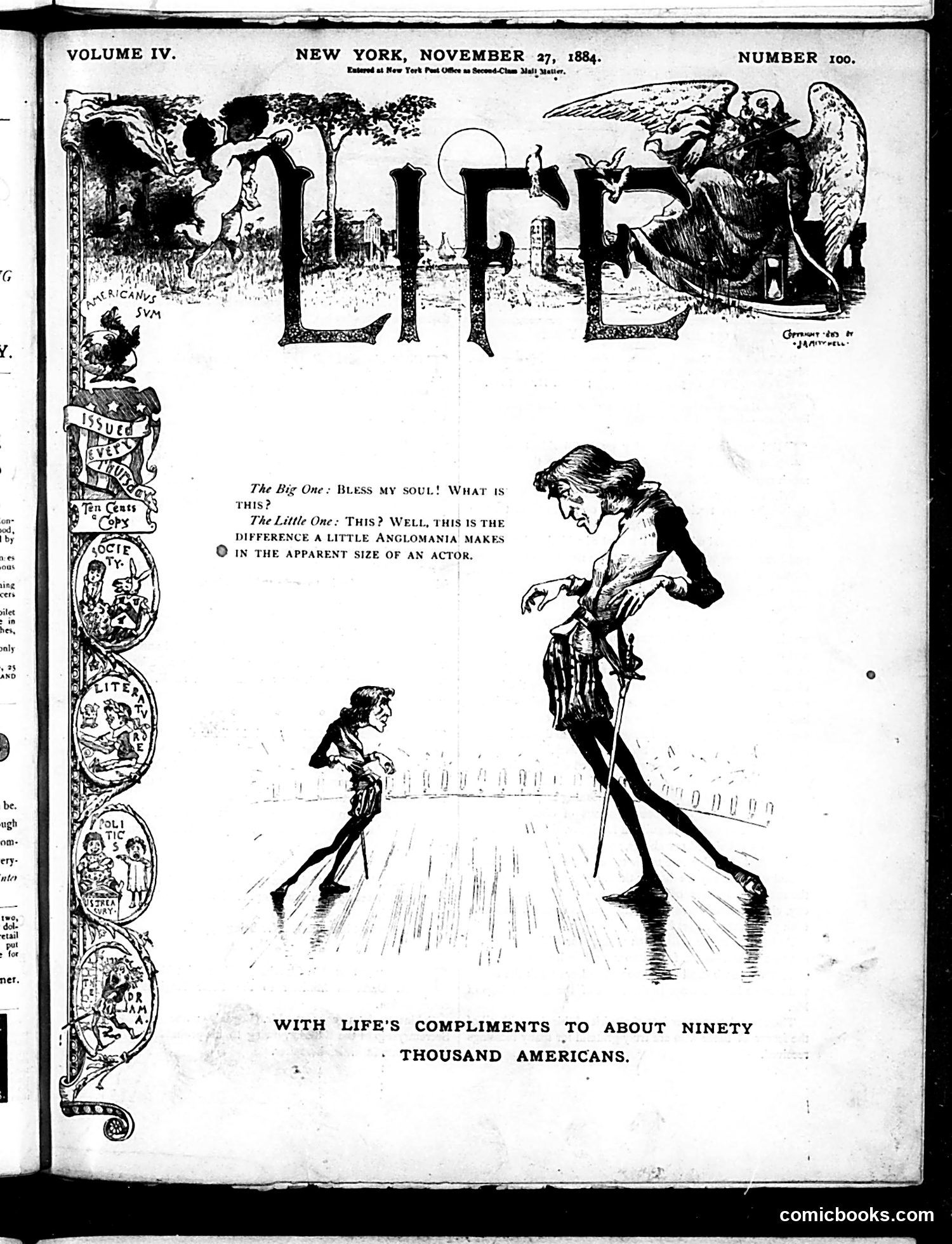
This page features a satirical cartoon about the difference in physical stature between two actors. The dialogue reads: "The Big One: 'Bless my soul! What is this?' The Little One: 'This? Well, this is the difference a little Anglomania makes in the apparent size of an actor.'" The cartoon depicts two figures on stage—one notably smaller than the other—suggesting commentary on how British theatrical affectation or "Anglomania" (excessive admiration for English culture) might affect an actor's perceived stature or importance. The humor relies on visual contrast and plays on contemporary anxieties about American performers adopting British mannerisms during this era when British theatrical traditions heavily influenced American stages.
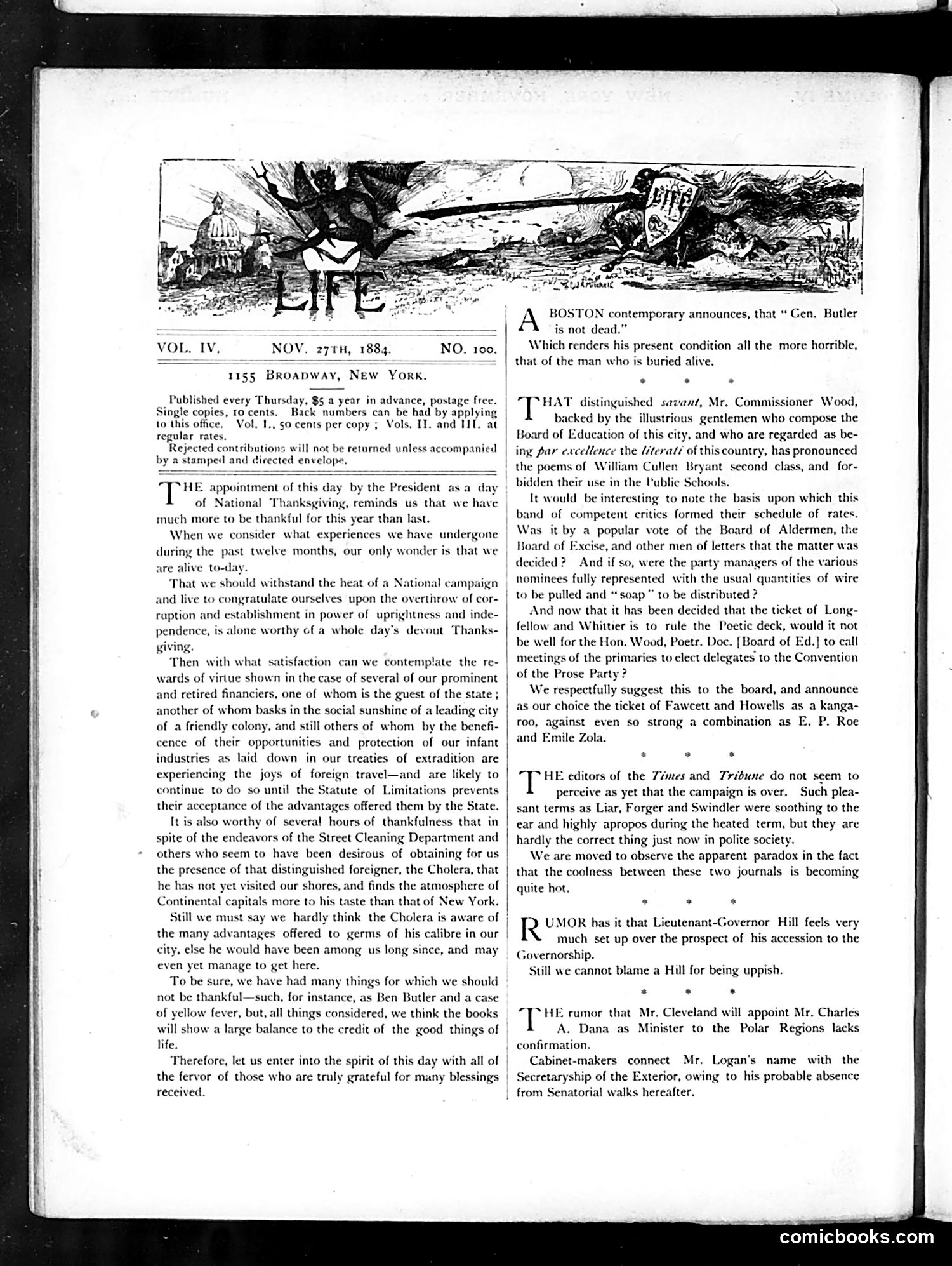
The masthead cartoon depicts "Life" as a classical figure amid scenes of death and destruction—a visual metaphor for the magazine's satirical mission to comment on mortality and social issues. The text discusses Thanksgiving amid political turmoil, celebrating survival of "corruption and establishment in power of uprightness and independence." It references prominent retired figures and mentions the "Statute of Limitations" preventing prosecution of past wrongs. The editorial also critiques newspaper rivals (*Times* and *Tribune*) for continuing partisan "liar" rhetoric post-election, calls Lieutenant-Governor Hill "uppish," and reports rumors that Cleveland will appoint Charles A. Dana as Minister to the Polar Regions—clearly sarcastic commentary on Dana's exclusion from Cabinet positions. The tone is darkly humorous about political aftermath and journalistic excess.
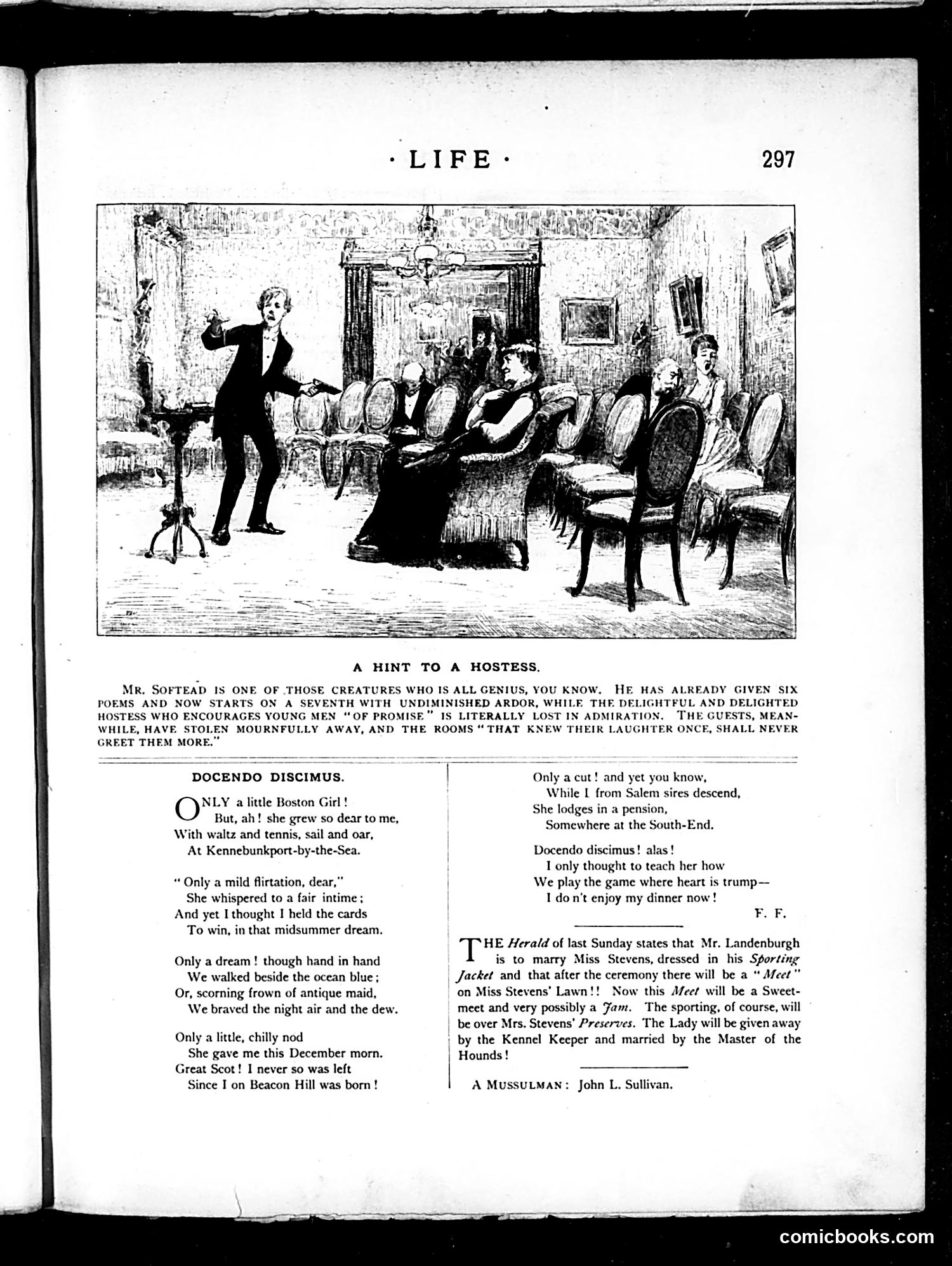
**Main Content:** This page contains literary and social commentary rather than political cartoons. **"A Hint to a Hostess"** mocks Mr. Softead, described as an insufferable poet who monopolizes social gatherings. The illustration shows him gesturing dramatically while seated guests endure his recitations. The satire targets pretentious artists who impose themselves on unwilling audiences at social events. **"Docendo Discimus"** is a sentimental poem about a Boston girl and failed romance at Kennebunkport-by-the-Sea, signed "F.F." **"A Mussuleman"** brief note announces an engagement between Mr. Landenburgh and Miss Stevens, with hunting-themed wedding plans. The page satirizes artistic pretension and social climbing while featuring romantic nostalgia—typical Life magazine content mixing humor with sentiment.
This page consists entirely of text columns labeled "By the Way" — a satirical commentary section. There are no political cartoons visible. The section includes brief satirical items about contemporary topics: a cable from Baku regarding Muslim-Christian tensions (likely referencing early 20th-century Caucasus conflicts), comments on English-Crofter disputes, fashion criticism about prayer books, and commentary on a miniature engine's horsepower. Notable is satire on Benjamin F. Butler as a farce-comedy character and criticism of a new "Limited Express" fiction format by Hugh Conway, which the reviewer dismisses as plot-driven entertainment lacking literary merit. The page is primarily written commentary and social criticism rather than visual satire, relying on wit and irony rather than illustration.
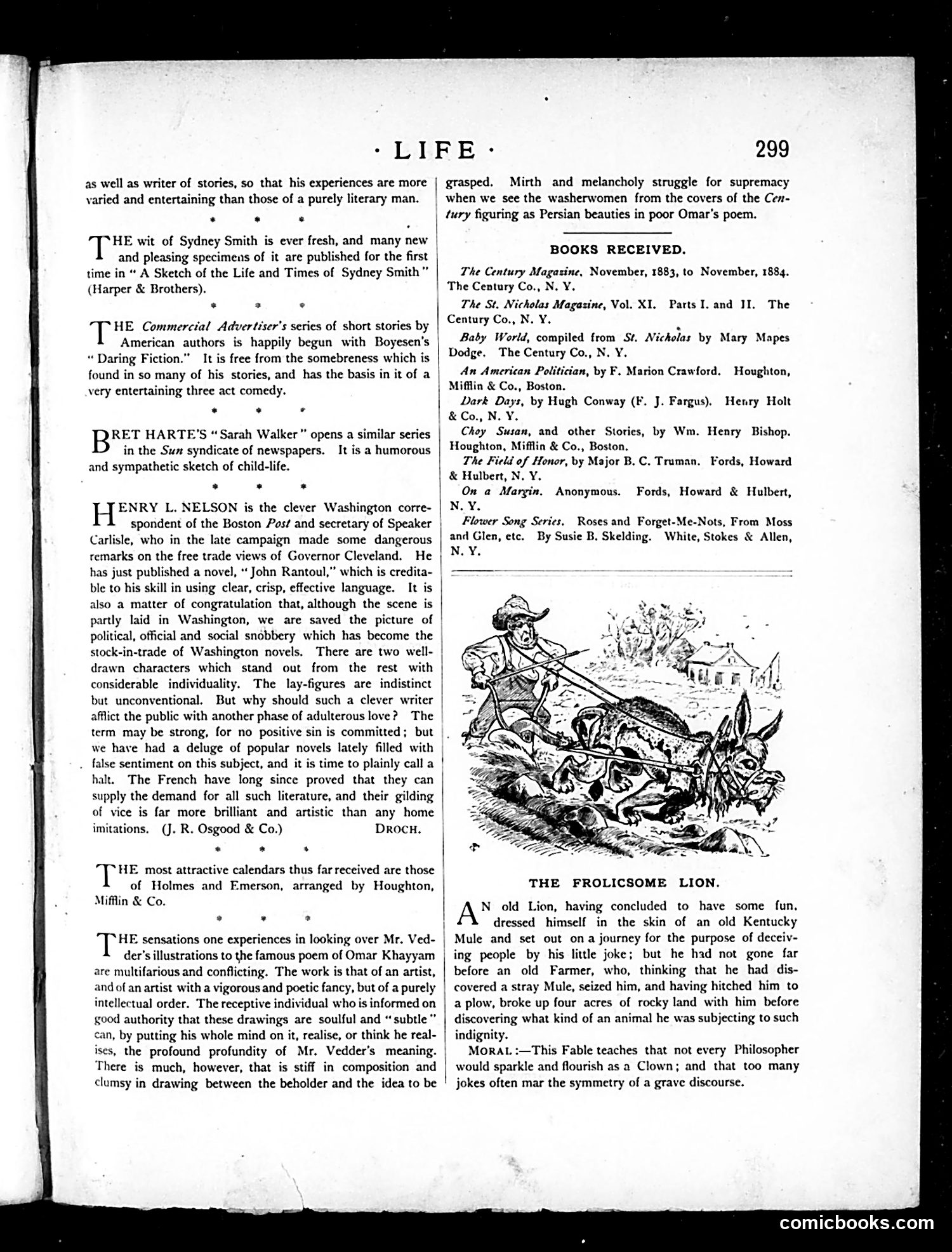
This page is primarily book reviews and literary criticism, not political satire. The single cartoon depicts a humorous fable about a lion who dressed in a mule's skin to play pranks on farmers. The moral warns that "not every Philosopher would sparkle and flourish as a Clown; and that too many jokes often mar the symmetry of a grave discourse." The joke is straightforward: the lion's disguise backfires when a real farmer beats the mule, causing the lion pain and indignity. It's a cautionary tale about the limits of humor and the importance of maintaining dignity—likely commentary on satirical writing itself, given this appears in *Life*, a satirical publication. No specific political figures are caricatured here.
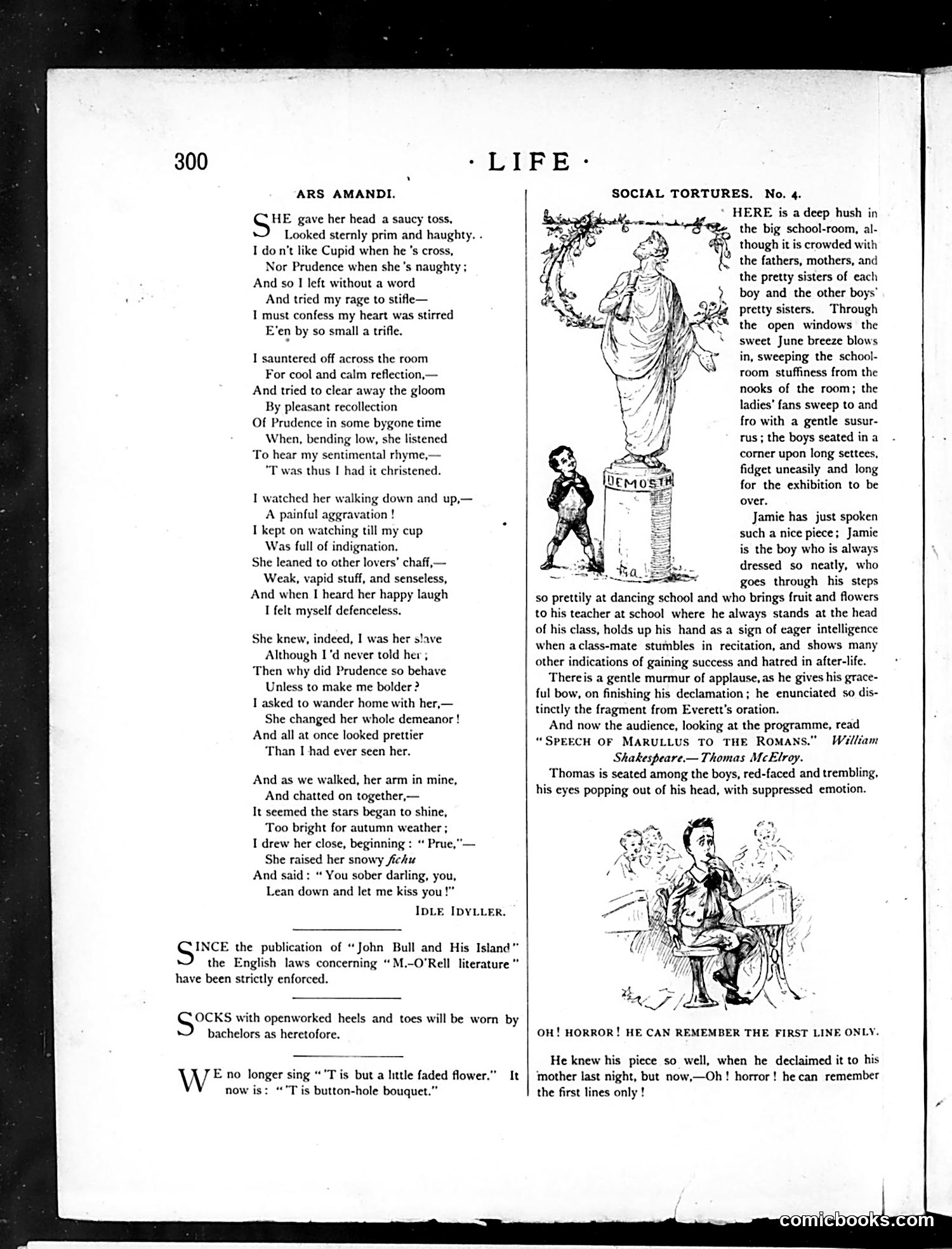
This page contains literary content rather than political cartoons. The left side features "Ars Amandi," a poem by Idle Idyller about romantic disappointment and jealousy. The right side presents "Social Tortures No. 4," a humorous sketch about a school recitation event where Jamie, a well-dressed boy, performs Shakespearean material from Marullus's speech to Roman citizens. Thomas, another boy, sits among the audience "red-faced and trembling" because he can only remember the first line of the same piece—a common anxiety about public performance and competitive embarrassment among schoolchildren. The satire gently mocks social hierarchies and academic competition in early 20th-century American schools.
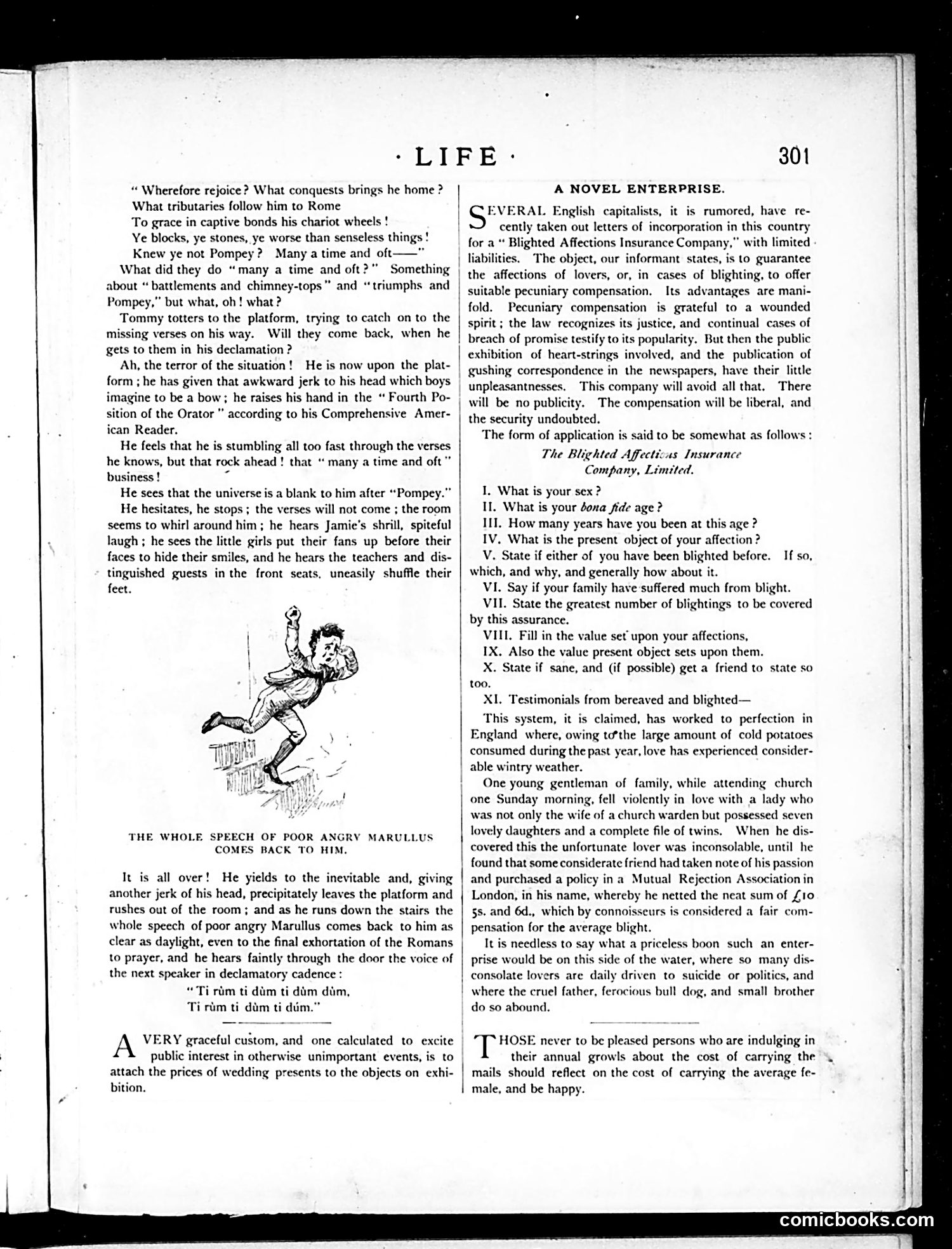
The cartoon depicts a figure fleeing a platform in apparent panic, illustrating a literary scene from classical studies. The caption "THE WHOLE SPEECH OF POOR ANGRY NARULLUS COMES BACK TO HIM" suggests this depicts a character from ancient Roman literature (likely Ovid or similar classical work) who has forgotten his speech while on stage. The accompanying text describes the embarrassing moment when the character realizes the verses won't come and observes the audience's discomfort—girls hiding smiles, teachers shuffling their feet. The satire humorously captures the universal anxiety of public speaking failure and forgotten memorization, common experiences in educational settings of the era. The exaggerated physical comedy of the fleeing figure emphasizes the mortification of the moment.
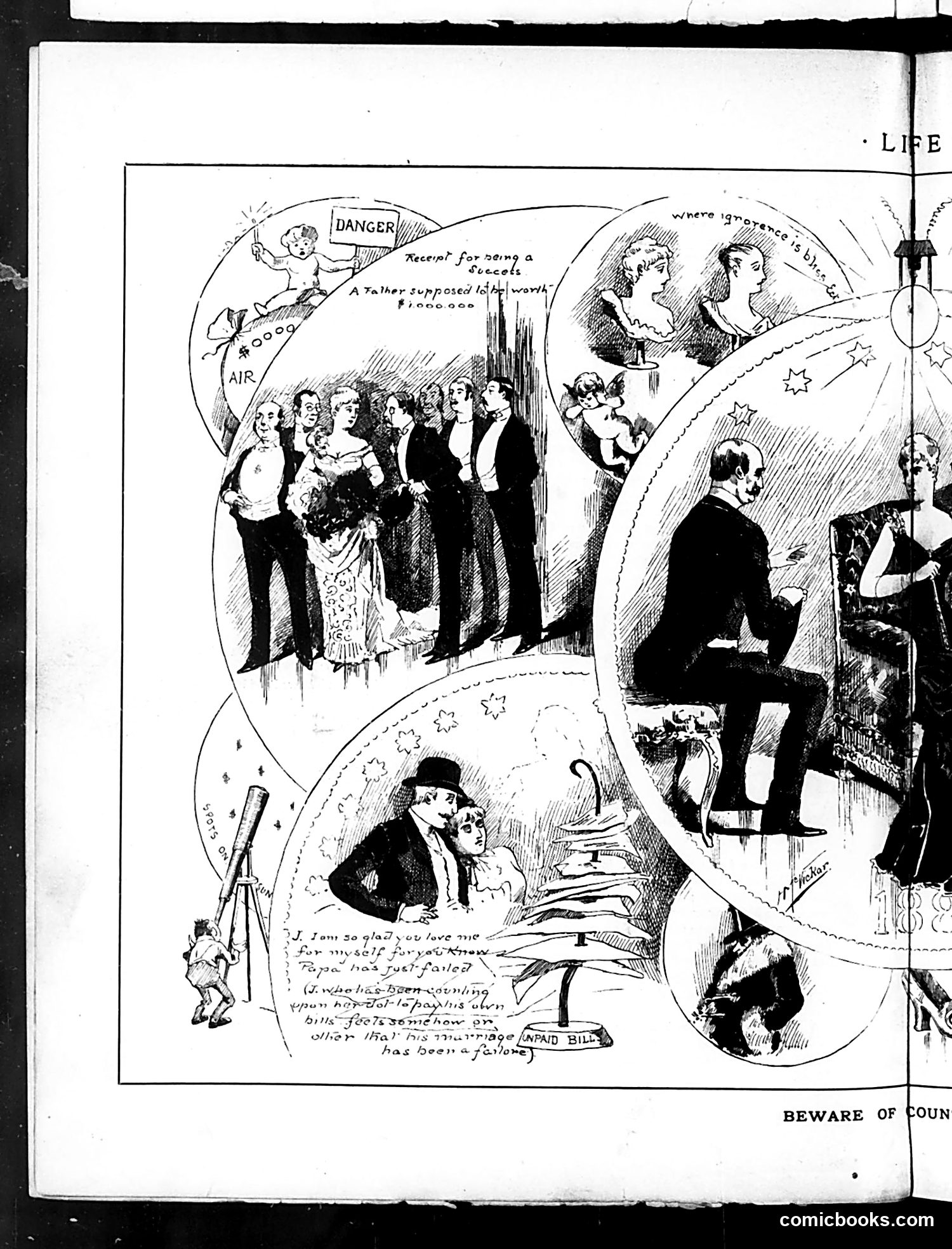
This satirical cartoon depicts the dreams and fantasies of a man labeled "AFRAID BILL" (visible at bottom). The central bubble shows a wealthy gentleman's social aspirations—fantasies of high society gatherings, romance, and respectability. Upper bubbles show celestial dreams: danger, wealth ("A father supposed to be worth $1,000,000"), and romantic encounters with elegant women. The lower left shows Bill himself, described as someone "so glad of love me for myself for you know 'Papa' has just failed" (suggesting financial anxiety about courtship). The satire mocks the aspirational anxiety of middle-class men—their simultaneous desire for wealth, social status, and romantic success, while fearing financial instability would undermine their marriageability. The title "BEWARE OF COUN[T]" (cut off) likely warns against fortune-hunting or class pretension.
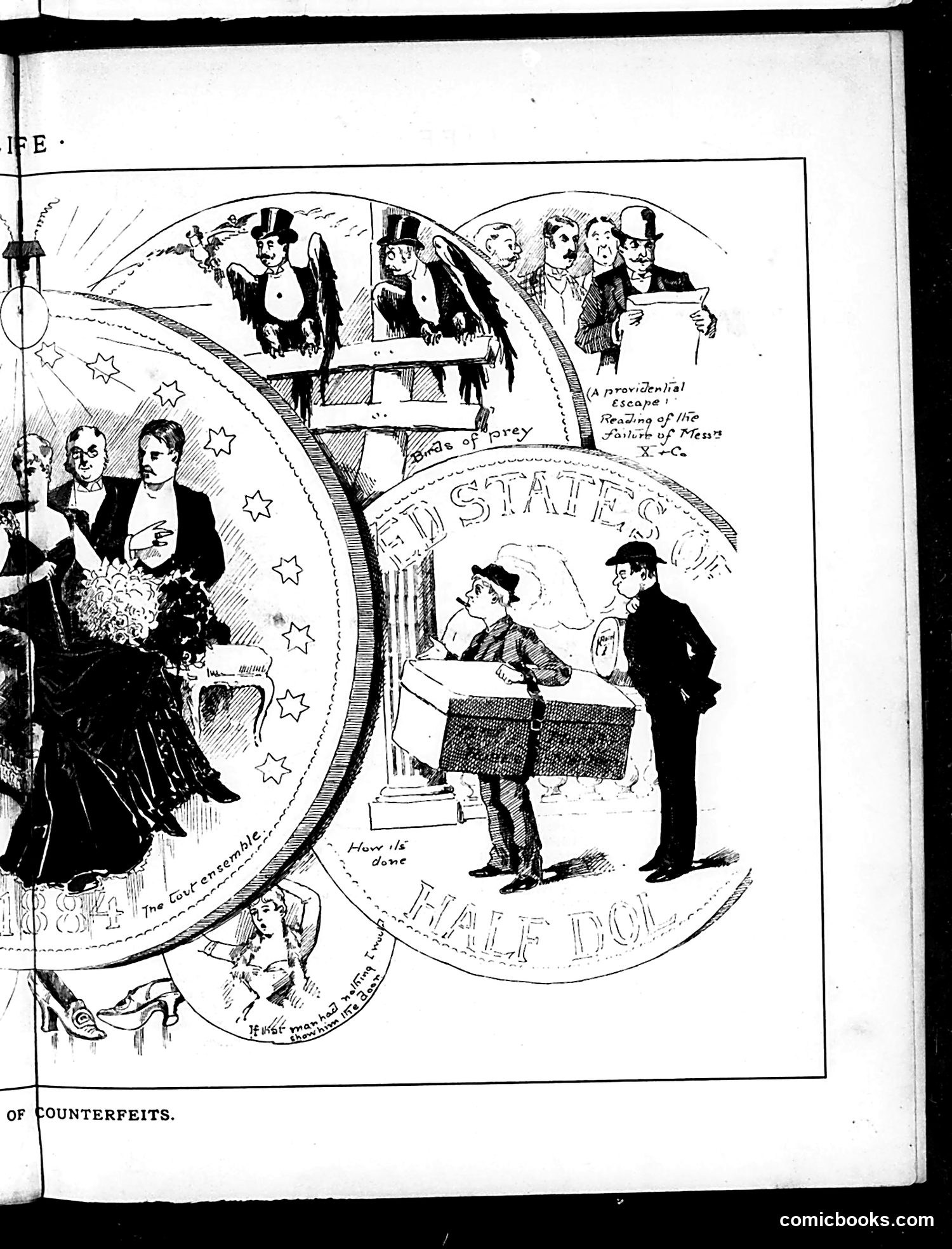
This satirical cartoon depicts the U.S. government as a massive dome or building, with officials inside examining counterfeit currency. The imagery contrasts sharply: wealthy, well-dressed citizens on the left appear oblivious or complicit ("The cost assembly"), while working-class men on the right interact with what appears to be a customs or government official inspecting goods marked "United States." The cartoon's point seems to satirize government hypocrisy regarding counterfeits—suggesting those in power ignore or enable financial fraud while scrutinizing common people. References to "birds of prey" and "reading of the articles of peace" indicate critique of political corruption and economic inequality during this era of American capitalism and industrial growth.
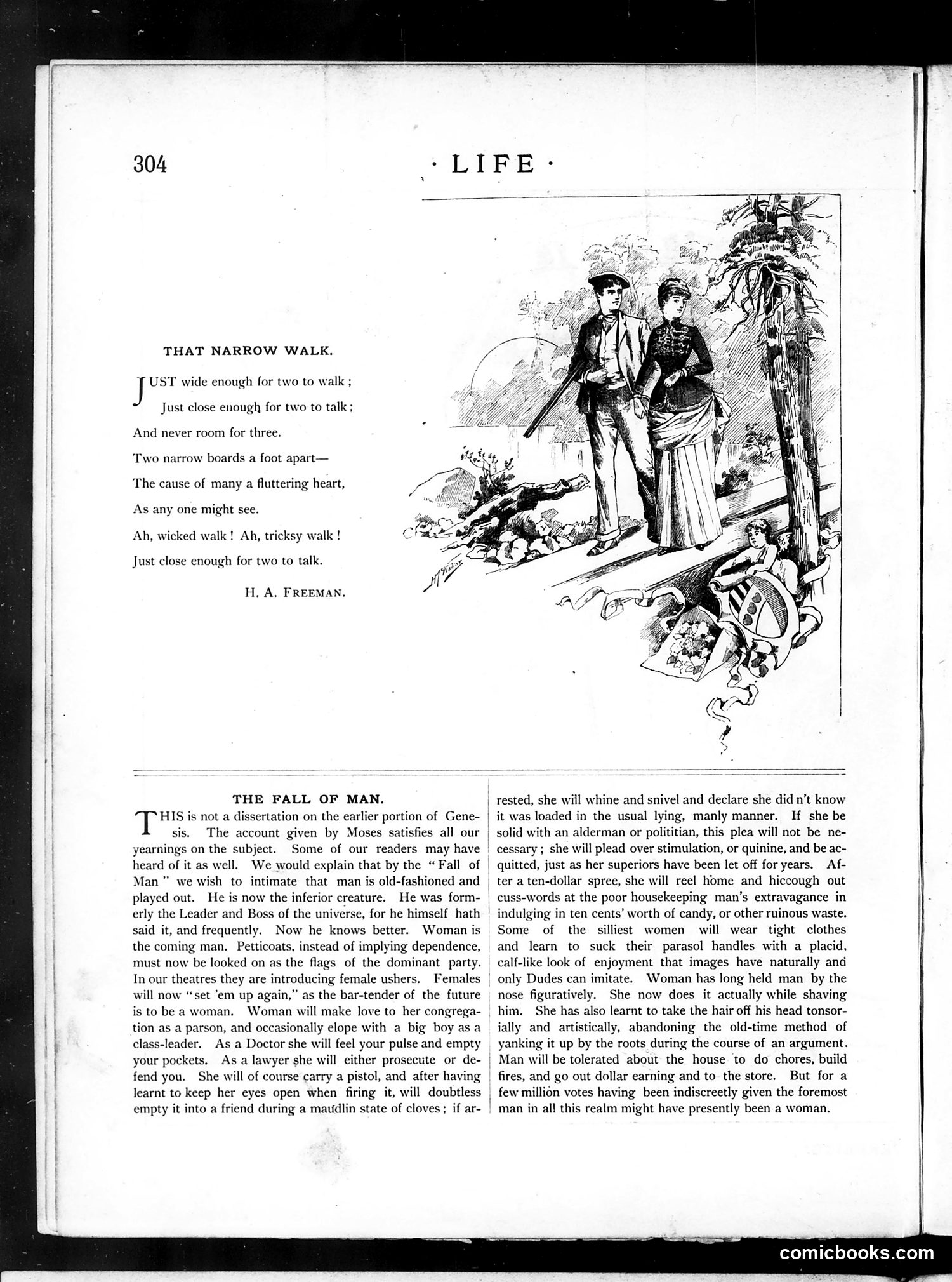
**Top poem**: A lighthearted piece about a narrow footbridge or boardwalk where two people can walk side-by-side and converse intimately, but a third person cannot fit—creating romantic tension. The accompanying illustration shows a couple walking together while a child sits alone below, suggesting exclusion and flirtation. **"The Fall of Man" essay**: Satirical commentary on women's increasing social and professional advancement. The author mockingly predicts women will dominate as "the coming man"—working as theater ushers, bartenders, doctors, lawyers, and barbers. The satire targets contemporary anxiety about women's expanding roles by exaggerating them absurdly (women carrying pistols, getting drunk, neglecting housekeeping). The piece ends darkly: men retain power only because they were given "a few million votes"—suggesting suffrage expansion threatens male dominance entirely. This reflects late-19th/early-20th century fears about women's rights and changing gender roles in American society.
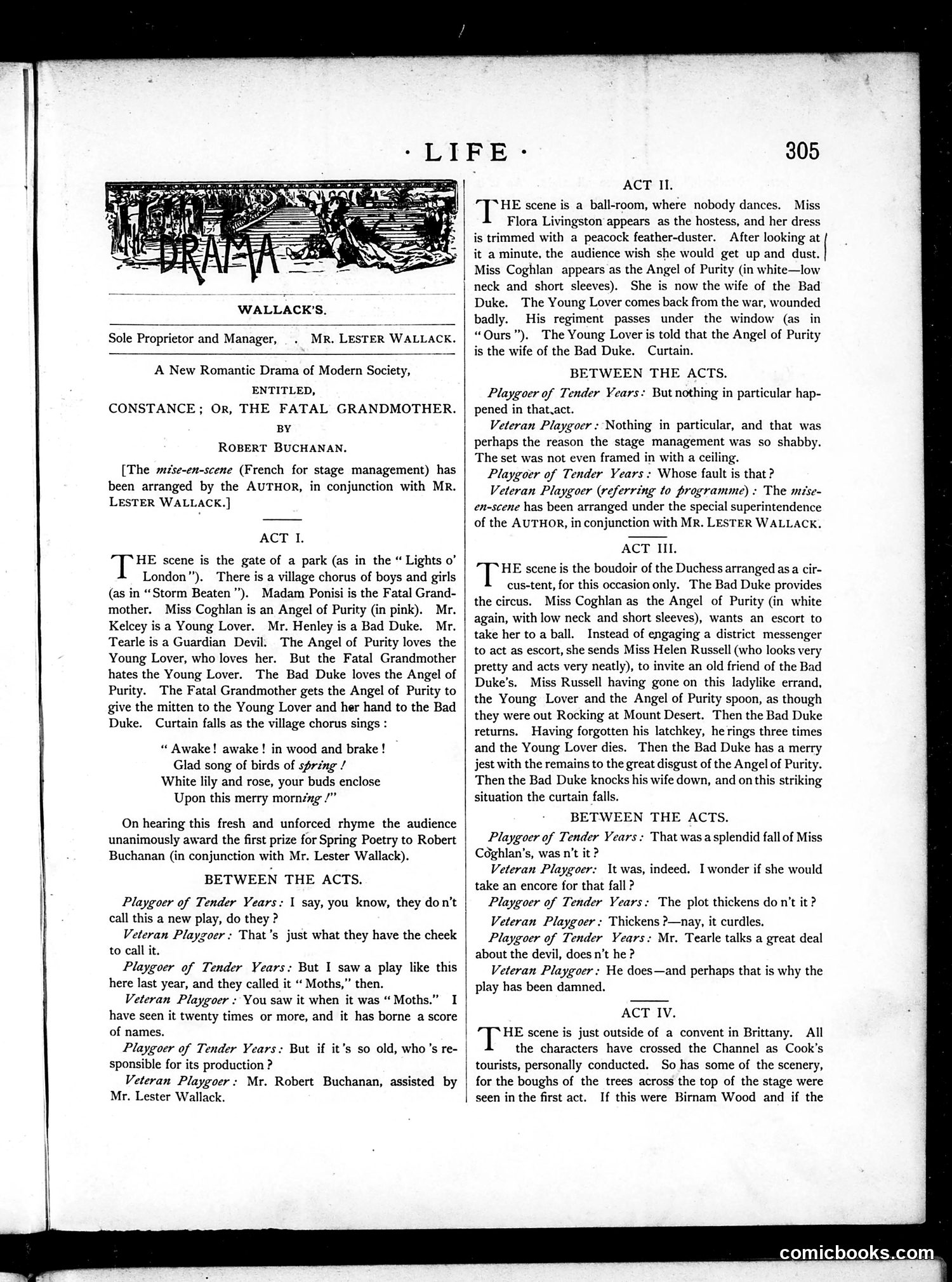
This page satirizes a theatrical production at Wallack's Theatre. The main text critiques Robert Buchanan's play "Constance; Or, The Fatal Grandmother," presented as a melodramatic romance of "modern society." The satire's point: Life mocks the play's recycled, hackneyed plot (a Fatal Grandmother, an Angel of Purity in pink/white, a Bad Duke, doomed lovers) through dialogue between a naive young playgoer and a cynical veteran. The veteran reveals this supposedly "new" play has been performed at least twenty times under different titles, including "Moths." The humor targets both Buchanan's unoriginal writing and the lazy stage management. Between acts, the veterans note shabby sets (one act has no ceiling), absurd costume choices (a peacock feather-duster dress), and the author's credit for poor production design—suggesting pretentious overreach by both playwright and theater. The satire exposes theatrical fraud: audiences pay for "new" work while receiving warmed-over melodrama.
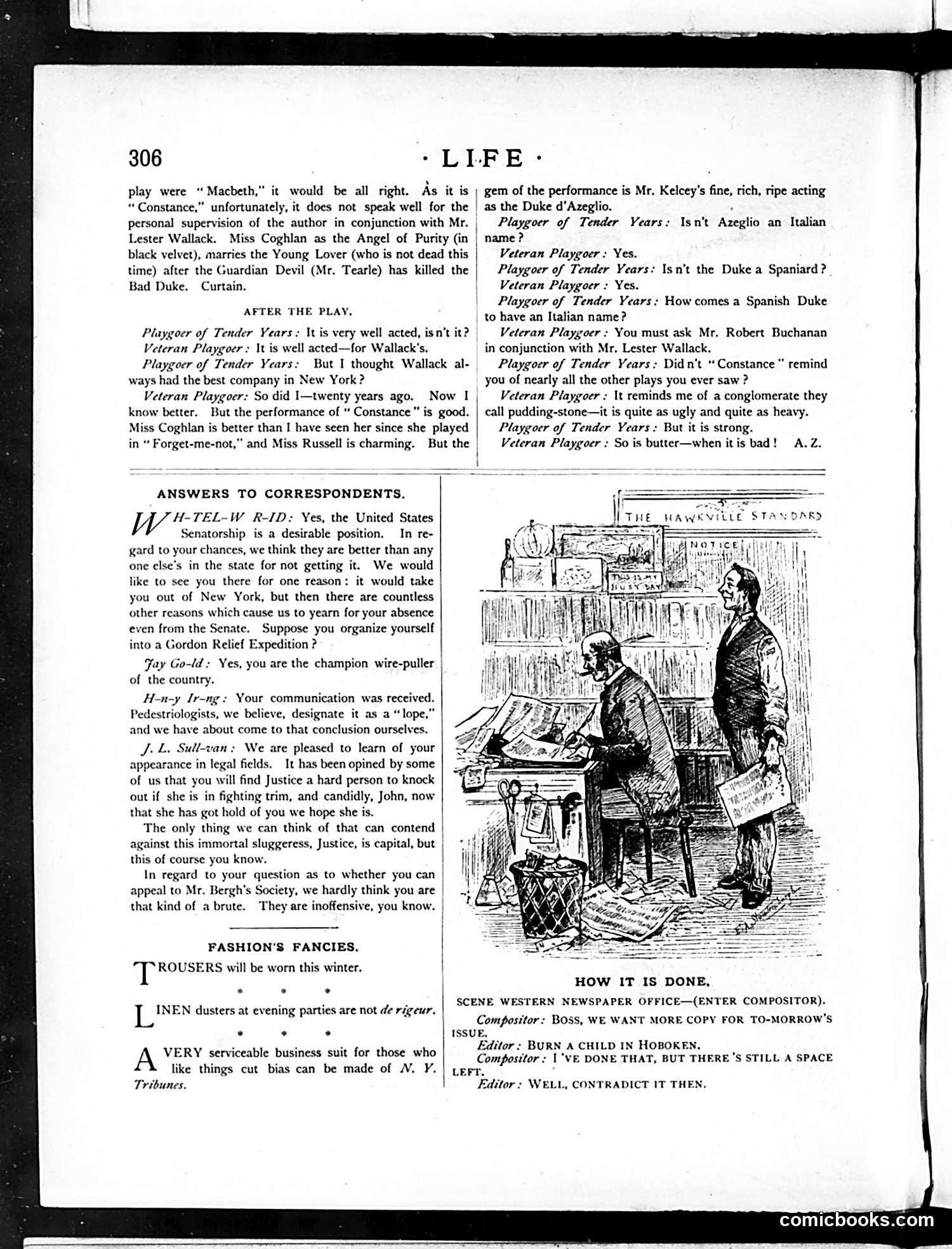
This page contains two distinct satirical pieces: **Theater Criticism ("After the Play"):** A seasoned theatergoer dismisses the new play "Constance" as mediocre, contrasting it with Wallack's theater company's supposedly superior past. The older playgoer uses cutting metaphors—comparing the plot to "pudding-stone" (an ugly geological formation)—to convey cynical disillusionment with theatrical decline. **"Answers to Correspondents":** Life's editorial staff responds sarcastically to named public figures. Most notably, **J.L. Sullivan** (the famous boxer) receives mockery about entering the legal profession, with dark humor about Justice being "hard to knock out." This mocks his celebrity attempting serious pursuits beyond boxing. **"How It Is Done":** A brief cartoon joke about newspaper production: when space remains, editors simply contradict previous stories rather than find new content—satirizing journalistic corner-cutting and editorial laziness. The cartoon (visible but not detailed here) appears to show a newspaper office scene illustrating this editorial cynicism.
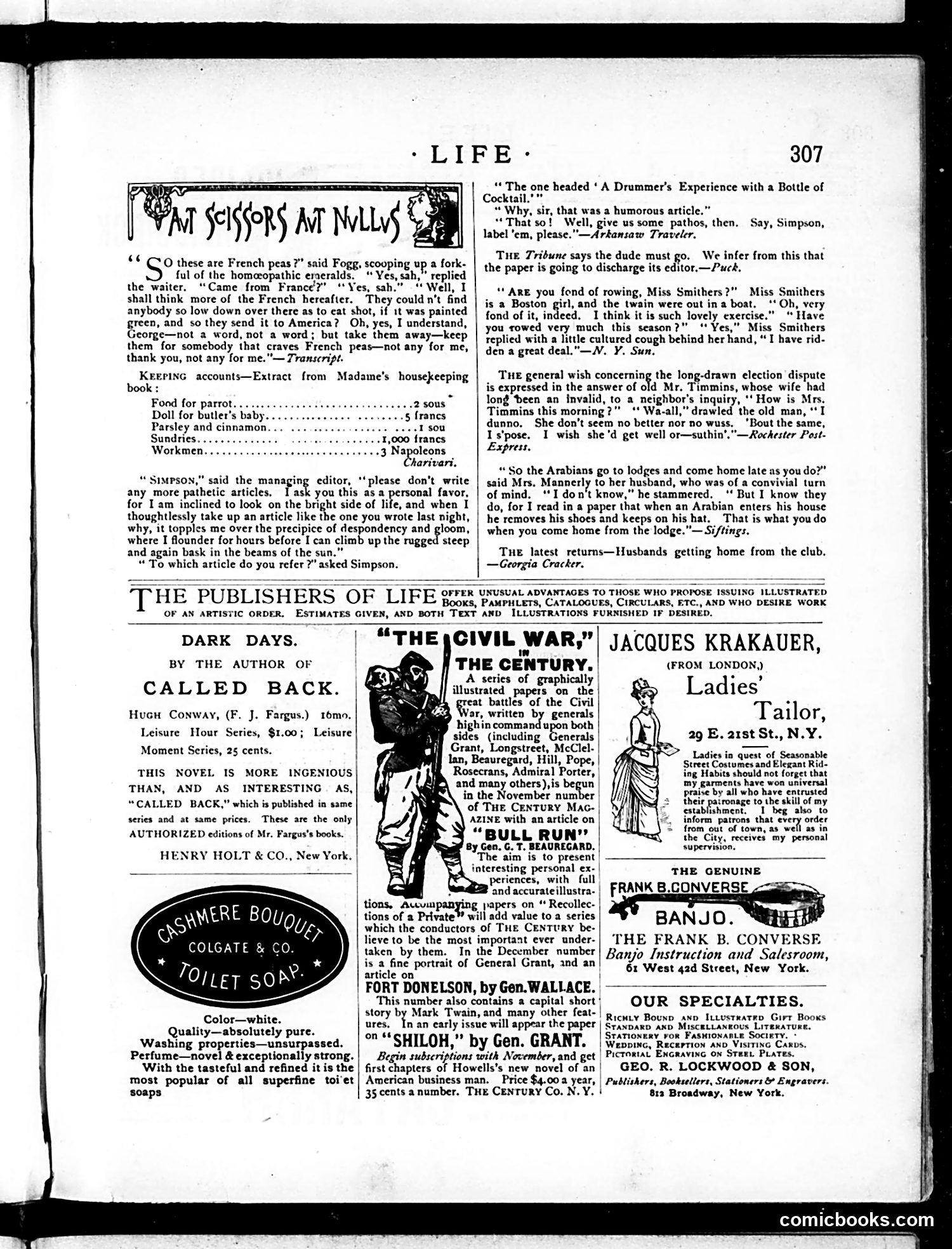
This page consists primarily of **satirical humor pieces and advertisements** rather than political cartoons. The content includes several short jokes and anecdotes satirizing American society and manners: **Key satirical pieces:** - A dialogue mocking American attitudes toward French cuisine (dismissing French peas as equivalent to ammunition) - Editorial commentary on pathetic newspaper articles causing reader despair - A joke about a Boston woman confusing "rowing" with "riding" (social pretension) - Humor about election disputes and domestic complaints - A gibe at men returning late from lodge meetings, compared unfavorably to Arabs who keep their hats on indoors **The satire targets:** American provincialism, newspaper melodrama, class pretension, and domestic/social conventions of the era. The page is otherwise dominated by **book advertisements** and publisher notices, including promotions for Hugh Conway's novel *Dark Days* and advertisements for banjos, tailoring services, and Colgate soap.
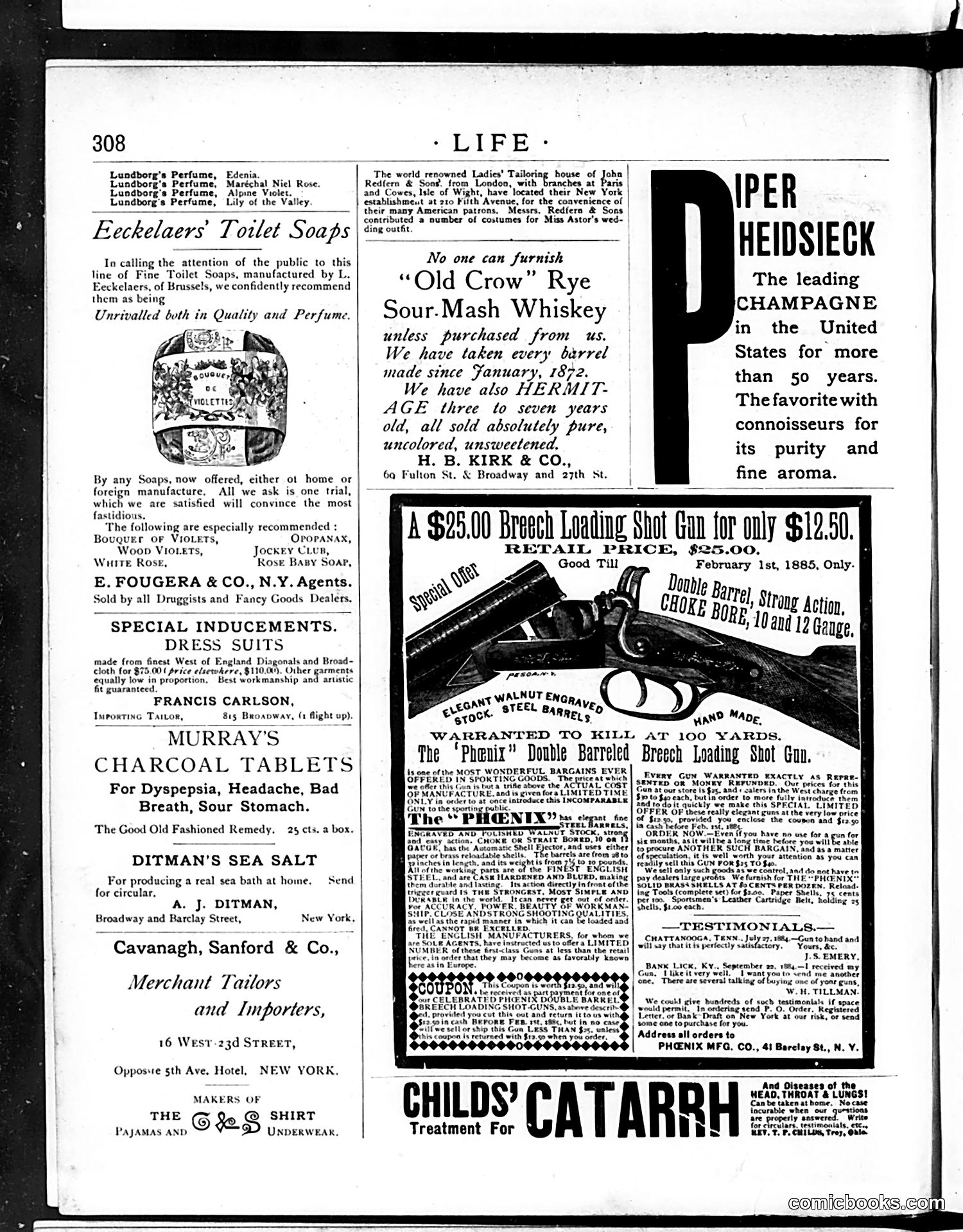
This page is **primarily advertising** from what appears to be the 1880s, with no significant political cartoons or satirical content requiring historical context. The ads reflect period consumer goods: luxury items like Piper Heidsieck champagne (marketed for 50+ years of prestige), fine French toilet soaps, and tailoring services for wealthy urbanites. Most notably, a prominent advertisement offers a "$25 breech-loading shotgun for only $12.50"—presented as an extraordinary bargain with testimonials from satisfied customers. The lone editorial content announces that London's prestigious "Redfern & Sons" ladies' tailoring house has opened a New York branch at Fifth Avenue, noting they supplied costumes for "Miss Astor's wedding." The page documents **Gilded Age consumer culture**: expensive imported luxuries for the wealthy elite, aggressive marketing of industrial products (firearms), and the fashion industry's transatlantic reach. No satire or political commentary is evident—this is straightforward commercial messaging aimed at affluent American readers.
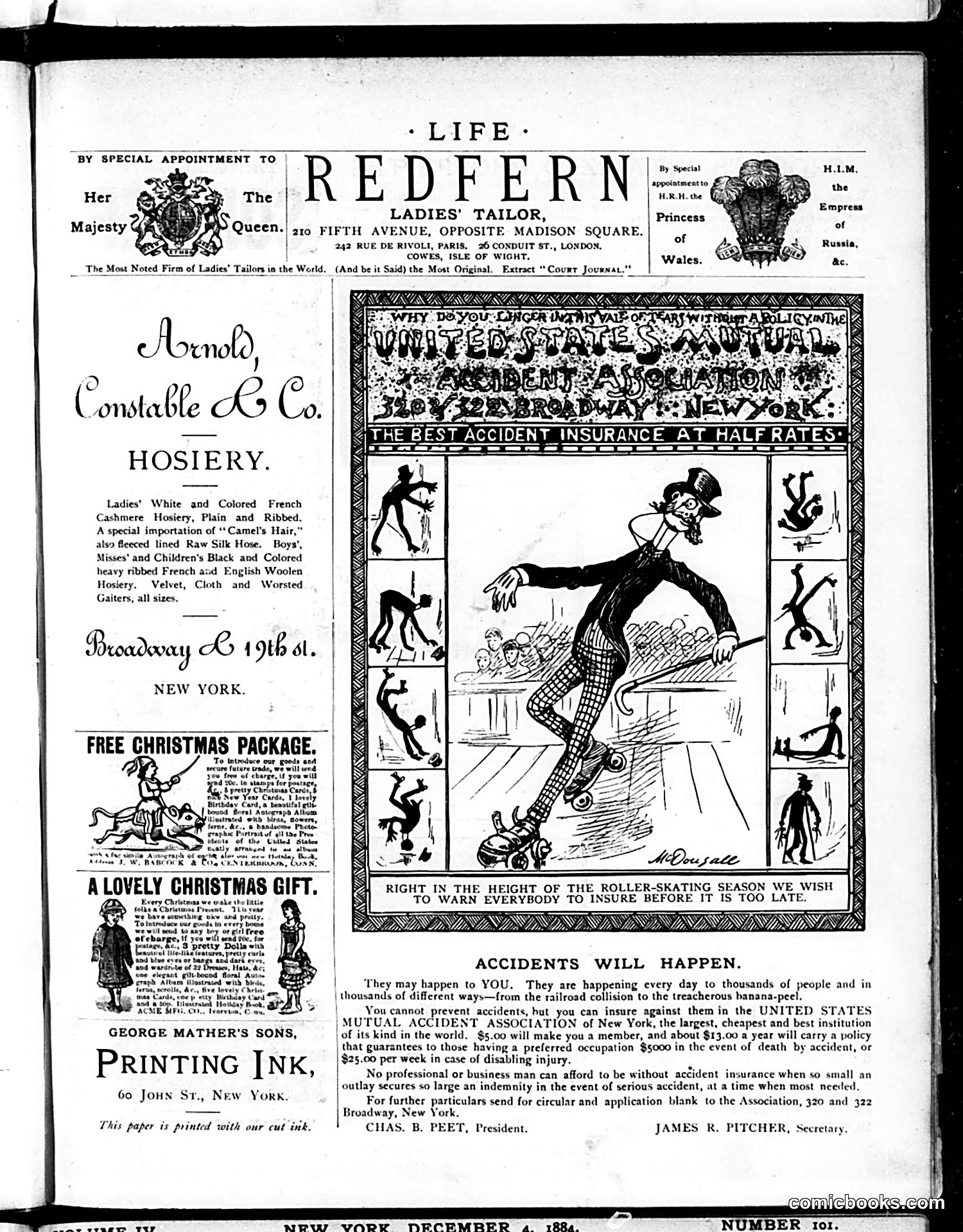
This page combines fashion/commercial advertising with a satirical cartoon about roller-skating safety. The central cartoon depicts a man in formal dress losing control on roller skates, flailing dramatically as he careens across a floor. Smaller vignettes around him show various skating mishaps—people falling and tumbling in different poses. The satire targets the roller-skating craze sweeping America in the 1880s by humorously warning of its dangers. The caption reads: "Right in the height of the roller-skating season we wish to warn everybody to insure before it is too late." This introduces the page's actual purpose: advertising the United States Mutual Accident Association, which sold accident insurance. The joke positions roller-skating as so hazardous that insurance is urgent. The advertisement below claims the association is "the largest, cheapest and best institution of its kind," offering coverage for $5 annual membership plus $13/year for death or injury protection. The page thus uses contemporary leisure-activity anxiety to market insurance—a common Victorian advertising strategy.
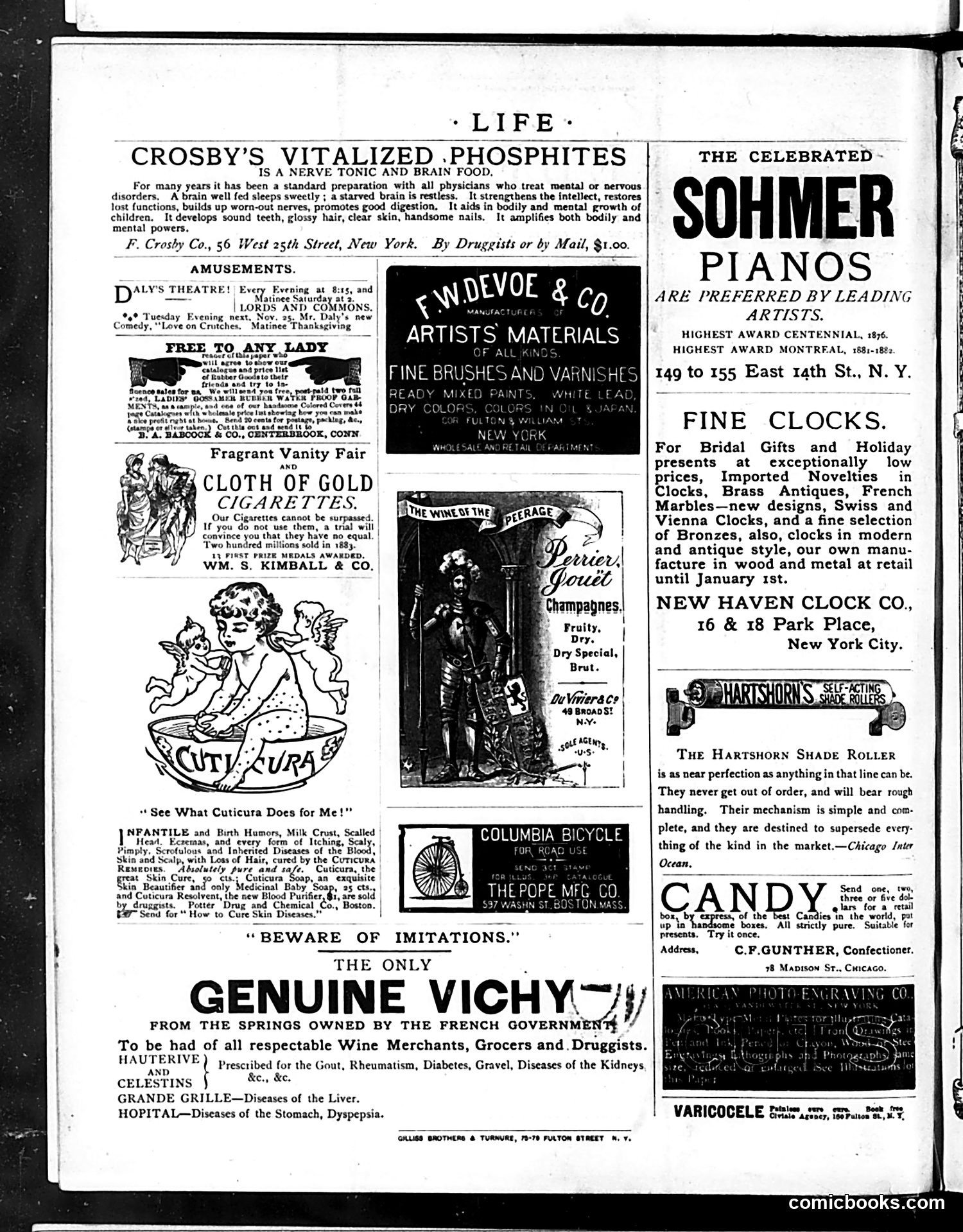
This is primarily an **advertising page** from Life magazine, likely from the 1880s, containing no political cartoons or satire requiring historical context. The page showcases period patent medicines and consumer goods typical of late-Victorian America. Notable ads include: - **Crosby's Vitalized Phosphites**: A "nerve tonic and brain food" claiming to treat mental disorders, strengthen intellect, and promote hair growth—representative of the era's unregulated medical claims. - **Cuticura remedies**: Marketed for skin conditions, emphasizing safety ("absolutely pure") to address public concerns about product quality. - **Vichy water**: Imported French mineral water prescribed for gout, rheumatism, and digestive ailments. - **Cloth of Gold cigarettes**: Advertised with decorative cherubs and claims of superiority backed by "two hundred million sold." The decorative illustrations (cherubs, classical figures) reflect Victorian aesthetic conventions. These ads collectively illustrate how late-19th-century commerce exploited consumer anxieties about health and appearance through largely unsubstantiated product claims—practices that would later prompt regulation.