
Life, 1884-11-27 · page 4 of 16
Life — November 27, 1884 — page 4: what you’re looking at
What you’re looking at
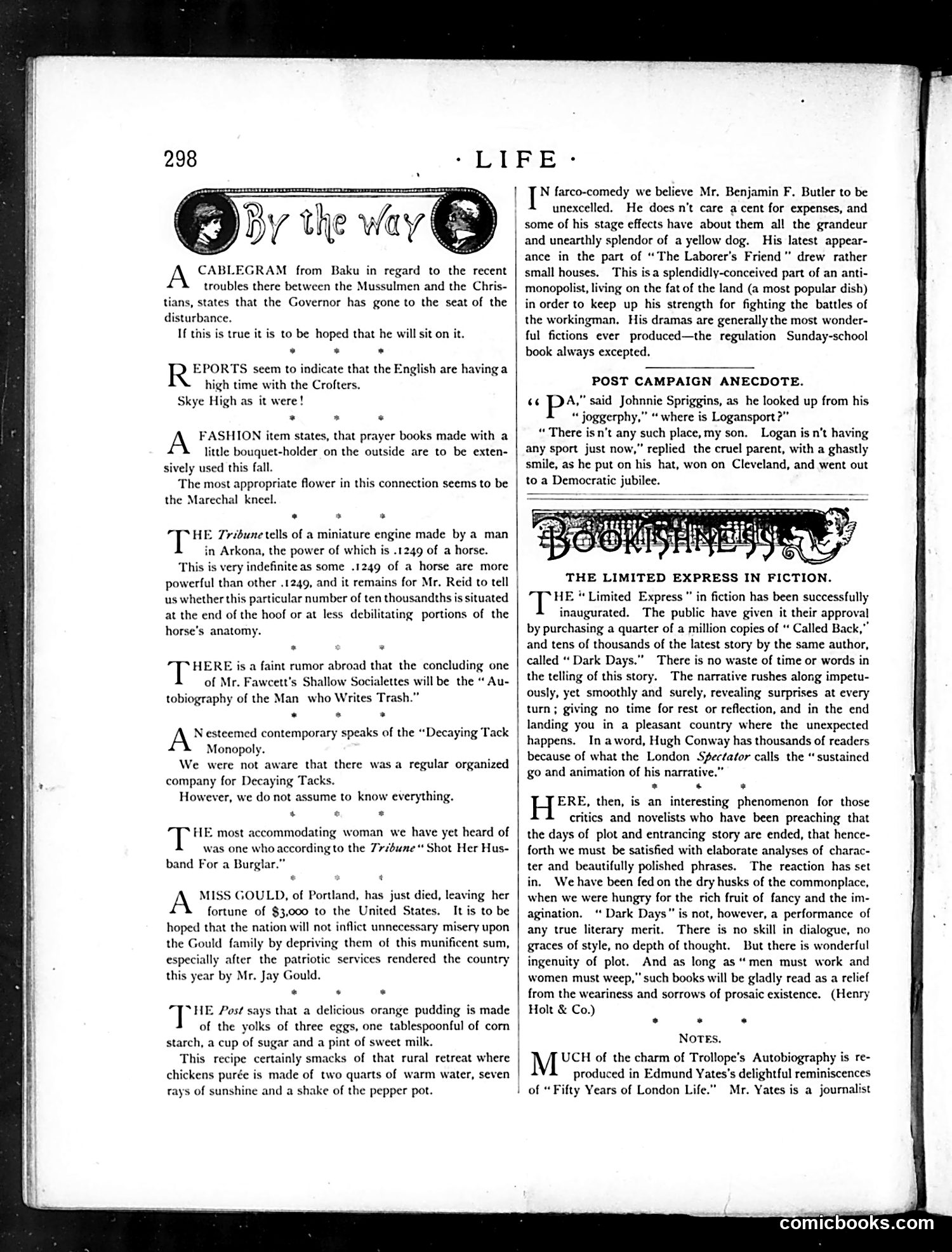
This page consists entirely of text columns labeled "By the Way" — a satirical commentary section. There are no political cartoons visible. The section includes brief satirical items about contemporary topics: a cable from Baku regarding Muslim-Christian tensions (likely referencing early 20th-century Caucasus conflicts), comments on English-Crofter disputes, fashion criticism about prayer books, and commentary on a miniature engine's horsepower. Notable is satire on Benjamin F. Butler as a farce-comedy character and criticism of a new "Limited Express" fiction format by Hugh Conway, which the reviewer dismisses as plot-driven entertainment lacking literary merit. The page is primarily written commentary and social criticism rather than visual satire, relying on wit and irony rather than illustration.
📄 Transcribed text from this page (OCR, searchable)
Machine-transcribed from the original scan — historical spelling and the odd misread are preserved.
-LI oe, CABLEGRAM from Baku in regard to the recent troubles there between the Mussulmen and the Chris- tians, states that the Governor has gone to the seat of the disturbance. If this is true it is to be hoped that he will sit on it. . * . RES seem to indicate that the English are having a high time with the Crofters. Skye High as it were! * . . FASHION item states, that prayer books made with a little bouquet-holder on the outside are to be exten- sively used this fall. The most appropriate flower in this connection seems to be the Marechal kneel. . * * T HE 7rébunetells of a miniature engine made by a man Arkona, the power of which is .1249 of a horse. This is very indefinite as some .1249 of a horse are more powerful than other .1249, and it remains for Mr. Reid to tell | us whether this particular number of ten thousandths is situated at the end of the hoof or at less debilitating portions of the horse’s anatomy. * * HERE is a faint rumor abroad that the concluding one of Mr. Fawcett’s Shallow Socialettes will be the “ Au- tobiography of the Man who Writes Trash.” . . . N esteemed contemporary speaks of the “Decaying Tack | Monopoly. We were not aware that there was a regular organized company for Decaying Tacks. However, we do not assume to know everything. rs e . HE most accommodating woman we have yet heard of was one who according to the 7rune“ Shot Her Hus- band For a Burglar.” ‘ ‘ MISS GOULD, of Portland, has just died, leaving her fortune of $3,000 to the United States. It is to be hoped that the nation will not inflict unnecessary misery upon the Gould family by depriving them of this munificent sum, especially after the patriotic services rendered the country this year by Mr. Jay Gould. « . . Te Post says that a delicious orange pudding is made of the yolks of three eggs, one tablespoonful of corn starch, a cup of sugar and a pint of sweet milk. This recipe certainly smacks of that rural retreat where chickens purée is made of two quarts of warm water, seven rays of sunshine and a shake of the pepper pot. FE: | TN farco-comedy we believe Mr. Benjamin F. Butler to be unexcelled. He does n't care a cent for expenses, and some of his stage effects have about them all the grandeur and unearthly splendor of a yellow dog. His latest appear- ance in the part of “The Laborer’s Friend" drew rather small houses. This isa splendidly-conceived part of an anti- monopolist, living on the fat of the land (a most popular dish) in order to keep up his strength for fighting the battles of the workingman. His dramas are generally the most wonder- ful fictions ever produced—the regulation Sunday-school book always excepted. POST CAMPAIGN ANECDOTE. “cs P*. said Johnnie Spriggins, as he looked up from his. “ joggerphy,” “ where is Logansport ?” “ There isn’t any such place, my son. Logan is n't having any sport just now,” replied the cruel parent, with a ghastly | smile, as he put on his hat, won on Cleveland, and went out to a Democratic jubilee. THE LIMITED EXPRESS IN FICTION. HE * Limited Express " in fiction has been successfully inaugurated. The public have given it their approval by purchasing a quarter of a million copies of “ Called Back,” and tens of thousands of the latest story by the same author, called “ Dark Days.” There is no waste of time or words in the telling of this story. The narrative rushes along impetu- ously, yet smoothly and surely, revealing surprises at every turn; giving no time for rest or reflection, and in the end landing you in a pleasant country where the unexpected happens. In aword, Hugh Conway has thousands of readers because of what the London Sfectator calls the “ sustained go and animation of his narrative.” * . * ERE, then, is an interesting phenomenon for those critics and novelists who have been preaching that the days of plot and entrancing story are ended, that hence- forth we must be satisfied with elaborate analyses of charac- ter and beautifully polished phrases. The reaction has set in. We have been fed on the dry husks of the commonplace, when we were hungry for the rich fruit of fancy and the im- agination. ‘ Dark Days” is not, however, a performance of any true literary merit. There is no skill in dialogue, no graces of style, no depth of thought. But there is wonderful ingenuity of plot. And as long as “men must work and women must weep,” such books will be gladly read as a relief from the weariness and sorrows of prosaic existence. (Henry | Holt & Co.) ° . . NOTES. UCH of the charm of Trollope’s Autobiography is re- produced in Edmund Yates's delightful reminiscences | of “Fifty Years of London Life.” Mr. Yates is a journalist comicbooks.com