
A complete issue · 16 pages · 1884
Life — October 30, 1884
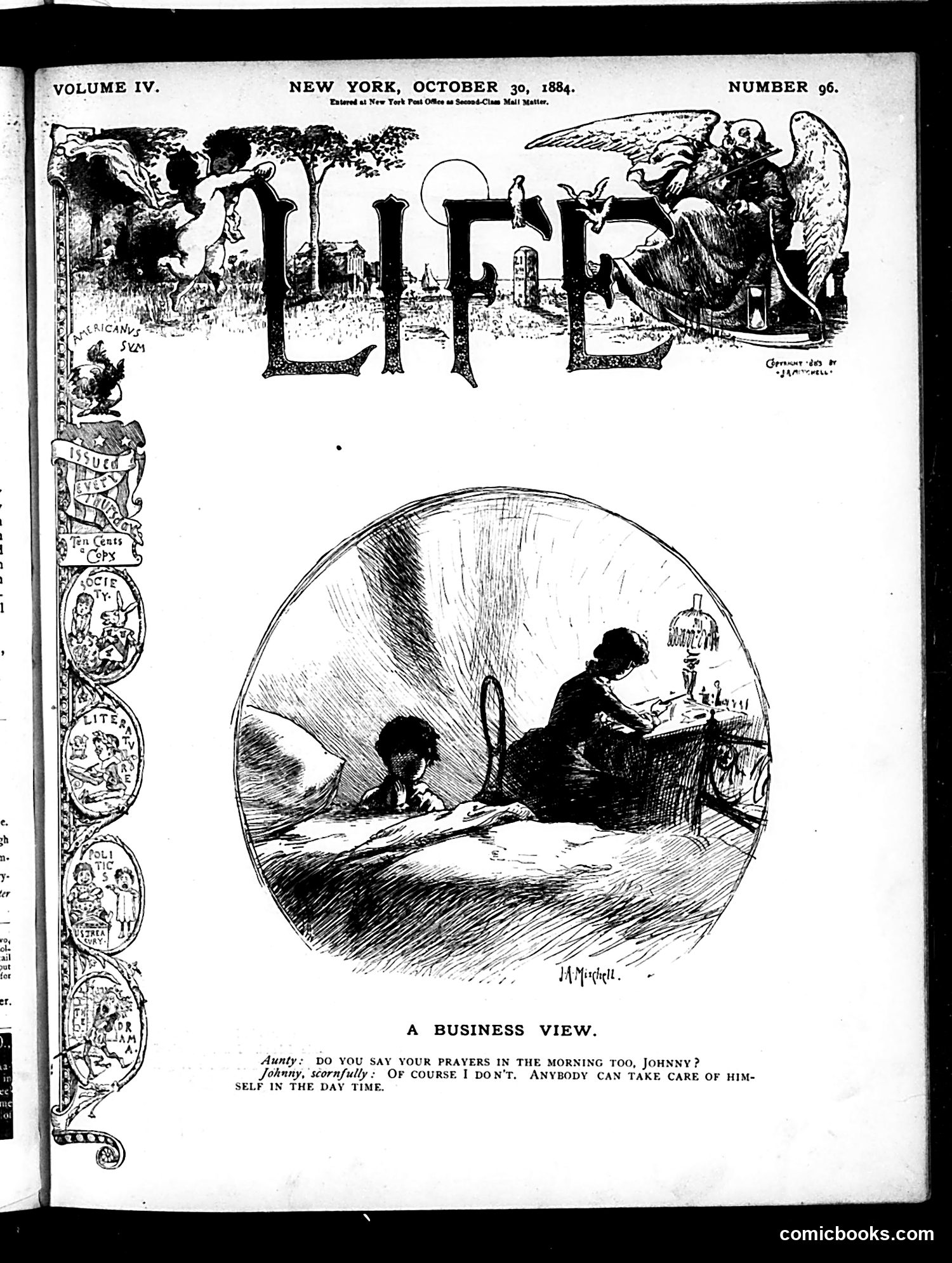
This cartoon satirizes parental hypocrisy regarding children's religious education. The illustration shows a mother and son in what appears to be a bedroom scene. The caption has the aunt asking if the boy says his prayers in the morning, to which the mother responds that she doesn't—anyone can take care of themselves during the day. The satire targets the selective or inconsistent application of religious practice: the mother expects her son to pray but openly admits she neglects her own prayers, dismissing them as unnecessary for adult self-reliance. This exposes the double standard of imposing spiritual discipline on children while abandoning it oneself—a critique of Victorian-era parental attitudes and the gap between professed values and actual behavior.
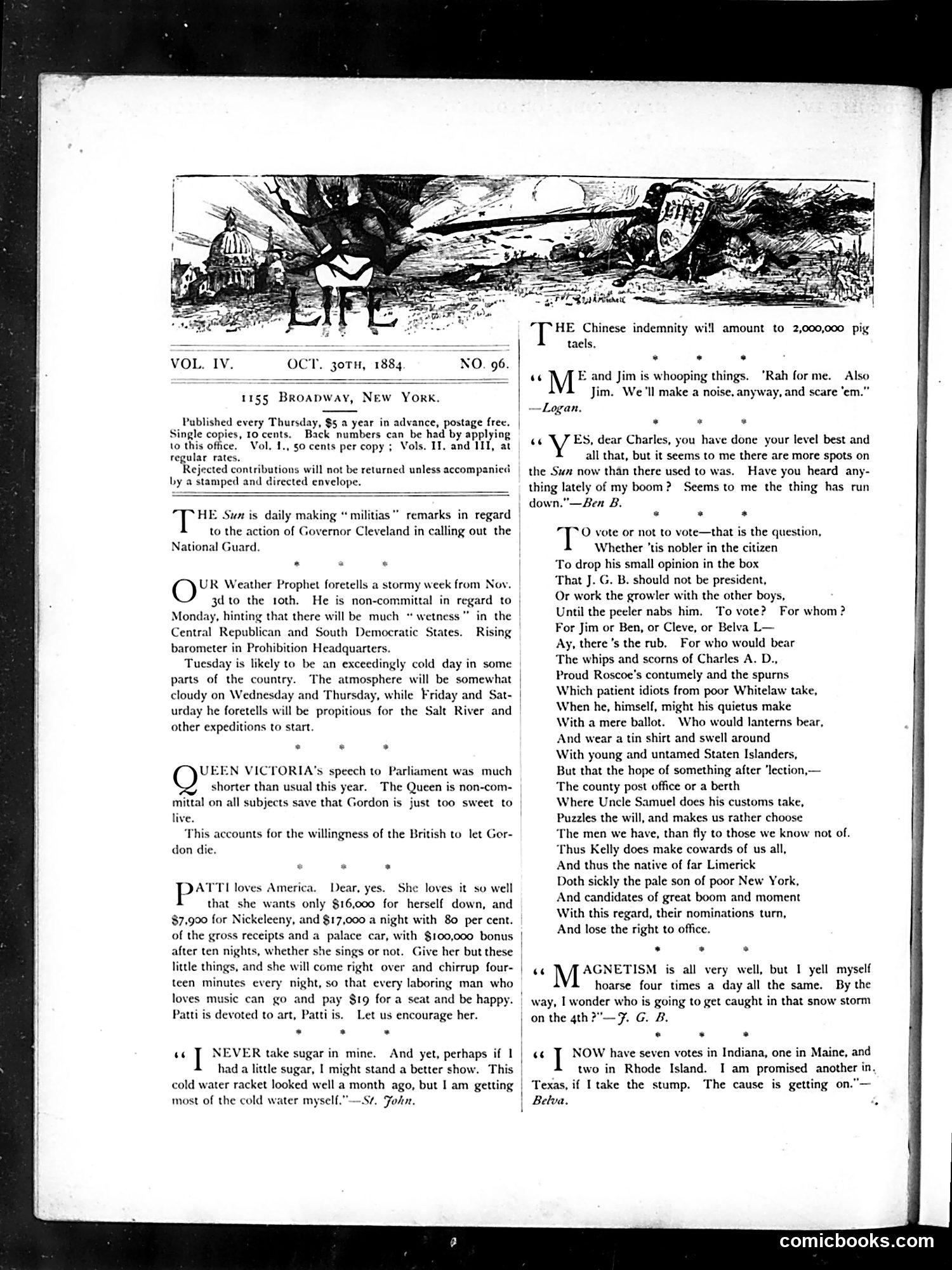
The page's masthead cartoon depicts a chaotic scene with figures and wreckage, likely referencing contemporary political turmoil, though specific identities are unclear from the image alone. The text below discusses Governor Cleveland's actions regarding the National Guard and weather predictions. One article criticizes Kelly for making "cowards" of New Yorkers regarding voting and political nominations, suggesting electoral corruption or manipulation. Another section mocks Patti (likely opera singer Adelina Patti), satirizing her high financial demands for American performances—$16,000 for herself, bonuses, and other fees. The various quoted remarks address political voting, magnetism (possibly a pseudonym for someone's campaign), and voting fraud across multiple states. The overall tone is satirical commentary on 1884 American politics, entertainment industry excess, and electoral integrity concerns.
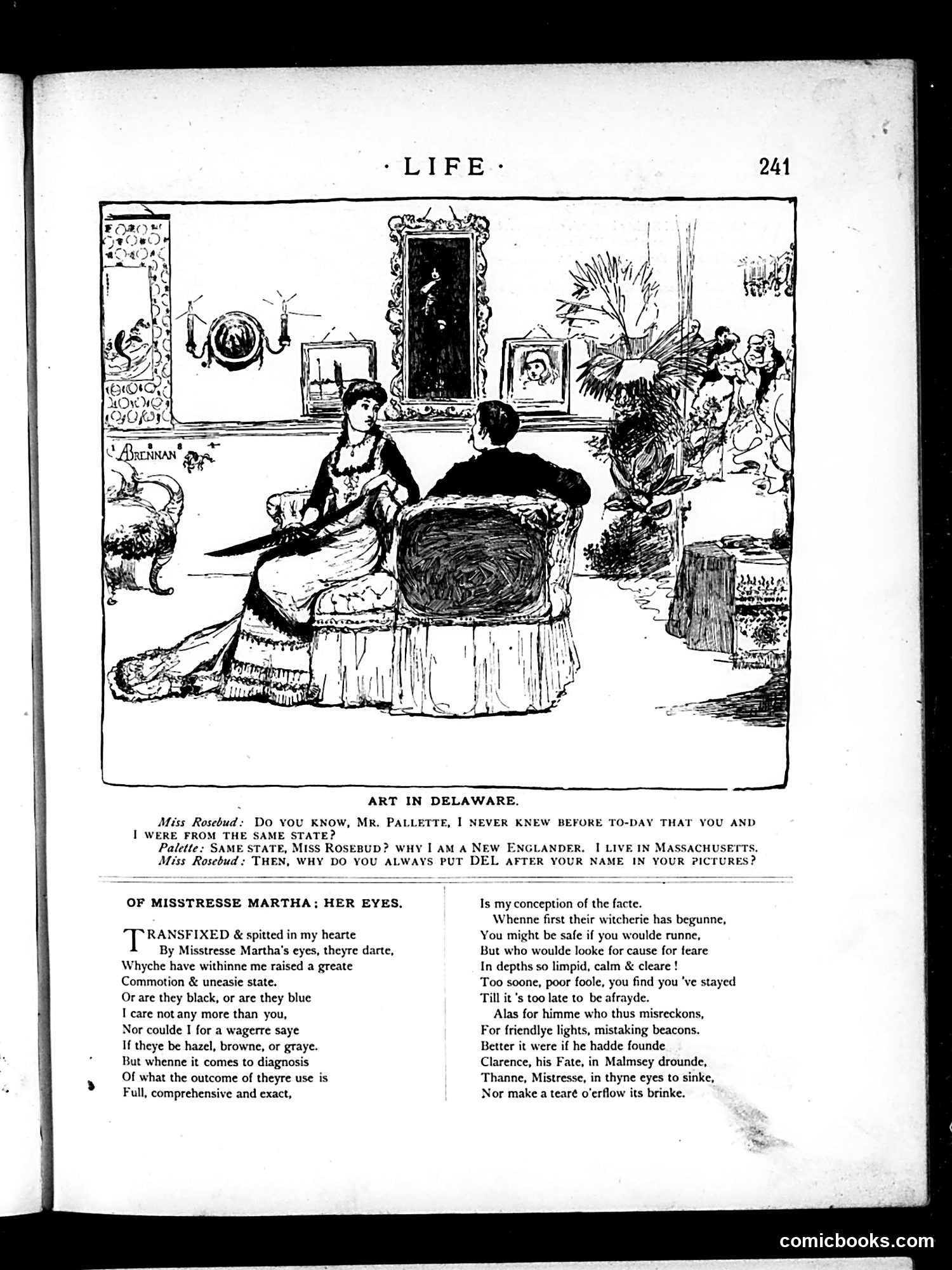
This cartoon satirizes regional cultural pretensions. Two figures discuss art in what appears to be a fancy interior with paintings and sculptures. The joke relies on a dialogue where Miss Rosebud claims never to have known that the man and woman both lived in the same state, while Palette (apparently a New Englander from Massachusetts) responds that he puts "Del" after their names in his pictures—a play on "Delaware" sounding like "Del." The humor targets both Delaware's cultural obscurity and affected artistic circles that use French names or affectations. The elaborate room with classical art references emphasizes the pretentiousness being mocked. This reflects early 20th-century regional stereotypes about which American states were considered culturally sophisticated versus provincial.
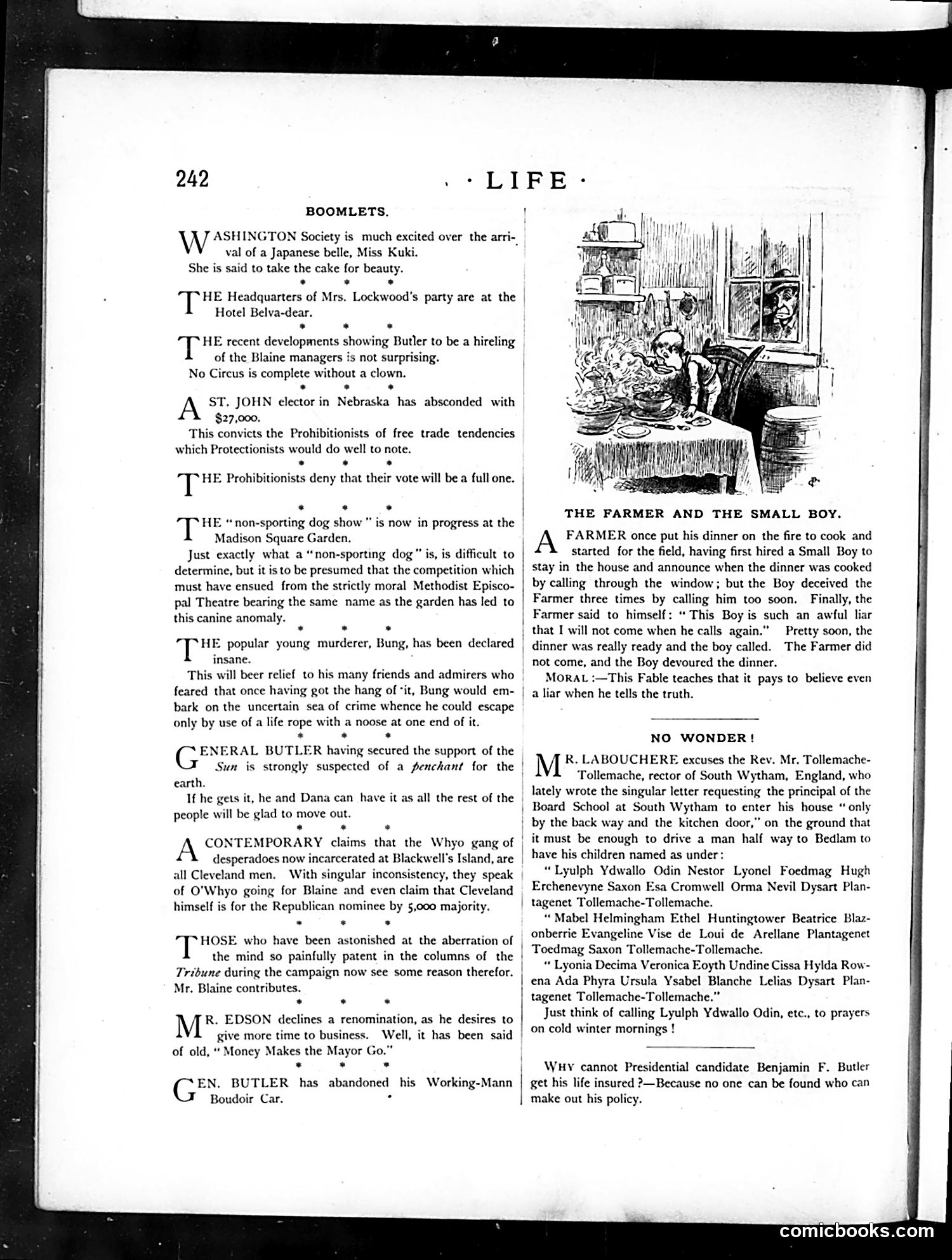
The cartoon illustrates a moral fable about dishonesty. A farmer prepares dinner and hires a boy to stay inside and announce when it's ready. The farmer calls three times falsely before the meal actually cooks. When dinner is genuinely ready, the boy ignores him—having learned not to trust the farmer's word. The moral teaches that "it pays to believe even a liar when he tells the truth." This satirizes the broader human tendency toward skepticism after repeated deception. The accompanying "Boomlets" section contains Washington social gossip and political commentary, including jabs at General Butler and Mr. Blaine's political positions, typical of Life magazine's satirical nature during this era.
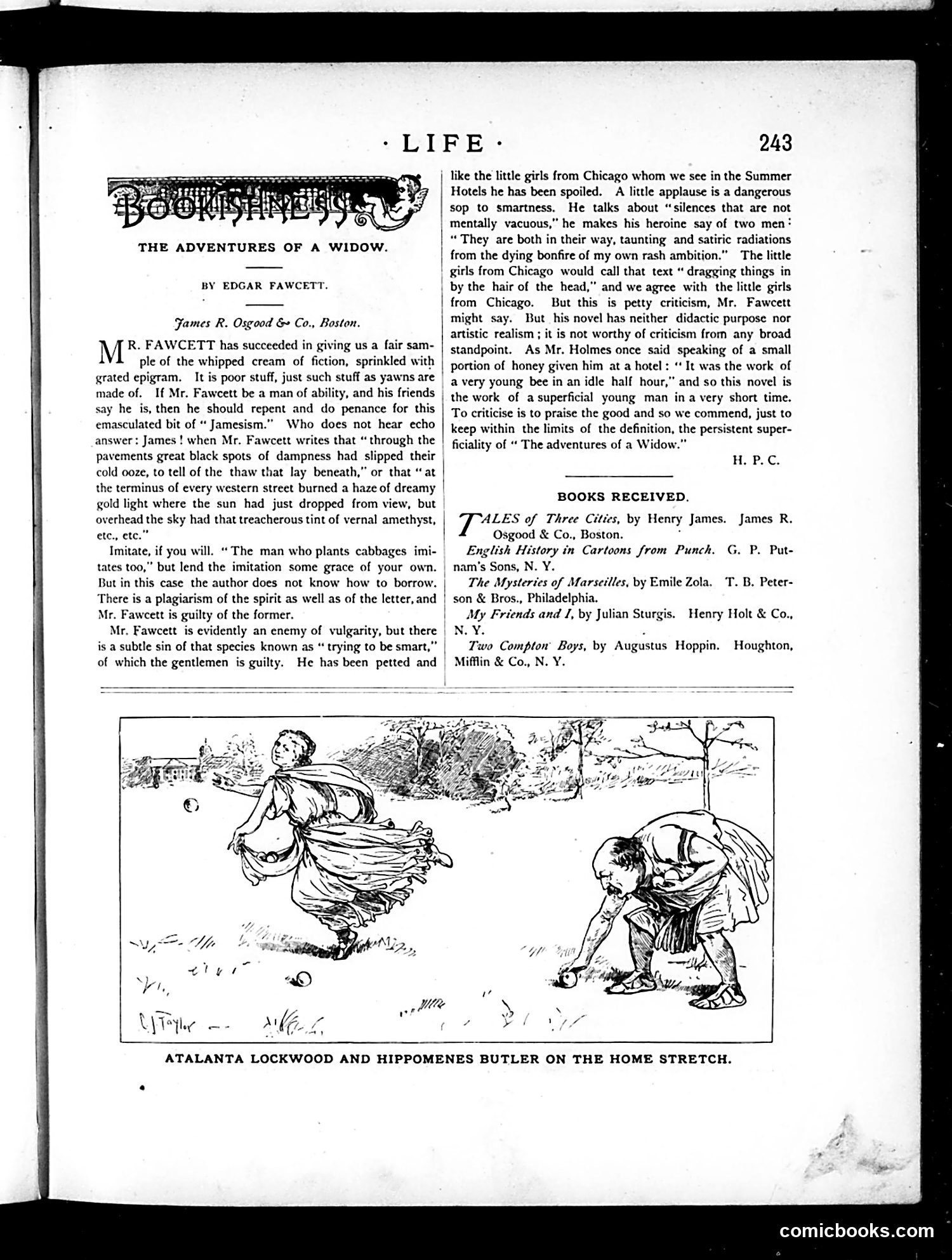
This page reviews Edgar Fawcett's novel *The Adventures of a Widow*. The critic (H.P.C.) offers a mixed assessment, praising Fawcett's ability to write "whipped cream of fiction" while criticizing his work as superficial and derivative—lacking both didactic purpose and artistic realism. The illustration shows two figures on a home street: a woman in flowing dress (presumably the widow protagonist) and a man bending over in exaggerated posture. This appears to be satirizing the novel's romantic or comedic situations. The caption references "Atalanta Lockwood and Hippomenes Butler," suggesting character names that the contemporary reader would recognize from the novel itself. The "Books Received" section lists contemporary literary works, positioning this within 1880s-90s publishing culture.
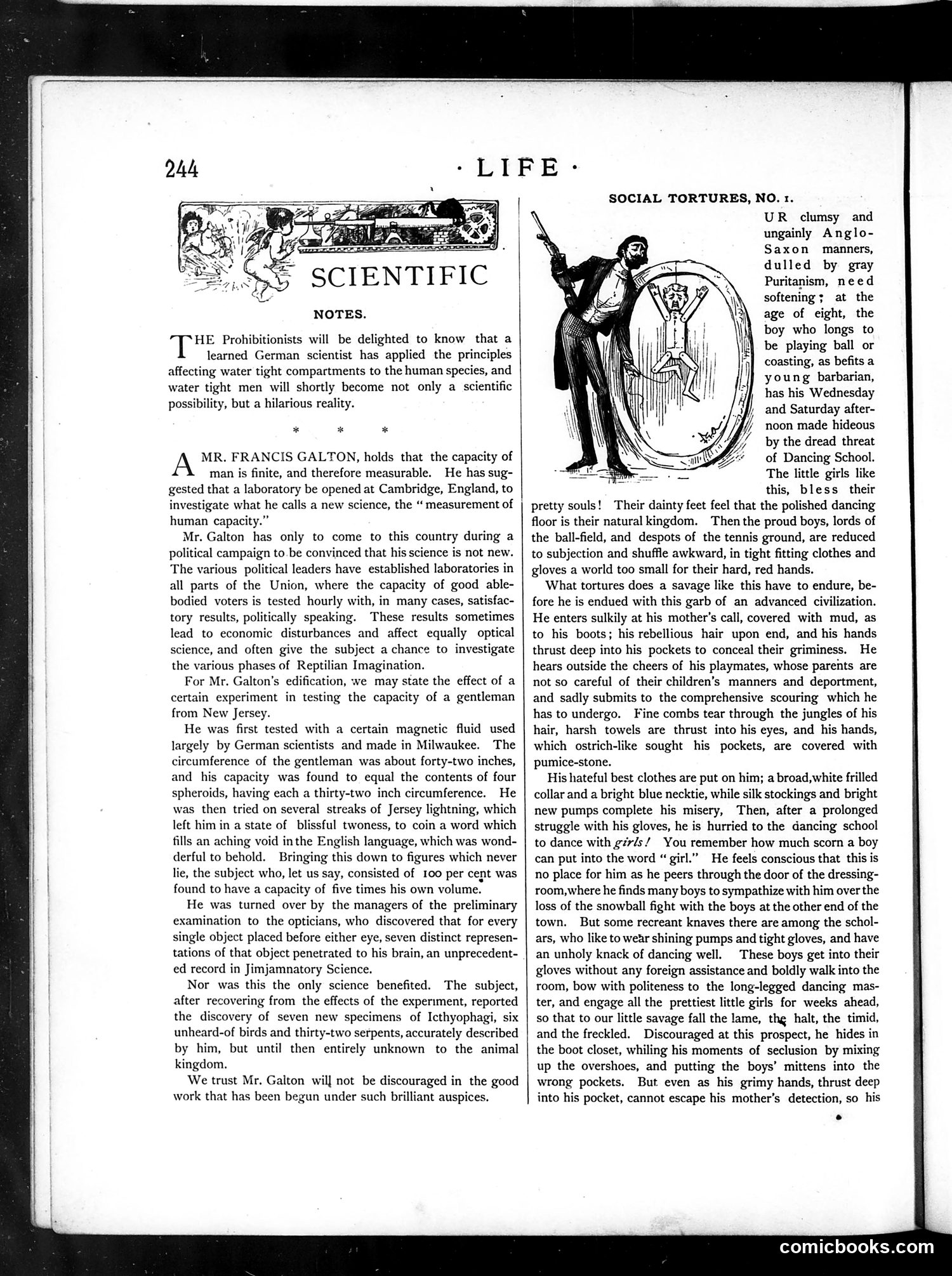
The main cartoon depicts a thin, elongated man examining or manipulating a large wheel or circular object—likely representing a scientific instrument or measuring device. The "Scientific Notes" column discusses **Francis Galton's** research on measuring human capacity, referencing his experiments in Cambridge, England testing "the measurement of human capacity." The text mentions testing magnetic fluids on a gentleman from New Jersey and describes bizarre experimental results involving objects penetrating the brain. The right column, "Social Tortures, No. 1," satirizes the rigid discipline imposed on young boys in Anglo-Saxon society—specifically the ordeal of mandatory dancing school. It humorously describes the uncomfortable clothing, social awkwardness, and maternal enforcement of these "tortures" on reluctant children forced to learn ballroom dancing.
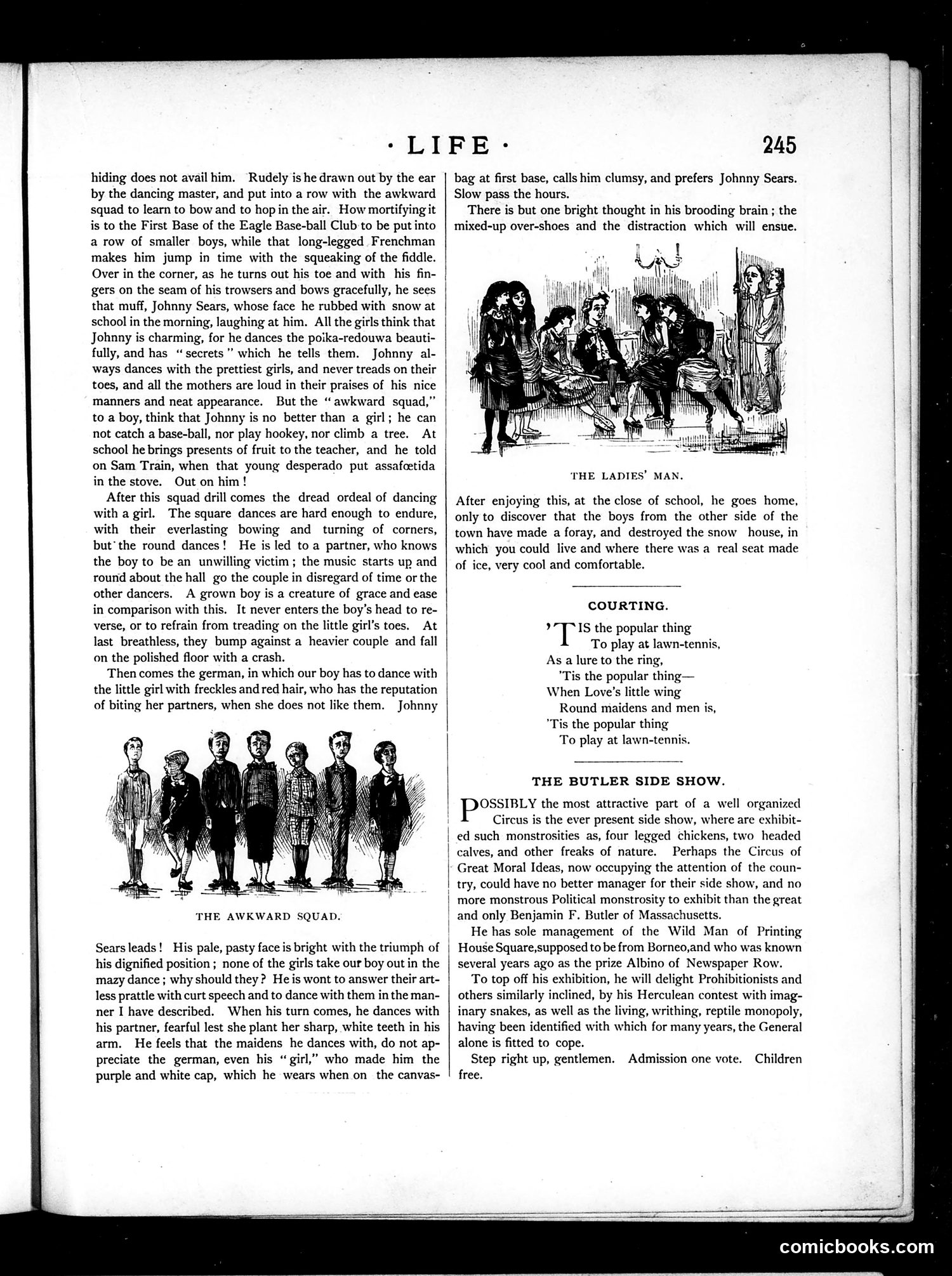
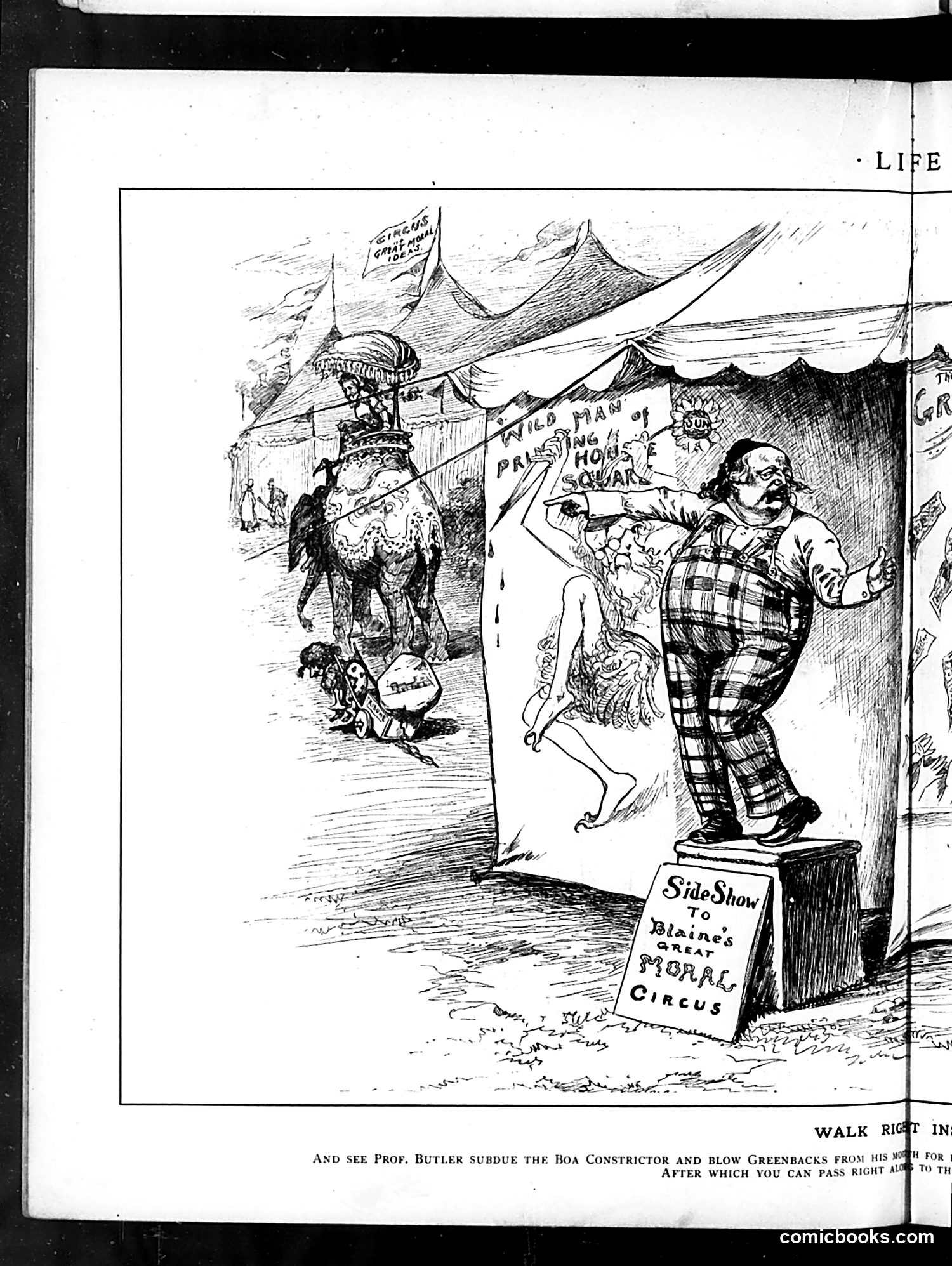
This Life magazine cartoon depicts a circus sideshow satirizing what appears to be a scandal or controversy involving "Prof. Butler Surdue" (likely Professor James H. Surdue) and improper conduct. The visual setup is a mock carnival attraction advertising a "Side Show to Blaine's art Morals Circus." A portly barker in Scottish attire stands outside a tent displaying crude illustrations, while an elephant and handler represent the main circus attractions. The sign references "Greenbacks" (money), suggesting financial corruption or moral compromise related to James G. Blaine, a prominent late 19th-century politician known for scandals involving improper financial dealings. The satire conflates Blaine's controversial reputation with circus spectacle, mocking both the politician and public fascination with scandal.
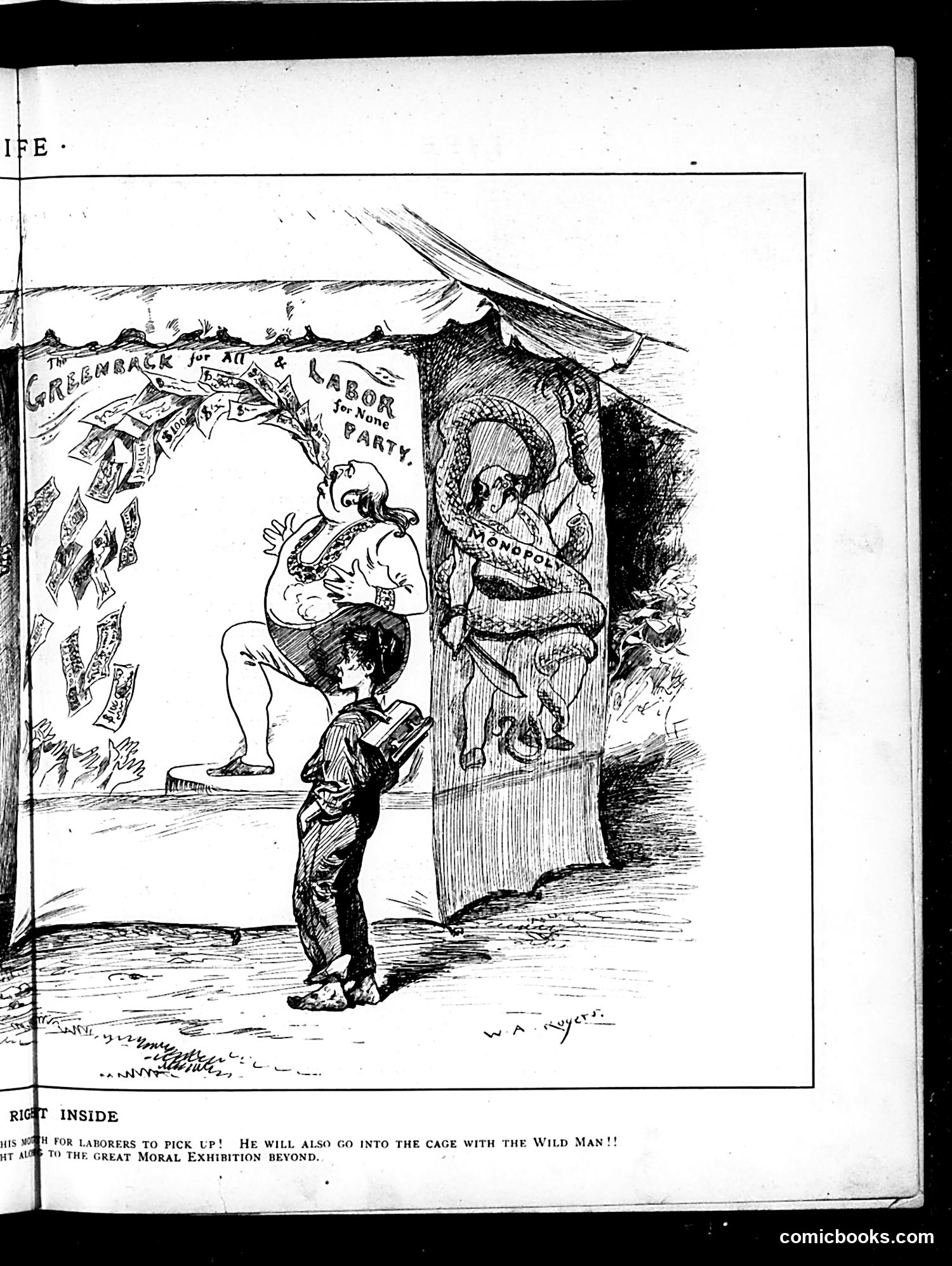
This cartoon satirizes the **Greenback Labor Party**, a late 19th-century American political movement. The tent banner reads "GREENBACK LABOR PARTY," and the illustration shows a well-dressed man in a cage labeled "MONOPOLY," while a smaller figure (likely representing a worker or common man) stands outside observing. The satire criticizes how the Greenback movement—which advocated for paper currency and workers' rights—was actually controlled by monopolistic interests despite its anti-monopoly rhetoric. The "wild man in the cage" appears to represent the movement itself or its leadership, suggesting it was a spectacle or oddity rather than a genuine reform effort. The caption references "laborers" and a "great moral exhibition," implying the party was more showmanship than substance.
This page satirizes the New York theater world through mock reviews of productions and performers. The humor targets theatrical pretension and incompetence: The satire mocks the **Lyceum Theatre's "school of instruction"** by suggesting it teaches "bungling" and praising instructors for teaching subjects they don't understand—a jab at the institution's credibility. **Isaac Norcross's reappearance** is sarcastically celebrated as delighting "wig-makers and costumers," implying his poor performances necessitate extensive costume work. **Edwin Booth's production** is ridiculed for spending only $38.70 on scenery while guaranteeing his lead actor just $23/week—exposing misplaced theatrical priorities. **Colonel Mapleson's "Uncle Tom's Cabin" revival** receives heavy-handed criticism through descriptions of "200 colored jubilee singers" and "400 on the bills," mocking the production's exploitation and saccharine sentimentality. The page exemplifies Life's theatrical criticism style: using exaggeration and irony to expose vanity, waste, and artistic mediocrity in contemporary Broadway.
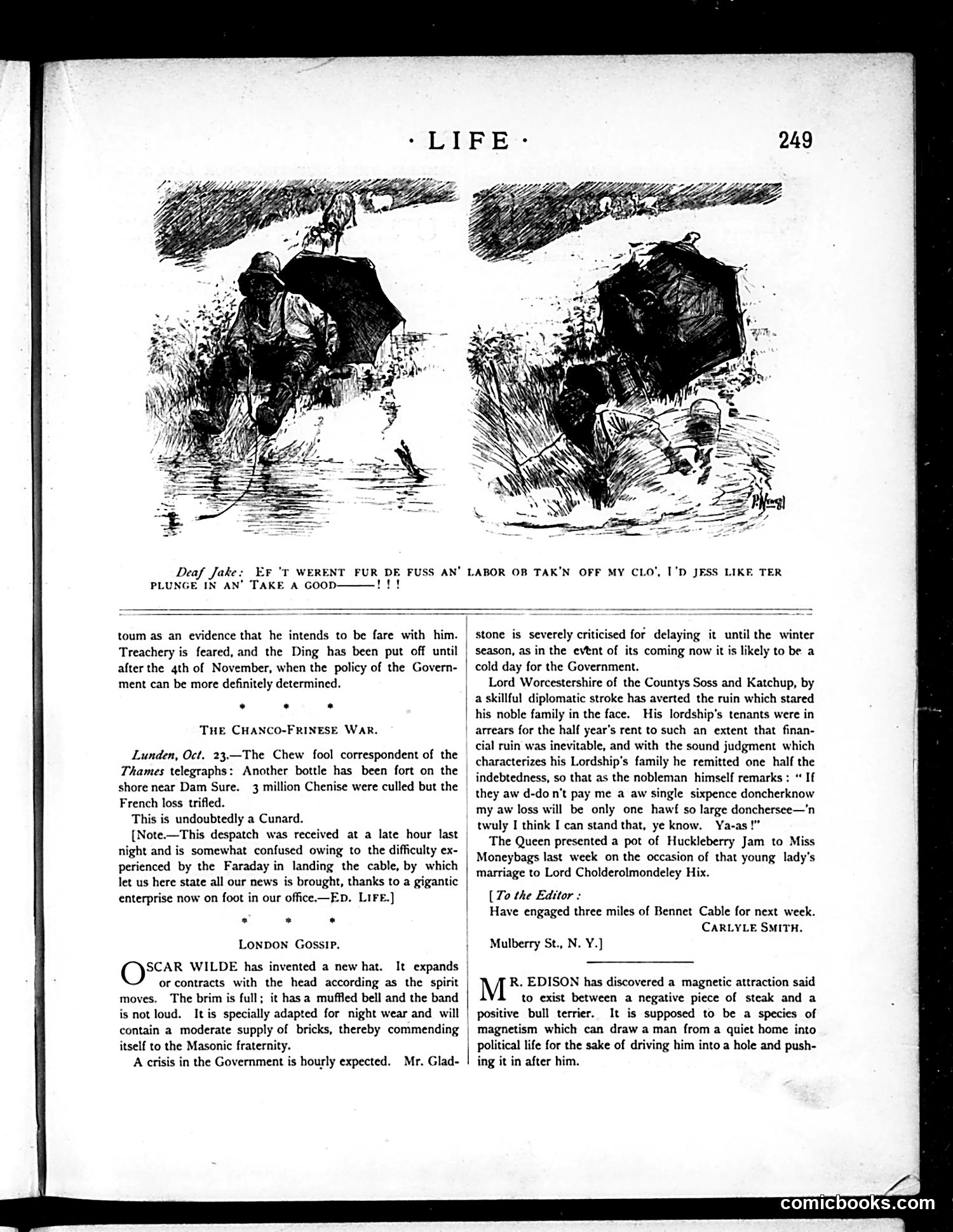
This page contains two main satirical pieces: **The Cartoon (top):** "Deaf Jake" depicts someone reluctant to take a plunge into water, using dialect humor typical of period comedy. The joke plays on working-class speech patterns and physical cowardice. **"The Chanco-Frinese War":** A mock-serious news parody mocking sensationalized war reporting and transatlantic cable communications. References to garbled details ("3 million Chenise," "Cunard") satirize unreliable foreign dispatches. **London Gossip section:** Includes jabs at Oscar Wilde (his new expandable hat mocks his aesthetic pretensions), British politics (Gladstone's government crisis), and aristocratic absurdity (Lord Worcestershire's tenant-rent forgiveness scheme that barely helps). **Edison reference:** A cynical quip suggesting magnetism draws men from peaceful homes into destructive political careers. The overall tone reflects *Life*'s role as a satirical magazine targeting contemporary celebrities, politicians, and social absurdities through exaggeration and mockery.
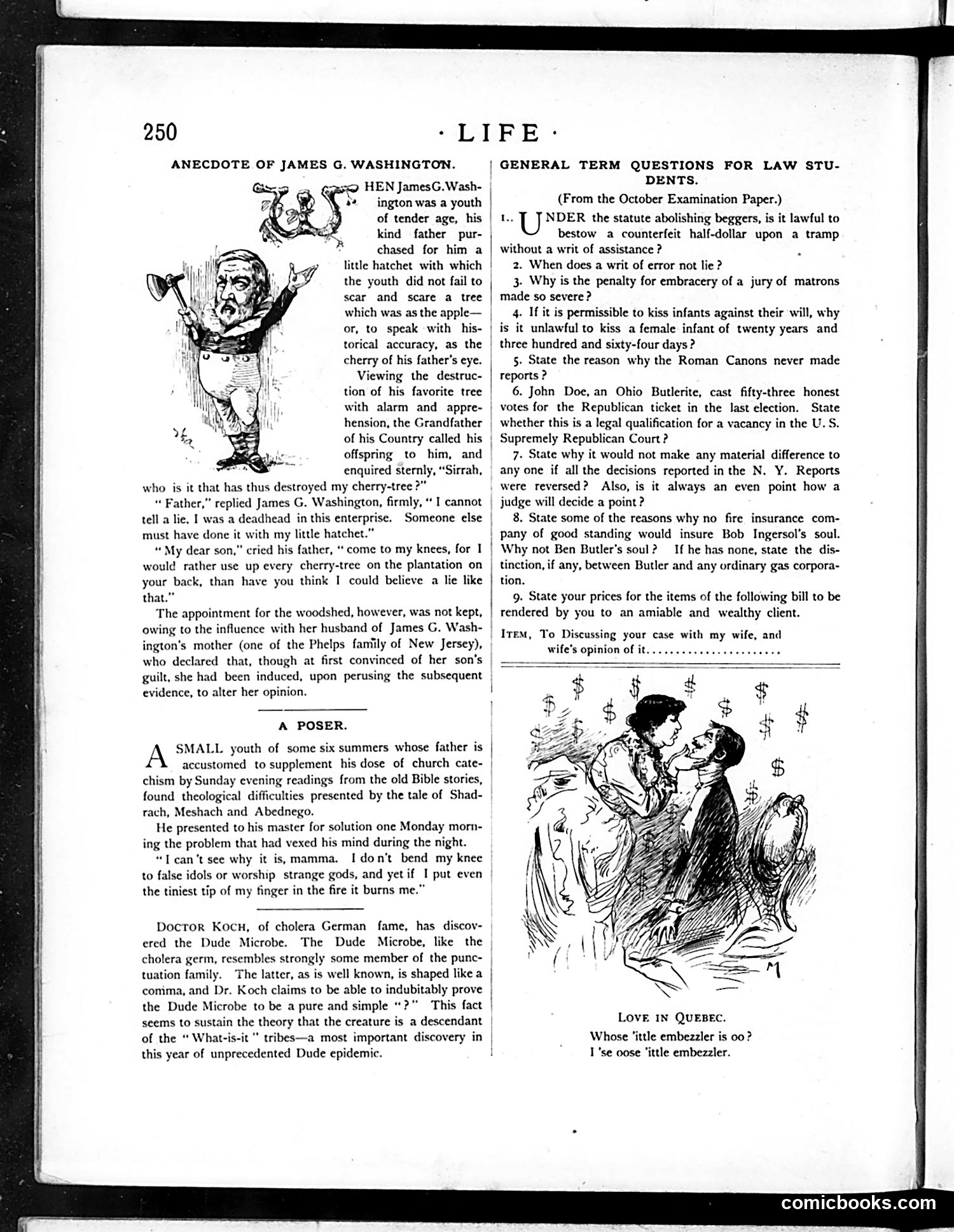
This satirical page mocks multiple targets through humor: **"Anecdote of James G. Washington"**: A parody of the famous (apocryphal) story of young George Washington confessing to cutting down his father's cherry tree. Here, "James G. Washington" deflects blame onto someone else despite claiming he "cannot tell a lie"—satirizing politicians who invoke honesty while evading responsibility. **"A Poser"**: A brief theological joke about a child unable to reconcile religious instruction (not worshipping false gods) with physical reality (fire burns). **"General Term Questions for Law Students"**: Mock exam questions ridiculing legal absurdities and ambiguities. Question 8 attacks Robert Ingersoll (a famous atheist) and Ben Butler (a controversial political figure), questioning whether they possess souls—combining legal satire with personal political mockery. **"Love in Quebec"**: A small sketch with flirtatious French-Canadian dialect. The page exemplifies *Life*'s characteristic blend of political satire, legal critique, and social mockery targeting 1890s American public figures and institutions.
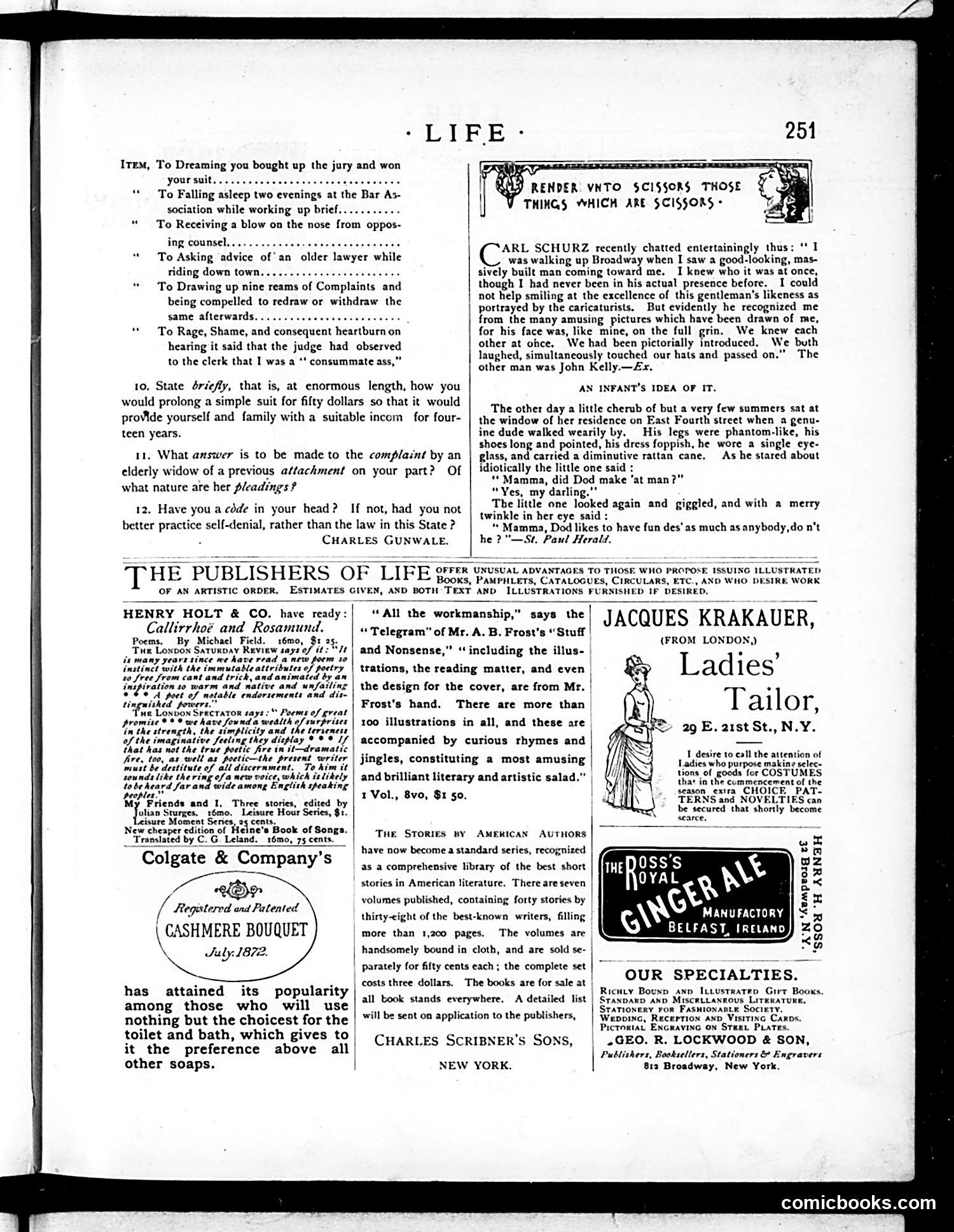
This page combines satirical legal commentary with social humor and advertisements. The main content includes: **Legal Satire** (top left): A humorous questionnaire attributed to "Charles Gunwale" mocking incompetent lawyers—their courtroom failures, inability to win cases, and tendency to bumble simple matters into lengthy, profitable ordeals. **The Cartoon Caption** (top center): References political figure Carl Schurz recognizing someone (John Kelly) on Broadway through newspaper caricatures rather than personal acquaintance—satirizing how widely circulated political cartoons made public figures' drawn likenesses more familiar than their actual faces. **Social Humor** (center): A child's innocent observation of a fashionable "dude" (a vain, effeminate man in tight clothes and monocle), asking if God made him—implying even God enjoys joking around. The page is primarily **advertising and publisher announcements** for books and services. The satire targets legal incompetence, celebrity recognition through caricature, and Victorian-era fashion pretension.
This page is primarily advertisements and two brief satirical anecdotes, not political cartoons. The two jokes are: 1. A schoolmaster questions a student about the North Pole's location. When the boy admits ignorance, the teacher expresses shame—until the student retorts that even famous Arctic explorers (Sir John Franklin, Dr. Kane, Captains Nares and Markham) couldn't find it, so how should he? The joke mocks pedantic schoolmasters who demand knowledge on impossibly obscure topics. 2. A follow-up joke references "Monsigneur Capel's lecture" on "moral crookedness," with someone asking sarcastically if he's "taking a whack at Blaine too." This appears to reference James G. Blaine, likely the 1880s-era politician associated with corruption scandals. The joke suggests widespread moral failings among public figures. Both anecdotes use humor to satirize education and politics without depicting specific figures.
This is primarily an **advertising page** from Life magazine, not a satirical cartoon. The page contains multiple commercial advertisements from the 1880s, including: - Book publishers promoting Life's collected humor - A department store (James McCreery & Co.) advertising silks - A printing ink company - Musical instrument and clothing retailers - Cigarette and medicine advertisements The most notable content is a large advertisement for "Ocean to Ocean" magazine's subscription scheme, promising subscribers a valuable engraving titled "Waiting for the Verdict" as a premium. The ad describes an elaborate business model involving millions of subscribers and substantial advertising revenue. The page reflects late-19th-century publishing economics and consumer culture, showing how magazines used premiums and promotional schemes to build circulation. There are no political cartoons or satirical commentary visible—this appears to be a commercial rather than editorial page.
This is primarily an **advertising page** from Life magazine with minimal satirical content. The page consists almost entirely of commercial advertisements for patent medicines and consumer goods typical of the late 19th century. The ads promote dubious health products common to the era: Crosby's Vitalized Phosphites (a "nerve tonic and brain food"), Cuticura (claiming to cure all skin diseases), and Stiedrichshall Natural Bitter-Water (marketed as a cure-all for constipation, indigestion, and various ailments). These reflect the widespread quackery of the period before FDA regulation. The few non-advertising items are theater notices and product placements for pianos and clocks. No political cartoons or satirical commentary appear on this particular page. The implicit satire, if any, lies in Life's acceptance of these exaggerated medical claims—though this was standard practice for contemporary publications.