
Life, 1884-10-30 · page 5 of 16
Life — October 30, 1884 — page 5: what you’re looking at
What you’re looking at
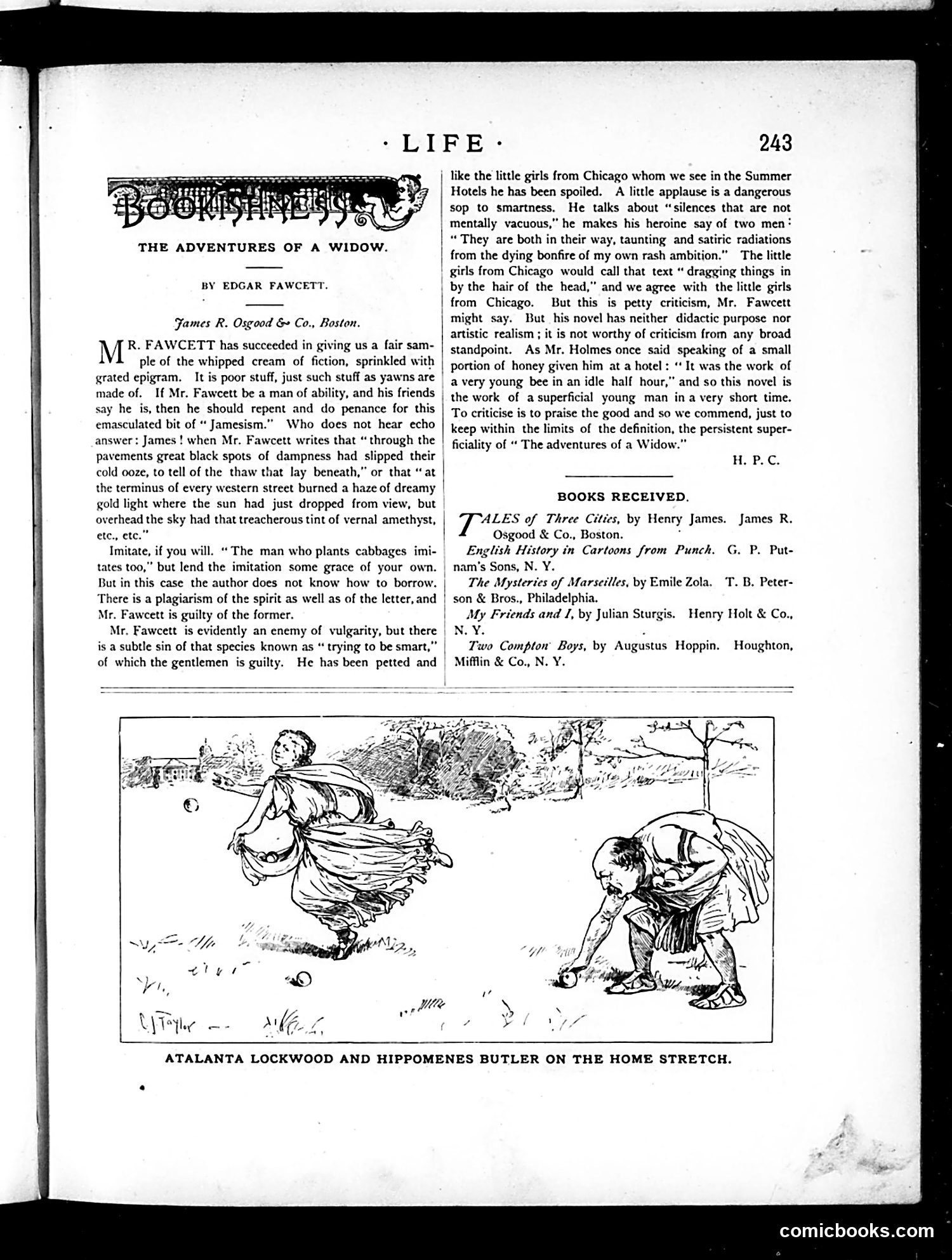
This page reviews Edgar Fawcett's novel *The Adventures of a Widow*. The critic (H.P.C.) offers a mixed assessment, praising Fawcett's ability to write "whipped cream of fiction" while criticizing his work as superficial and derivative—lacking both didactic purpose and artistic realism. The illustration shows two figures on a home street: a woman in flowing dress (presumably the widow protagonist) and a man bending over in exaggerated posture. This appears to be satirizing the novel's romantic or comedic situations. The caption references "Atalanta Lockwood and Hippomenes Butler," suggesting character names that the contemporary reader would recognize from the novel itself. The "Books Received" section lists contemporary literary works, positioning this within 1880s-90s publishing culture.
📄 Transcribed text from this page (OCR, searchable)
Machine-transcribed from the original scan — historical spelling and the odd misread are preserved.
- LIFE: THE ADVENTURES OF A WIDOW. BY EDGAR FAWCETT. James R. Osgood & Co., Boston. R. FAWCETT has succeeded in giving us a fair sam- ple of the whipped cream of fiction, sprinkled with grated epigram. made of. If Mr. Fawcett be a man of ability, and his friends say he is, then he should repent and do penance for this emasculated bit of “ Jamesism.” Who does not hear echo answer: James ! when Mr. Fawcett writes that “through the pavements great black spots of dampness had slipped their cold ooze, to tell of the thaw that lay beneath,” or that “at the terminus of every western street burned a haze of dreamy gold light where the sun had just dropped from view, but overhead the sky had that treacherous tint of vernal amethyst, ete, etc.” Imitate, if you will. “The man who plants cabbages imi- tates too,” but lend the imitation some grace of your own. But in this case the author does not know how to borrow. There is a plagiarism of the spirit as well as of the letter, and | Mr. Faweett is guilty of the former. Mr. Fawcett is evidently an enemy of vulgarity, but there is a subtle sin of that species known as “ trying to be smart,” | of which the gentlemen is guilty. He has been petted and | from Chicago. It is poor stuff, just such stuff as yawns are | 243 like the little girls from Chicago whom we see in the Summer Hotels he has been spoiled. A little applause is a dangerous | sop to smartness. He talks about “ silences that are not mentally vacuous,” he makes his heroine say of two men! “They are both in their way, taunting and satiric radiations from the dying bonfire of my own rash ambition.” The little girls from Chicago would call that text “ dragging things in by the hair of the head,” and we agree with the little girls But this is petty criticism, Mr. Fawcett might say. But his novel has neither didactic purpose nor artistic realism ; it is not worthy of criticism from any broad standpoint. As Mr. Holmes once said speaking of a small portion of honey given him at a hotel : ‘It was the work of a very young bee in an idle half hour,” and so this novel is the work of a superficial young man ina very short time. To criticise is to praise the good and so we commend, just to keep within the limits of the definition, the persistent super- ficiality of “ The adventures of a Widow.” H. P.C. BOOKS RECEIVED. ‘ALES of Three Cities, by Henry James. James R. Osgood & Co., Boston. . English History in Cartoons from Punch. G,. P. Put- nam's Sons, N. Y. The Mysteries of Marseilles, by Emile Zola. son & Bros., Philadelphia. My Friends and I, by Julian Sturgis. N.Y. s Two Compton’ Boys, by Augustus Hoppin. Houghton, Mifflin & Co., N. Y. T. B. Peter- Henry Holt & Co., UTA = - ATALANTA LOCKWOOD AND HIPPOMENES BUTLER ON THE HOME STRETCH. comicbooks.com