
A complete issue · 16 pages · 1884
Life — September 4, 1884
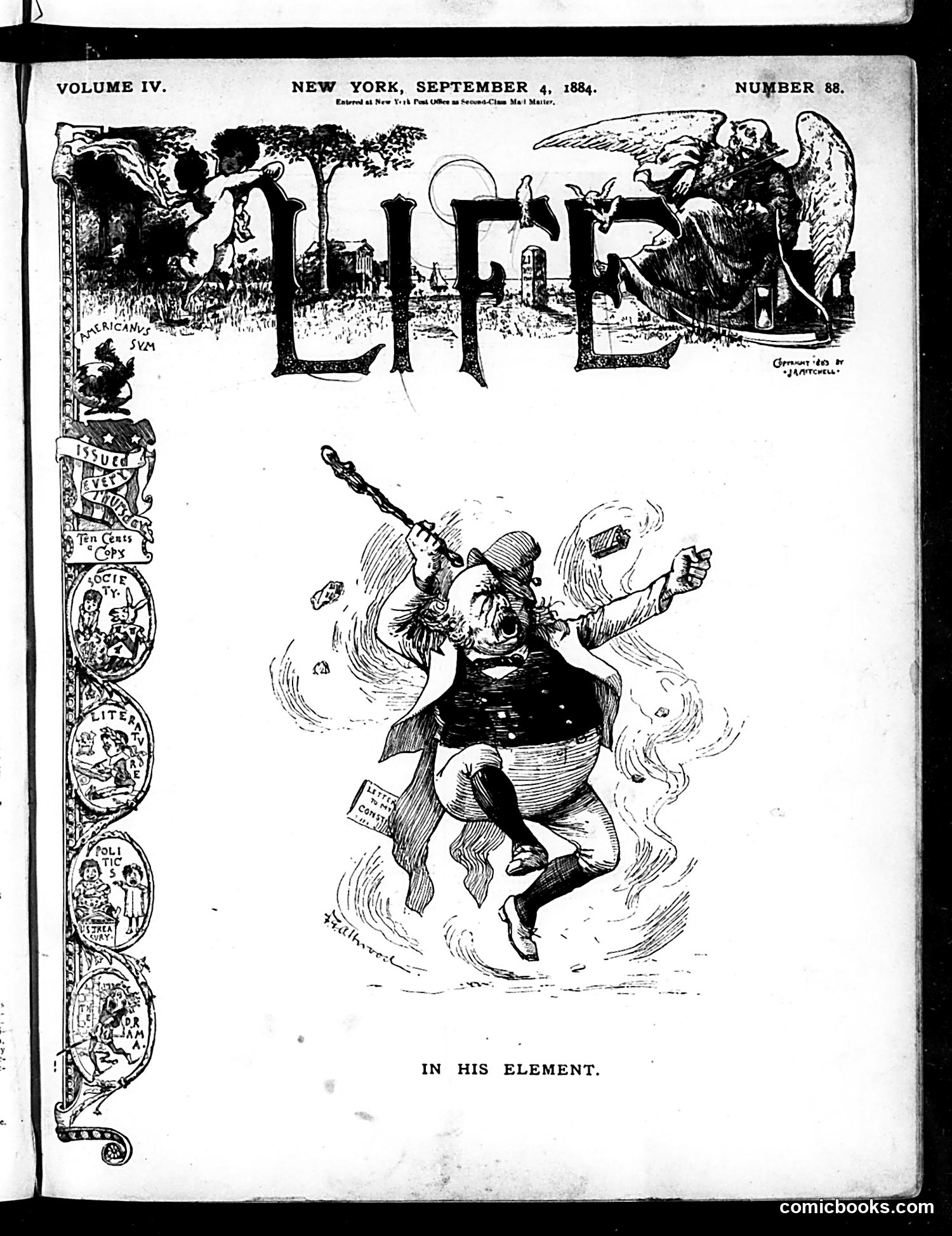
This political cartoon depicts a figure in water, wielding what appears to be a club or paddle, surrounded by swirling waves. The title "In His Element" is a pun—suggesting the subject is metaphorically "in water" (in trouble or difficulty) while literally depicted in water. Without being able to identify the specific caricatured figure with certainty, the cartoon appears to reference a political figure of 1884 facing some scandal, controversy, or embarrassing situation. The dynamic pose and turbulent imagery suggest chaos or struggle. The date places this during the 1884 U.S. presidential election year, when Life magazine frequently lampooned candidates and political figures through satirical cartoons employing visual wordplay and caricature.
The page contains several short humorous items rather than a political cartoon. Key content includes: 1. **"Why should I mourn and mourn?"** — An editor responds sarcastically to a Chicago poet (Miss Ella Wheeler) complaining her verses weren't accepted. The satire mocks amateur poets expecting payment for poor work. 2. **Little Willie Perkins story** — Anecdotal humor about a mischievous child left unsupervised, combining a cat, serene and house chaos—typical Victorian "naughty child" humor. 3. **Official Report** — A letter describing the USS *Tallapoosa* collision near Martha's Vineyard, critiquing incompetent naval officers and poorly-maintained vessels. 4. **Short quips** — Miscellaneous jokes about hymns, cholera, and voting. The page is primarily humorous commentary rather than political satire.
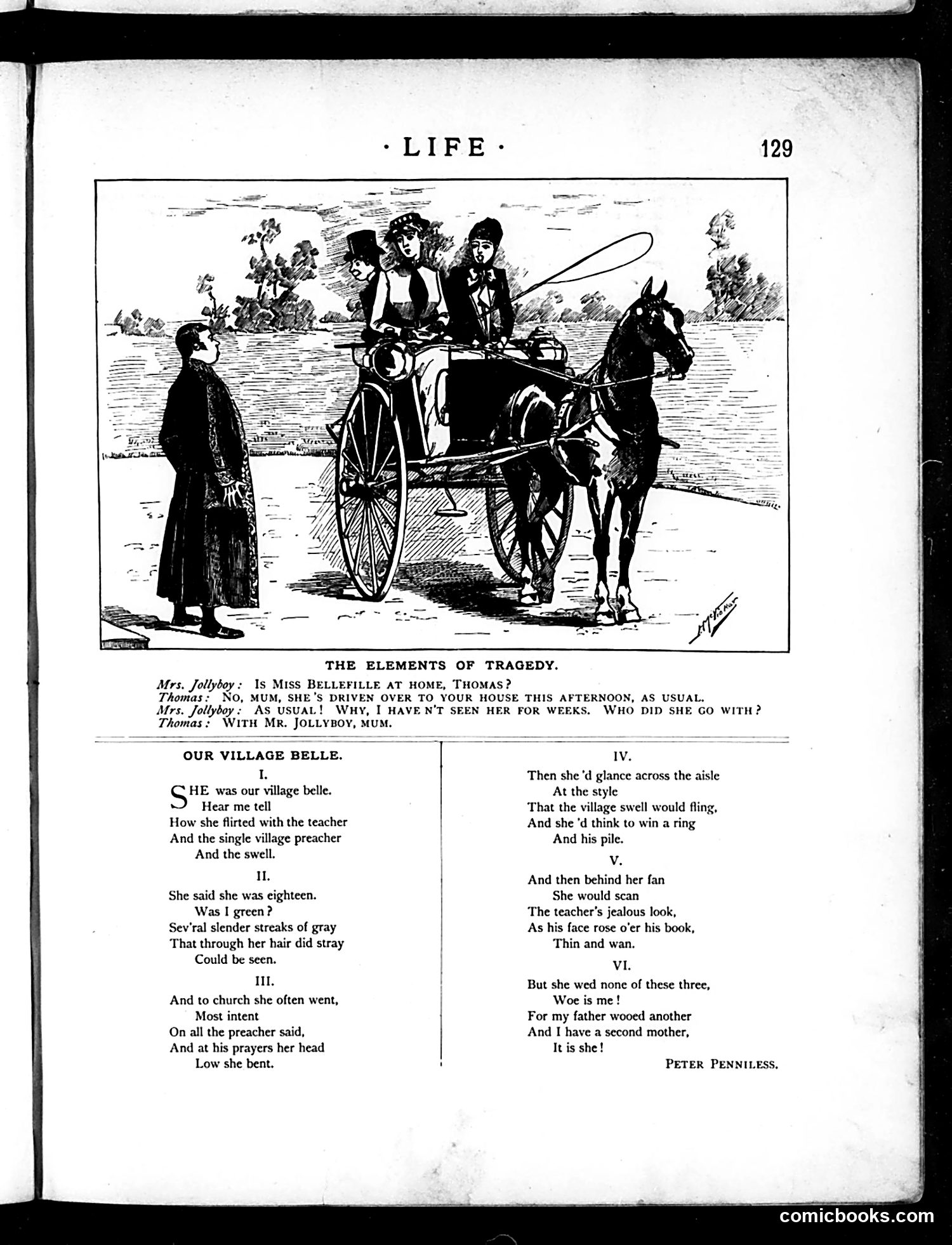
The cartoon satirizes domestic infidelity. A woman (Miss Bellefille) has been driven to a man's house by Mr. Jollyboy, prompting her husband Thomas to ask pointedly where she's been all afternoon—"as usual." The illustration shows the guilty parties in a carriage, while the wronged husband stands alone on the road, a visual representation of betrayal and exclusion. The accompanying poem "Our Village Belle" by Peter Penniless reinforces the theme: it describes a flirtatious village woman who attracted suitors but ultimately married someone else, leaving the narrator lamenting his loss ("Woe is me!"). The page combines visual and literary humor to mock both marital infidelity and romantic disappointment in a small-town setting.
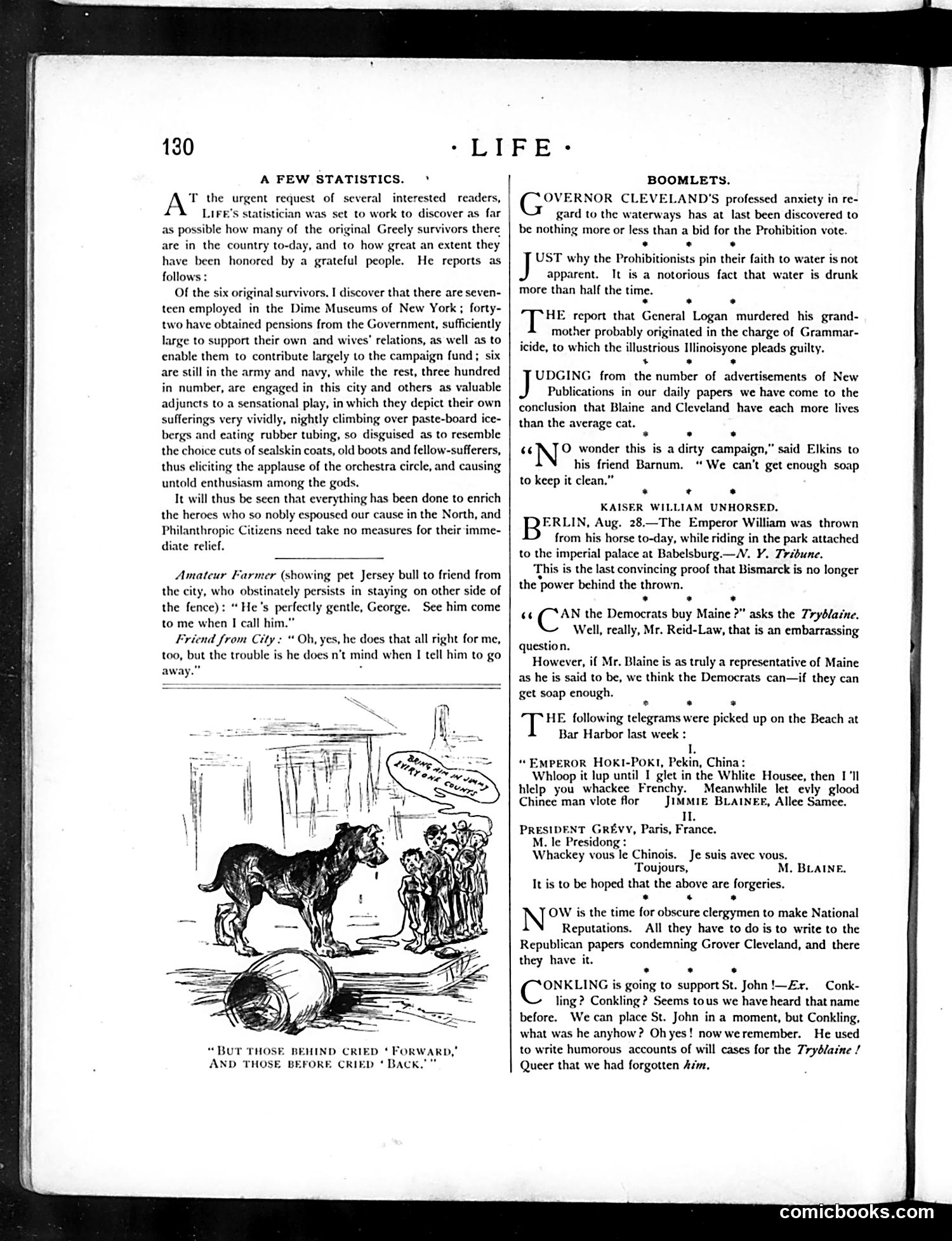
The cartoon depicts a working-class man with a Jersey bull, captioned with dialogue about the animal's gentle temperament. The joke plays on class humor—a rural farmer defending his bull's docility to a city friend, using folksy speech patterns ("He does that all right for me...but the trouble is he don't mind when I tell him to go away"). The "Boomlets" section contains political satire mocking 1880s candidates, particularly **James G. Blaine** and **Grover Cleveland**. References include Cleveland's alleged murder of his grandmother, water safety debates, and campaign cleanliness. The satirical telegrams mock diplomatic negotiations and Republican efforts to "buy Maine" politically. The satire attacks both candidates' credibility through absurdist humor typical of late-19th-century American political magazines.
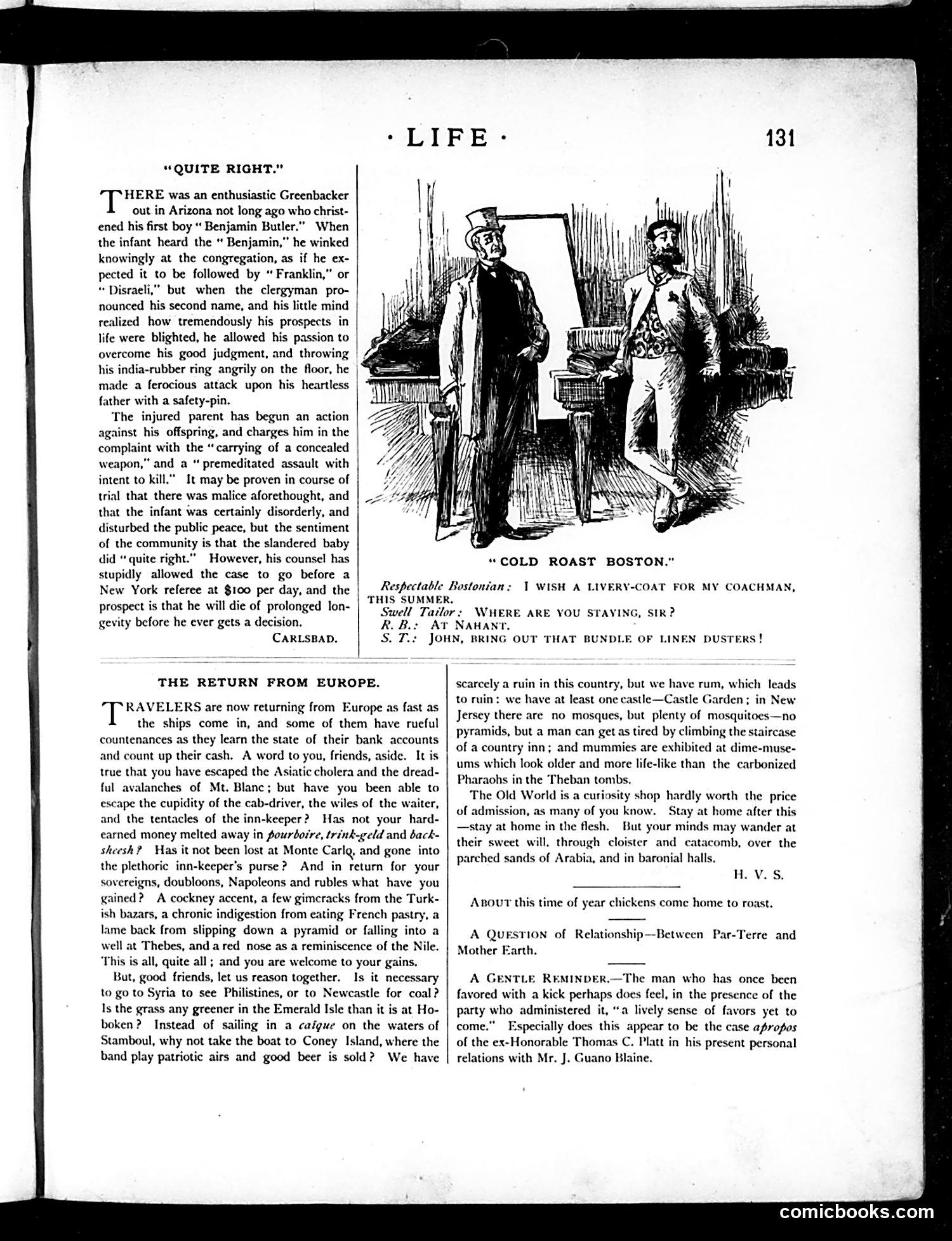
This cartoon satirizes Boston society's pretensions and stinginess. The illustration shows two men in conversation, with dialogue beneath labeled "Cold Roast Boston"—a derisive nickname for the city. The joke plays on Boston's reputation for being socially snobbish yet financially cheap. One figure requests a livery coat for his coachman; another asks about accommodations; a third demands "linen dusters"—all suggesting Boston residents making demands while being notoriously reluctant to spend money. The "cold roast" metaphor suggests serving leftover, reheated food—implying Bostonians offer shabby hospitality despite their cultural pretensions. This reflects 19th-century American regional stereotypes, positioning Boston as arrogant but miserly, contrasting its intellectual reputation with unfriendly, ungenerous behavior toward visitors.
This page contains three distinct literary pieces rather than political cartoons: 1. **"Bar Harbor"** — A prose essay about the author's visit to Bar Harbor, Maine, describing social encounters and activities like ice skating and cod fishing. 2. **"Ballad of the Can't-Get-Aways"** — A humorous poem about being stuck in the town of Dull during summer, with repeated refrains about wanting to escape. It's a lighthearted complaint about provincial summer tedium. 3. **"Ten Dollars or Ten Days"** — A satirical dialogue between a judge and prisoner named "Gulliver Jones," mocking the defendant's claim that he only drinks water, while the judge presents evidence his nose is "tinted with a crimson paint"—implying drunkenness. It's a courtroom humor piece playing on the defendant's obvious dishonesty.
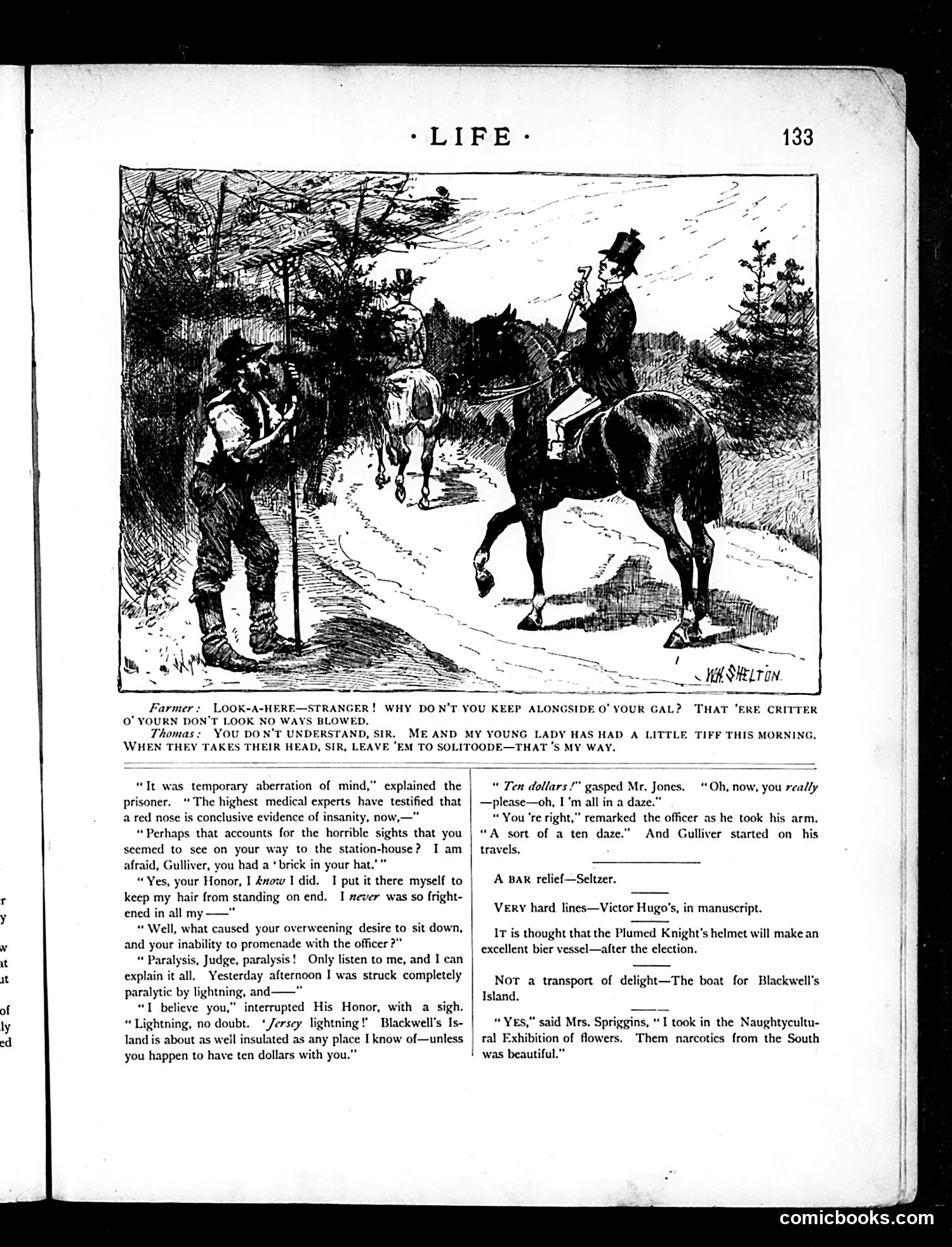
This page contains a single cartoon depicting a countryside encounter between a well-dressed horseman and a farmer with his companion. The farmer (Thomas) explains to the horseman (labeled "Farmer") that he and "my young lady" had "a little tiff this morning" and are now separated—he's walking one direction while she rides ahead. The humor relies on misunderstanding: the horseman assumes the woman riding alone represents impropriety, but Thomas clarifies this is their normal arrangement after quarrels. The cartoon satirizes Victorian social conventions and middle-class anxieties about propriety and respectability. The joke depends on the reader's awareness of period attitudes regarding unmarried couples' public behavior and proper social decorum.
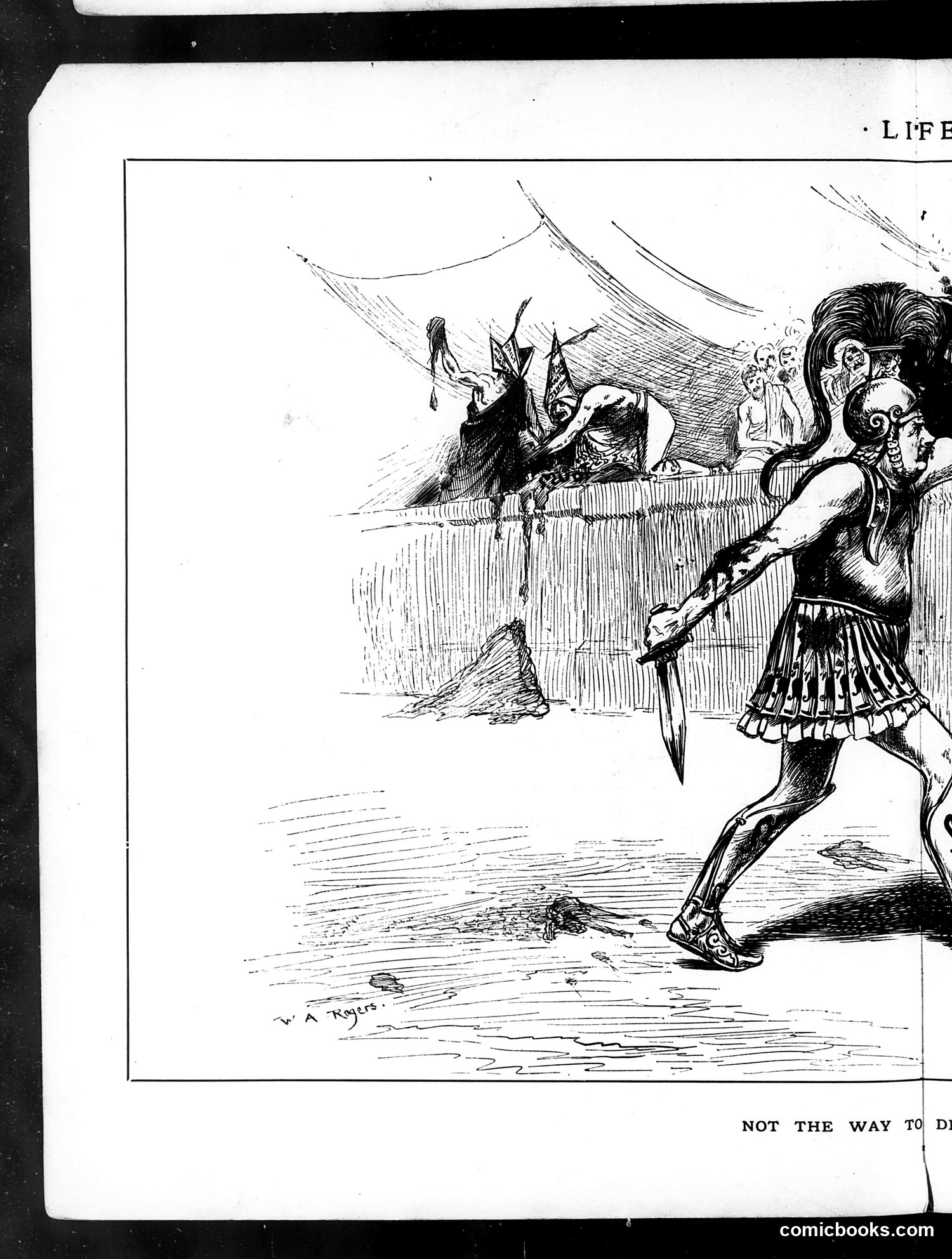
This political cartoon depicts a classical gladiatorial or mythological scene. On the right, a warrior in Roman/classical dress with a helmet and spear confronts what appears to be a horned demon or devil-like creature on the left. Behind them is a palisade fence and tent structure, suggesting a military encampment. The caption reads "NOT THE WAY TO D[ISPOSE]" (text cut off), suggesting the cartoon critiques some contemporary approach or solution to an issue. The classical imagery typically signals *Life* magazine's use of historical/mythological metaphors to comment on modern politics or social problems. Without the full caption or publication date, the specific political reference remains unclear—it could address military strategy, diplomacy, or domestic policy debates of its era.
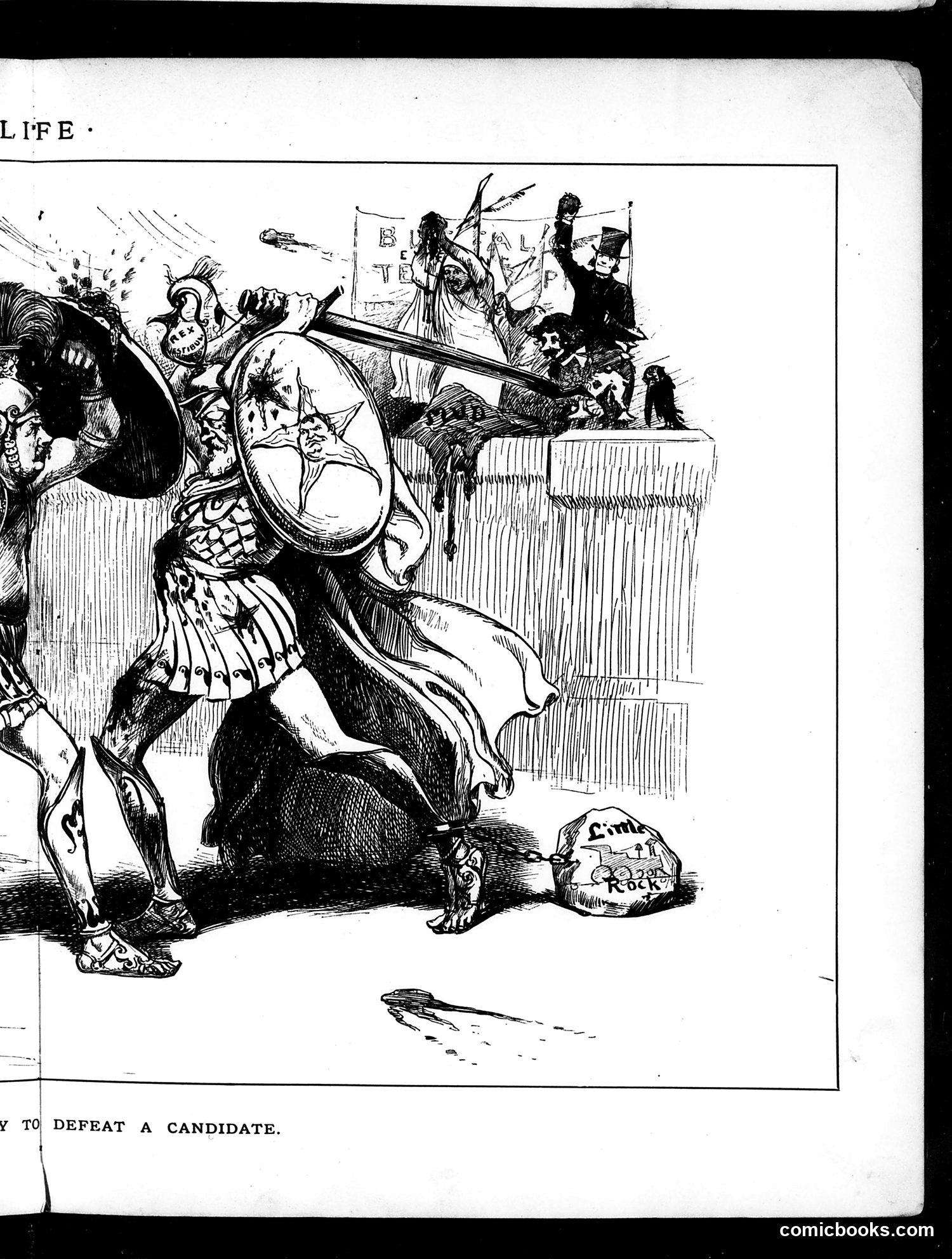
This is a satirical cartoon titled "WAY TO DEFEAT A CANDIDATE" from Life magazine. The image depicts a Roman gladiator or warrior figure being attacked and overwhelmed by a mob of hostile figures in what appears to be an arena setting with spectators above. The cartoon uses classical imagery to satirize political campaign tactics. The lone warrior represents a political candidate, while the attacking mob represents opposition forces or critics. The arena setting suggests this is public spectacle—politics as entertainment or blood sport. The satire criticizes the brutal, chaotic nature of political campaigns, portraying them as gladiatorial combat where candidates are figuratively torn apart by their opponents and the crowd. The classical allusion elevates the critique, suggesting such tactics are barbaric or uncivilized.
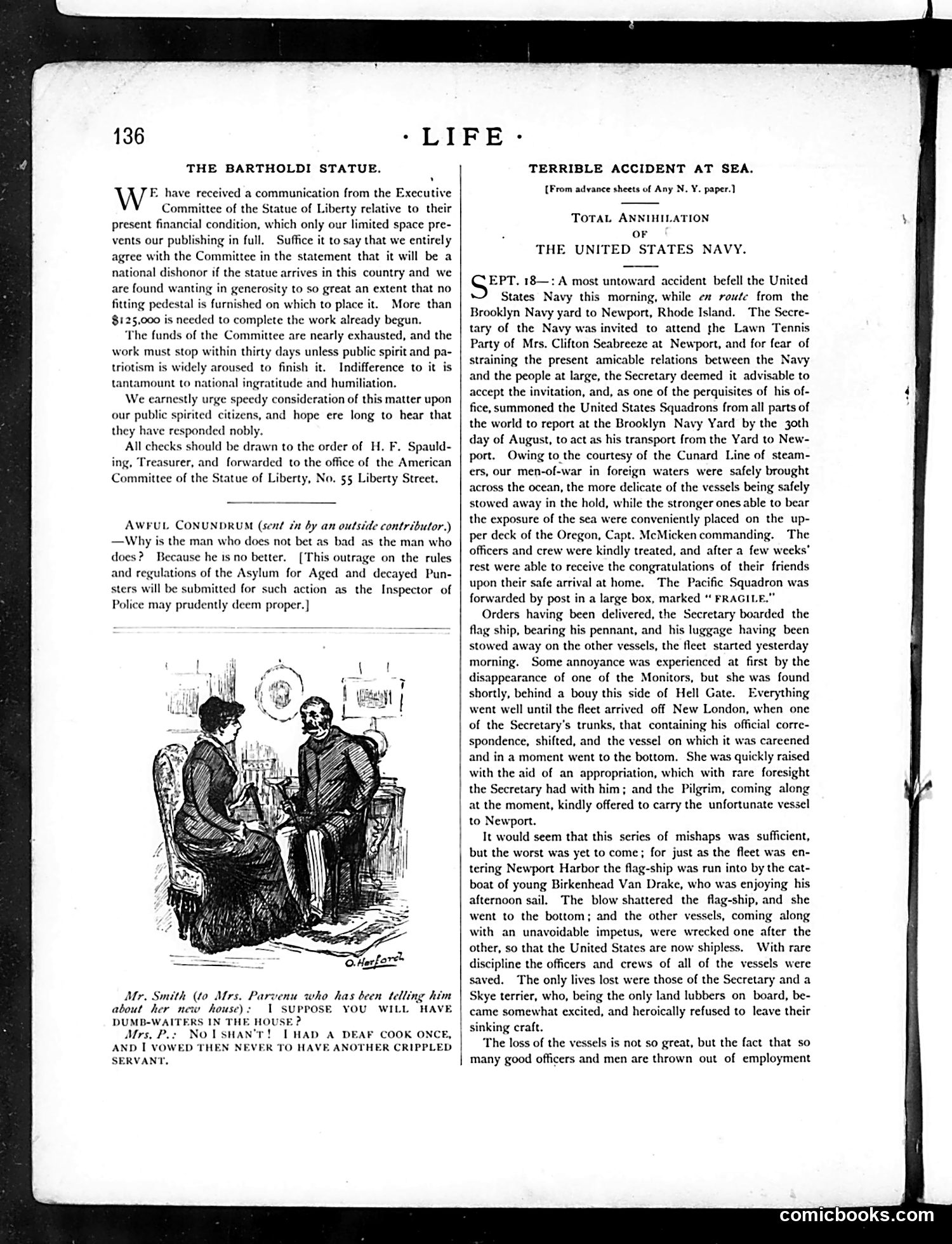
This page contains two distinct satirical pieces: **"The Bartholdi Statue"** editorial urges readers to donate to the Statue of Liberty's pedestal fund, arguing that failing to do so would be national disgrace. The appeal notes $125,000 remains needed. **The small cartoon** shows a domestic exchange between Mr. Smith and Mrs. Parvenu about her new house's "dumb-waiters"—a cruel joke playing on the term. Mrs. Parvenu responds that she had a deaf cook once and vowed never to hire another "crippled servant," missing the point entirely. The satire mocks nouveau-riche social pretension and insensitivity. **"Terrible Accident at Sea"** is absurdist mock-reporting imagining the entire U.S. Navy assembled as transport for the Secretary's social event to Newport, then destroyed by accidents (a trunk shifts, a ship sinks). The satire ridicules government waste and the Secretary's self-importance—using entire military resources for personal social convenience is portrayed as absurdly wasteful and irresponsible.
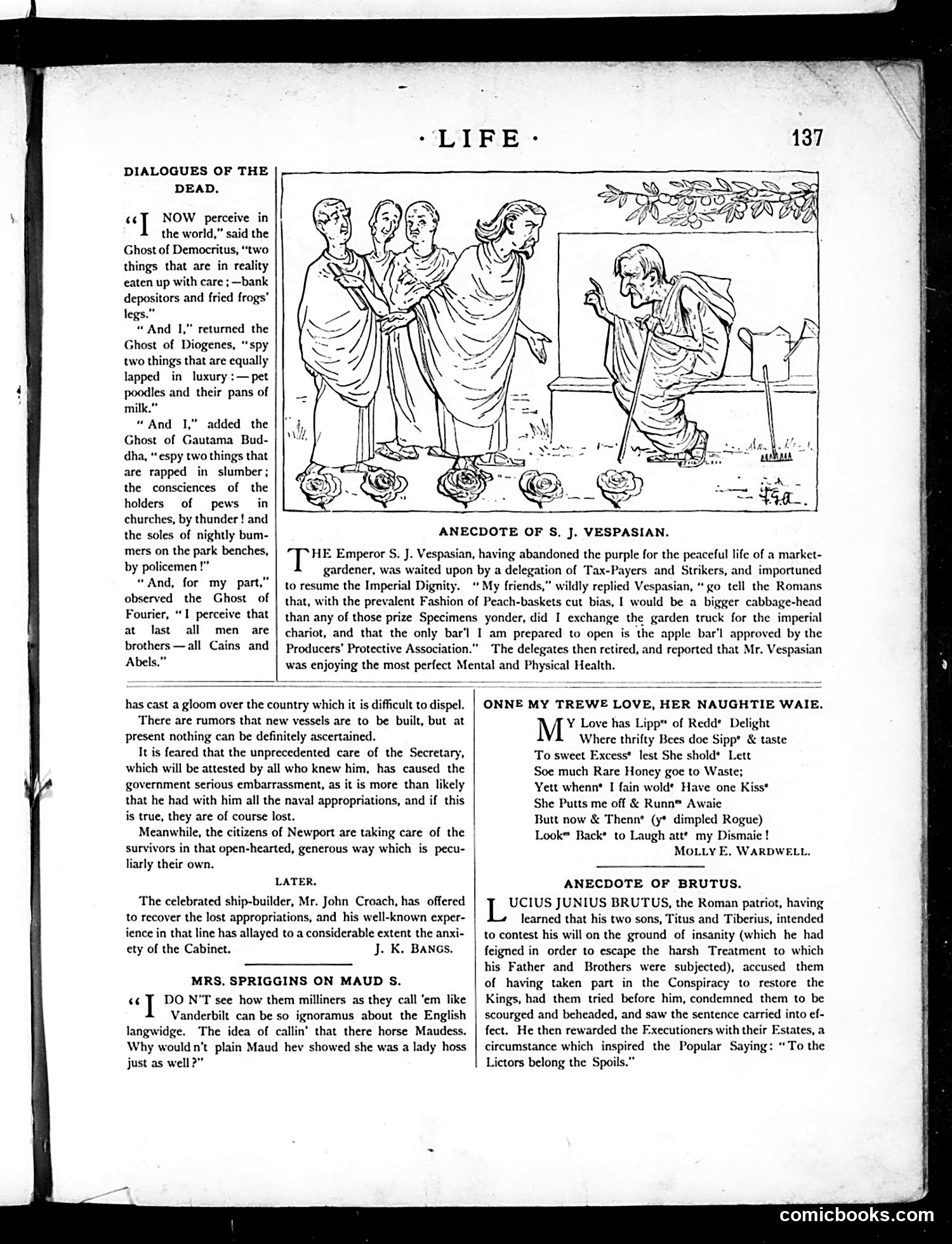
This page contains multiple satirical pieces mocking contemporary American society through classical references. **"Dialogues of the Dead"** presents famous philosophers and historical figures observing modern follies: Democritus notes anxiety among bank depositors and the absurdity of eating fried frogs' legs; Diogenes mocks the luxury afforded to pet poodles; Buddha critiques the moral indifference of church-goers and homeless vagrants; Fourier ironically observes that all men are "brothers" despite inequality. **The Vespasian anecdote** satirizes wealthy industrialists (likely referencing Vanderbilt-era magnates) abandoning public duty for comfortable private life, rejecting political pressure to return to power. **"Mrs. Spriggins on Maud S."** ridicules nouveau-riche pronunciation and pretension—specifically wealthy horse-owners' affected speech patterns. The **Brutus anecdote** darkly jokes about rewarding executioners, implying corrupt reward systems in contemporary politics. Throughout, Life uses classical parallels to expose American hypocrisy, greed, and moral blindness among the wealthy and powerful.
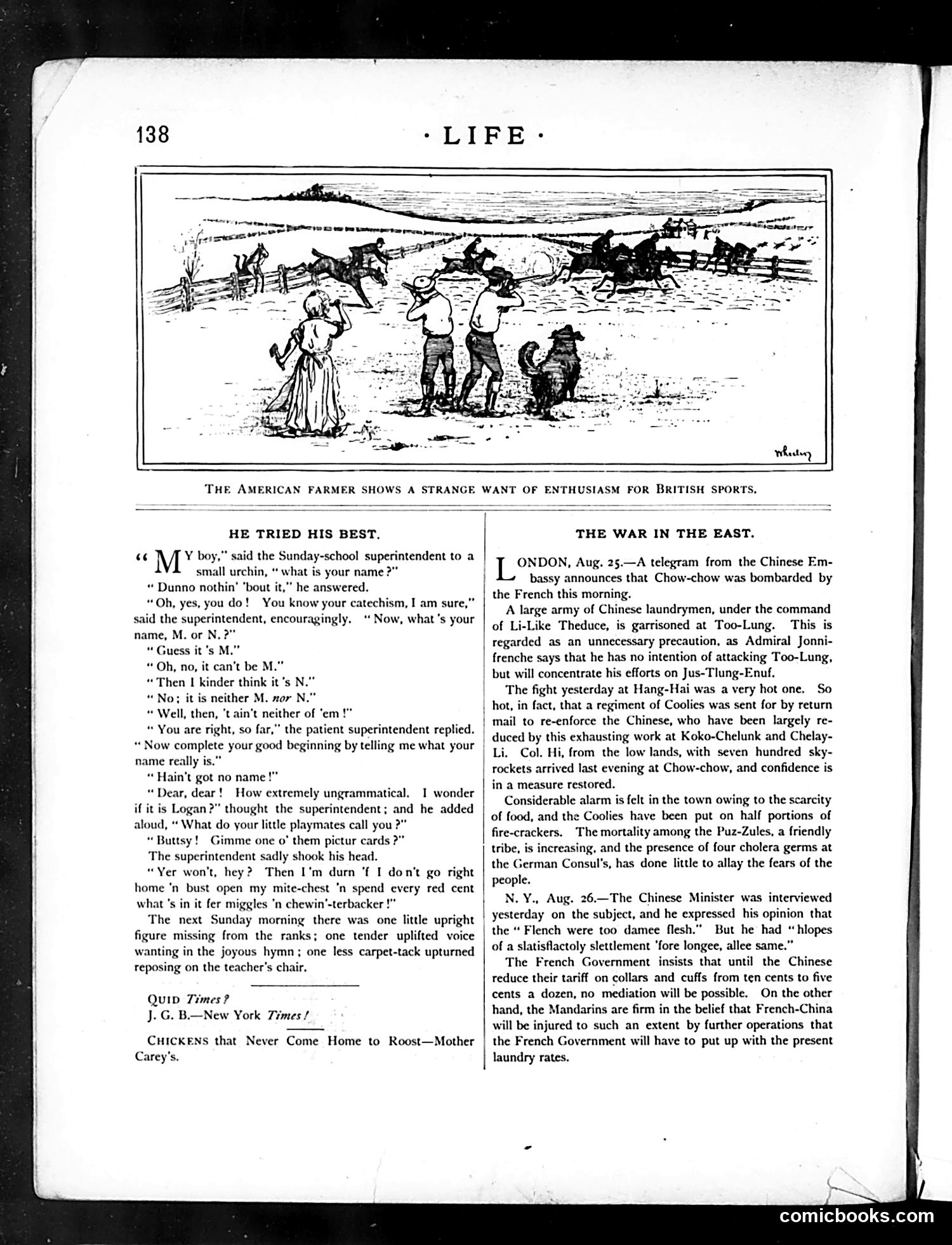
**Top Cartoon:** An American farmer watches British horsemen and fox hunters with bewilderment. The caption satirizes the farmer's lack of enthusiasm for British field sports—suggesting American rural culture finds fox hunting and similar pastimes puzzling or irrelevant compared to their own concerns. **"He Tried His Best":** A humorous anecdote about a poor, uneducated boy ("Buttsy") at Sunday school who lacks a proper name and speaks in dialect. When the superintendent discourages him by withholding picture cards as reward, the boy defiantly withdraws from the congregation—satirizing the condescension of middle-class religious instruction toward poor children. **"The War in the East":** A mock-serious news report about the Boxer Rebellion (references to Chinese laundrymen, French bombardment, coolies). The humor derives from crude ethnic stereotypes—fake Chinese place names ("Chow-chow," "Too-Lung") and phonetic dialect spelling ("Flench," "allee same")—treating the conflict as comic rather than serious. This reflects contemporary American attitudes toward both the conflict and Chinese immigrants.
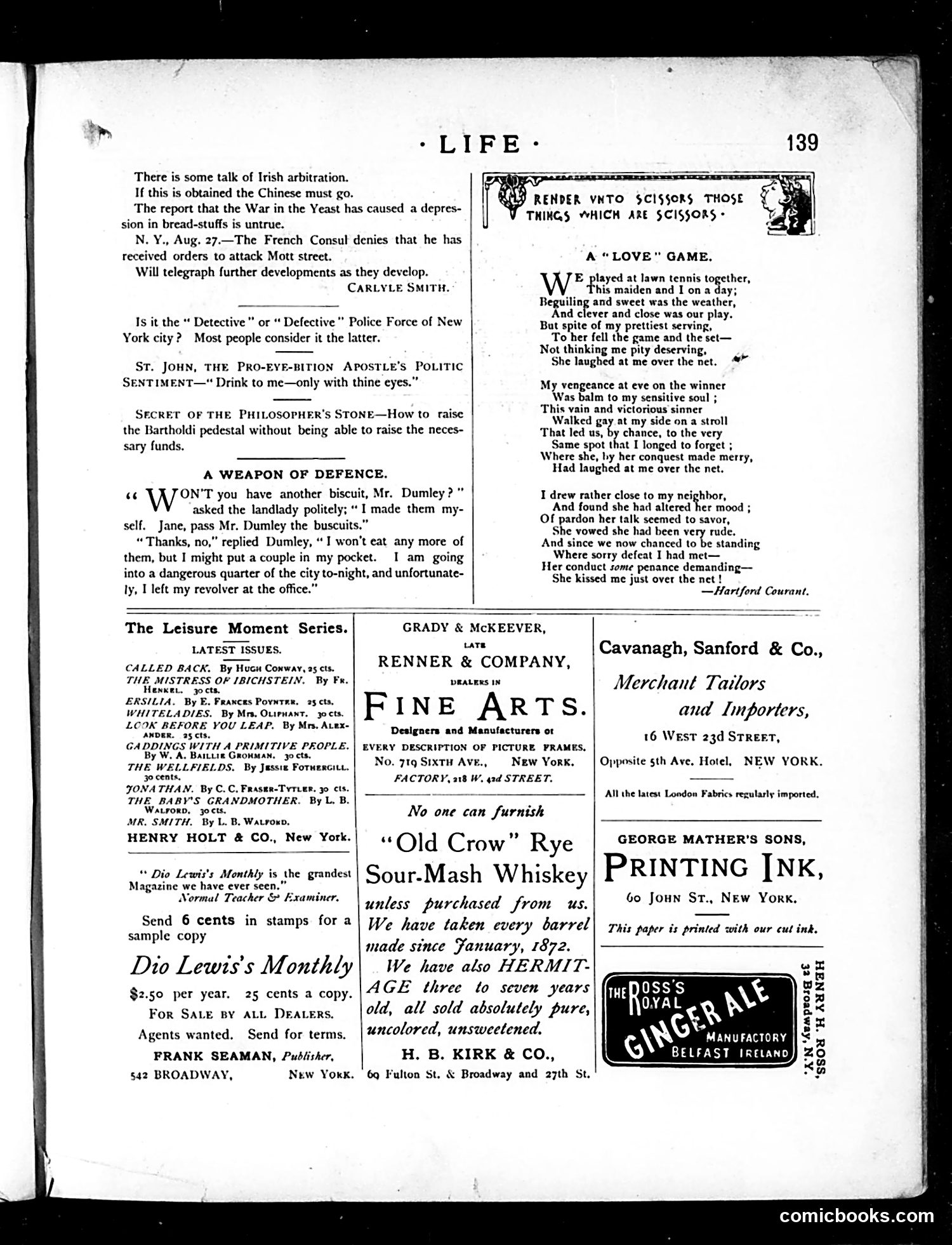
This page is primarily **advertisements and miscellaneous content** rather than political satire. The notable elements include: **Text Items:** - Brief news dispatches from Carlyle Smith on Chinese immigration, French-Chinese tensions, and NYC police ("Detective" vs. "Defective") - A quip about St. John (pro-prohibition apostle) and drinking - A humorous anecdote about Mr. Dumley using biscuits as weapons for dangerous city streets **Poetry/Fiction:** A romantic poem titled "A Love Game" about lawn tennis and courtship, where rivals compete and reconcile. **Advertisements:** Book publishers, art frame manufacturers, merchant tailors, printing ink, and whiskey companies dominate the page. The page reflects 1880s concerns: Chinese exclusion sentiment, urban crime, temperance debates, and genteel entertainment culture. The satire is gentle and domestic rather than hard political commentary.
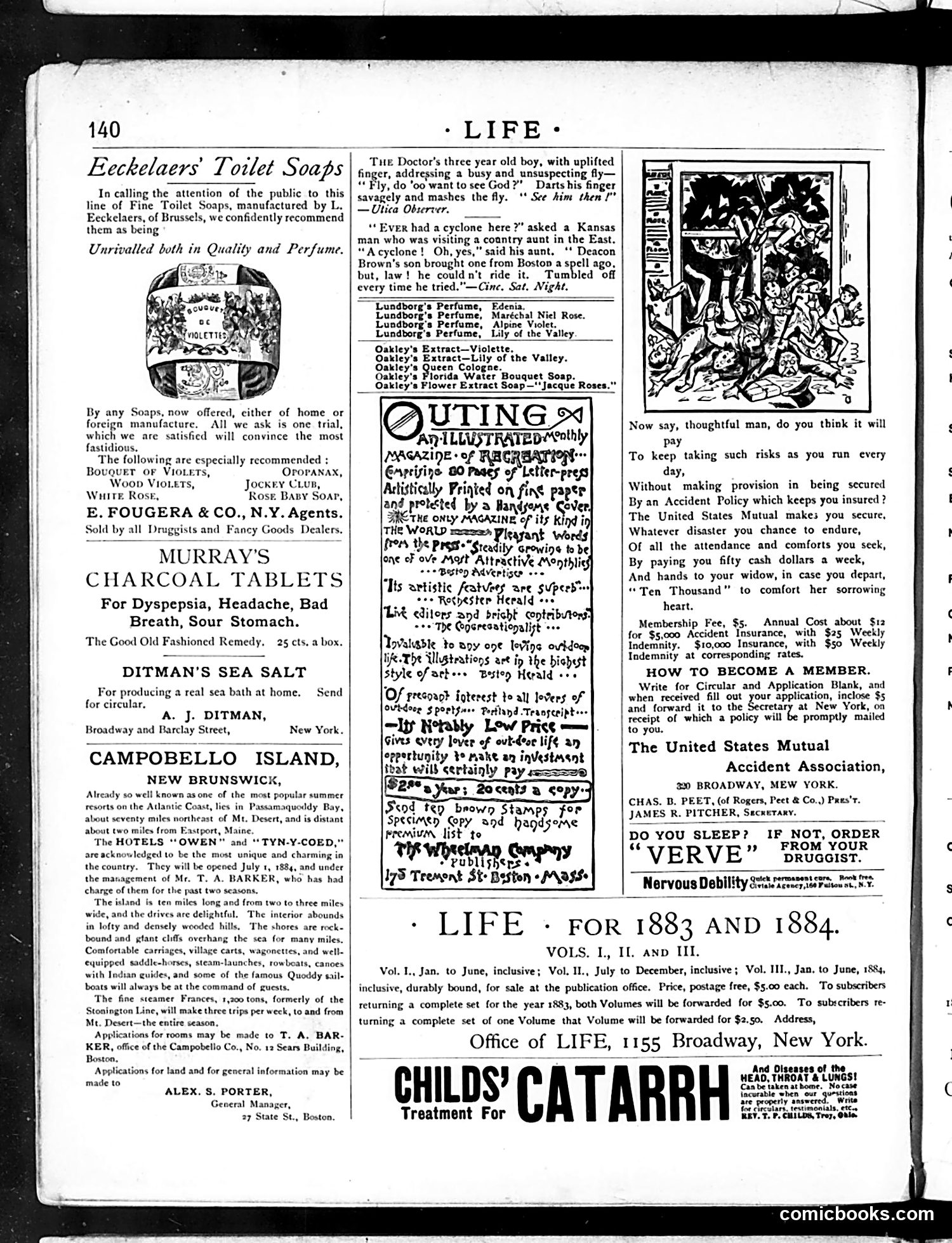
This page is primarily **advertising**, with two brief humorous anecdotes. ## The Cartoons/Jokes: **"The Doctor's Boy and the Fly"**: A three-year-old asks a fly "do you want to see God?" before killing it—dark humor about a child's casual violence and theological naïveté. The joke plays on the child's innocence and morbid phrasing. **"The Kansas Cyclone"**: A visiting Kansas man asks his Eastern aunt if she's experienced a cyclone. She replies that Deacon Brown's son brought one from Boston, but "couldn't ride it" and kept falling off. This is **regional satire**: it mocks rural Eastern ignorance by pretending she mistakes a man/object from Boston for an actual weather phenomenon—playing on stereotypes of unsophisticated country folk and suggesting Boston produces troublesome things. Both jokes rely on misunderstandings and innocent/naive perspectives for humor. ## The Rest: The page is dominated by period advertisements for soaps, digestive tablets, sea salt, and Campobello Island resort amenities—typical magazine filler of the 1880s.
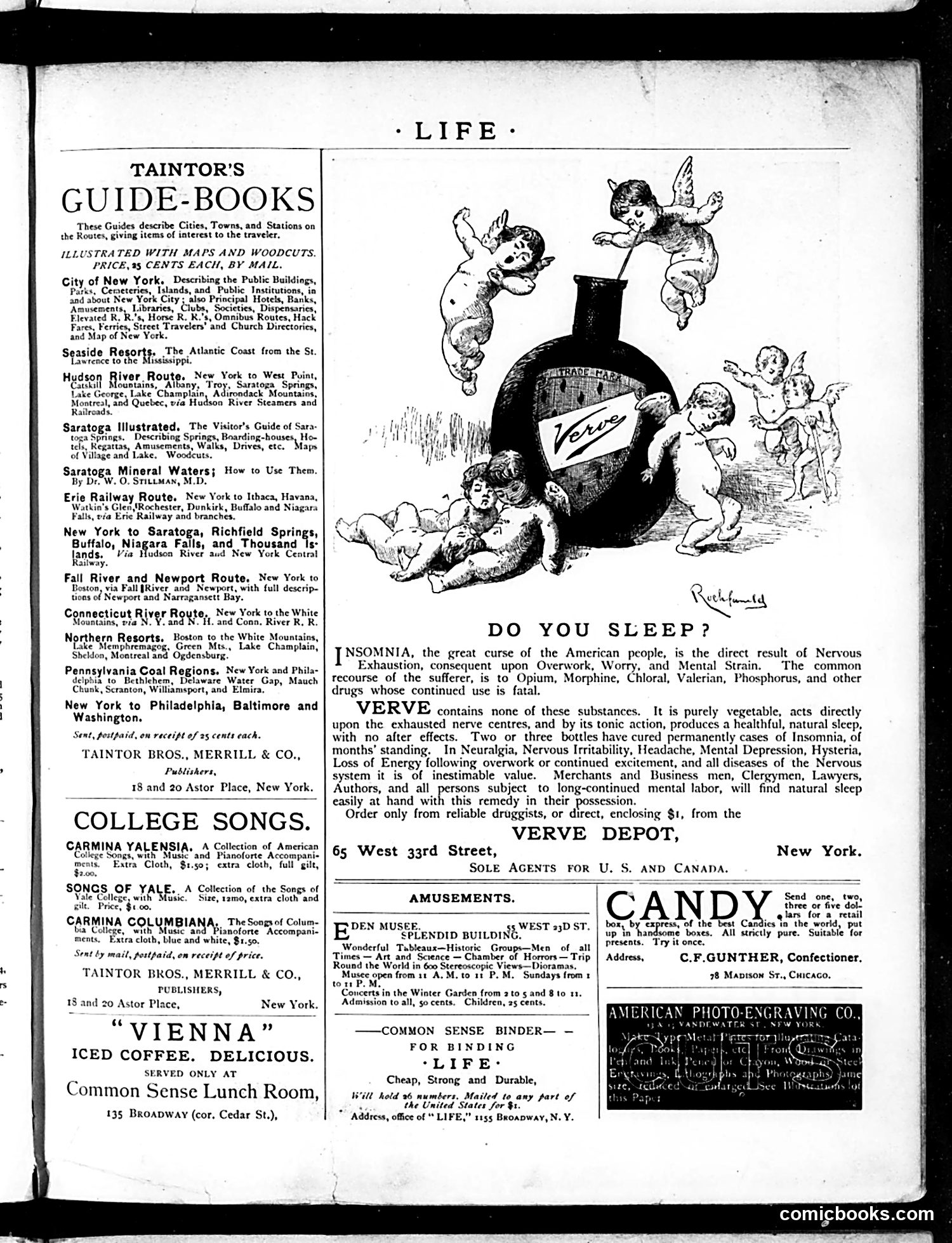
This page is primarily **advertising copy**, dominated by a patent medicine ad for "VERVE," a purported cure for insomnia. The accompanying illustration shows cherubs/putti playfully surrounding a bottle labeled "Verve"—imagery designed to evoke healthfulness and innocent vitality. The ad claims VERVE is "purely vegetable" and safe, contrasting it with addictive substances (opium, morphine, chloral) then commonly used as sleep aids. This reflects genuine late-19th-century anxiety about narcotic dependency. The target market is explicit: "Merchants and Business men, Clergymen, Lawyers, Authors"—educated professionals suffering "Nervous Exhaustion" from mental labor. This diagnosis reflects period beliefs about neurasthenia, a supposed epidemic of nervous exhaustion afflicting the overworked middle class. The satire in *Life* magazine likely targeted not VERVE itself but the broader patent-medicine industry's exaggerated health claims and the era's widespread nervous ailments among the ambitious urban professional class.
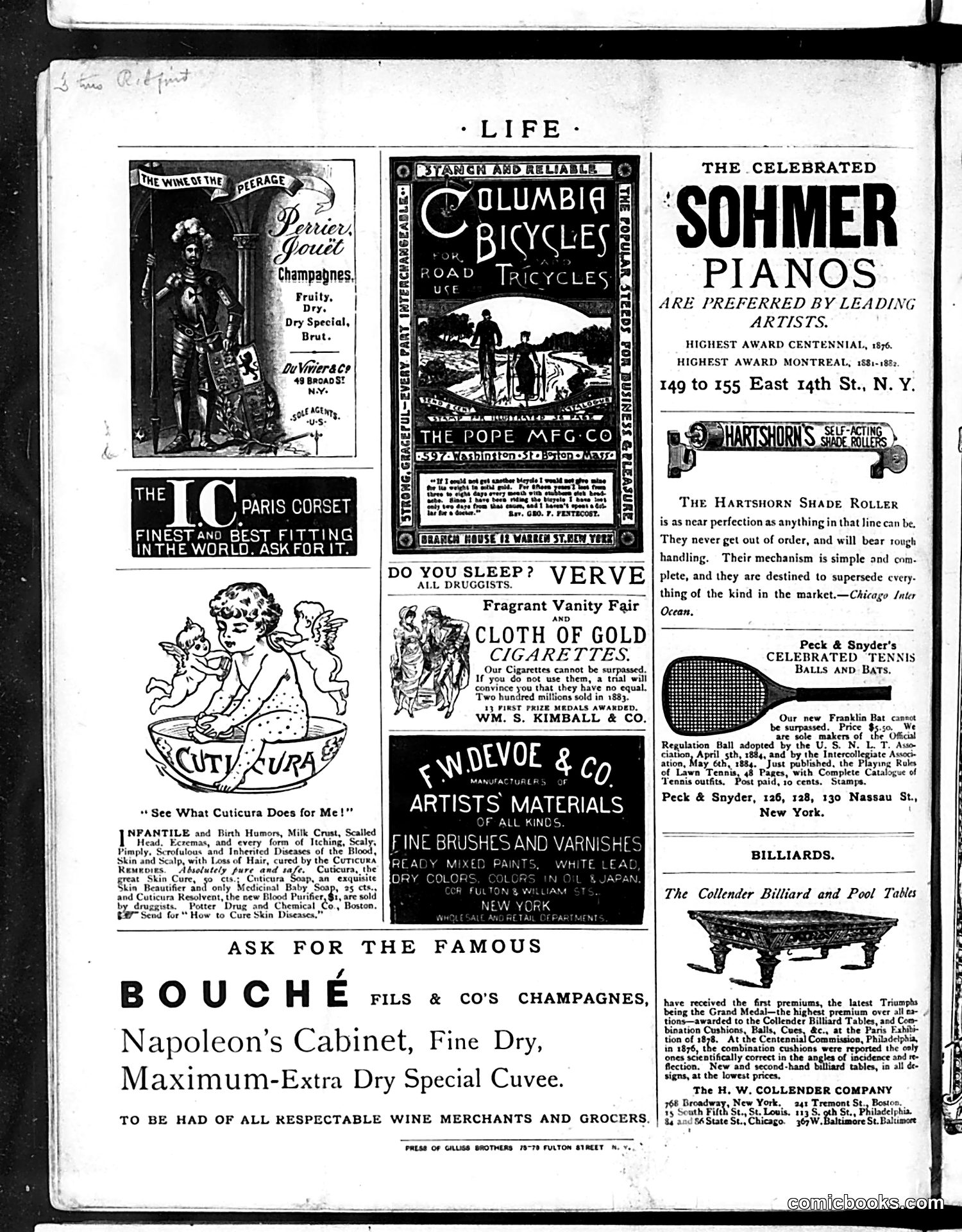
This is primarily an **advertising page** from Life magazine, circa 1880s, with minimal editorial content. The page contains no political cartoons requiring historical interpretation. The few illustrations present are **product advertisements**: - A figure in historical dress (appearing regal or aristocratic) promotes Perrier-Jouët champagne, leveraging luxury associations - Cherubs in a bathtub advertise Cuticura skin treatments - A small bicycle advertisement The page reflects **late 19th-century consumer culture**: advertisements emphasize imported European goods (champagnes, corsets), patent medicines (Cuticura for skin conditions), and emerging technologies (bicycles, shade rollers, billiard tables). The satirical magazine Life, known for political commentary, appears here in its revenue-generating advertising function rather than editorial voice. The ads target middle and upper-class readers with disposable income, showing what products and leisure activities defined respectability in the Gilded Age.