
A complete issue · 16 pages · 1884
Life — June 5, 1884
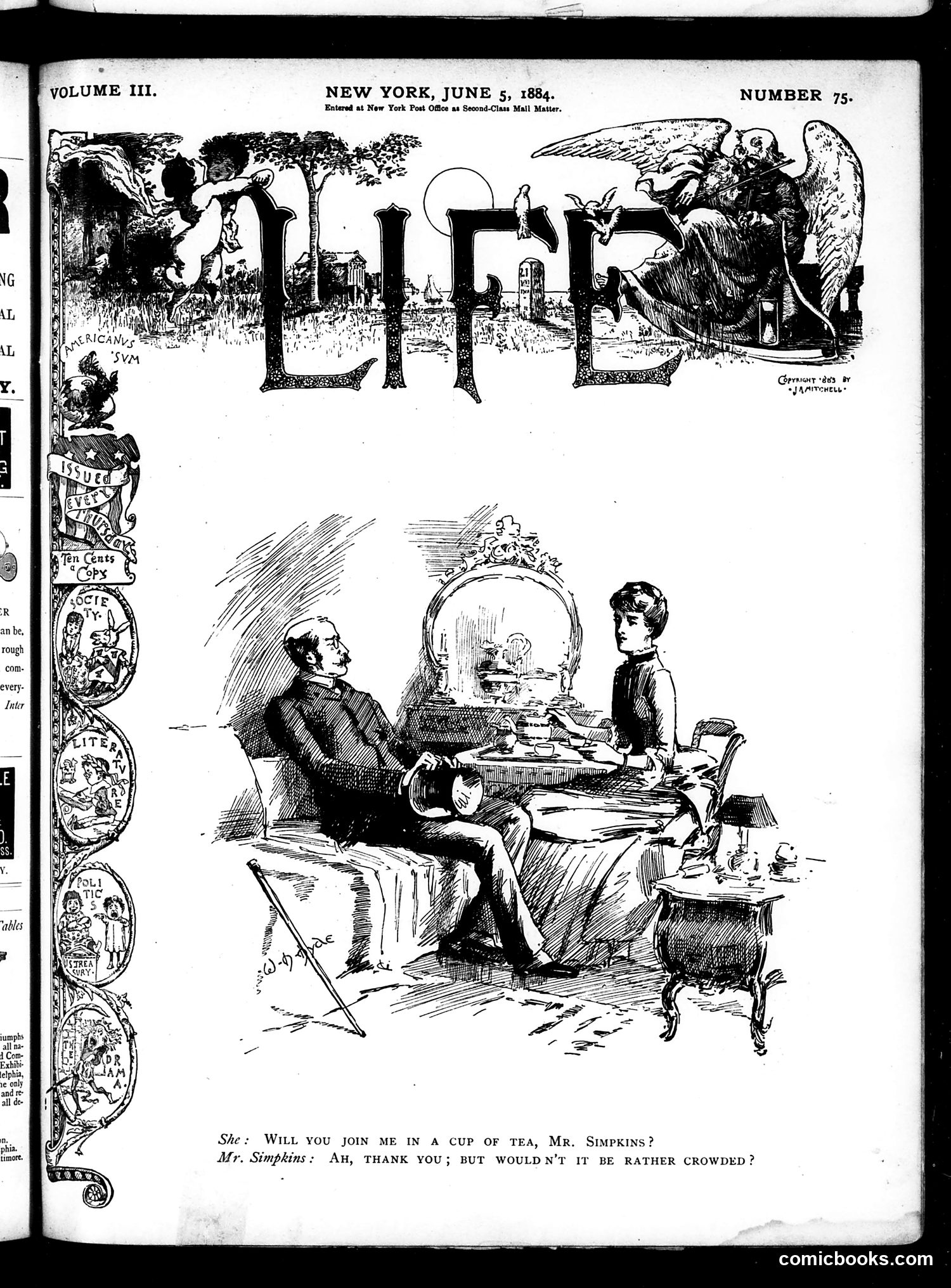
This page contains a satirical illustration about social etiquette and domestic life. The main cartoon depicts a domestic scene where a man (Mr. Simpkins) sits on a bed while a woman offers him tea. His response—"Ah, thank you; but wouldn't it be rather crowded?"—is the joke's punchline. The humor appears to rely on Victorian-era propriety and the awkwardness of social situations. The cramped bedroom setting makes his acceptance of tea socially questionable or improper by 1880s standards, which is why he jokingly suggests it would be "crowded." The cartoon satirizes middle-class social conventions and the awkward negotiations of proper behavior in intimate domestic spaces.
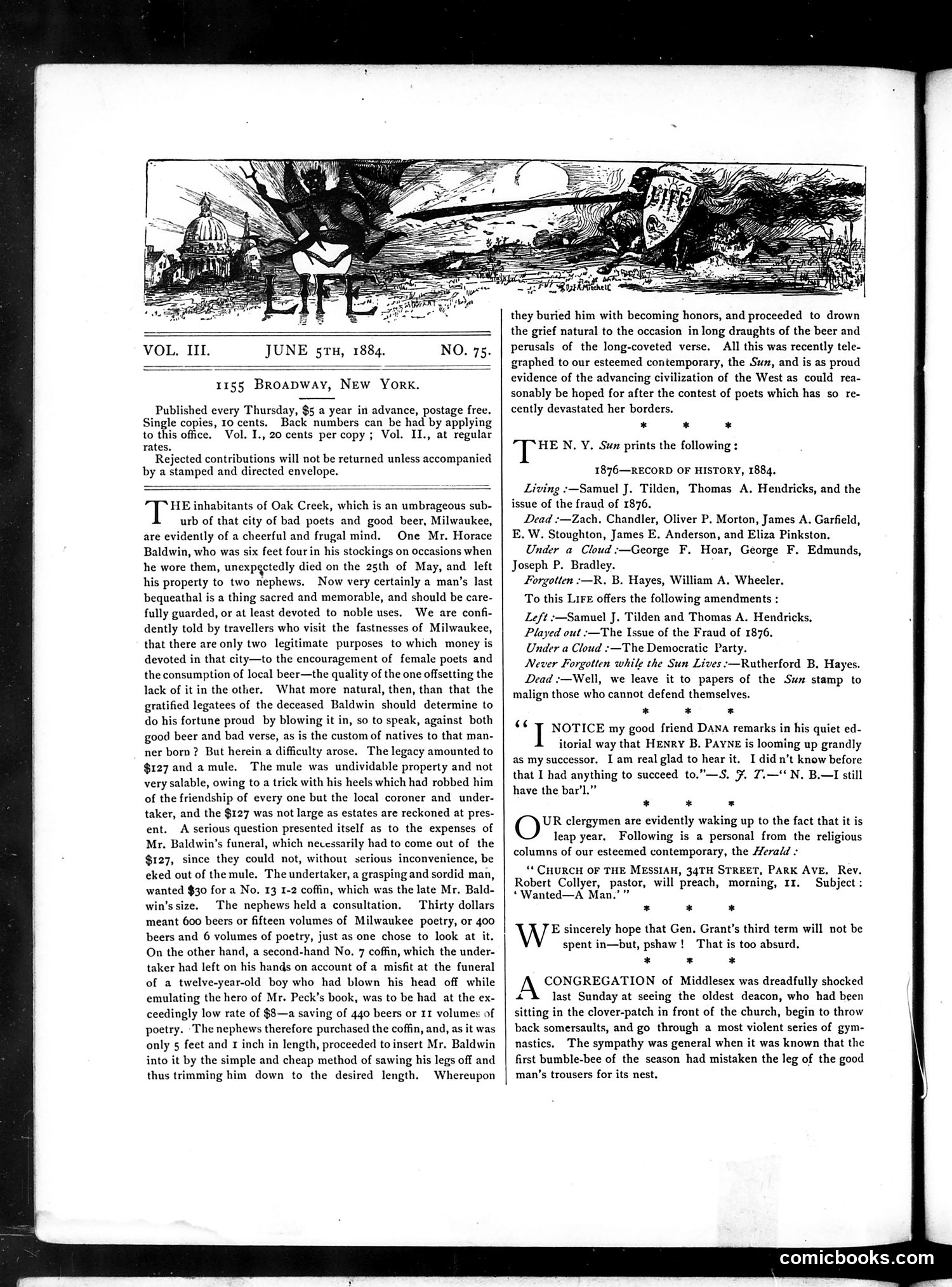
The banner illustration shows "LIFE" as a skeletal figure amid destruction, with a dome (likely the Capitol) visible. This appears to satirize the state of American politics or society. The text below discusses Oak Creek, Wisconsin, and a local bequest dispute involving poet Samuel Baldwin. The satire concerns how his heirs fought over his estate while debating whether to honor his literary legacy or pursue financial gain—a commentary on how survivors often abandon artistic principles for money. The page also contains editorial notes about the magazine's coverage, including references to the "Sun" newspaper and various political figures. Without clearer image detail of specific caricatures, the exact targets remain somewhat unclear, though the overall theme critiques the conflict between commercial interests and cultural values.
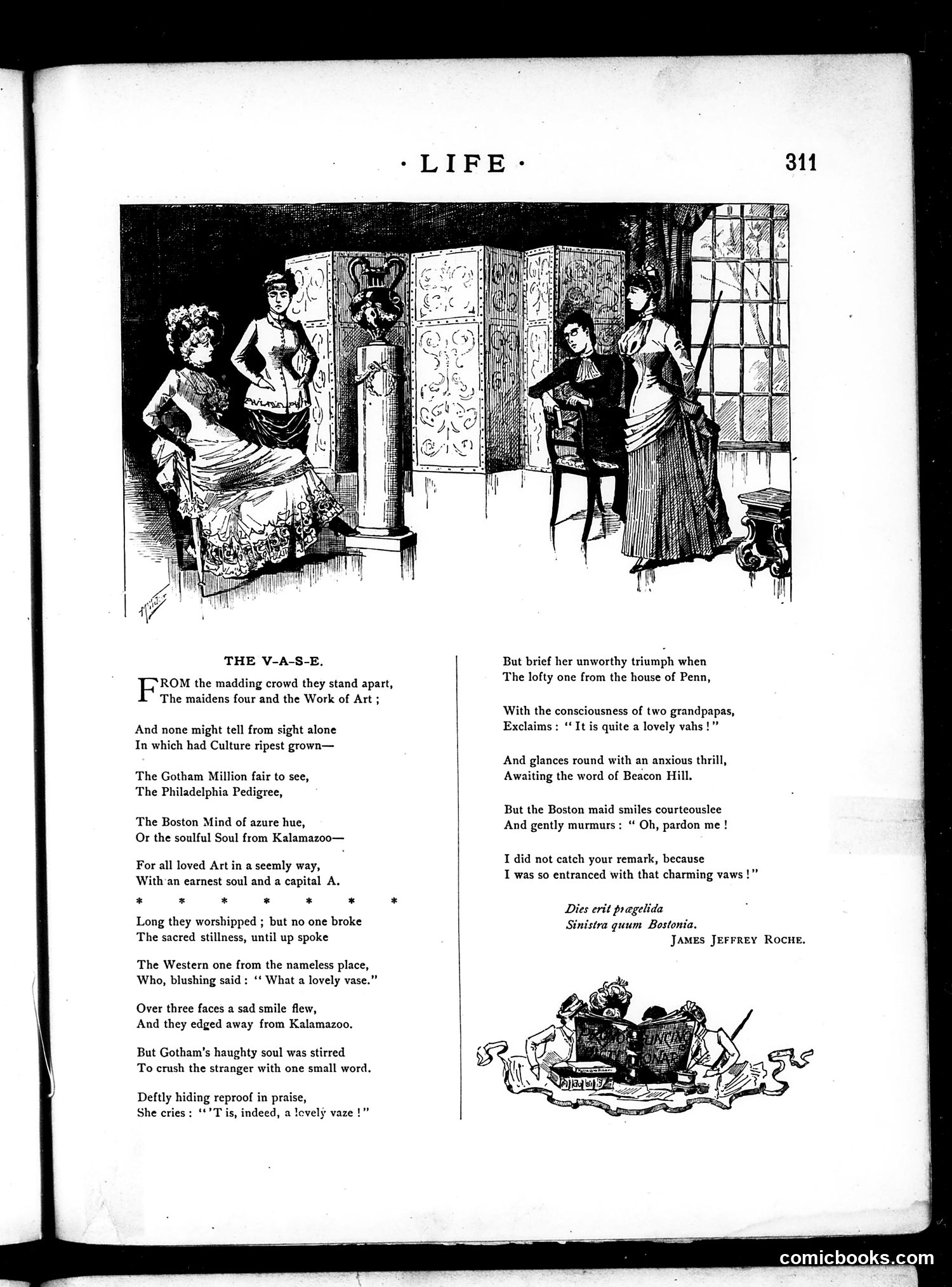
This poem satirizes upper-class American society's pretentious relationship with art and culture. The narrative depicts four wealthy women from prominent East Coast families (Gotham, Philadelphia, Boston, and a western "nameless place") gathering to admire a classical vase—a symbol of refined taste. The satire centers on Gotham's snobbish attempt to dismiss the vase as merely "lovely," only to be corrected by the Boston woman's superior judgment. The joke targets how wealthy Americans, lacking genuine cultural knowledge, compete over art appreciation as social status. The final couplet reveals the Boston woman's empty praise ("It is, indeed, a lovely vase") masks the same shallow understanding she mocked in others—exposing the hypocrisy underlying American high society's cultural pretensions.
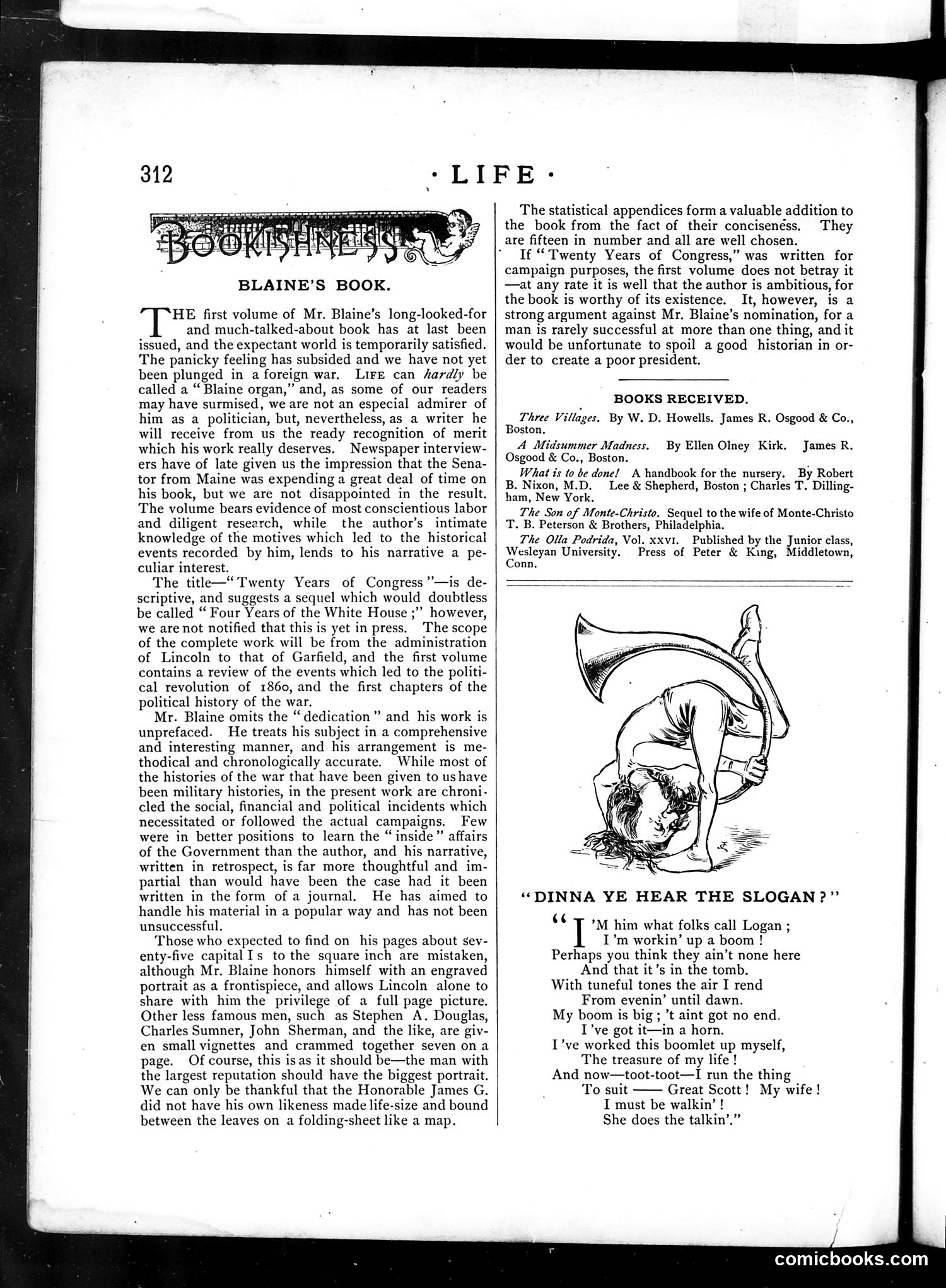
This page contains a book review of James G. Blaine's "Twenty Years of Congress" alongside an unrelated humorous poem titled "Dinna Ye Hear the Slogan?" The cartoon shows a man doing a headstand or acrobatic flip, illustrating the poem's narrative about a character named Logan who operates a boom (likely a logging device). The figure appears to be performing physical labor or struggling with equipment. The poem is a Scottish-dialect comedic piece about working-class labor, with Logan boasting about his hard work and the size of his boom. The cartoon humorously depicts the physical demands he describes. The review discusses Blaine's historical work on Congressional events and Civil War politics, praising its chronological accuracy while noting its comprehensiveness may require multiple volumes to complete.
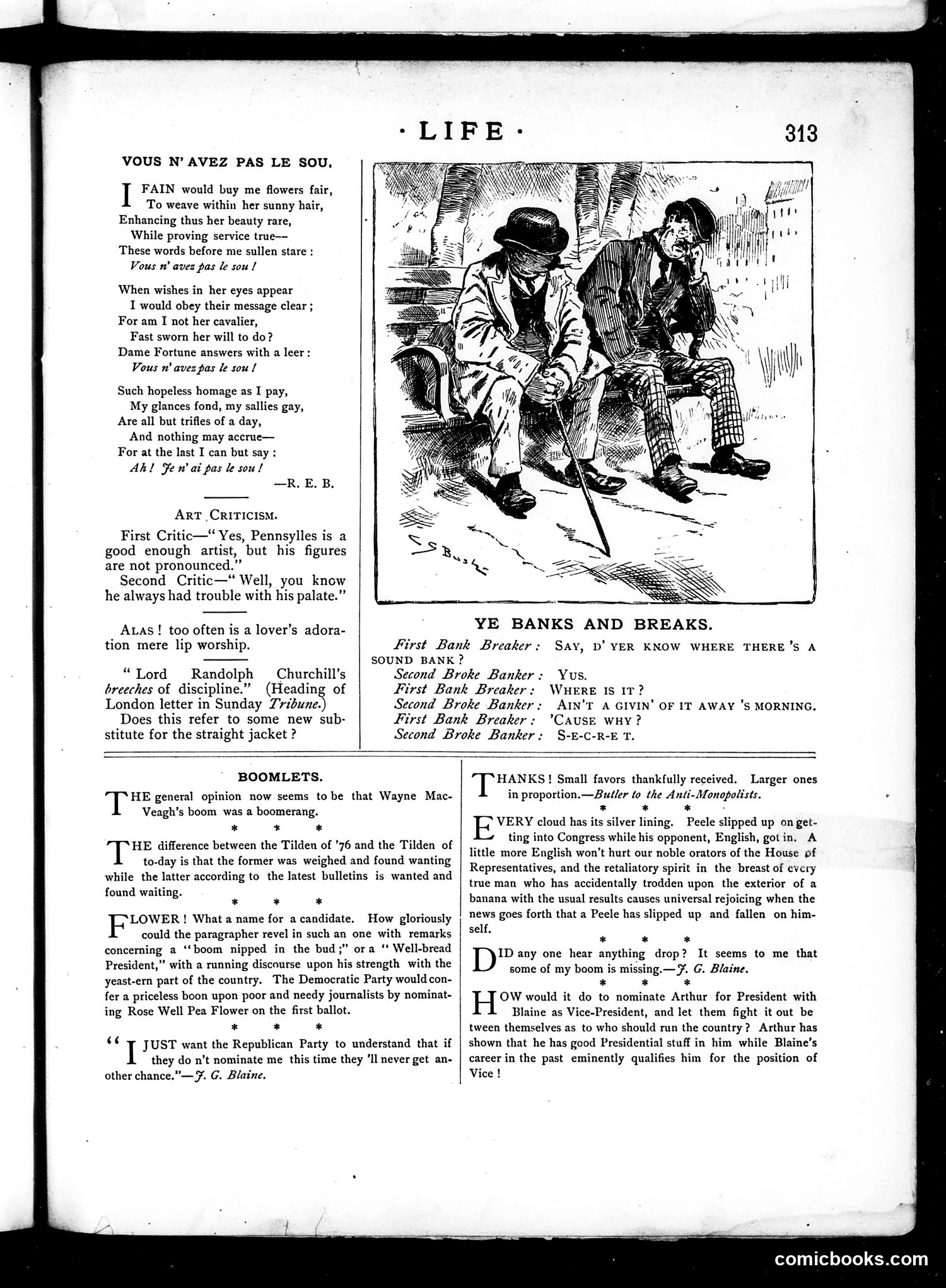
The cartoon depicts two men in shabby clothes sitting together, appearing to be homeless or impoverished. The dialogue between "First Bank Breaker" and "Second Broke Banker" is a pun-based joke playing on the phrase "bank breaker"—someone who breaks/ruins banks financially—versus "broke banker"—a banker who is financially ruined himself. The humor relies on wordplay rather than specific political figures. The dialogue suggests ironic role reversal: discussing a "sound bank" while these two represent financial failure. This appears to satirize the economic anxiety of the era, possibly referencing banking instability or financial hardship affecting even financial professionals. The exact historical context (which banking crisis or economic period) isn't specified in the visible text.
This page contains primarily **text content rather than political cartoons**. The visible material includes: 1. **Brief satirical anecdotes** about various figures (Mr. Butler's house-cleaning, references to Blaine's candidacy and Jay Gould) 2. **A "SPORT" section** with commentary on cricket, lacrosse in England, and upcoming Harvard-Yale athletic competitions 3. **"FILE NO. 41144"** — a French-English literary piece titled "Forty Years Behind," presented as a translation with notes 4. **Social gossip items** about events like Mr. Billy Edwards' retribution and Mitchell's celebration The page functions as a **satirical miscellany** typical of Life magazine's format: short jabs at public figures, sporting commentary, and literary excerpts. Without identifying specific political cartoons, the overall tone is mocking and sardonic toward contemporary society.
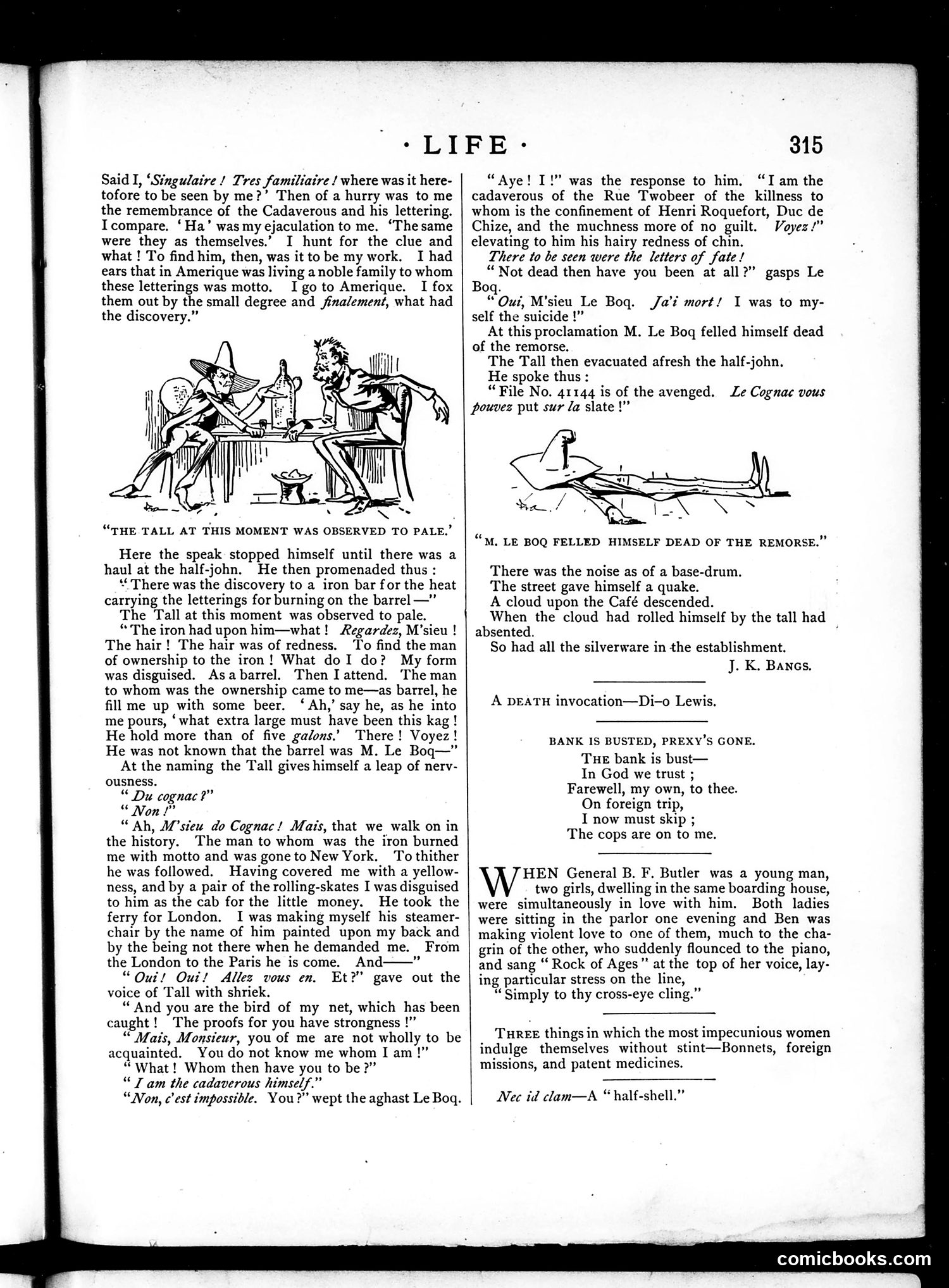
This page contains literary content rather than political cartoons. The main illustration shows two men in period dress seated at a table, apparently from a satirical story or serialized fiction. The narrative concerns a character named "Le Boq" and involves elaborate wordplay about an identity mix-up related to discovering letters and a barrel used for smuggling. The humor relies on mistaken identity and absurdist escalation—the narrator is initially thought to be a barrel, then confused with contraband, eventually leading Le Boq to commit suicide from remorse. The page also includes unrelated content: a death invocation by Di-o Lewis, a brief poem about a bank closure, and an anecdote about General B. F. Butler and two young women. The satirical tone is primarily literary rather than political.
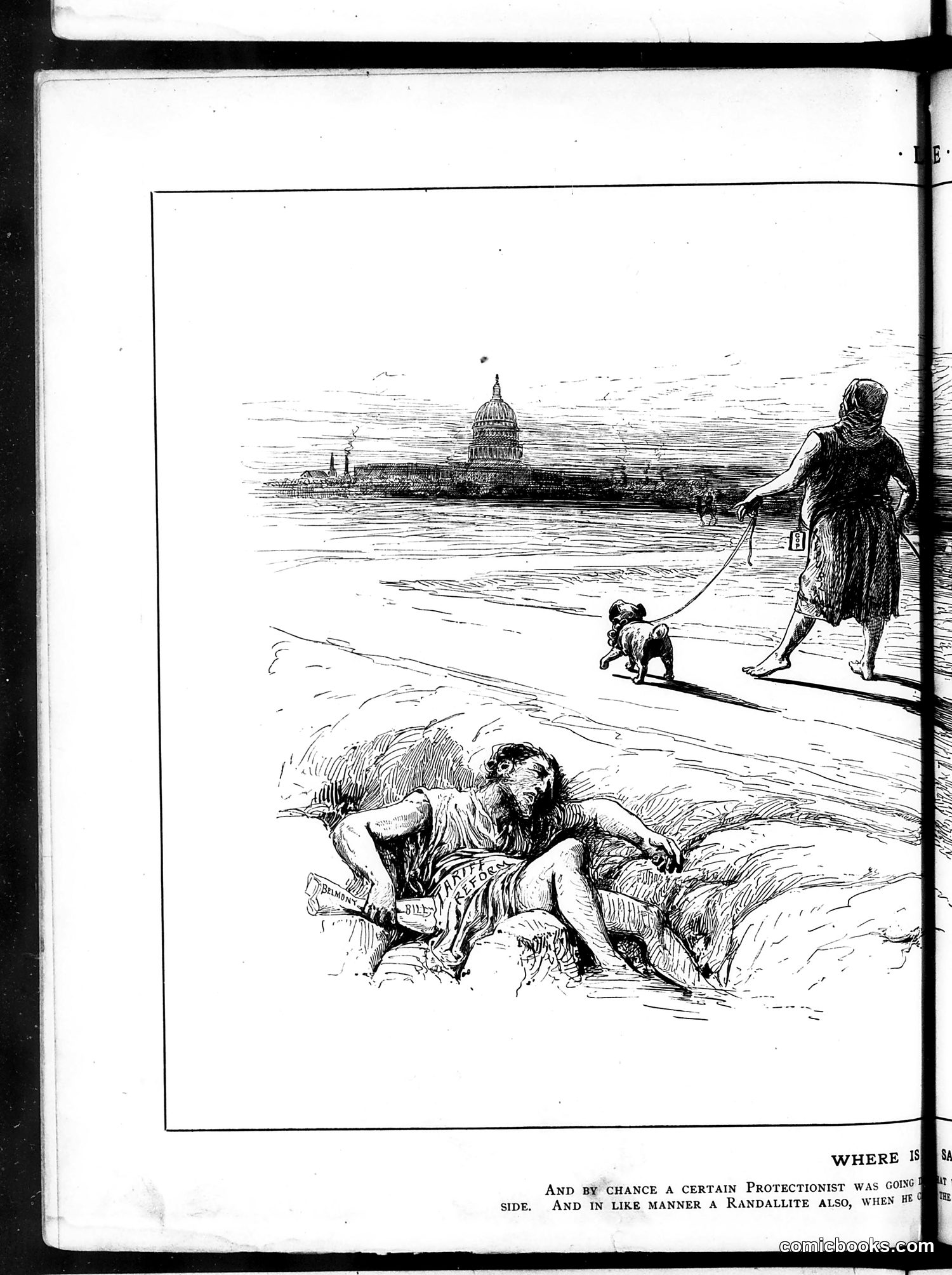
This satirical cartoon depicts a scene along the Potomac River in Washington, D.C., with the Capitol Building visible in the background. In the foreground, two figures engaged in mudslinging or corruption appear in the water/mud, while a woman walks a small dog in the background, seemingly oblivious or indifferent to the sordid activity nearby. The text references "a certain Protectionist" and "a Randallite"—political factions of the era. The satire suggests that political corruption and underhanded dealings were commonplace in Washington, happening literally under the nose of ordinary citizens and institutions of government. The cartoon critiques the dirty nature of political maneuvering, presenting it as inevitable and accepted behavior in the capital.
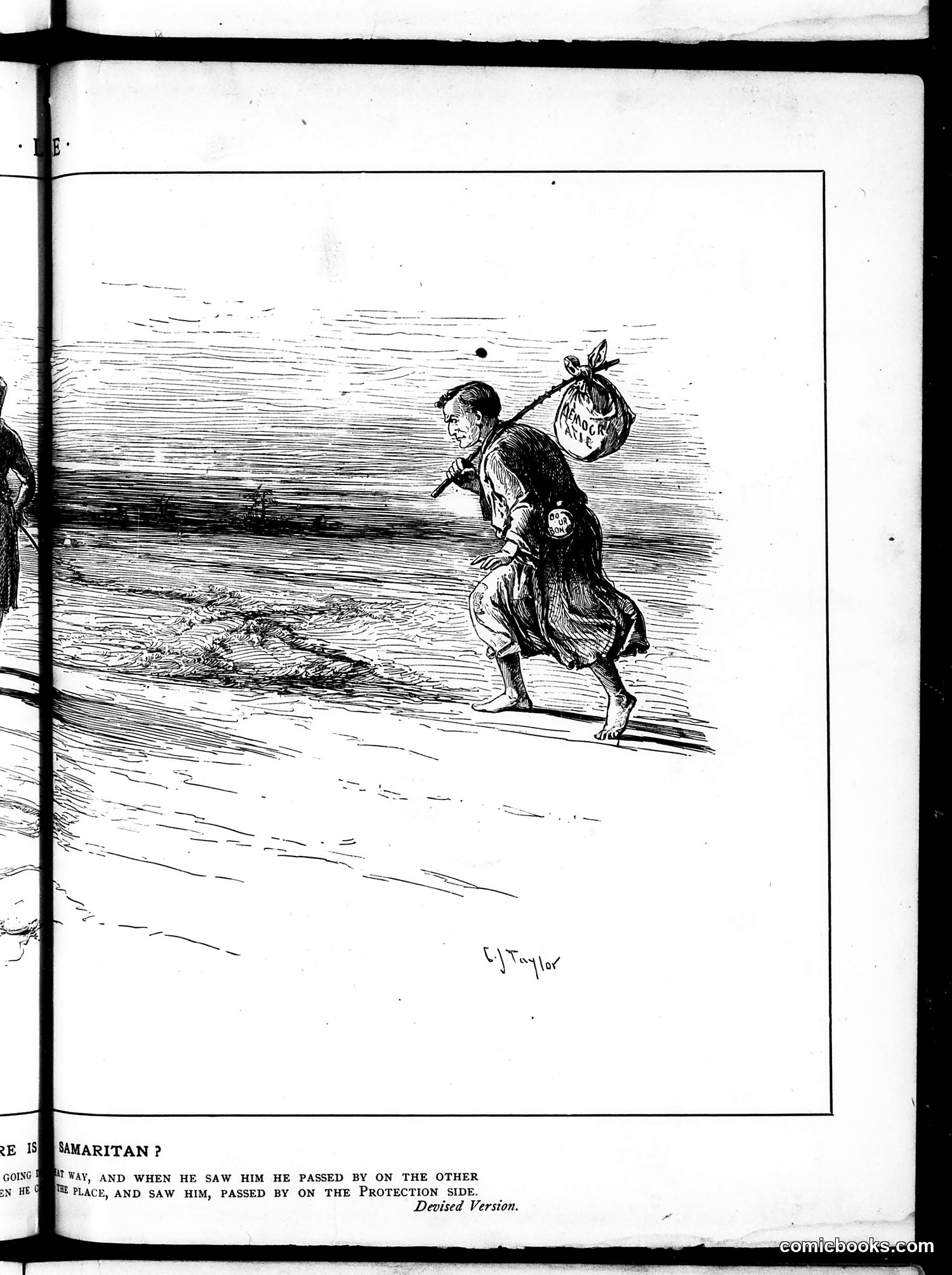
This C.J. Taylor cartoon depicts a figure carrying a bundle labeled "PROTECTION" while passing by someone in distress on the ground. The caption references the Biblical parable of the Good Samaritan, asking whether this person will help—but the "Revised Version" suggests they won't. The satire critiques the hypocrisy of those who claim to support "protection" (likely tariffs or trade policy) while ignoring human suffering. The figure passes by without assistance, mocking claims of moral concern or social responsibility that ring hollow in practice. The artwork's style and Life magazine's satirical nature suggest this targets Gilded Age political rhetoric about "protective" policies that benefited industrial interests rather than ordinary people in need.
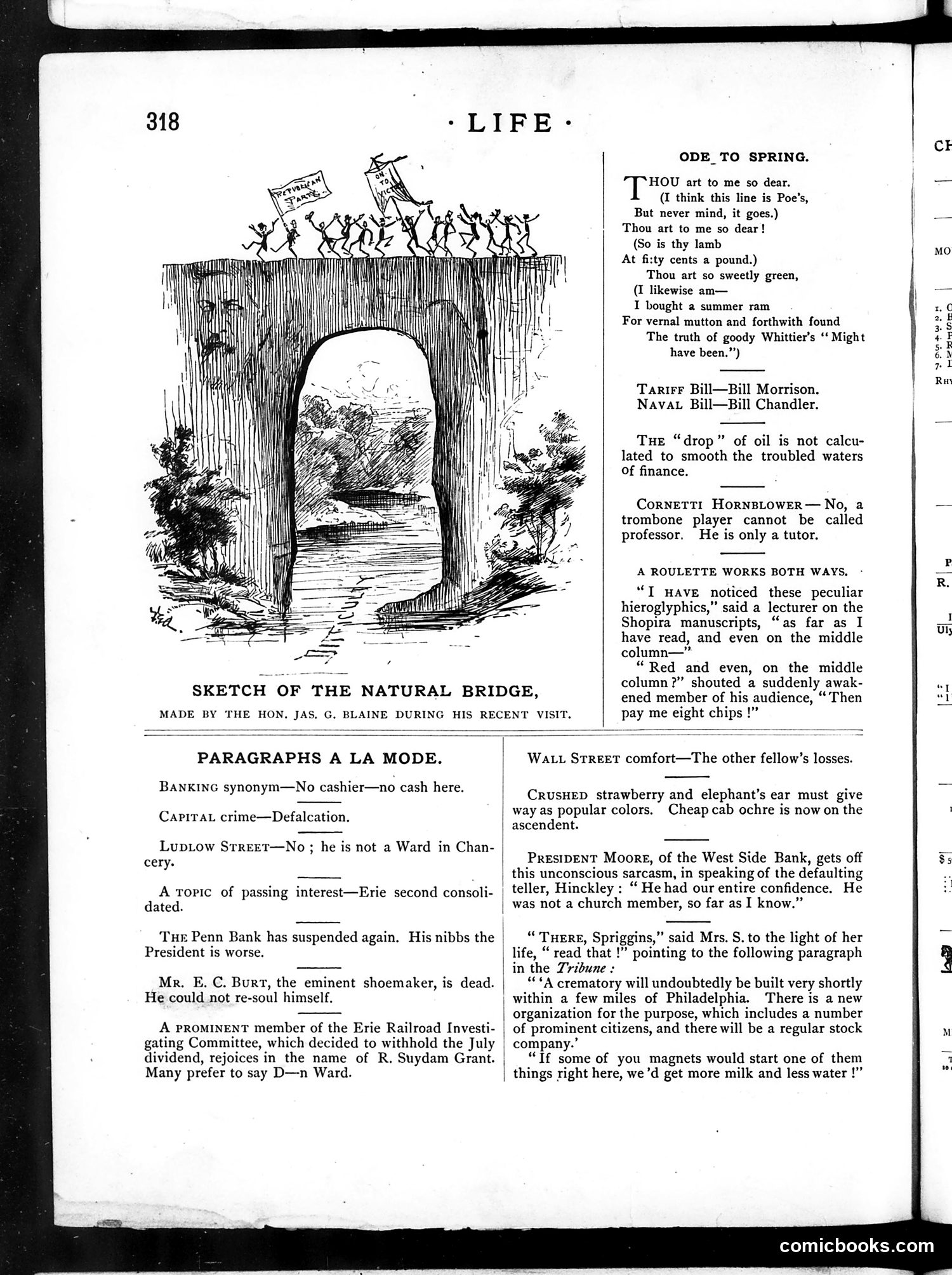
The main cartoon sketches the Natural Bridge, labeled as drawn by Hon. James G. Blaine during a recent visit. This appears to be satirizing Blaine, a prominent Republican politician, though the specific reference is unclear without dating context. The page contains political mockery through punning "Paragraphs à la Mode": banking jokes about missing cash, references to corruption (capital crime = "defalcation"), and jibes at financial scandals like the Erie Railroad and Penn Bank suspensions—reflecting late-19th-century financial instability and fraud. The satire targets Wall Street comfort ("the other fellow's losses"), church hypocrisy (a bank president trusting a non-church-member teller), and contemporary figures like President Moore of West Side Bank. The "Ode to Spring" parodies romantic poetry while mocking inflation (lamb at fifty cents/pound). Overall, the page satirizes financial corruption, political figures, and social pretension typical of Gilded Age *Life* magazine content.
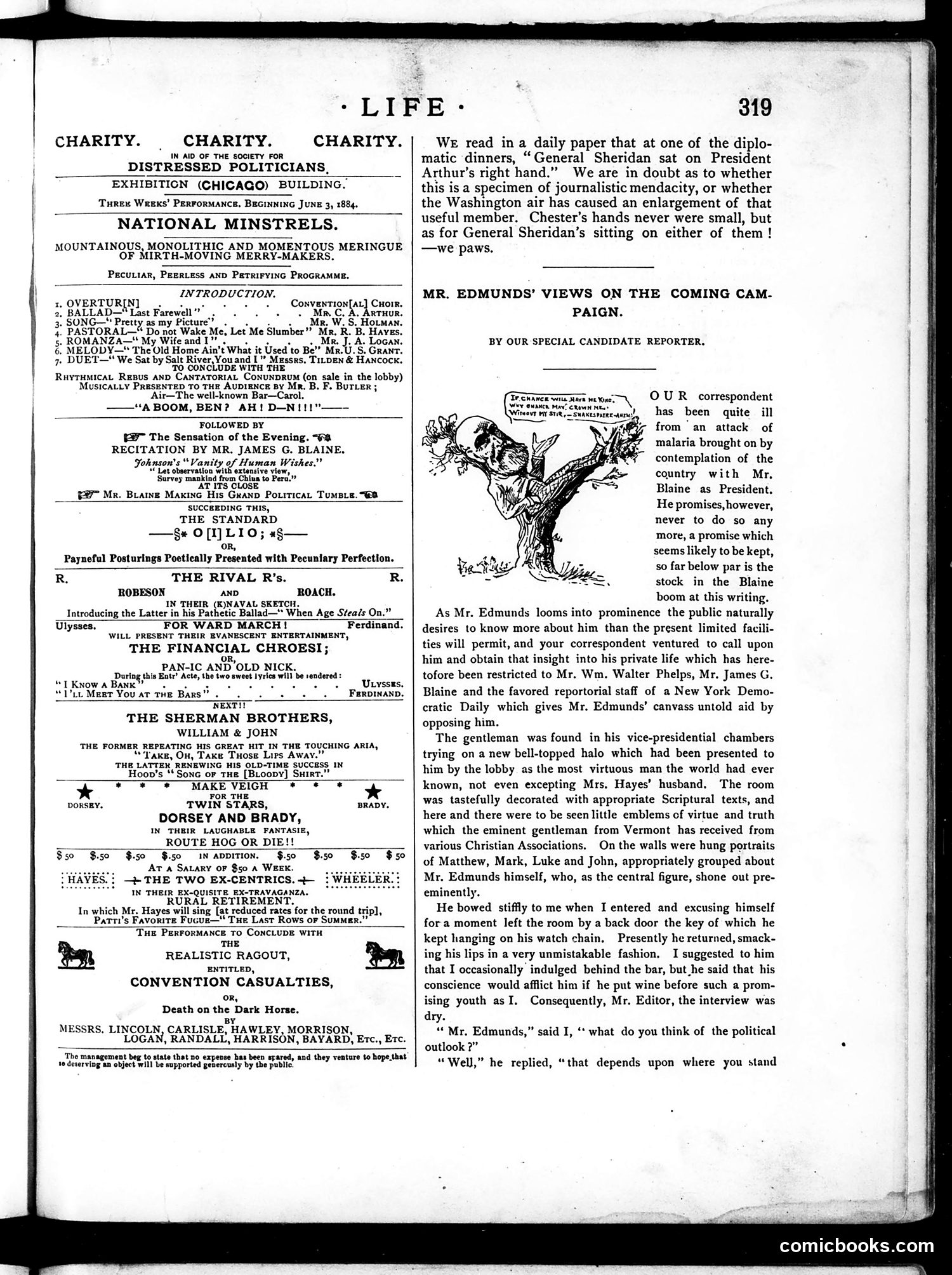
This is a satirical program for a fake "National Minstrels" charity show ostensibly benefiting "Distressed Politicians." The joke mocks prominent Republican figures through theatrical billing—likely from the 1884 presidential campaign context. The listed "performers" appear to be political figures (names like Hayes, Logan, Blaine, Sherman Brothers, etc.) cast in humorous roles with song titles that mock their political positions or failures. References like "Salt River" (political slang for defeat) and "Financial Chroesis" (financial distress) underscore the satire. The accompanying article discusses Mr. Edmunds as a potential presidential candidate, describing his office decorated with virtue-themed portraits—a gentle mockery of his self-righteousness. The overall effect ridicules Republican politicians as washed-up performers—entertainers rather than serious statesmen—during a campaign year when party leadership faced public skepticism.
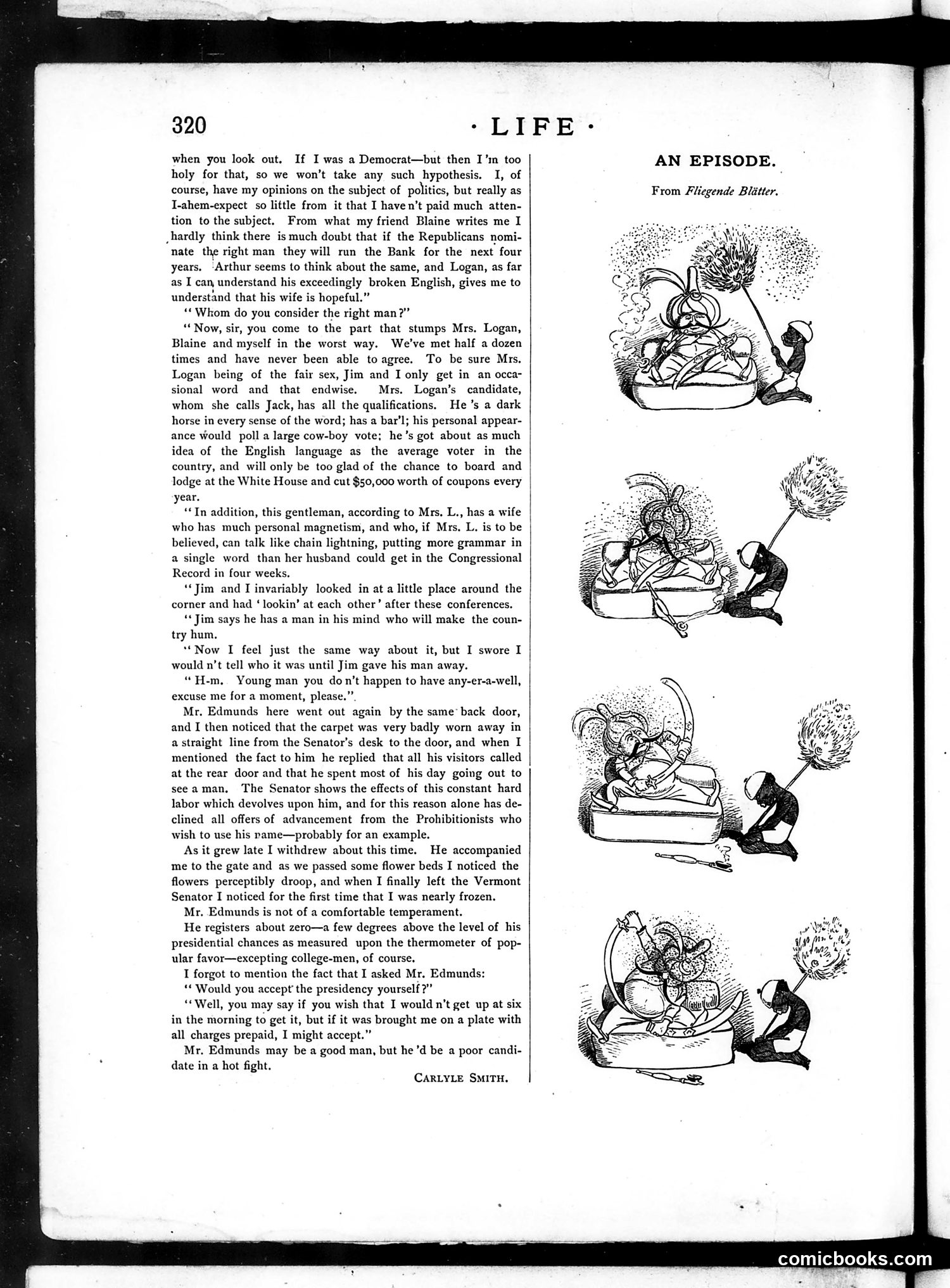
This article by Carlyle Smith mocks Republican candidates for the presidency, centering on Senator George Edmunds of Vermont. The text satirizes the difficulty party insiders face selecting their nominee—they cannot agree on a suitable candidate. The joke hinges on Edmunds' cold, aloof personality. Smith describes how Edmunds' carpet is worn from constantly escorting visitors out the back door, and notes that flowers droop as he passes and Smith himself nearly freezes in his presence. This physical coldness becomes a metaphor for his political "coldness"—his poor viability as a candidate despite being "a good man." The accompanying illustrations from *Fliegende Blätter* (a German satirical magazine) appear to show whimsical garden scenes unrelated to the American political content, suggesting they were reprinted stock material. The satire suggests Republicans lack an inspiring nominee and Edmunds, though respectable, would be an ineffective campaigner.
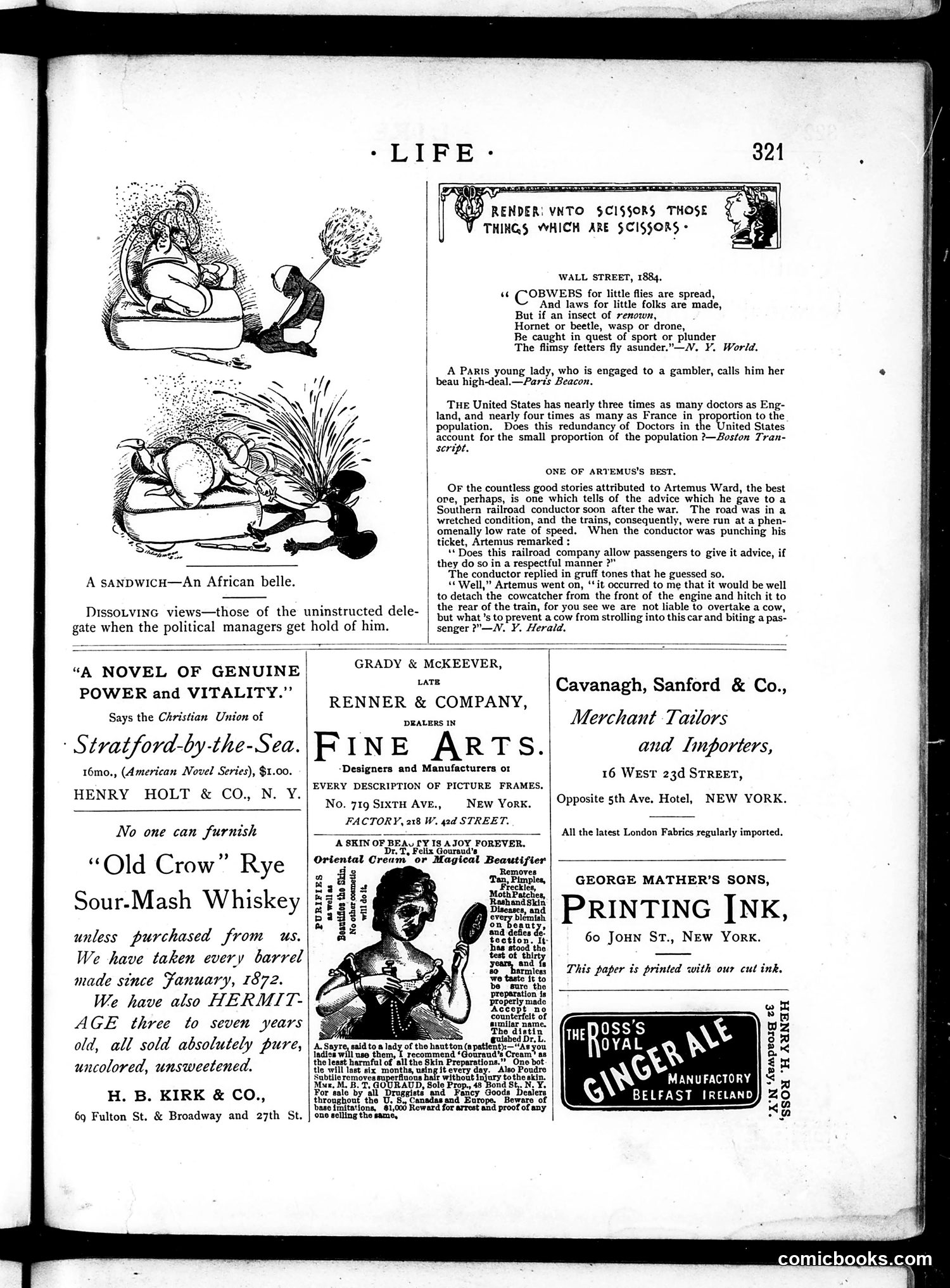
This page contains two brief satirical pieces typical of Life magazine's humor: **"A Sandwich—An African Belle"**: A racist joke playing on the word "sandwich," likely referencing a Black woman's body shape. This reflects the era's deeply offensive racial stereotyping common in 1880s American publications. **"Dissolving Views"**: A political cartoon caption satirizing uninformed voters ("uninstructed delegate") whose political opinions are easily manipulated by party operatives ("political managers"). The term "dissolving views" refers to a magic lantern technique, suggesting voters' convictions disappear when pressured. The page is predominantly filled with period advertisements for whiskey, art frames, printing ink, and cosmetics. One ad includes racist imagery typical of the era. The content reflects 1880s American magazine culture: casual racism was normalized, and political commentary focused on concerns about voter manipulation and machine politics—issues relevant to the Gilded Age.
This page is primarily **advertisements and short humorous anecdotes**, not a political cartoon. The content consists of: **Product Advertisements:** Arnold Constable & Co. (underwear/hosiery), Parker House Hotel (Boston), Sohmer pianos, Lundborg perfumes, and patent medicines. **Humor Sections:** Several brief jokes appear, including one mocking a young couple's romantic plans (the groom jokes they'll need two cottages if the bride's mother joins them), and another where a man asks his departing friend to give regards to Jenkins—only to learn Jenkins is in jail, but the friend says he'll pass along the regards anyway. **Social Context:** The jokes reflect late 19th-century concerns: courtship etiquette, practical marriage anxieties, and casual acceptance of imprisonment. The Japanese women/pins reference at the top reflects period Orientalism and assumptions about exotic foreign customs. This is essentially a **page of classified advertising with filler humor**—typical of Life magazine's mixed content during this era.
This is primarily an **advertisements and notices page** from *Life* magazine, not a political cartoon page. The small satirical content consists of brief joke items scattered among commercial listings. The visible humor pieces are short, mild social observations: 1. **Fred Grant joke**: References General Ulysses S. Grant's son claiming his father needs $1 million to recover financially—a jab at Grant's failed business ventures and poor finances in his later years. 2. **"Fashionable society" quip**: Mocks upper-class women's trend of carrying ornate smelling salts ($40-100), sarcastically noting that "fainting has been revived" among the wealthy as a fashionable affectation. 3. **"Hong Kee" story**: A stereotypical Chinese immigrant character attempting to "paint the town red" like an American, ordering drinks with broken English ("bustee town," "Melican man"). The joke relies on ethnic caricature and his ejection for running up a tab—mild period humor about immigrants and class. The page is dominated by product advertisements for silverware, books, and patent medicines—typical of *Life*'s commercial content of this era.
This page is primarily **advertisements**, not political satire. It's a typical 1880s American magazine advertisement section showcasing patent medicines, sporting goods, and consumer products. Key content includes: - **Crosby's Vitalized Phosphites**: A "brain food" tonic claiming to cure mental/nervous disorders—typical of the era's dubious patent medicine marketing - **Cuticura Remedies**: Skin treatments promising to cure humors and eruptions - **Sporting goods** (tennis equipment, bicycles) - **Consumer products** (pianos, corsets, shade rollers) The testimonial quote from "GEO. F. PENTECOST" praising Columbia bicycles ("I would not give mine weight in gold") exemplifies the exaggerated marketing claims common in Victorian advertising. There is **no political cartoon visible**. The page reflects late-19th-century consumer culture and the unregulated patent medicine industry that thrived before FDA oversight.