
Life, 1884-06-05 · page 2 of 16
Life — June 5, 1884 — page 2: what you’re looking at
What you’re looking at
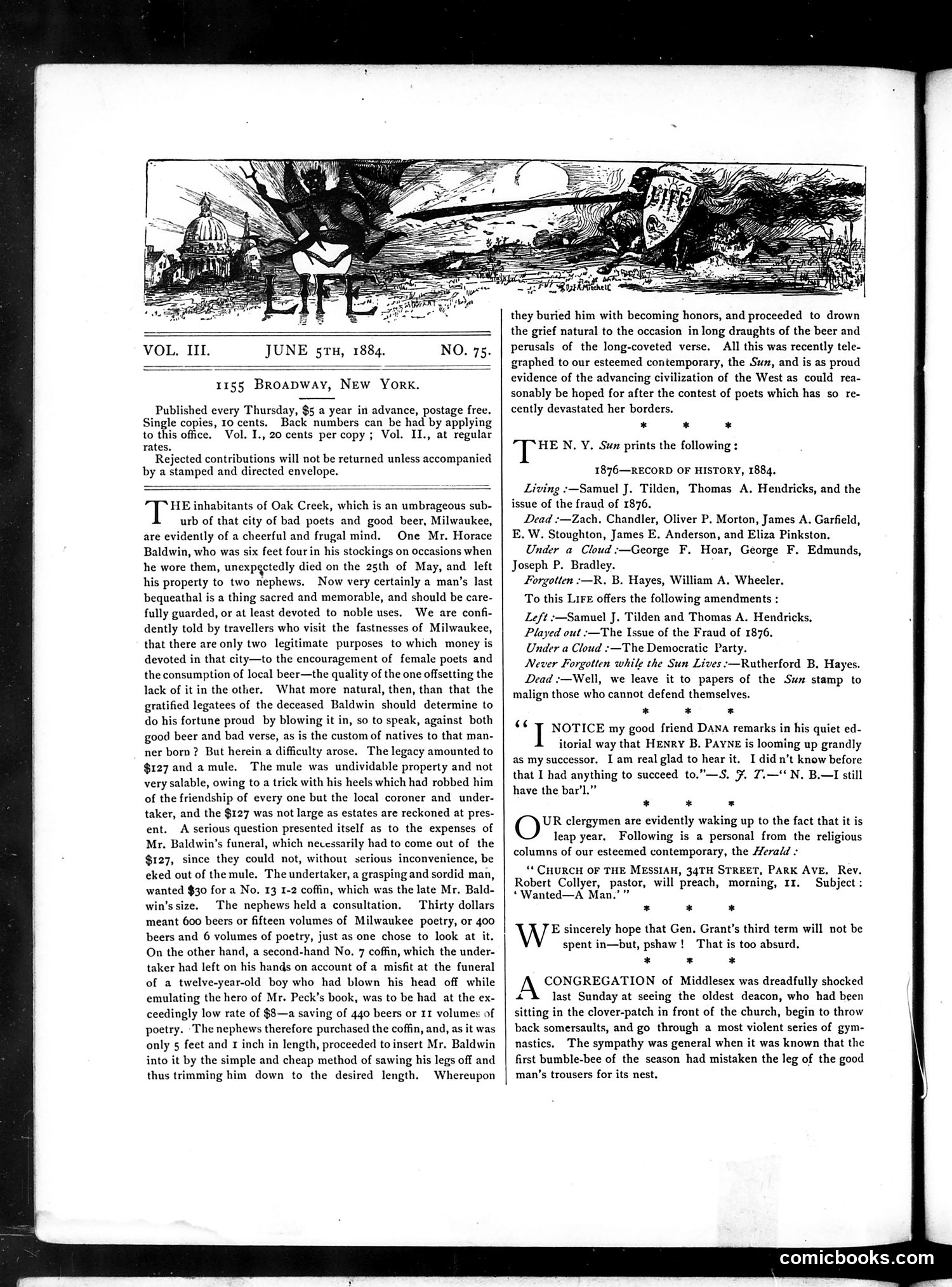
The banner illustration shows "LIFE" as a skeletal figure amid destruction, with a dome (likely the Capitol) visible. This appears to satirize the state of American politics or society. The text below discusses Oak Creek, Wisconsin, and a local bequest dispute involving poet Samuel Baldwin. The satire concerns how his heirs fought over his estate while debating whether to honor his literary legacy or pursue financial gain—a commentary on how survivors often abandon artistic principles for money. The page also contains editorial notes about the magazine's coverage, including references to the "Sun" newspaper and various political figures. Without clearer image detail of specific caricatures, the exact targets remain somewhat unclear, though the overall theme critiques the conflict between commercial interests and cultural values.
📄 Transcribed text from this page (OCR, searchable)
Machine-transcribed from the original scan — historical spelling and the odd misread are preserved.
VOL. III. JUNE 5ru, 1884. 1155 Broapway, New York. Published every Thursday, $5 a year in advance, postage free. Single copies, 10 cents. Back numbers can be had by applying to this office. Vol. I., 20 cents per copy; Vol. II., at regular rates. Rejected contributions will not be returned unless accompanied by a stamped and directed envelope. HE inhabitants of Oak Creek, which is an umbrageous sub- urb of that city of bad poets and good beer, Milwaukee, are evidently of a cheerful and frugal mind. One Mr. Horace Baldwin, who was six feet four in his stockings on occasions when he wore them, unexpgctedly died on the 25th of May, and left his property to two nephews. Now very certainly a man’s last bequeathal is a thing sacred and memorable, and should be care- fully guarded, or at least devoted to noble uses. We are confi- dently told by travellers who visit the fastnesses of Milwaukee, that there are only two legitimate purposes to which money is devoted in that city—to the encouragement of female poets and the consumption of local beer—the quality of the one offsetting the lack of it in the other. What more natural, then, than that the gratified legatees of the deceased Baldwin should determine to do his fortune proud by blowing it in, so to speak, against both good beer and bad verse, as is the custom of natives to that man- ner born? But herein a difficulty arose. The legacy amounted to $127 and a mule. The mule was undividable property and not very salable, owing to a trick with his heels which had robbed him of the friendship of every one but the local coroner and under- taker, and the $127 was not large as estates are reckoned at pres- ent. A serious question presented itself as to the expenses of Mr. Baldwin's funeral, which necessarily had to come out of the $127, since they could not, without serious inconvenience, be eked out of themule. The undertaker, a grasping and sordid man, wanted $30 for a No. 13 1-2 coffin, which was the late Mr. Bald- win’s size. The nephews held a consultation, Thirty dollars meant 600 beers or fifteen volumes of Milwaukee poetry, or 400 beers and 6 volumes of poetry, just as one chose to look at it. On the other hand, a second-hand No. 7 coffin, which the under- taker had left on his hands on account of a misfit at the funeral of a twelve-year-old boy who had blown his head off while emulating the hero of Mr. Peck’s book, was to be had at the ex- ceedingly low rate of $8—a saving of 44o beers or 11 volumes of poetry. ‘The nephews therefore purchased the coffin, and, as it was only 5 feet and x inch in length, proceeded to insert Mr. Baldwin into it by the simple and cheap method of sawing his legs off and thus trimming him down to the desired length. Whereupon they buried him with becoming honors, and proceeded to drown the grief natural to the occasion in long draughts of the beer and perusals of the long-coveted verse. All this was recently tele- graphed to our esteemed contemporary, the Suz, and is as proud evidence of the advancing civilization of the West as could rea- sonably be hoped for after the contest of poets which has so re- cently devastated her borders. * * * T N. Y. Sun prints the following : 1876—RECORD OF HISTORY, 1884, Living :—Samuel J. Tilden, Thomas A. Hendricks, and the issue of the fraud of 1876. Dead :—Zach. Chandler, Oliver P, Morton, James A. Garfield, E. W. Stoughton, James E. Anderson, and Eliza Pinkston, Under a Cloud :—George F, Hoar, George F. Edmunds, Joseph P. Bradley. Forgotten :—R. B. Hayes, William A. Wheeler. To this Lire offers the following amendments : Left :—Samuel J. Tilden and Thomas A. Hendricks. Played out :—The Issue of the Fraud of 1876, Under a Cloud :—The Democratic Party. Never Forgotten while the Sun Lives :—Rutherford B. Hayes. Dead :—Well, we leave it to papers of the Sun stamp to malign those who cannot defend themselves. * * ® 6¢ 7 NOTICE my good friend Dana remarks in his quiet ed- itorial way that HENRY B, PAYNE is looming up grandly as my successor. I am real glad to hear it. I did n’t know before that I had anything to succeed to.”—S. ¥. 7.—‘‘ N. B.—I still have the bar’l.”” * * * UR clergymen are evidently waking up to the fact that it is leap year. Following is a personal from the religious columns of our esteemed contemporary, the Herald - “* CHURCH OF THE MESSIAH, 34TH STREET, PARK AVE. Rev. Robert Collyer, pastor, will preach, morning, 11, Subject : “Wanted—A Man.’” * * * E sincerely hope that Gen. Grant’s third term will not be spent in—but, pshaw! That is too absurd. * * * A CONGREGATION of Middlesex was dreadfully shocked a last Sunday at seeing the oldest deacon, who had been sitting in the clover-patch in front of the church, begin to throw back somersaults, and go through a most violent series of gym- nastics. The sympathy was general when it was known that the first bumble-bee of the season had mistaken the leg of the good man’s trousers for its nest, comicbooks.com