
Life, 1884-06-05 · page 4 of 16
Life — June 5, 1884 — page 4: what you’re looking at
What you’re looking at
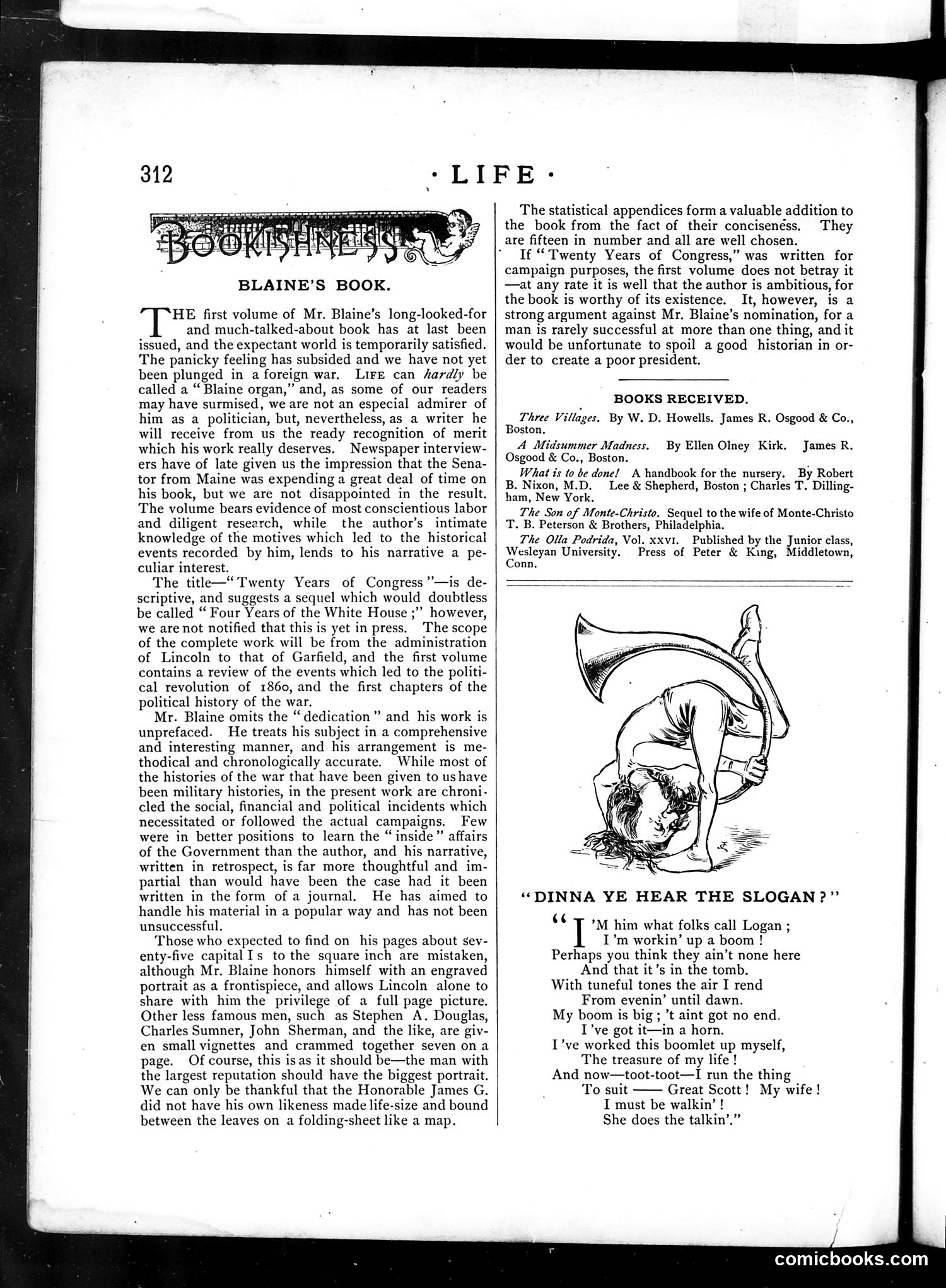
This page contains a book review of James G. Blaine's "Twenty Years of Congress" alongside an unrelated humorous poem titled "Dinna Ye Hear the Slogan?" The cartoon shows a man doing a headstand or acrobatic flip, illustrating the poem's narrative about a character named Logan who operates a boom (likely a logging device). The figure appears to be performing physical labor or struggling with equipment. The poem is a Scottish-dialect comedic piece about working-class labor, with Logan boasting about his hard work and the size of his boom. The cartoon humorously depicts the physical demands he describes. The review discusses Blaine's historical work on Congressional events and Civil War politics, praising its chronological accuracy while noting its comprehensiveness may require multiple volumes to complete.
📄 Transcribed text from this page (OCR, searchable)
Machine-transcribed from the original scan — historical spelling and the odd misread are preserved.
+ LIFE: BLAINE’S BOOK. HE first volume of Mr. Blaine’s long-looked-for and much-talked-about book has at last been issued, and the expectant world is temporarily satisfied. The panicky feeling has subsided and we have not yet been plunged in a foreign war. Lire can hardly be called a “Blaine organ,” and, as some of our readers may have surmised, we are not an especial admirer of him as a politician, but, nevertheless, as a writer he will receive from us the ready recognition of merit which his work really deserves. Newspaper interview- ers have of late given us the impression that the Sena- tor from Maine was expending a great deal of time on his book, but we are not disappointed in the result. The volume bears evidence of most conscientious labor and diligent research, while the author’s intimate knowledge of the motives which led to the historical events recorded by him, lends to his narrative a pe- culiar interest. The statistical appendices form a valuable addition to the book from the fact of their concisenéss. They are fifteen in number and all are well chosen. If “Twenty Years of Congress,” was written for campaign purposes, the first volume does not betray it —at any rate it is well that the author is ambitious, for the book is worthy of its existence. It, however, is a strong argument against Mr. Blaine’s nomination, for a man is rarely successful at more than one thing, and it would be unfortunate to spoil a good historian in or- der to create a poor president. BOOKS RECEIVED. Three Villages. By W. D. Howells, James R. Osgood & Co., Boston, A Midsummer Madness, Osgood & Co., Boston. Wheat is to be done! A handbook for the nursery. By Robert B. Nixon, M.D. Lee & Shepherd, Boston ; Charles T. Dilling- ham, New York. The Son of Monte-Christo. Sequel to the wife of Monte-Christo T. B. Peterson & Brothers, Philadelphia. The Olla Podrida, Vol. xxv1. Published by the Junior class, Ueslevan University. Press of Peter & King, Middletown, ‘onn. By Ellen Olney Kirk. James R. The title—“ Twenty Years of Congress”—is de- scriptive, and suggests a sequel which would doubtless be called “ Four Years of the White House ;”” however, we are not notified that this is yet in press. The scope of the complete work will be from the administration of Lincoln to that of Garfield, and the first volume contains a review of the events which led to the politi- cal revolution of 1860, and the first chapters of the political history of the war. Mr. Blaine omits the “ dedication” and his work is unprefaced. He treats his subject in a comprehensive and interesting manner, and his arrangement is me- thodical and chronologically accurate. While most of the histories of the war that have been given to us have been military histories, in the present work are chroni- cled the social, financial and political incidents which necessitated or followed the actual campaigns. Few were in better positions to learn the “ inside” affairs of the Government than the author, and his narrative, written in retrospect, is far more thoughtful and im- partial than would have been the case had it been written in the form of a journal. He has aimed to handle his material in a popular way and has not been unsuccessful. Those who expected to find on his pages about sev- enty-five capital Is to the square inch are mistaken, although Mr. Blaine honors himself with an engraved portrait as a frontispiece, and allows Lincoln alone to share with him the privilege of a full page picture. Other less famous men, such as Stephen A. Douglas, Charles Sumner, John Sherman, and the like, are giv- en small vignettes and crammed together seven on a page. Of course, this is as it should be—the man with the largest reputation should have the biggest portrait. We can only be thankful that the Honorable James G. did not have his own likeness made life-size and bound between the leaves on a folding-sheet like a map. “DINNA YE HEAR THE SLOGAN?” iI ’M him what folks call Logan ; I’m workin’ up a boom! Perhaps you think they ain’t none here And that it’s in the tomb. With tuneful tones the air I rend From evenin’ until dawn. My boom is big ; ’t aint got no end. I’ve got it—in a horn. I’ve worked this boomlet up myself, The treasure of my life ! And now—toot-toot—I run the thing To suit —— Great Scott! My wife! I must be walkin’! She does the talkin’.” comicbooks.com