
A complete issue · 14 pages · 1884
Life — February 28, 1884
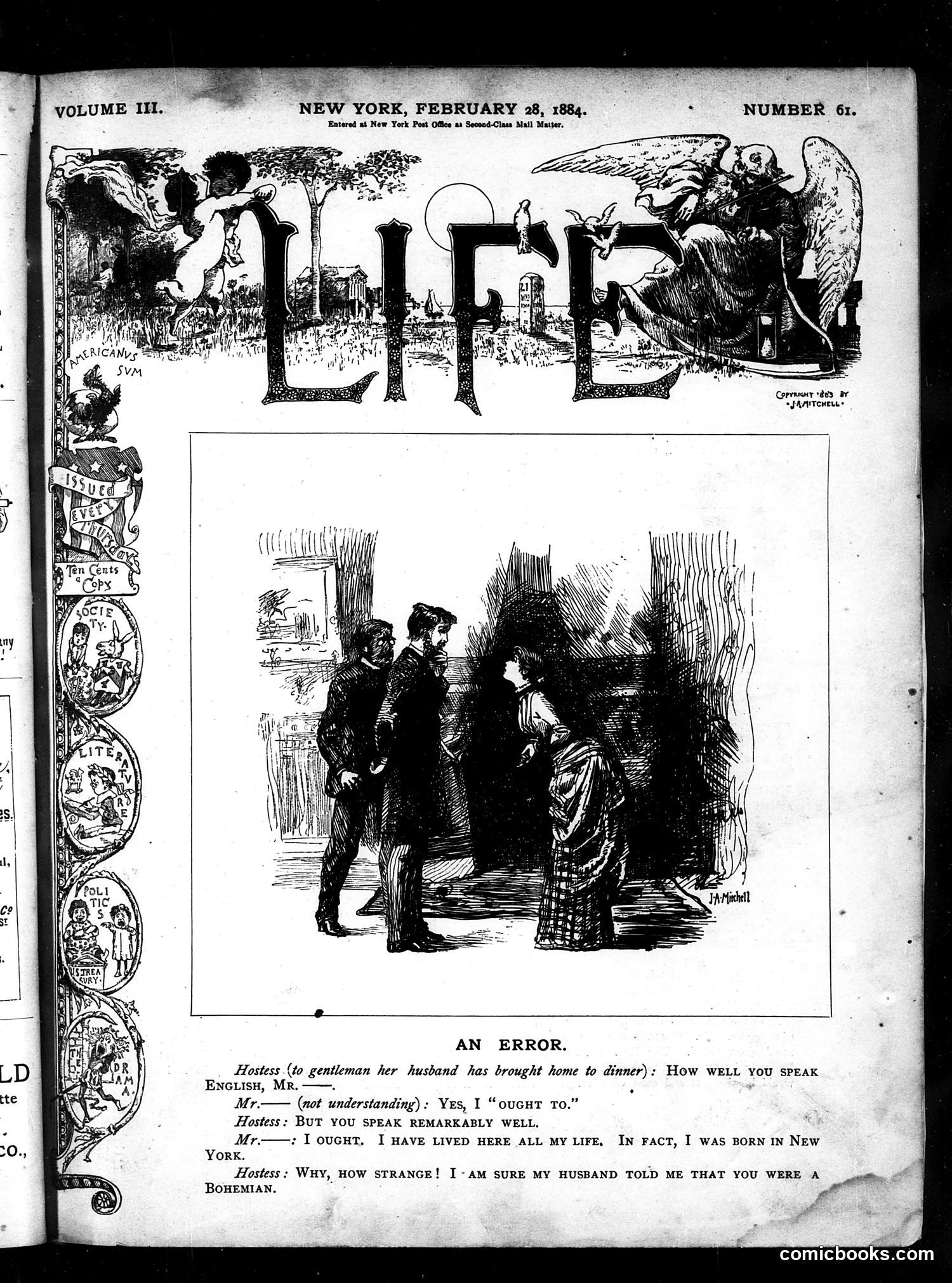
This satirical cartoon mocks a social embarrassment. A hostess compliments a gentleman guest on his excellent English, saying he "speaks remarkably well." The man replies he was born in New York. The hostess then expresses surprise, claiming her husband told her the guest was a Bohemian. The joke targets class prejudice and ethnic stereotyping of the 1880s. The hostess assumed poor English indicated foreign origin, but her assumption was wrong—he's American-born. The satire critiques how upper-class Americans made hasty ethnic judgments based on accent or appearance, and the social awkwardness that resulted when such assumptions proved incorrect. "Bohemian" likely referred to Central European immigrants, often viewed with suspicion.
The page contains a short story titled "The Thompson Street Poker Club" rather than political cartoons. The narrative satirizes a poker game among gentlemen including a Reverend Mr. Smith, where players engage in increasingly absurd behavior and dialogue. The satire targets the hypocrisy of respectable society figures—particularly a clergyman—participating in gambling and card games while maintaining moral pretenses. The characters speak in exaggerated dialect and make nonsensical utterances ("Nigguhs, dad's what genelemen gits fer takin' his eye often de pack"), which appears designed for comedic effect through absurdist humor typical of 1880s satirical magazines. The text mocks both gambling culture and the contradiction between religious authority and actual conduct.
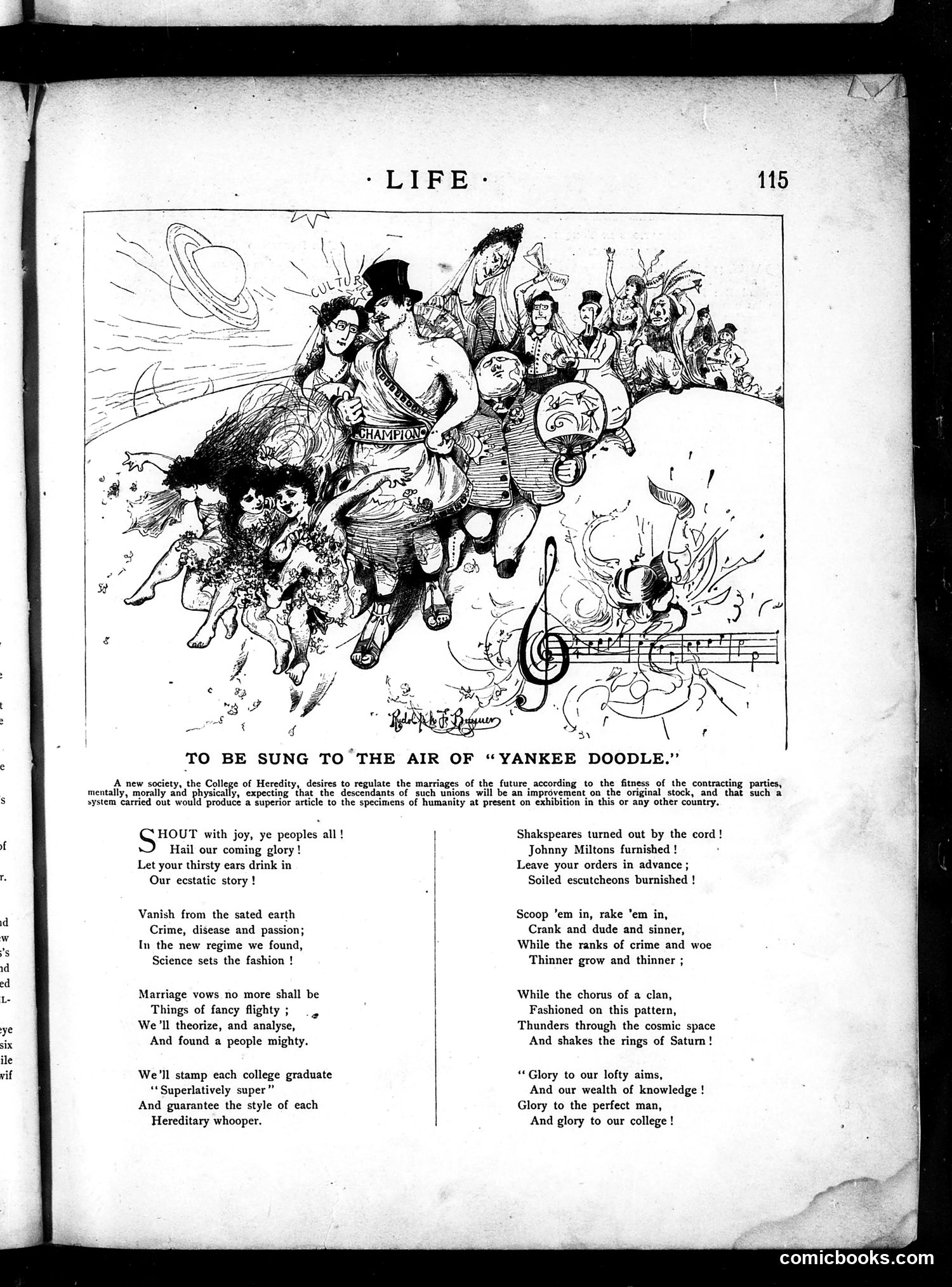
This page satirizes late 19th-century eugenic and "scientific" theories about human improvement through selective breeding. The elaborate cartoon depicts various caricatured figures—appearing to represent different social types—being herded together like cattle, labeled with pseudo-scientific attributes like "Champion" and various physical/mental characteristics. The accompanying song, set to "Yankee Doodle," mocks utopian schemes promising societal perfection through controlled marriage, education, and selective reproduction. References to "Shakespeares turned out by the cord" and guaranteeing "hereditary" traits ridicule the era's popular belief that breeding "superior" people could eliminate crime and disease. The satire targets pseudo-scientific racism and eugenics movements gaining traction among American intellectuals—systems proposing to scientifically "improve" the human stock, which the cartoonist clearly views as absurd social engineering.
This page contains satirical news commentary and literary content rather than visual cartoons. The left column includes three sections: **"Telegraphic: Operations in Tonquim"** mocks French military operations, likely referencing the Tonkin conflict in Indochina. **"National Capital Topics"** reports on Washington social events, including presidential dinners—typical gossip-style commentary on political figures' social activities. **"Definitions"** presents humorous satirical definitions mocking Brown (unclear which public figure), criticizing stubbornness, poor parenting, and disagreeable neighbors—general social satire rather than specific political commentary. The right side features poetry and a story excerpt about "Dr. Recieveier," a New Orleans physician. The satire here is genteel and literary rather than visually cartooned.
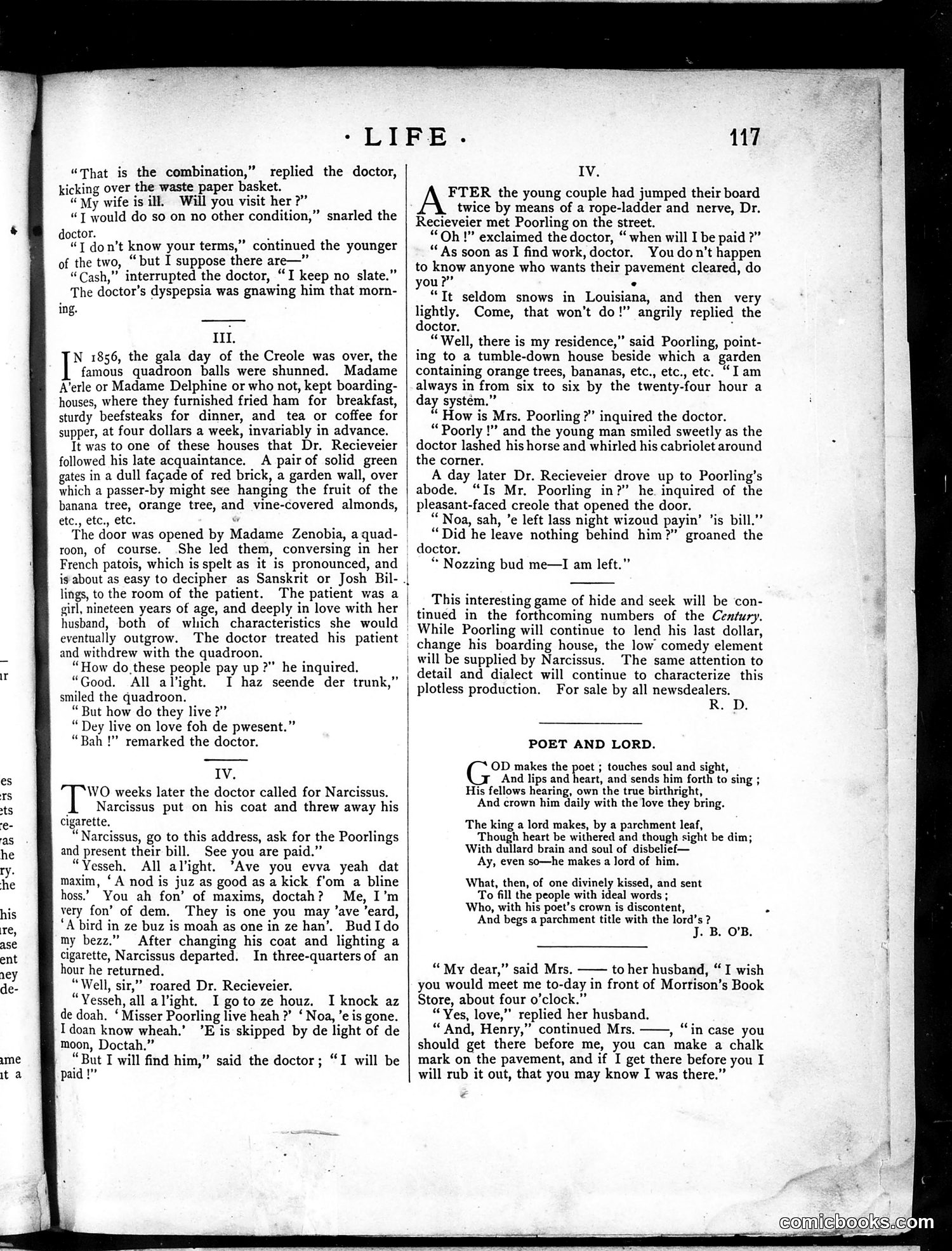
This page contains a serialized fiction story rather than political satire or cartoons. The narrative follows Dr. Recieveier's interactions with poor New Orleans residents, particularly a character named Poorling, in what appears to be the 1850s based on the text's reference to "1856, the gala day of the Creole was over." The story satirizes medical practice and social conditions through comedic dialogue—the doctor makes house calls to impoverished patients who cannot pay, and there's wordplay around Creole dialect and characters' financial desperation. The piece titled "Poet and Lord" appears to be unrelated poetry. Without illustrations visible in this reproduction, the satire relies entirely on dialogue and narrative rather than visual caricature.
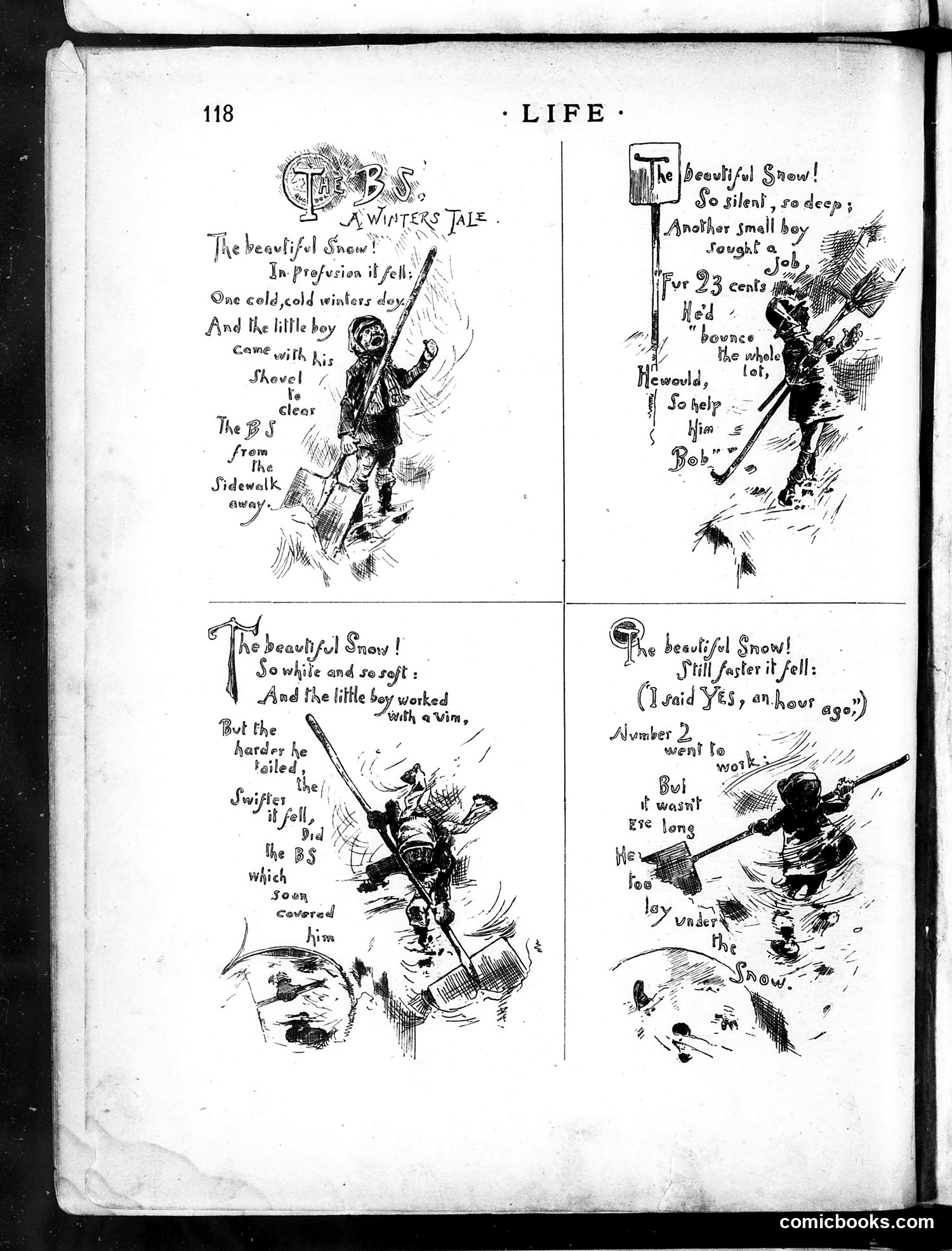
This appears to be a humorous narrative poem illustrated across four panels, telling the story of boys hired to shovel snow. The satire mocks the romanticization of winter and snow in literature (likely referencing popular sentimental poems about snow) by contrasting flowery language with gritty reality. The joke unfolds: boys are hired at 25 cents to clear snow, but the work proves exhausting and dangerous. One boy is buried under falling snow; another collapses. The poem's repeated refrain—"The beautiful snow!"—becomes increasingly ironic as the boys suffer physical mishaps. The satire critiques both sentimental Victorian literature and exploitative child labor practices, using the boys' misfortunes to expose the gap between romantic ideals and harsh working-class reality.
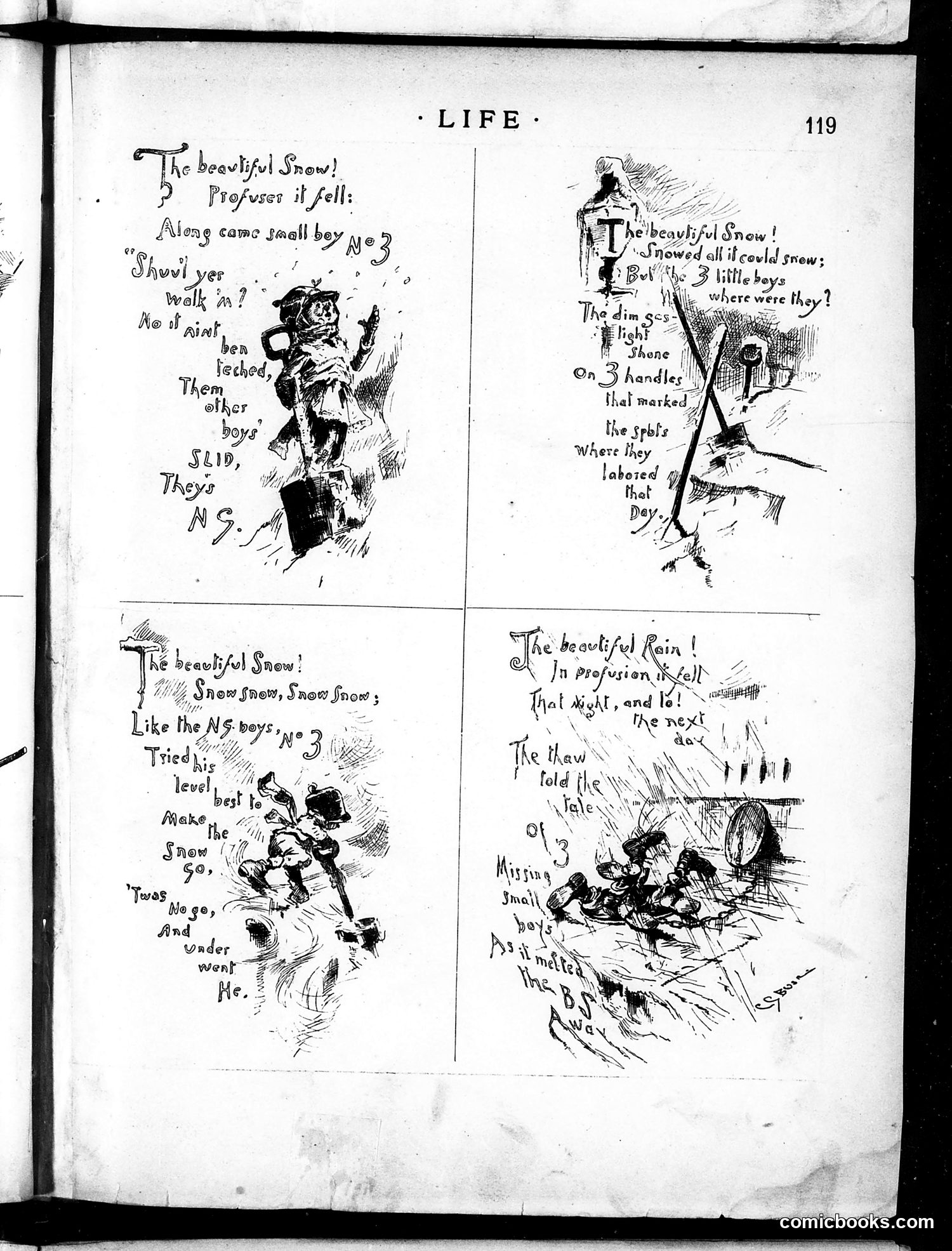
This page contains four illustrated narrative poems about winter weather and children's activities. The verses describe: 1. **"The Beautiful Snow"** - Children sledding and playing in snow, with references to "No. 3" boys sliding 2. **"The Beautiful Snow"** (second version) - Similar winter play scene with "3 little boys" and sleds marked with "splits" 3. **"The Beautiful Snow"** (third version) - More sledding, referencing "No. 3" boys and snow-making attempts 4. **"The Beautiful Rain"** - A contrasting poem about rain and flooding The repeated references to "No. 3" appear throughout, though their specific meaning is unclear without additional historical context. These appear to be humorous, nostalgic illustrations of childhood winter activities rather than political satire. The artistic style and handwritten text suggest early-to-mid 19th-century publication.
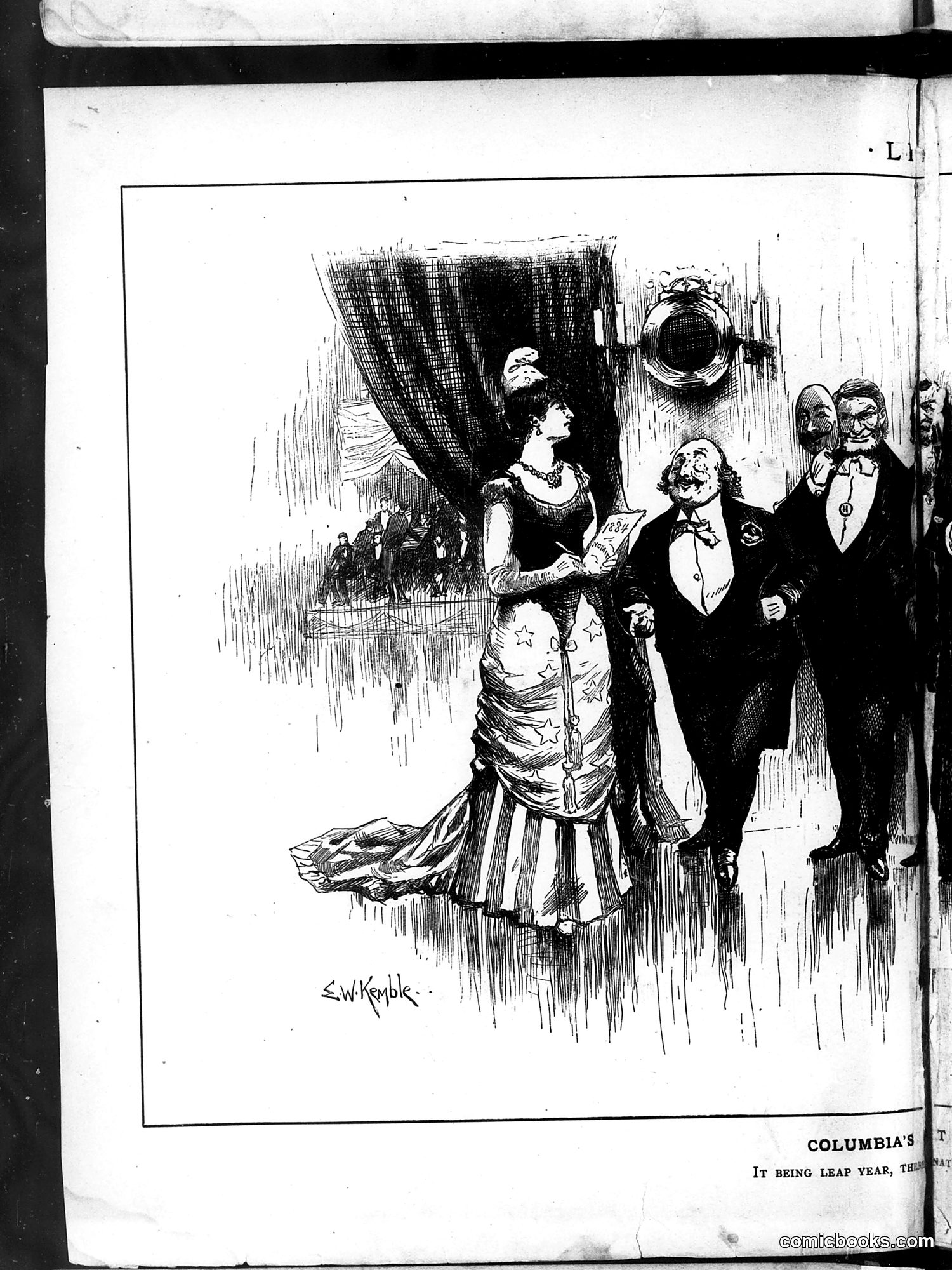
This appears to be a satirical illustration by E.W. Kemble (signed lower left) showing a formal theatrical or social scene. A woman in an elegant gown holds what appears to be a program or document, flanked by formally-dressed gentlemen in tuxedos. The architectural setting suggests a theater or opera house, with curtains and a circular light fixture visible above. The partial text at bottom references "Columbia's" and mentions "leap year," suggesting this cartoon satirizes social conventions around women's behavior or agency during leap year—a historical tradition when women were supposedly permitted to propose to men, inverting normal gender roles. The woman's prominent, commanding posture in the center appears to be the joke's focal point, likely mocking or celebrating women's temporary social power during this occasion.
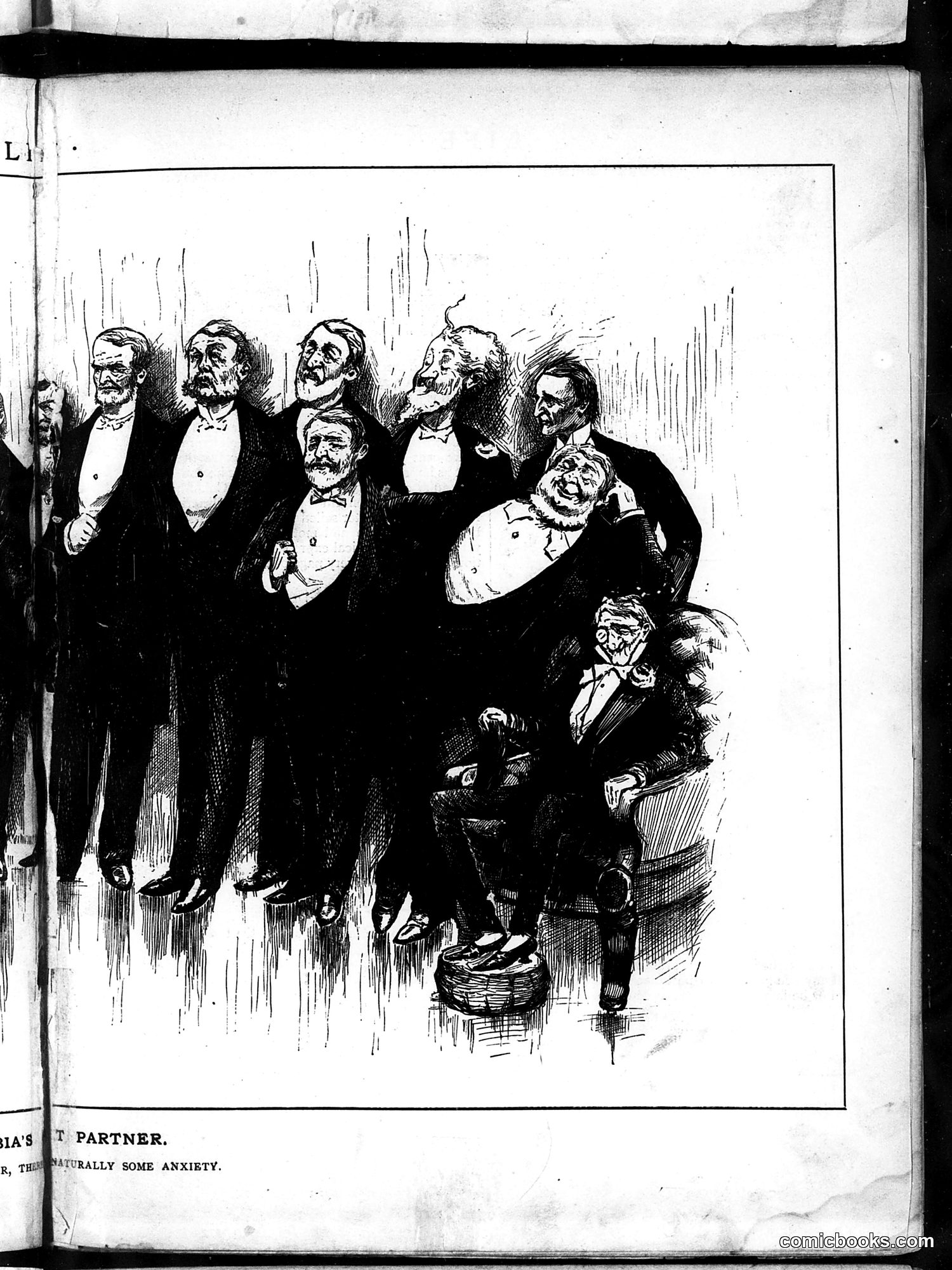
This sketch depicts a group of well-dressed men in formal attire gathered together, with what appears to be a smaller or younger figure seated among them. The visible text fragment reads "T PARTNER" and references "NATURALLY SOME ANXIETY." Without complete caption text or clear identifying labels, the specific political figures and incident remain unclear from this image alone. However, the composition suggests satire of a business or political alliance—the formal dress and grouping implies men of power or influence, while the anxious tone suggests tension or concern about their partnership or dealings. The drawing style is characteristic of late 19th/early 20th-century American satirical illustration. To accurately identify the specific figures and satirical point would require the complete caption and historical context.
This page contains two distinct satirical pieces: **"Our Set" on Women's Rights** (left column): A letter mockingly written from the perspective of fashionable society women dismissing the women's suffrage movement. The satire targets these women for opposing their own political empowerment—they claim they prefer leaving "voting and business to—man" and worry that voting would interfere with "mending and sewing." The piece ridicules both the anti-suffrage women for their self-undermining conservatism and implicitly critiques the broader resistance to women's rights as irrational vanity. **Book Reviews** (right column): Brief literary critiques of three recent novels, including works by Miss Fletcher (writing as George Fleming) and Julian Hawthorne. The reviews are harshly dismissive, particularly of Hawthorne's attempt to blend romance with modern social realism, which the critic calls a "literary hybrid" "as amusing as a mule." The page reflects Life's characteristic blend of political satire (mocking anti-feminist attitudes) with cultural commentary on contemporary literature.
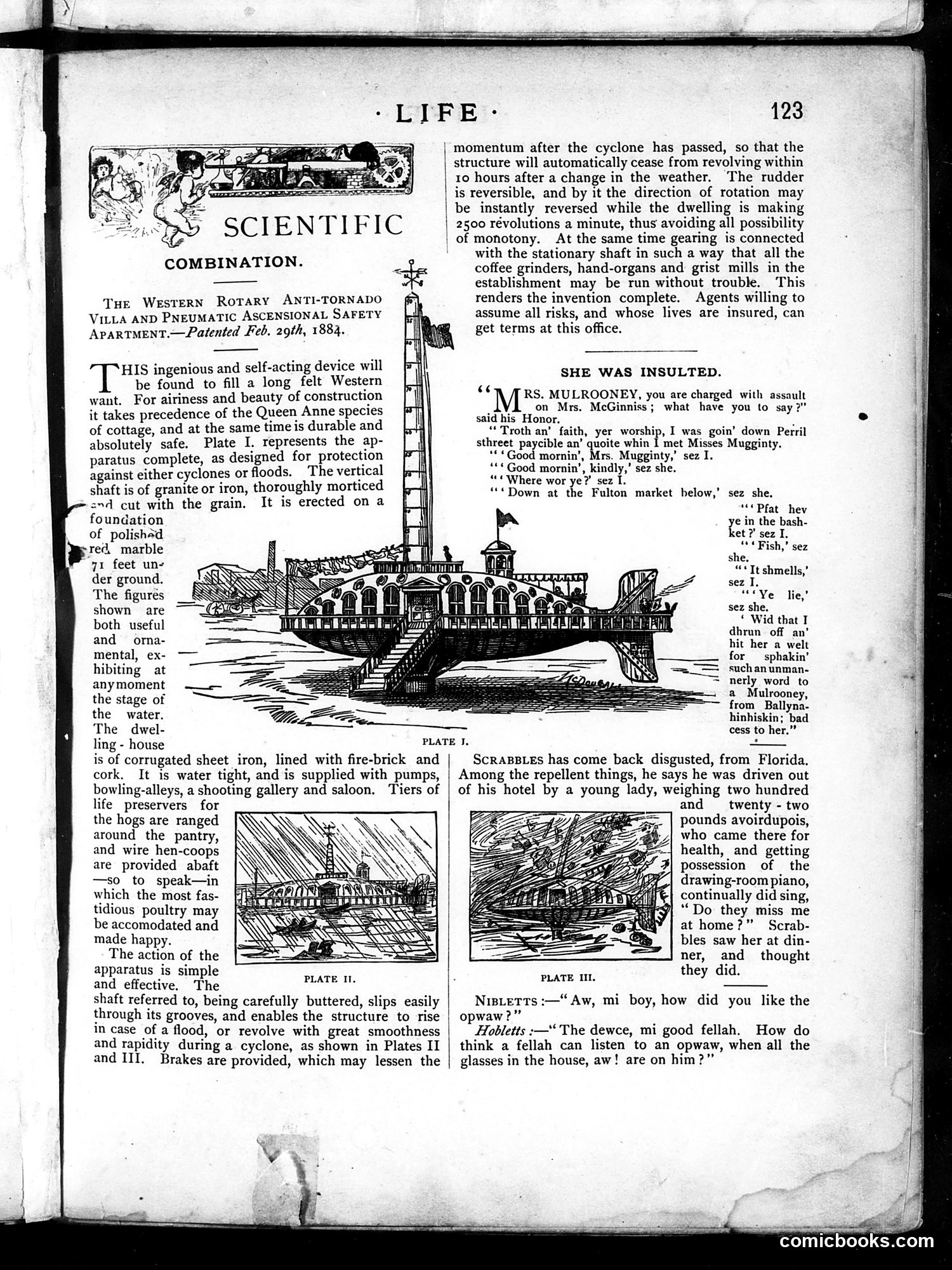
This page contains two distinct satirical pieces: **"Scientific Combination"** mocks the absurd patent-protection craze of the 1880s. It describes a ridiculous anti-tornado villa—a massive device with a 71-foot underground marble foundation that spins at 2,500 revolutions per minute during cyclones. The satire lies in treating this obvious contraption as serious engineering: it promises to power coffee grinders and hand-organs simultaneously while protecting livestock via "wire hen-coops." The joke targets Western Americans' desperation for tornado solutions and the era's proliferation of dubious, overcomplicated patents. **"She Was Insulted"** features working-class Irish immigrant characters (Mrs. Mulrooney, Mrs. McGinnis) in a courtroom, rendered in heavy dialect. The humor derives from her assault charge—she violently attacked a woman simply for calling fish "smelly," treating the observation as unforgivable rudeness. **"Nibletts"** satirizes upper-class affectation: a wealthy concertgoer cannot enjoy an opera because servants keep placing drinking glasses on him during performance. All three pieces mock Victorian-era social pretension through exaggeration and class contrast.
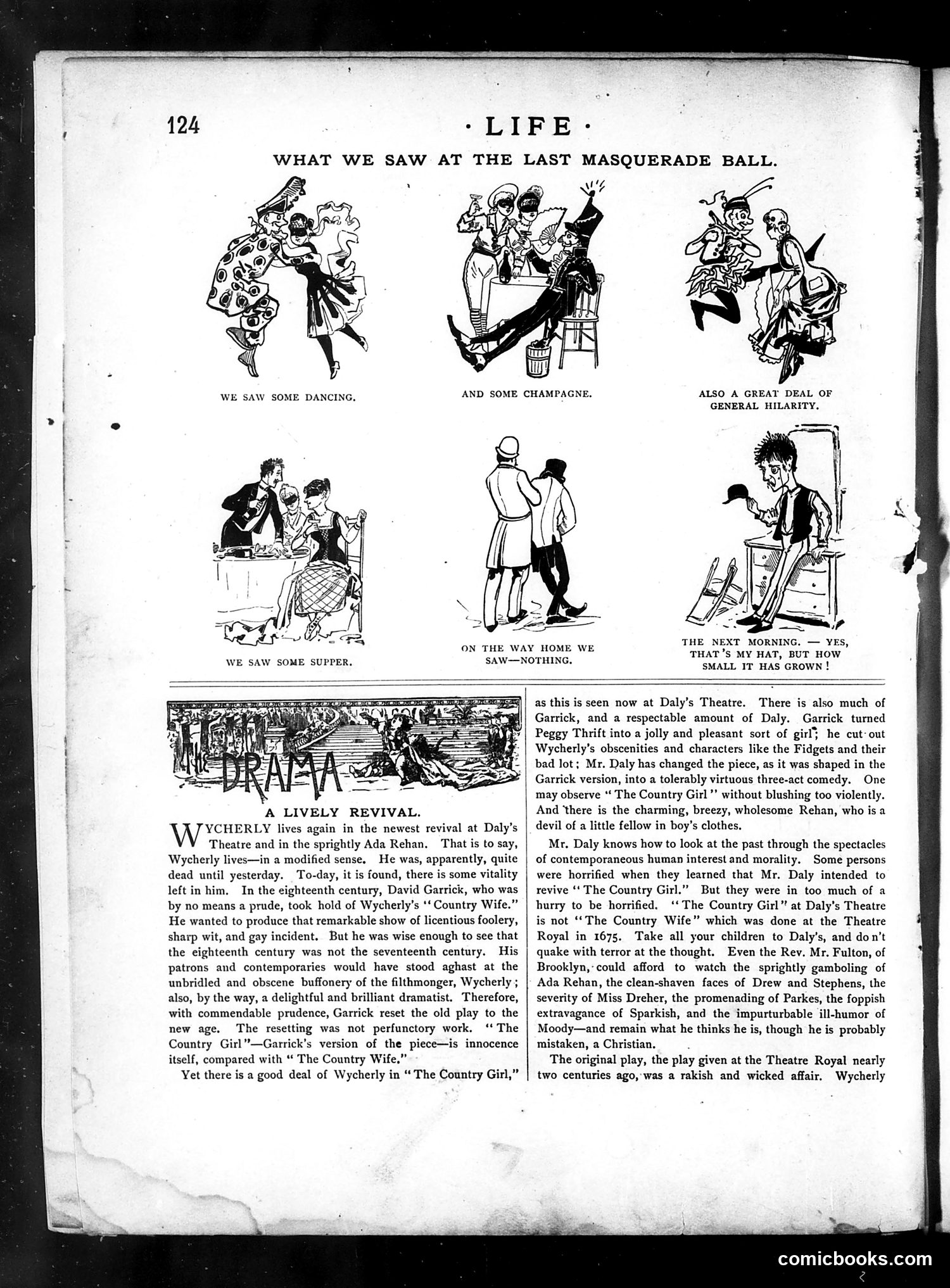
The upper section is a humorous comic strip about a masquerade ball, depicting guests dancing, drinking champagne, eating supper, and leaving with hangovers. The final panel jokes about a hat that "has grown" smaller—likely a reference to how alcohol affects perception or memory of the night. The lower section reviews a theatrical revival of Wycherly's *"The Country Girl"* (actually an adaptation of *"The Country Wife"*) at Daly's Theatre, starring Ada Rehan. The piece explains that David Garrick had already sanitized Wycherly's notoriously bawdy 17th-century play for 18th-century audiences by removing obscenities and questionable characters. Daly's modern production further tones down the material into "a tolerably virtuous three-act comedy," making it appropriate for families and even clergy. The critic implies this successive bowdlerization has drained much of the original's rakish wit and vigor, while praising Rehan's charming performance.
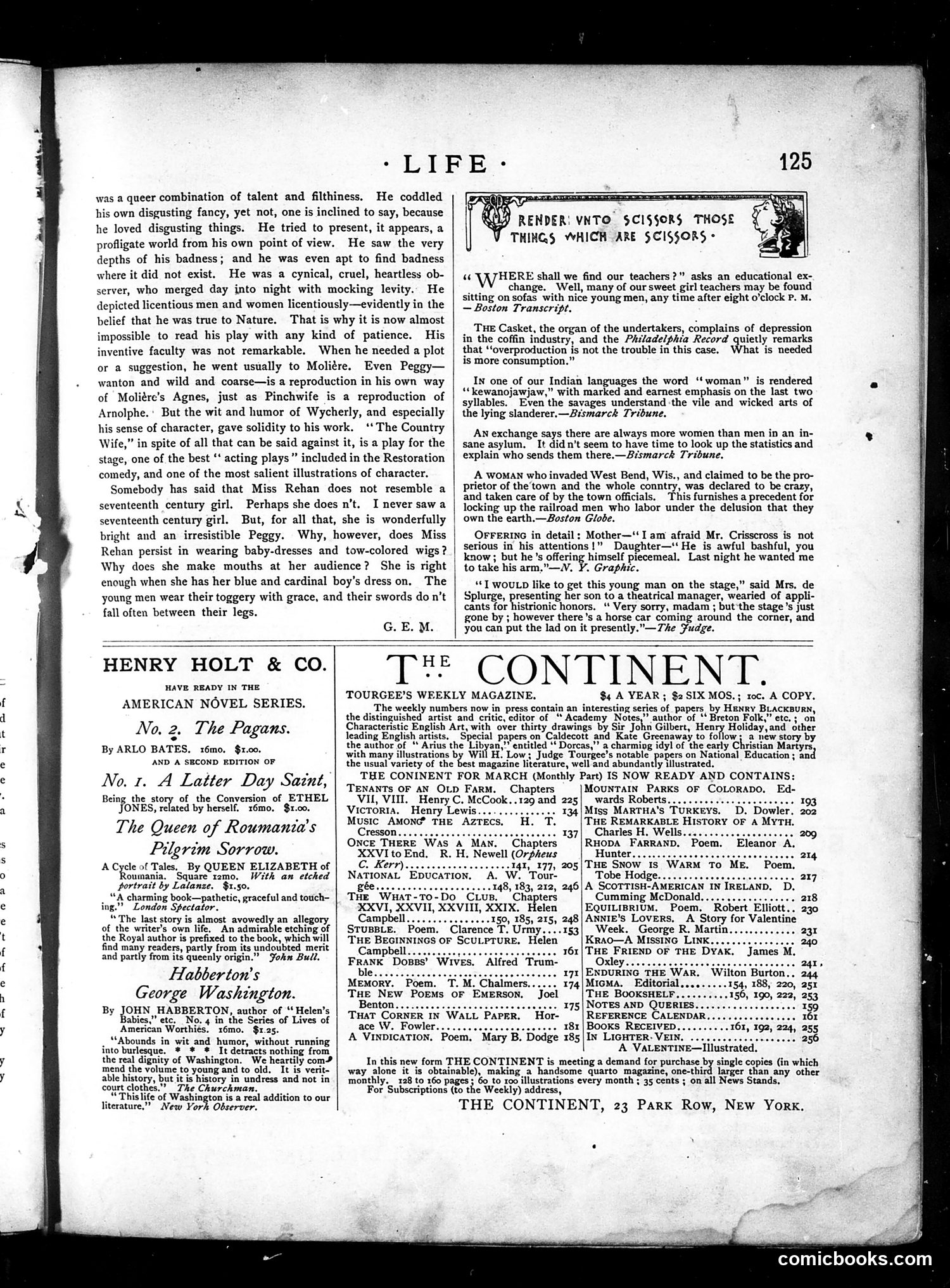
This page is primarily **literary criticism and advertisements** rather than political cartoons. The main content critiques William Wycherly's Restoration comedy "The Country Wife," analyzing the playwright's cynical worldview and praising actress Ada Rehan's performance as Peggy, though questioning her costume choices (baby-dresses and tow-colored wigs). The scattered humorous **satirical snippets** mock social conventions: - A Boston Transcript quip about young female teachers meeting men after 8 PM - Jokes about women's dishonesty, asylum demographics, and a woman claiming to own a Wisconsin town - A cartoon caption about a bashful suitor offering himself "piecemeal"—an extended metaphor on his timid courtship These represent typical **turn-of-century American humor**: gentle mockery of gender relations, women's behavior, and social pretension. The page concludes with book advertisements for Henry Holt & Co.'s American Novel Series, including titles like *George Washington* and *The Queen of Rumania's Pilgrim Sorrow*.
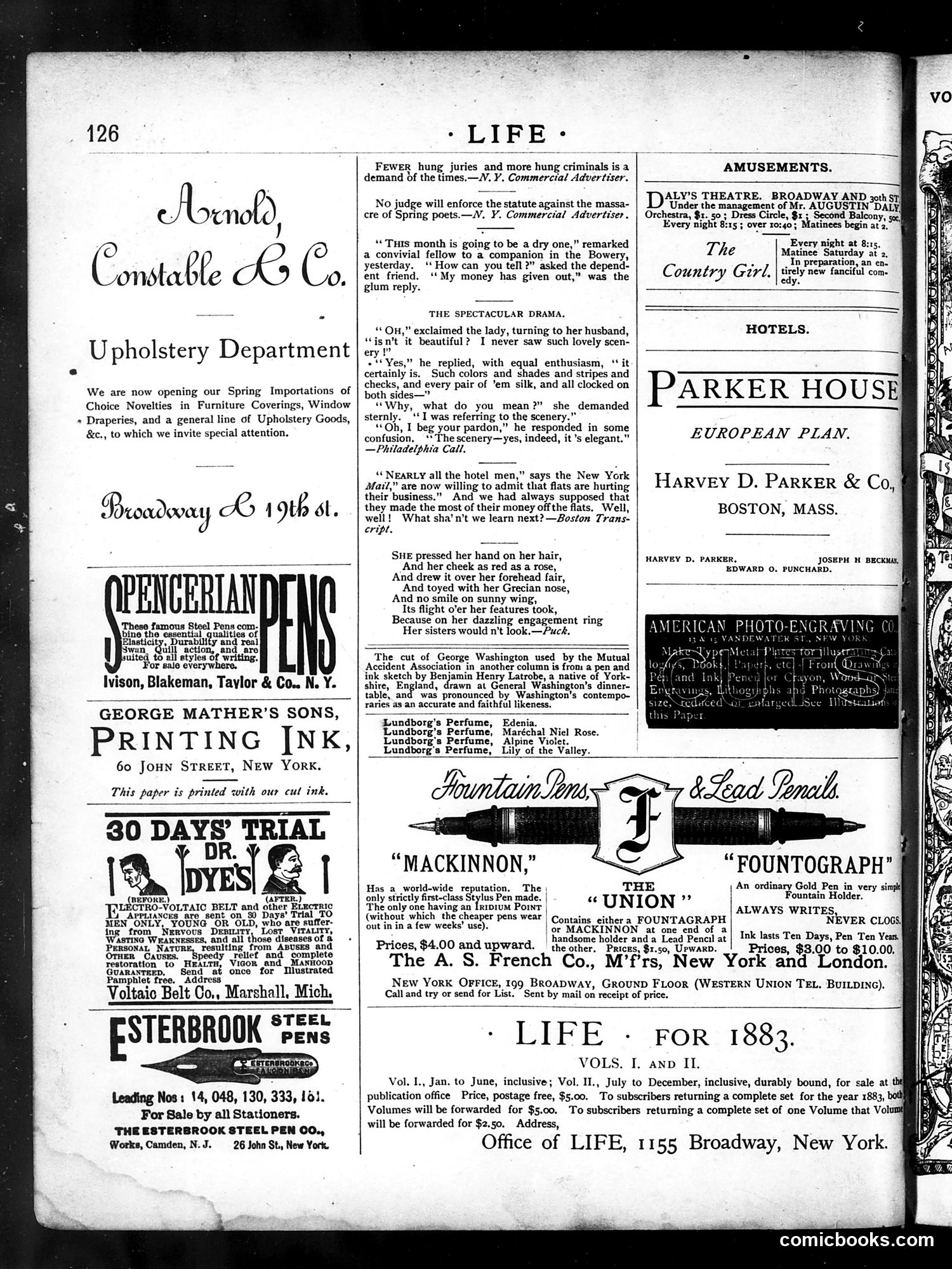
This page is primarily **advertising and notices** with minimal editorial cartooning. The substantive content consists of: **Satirical Quotes:** The page opens with three brief satirical comments from New York newspapers mocking contemporary issues: judicial leniency toward criminals, the death of "spring poets" (likely meaning mediocre romantic poetry), and poverty (a man claiming "this month is going to be dry" because his money ran out). **Humorous Anecdotes:** A theatrical scene depicts a husband mistaking silk fabric patterns on stage scenery for actual landscape scenery—satire on spectacle-driven theater. Another piece mocks a woman upset that her engagement ring isn't generating envy from her sisters. **The Bulk:** The remainder is **straightforward advertising**—for printing ink, upholstery, hotels, fountain pens, and patent medicines (notably a "voltaic belt" for treating male sexual dysfunction). **No significant political cartoons appear on this visible portion of the page.** This is a commercial/notices section rather than editorial content.