
Life, 1884-02-28 · page 5 of 14
Life — February 28, 1884 — page 5: what you’re looking at
What you’re looking at
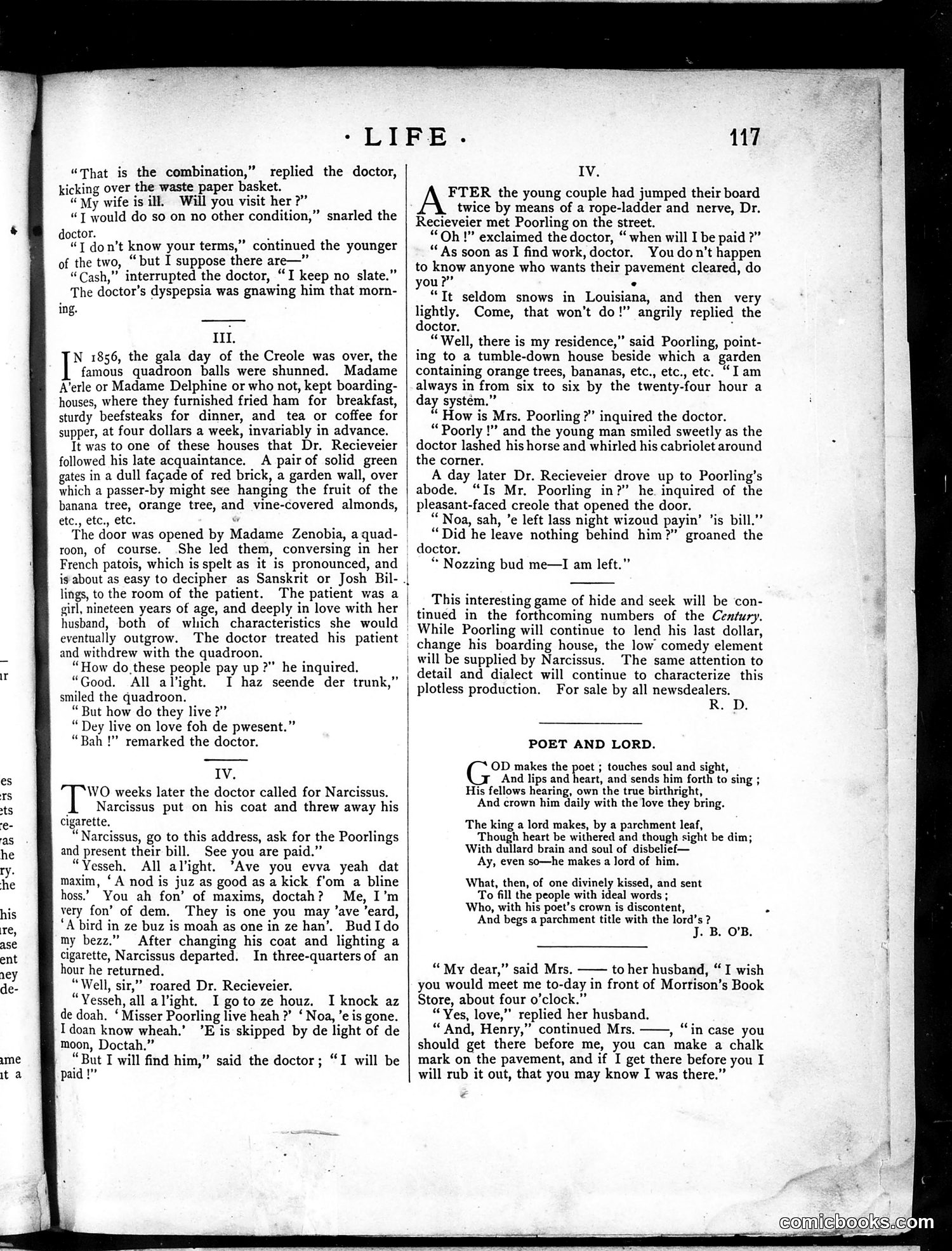
This page contains a serialized fiction story rather than political satire or cartoons. The narrative follows Dr. Recieveier's interactions with poor New Orleans residents, particularly a character named Poorling, in what appears to be the 1850s based on the text's reference to "1856, the gala day of the Creole was over." The story satirizes medical practice and social conditions through comedic dialogue—the doctor makes house calls to impoverished patients who cannot pay, and there's wordplay around Creole dialect and characters' financial desperation. The piece titled "Poet and Lord" appears to be unrelated poetry. Without illustrations visible in this reproduction, the satire relies entirely on dialogue and narrative rather than visual caricature.
📄 Transcribed text from this page (OCR, searchable)
Machine-transcribed from the original scan — historical spelling and the odd misread are preserved.
- LIFE. “That is the combination,” replied the doctor, kicking over the waste paper basket. “My wife is ill. Will you visit her ?” “J would do so on no other condition,” snarled the tor. see don’t know your terms,” continued the younger of the two, “but I suppose there are—” “Cash,” interrupted the doctor, “I keep no slate.” The doctor’s dyspepsia was gnawing him that morn- ing. Ill. N 1856, the gala day of the Creole was over, the famous quadroon balls were shunned. Madame A’erle or Madame Delphine or who not, kept boarding- houses, where they furnished fried ham for breakfast, sturdy beefsteaks for dinner, and tea or coffee for supper, at four dollars a week, invariably in advance. It was to one of these houses that Dr. Recieveier followed his late acquaintance. A pair of solid green gates in a dull facade of red brick, a garden wall, over which a passer-by might see hanging the fruit of the banana tree, orange tree, and vine-covered almonds, etc., etc., etc. @ The door was opened by Madame Zenobia, a quad- roon, of course. She led them, conversing in her French patois, which is spelt as it is pronounced, and is about as easy to decipher as Sanskrit or Josh Bil- .| lings, to the room of the patient. The patient was a girl, nineteen years of age, and deeply in love with her husband, both of which characteristics she would eventually outgrow. The doctor treated his patient and withdrew with the quadroon. “How do,.these people pay up ?” he inquired. “Good. All alight. I haz seende der trunk,” smiled the quadroon. “But how do they live ?” “Dey live on love foh de pwesent.” “Bah !”" remarked the doctor. Iv. WO weeks later the doctor called for Narcissus. Narcissus put on his coat and threw away his cigarette. “Narcissus, go to this address, ask for the Poorlings and present their bill. See you are paid.” “Yesseh. All alight. *Ave you evva yeah dat maxim, ‘A nod is juz as good as a kick f'om a bline hoss.’ You ah fon’ of maxims, doctah? Me, I’m very fon’ of dem. They is one you may ’ave ’eard, ‘A bird in ze buz is moah as one in ze han’. BudIdo my bezz.” After changing his coat and lighting a cigarette, Narcissus departed. In three-quarters of an hour he returned. “Well, sir,” roared Dr. Recieveier. “Yesseh, all al'ight. I goto ze houz. I knock az de doah. ‘ Misser Poorling live heah ?’ ‘ Noa, ’e is gone. Idoan know wheah.’ ’E is skipped by de light of de moon, Doctah.” put I will find him,” said the doctor; “I will be paid !”” | will be supplied by Narcissus. Iv. FTER the young couple had jumped their board twice by means of a rope-ladder and nerve, Dr. Recieveier met Poorling on the street. “Oh !” exclaimed the doctor, “when will I be paid ?” “As soon as I find work, doctor. You don’t happen to know anyone who wants their pavement cleared, do you?” . “Tt seldom snows in Louisiana, and then very lightly. Come, that won't do!” angrily replied the doctor. a “Well, there is my residence,” said Poorling, point- ing to a tumble-down house beside which a garden containing orange trees, bananas, etc., etc., etc. “Iam always in from six to six by the twenty-four hour a day systém.” “ How is Mrs. Poorling ?” inquired the doctor. “Poorly !”” and the young man smiled sweetly as the doctor lashed his horse and whirled his cabriolet around the corner. A day later Dr. Recieveier drove up to Poorling’s abode. “Is Mr. Poorling in?” he. inquired of the pleasant-faced creole that opened the door. “Noa, sah, ’e left lass night wizoud payin’ ’is bill.” “Did he leave nothing behind him?” groaned the doctor. “ Nozzing bud me—I am left.” This interesting game of hide and seek will be con- | tinued in the forthcoming numbers of the Century. While Poorling will continue to lend his last dollar, change his boarding house, the low comedy element The same attention to detail and dialect will continue to characterize this plotless production. For sale by all newsdealers. R. D. POET AND LORD. OD makes the poet ; touches soul and sight, And lips and heart, and sends him forth to sing ; His fellows hearing, own the true birthright, And crown him daily with the love they bring. The king a lord makes, by a parchment leaf, Though heart be withered and though sight be dim; With dullard brain and soul of disbelief— Ay, even so—he makes a lord of him. What, then, of one divinely kissed, and sent To fill the people with ideal words ; Who, with his poet’s crown is discontent, And begs a parchment title with the lord’s ? J. B. OB. “My dear,” said Mrs. —— to her husband, “I wish you would meet me to-day in front of Morrison’s Book Store, about four o’clock.” “Yes, love,” replied her husband. “And, Henry,” continued Mrs. —,, “in case you should get there before me, you can make a chalk mark on the pavement, and if I get there before you I will rub it out, that you may know I was there.”