
Life, 1884-02-28 · page 2 of 14
Life — February 28, 1884 — page 2: what you’re looking at
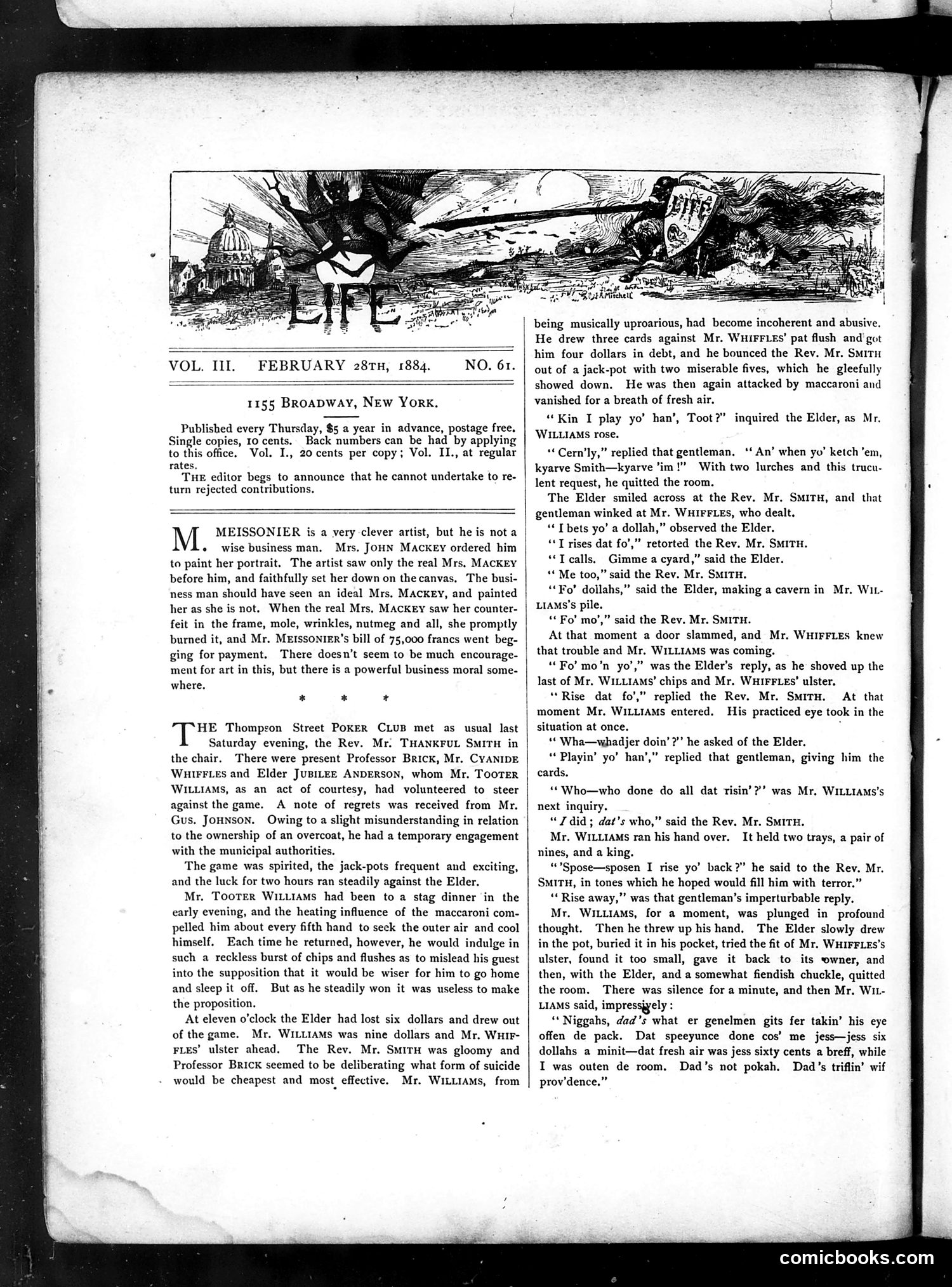
What you’re looking at
The page contains a short story titled "The Thompson Street Poker Club" rather than political cartoons. The narrative satirizes a poker game among gentlemen including a Reverend Mr. Smith, where players engage in increasingly absurd behavior and dialogue. The satire targets the hypocrisy of respectable society figures—particularly a clergyman—participating in gambling and card games while maintaining moral pretenses. The characters speak in exaggerated dialect and make nonsensical utterances ("Nigguhs, dad's what genelemen gits fer takin' his eye often de pack"), which appears designed for comedic effect through absurdist humor typical of 1880s satirical magazines. The text mocks both gambling culture and the contradiction between religious authority and actual conduct.
📄 Transcribed text from this page (OCR, searchable)
Machine-transcribed from the original scan — historical spelling and the odd misread are preserved.
= ie | being musically uproarious, had become incoherent and abusive, VOL. III. FEBRUARY 281TH, 1884. 1155 BRoaADWAY, NEw York. Published every Thursday, $5 a year in advance, postage free, Single copies, 10 cents. Back numbers can be had by applying to this office. Vol. I., 20 cents per copy; Vol. II., at regular rates. THE editor begs to announce that he cannot undertake to re- turn rejected contributions. MEISSONIER is a very clever artist, but he is not a « wise business man. Mrs. JOHN MACKEY ordered him to paint her portrait. The artist saw only the real Mrs, MACKEY before him, and faithfully set her down on the canvas, The busi- ness man should have seen an ideal Mrs. MACKEY, and painted her as she is not, When the real Mrs. MACKEY saw her counter- | feit in the frame, mole, wrinkles, nutmeg and all, she promptly burned it, and Mr. Merssonter’s bill of 75,000 francs went beg- ging for payment. There doesn’t seem to be much encourage- ment for art in this, but there is a powerful business moral some- where, * * * HE Thompson Street PokKER CLUB met as usual last Saturday evening, the Rev. Mr. THANKFUL SMITH in the chair. There were present Professor Brick, Mr. CYANIDE Wuirrtes and Elder JUBILEE ANDERSON, whom Mr. Tooter | WILLIAMS, as an act of courtesy, had volunteered to steer against the game. A note of regrets was received from Mr. Gus. JoHNson. Owing to a slight misunderstanding in relation to the ownership of an overcoat, he had a temporary engagement with the municipal authorities. The game was spirited, the jack-pots frequent and exciting, and the luck for two hours ran steadily against the Elder. Mr. TooTer WILLIAMS had been to a stag dinner in the early evening, and the heating influence of the maccaroni com- pelled him about every fifth hand to seck the outer air and cool himself. Each time he returned, however, he would indulge in such a reckless burst of chips and flushes as to mislead his guest into the supposition that it would be wiser for him to go home and sleep it off. But as he steadily won it was useless to make the proposition. At eleven o'clock the Elder had lost six dollars and drew out of the game. Mr. WILLIAMS was nine dollars and Mr. WHIF- FLEs’ ulster ahead. The Rev. Mr. SmirH was gloomy and Professor BRICK seemed to be deliberating what form of suicide would be cheapest and most, effective. Mr. WILLIAMS, from He drew three cards against Mr. WHIFFLES’ pat flush and’ got him four dollars in debt, and he bounced the Rev. Mr. Smiru out of a jack-pot with two miserable fives, which he gleefully showed down. He was then again attacked by maccaroni and vanished for a breath of fresh air. “Kin I play yo’ han’, Toot?” inquired the Elder, as Mr. WILLIAMS rose. ‘*Cern’ly,” replied that gentleman. ‘‘ An’ when yo’ ketch ’em, kyarve Smith—kyarve ’im !” With two lurches and this trucu- lent request, he quitted the room. The Elder smiled across at the Rev. Mr. SMITH, and that gentleman winked at Mr. WHIFFLES, who dealt. “‘T bets yo’ a dollah,” observed the Elder. “T rises dat fo’,” retorted the Rev. Mr. SMITH. “Tcalls. Gimme a cyard,” said the Elder. ** Me too,” said the Rev. Mr. SMITH. «Fo! dollahs,” said the Elder, making a cavern in Mr. Wit- LIAMS's pile. “* Fo’ mo’,” said the Rev. Mr. SMITH. At that moment a door slammed, and Mr, WHIFFLES knew that trouble and Mr. WILLIAMS was coming. ‘Fo’ mo’n yo’,” was the Elder's reply, as he shoved up the last of Mr. WILLIAMS’ chips and Mr. WHIFFLEs’ ulster. “Rise dat fo’,” replied the Rev. Mr. SMITH. At that moment Mr. WILLIAMs entered. His practiced eye took in the situation at once. . ‘‘ Wha—whadjer doin’ ?”’ he asked of the Elder. “ Playin’ yo’ han’, replied that gentleman, giving him the cards, ‘“Who—who done do all dat risin’?’ was Mr. WILLIAMs's next inquiry. “I did; dat’s who,” said the Rev. Mr. SMITH. Mr. WILL1AMs ran his hand over. It held two trays, a pair of nines, and a king. “'Spose—sposen I rise yo’ back ?” he said to the Rev. Mr. SMITH, in tones which he hoped would fill him with terror.” “ Rise away,” was that gentleman’s imperturbable reply. Mr. WILiiAMs, for a moment, was plunged in profound thought. Then he threw up his hand. The Elder slowly drew in the pot, buried it in his pocket, tried the fit of Mr. WHIFFLES’s ulster, found it too small, gave it back to its wwner, and then, with the Elder, and a somewhat fiendish chuckle, quitted the room, There was silence for a minute, and then Mr. WIL- Lams said, impressjyely : “Niggahs, dad’s what er genelmen gits fer takin’ his eye offen de pack. Dat speeyunce done cos’ me jess—jess six dollahs a minit—dat fresh air was jess sixty cents a breff, while I was outen de room. Dad’s not pokah. Dad’s triflin’ wif prov'dence,”” comicbooks.com