
Life, 1884-02-28 · page 10 of 14
Life — February 28, 1884 — page 10: what you’re looking at
What you’re looking at
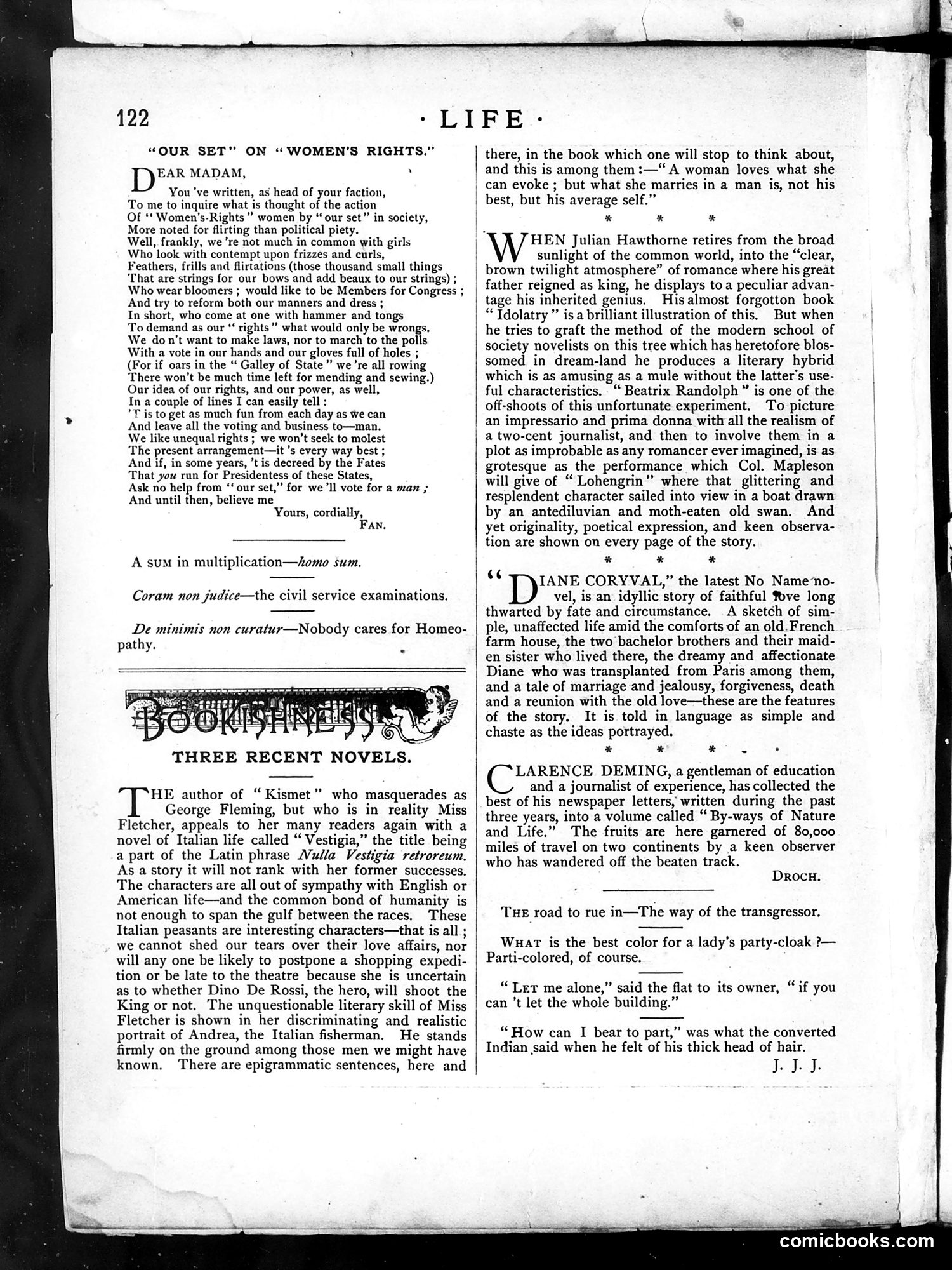
This page contains two distinct satirical pieces: **"Our Set" on Women's Rights** (left column): A letter mockingly written from the perspective of fashionable society women dismissing the women's suffrage movement. The satire targets these women for opposing their own political empowerment—they claim they prefer leaving "voting and business to—man" and worry that voting would interfere with "mending and sewing." The piece ridicules both the anti-suffrage women for their self-undermining conservatism and implicitly critiques the broader resistance to women's rights as irrational vanity. **Book Reviews** (right column): Brief literary critiques of three recent novels, including works by Miss Fletcher (writing as George Fleming) and Julian Hawthorne. The reviews are harshly dismissive, particularly of Hawthorne's attempt to blend romance with modern social realism, which the critic calls a "literary hybrid" "as amusing as a mule." The page reflects Life's characteristic blend of political satire (mocking anti-feminist attitudes) with cultural commentary on contemporary literature.
📄 Transcribed text from this page (OCR, searchable)
Machine-transcribed from the original scan — historical spelling and the odd misread are preserved.
122 “OUR SET” ON “WOMEN’S RIGHTS.” EAR MADAM, = You ve written, as head of your faction, To me to inquire what is thought of the action Of ‘* Women’s-Rights ” women by “our set” in society, More noted for flirting than political piety. Well, frankly, we ’re not much in common with girls Who look with contempt upon frizzes and curls, Feathers, frills and flirtations (those thousand small things ‘That are strings for our bows and add beaux to our strings) ; Who wear bloomers ; would like to be Members for Congress ; And try to reform both our manners and dress ; In short, who come at one with hammer and tongs To demand as our “‘ rights” what would only be wrongs. We don’t want to make laws, nor to march to the polls With a vote in our hands and our gloves full of holes ; (For if oars in the “ Galley of State” we’re all rowing There won't be much time left for mending and sewing.) Our idea of our rights, and our power, as well, In a couple of lines I can easily tell : ’T is to get as much fun from each day as we can And leave all the voting and business to—man. We like unequal rights ; we won't seek to molest The present arrangement—it ’s every way best ; And if, in some years, ’t is decreed by the Fates That you run for Presidentess of these States, Ask no help from “‘ our set,” for well vote for a man ; And until then, believe me Yours, cordially, FAn. A sum in multiplication—homo sum. Coram non judice—the civil service examinations. De minimis non curatur—Nobody cares for Homeo- HE author of “Kismet” who masquerades as George Fleming, but who is in reality Miss Fletcher, appeals to her many readers again with a novel of Italian life called “‘ Vestigia,” the title being a part of the Latin phrase Mulla Vestigia retroreum. As a story it will not rank with her former successes. The characters are all out of sympathy with English or American life—and the common bond of humanity is not enough to span the gulf between the races. These Italian peasants are interesting characters—that is all ; we cannot shed our tears over their love affairs, nor will any one be likely to postpone a shopping expedi- tion or be late to the theatre because she is uncertain as to whether Dino De Rossi, the hero, will shoot the King or not. The unquestionable literary skill of Miss Fletcher is shown in her discriminating and realistic portrait of Andrea, the Italian fisherman. He stands firmly on the ground among those men we might have known. There are epigrammatic sentences, here and -LIFE-: there, in the book which one will stop to think about, and this is among them :—“ A woman loves what she can evoke ; but what she marries in a man is, not his best, but his average self.” * * * HEN Julian Hawthorne retires from the broad sunlight of the common world, into the “clear, | brown twilight atmosphere” of romance where his great father reigned as king, he displays toa peculiar advan- tage his inherited genius. Hisalmost forgotton book “Idolatry ” isa brilliant illustration of this. But when he tries to graft the method of the modern school of society novelists on this tree which has heretofore blos- somed in dream-land he produces a literary hybrid which is as amusing as a mule without the latter's use- ful characteristics.“ Beatrix Randolph ” is one of the off-shoots of this unfortunate experiment. To picture | an impressario and prima donna with all the realism of a two-cent journalist, and then to involve them in a plot as improbable as any romancer ever imagined, is as grotesque as the performance which Col. Mapleson will give of “Lohengrin” where that glittering and resplendent character sailed into view in a boat drawn by an antediluvian and moth-eaten old swan. And yet originality, poetical expression, and keen observa- tion are shown on every page of the story. * * * IANE CORYVAL,” the latest No Name‘no- vel, is an idyllic story of faithful fove long thwarted by fate and circumstance. A sketch of sim- ple, unaffected life amid the comforts of an old.French farm house, the two bachelor brothers and their maid- en sister who lived there, the dreamy and affectionate Diane who was transplanted from Paris among them, and a tale of marriage and jealousy, forgiveness, death and a reunion with the old love—these are the features of the story. It is told in language as simple and chaste as the ideas portrayed. * * * - e: LARENCE DEMING, a gentleman of education and a journalist of experience, has collected the best of his newspaper letters, written during the past three years, into a volume called “ By-ways of Nature and Life.” The fruits are here garnered of 80,000 miles of travel on two continents by a keen observer who has wandered off the beaten track. 66 Drocu. Tue road to rue in—The way of the transgressor. Wuart is the best color for a lady’s party-cloak ?— Parti-colored, of course. “Ler me alone,” said the flat to its owner, “if you can 't let the whole building.” “ How can I bear to part,” was what the converted Indian said when he felt of his thick head of hair. J. J. J. comicbooks.com