
A complete issue · 18 pages · 1884
Life — January 31, 1884
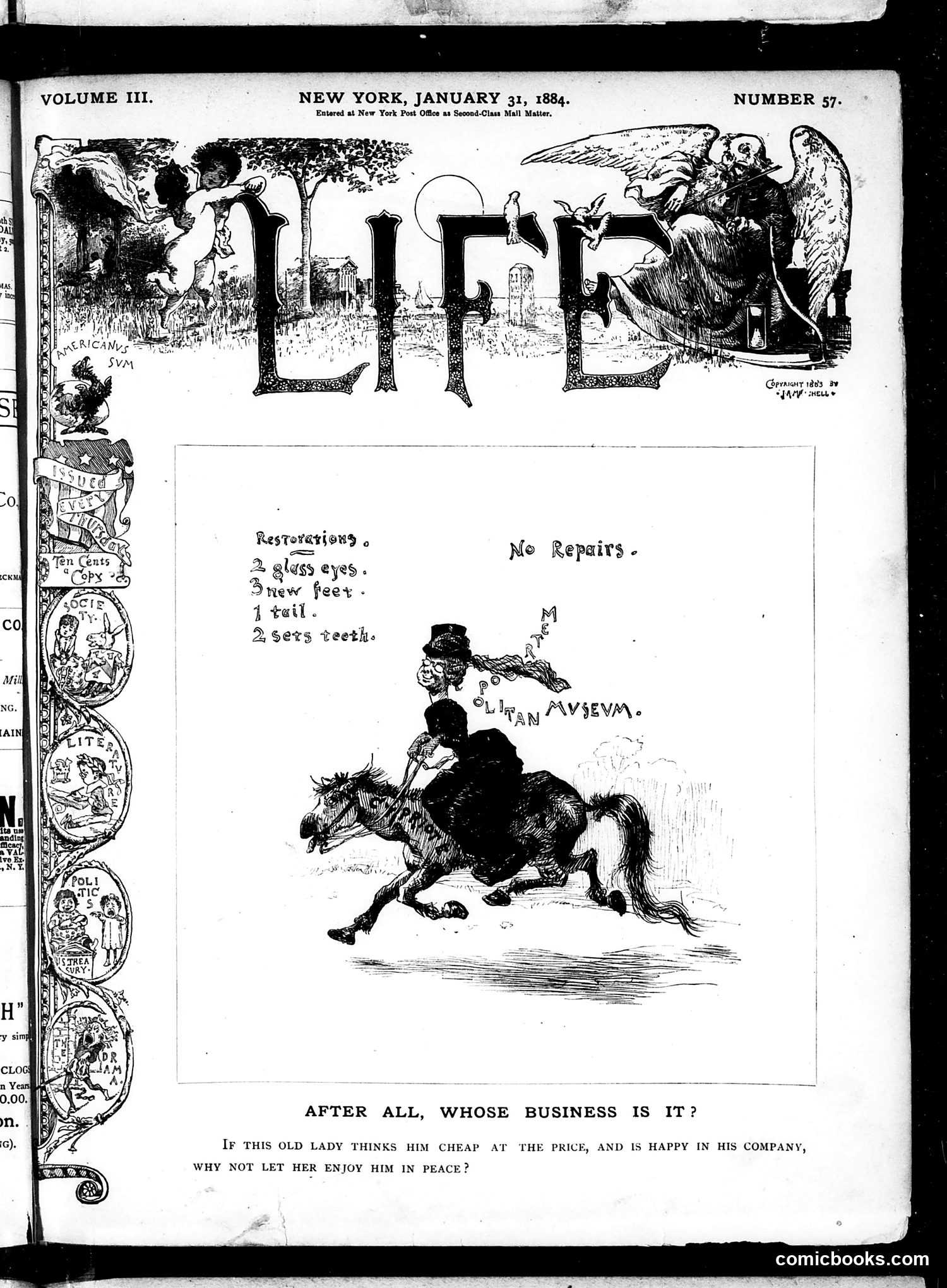
This satirical cartoon depicts an old woman riding a donkey labeled "LITAN AVIBUM" (likely a misspelling or coded reference). The animal requires extensive repairs: "2 glass eyes, 3 new feet, 1 tail, 2 sets teeth"—humorously suggesting the donkey is worn out and decrepit. The caption "AFTER ALL, WHOSE BUSINESS IS IT?" with the subheading questions why the woman shouldn't "enjoy him in peace" if she's "happy in his company" despite getting him cheaply. The satire likely comments on a contemporary figure or political entity represented as the failing donkey. Without additional context about 1884 politics, the specific target remains unclear, but the joke centers on accepting something damaged or disreputable if one finds it useful and affordable.
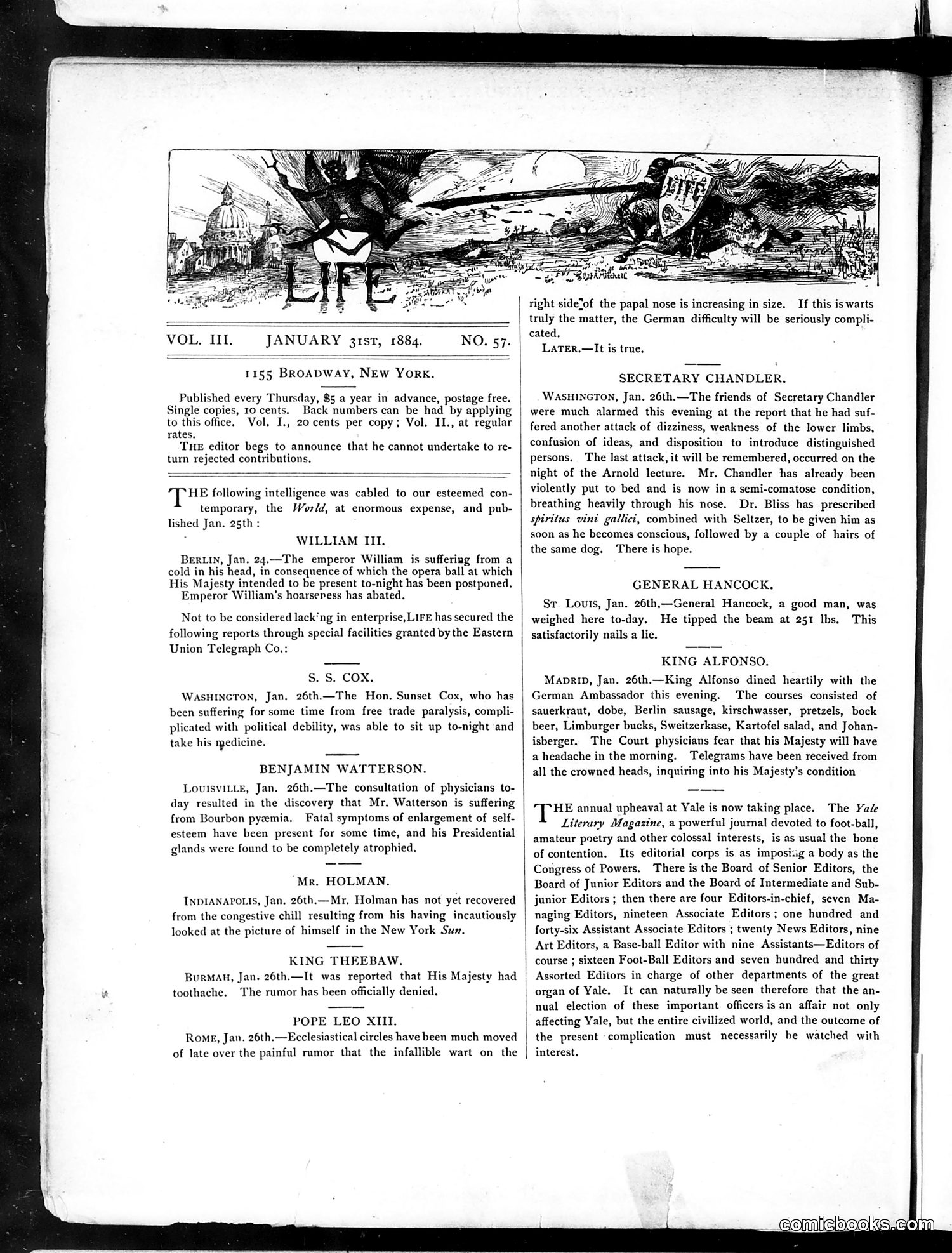
The masthead cartoon depicts a figure labeled "LIFE" straddling a globe, appearing to survey world events. This reflects the magazine's satirical mission to comment on contemporary news. The page contains brief news dispatches with satirical commentary on notable figures: - **William III**: References a cold affecting the opera ball in Berlin - **Secretary Chandler**: Reports on the secretary's recent illness and semi-comatose state - **General Hancock**: Notes his weight (251 lbs), likely mocking his physical condition - **King Alfonso**: Satirizes a German diplomatic dinner's menu - **King Thebaw**: References a rumored toothache The satire targets prominent political and royal figures through humorous exaggeration of minor physical ailments—colds, dizziness, and weight—reflecting Life's approach of ridiculing the powerful through mock-serious reporting.
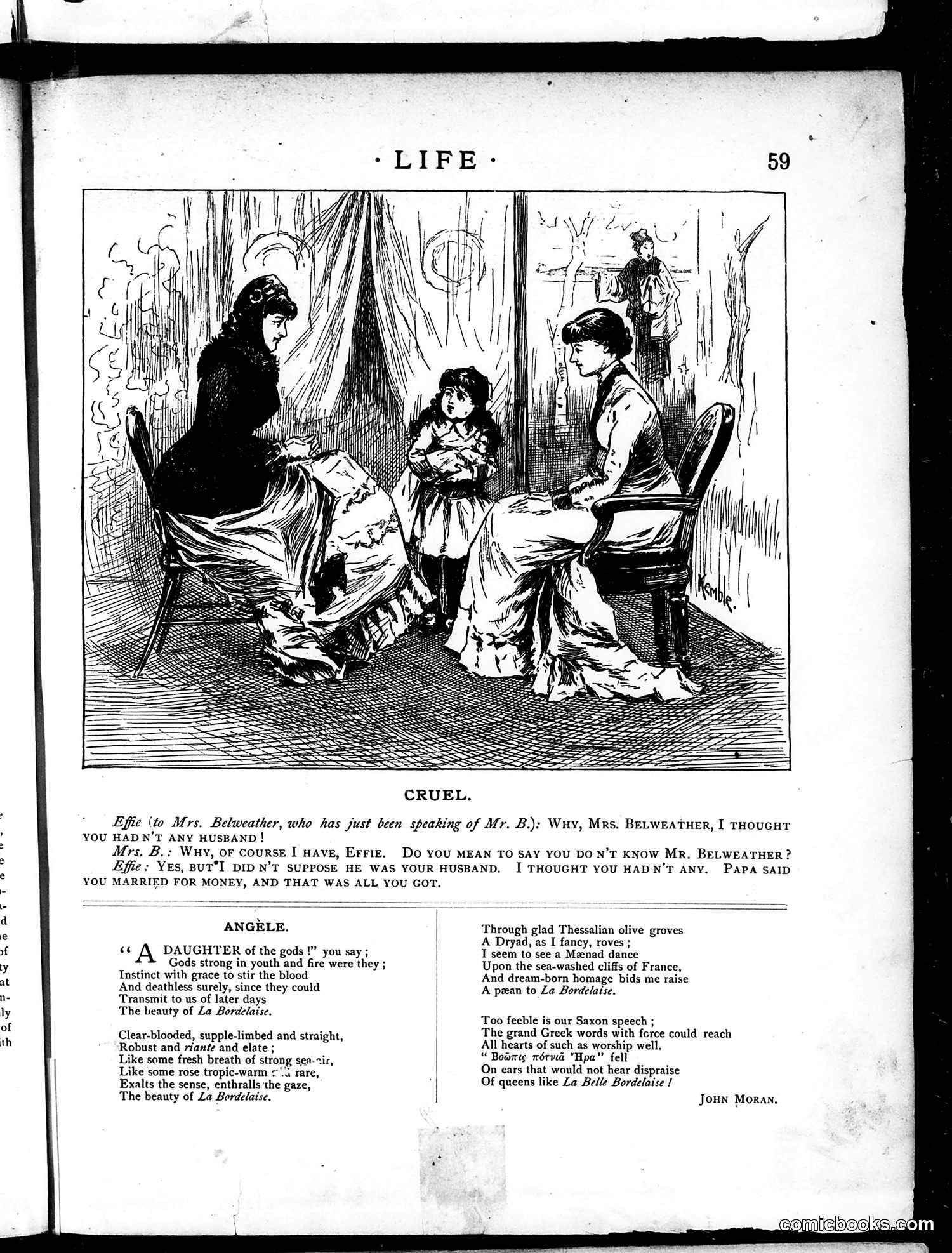
**The Cartoon "Cruel":** This sketch depicts a domestic scene where Mrs. Belweather confronts a woman (Effie) about her husband, Mr. B. The satire targets class assumptions and marriage for money: Effie admits she married "for money, and that was all you got"—implying Mr. B. is wealthy but undesirable. Mrs. Belweather's shock that Effie didn't know her own husband satirizes marriages of convenience among the wealthy, where couples may be strangers despite legal union. The humor lies in the brutal honesty about transactional marriage. **"Angele":** This appears to be a sentimental poem by John Moran celebrating feminine beauty and classical ideals, referencing *La Bordelaise* (likely a wine or cultural reference). It contrasts sharply with the cynical marriage satire above.
This page contains two distinct sections with no political cartoon: **Top section** ("First Aid to the Injured"): A medical lecture on electrical injuries, providing practical safety advice (points 1-9). This is straightforward instructional content, not satire. **Bottom section** ("A Co-operative Nursery"): An article advocating for communal childcare facilities. The text describes a cooperative scheme where working mothers could pool resources for shared nursing care, laundry, and bakery services—reducing individual household expenses while enabling women's employment. The piece presents this as progressive social innovation, claiming it could transform "woman-kind" through practical cooperation. This reflects early 20th-century debates about women's work and domestic labor. Neither section contains satire or caricature—this appears to be straight advocacy journalism mixed with practical advice, typical of *Life* magazine's reformist content.
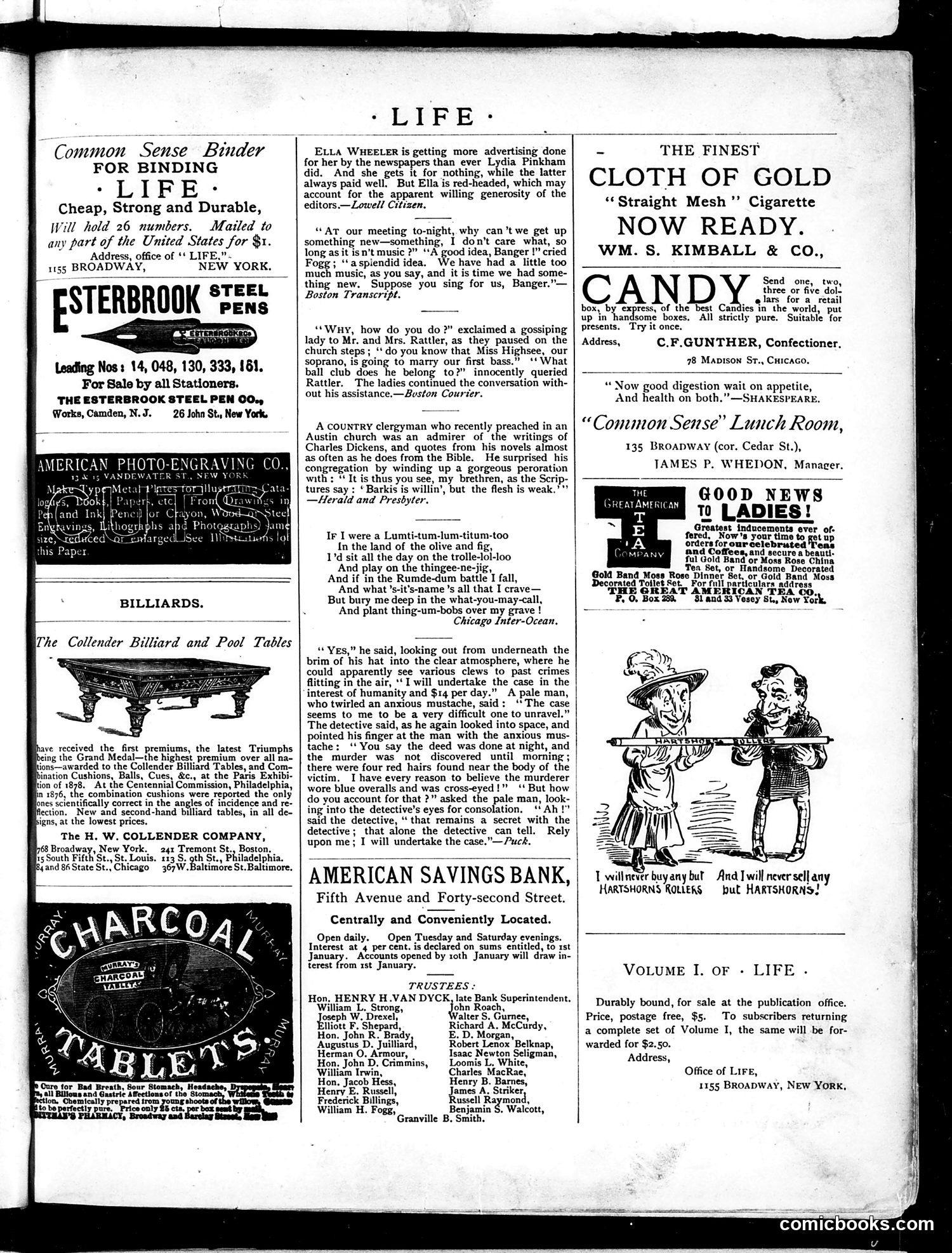
This page is predominantly **advertisements and notices** rather than satirical content. The main cartoon shows two figures in exaggerated poses—one appears to be a fisherman or outdoorsman with a rifle, the other a thin, comical character. Their dialogue reads: "I will never buy an but HARTSHORNS ROLLEKS" and "And I will never sell any but HARTSHORNS!" This is an **advertisement for Hartshorn's Rollers** (window shade fixtures), using humor and absurdist commitment to sell the product. The cartoonish figures and their emphatic declarations create comedic effect through exaggeration rather than political satire. The page also includes ads for pens, billiard tables, candy, a lunch room, and banking services—typical period magazine content.
This page is **primarily advertising** with minimal editorial content. The main visual element is a large circular logo/seal for the "United States Accident Association" featuring a spiky sunburst design—a striking but non-satirical graphic. The advertisements promote: - Wallpaper and decorative art supplies - Oil paintings and art gallery services - Accident insurance policies - Lenox fountain pens - Champagne There is **no political cartoon or satirical content** visible on this page. It appears to be a standard commercial page from *Life* magazine's 34th Annual Report issue (1883), mixing product advertisements with company financial information. The visual design is commercial rather than editorial or humorous.
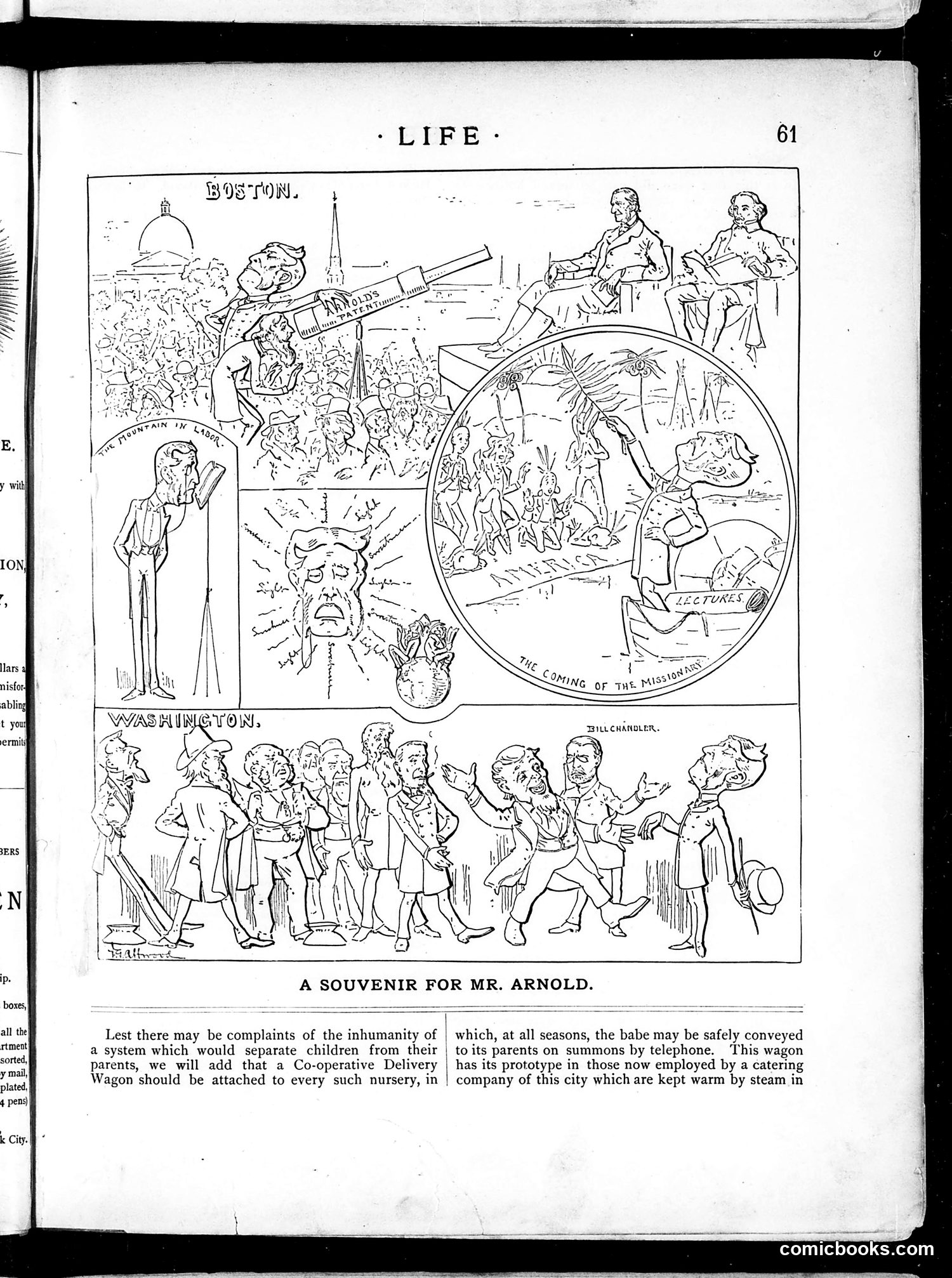
This satirical page from *Life* magazine mocks political and social conditions in Boston and Washington, D.C. through exaggerated caricatures. The **Boston panel** depicts chaos involving large syringes/vaccination equipment and crowds, likely satirizing public health controversies or medical mandates of the era. The **Washington panel** shows figures in formal dress appearing agitated or argumentative, suggesting political discord among government officials. The accompanying text proposes a darkly humorous "Co-operative Delivery Wagon" attached to nurseries—a tongue-in-cheek critique of child welfare systems that separated children from parents, suggesting the system was so problematic it warranted ridicule through absurdist proposals. The overall tone critiques government incompetence and institutional failures affecting ordinary citizens.
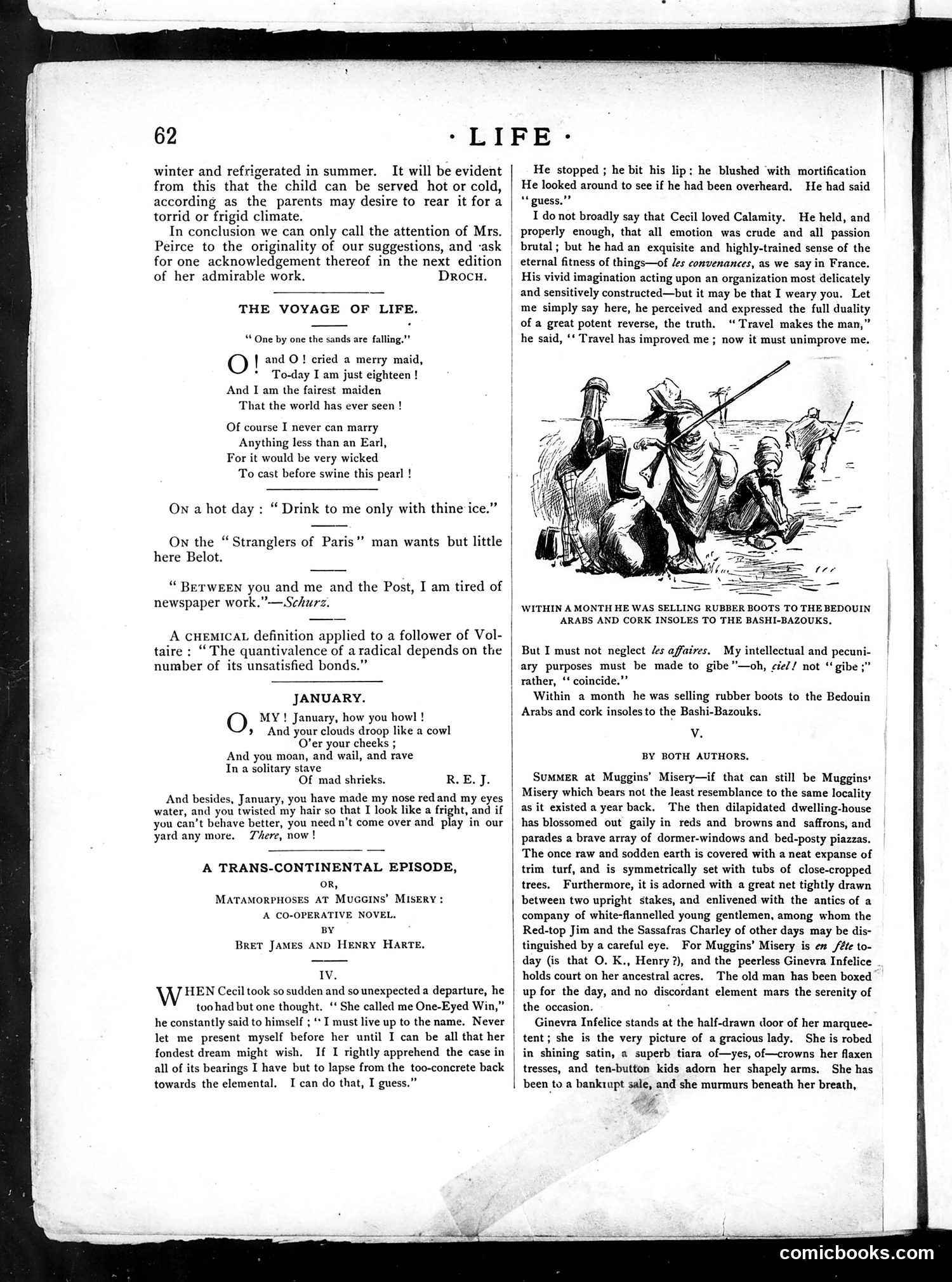
This page from *Life* magazine contains several satirical pieces rather than a single political cartoon. The main illustration shows what appears to be travelers or adventurers in colonial dress, accompanying a story titled "A Trans-Continental Episode, or, Metamorphoses at Muggins' Misery." The caption indicates the figure is "selling rubber boots to the Bedouin Arabs and cork insoles to the Bashi-Bazouks"—absurdist humor about a merchant peddling inappropriate goods to exotic foreign groups. The text includes various satirical quips and poems mocking contemporary social conventions—January's depressing weather, newspaper work tedium, and romantic pretensions. The piece titled "The Voyage of Life" uses verse to mock a young woman's romantic idealism and vanity. The satire targets Victorian social pretension and romantic excess rather than specific political figures.
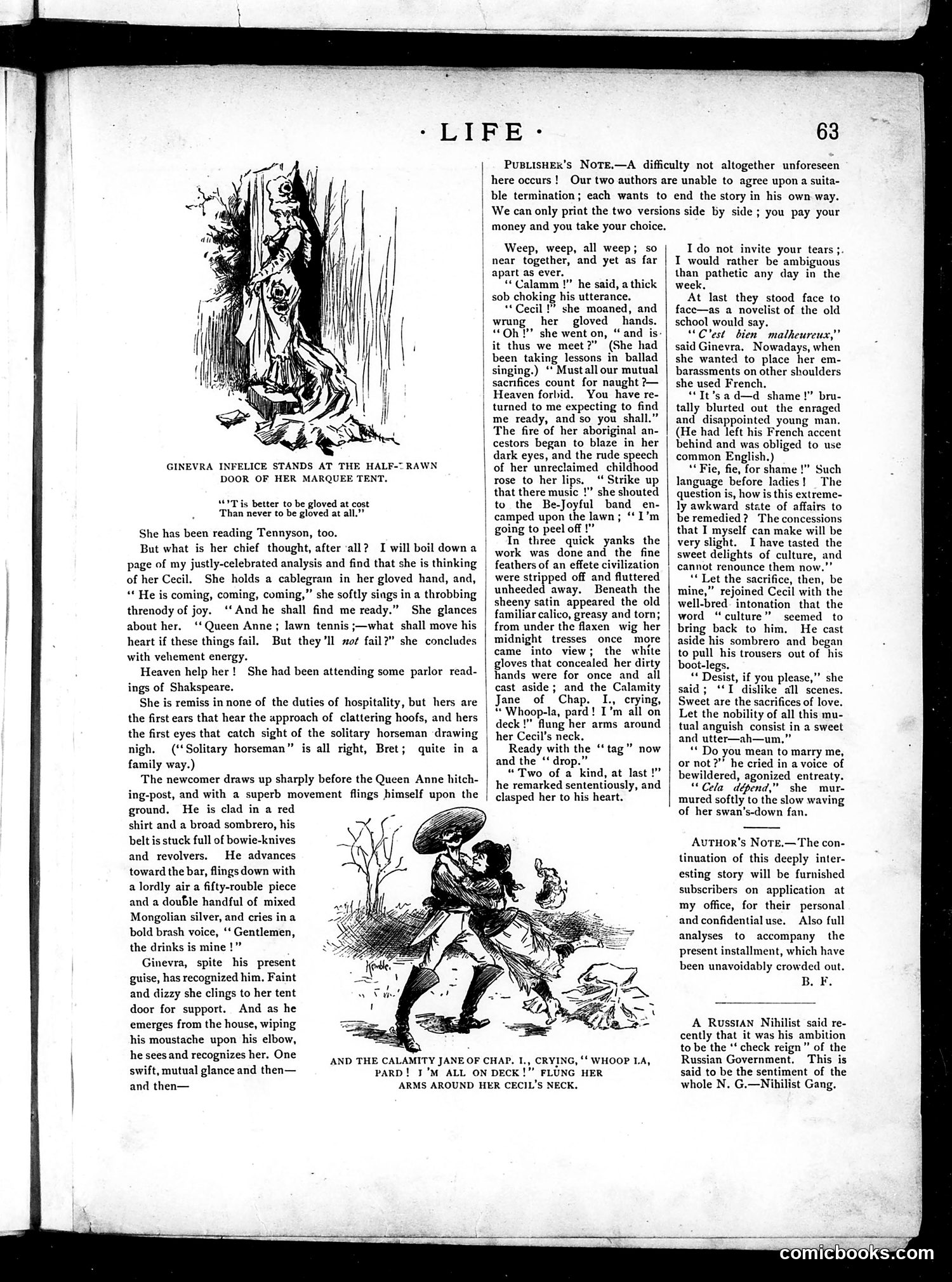
This page appears to be a serialized fiction story rather than political satire. The two illustrations show dramatic scenes from what seems to be a romantic narrative: one depicts "Ginevra" at a tent entrance, and another shows a cavalryman with the caption about "the Calamity Jane of Chap. 1, crying 'Whoop-la, pard!'" The accompanying text includes a **Publisher's Note** explaining that two authors submitted different endings to this story, and readers must choose their preferred version by paying extra. An **Author's Note** promises the story's continuation will be available separately. At the bottom, there's a brief note about Russian nihilism, but this appears unrelated to the main story content. This is primarily **serialized fiction entertainment**, not political commentary.
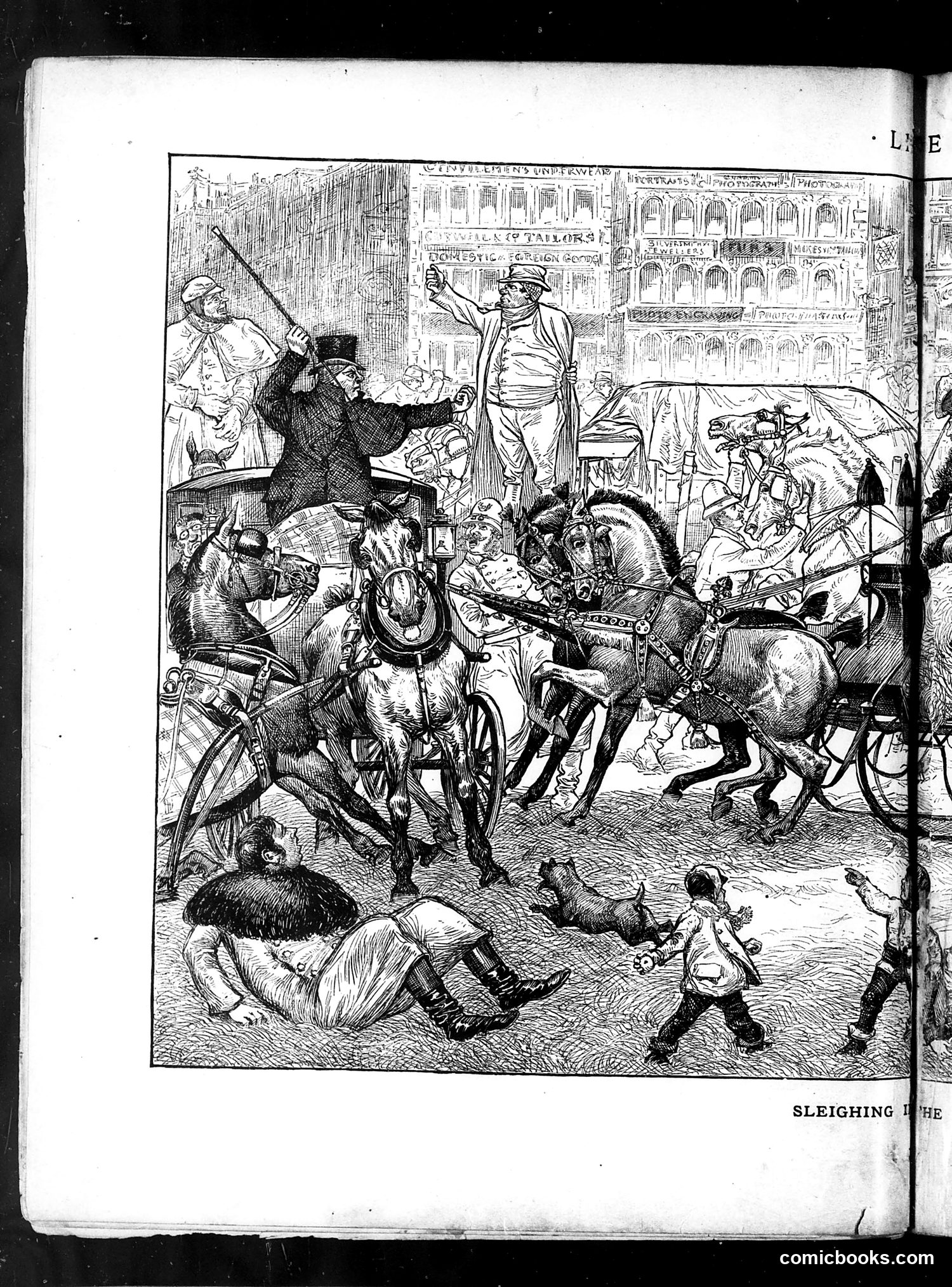
This satirical engraving depicts a chaotic street scene with horses, sledges, and pedestrians in apparent disorder. The caption "SLEIGHING IN THE STREETS" suggests commentary on winter transportation hazards in an urban setting, likely a major American city given the tall buildings visible in the background. The cartoon appears to satirize the dangers and disruptions caused by sledges operating in crowded city streets—showing collisions, near-misses, and general mayhem. People lie on the ground while others navigate around horses and vehicles, suggesting criticism of inadequate street safety regulations or the practice itself. Without a date visible, the specific historical context remains unclear, but this represents typical Life magazine social satire addressing public safety concerns.
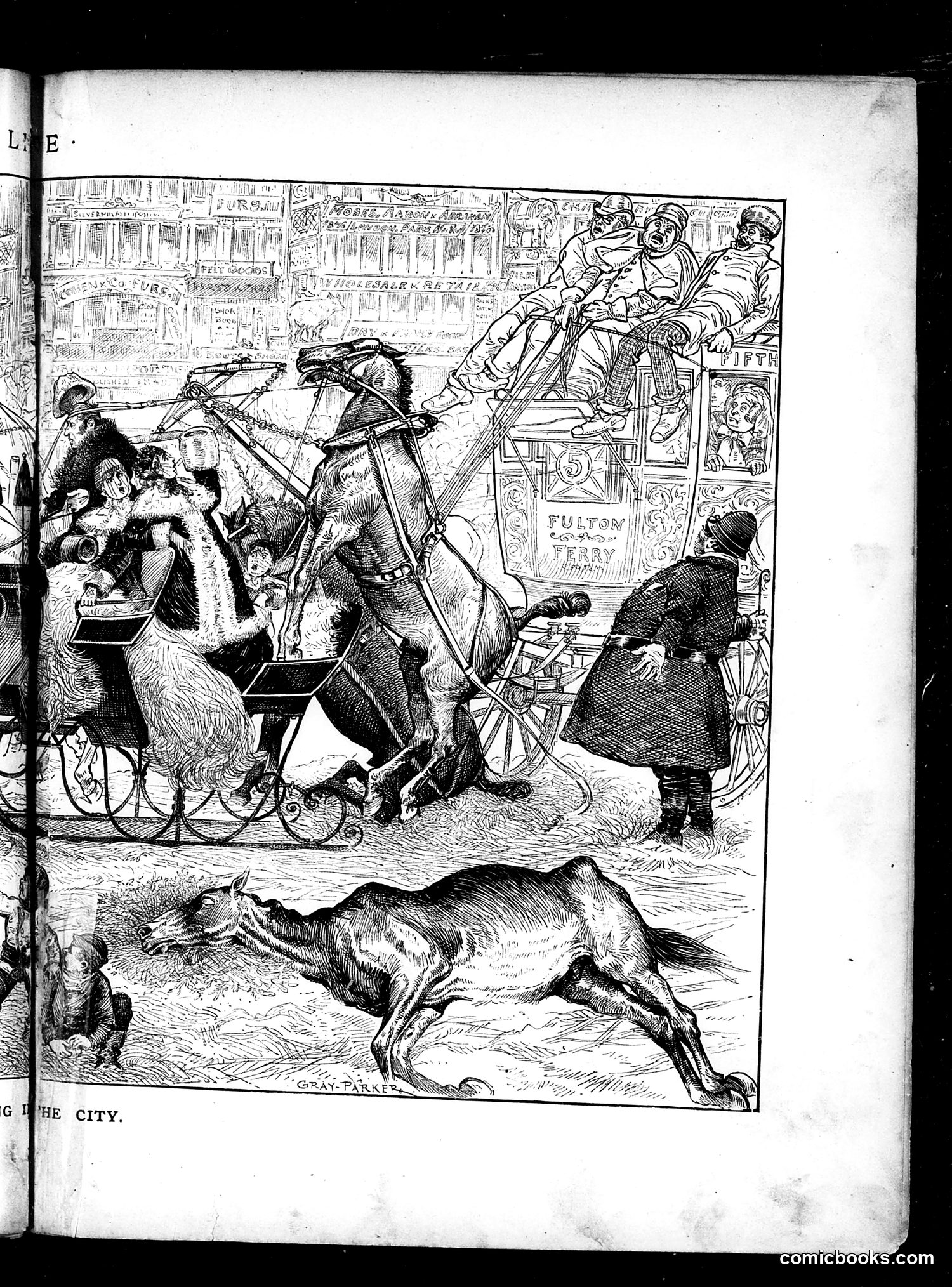
This engraving depicts urban chaos: a runaway horse pulling a carriage with frightened passengers crashes into a street scene while pedestrians scatter. The drawing emphasizes the danger and disorder of city life, with various figures fleeing or reacting in alarm. A dog runs in the foreground, adding to the pandemonium. The satire likely comments on the hazards of modern urban transportation and crowded city streets—a common concern in 19th-century Life magazine. The exaggerated chaos serves to mock both reckless drivers and the general bedlam of metropolitan life. The title "Life in the City" suggests ironic commentary on supposedly civilized urban living that was, in reality, frequently chaotic and dangerous.
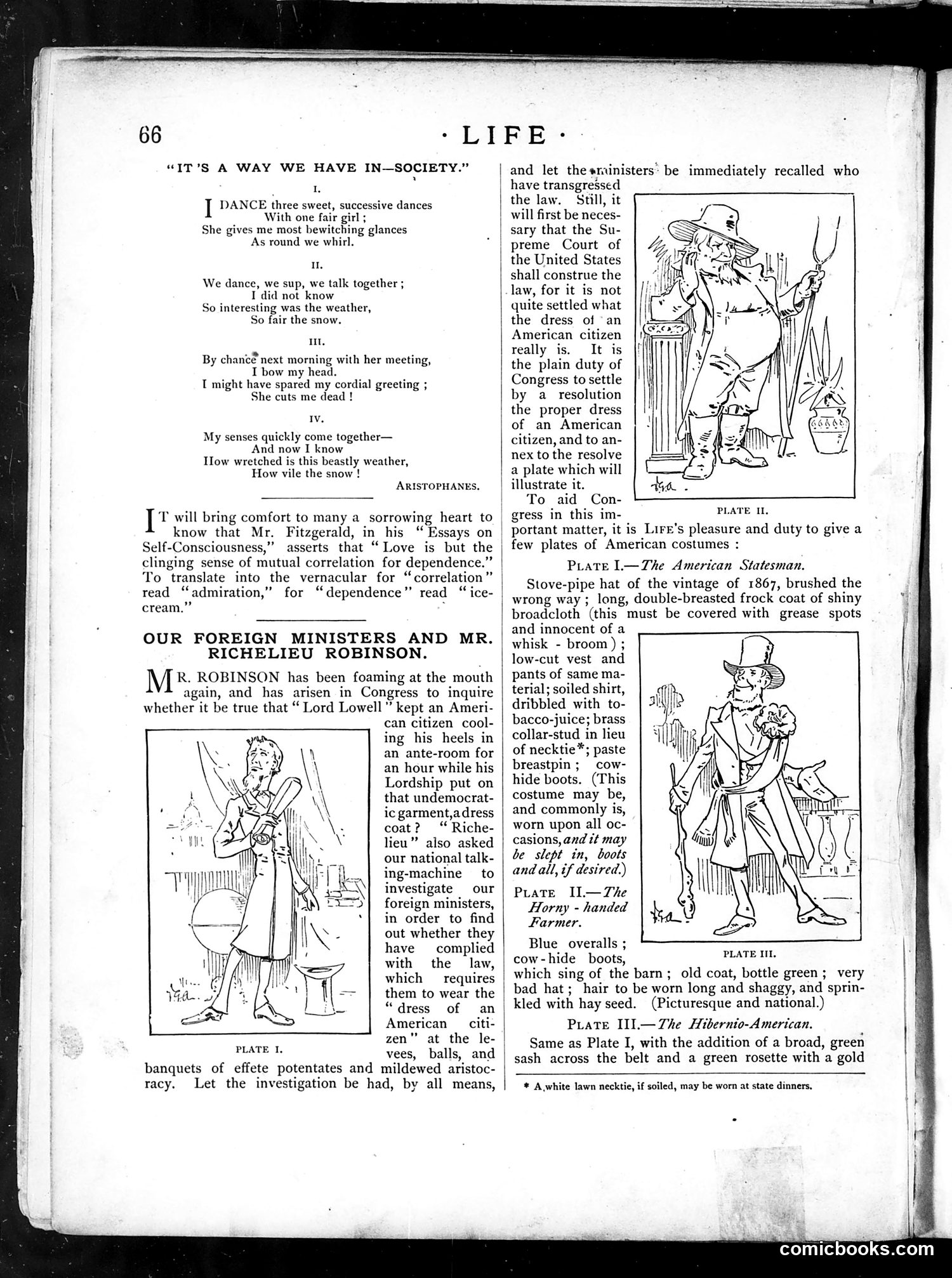
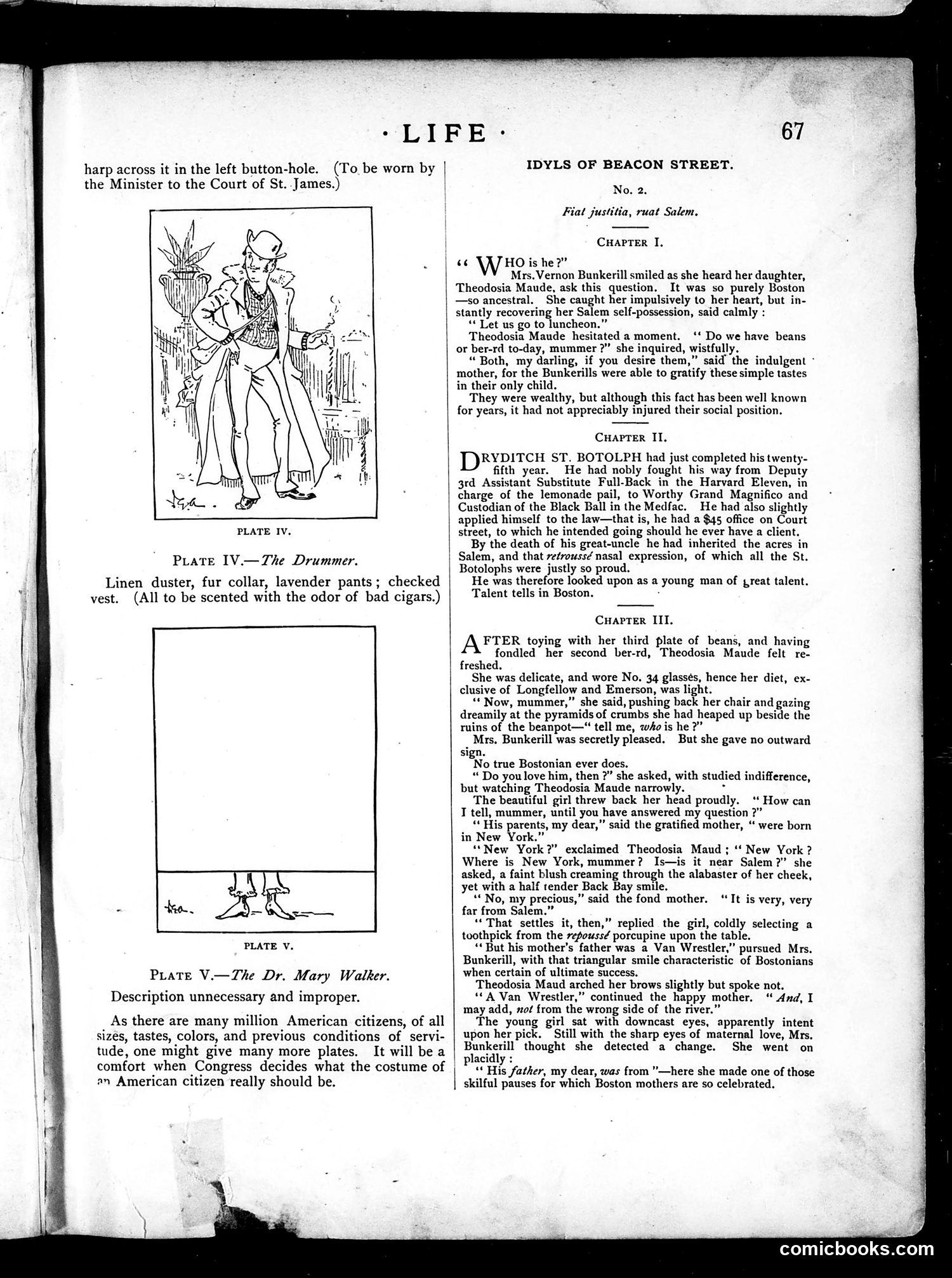
This page mocks Congressional concern about proper "American citizen" dress codes for foreign ministers. Representative Richelieu Robinson had demanded an investigation into whether diplomats wore appropriate attire, implying that formal diplomatic dress violated American democratic principles. Life's satire is caustic: the magazine presents three "authentic" American costumes as models. Plate I shows the "American Statesman"—a deliberately shabby, stained figure in wrinkled 1867-era clothing. Plate II depicts the "Horny-handed Farmer" in work clothes. Plate III adds a green sash and rosette, suggesting Irish-American identity. The joke exposes Robinson's hypocrisy: Americans themselves have no unified "proper dress," wearing everything from soiled, outdated suits to farm wear. Therefore, Congress cannot legitimately dictate what constitutes American citizen dress. The satire suggests Robinson's patriotic bluster masks either absurd provincialism or political grandstanding against foreign officials.
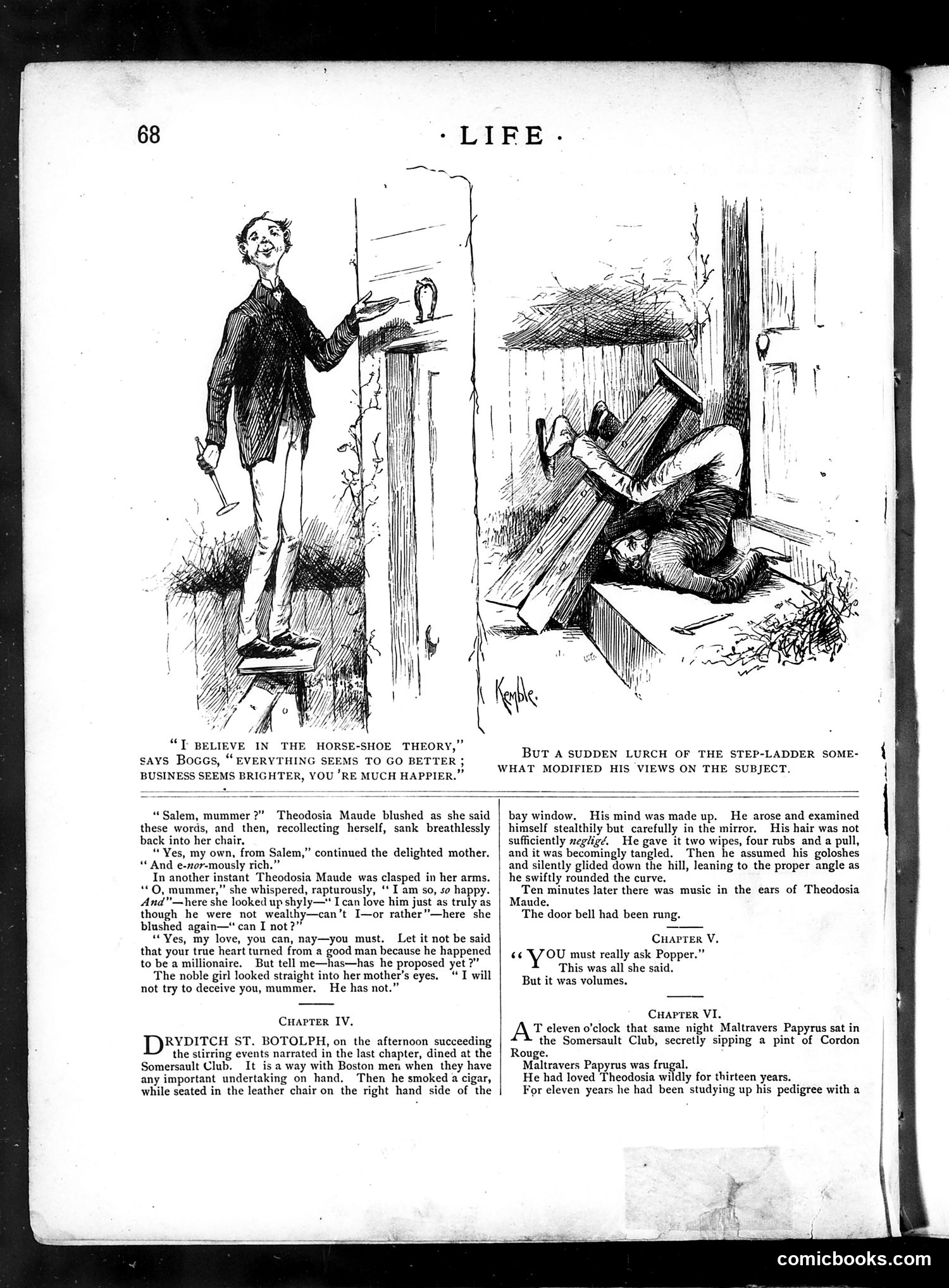
This page contains two distinct satirical elements: **The Cartoon (top):** Shows a man standing on a step-ladder holding a horseshoe, claiming superstitious belief that horseshoes bring good fortune and happiness. A sudden lurch of the ladder sends him falling—visually demonstrating that superstition provides no actual protection or safety. The joke mocks people who rely on lucky charms rather than practical sense. **The Serial Story (below):** A melodramatic romantic parody featuring characters with absurdly ornate names (Theodosia Maude, Maltravers Papyrus, Dryditch St. Botolph). The humor satirizes overwrought Victorian romance novels, with exaggerated emotionalism ("I can love him just as truly as though he were not wealthy"), stilted dialogue, and elaborate descriptions of trivial actions. The story pokes fun at sentimental literature and wealthy Bostonian society's pretensions. Together, the page mocks both superstitious thinking and the florid sentimentality of popular romance fiction.
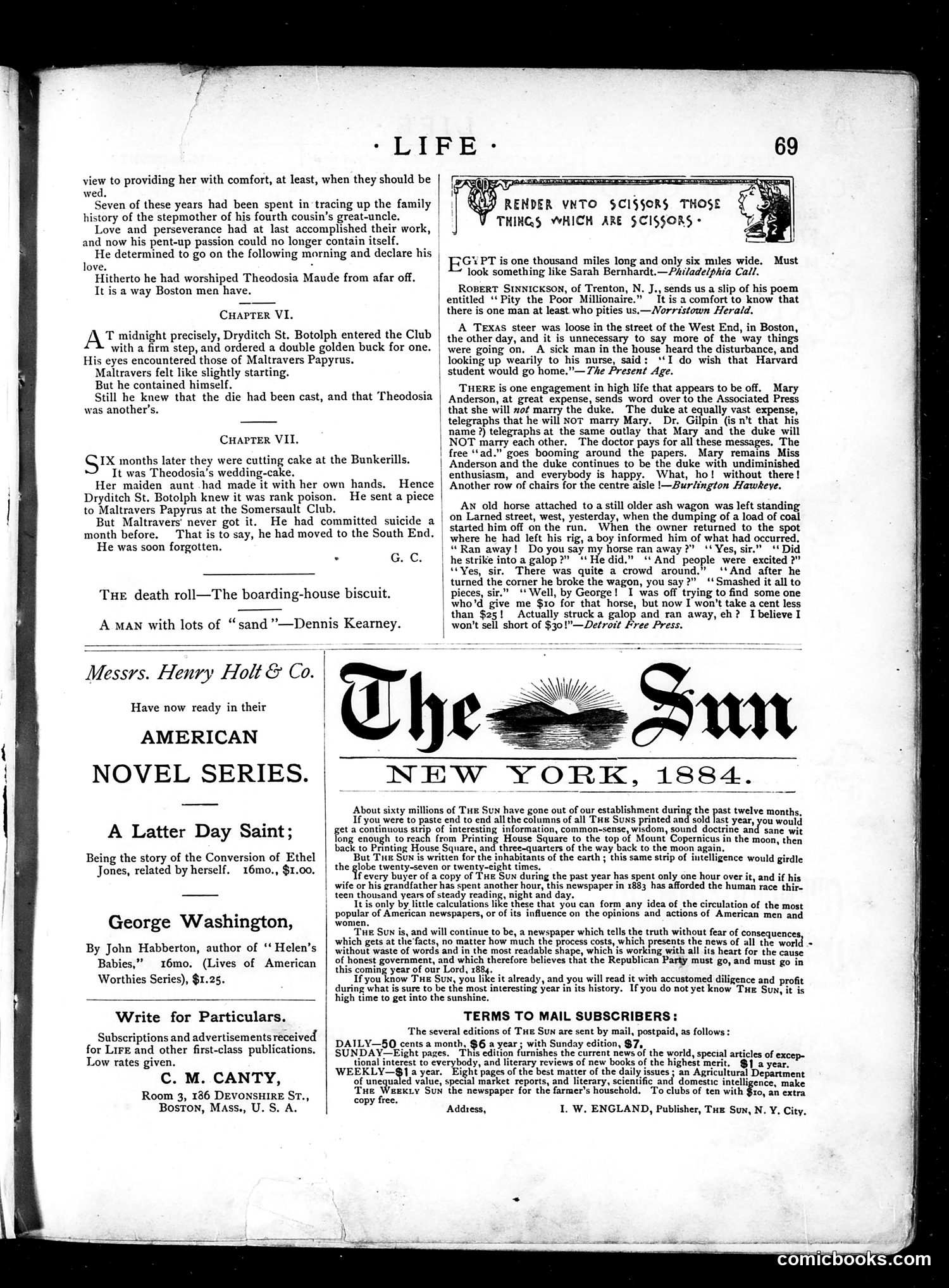
This page contains satirical humor pieces typical of Life's format. The main content includes: **"The Death Roll—The Boarding-House Biscuit"** and **"A Man with Lots of 'Sand'—Dennis Kearney"**: These are brief joke items; Kearney likely references the California labor agitator of that era, though context here is unclear. **The cartoon at top** shows a pair of scissors with the caption "RENDER UNTO SCISSORS THOSE THINGS WHICH ARE SCISSORS"—a parody of the Biblical phrase "render unto Caesar," apparently a visual pun about scissors themselves. **The serialized story** ("Chapters VI-VII") appears to be satirizing sentimental Victorian romance fiction, mocking overwrought dramatic conventions through absurdist plotting. **Lower half**: Advertisements for Henry Holt & Co.'s novel series and The Sun newspaper (New York, 1884), offering subscription information. The page exemplifies Life's mix of satirical fiction, visual humor, and period advertising—reflecting 1880s American culture and literary tastes.
This page is primarily **advertisements and filler content**, not political cartoons. The page contains commercial ads for cigarettes, candy, restaurants, printing ink, and fountain pens—typical of 19th-century magazine layouts. The editorial content consists of brief **satirical anecdotes and reprinted newspaper items**: 1. A joke about a comet (referencing the 1812 comet) where a young woman tells an infatuated suitor she wishes he'd travel away "at the same rate" as the comet—social satire on unwanted romantic attention. 2. A humorous notice about how a "Boy Wanted" advertisement in the New Haven *Morning News* was quickly followed by a birth announcement to "G.D.R. Hubbard"—implying the advertiser immediately hired someone. 3. A note celebrating the return of Mr. Loring's Boston bookstore to its original location, showing nostalgia for commercial establishments. These are lighthearted social observations rather than political satire, reflecting typical Victorian-era magazine humor focused on domestic and commercial life.
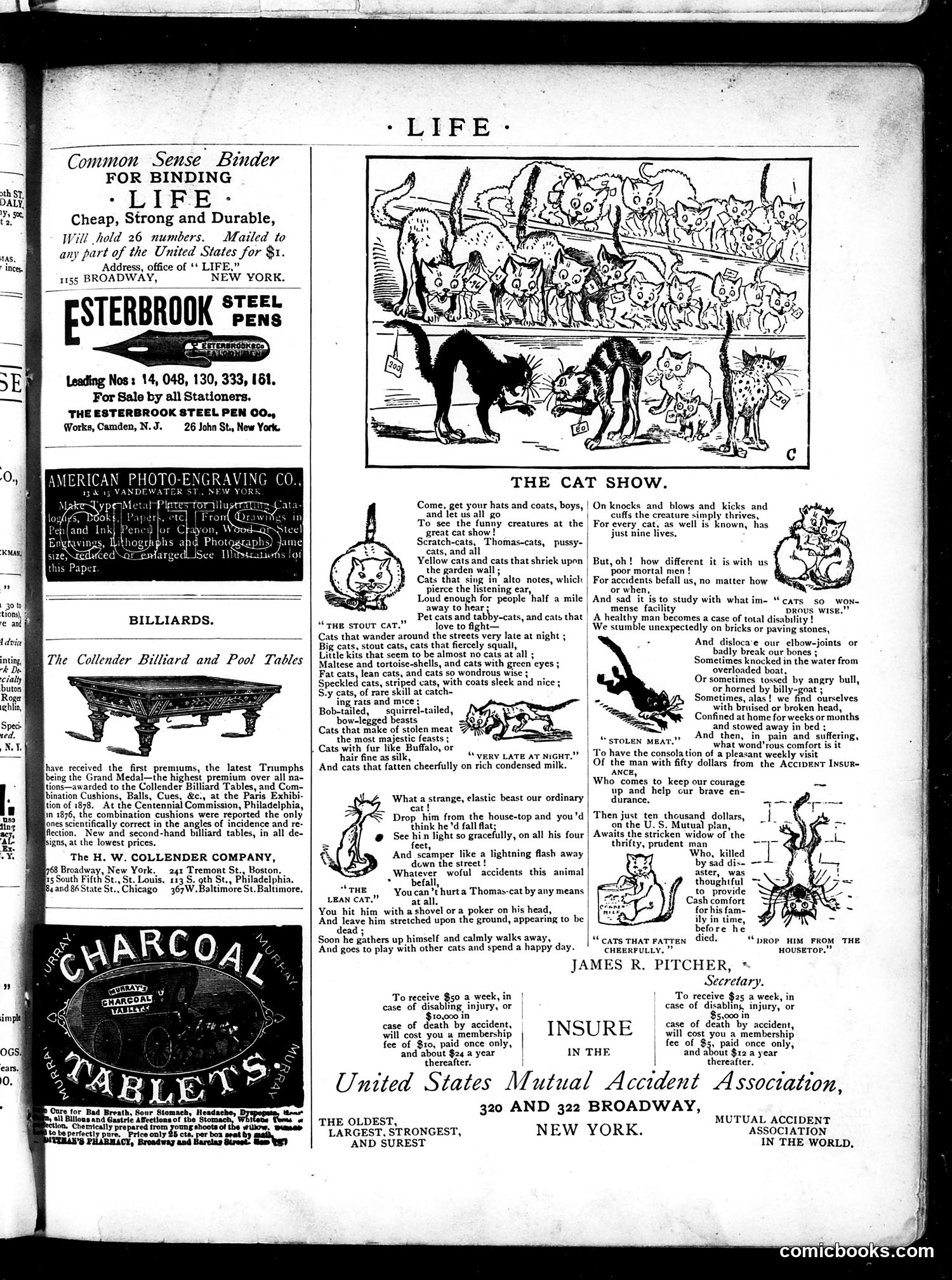
This is a whimsical poem-and-illustration feature celebrating the diversity of cats, contrasting their resilience with human vulnerability. The text describes various cat types attending a "cat show"—tabby cats, Maltese, tom-cats, lean cats, stout cats—with charming details like cats "that fatten cheerfully on rich condensed milk." The satire's point emerges in the final section: cats possess legendary durability (the "nine lives" folklore), surviving falls and injuries effortlessly. Humans, by contrast, are fragile—we slip on bricks and suffer dislocations from minor accidents. This ironic comparison serves as a transition to the adjacent advertisement for the **United States Mutual Accident Association**, which offers insurance protection against life's unpredictable mishaps. The cartoon thus uses playful anthropomorphism to highlight human vulnerability and insurance necessity, making a commercial argument through humor.
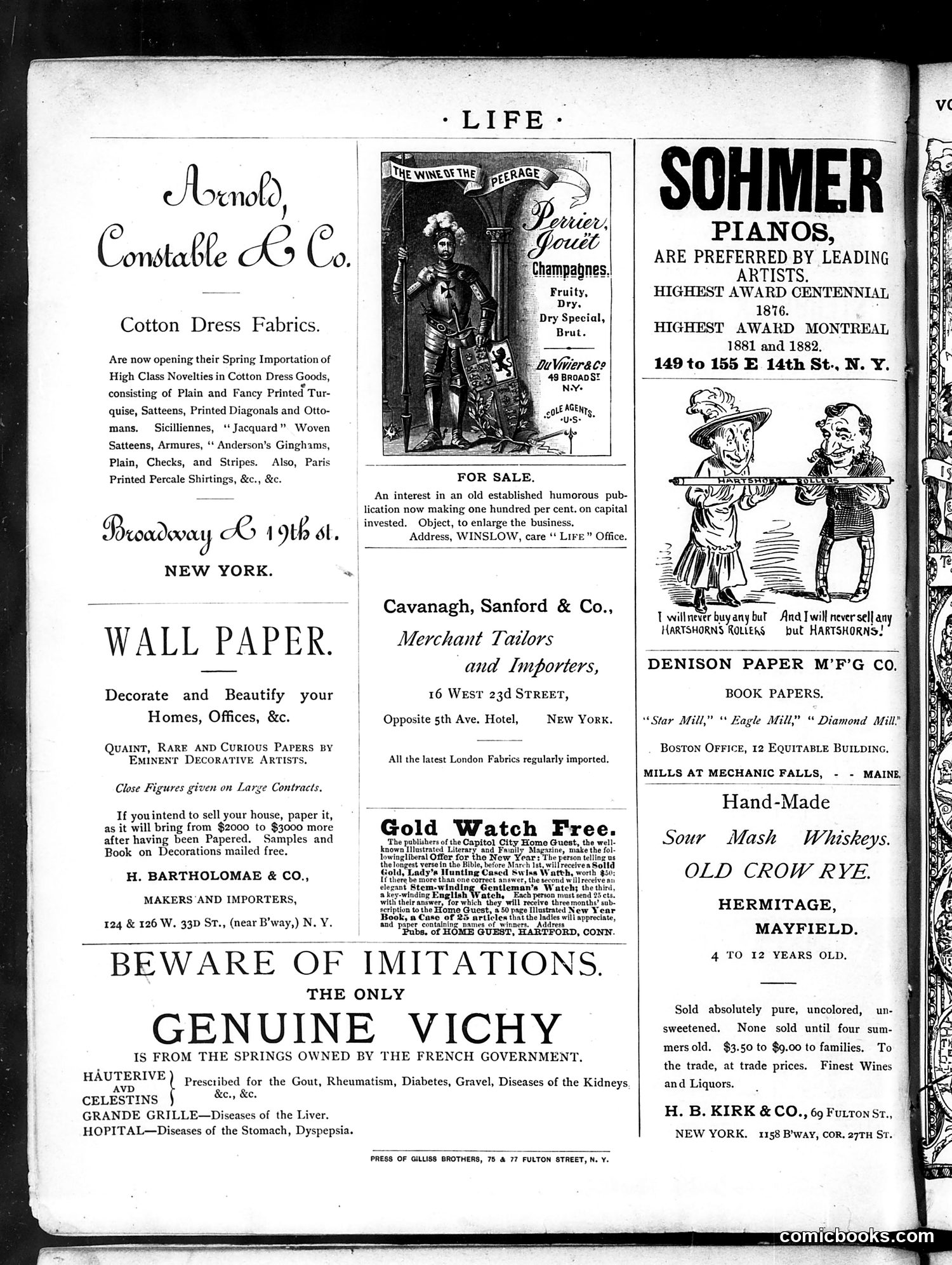
This page is primarily **advertising**, with one small cartoon. The cartoon (right side, middle) shows two caricatured figures in a dispute over window blinds—one saying "I will never buy any but HARTSHORNS ROLLERS" while the other counters "And I will never sell any but HARTSHORNS!" **The joke**: This is a mock-serious argument about a mundane product (window roller blinds). The exaggerated commitment both figures display to this unremarkable item satirizes contemporary advertising's breathless product endorsements and consumer brand loyalty. It's absurdist humor—the triviality of the dispute is the point. The cartoon likely parodies the era's increasingly aggressive marketing tactics and the newly manufactured "brand loyalty" driving consumer culture in the 1880s. By treating window blinds with the gravity of a serious conflict, Life mocks both advertisers' hyperbole and consumers' susceptibility to it. The rest of the page contains standard period advertisements for fabric, wallpaper, pianos, watches, whiskey, and mineral water—itself supporting the cartoon's commentary on advertising saturation.