
Life, 1884-01-31 · page 8 of 18
Life — January 31, 1884 — page 8: what you’re looking at
What you’re looking at
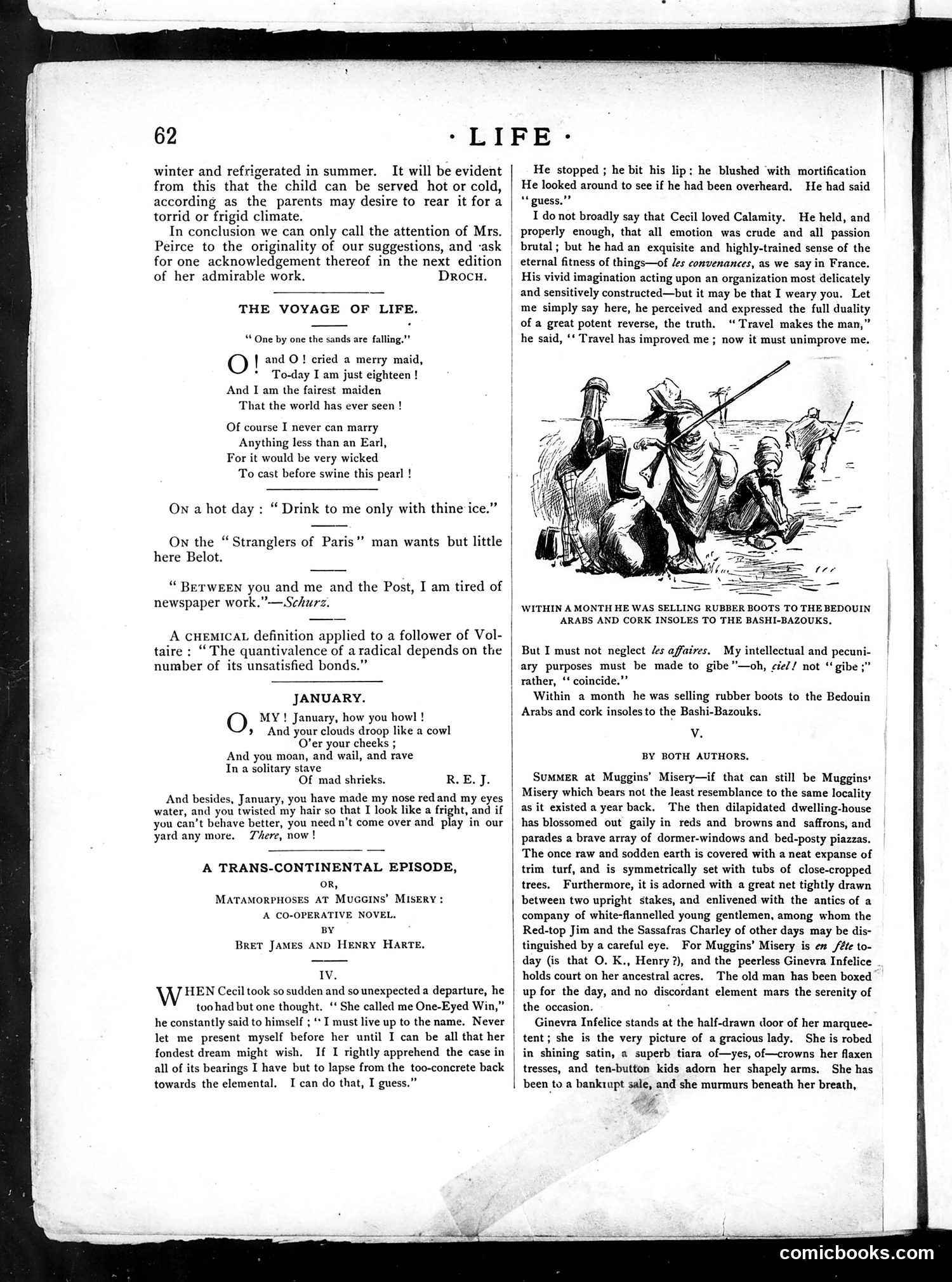
This page from *Life* magazine contains several satirical pieces rather than a single political cartoon. The main illustration shows what appears to be travelers or adventurers in colonial dress, accompanying a story titled "A Trans-Continental Episode, or, Metamorphoses at Muggins' Misery." The caption indicates the figure is "selling rubber boots to the Bedouin Arabs and cork insoles to the Bashi-Bazouks"—absurdist humor about a merchant peddling inappropriate goods to exotic foreign groups. The text includes various satirical quips and poems mocking contemporary social conventions—January's depressing weather, newspaper work tedium, and romantic pretensions. The piece titled "The Voyage of Life" uses verse to mock a young woman's romantic idealism and vanity. The satire targets Victorian social pretension and romantic excess rather than specific political figures.
📄 Transcribed text from this page (OCR, searchable)
Machine-transcribed from the original scan — historical spelling and the odd misread are preserved.
62 winter and refrigerated in summer. It will be evident from this that the child can be served hot or cold, according as the parents may desire to rear it fora torrid or frigid climate. In conclusion we can only call the attention of Mrs. Peirce to the originality of our suggestions, and ‘ask for one acknowledgement thereof in the next edition of her admirable work. Drocu. THE VOYAGE OF LIFE. “One by one the sands are falling.” O | and O! cried a merry maid, * To-day I am just eighteen ! And I am the fairest maiden That the world has ever seen ! Of course I never can marry Anything less than an Earl, For it would be very wicked To cast before swine this pearl ! On a hot day : “ Drink to me only with thine ice.” On the “Stranglers of Paris’ man wants but little here Belot. “BETWEEN you and me and the Post, I am tired of newspaper work.”— Schurz. A CHEMICAL definition applied to a follower of Vol- | taire : “The quantivalence of a radical depends on the number of its unsatisfied bonds.” JANUARY. MY ! January, how you howl ! » And your clouds droop like a cowl O’er your cheeks ; And you moan, and wail, and rave In a solitary stave Of mad shrieks. R.E. J. And besides, January, you have made my nose redand my eyes water, and you twisted my hair so that I look like a fright, and if you can’t behave better, you need n’t come over and play in our yard any more. There, now ! A TRANS-CONTINENTAL EPISODE, or, MATAMORPHOSES AT MuGGINS’ MISERY : A CO-OPERATIVE NOVEL. BY Bret JAMES AND HENRY HARrTE. Iv. W HEN Cecil took so sudden and so unexpected a departure, he toohad but one thought. ‘‘ She called me One-Eyed Win,” he constantly said to himself ; ‘* I must live up to the name. Never let me present myself before her until I can be all that her fondest dream might wish. If I rightly apprehend the case in | all of its bearings I have but to lapse from the too-concrete back | of a great potent reverse, the truth. towards the elemental. I can do that, I guess.”” » LIFE: He stopped ; he bit his lip: he blushed ‘with mortification He looked around to see if he had been overheard. He had said “* guess,’” I donot broadly say that Cecil loved Calamity. He held, and properly enough, that all emotion was crude and all passion brutal ; but he had an exquisite and highly-trained sense of the eternal fitness of things—of /es convenances, as we say in France. | His vivid imagination acting upon an organization most delicately and sensitively constructed—but it may be that I weary you. Let me simply say here, he perceived and expressed the full duality “Travel makes the man,” he said, ‘‘ Travel has improved me ; now it must unimprove me. WITHIN A MONTH HE WAS SELLING RUBBER BOOTS TO THE BEDOUIN ARABS AND CORK INSOLES TO THE BASHI-BAZOUKS. But I must not neglect /es affaires. My intellectual and pecuni- ary purposes must be made to gibe”—oh, cée// not “ gibe ;” rather, ‘‘ coincide.” Within a month he was selling rubber boots to the Bedouin Arabs and cork insoles to the Bashi-Bazouks. Vv. BY BOTH AUTHORS, SUMMER at Muggins’ Misery—if that can still be Muggins’ Misery which bears not the least resemblance to the same locality as it existed a year back. The then dilapidated dwelling-house has blossomed out gaily in reds and browns and saffrons, and parades a brave array of dormer-windows and bed-posty piazzas. The once raw and sodden earth is covered with a neat expanse of trim turf, and is symmetrically set with tubs of close-cropped trees. Furthermore, it is adorned with a great net tightly drawn. between two upright stakes, and enlivened with the antics of a company of white-flannelled young gentlemen, among whom the Red-top Jim and the Sassafras Charley of other days may be dis- tinguished by a careful eye. For Muggins’ Misery is en /éte to- day (is that O, K., Henry 2), and the peerless Ginevra Infelice holds court on her ancestral acres. The old man has been boxed up for the day, and no discordant element mars the serenity of the occasion. Ginevra Infelice stands at the half-drawn door of her marquee- tent; she is the very picture of a gracious lady. She is robed in shining satin, a superb tiara of—yes, of—crowns her flaxen tresses, and ten-button kids adorn her shapely arms. She has been to a bankrupt sale, and she murmurs beneath her breath, ee