
Life, 1884-01-31 · page 4 of 18
Life — January 31, 1884 — page 4: what you’re looking at
What you’re looking at
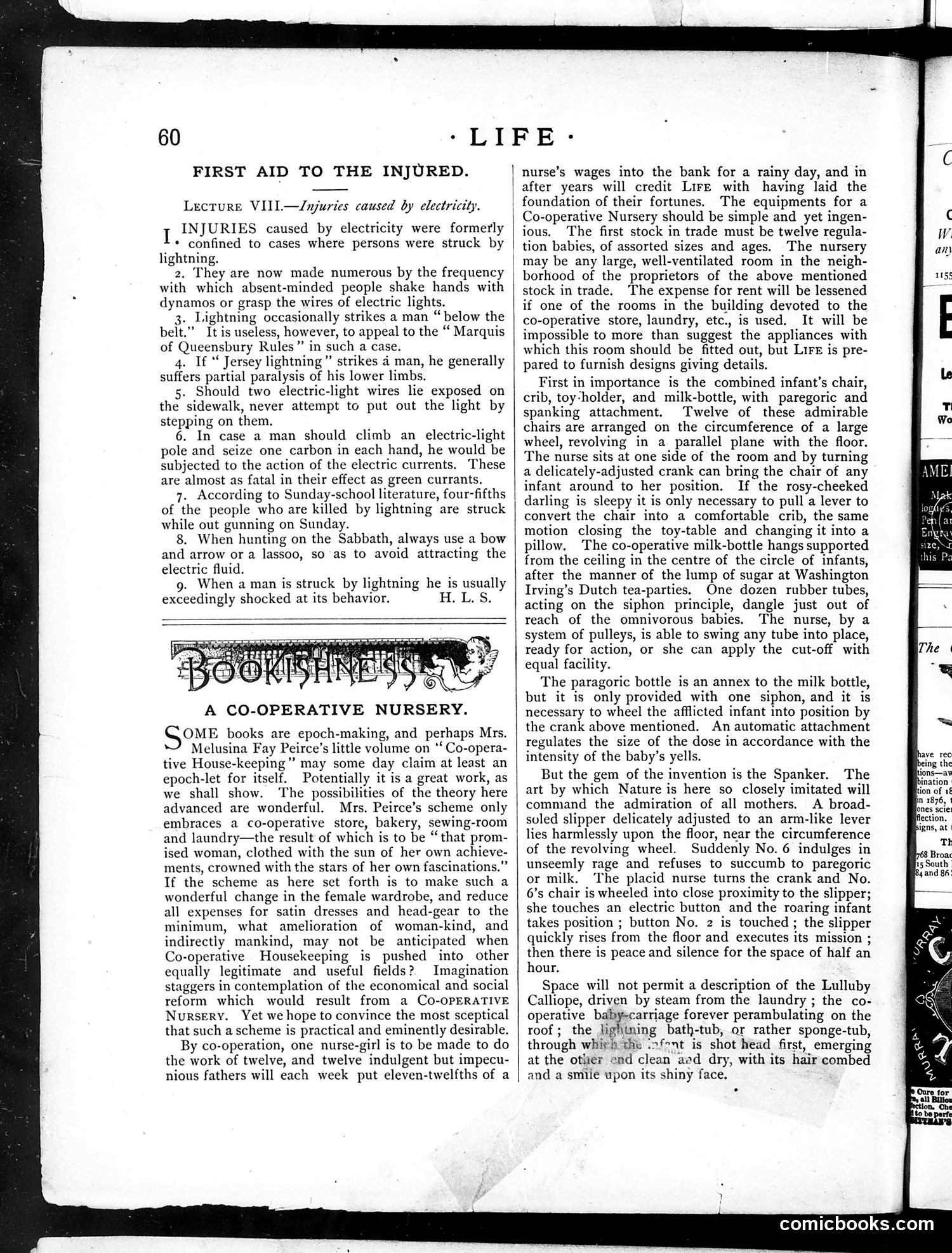
This page contains two distinct sections with no political cartoon: **Top section** ("First Aid to the Injured"): A medical lecture on electrical injuries, providing practical safety advice (points 1-9). This is straightforward instructional content, not satire. **Bottom section** ("A Co-operative Nursery"): An article advocating for communal childcare facilities. The text describes a cooperative scheme where working mothers could pool resources for shared nursing care, laundry, and bakery services—reducing individual household expenses while enabling women's employment. The piece presents this as progressive social innovation, claiming it could transform "woman-kind" through practical cooperation. This reflects early 20th-century debates about women's work and domestic labor. Neither section contains satire or caricature—this appears to be straight advocacy journalism mixed with practical advice, typical of *Life* magazine's reformist content.
📄 Transcribed text from this page (OCR, searchable)
Machine-transcribed from the original scan — historical spelling and the odd misread are preserved.
60 FIRST AID TO THE INJURED. Lecture VIII.—Jnjuries caused by electricity. I INJURIES caused by electricity were formerly * confined to cases where persons were struck by lightning. 2, They are now made numerous by the frequency with which absent-minded people shake hands with dynamos or grasp the wires of electric lights. 3. Lightning occasionally strikes a man “ below the belt.” It is useless, however, to appeal to the “ Marquis of Queensbury Rules” in such a case. 4. If “ Jersey lightning ” strikes 4 man, he generally suffers partial paralysis of his lower limbs. 5. Should two electric-light wires lie exposed on the sidewalk, never attempt to put out the light by stepping on them. 6. In case a man should climb an electric-light pole and seize one carbon in each hand, he would be subjected to the action of the electric currents. These are almost as fatal in their effect as green currants. 7. According to Sunday-school literature, four-fifths of the people who are killed by lightning are struck while out gunning on Sunday. 8. When hunting on the Sabbath, always use a bow and arrow or a lassoo, so as to avoid attracting the electric fluid. 9. When a man is struck by lightning he is usually exceedingly shocked at its behavior. H.L. S. A CO-OPERATIVE NURSERY. Some books are epoch-making, and perhaps Mrs. Melusina Fay Peirce’s little volume on ‘‘ Co-opera- tive House-keeping” may some day claim at least an epoch-let for itself. Potentially it is a great work, as we shall show. The possibilities of the theory here advanced are wonderful. Mrs. Peirce’s scheme only embraces a co-operative store, bakery, sewing- room and laundry—the result of which is to be “that prom- ised woman, clothed with the sun of her own achieve- ments, crowned with the stars of her own fascinations.” If the scheme as here set forth is to make such a wonderful change in the female wardrobe, and reduce all expenses for satin dresses and head-gear to the minimum, what amelioration of woman-kind, and indirectly mankind, may not be anticipated when Co-operative Housekeeping is pushed into other equally legitimate and useful fields? Imagination staggers in contemplation of the economical and social reform which would result from a CO-OPERATIVE Nursery. Yet we hope to convince the most sceptical that such a scheme is practical and eminently desirable. By co-operation, one nurse-girl is to be made to do the work of twelve, and twelve indulgent but impecu- | tion babies, of assorted sizes and ages. | may be any large, well-ventilated room in the neigh- LIFE nurse’s wages into the bank for a rainy day, and in after years will credit Lire with having laid the foundation of their fortunes. The equipments for a Co-operative Nursery should be simple and yet ingen- ious. The first stock in trade must be twelve regula- The nursery borhood of the proprietors of the above mentioned stock in trade. The expense for rent will be lessened if one of the rooms in the building devoted to the co-operative store, laundry, etc., is used. It will be impossible to more than suggest the appliances with | which this room should be fitted out, but Lire is pre- | pared to furnish designs giving details. First in importance is the combined infant's chair, crib, toy-holder, and milk-bottle, with paregoric and spanking attachment. Twelve of these admirable chairs are arranged on the circumference of a large wheel, revolving in a parallel plane with the floor. The nurse sits at one side of the room and by turning a delicately-adjusted crank can bring the chair of any infant around to her position. If the rosy-cheeked darling is sleepy it is only necessary to pull a lever to convert the chair into a comfortable crib, the same motion closing the toy-table and changing it into a pillow. The co-operative milk-bottle hangs supported from the ceiling in the centre of the circle of infants, after the manner of the lump of sugar at Washington Irving’s Dutch tea-parties. One dozen rubber tubes, acting on the siphon principle, dangle just out of reach of the omnivorous babies. The nurse, by a system of pulleys, is able to swing any tube into place, ready for action, or she can apply the cut-off with equal facility. The paragoric bottle is an annex to the milk bottle, but it is only provided with one siphon, and it is necessary to wheel the afflicted infant into position by the crank above mentioned. An automatic attachment regulates the size of the dose in accordance with the intensity of the baby’s yells. But the gem of the invention is the Spanker. The art by which Nature is here so closely imitated will command the admiration of all mothers. A broad- soled slipper delicately adjusted to an arm-like lever lies harmlessly upon the floor, near the circumference of the revolving wheel. Suddenly No. 6 indulges in unseemly rage and refuses to succumb to paregoric or milk. The placid nurse turns the crank and No. 6’s chair is wheeled into close proximity to the slipper; she touches an electric button and the roaring infant takes position ; button No. 2 is touched ; the slipper quickly rises from the floor and executes its mission ; then there is peace and silence for the space of half an hour. Space will not permit a description of the Lulluby Calliope, driven by steam from the laundry ; the co- operative baby-carriage forever perambulating on the roof; the lightning bath-tub, or rather sponge-tub, through whieh the ‘>fent is shot head first, emerging at the other end clean aed dry, with its hair combed nious fathers will each week put eleven-twelfths of a | and a smile upon its shiny face. comicbooks.com