
A complete issue · 16 pages · 1883
Life — November 8, 1883
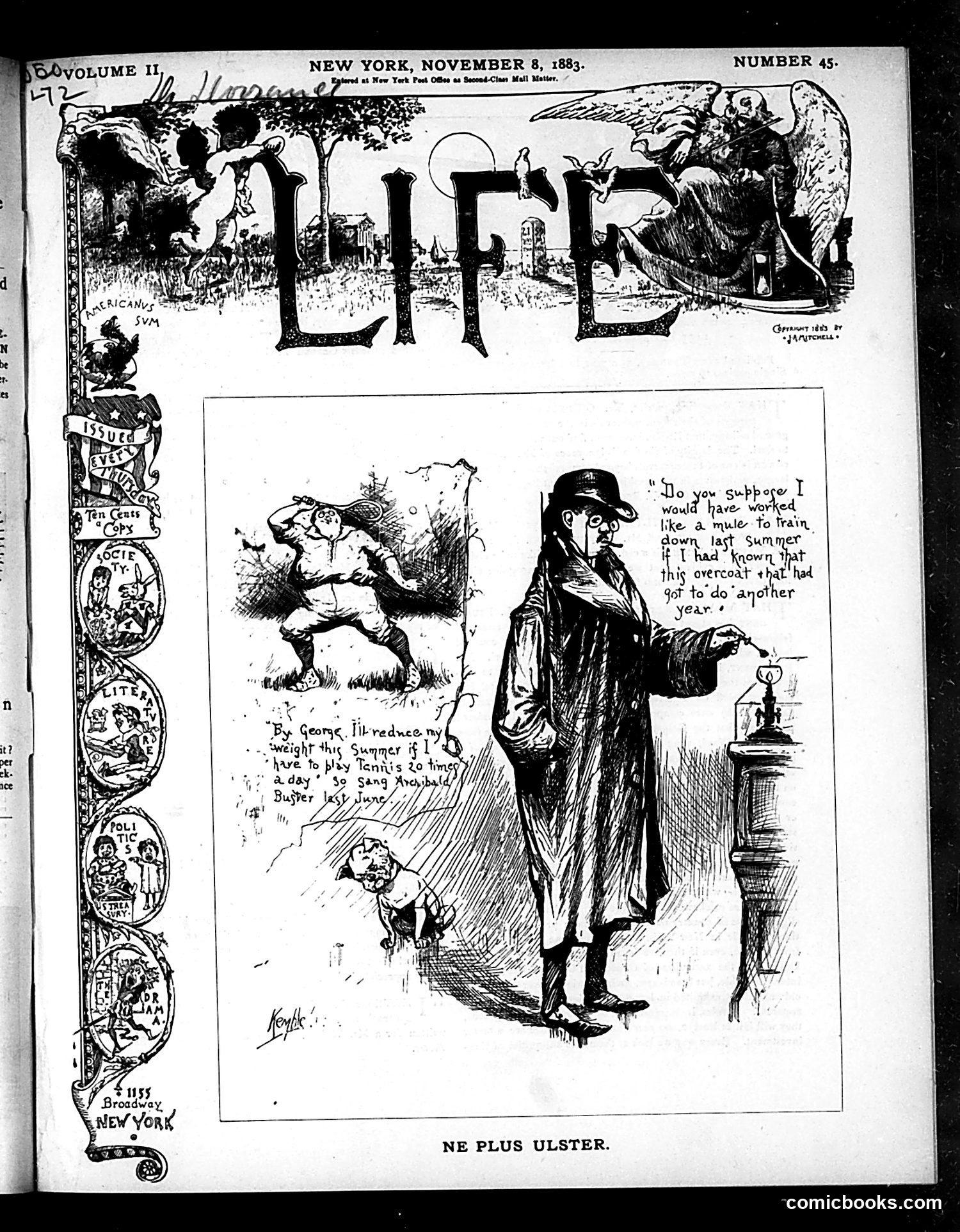
This cartoon satirizes a wealthy man's complaint about his overcoat. The well-dressed figure complains that he had to work like a mule last summer and must now wear last year's overcoat for another season. Meanwhile, a laborer (shown crouching below) struggles in poverty. The title "Ne Plus Ulster" appears to be a pun on "ne plus ultra" (the ultimate/highest point), playing on "Ulster" (a type of overcoat). The joke mocks the rich man's self-pitying complaint—that wearing an old overcoat for a second year constitutes hardship—by contrasting his minor inconvenience with the actual deprivation of working-class people. The satire targets wealth inequality and the obliviousness of the affluent.
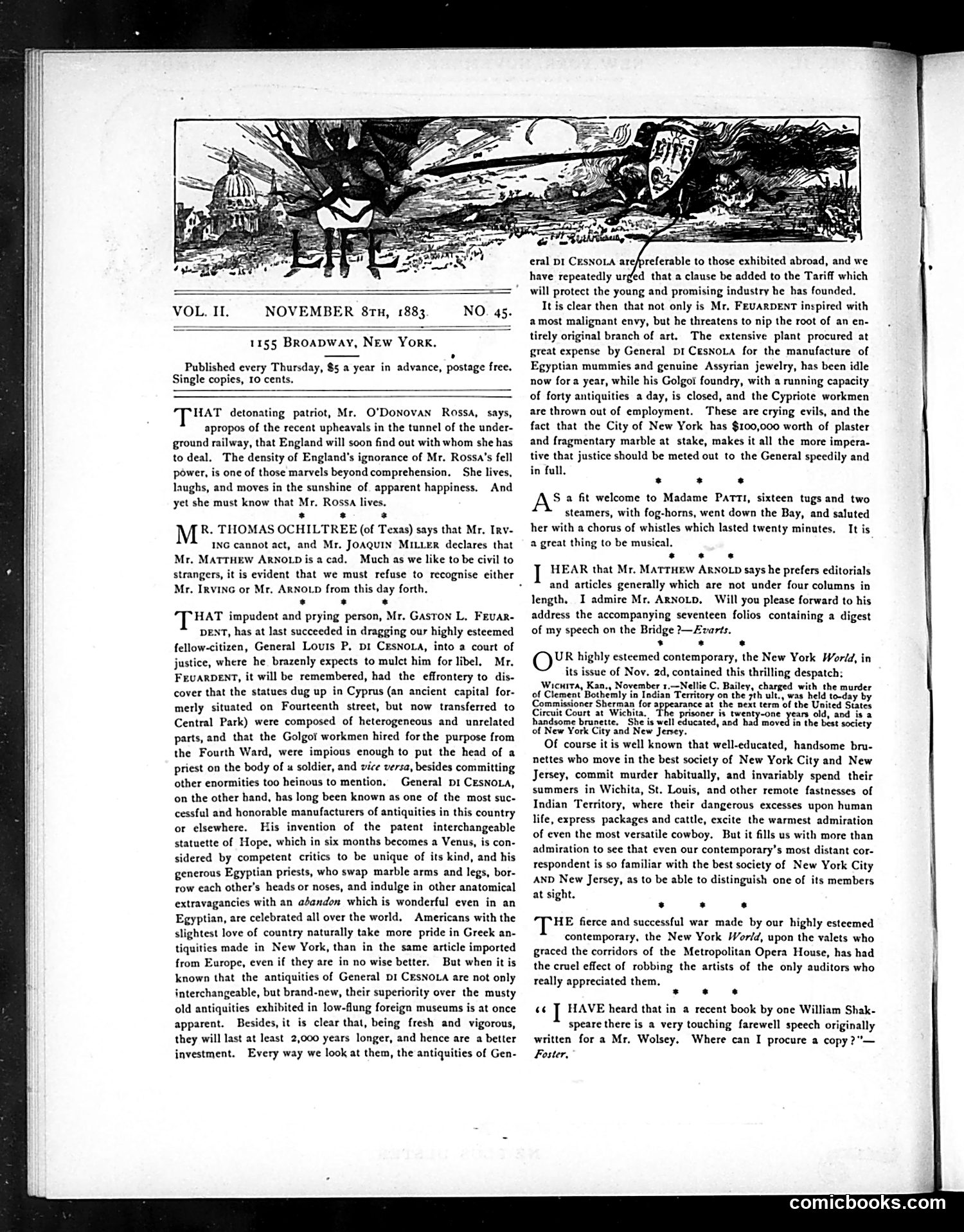
The masthead illustration depicts "LIFE" as a classical figure amid architectural and natural imagery, establishing the magazine's satirical identity. The text consists of editorial commentary rather than cartoons. Topics include: - **Mr. O'Donovan Rossa**: A nationalist figure whose tunnel-digging activities are satirized - **General di Cesnola**: Director of the Metropolitan Museum, criticized for importing Egyptian antiquities while local American artisans (specifically Golgoi foundry workers) lack employment - **Matthew Arnold**: The British critic, praised for editorial contributions - **Gaston Fuardent**: A character involved in litigation regarding relocated crypt artifacts The satire critiques both foreign cultural imports prioritized over American industry and questionable antiquities acquisition practices by major institutions. The tone suggests Progressive-era skepticism toward wealthy collectors and institutions prioritizing foreign prestige over domestic labor and concerns.
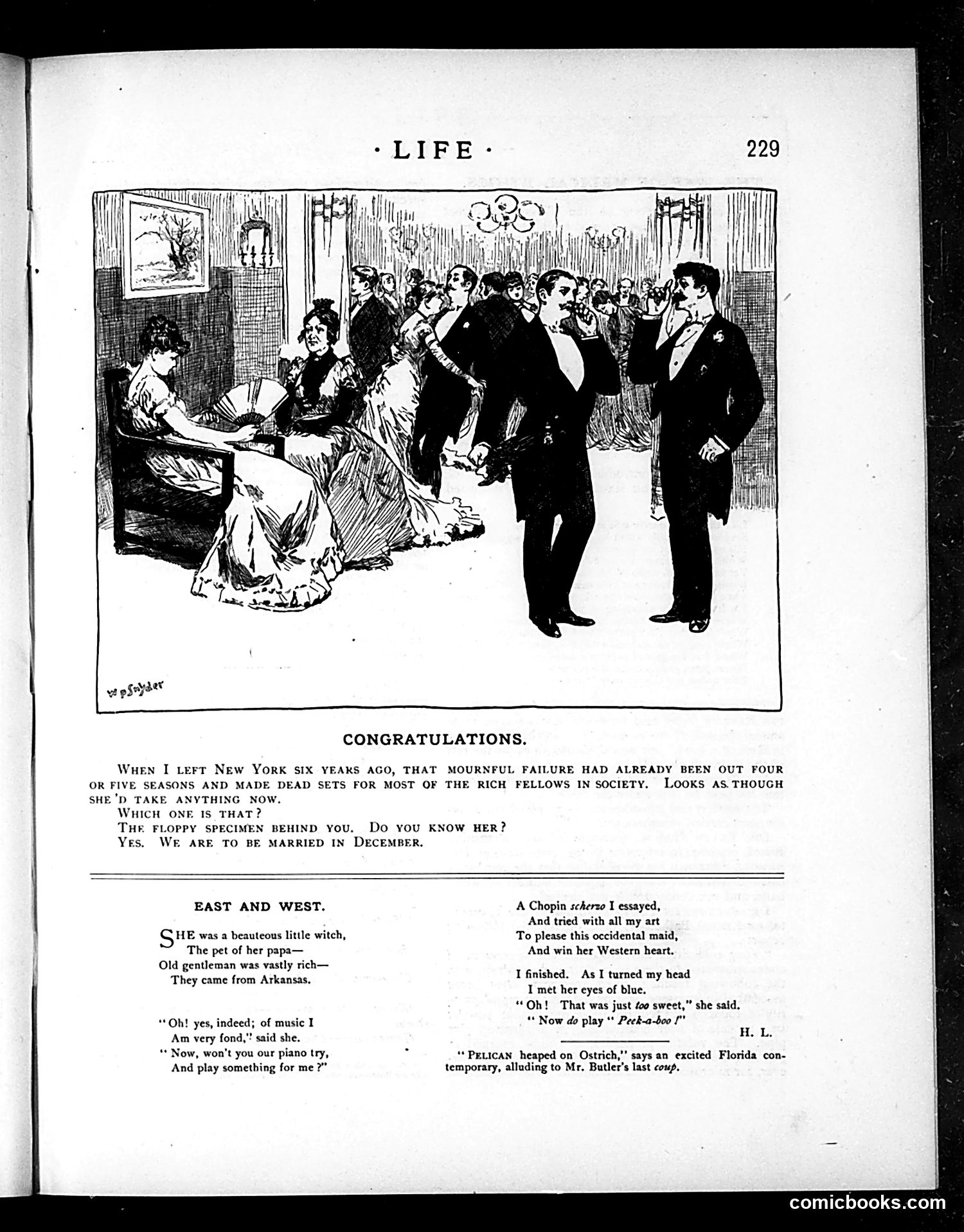
This page from *Life* magazine contains two separate pieces: **"Congratulations"** (top cartoon): A social satire depicting high-society courtship. Two men discuss a woman's engagement, with one noting that six years ago, similar women repeatedly failed to "catch" wealthy husbands. The joke critiques marriage as transactional—wealthy men as desirable "catches" and women as mercenary social climbers hunting them. **"East and West"** (bottom): A poem-and-quip section mocking a relationship between a wealthy Eastern gentleman and a Western woman ("a beauteous little witch"). The humor plays on regional stereotypes and the clash between refined Eastern society and rougher Western culture, while poking fun at his attempts to impress her musically. Both pieces satirize Gilded Age courtship conventions and class anxieties.
This satirical piece describes a meeting of the Thomson Street Medical Association where doctors debated and ultimately revised an old medical code of ethics. The humor centers on the absurdity of their process: they subjected medical "codes" to chemical analysis by burning them in clay pipes and examining the ash under microscopes—treating abstract ethical principles as if they were physical substances that could be scientifically tested. The satire mocks the pretension of reducing professional ethics to measurable, objective standards. The accompanying poem by Dr. O'Dante Kossuth further ridicules physicians who profit from patients while claiming moral superiority. The page satirizes medical professionals' self-importance and hypocrisy regarding ethics.
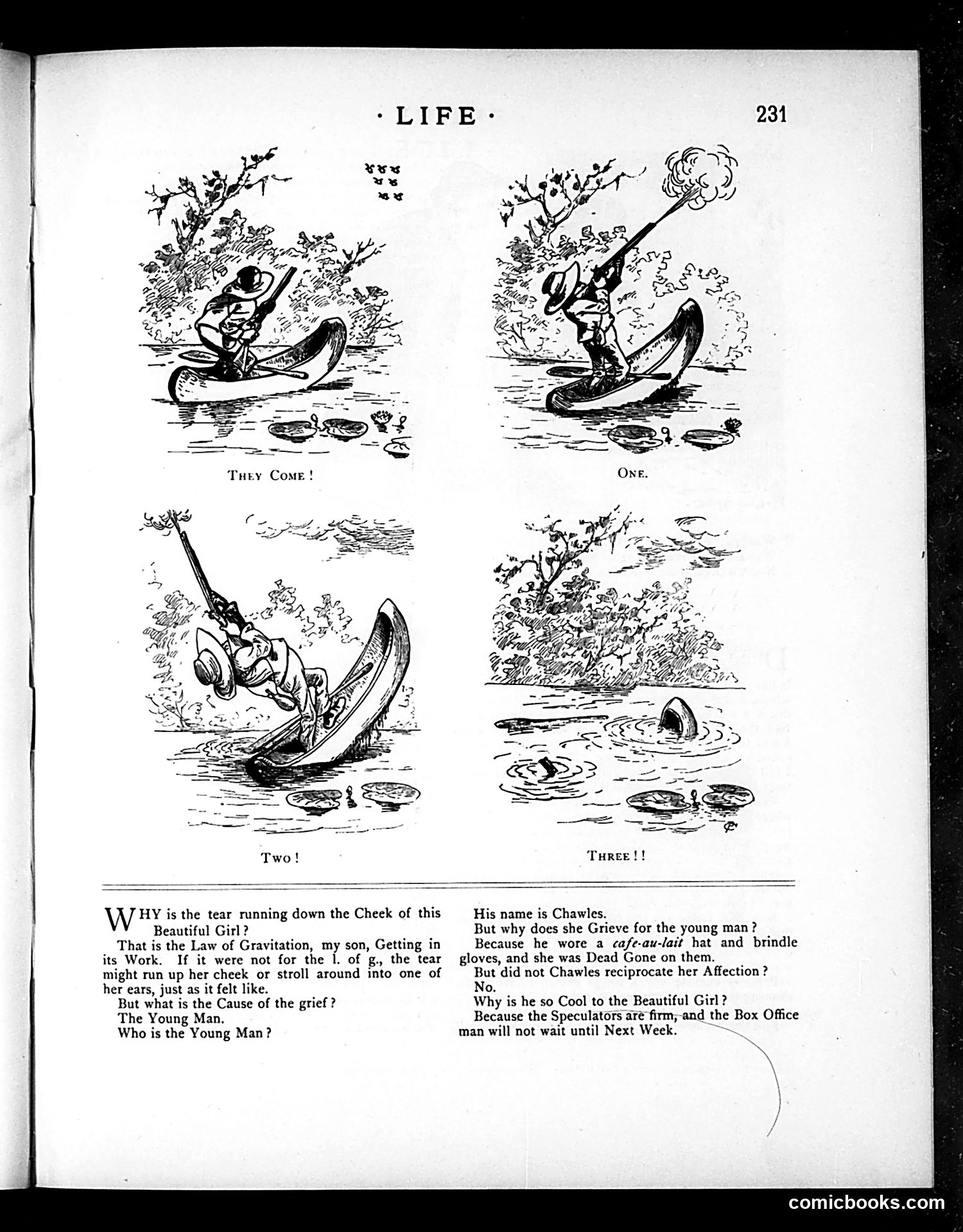
This page contains a humorous comic strip sequence showing a figure in a small boat catching fish, numbered "They Come!," "One," "Two!," and "Three!!" The progression depicts escalating chaos as the catch increases. Below, a dialogue explains the scene through theatrical/romantic satire. A "Beautiful Girl" cries over a young man named Chawles who wore "café-au-lait and brindle gloves" and is now "Dead Gone." The humor relies on wordplay (the "l" in gravitation affecting tear physics) and references theater box office mechanics—suggesting the young man's coolness depends on spectators and ticket availability. The satire appears to mock theatrical melodrama and audience-dependent romance rather than addressing specific political figures.
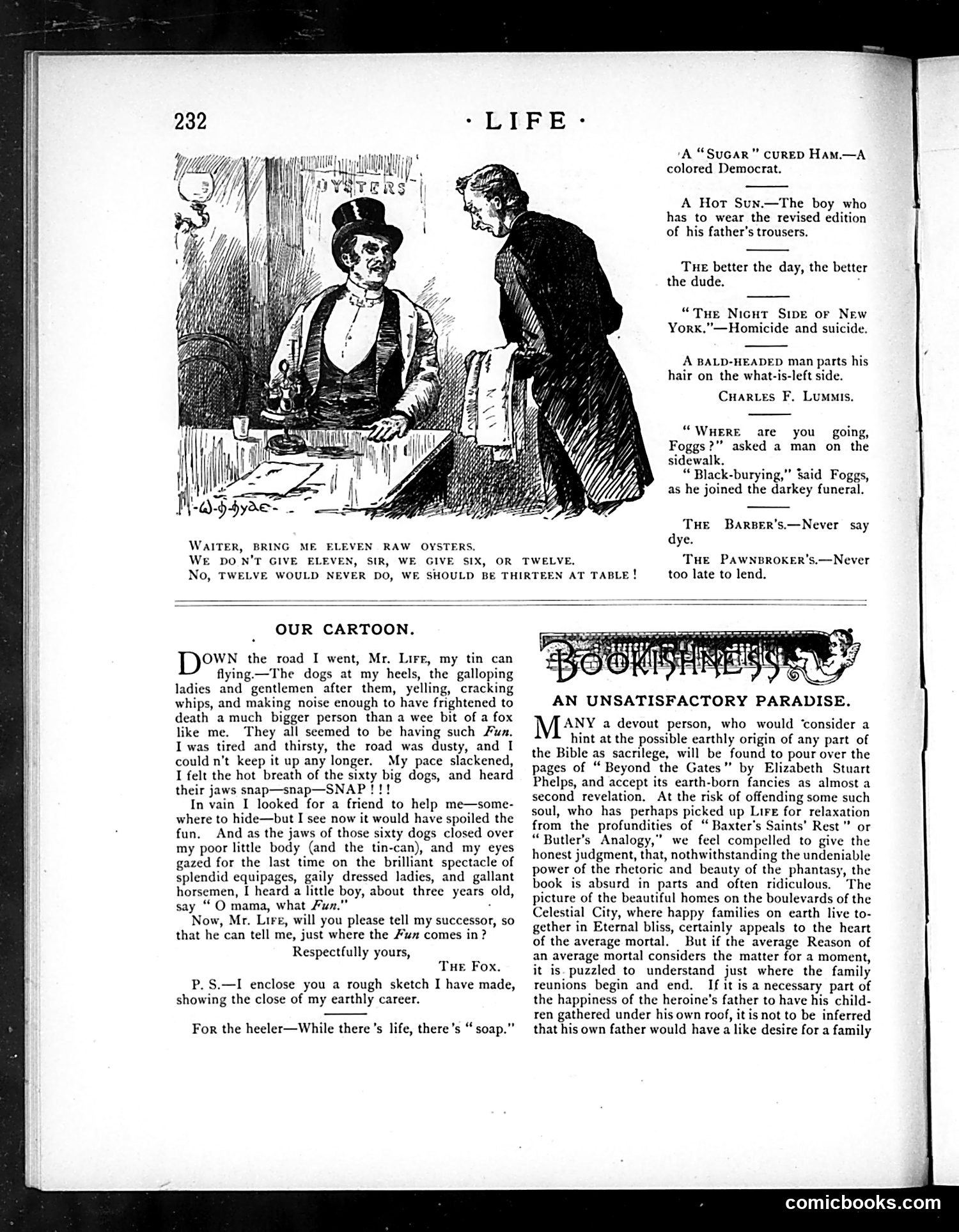
The main cartoon depicts a waiter and customer in what appears to be a restaurant dispute. The waiter insists they serve only six, twelve, or thirteen oysters per order—never eleven—suggesting either a rigid house rule or a joke about superstition (thirteen being unlucky). The humor likely plays on restaurant absurdity and customer frustration. The right column contains brief aphorisms and satirical observations typical of Life's humor section, including critiques of politicians ("colored Democrat"), social pretension, and urban life ("The Night Side of New York"). The longer "Our Cartoon" piece is a humorous essay signed "The Fox" about a country journey, using animal metaphors to comment on rural pleasures versus urban life. The specific political or social targets are unclear from this excerpt alone.
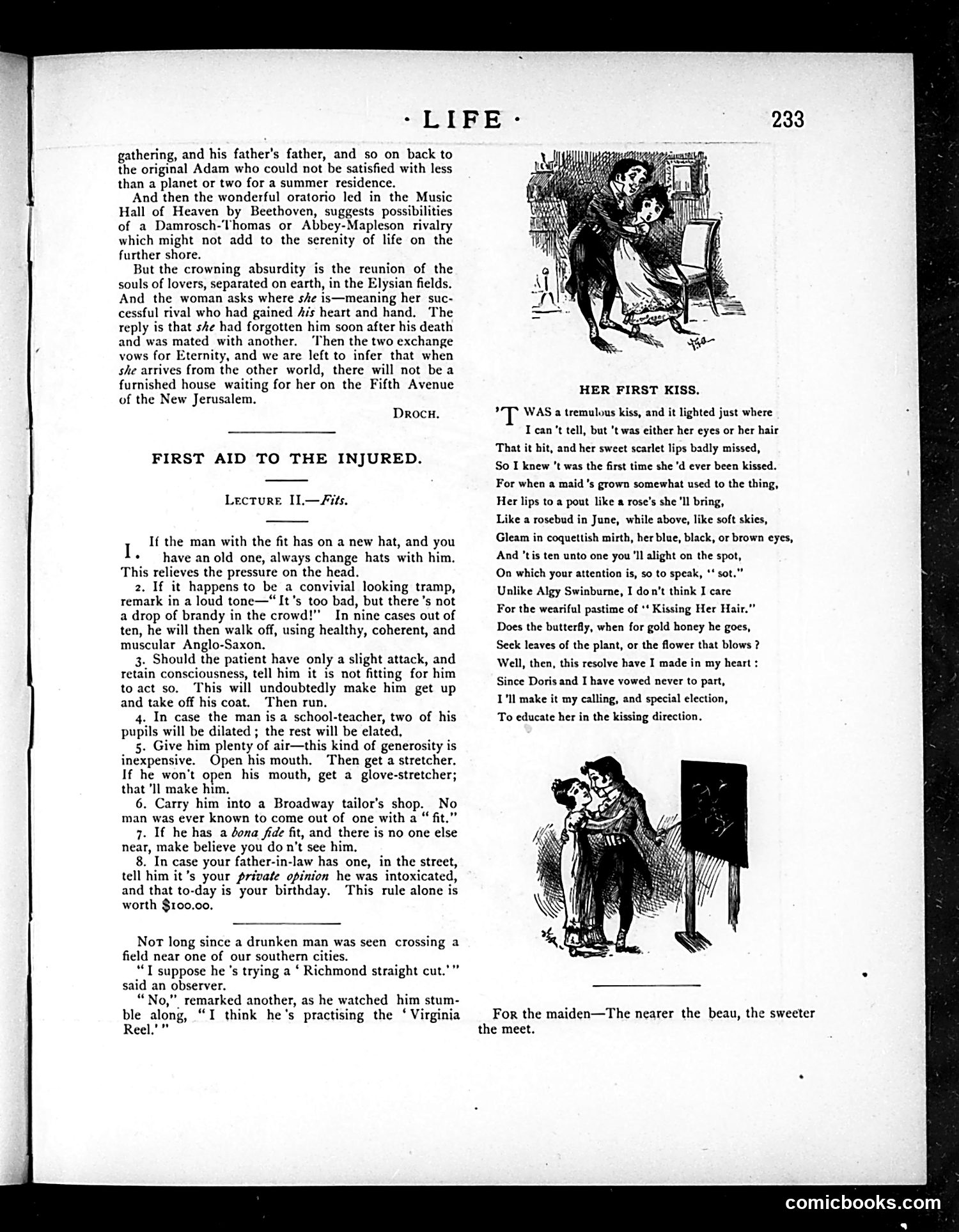
This page contains two distinct pieces of humor: **"First Aid to the Injured"** (left column) is a lecture offering practical advice for treating injuries and handling medical situations. The eight numbered tips cover issues like hat-swapping during unconsciousness and carrying drunken men to tailors' shops to make their condition seem intentional. The humor relies on absurdist logic and social commentary about gentlemen's behavior and propriety. **"Her First Kiss"** (right) is a romantic poem illustrated with period engravings. The verse humorously describes a young woman's first kiss experience, contrasting her excitement with sentimental language about butterflies and flowers. The satire mocks Victorian romantic conventions and flowery love poetry through exaggerated sentimentality.
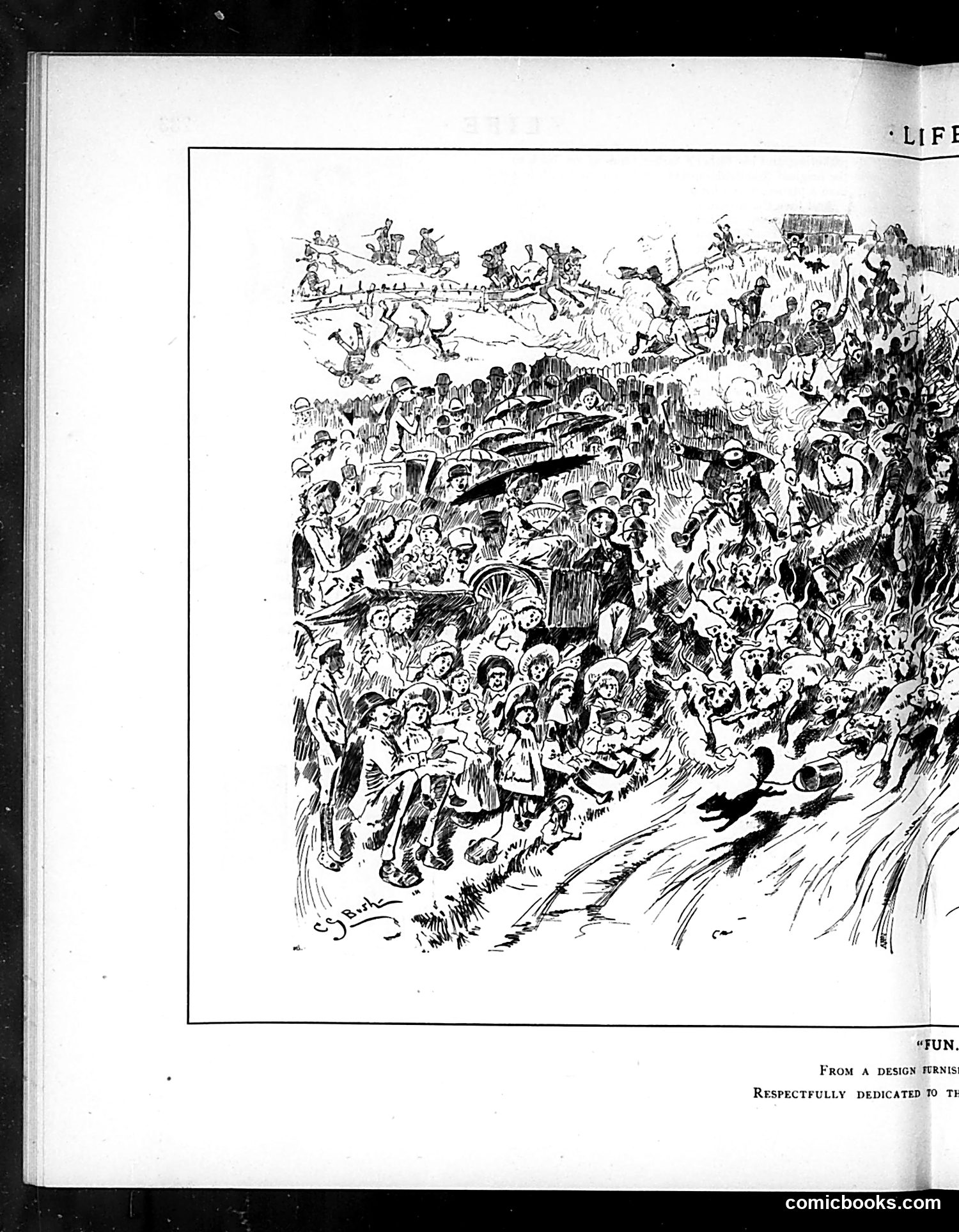
This appears to be a satirical illustration from *Life* magazine showing a massive, chaotic crowd scene. The drawing depicts hundreds of figures packed densely together in what seems to be a public gathering or event—possibly a beach, fair, or popular entertainment venue. The cartoon's point appears to be social satire about **overcrowding and mass culture**. The sheer density of humanity, rendered in intricate detail, suggests commentary on: - American consumerism and public spectacles drawing enormous crowds - The loss of individual identity in mass society - Urban congestion or recreational overcrowding The caption references "FUN" and mentions a design, though the full text is partially obscured. The artist's signature appears present. Without complete caption information, the specific event being satirized remains unclear, but the visual commentary on crowding and conformity is evident.
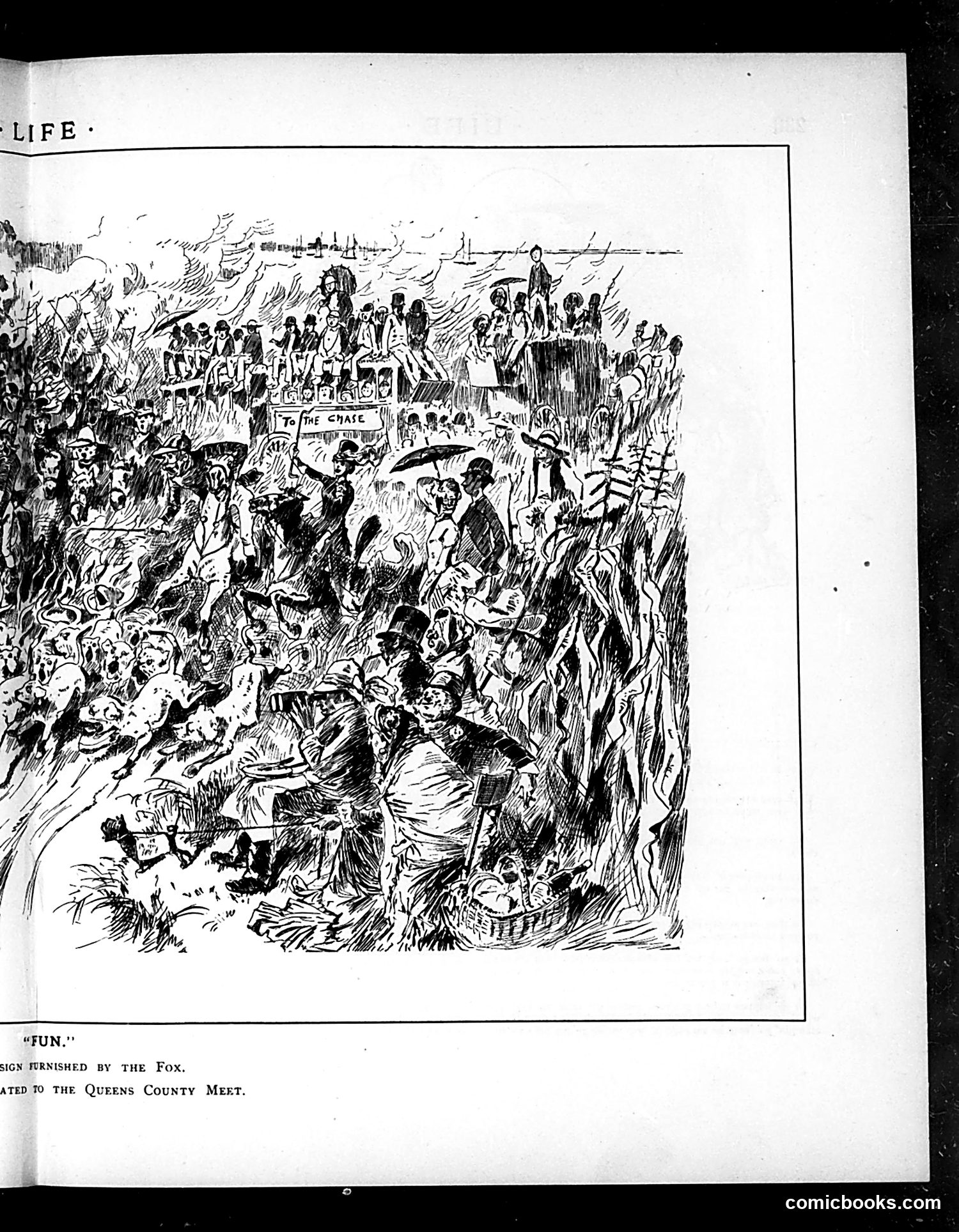
This is a satirical illustration titled "FUN" depicting a chaotic hunting scene. The text indicates it relates to "the Queens County Meet" — a fox hunt event. The cartoon satirizes fox hunting culture through exaggerated chaos: dozens of figures (hunters, spectators, and horses) are depicted in wild disorder rather than the orderly sport fox hunting was meant to be. The crowd appears uncontrolled and comical. The caption notes the design was "furnished by the Fox," a humorous personification suggesting the fox itself is the artist — implying the fox has made a mockery of the hunters' sporting pretensions. This appears to be satire mocking the pretensions and disorderly conduct of fox hunting participants, using the traditional British countryside sport as a target for ridicule in this American satirical magazine.
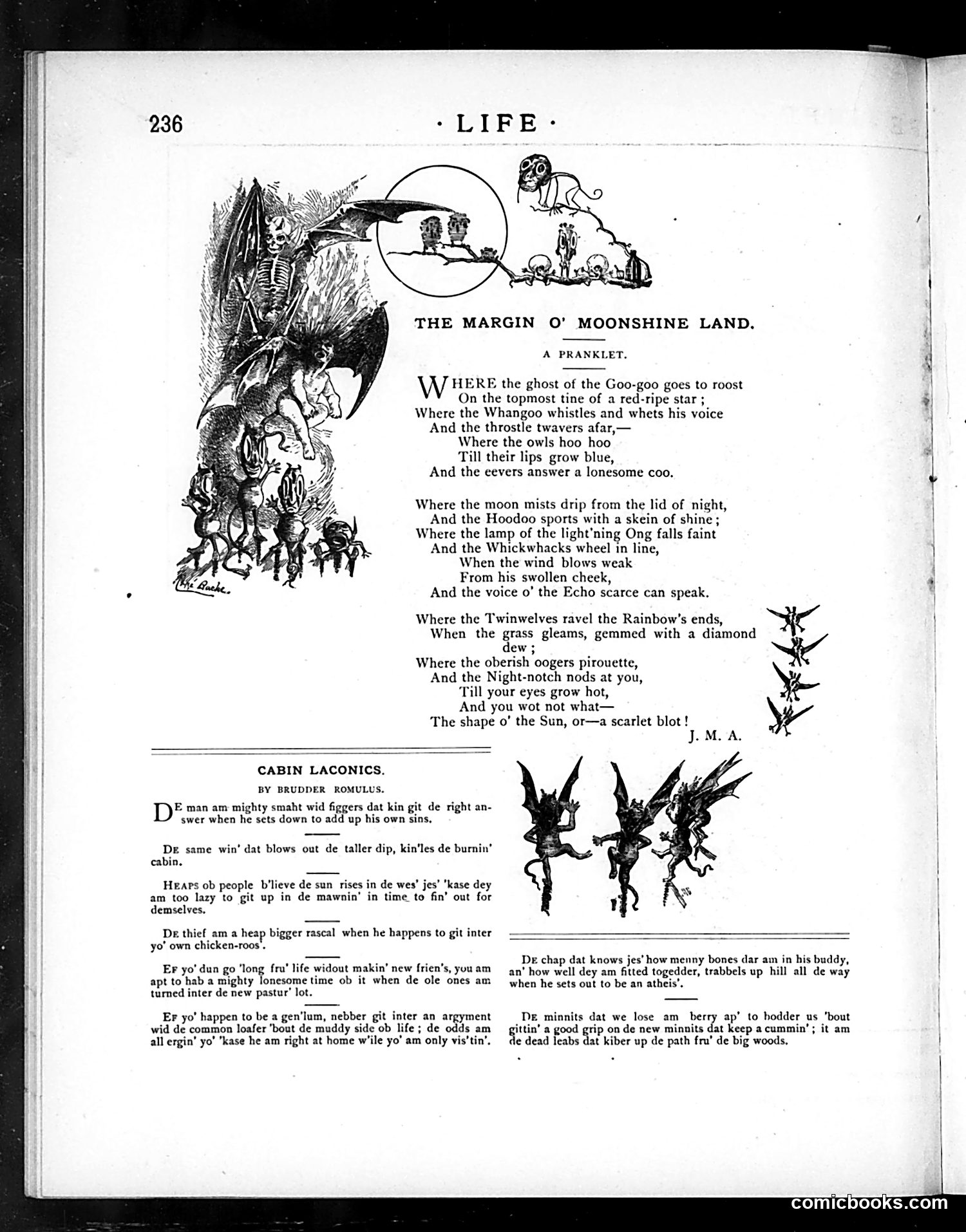
This page contains two distinct pieces of satirical content: **"The Margin o' Moonshine Land"** (top) is whimsical nonsense verse by J.M.A., featuring invented fantastical creatures ("Goo-goo," "Whangoo," "oberish oogers") in a dreamlike landscape. It's playful absurdist humor with no political meaning—pure imaginative entertainment. **"Cabin Laconics"** (bottom) by "Brudder Romulus" presents dialect-heavy folk wisdom spoken in exaggerated African American vernacular. These are brief moral observations about human nature: men are skilled at self-deception, thieves are worse when stealing from you personally, loneliness follows losing old friends, etc. The heavy dialect ("jes'," "kase," "dey") reflects period conventions of minstrelsy-influenced humor. While the observations themselves are sensible, the presentation relies on racial caricature stereotypes common to early 20th-century American satire magazines.
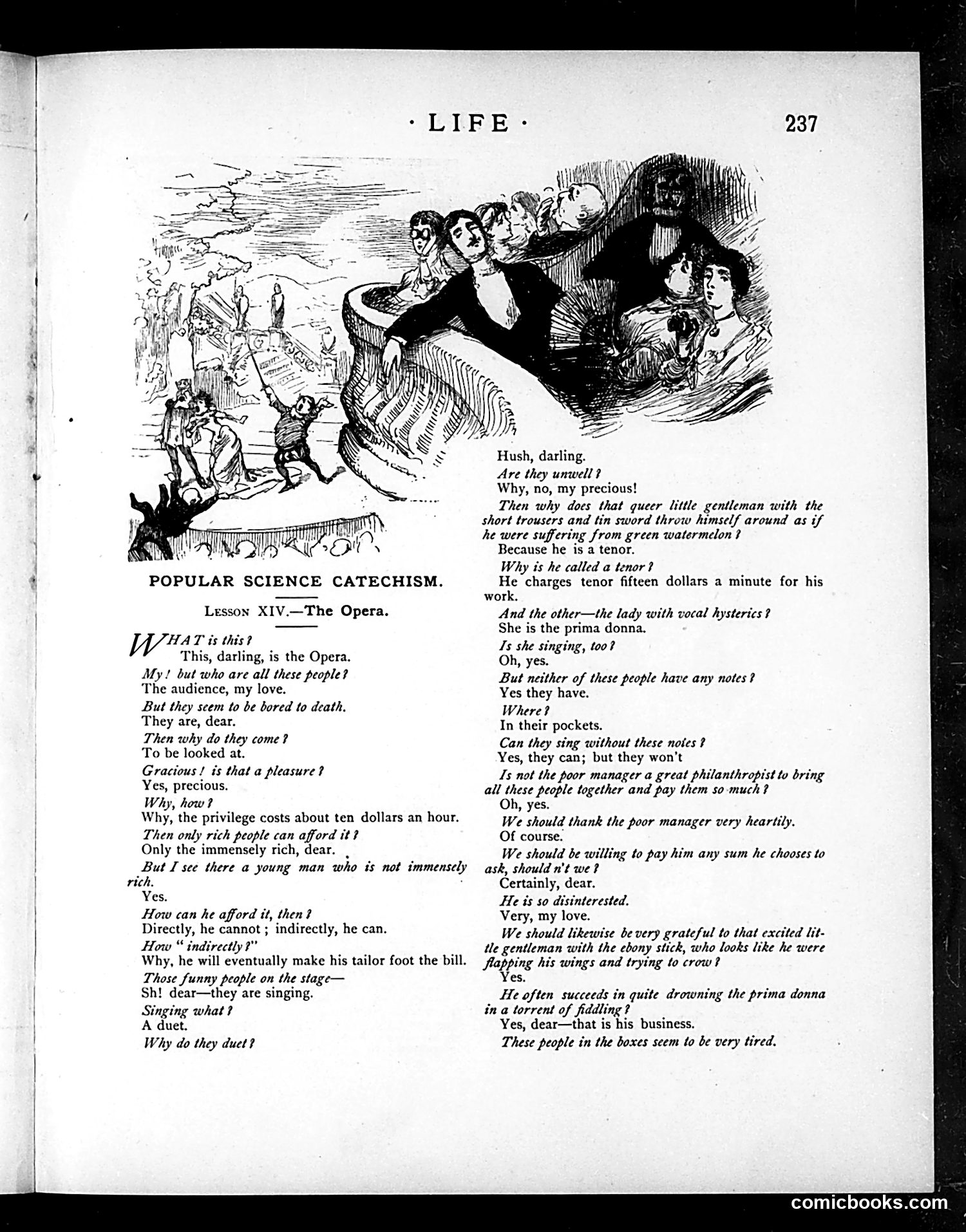
This is a comedic "catechism" (Q&A lesson) mocking opera culture and its audience. The dialogue presents opera as a ritualistic display of wealth rather than genuine art appreciation. Key satirical points: **The Audience**: Wealthy patrons attend not for artistic merit but to be seen, paying "ten dollars an hour" for the privilege—a fortune then. **The Performers**: The tenor (a man in short trousers with a sword) is mocked for dramatic overacting ("suffering from green watermelon") and demands exorbitant pay ("fifteen dollars a minute"). The prima donna similarly performs histrionically. **The Conductor**: The "excited little gentleman with the ebony stick" (conductor) drowns out singers with excessive orchestration—his actual "business." **The Joke**: Opera is portrayed as expensive pretense where neither performers nor audience genuinely care about the art, everyone is financially motivated, and the whole enterprise depends on wealthy patrons' social vanity. The illustration shows bored, wealthy box-seat occupants, confirming the text's satire.
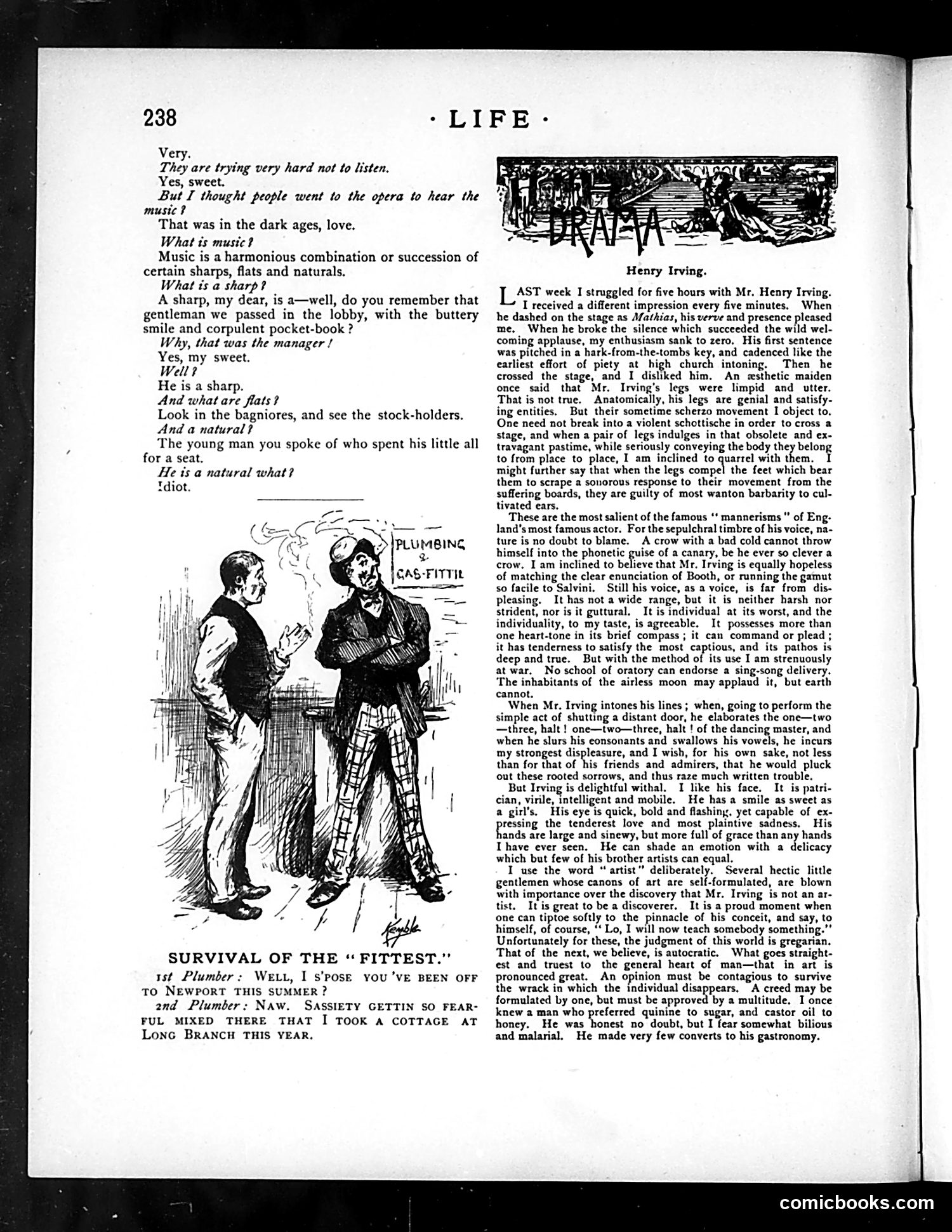
This Life magazine page (page 238) contains two distinct pieces of satire: **Top: Opera House Dialogue** — A couple at the opera discusses what "music" means. The joke mocks pretentious society: the wife defines music academically, then compares a "sharp" to the obese manager, and "flats" to stock-holders sitting in cheap seats, calling the young man who spent all his money on a ticket an "idiot." This satirizes class divisions and the absurdity of high-society posturing at cultural events. **Bottom: Working-Class Plumbers** — Two plumbers discuss summer vacation spots. One avoided Newport because "society" has become too chaotic/mixed there, so he took a cottage at Long Branch instead. The "Survival of the Fittest" title suggests social anxiety about class mixing—even tradesmen are fleeing exclusive resorts because wealthy society has become too crowded and chaotic. **Right: Henry Irving Review** — The lengthy text critiques the famous English actor's theatrical mannerisms—his affected voice, exaggerated leg movements, and sing-song delivery—despite acknowledging his genuine talent. It's a backhanded compliment typical of period theater criticism.
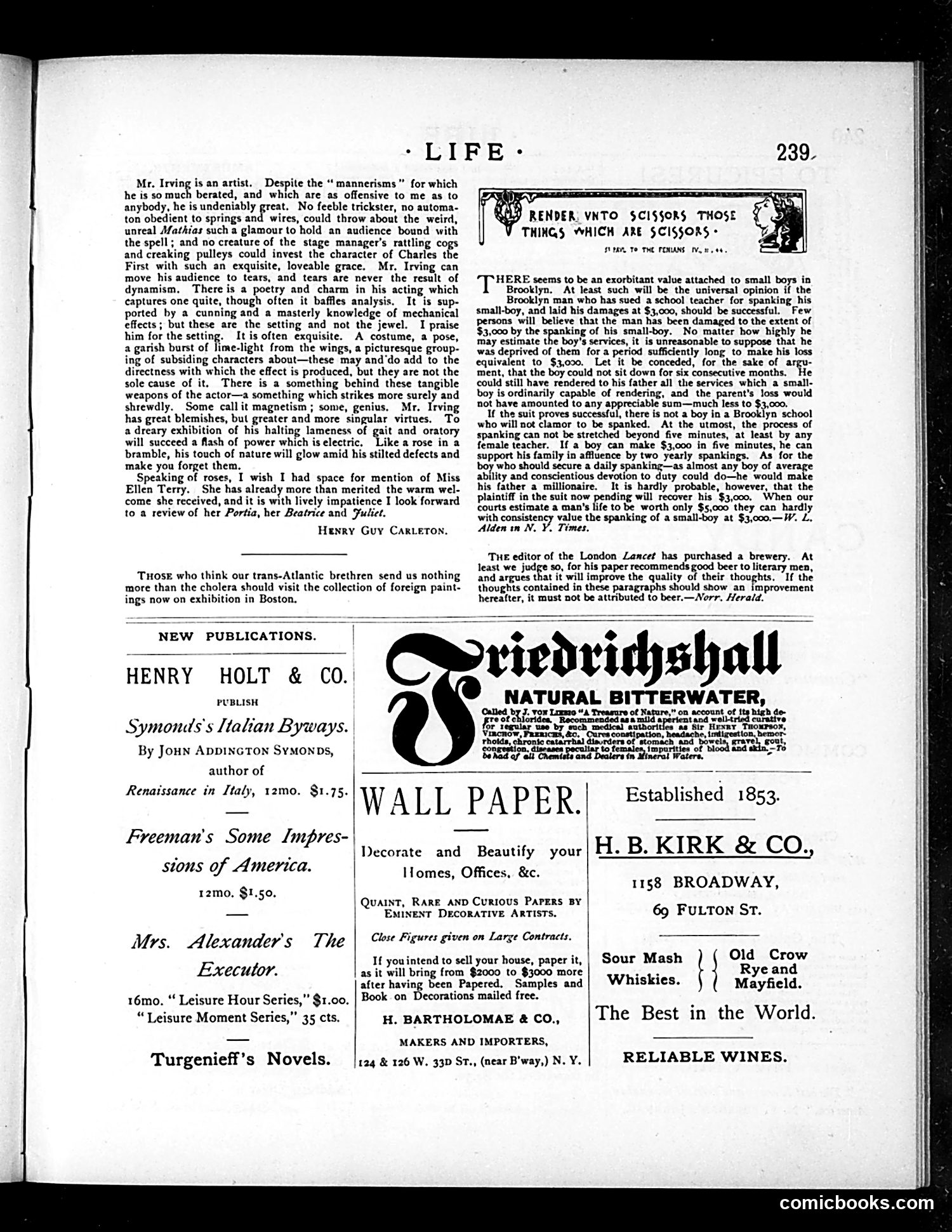
This page contains a satirical commentary (by Henry Guy Carleton) on a lawsuit filed by a Brooklyn father against a schoolteacher who spanked his son. The father is seeking $3,000 in damages. The satire works through **reductio ad absurdum**: if a brief spanking genuinely causes $3,000 worth of harm, then spanking becomes extraordinarily profitable. The author mockingly calculates that a boy receiving daily spankings could make his father a millionaire, and that every Brooklyn schoolboy would eagerly seek punishment for such financial gain. The opening epigraph—"Render unto scissors those things which are scissors"—is a biblical parody (playing on "render unto Caesar") that establishes the joke's framework about proper proportions and what deserves what. The satire attacks both the father's unreasonable damage claim and, implicitly, the growing litigation culture around corporal punishment in schools. The piece suggests the lawsuit is financially absurd and logically indefensible.
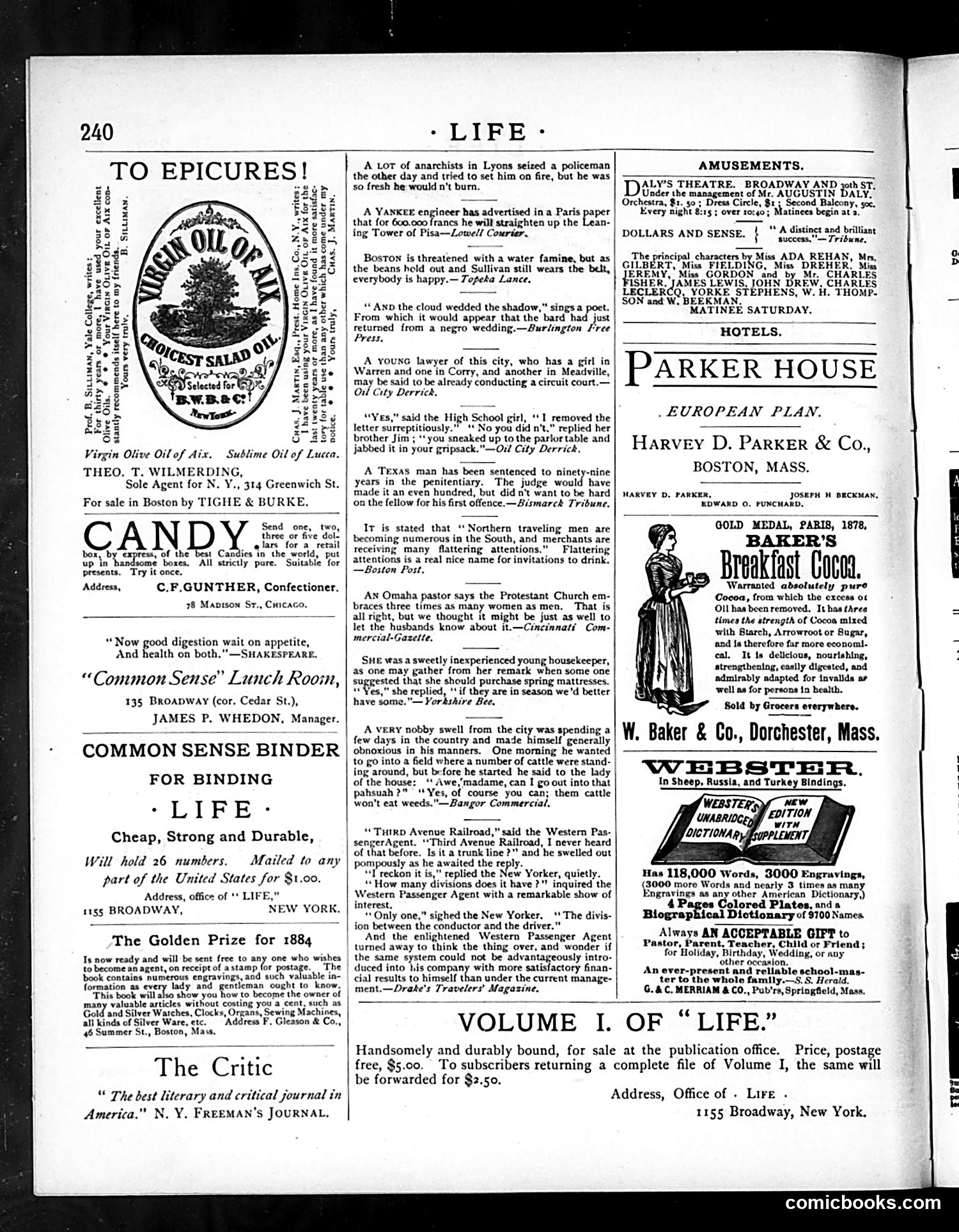
This page is primarily **advertising and announcements**, not political satire. The small cartoon at top left appears to be a product advertisement for "Virgin Oil of Arlx" cooking oil, showing a classical olive oil label design. The bulk of the page contains **humor items and jokes** typical of Life's satirical style—brief, often cynical observations about contemporary life. These include: anarchists in France too "fresh" to burn, a Yankee engineer offering to straighten the Leaning Tower, Boston's water shortage, a young lawyer juggling three girlfriends, and a Southern observation about Northern traveling men receiving "flattering attentions" (drinking invitations). The remaining space features **classified advertisements** for candy, lunch rooms, book binders, and competing publications like *The Critic* and *Webster's Dictionary*. There is **no significant political cartoon** on this page—it's a typical late 1880s magazine mixture of brief jokes, product ads, and service announcements.
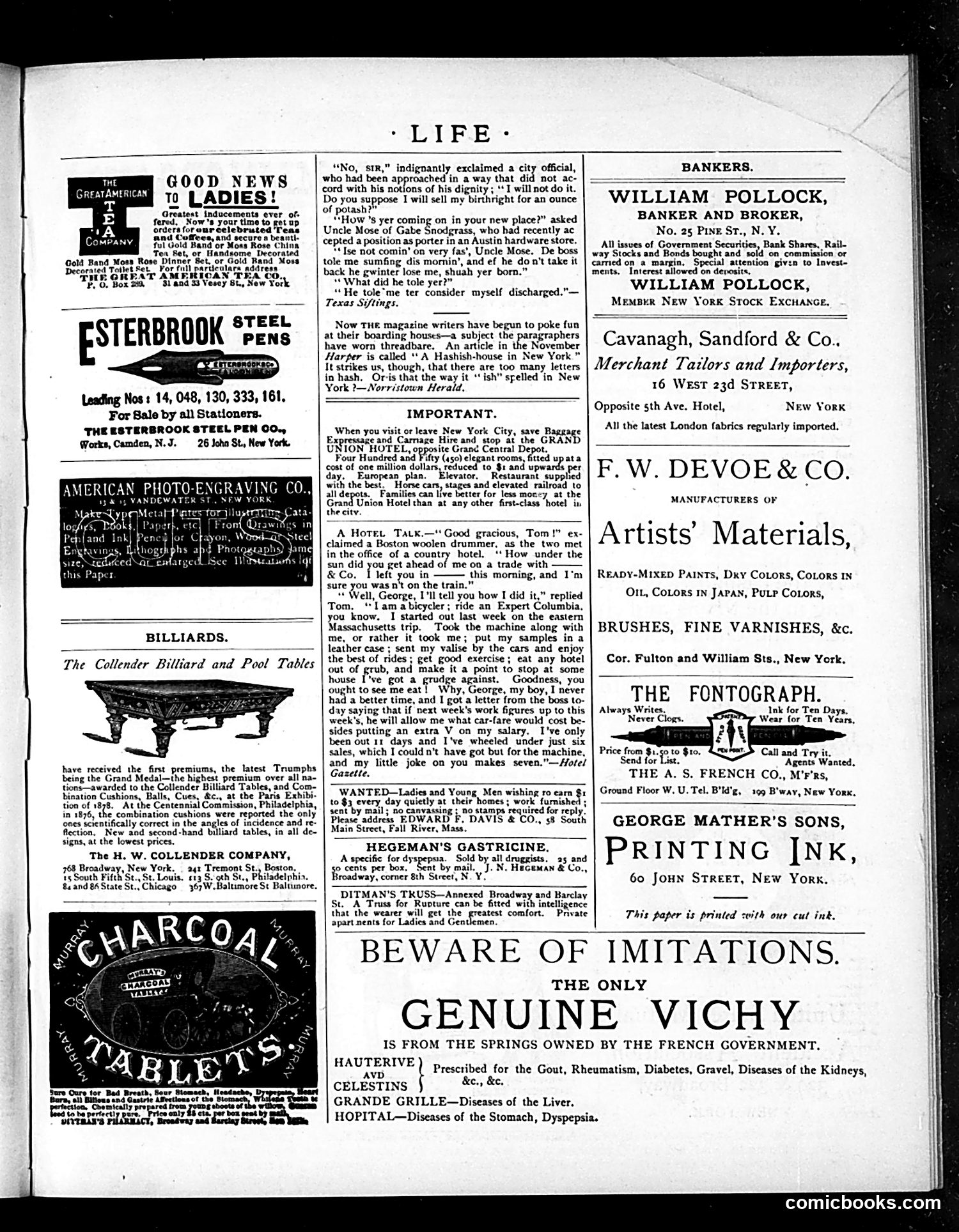
This is primarily an **advertising page** from Life magazine, not a political cartoon page. The advertisements showcase various late 19th/early 20th-century commercial products: steel pens, billiard tables, photo-engraving services, artists' materials, printing ink, and patent medicines like Hegeman's Gastricine and Vichy water. The only satirical content is a brief anecdote titled "A Hotel Talk" about a man named Tom bragging to George about saving money through various tricks—bicycle riding, using a hotel's laundry machine, and economizing on meals. George's response satirizes Tom's penny-pinching as ultimately self-defeating and annoying. The page demonstrates how Life mixed humor with advertisements to support its publication.
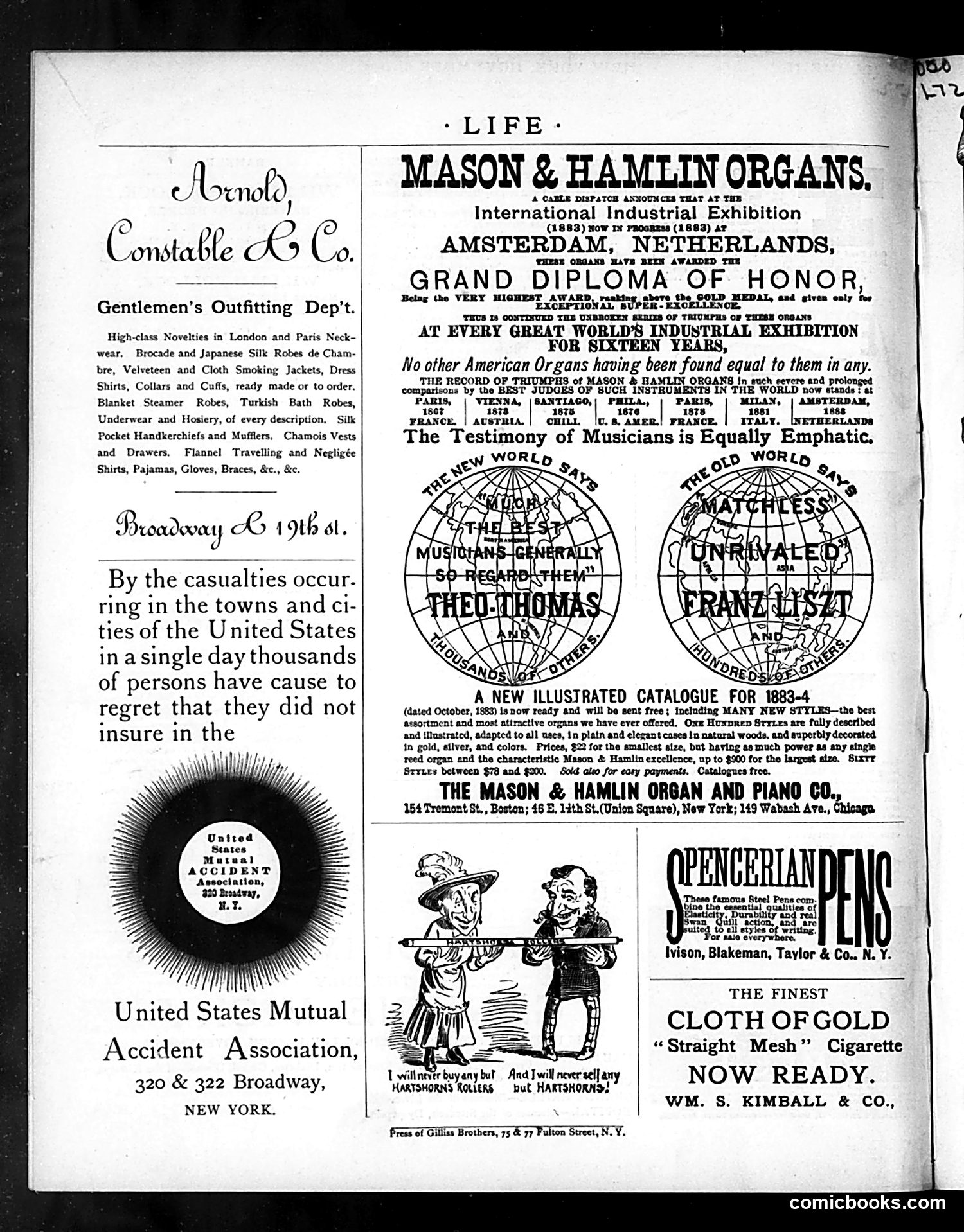
This page is primarily **advertising**, not political satire. It contains multiple commercial advertisements from the 1880s: The dominant ad promotes **Mason & Hamlin Organs**, highlighting their "Grand Diploma of Honor" at the Amsterdam International Industrial Exhibition. The ad emphasizes these American organs won highest awards at major world exhibitions over sixteen years, with testimonials from musicians. A small cartoon appears mid-page showing two figures in what appears to be a humorous disagreement about **Hartshorn Rollers** (window shade hardware)—one refuses to buy anything but Hartshorns; the other refuses to sell anything but Hartshorns. This is a light joke about brand loyalty, not political commentary. Other ads include: - Arnold Constable & Co. (gentlemen's clothing) - United States Mutual Accident Association (insurance) - Spencer & Pens (writing instruments) - Wm. S. Kimball & Co. (cigarettes) The page reflects Victorian-era consumer culture and competitive advertising rather than satirical commentary.