
Life, 1883-11-08 · page 11 of 16
Life — November 8, 1883 — page 11: what you’re looking at
What you’re looking at
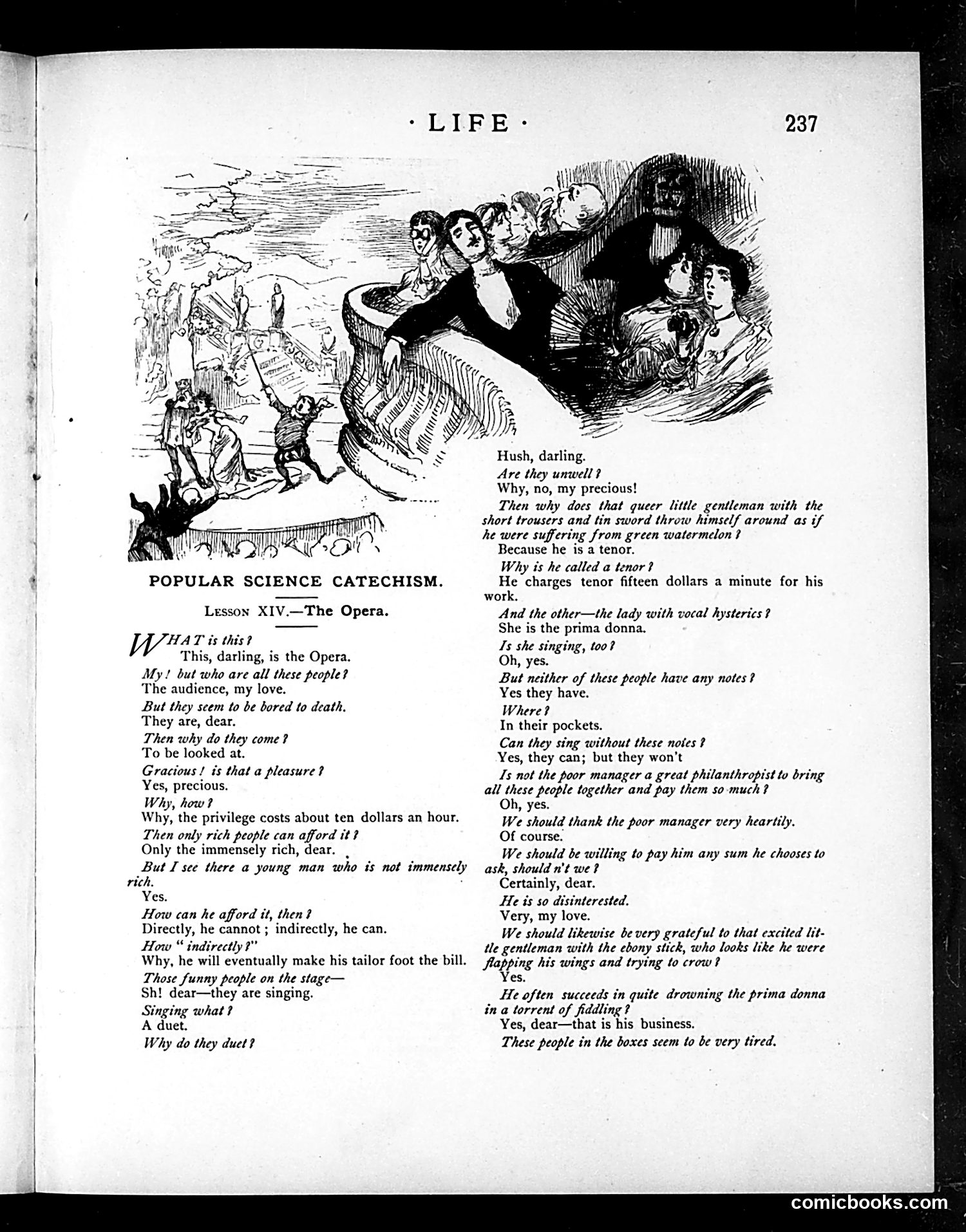
This is a comedic "catechism" (Q&A lesson) mocking opera culture and its audience. The dialogue presents opera as a ritualistic display of wealth rather than genuine art appreciation. Key satirical points: **The Audience**: Wealthy patrons attend not for artistic merit but to be seen, paying "ten dollars an hour" for the privilege—a fortune then. **The Performers**: The tenor (a man in short trousers with a sword) is mocked for dramatic overacting ("suffering from green watermelon") and demands exorbitant pay ("fifteen dollars a minute"). The prima donna similarly performs histrionically. **The Conductor**: The "excited little gentleman with the ebony stick" (conductor) drowns out singers with excessive orchestration—his actual "business." **The Joke**: Opera is portrayed as expensive pretense where neither performers nor audience genuinely care about the art, everyone is financially motivated, and the whole enterprise depends on wealthy patrons' social vanity. The illustration shows bored, wealthy box-seat occupants, confirming the text's satire.
📄 Transcribed text from this page (OCR, searchable)
Machine-transcribed from the original scan — historical spelling and the odd misread are preserved.
% POPULAR SCIENCE CATECHISM. Lesson XIV.—The Opera. HAT is this? This, darling, is the Opera. My! but who are all these people? The audience, my love. But they seem to be bored to death. They are, dear. Then why do they come? To be looked at. Gracious! is thata pleasure? Yes, precious. Why, how? Why, the privilege costs about ten dollars an hour. Then only rich people can afford it? Only the immensely rich, dear. , | But I see there a young man who ts not immensely | rich. | Yes. | How can he afford it, then? | Directly, he cannot ; indirectly, he can. | How “ indirectly?” | Why, he will eventually make his tailor foot the bill. Those funny people on the stage— Sh! dear—they are singing. Singing what? A duet. Why do they duet? Hush, darling. Are they unwell? Why, no, my precious! Then why does that queer little gentleman with the short trousers and tin sword throw himself around as if he were suffering from green watermelon? Because he is a tenor. Why is he called a tenor? He charges tenor fifteen dollars a minute for his work. And the other—the lady with vocal hysterics? She is the prima donna. Ts she singing, too? Oh, yes. But neither of these people have any notes? Yes they have. Where? In their pockets. Can they sing without these notes? Yes, they can; but they won't Is not the poor manager a great philanthropist to bring all these people together and pay them so-much? Oh, yes. We should thank the poor manager very heartily. Of course. We should be willing to pay him any sum he chooses to ask, should n't we? Certainly, dear. He ts so disinterested. Very, my love. We should likewise be very grateful to that excited lit- de gentleman with the ebony stick, who looks like he were Slapping his wings and trying to crow? Yes. He often succeeds in quite drowning the prima donna ina torrent of fiddling? Yes, dear—that is his business. These people in the boxes seem to be very tired. comicbooks.com