
A complete issue · 16 pages · 1883
Life — November 1, 1883
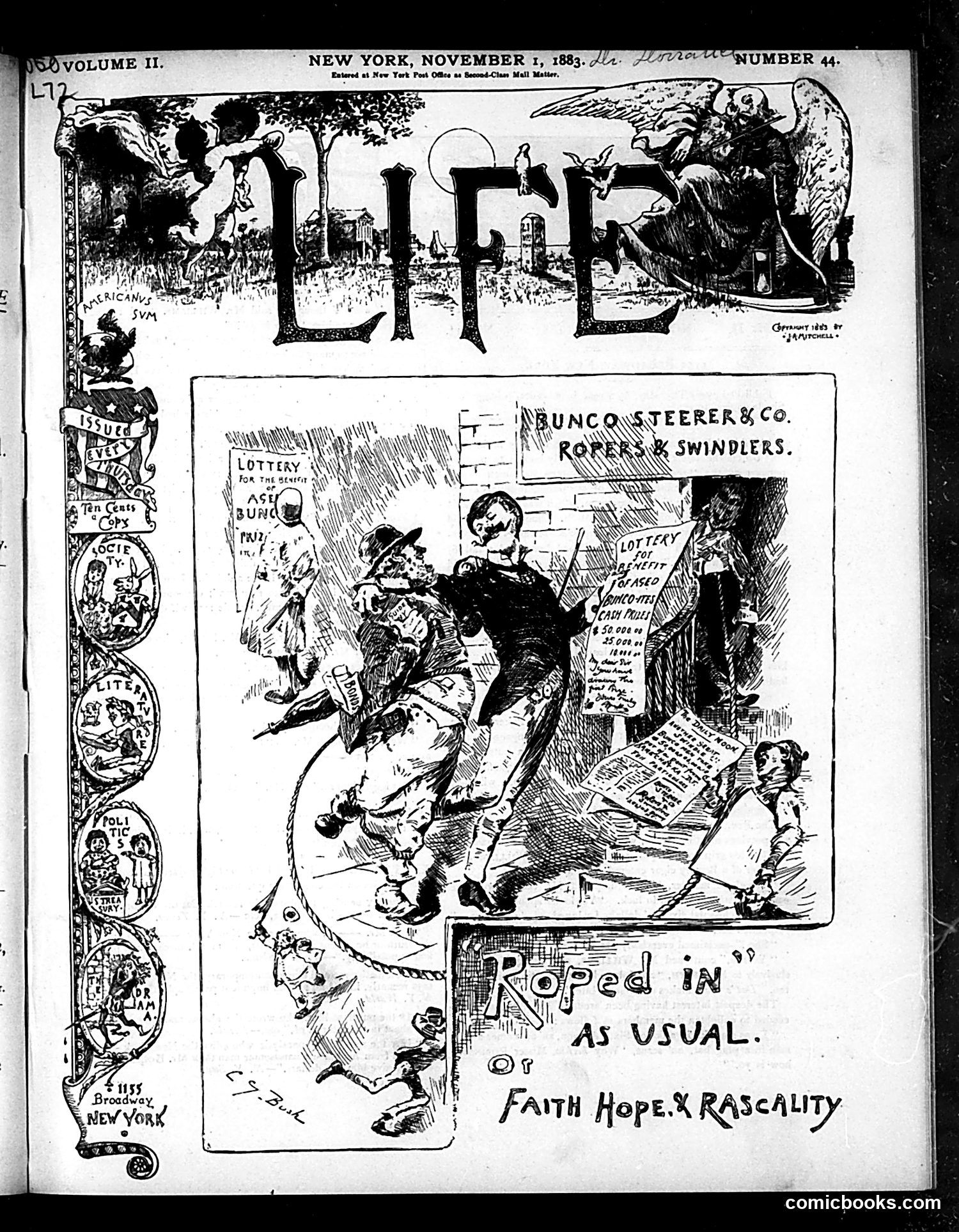
This satirical cartoon criticizes the "Bunco Steerer & Co." — con artists running lotteries and swindles. The central figures appear to be fraudsters operating a lottery scheme, with posted signs advertising various lottery opportunities designed to bilk the public. The subtitle "Roped In 'As Usual' of Faith Hope & Rascality" indicates the satire targets gullible victims who repeatedly fall for such schemes despite being defrauded. The chaotic scene shows the mechanics of the con: operators managing lottery tickets, posting advertisements, and conducting their dishonest business. This reflects 1880s concerns about urban fraud and unregulated gambling schemes that preyed on working-class citizens. The cartoon critiques both the criminals operating these scams and the public's persistent vulnerability to them.
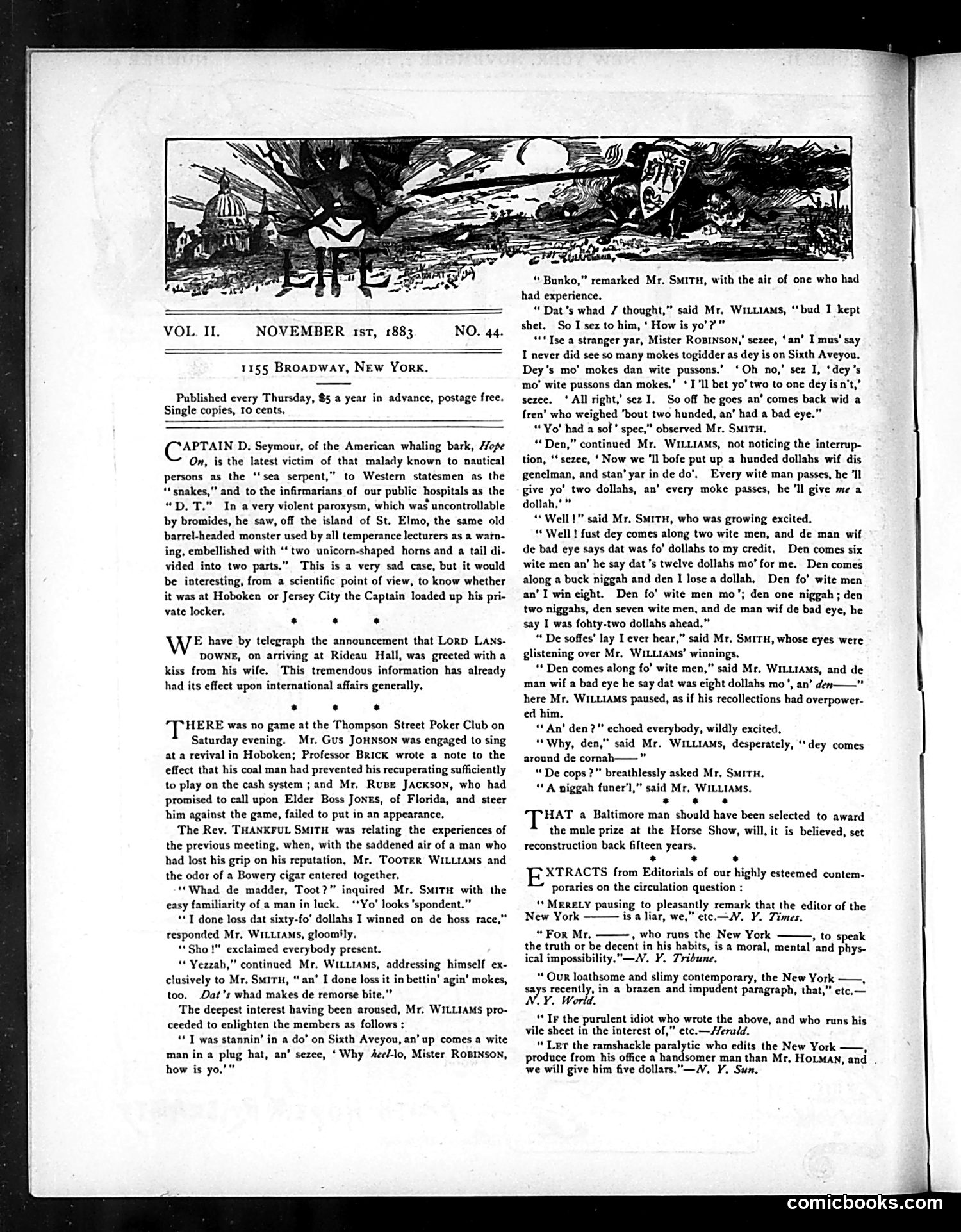
The banner cartoon depicts a dramatic nighttime scene with figures and celestial elements—the exact meaning is unclear from the image quality, but it appears to be a satirical illustration typical of Life's social commentary. The article "Captain D. Seymour, of the American whaling bark *Hope On*" discusses maritime safety concerns, particularly referencing a dangerous animal (likely a whale) that injured whalers. The text notes disagreement about whether the incident occurred near Hoboken or Jersey City. The page primarily contains satirical anecdotes and newspaper criticism excerpts, mocking various public figures and institutions. One piece ridicules a Baltimore man selected to award prizes at a Horse Show after fifteen years' absence—poking fun at his qualifications or relevance. Overall, this represents Life's typical 1880s format: mixing visual satire with pointed commentary on contemporary social absurdities.
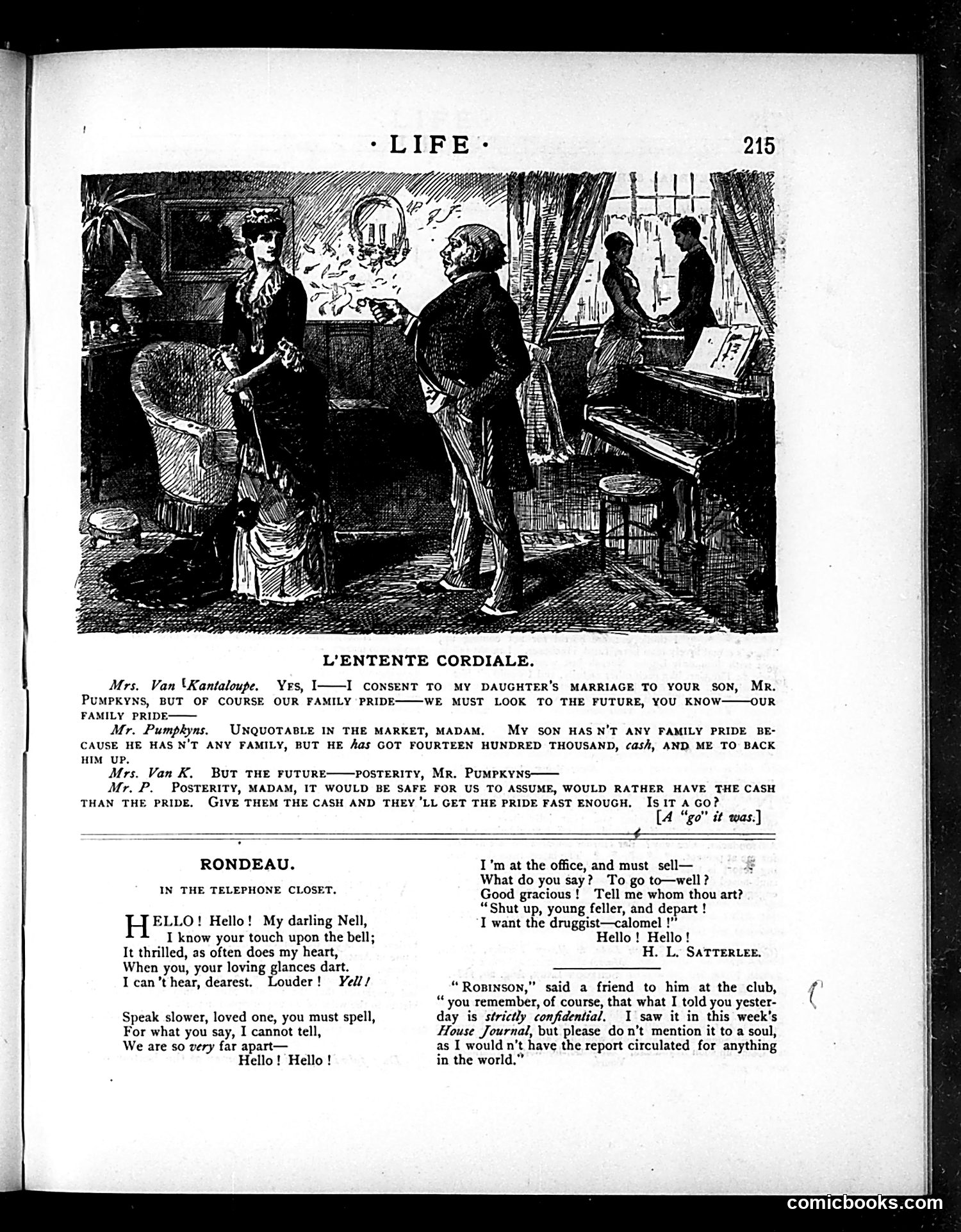
The top cartoon, "L'Entente Cordiale," depicts a marriage negotiation between two families. Mr. Van K(antaloupe) and Mr. Pumpkyns discuss their children's engagement, but disagree on financial arrangements. Van K insists on preserving "family pride," while Pumpkyns, lacking ancestral wealth, proposes giving cash instead—arguing money ensures the couple's future security better than pride. The satire mocks the tension between Old World aristocratic values (inherited status, family honor) and New World pragmatism (cash wealth). The French title references the Anglo-French diplomatic alliance, suggesting parallel negotiations between nations prioritizing pride versus practical interests. The lower section contains unrelated humorous poetry and a brief anecdote about discretion regarding club gossip.
This page contains no political cartoons. Instead, it's a collection of short letters and telegrams labeled "Several Scraps of Paper," featuring gossipy social correspondence from August 1888. The content includes personal notes about engagements, social events, and scandals among the upper classes—particularly regarding Lord Tinchaser and a woman named Josie de Thé-Cart. One section mocks American pretensions ("Y-YA-AS, this iss-aw-most-aw-awful country") and another reports a society wedding scandal. The page functions as satirical gossip column rather than political commentary, using humor to mock aristocratic affectation, social climbing, and romantic entanglements of the era's elite.
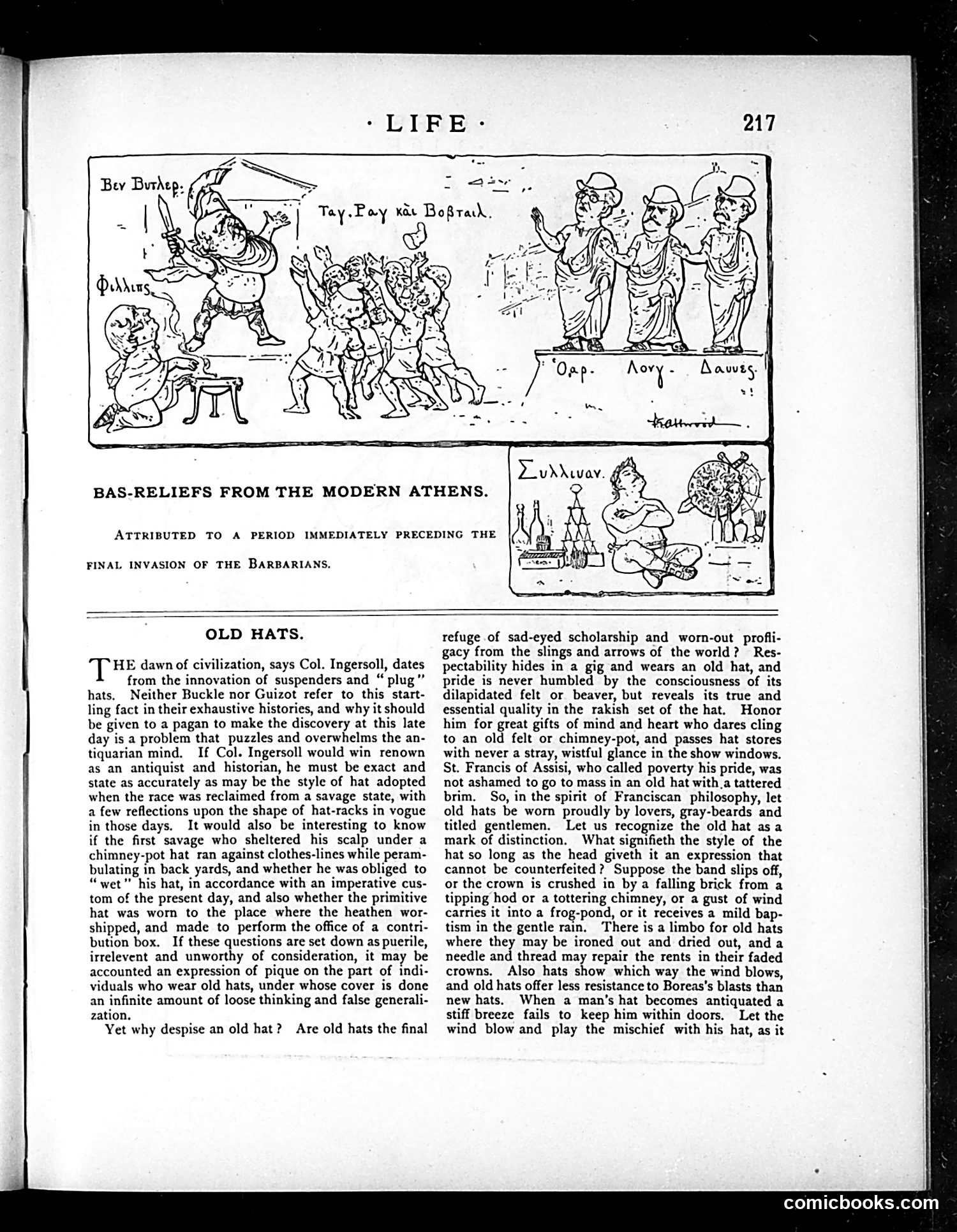
The upper cartoon depicts ancient Greek scenes labeled with Greek names (Tay, Fay, Bobtail, Philips, Opp, Aory, Dawes, Sullivan). These are **bas-reliefs from modern Athens** attributed to a period before "the final invasion of the barbarians." The joke appears to be satirizing contemporary American political figures by disguising them as classical Greek sculptures. The text labels suggest recognizable names from early 20th-century American politics, though the specific individuals remain unclear from the image alone. The lower section, "Old Hats," is an essay defending the wearing of old hats as a mark of distinction and character—a humorous counterpoint to fashion concern, emphasizing that worn hats reveal the wearer's indifference to frivolous social pretense.
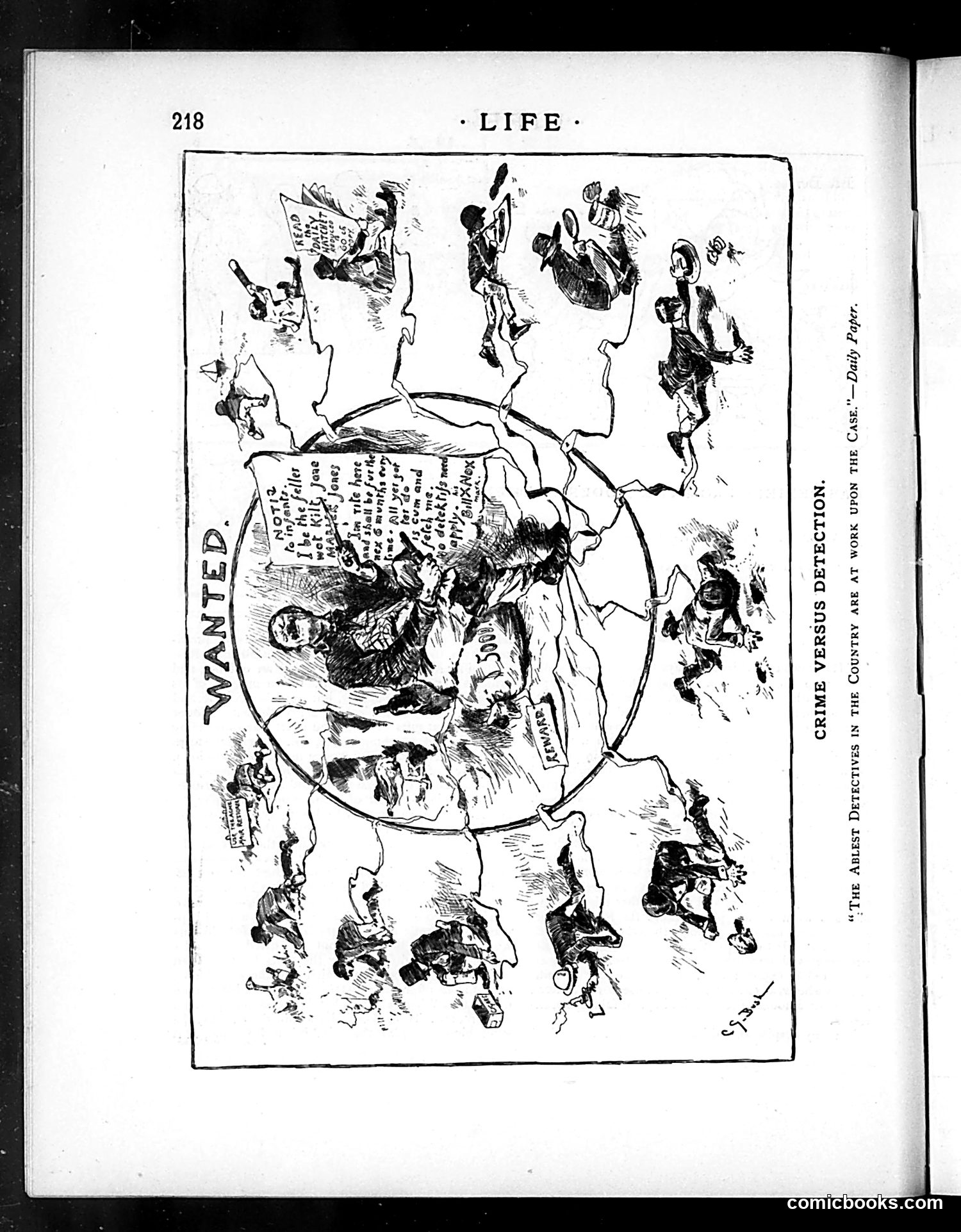
This satirical cartoon depicts the struggle between crime and law enforcement. The central figure labeled "WANTED" appears to represent criminal activity or a specific criminal, surrounded by various scenes of lawbreaking and disorder. Around the perimeter, figures labeled as detectives or police work to apprehend criminals. The title "Crime Versus Detection" suggests the cartoon comments on whether law enforcement can effectively combat rising crime. The chaotic arrangement of criminal figures suggests crime's proliferation, while the surrounding detectives represent authorities' attempts to maintain order. Without clearer identification of specific individuals or a visible date, the exact historical reference remains unclear, though this likely reflects early-to-mid 20th century concerns about organized crime or urban crime waves and police effectiveness.
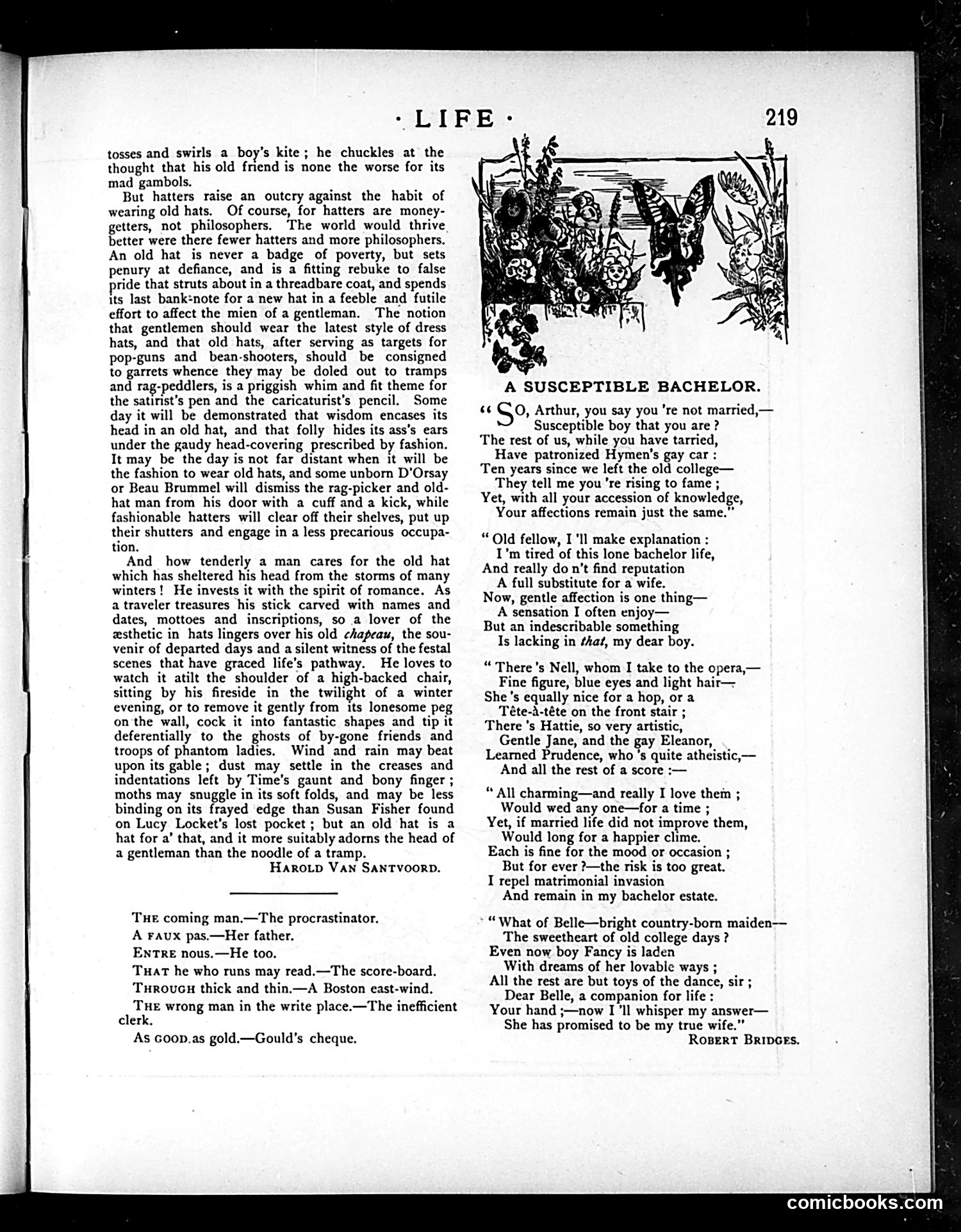
The main illustration titled "A Susceptible Bachelor" depicts a young man surrounded by four women in what appears to be a Victorian-era social setting. The accompanying poem by Robert Bridges presents a dialogue between the bachelor (Arthur) and a friend questioning why he remains unmarried despite his apparent popularity with women. The satire targets the social expectations and contradictions of bachelor life: Arthur claims bachelorhood offers freedom and independence, yet his friend points out he's equally devoted to various women. The joke centers on the bachelor's inability to commit while maintaining romantic entanglements—a commentary on the era's contradictory attitudes toward male independence versus marriageable responsibility. The illustration's crowded composition emphasizes his simultaneous attraction to multiple women, visualizing the satire's central tension.
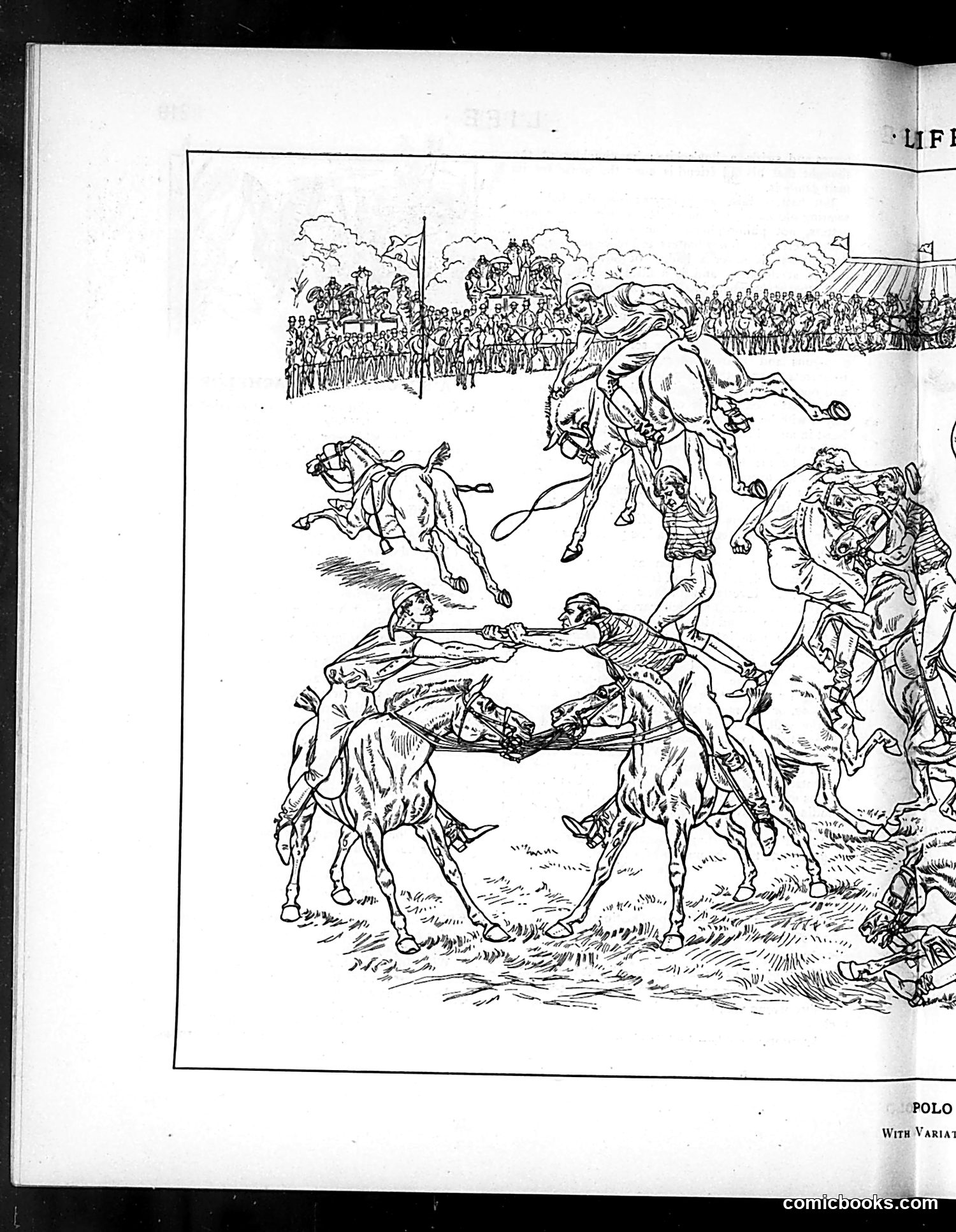
This appears to be a historical illustration about **polo**, a sport played on horseback. The image shows mounted players in active competition, with spectators gathered in the background. The text references "POLO" and mentions "WITH VARIAT[ION]" (partially cut off). The drawing depicts the sport's characteristic elements: horses, mallets, and players engaged in the game. The style and inclusion in *Life* magazine suggests this is either instructional or satirical commentary on polo—which was an elite, wealthy pastime in America. Without the complete caption or date visible, I cannot specify the exact satirical angle. However, given *Life*'s tradition of social commentary, this likely critiques polo as a frivolous upper-class pursuit, though the specific target or variation mentioned remains unclear from the visible text.
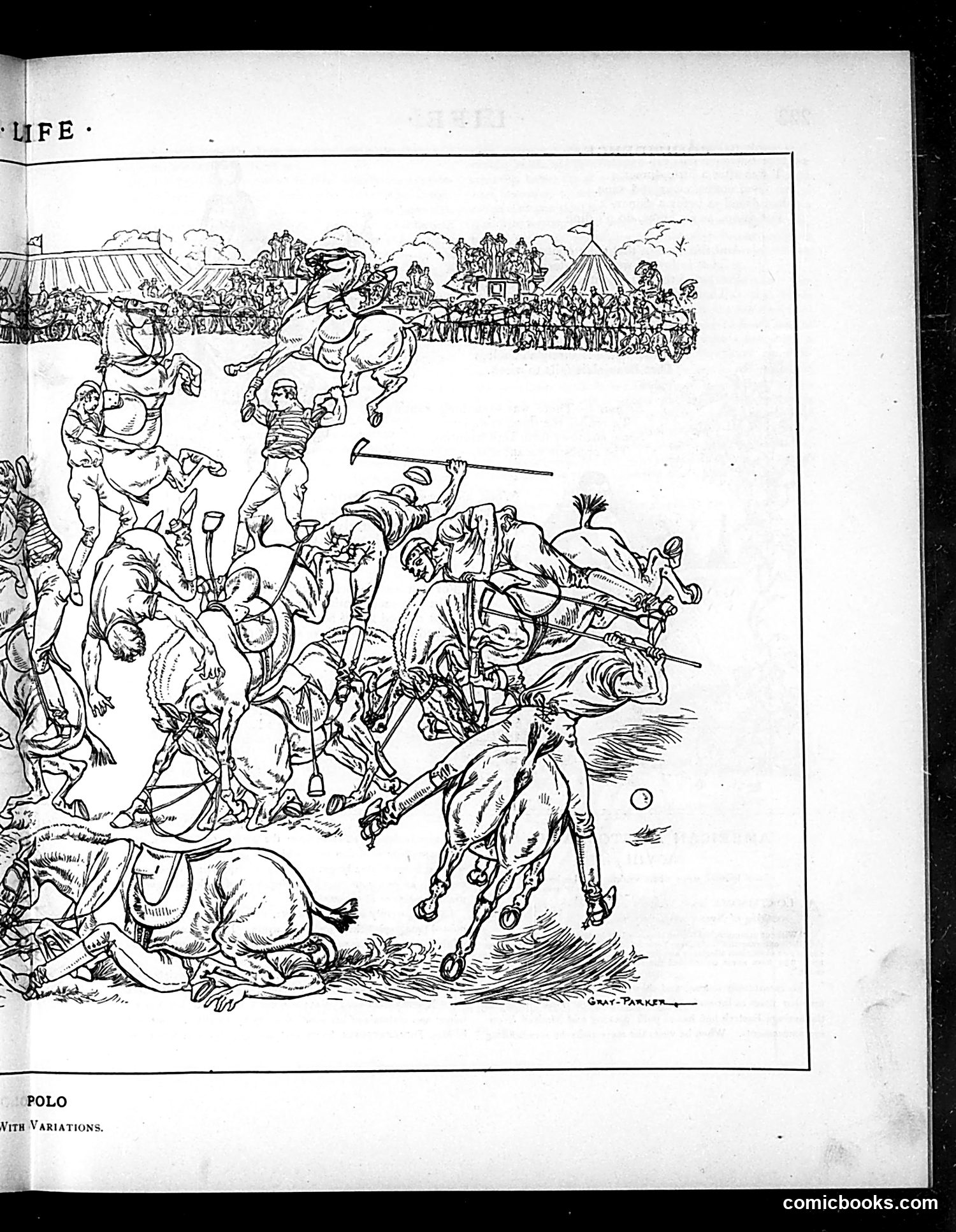
This satirical illustration depicts a chaotic polo match that appears to serve as political commentary. The drawing shows mounted players engaged in violent, disorderly combat rather than organized sport—figures wielding long poles as weapons while others fall from horses or lie wounded on the ground. The title "Polo with Variations" suggests the artist is satirizing polo as a genteel upper-class sport by depicting it descending into brutal warfare. A grandstand of spectators watches the mayhem in the background. The signature reads "Gray-Parker." Without additional context from the magazine's date, the specific political figures or events being referenced remain unclear, though the imagery suggests commentary on wealthy elites engaging in destructive conflict, possibly referencing contemporary political or social tensions of the era.
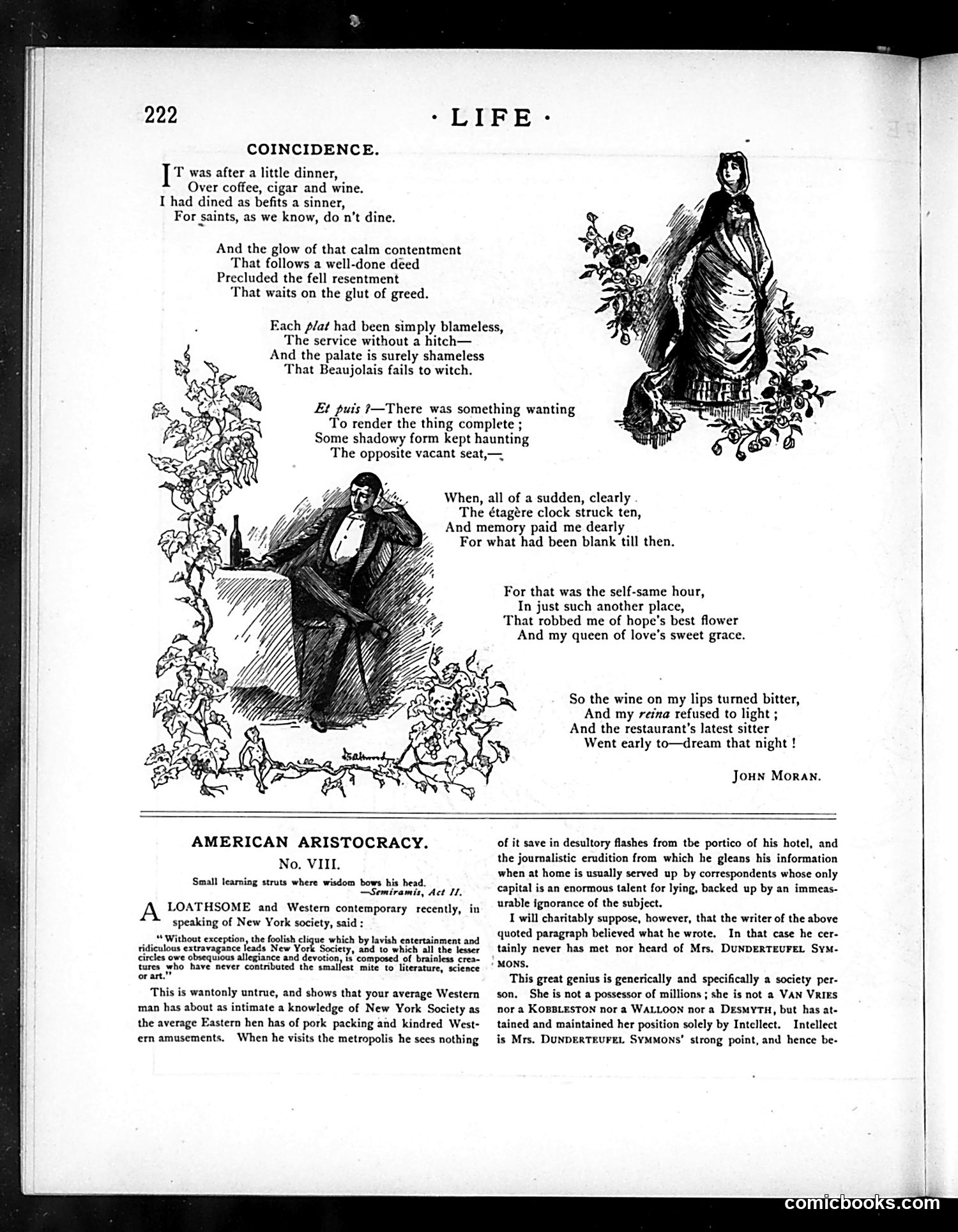
**"Coincidence"** (by John Moran) is a sentimental poem about a man enjoying an elegant dinner who is suddenly reminded—by a clock striking ten—of a lost love. The memory turns his wine bitter and ruins his evening. The accompanying illustrations show a melancholy gentleman and a draped female figure, visualizing this romantic regret. **"American Aristocracy, No. VIII"** satirizes Western critics who dismiss New York high society as brainless and extravagant. The author defends NYC society, arguing that Westerners judge it ignorantly from hotel porticos and unreliable journalism. He introduces Mrs. Dunderteufel Symmons as a counterexample—a woman of genuine intellect (not inherited wealth) who maintains her social position through intellect alone. The satire mocks both the Western critic's shallow dismissal and, implicitly, the pretension that "intellect" alone sustains American aristocracy.
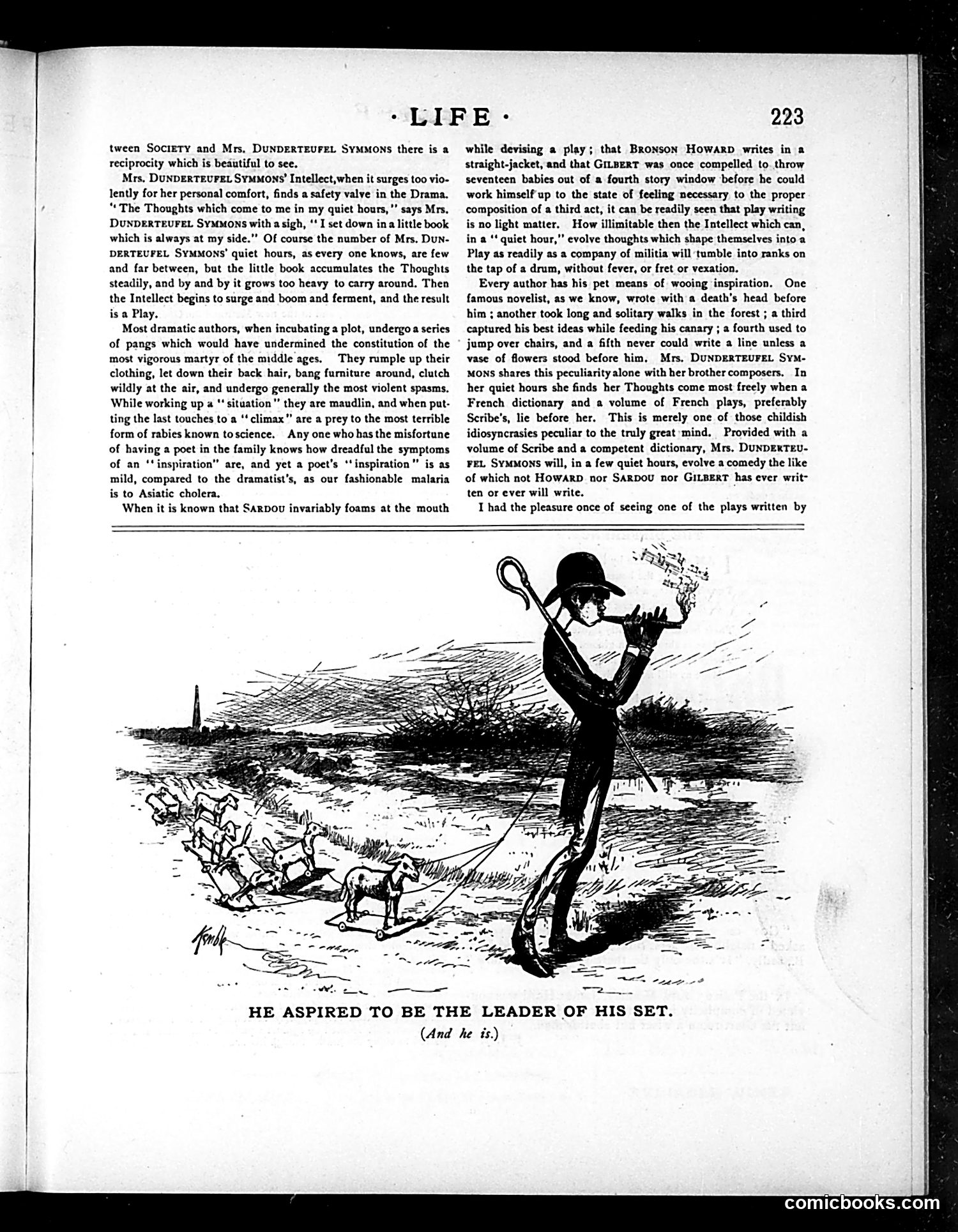
This page satirizes amateur dramatists, particularly society women who fancy themselves playwrights. The text mocks "Mrs. Dunderteufel Symmons," who casually writes plays during her "quiet hours" using only a French dictionary and plays by Scribe as inspiration—contrasted sharply with the genuine creative anguish of famous playwrights like Sardou, Bronson Howard, and Gilbert. The bottom illustration shows a figure in formal dress striking an exaggerated, theatrical pose with a tennis racket by the seaside, attempting to lead a small dog. The caption "He aspired to be the leader of his set (And he is.)" is a pun: "set" means both his social circle and the group of tennis players/dogs around him. The joke mocks pretentious social climbers who assume leadership through posturing rather than genuine ability—mirroring the article's critique of amateur playwrights mistaking idle scribbling for artistic creation.
This page satirizes New York high society's pretensions and double standards, circa 1880s-90s. **The main text** mocks a society play by "Mrs. Dunderteufel Symmons," performed before elite audiences (Vanderbilt, Gould, Sage mentioned). The satire targets that professional theatre critics harshly judge serious artists, yet shower undeserved praise on amateur society productions merely because wealthy people perform them. The author notes the "Lower Classes" were explicitly barred from attending—revealing class exclusion. **"The Difference" poem** explores social alienation: a man declines his friend's ball invitation because his friend married, creating an unbridgeable class gap. The final joke plays on "tie"—marriage bonds the social difference between them. **The bottom jokes** continue mocking marriage and social pretense, including a quip about a wife's only connection to her husband being his cravat. The **Metropolitan Opera House** mention anchors this to that venue's 1883 opening, emphasizing how wealth—not artistic merit—determined cultural institutions.
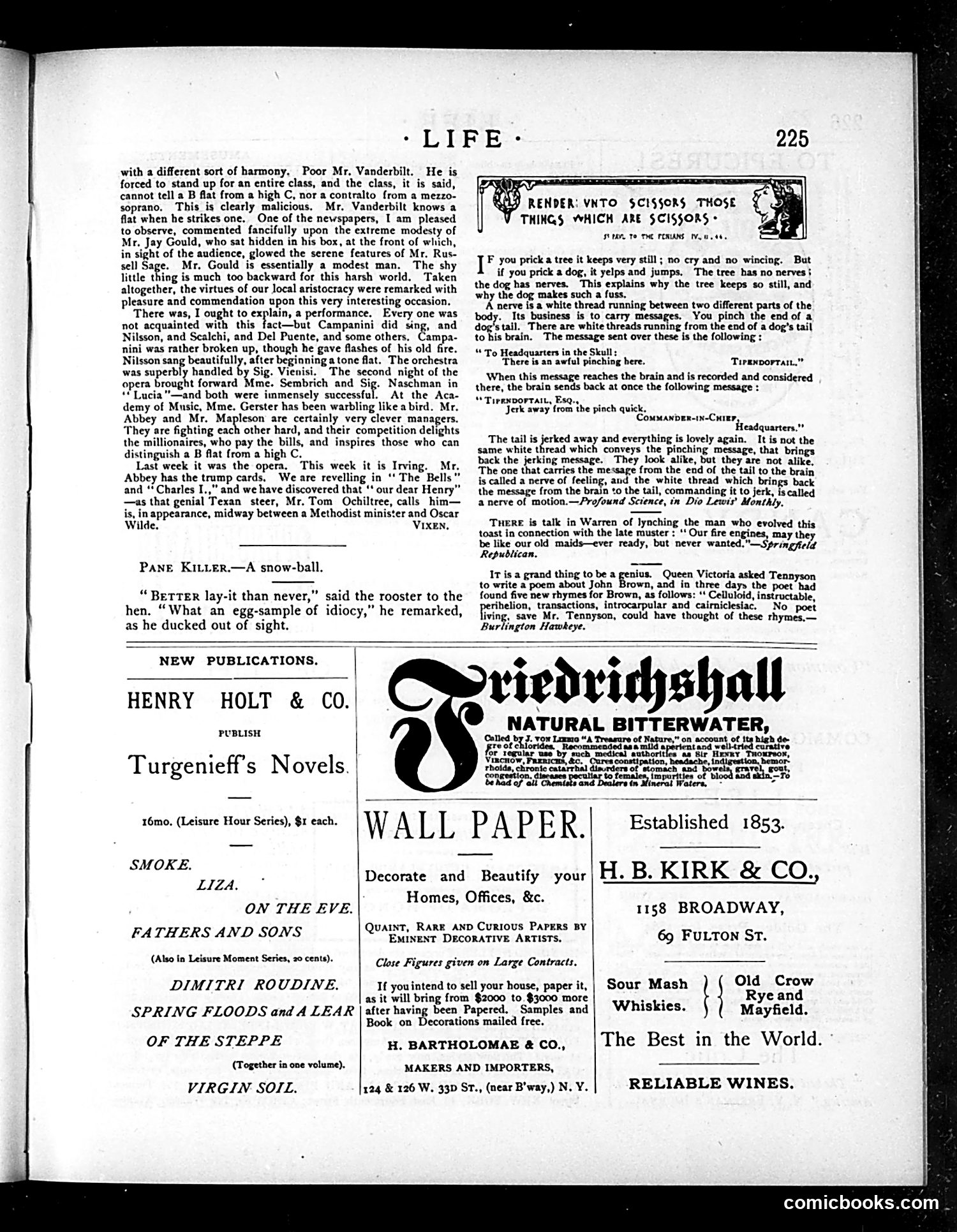
This page contains **no political cartoon**—it's primarily satirical *text* commentary on New York's opera season and high society. The main piece (bylined "VIXEN") mocks wealthy patrons like Vanderbilt and Jay Gould attending the opera. The satire: these millionaires bankroll opera competition between impresarios Abbey and Mapleson, yet the satirist suggests they lack genuine musical knowledge—they can't distinguish "a B flat from a high C." Gould's hiding in his box is portrayed as cowardly false modesty. The piece celebrates the actual *performers* (Campanini, Nilsson, Gerster) while skewering the rich men who merely pay to be seen. A secondary piece explains dog nerves versus tree nerves using children's-magazine science language—seemingly unrelated educational filler. The page is largely **advertisements** for Turgenieff novels, wallpaper, and whisky. The overall tone: genteel mockery of Gilded Age wealth masquerading as cultural sophistication.
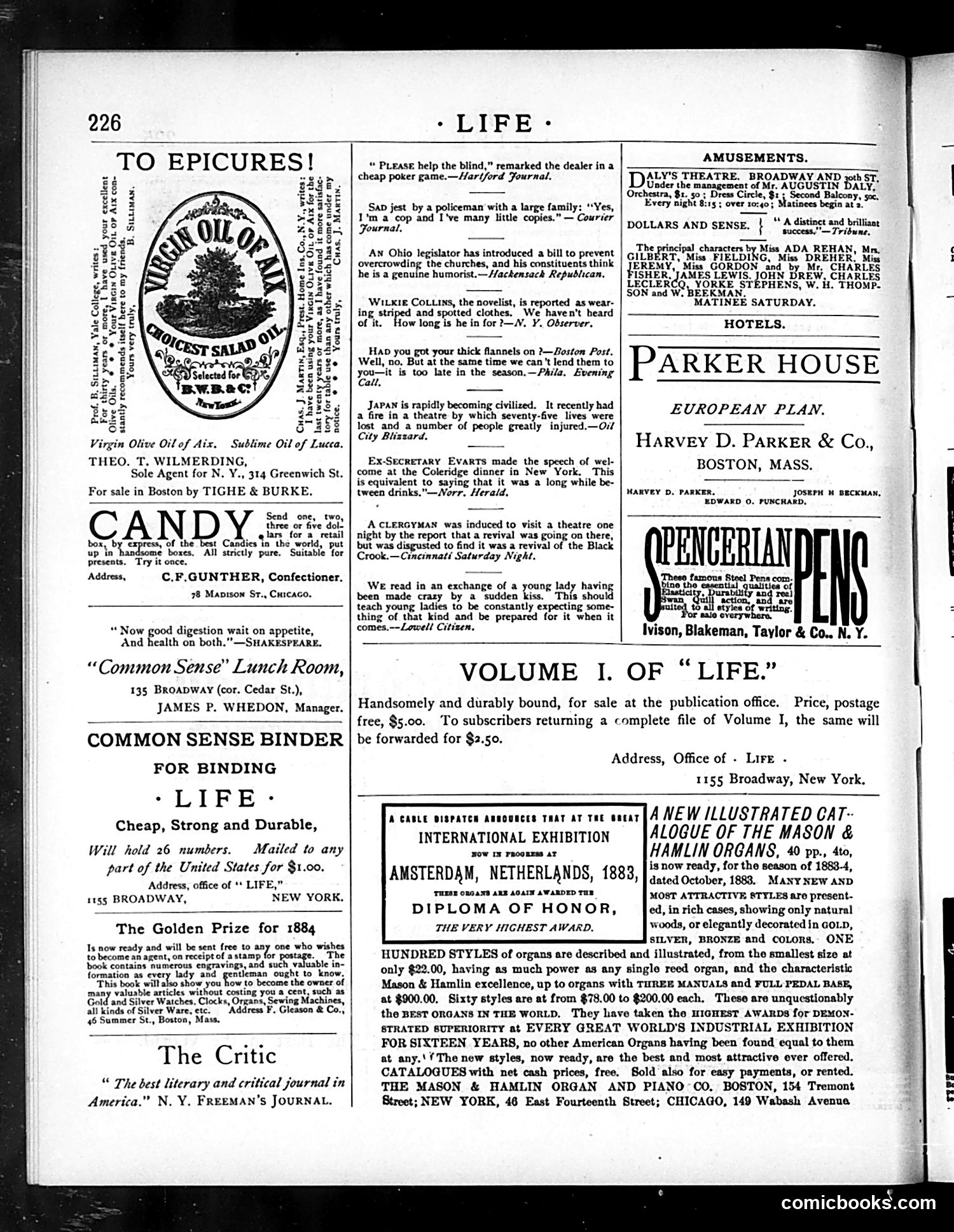
This page is primarily advertisements and announcements rather than political satire. The left side contains several brief humorous items typical of *Life* magazine's satirical content: - A joke about a policeman with many children making a pun on "copies" - A quip about an Ohio legislator trying to prevent church-going - Remarks about novelist Wilkie Collins wearing striped and spotted clothes - A joke equating Ex-Secretary Evarts' long speech to extended drinking - A comment about Japan's "civilization" demonstrated by a theater fire with casualties - A joke about a clergyman disappointed to find "The Black Crook" (a theatrical revival) rather than a religious revival These are light social commentary typical of the era—gentle mockery of politicians, public figures, and social customs. The bulk of the page, however, consists of product advertisements (olive oil, candy, organs, the *Life* magazine binder itself) and theater/hotel notices, indicating this is primarily a commercial publication page rather than a political cartoon issue.
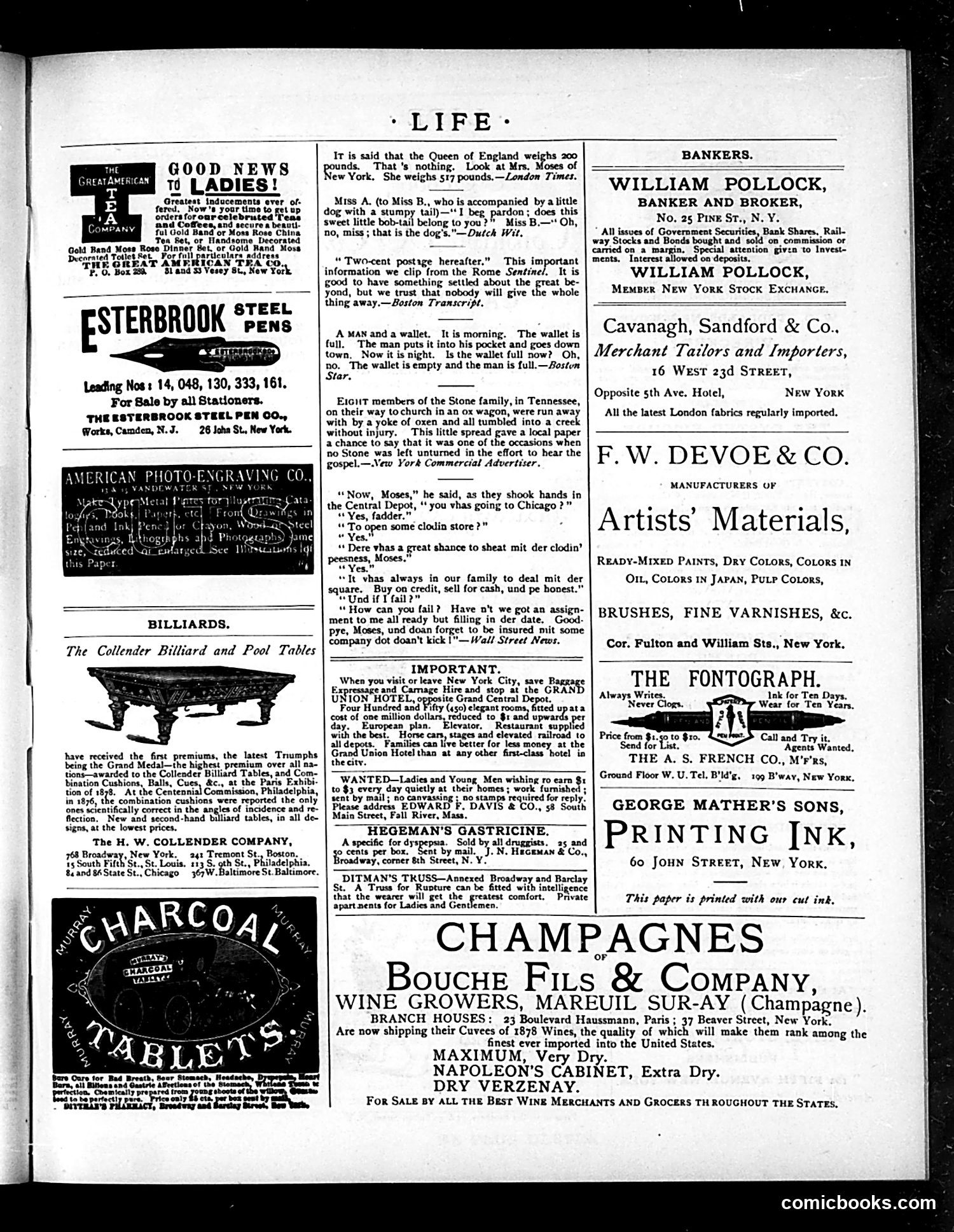
This page is primarily **advertisements** interspersed with short humorous anecdotes typical of Life magazine's satirical format. The jokes are simple, genteel humor for the era: - **Queen Victoria weight joke**: Contrasts Queen Victoria's alleged 200 pounds with a heavier New York woman at 517 pounds—poking fun at American excess. - **Postal reform**: A brief jab at settling the "two-cent postage" debate, mocking bureaucratic announcements. - **Stone family pun**: A local newspaper pun exploiting the family's surname ("no Stone was left unturned") when they survive a wagon accident. - **Wallet joke**: A simple riddle about a man losing his wallet and getting drunk—mild drinking humor. - **Jewish immigrant stereotype**: A longer dialogue about a father sending his son Moses to work in the clothing business, full of Yiddish-accented English and casual fraud ("already got an assignment..."). This reflects common 19th-century stereotyping of Jewish immigrants in commerce. The advertisements feature pens, billiard tables, champagne, printing ink, and banking services—products for middle and upper-class readers.
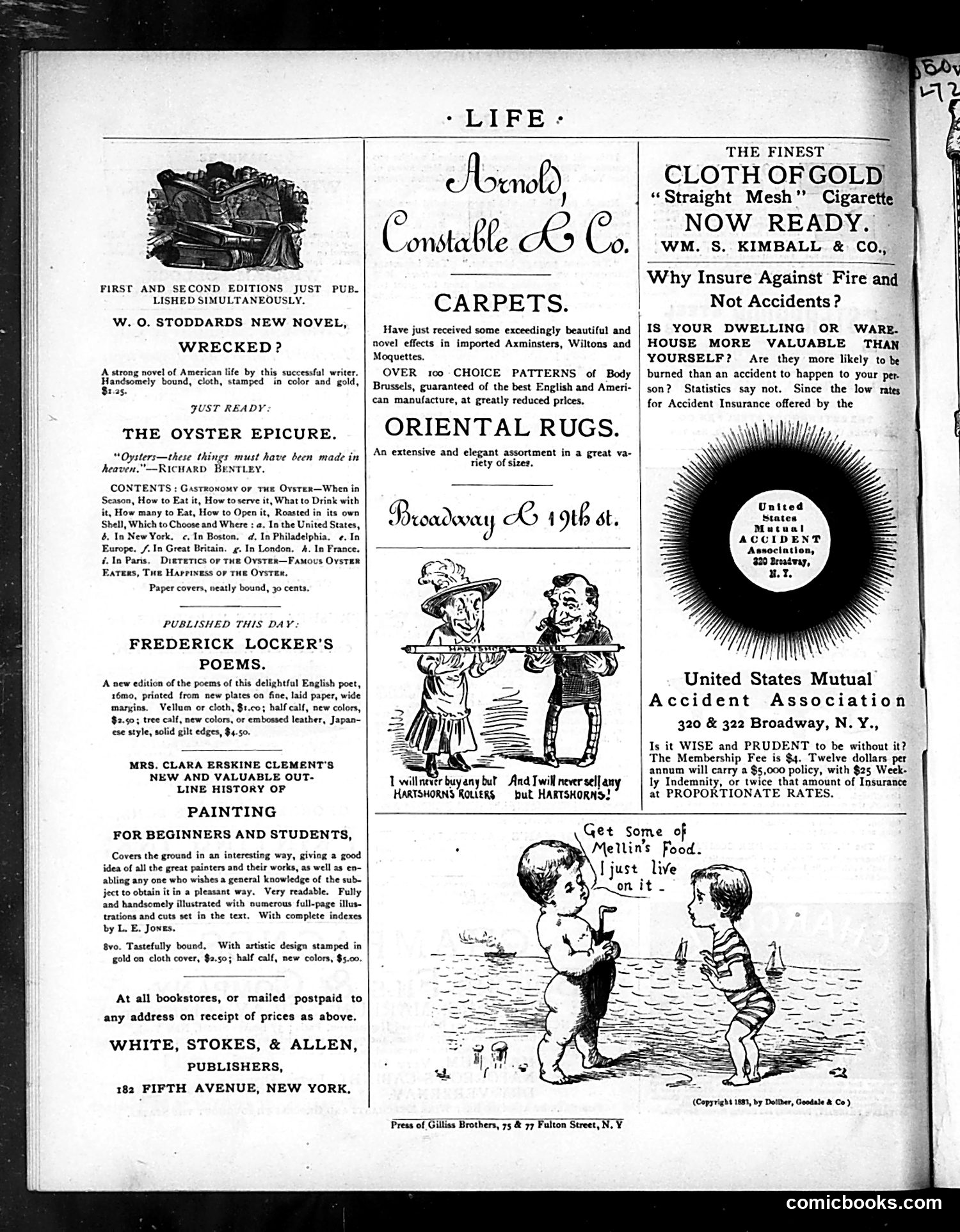
This is primarily a **book and product advertising page** from Life magazine, not a political cartoon. The page showcases new publications from White, Stokes & Allen Publishers and various commercial advertisements. The notable illustration is a small **Mellin's Food advertisement** at bottom-right, featuring two cherubic infants on a beach. One child offers food to the other, saying "Get Some of Mellin's Food. I just live on it." This was a common advertising approach of the era—using idealized, healthy-looking babies to promote infant food products, implying nutritional superiority and health benefits. The page reflects late-19th-century publishing and consumer culture: literary works (poetry, painting instruction), household goods (carpets, cigarettes), and emerging consumer products marketed with health claims. The accident insurance advertisement suggests growing awareness of personal risk management alongside traditional fire insurance. No political satire is evident on this page.