
Life, 1883-11-01 · page 12 of 16
Life — November 1, 1883 — page 12: what you’re looking at
What you’re looking at
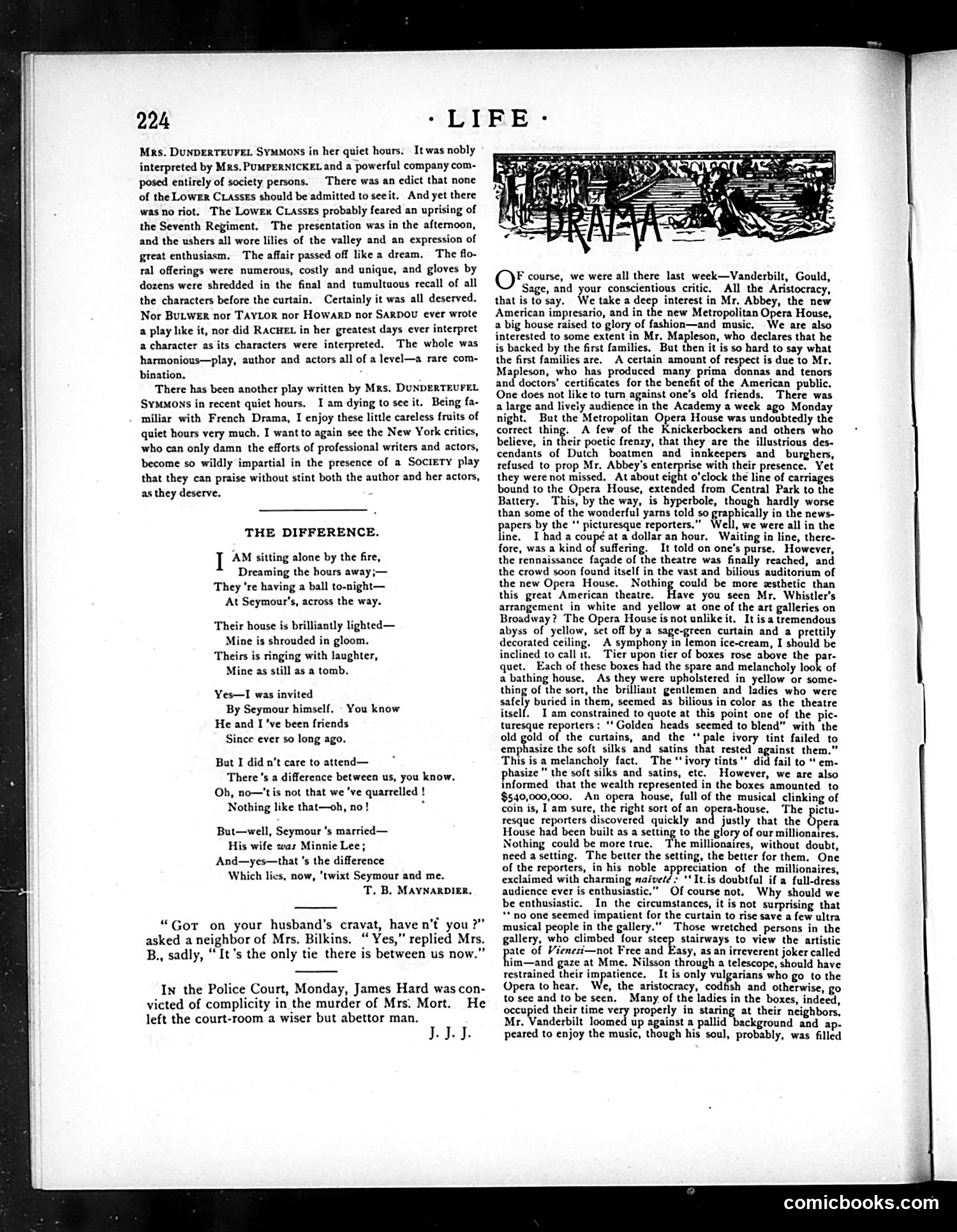
This page satirizes New York high society's pretensions and double standards, circa 1880s-90s. **The main text** mocks a society play by "Mrs. Dunderteufel Symmons," performed before elite audiences (Vanderbilt, Gould, Sage mentioned). The satire targets that professional theatre critics harshly judge serious artists, yet shower undeserved praise on amateur society productions merely because wealthy people perform them. The author notes the "Lower Classes" were explicitly barred from attending—revealing class exclusion. **"The Difference" poem** explores social alienation: a man declines his friend's ball invitation because his friend married, creating an unbridgeable class gap. The final joke plays on "tie"—marriage bonds the social difference between them. **The bottom jokes** continue mocking marriage and social pretense, including a quip about a wife's only connection to her husband being his cravat. The **Metropolitan Opera House** mention anchors this to that venue's 1883 opening, emphasizing how wealth—not artistic merit—determined cultural institutions.
📄 Transcribed text from this page (OCR, searchable)
Machine-transcribed from the original scan — historical spelling and the odd misread are preserved.
224 Mrs. DUNDERTEUFEL SyMMONS in her quiet hours. Itwas nobly interpreted by MRs. PUMPERNICKEL and a powerful company com- posed entirely of society persons. There was an edict that none of the Lower CLasses should be admitted to seeit. And yet there wasno riot. The Lowex CLAssEs probably feared an uprising of the Seventh Regiment. The presentation was in the afternoon, and the ushers all wore lilies of the valley and an expression of great enthusiasm. The affair passed off like a dream. The flo- ral offerings were numerous, costly and unique, and gloves by dozens were shredded in the final and tumultuous recall of all the characters before the curtain. Certainly it was all deserved. Nor BuLwer nor TAYLOR nor HowarD nor SARDOU ever wrote a play like it, nor did RACHEL in her greatest days ever interpret a character as its characters were interpreted. The whole was harmonious—play, author and actors all of a level—a rare com- bination. There has been another play written by Mrs. DUNDERTEUFEL SYMMONS in recent quiet hours. I am dying to see it. Being fa- miliar with French Drama, I enjoy these little careless fruits of quiet hours very much. I want to again see the New York critics, who can only damn the efforts of professional writers and actors, become so wildly impartial in the presence of a Society play that they can praise without stint both the author and her actors, as they deserve. THE DIFFERENCE. I ‘AM sitting alone by the fire, Dreaming the hours away;— They 're having a ball to-night— At Seymour's, across the way. Their house is brilliantly lighted— Mine is shrouded in gloom. ‘Theirs is ringing with laughter, Mine as still as a tomb. Yes—I was invited By Seymour himself. - You know He and I 've been friends Since ever so long ago. Bat I did n’t care to attend— There's a difference between us, you know. Ob, no—'t is not that we 've quarrelled ! Nothing like that—oh, no! 7 But—well, Seymour 's married— His wife was Minnie Lee; And—yes—that 's the difference Which lies, now, ’twixt Seymour and me. T. B. MAYNARDIER. “Gor on your husband’s cravat, have n't you ?” asked a neighbor of Mrs. Bilkins. “ Yes,” replied Mrs. B., sadly, “It’s the only tie there is between us now.” In the Police Court, Monday, James Hard was con- victed of complicity in the murder of Mrs. Mort. He left the court-room a wiser but abettor man. J.J. J. * LIFE: F course, we were all there last week—Vanderbilt, Gould, Sage, and your conscientious critic, All the Aristocracy, that is to say. ‘e take a deep interest in Mr. Abbey, the new American impresario, and in the new Metropolitan Opera House, a big house raised to glory of fashion—and music, We are also interested to some extent in Mr. Mapleson, who declares that he is backed by the first families, But then it is so hard to say what the first families are. A certain amount of respect is due to Mr. Mapleson, who has produced many prima donnas and tenors and doctors’ certificates for the benefit of the American public. One does not like to turn against one’s old friends, There was a large and lively audience in the Academy a week ago Monday night. But the Metropolitan Opera House was undoubtedly the correct thing. A few of the Knickerbockers and others who believe, in their poetic frenzy, that they are the illustrious des- cendants of Dutch boatmen and innkeepers and burghers, refused to prop Mr. Abbey's enterprise with their presence. Yet they were not missed. At about cight o'clock the line of carriages bound to the Opera House, extended from Central Park to the Battery. This, by the way, is hyperbole, though hardly worse than some of the wonderful yarns told 0 graphically in the news- papers by the ‘‘ picturesque reporters.” Well, we were all in the line. I had a coupé at a dollar an hour, Waiting in line, there- fore, was a kind of suffering. It told on one’s purse. However, the renaissance fagade of the theatre was finally reached, and the crowd soon found itself in the vast and bilious auditorium of the new Opera House. Nothing could be more esthetic than this great American theatre, Have you seen Mr. Whistler's arrangement in white and yellow at one of the art galleries on Broadway? The Opera House is not unlike it. It is a tremendous abyss of ycllow, set off by a sage-green curtain and a prettily decorated ceiling. A symphony in lemon ice-cream, I should be inclined to call it. Tier upon tier of boxes rose above the par- quet. Each of these boxes had the spare and melancholy look of a bathing house. As they were upholstered in yellow or some- thing of the sort, the brilliant gentlemen and ladies who were safely buried in them, seemed as bilious in color as the theatre itselt, I am constrained to quote at this point one of the pic- turesque reporters: ‘*Golden heads seemed to blend” with the old gold of the curtains, and the ‘‘ pale ivory tint failed to emphasize the soft silks and_satins that rested against them.” This is a melancholy fact. The ‘ivory tints’’ did fail to “ em- phasize" the soft silks and satins, etc. However, we are also informed that the wealth represented in the boxes amounted to $540,000,000. An opera house, full of the musical clinking of coin is, I am sure, the right sort of an opera-house. The pictu- resque reporters discovered quickly and justly that the pera House had been built as a setting to the glory of our millionaires. Nothing could be more true. The millionaires, without doubt, need a setting. The better the setting, the better for them. One of the reporters, in his noble appreciation of the millionaires, exclaimed with charming naiveté: ‘It.is doubtful if a full-dress audience ever is enthusiastic.” Of course not. Why should we be enthusiastic. In the circumstances, it is not surprising that **no one seemed impatient for the curtain to rise save a few ultra musical people in the gallery." Those wretched persons in the gallery, who climbed four steep stairways to view the artistic te of Vienesi—not Free and Easy, as an irreverent joker called im—and gaze at Mme. Nilsson through a telescope, should have restrained their impatience. It is only vulgarians who go to the Opera to hear, ‘e, the aristocracy, codfish and otherwise, go to see and to be seen. Many of the ladies in the boxes, indeed, occupied their time very properly in staring at their neighbors, Mr. Vanderbilt loomed up against a pallid background and ap. peared to enjoy the music, though his soul, probably, was filled comicbooks.com