
A complete issue · 16 pages · 1883
Life — October 25, 1883
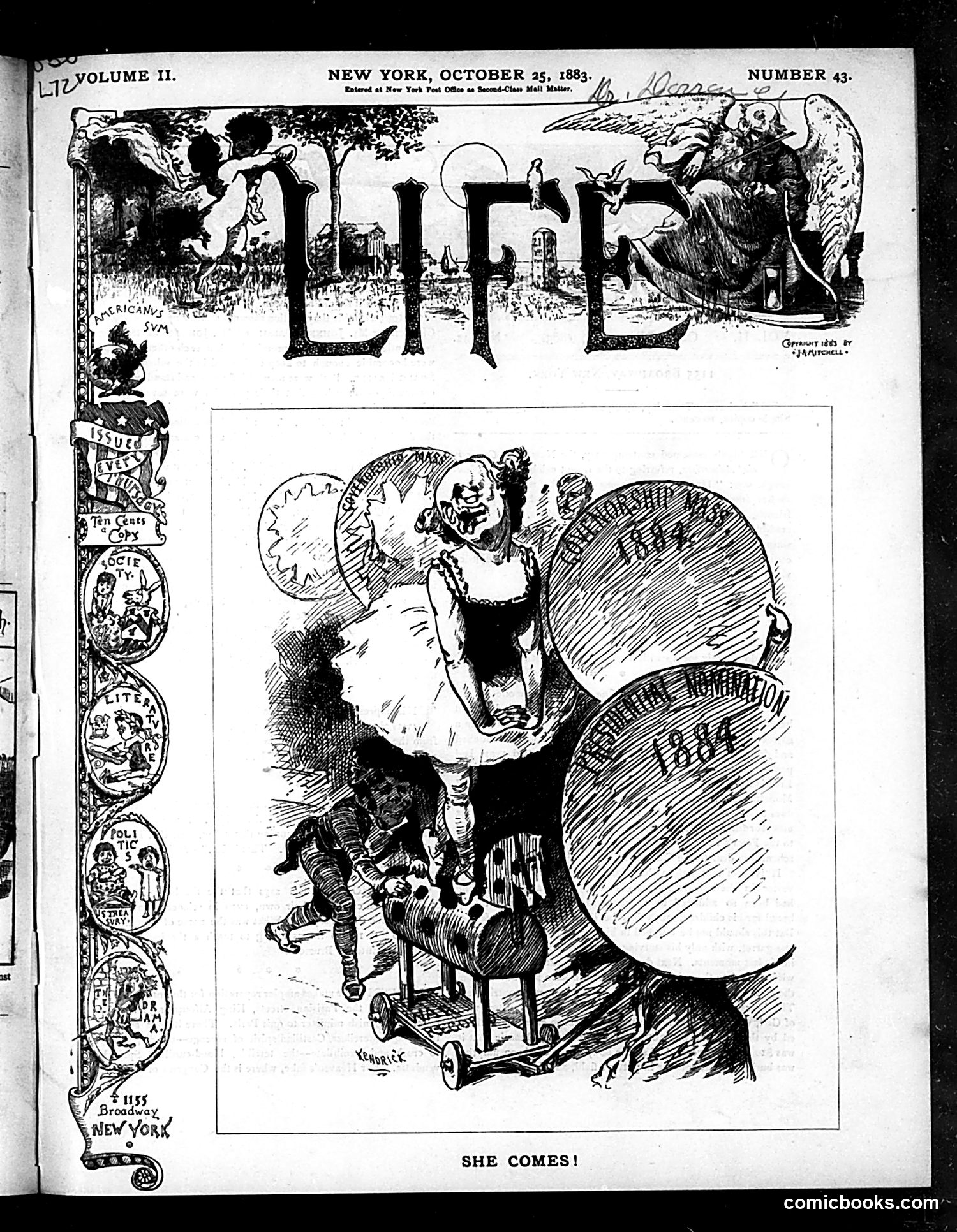
The main cartoon depicts a rotund woman in theatrical costume balanced precariously on what appears to be a wheeled platform or stage apparatus. She's drawn in an exaggerated, unflattering style typical of 1880s satirical illustration. Without additional context, the specific identity of "she" remains unclear—this could reference a visiting celebrity, performer, or public figure of 1883. The caption "She Comes!" suggests anticipation or alarm about someone's arrival. The theatrical costume and unstable conveyance suggest mockery of either the figure's physical appearance or her pretensions to importance. The ornate left-margin design typical of Life magazine's decorative style frames various small illustrated vignettes, though details are difficult to discern at this resolution.
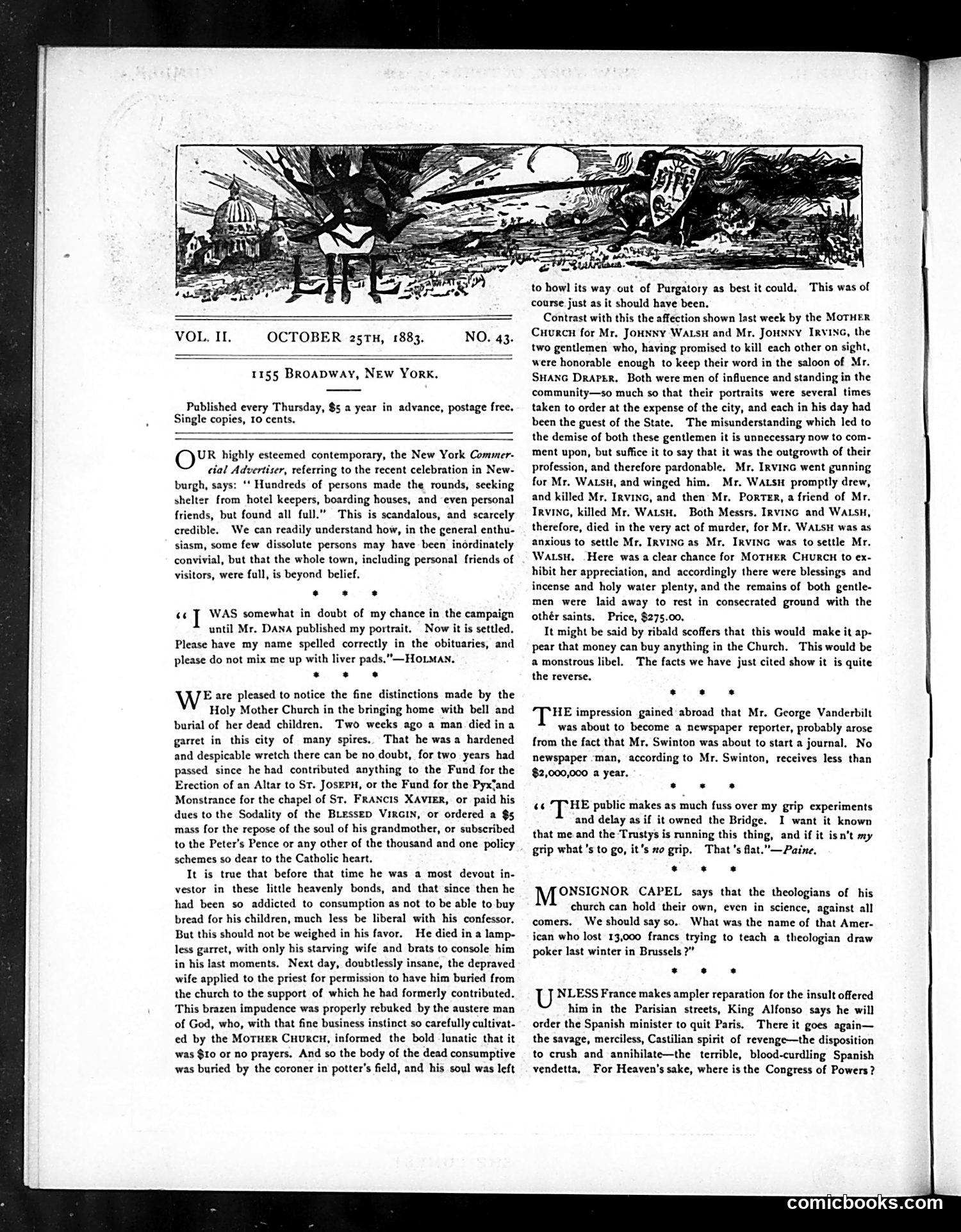
The masthead illustration depicts a nightmarish scene with a demonic figure looming over a cityscape featuring a prominent dome (likely St. Paul's Cathedral), with a crescent moon overhead—evoking Gothic horror imagery. The text criticizes the **New York Commercial Advertiser's** sensationalist reporting about a saloon incident involving gentlemen named Walsh, Irving, and Porter. The piece ridicules how their deaths (apparently from violence) became exaggerated into melodramatic newspaper coverage, mocking both the newspaper's yellow journalism and the public's appetite for scandalous stories. The cartoon and accompanying commentary satirize **sensationalist journalism** and how newspapers exploit real tragedies for circulation, a recurring concern in 1880s media criticism.
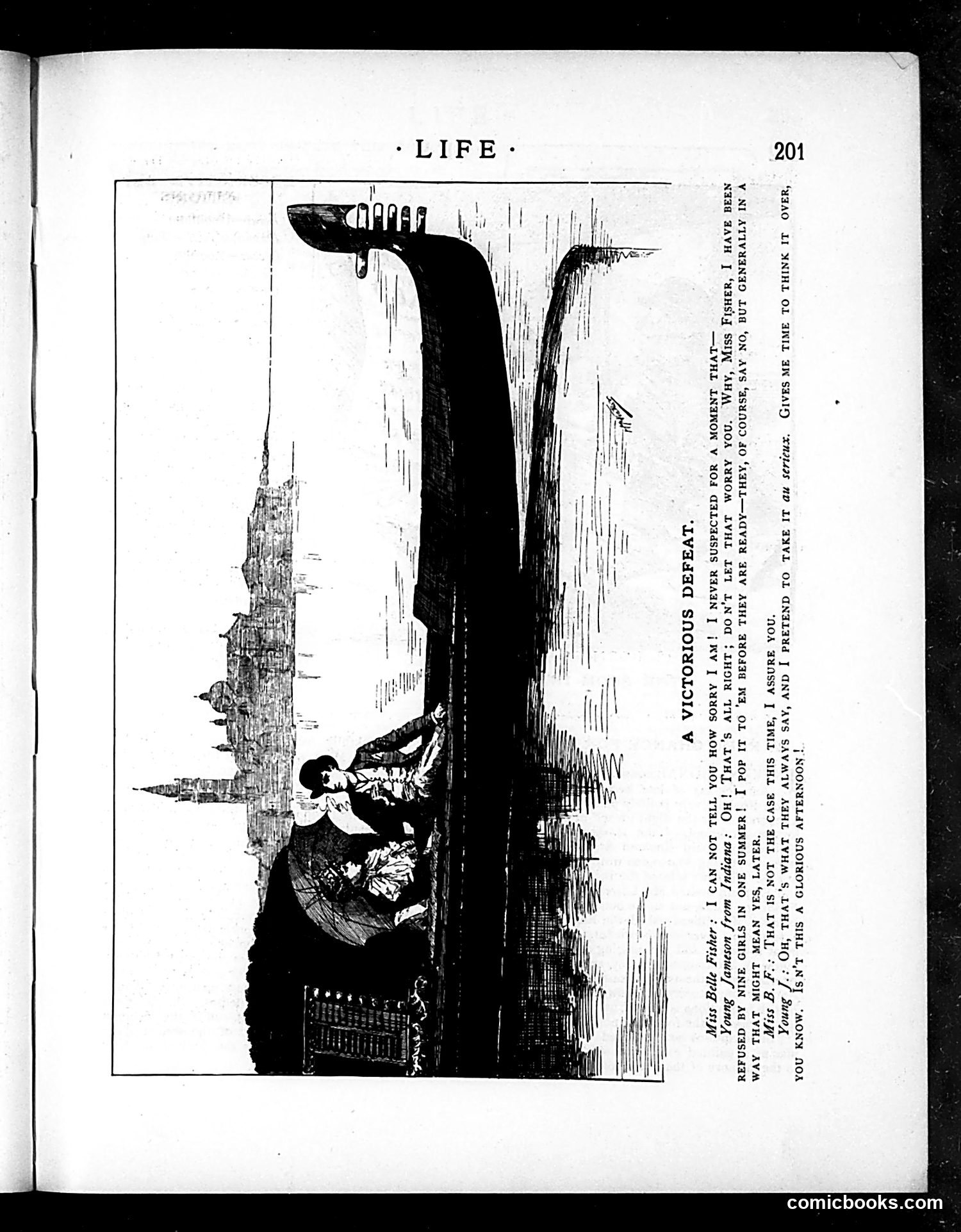
This political cartoon depicts a figure in formal attire reclining exhausted against a large structure (possibly representing a building or monument). The title and accompanying verse suggest ironic commentary on a hollow or pyrrhic victory. The text references "Bill Fisher" and discusses being "asked for a moment's bill" while observing that "cases this time I assure you, and pretend to take it easier. Give me time to think it over—you know it's this laborious afternoon." The satire appears to critique political posturing or pretended victories—situations where someone claims triumph while clearly defeated or exhausted. Without clearer historical context, the specific political figure or event referenced remains unclear, though the composition suggests commentary on political or public figures managing their public image following a setback or difficult situation.
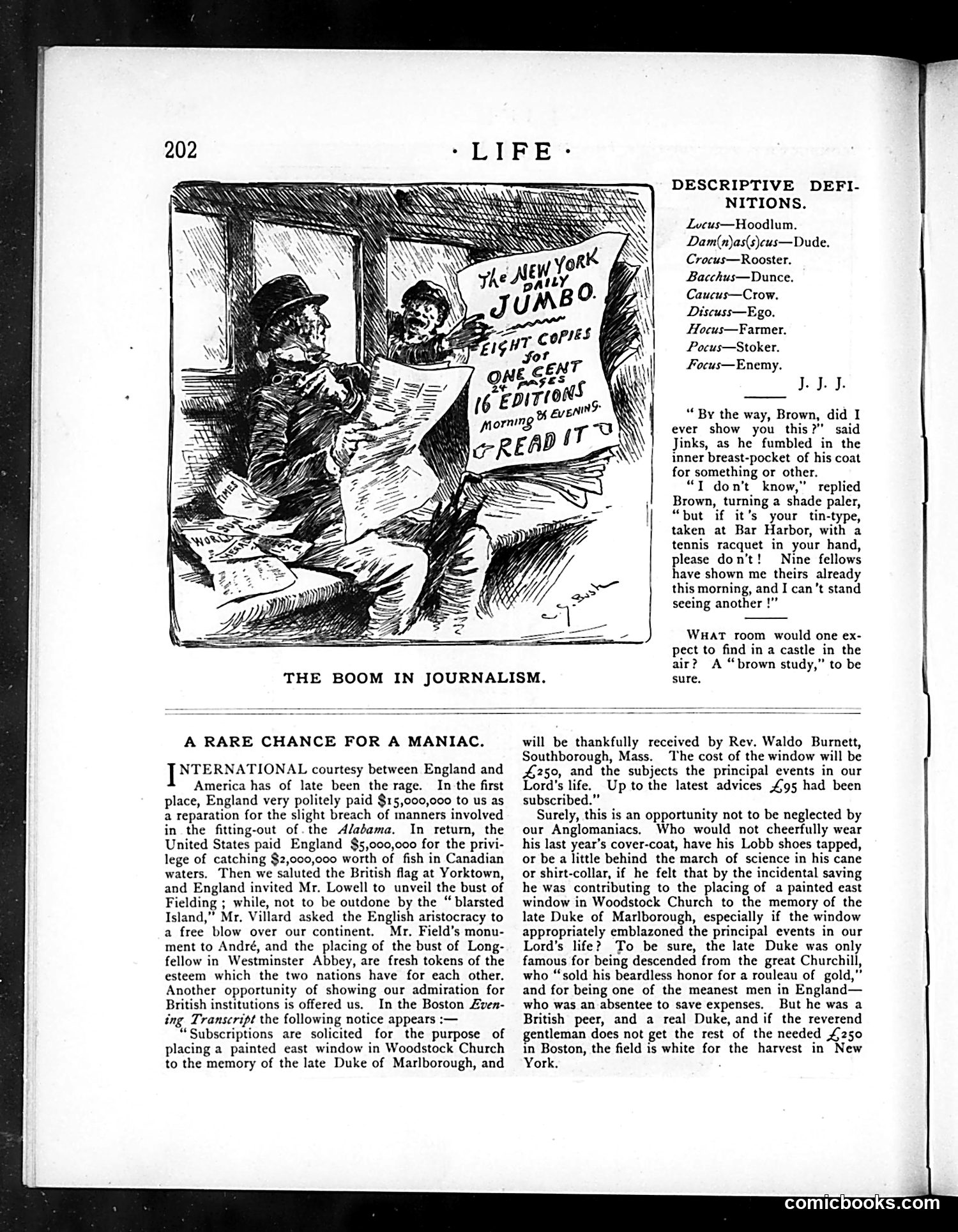
This cartoon satirizes the explosive growth of cheap newspapers in the early 20th century. Two figures huddle over a newspaper hawking "The New York Daily Jumbo" — advertised as "Eight Copies for One Cent, 16 Editions Morning, Evening, Read it!" The joke targets the absurdity of mass-produced, low-cost journalism: papers so cheap and numerous they're almost worthless. The exaggerated pitch suggests publishers prioritize volume and sensationalism ("Jumbo") over quality. The cartoon mocks both the competitive newspaper industry's race to the bottom and readers' hunger for content — even trivial content. The "boom" references journalism's rapid commercialization during this period, when circulation wars drove papers to ever-cheaper prices and more sensational headlines to capture readers.
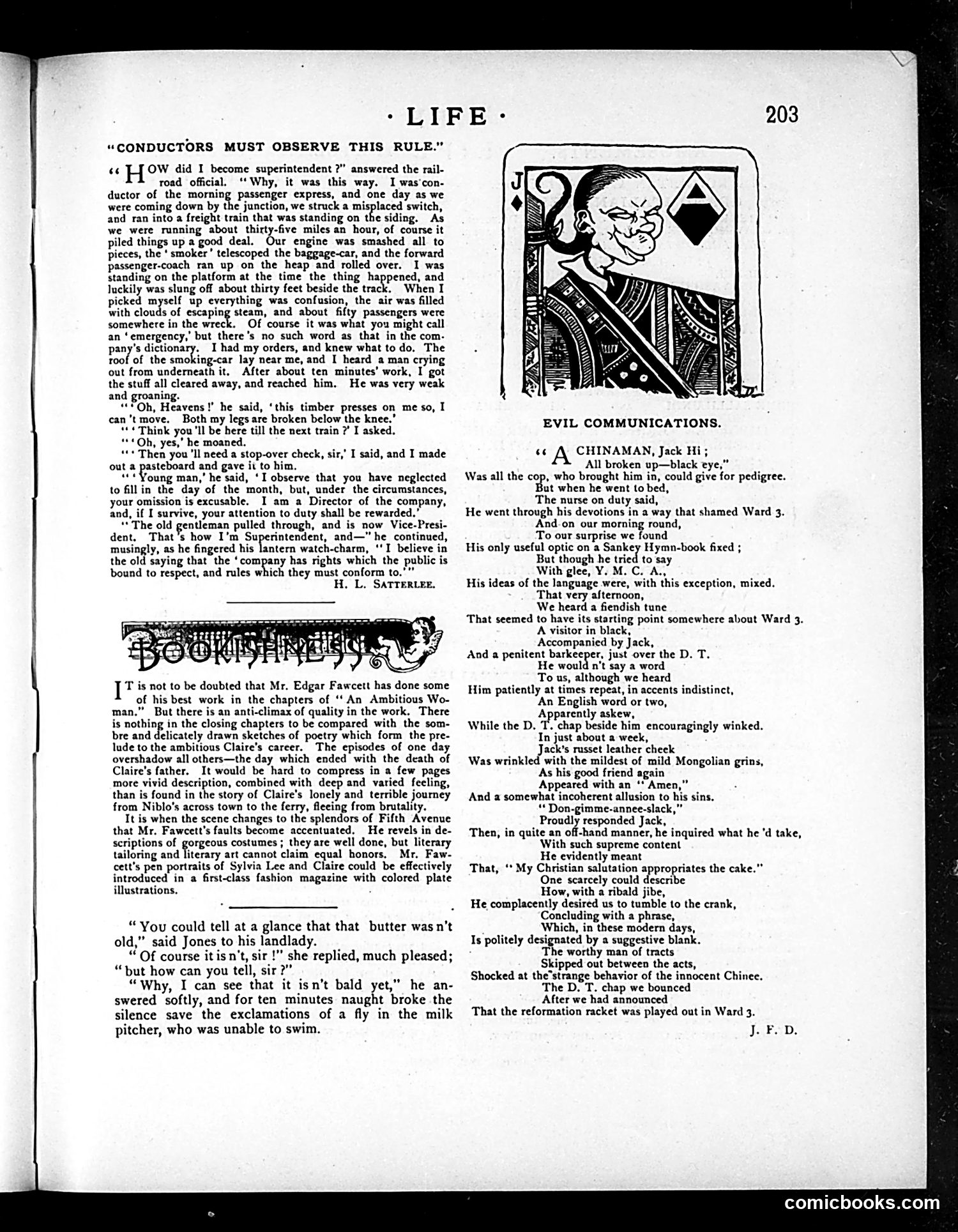
The page contains two distinct sections: **Left side:** A prose story titled "Conductors Must Observe This Rule" describes a railroad accident where a superintendent gained his position through negligence during a crisis—he made quick decisions that saved lives, earning promotion despite having caused the original mishap. **Right side:** A poem titled "Evil Communications" featuring a grotesque caricature of what appears to be a Chinese man (labeled "Jack III"). The accompanying verse mocks or satirizes this figure's behavior and speech patterns, using exaggerated dialect. The cartoon reflects period racism common in early 20th-century American satirical magazines, with the caricature employing stereotypical physical features typical of that era's offensive depictions. The page represents Life's mix of satirical commentary and crude racial humor characteristic of the publication's historical context.
This page contains no visible cartoon. Instead, it features three sections: 1. **Amusements** - listings for the Metropolitan Opera House's Italian opera and Academy of Music performances, with cast members and venue details. 2. **The Political Outlook** - three brief dispatches about Massachusetts politics, reporting on Governor Butler's expected election victory with a majority of at least 10,000 votes, and noting Republican opposition tactics including distribution of the "Skin pamphlet." 3. **Butler Interviewed** - a satirical Q&A dialogue between a correspondent and Governor Butler, where Butler appears evasive and contradictory regarding his political future and the Republican party's internal divisions. The satire targets Butler's political ambitions and perceived inconsistencies rather than visual caricature.
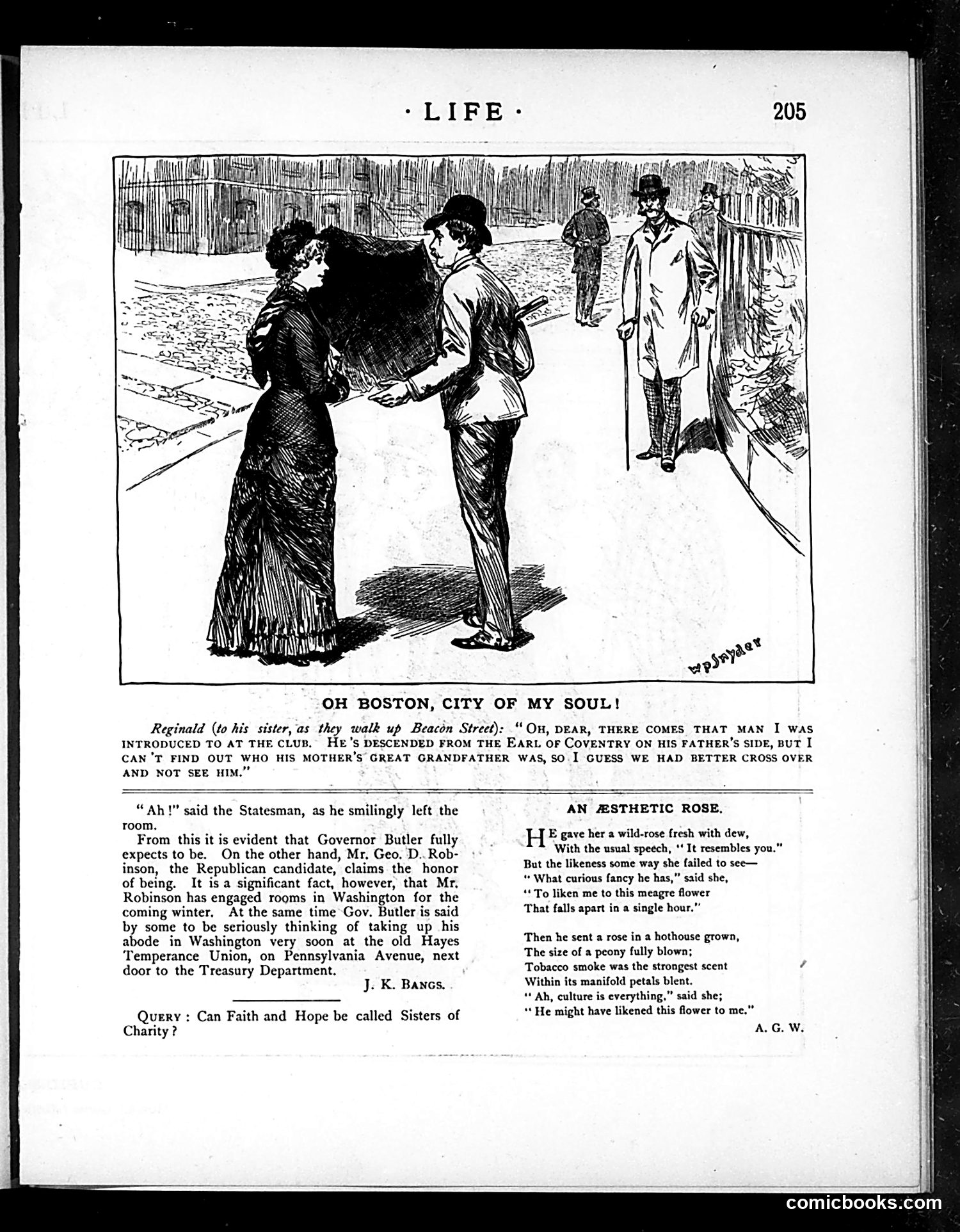
**Main Cartoon: "Oh Boston, City of My Soul!"** The cartoon depicts a social encounter on Boston's Beacon Street. A man (identified as "Reginald") boasts to his sister about meeting someone descended from the Earl of Coventry, claiming ignorance of his mother's ancestry. The satire targets Boston's obsession with genealogy and social pedigree—the joke being that Reginald proudly traces one ancestor while apparently unconcerned about not knowing his own maternal lineage. This mocks upper-class Bostonians' selective emphasis on prestigious ancestry while remaining indifferent to other family history. **Additional Content:** The page includes a poem titled "An Aesthetic Rose" and brief editorial items. These appear minor compared to the main cartoon's social commentary on Boston's class-conscious society and genealogical pretensions.
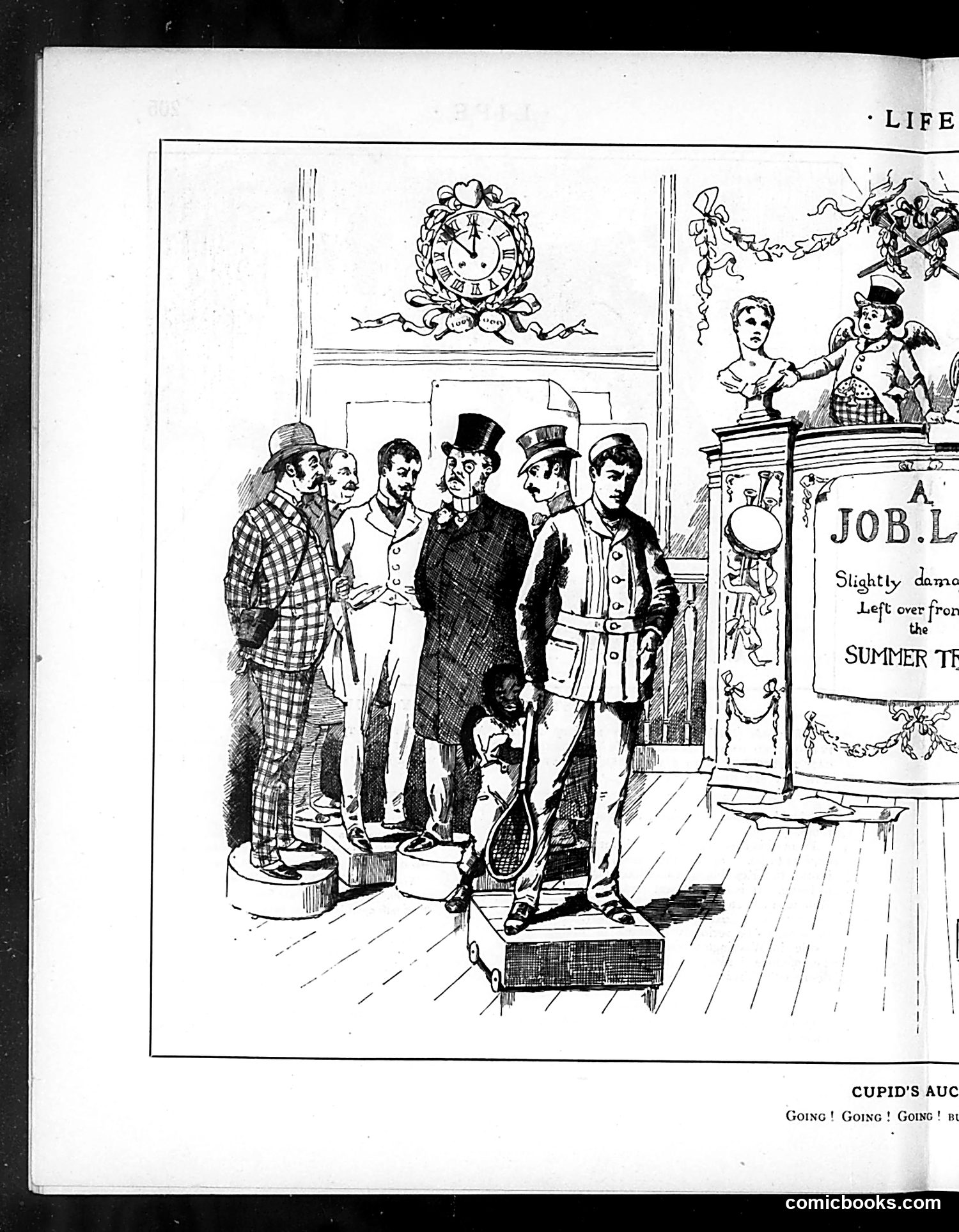
This cartoon depicts an auction scene where several well-dressed men in top hats bid on what appears to be a cherub or cupid figure being auctioned off. The caption reads "GOING! GOING! GOING! [incomplete]" The satire likely mocks the commercialization of romance or love during the era—treating Cupid (the mythological symbol of love) as a commodity to be bought and sold at auction. The formal businessmen bidding suggest how modern commercial society had reduced even romantic ideals to market transactions. The ornate window display and shop setting emphasize this mercenary angle. Without the full caption, the specific social target remains somewhat unclear, though the general critique of commodification in modern life is evident.
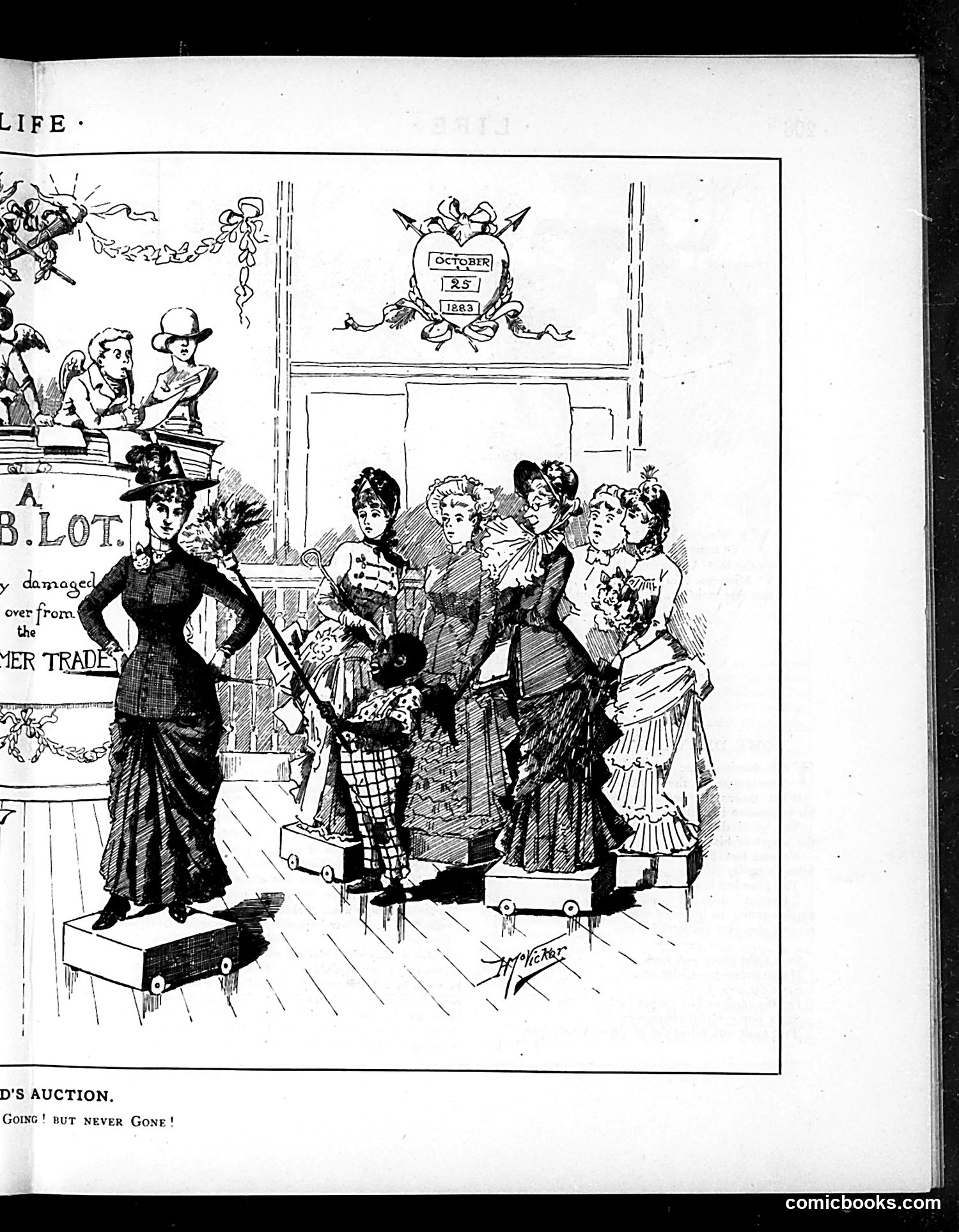
This appears to be a satirical cartoon titled "A B.LOT" with the caption "GOING! BUT NEVER GONE!" depicting a woman's auction. The scene shows a fashionably dressed woman standing prominently on a platform while several other women gather around, seemingly participating in or observing an auction. The cartoon likely satirizes the marriage market or social status of women in the 1880s-1890s era—the woman "on the block" represents how women were viewed as commodities to be bought and sold. The caption "Going! But Never Gone!" suggests social commentary about women's reputations or marital prospects, implying that once a woman loses her standing, it's permanent despite superficial changes. The exact figures remain unclear without additional context, but the satire targets gender dynamics and women's limited social autonomy of the period.
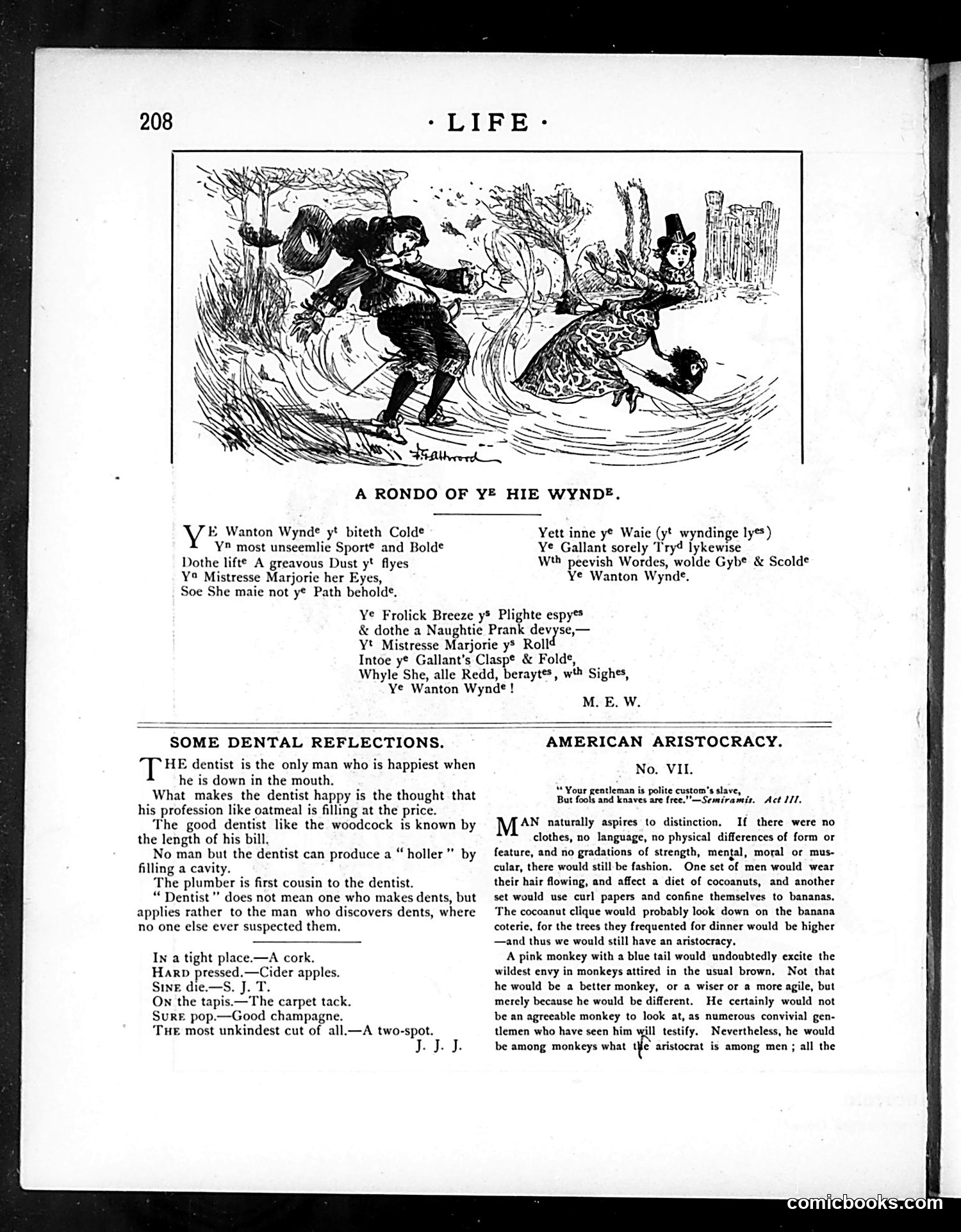
**Top Cartoon: "A Rondo of Ye Hie Wynde"** This whimsical illustrated poem (signed M.E.W.) depicts wind as a mischievous character lifting a woman's skirt while she walks with a gentleman. The archaic spelling ("ye," "yt") mimics old-fashioned verse. The satire targets the awkwardness of Victorian-era social encounters—the wind plays a "naughty prank" that embarrasses the lady ("alle Redd") while the gentleman struggles with "peevish Wordes." It's gentle humor about propriety disrupted by nature. **"Some Dental Reflections"** Pun-based jokes about dentists, playing on double meanings ("down in the mouth," "filling," "holler from filling a cavity"). **"American Aristocracy No. VII"** This essay mocks social class distinctions as arbitrary and superficial. The argument: humans create hierarchy based on trivial differences (clothing, diet, appearance) rather than merit. Even monkeys would develop "aristocracy" based purely on looking different—a pink monkey with a blue tail would be envied not for superiority but simply for distinction. The satire suggests class pretension lacks rational foundation.
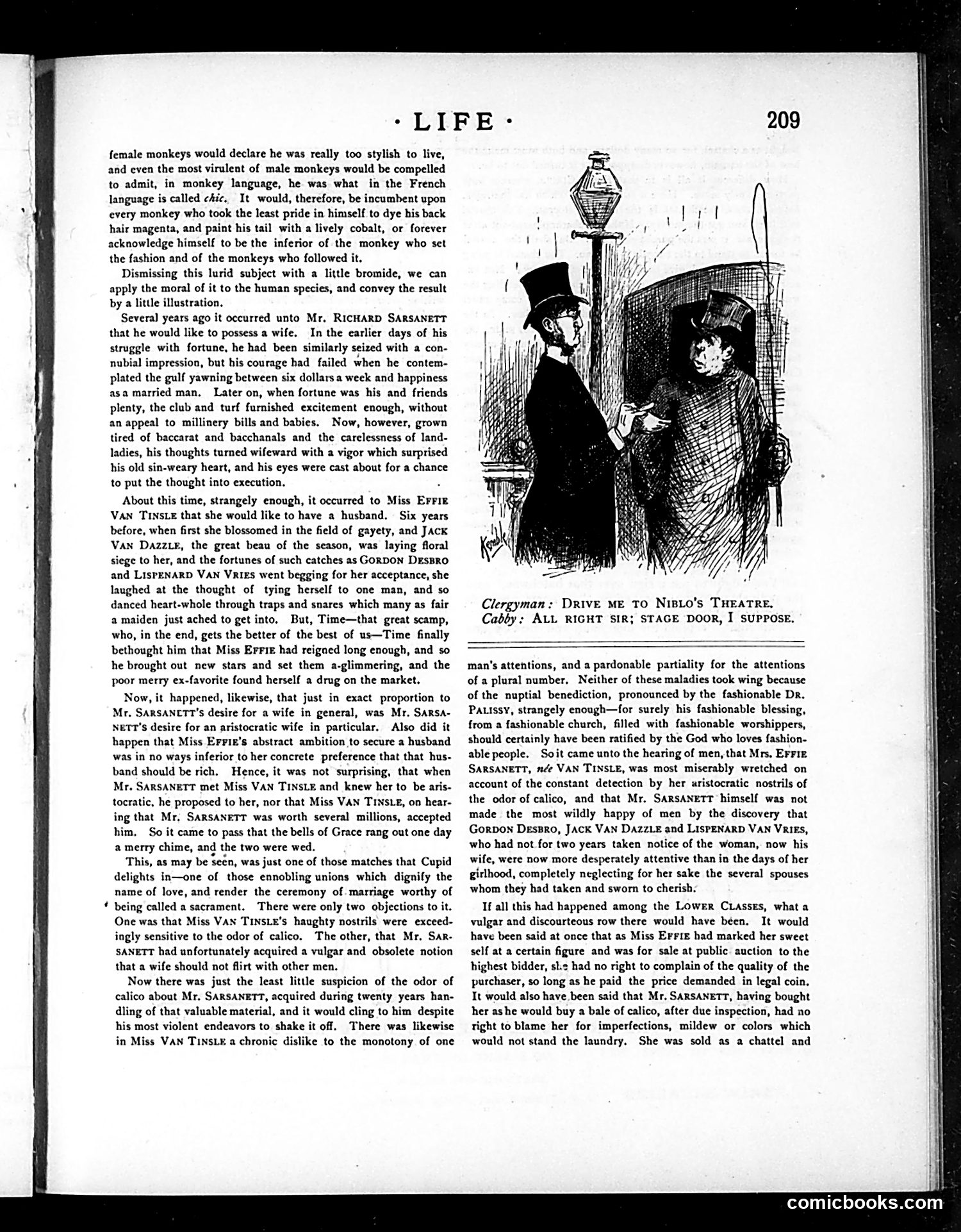
This page satirizes **class-based marriage markets in Gilded Age America**. The cartoon illustrates a cautionary tale: Richard Sarsanett, a self-made millionaire (likely from textiles—"calico"), desires an aristocratic wife. Effie Van Tinsle, once a sought-after socialite now aging out of fashion, accepts him for his wealth. The satire targets their incompatibility: Van Tinsle's aristocratic pretensions make her disdainful of Sarsanett's working-class origins (the "odor of calico" is literal and metaphorical), while Sarsanett expects traditional wifely behavior—she won't give up flirting with other men. The opening monkey parable warns that following superficial fashion (literally dyeing oneself) creates absurd hierarchies. Applied to humans, it mocks how both wealth-seeking and status-seeking lead to ridiculous, doomed unions based on vanity rather than genuine compatibility.
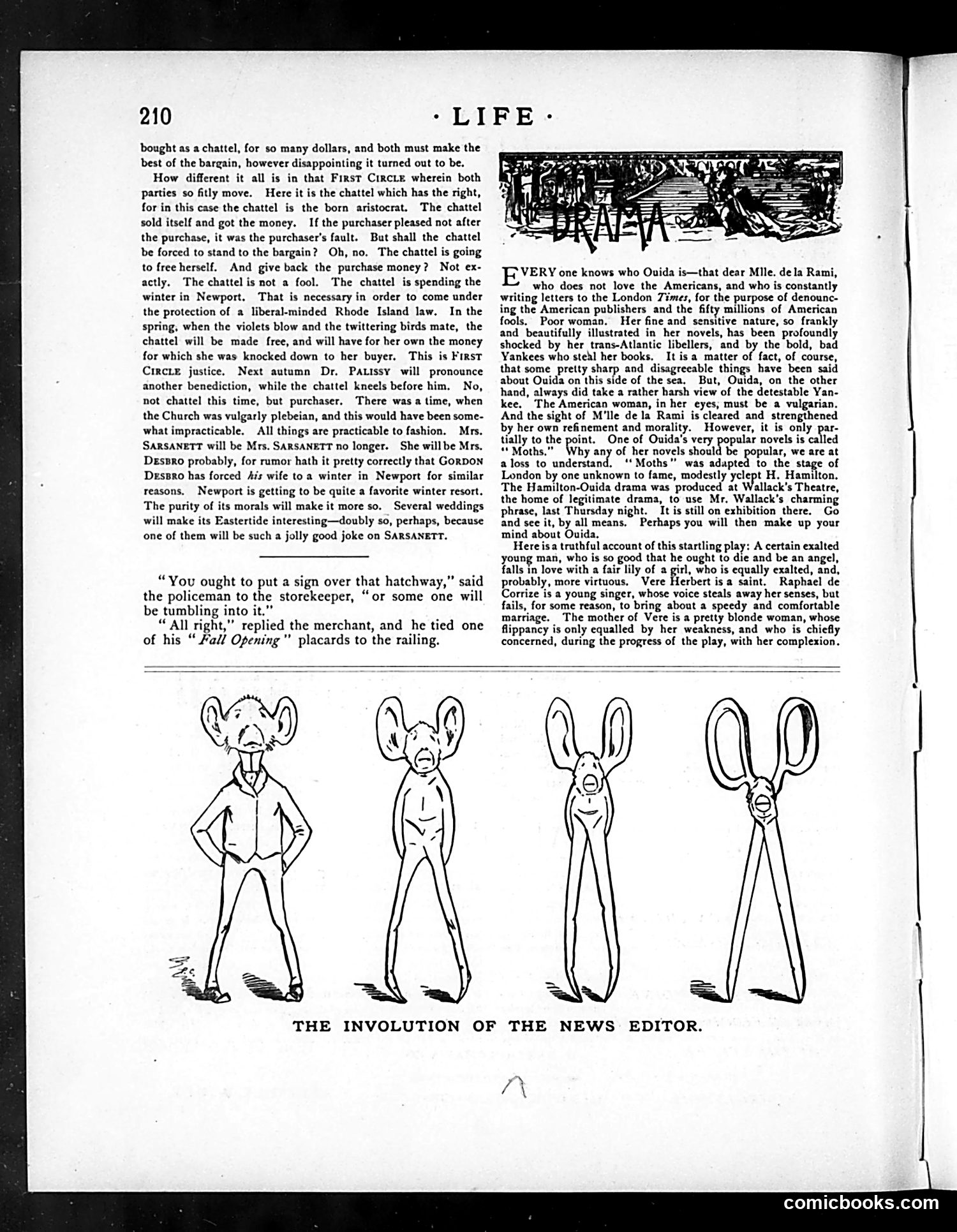
This Life magazine page (page 210) contains two distinct satirical pieces: **Upper section**: Social commentary on wealthy divorce and remarriage among New York's elite. The text mocks the "First Circle" (high society) where a woman can divorce her husband, keep his money, winter in Newport (Rhode Island's permissive divorce laws), and remarry—all while maintaining respectability. Named individuals like Mrs. Sarsanett and Gordon Dessro are gossiped about. The final joke warns storekeepers about unmarked hatches; a merchant responds by posting a "Fall Opening" sign instead of a safety warning—a pun on commercial greed overriding practical safety. **Lower section**: A cartoon titled "The Involution of the News Editor" shows four progressive stages of a figure with increasingly exaggerated, elongated ears—satirizing how editors become distorted or ridiculous through their work. **Right column**: A brief theater review attacking the British novelist Ouida (Marie Louise Ramé) for her anti-American sentiments while her novel "Moths" was adapted for Wallack's Theatre. Life mocks both Ouida's snobbery and the presumably terrible theatrical adaptation.
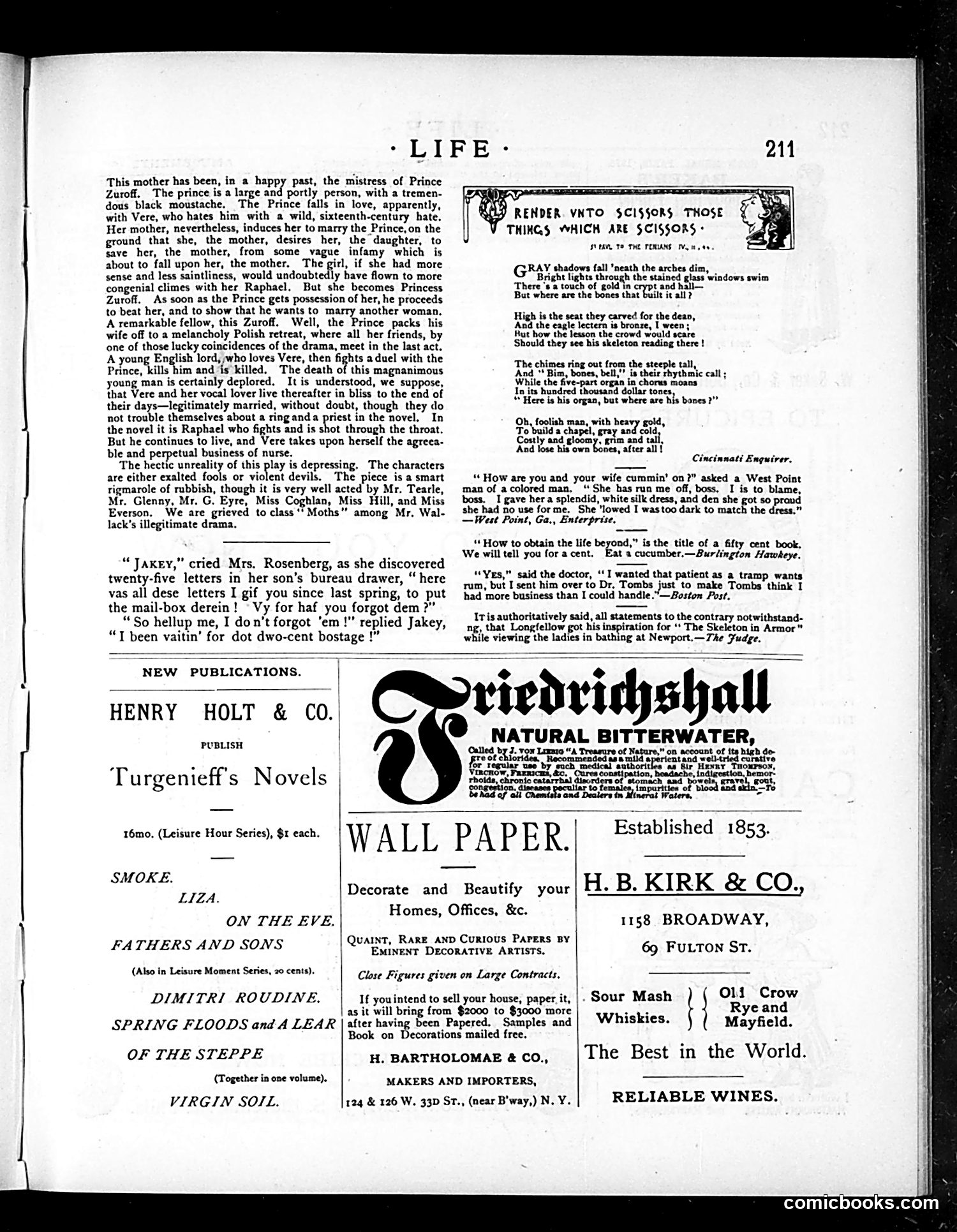
This page is primarily **literary criticism and advertisements** rather than political cartoons. The main content reviews a play called "Moths," criticizing its melodramatic plot about a woman forced to marry an abusive prince. The reviewer dismisses the characters as "exalted fools or violent devils" and calls it "smart rigmarole of rubbish." The page includes **humorous anecdotes** rather than cartoons: - A Jewish mother discovers her son never mailed letters she gave him, waiting for two-cent postage - A West Point anecdote about a Black man whose wife abandoned him after receiving a white silk dress, feeling it made her too refined for him The poetry titled "Render unto Scissors" appears to be satirical verse about elaborate cathedral construction prioritizing decoration over preserving actual remains. The remainder consists of **period advertisements** for novels, wallpaper, bitters, and wines—typical of Life magazine's revenue model.
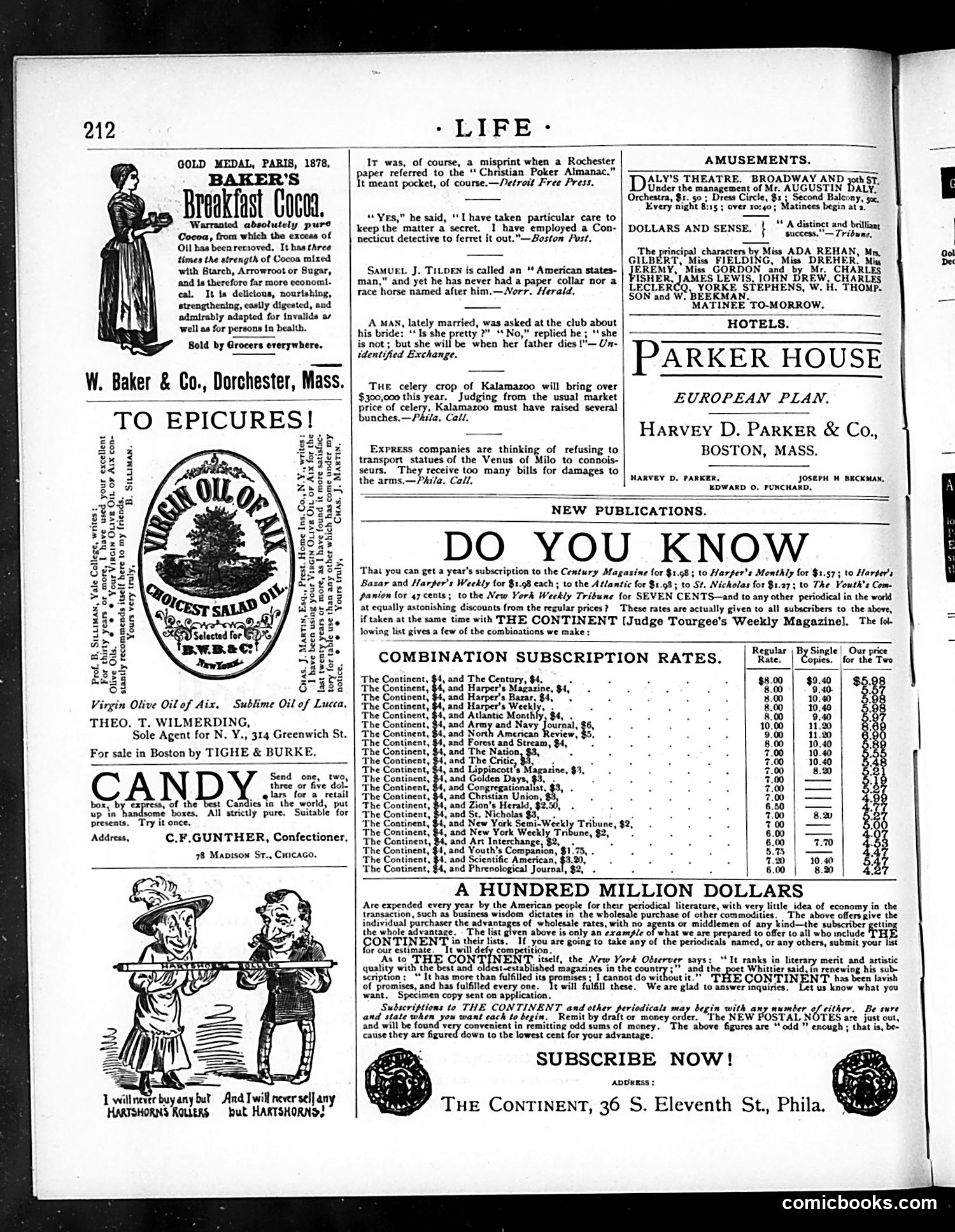
This page is primarily **advertising and entertainment listings**, not political satire. The main content includes: **Advertisements:** - Baker's Breakfast Cocoa (with woman endorsement illustration) - Virgin Olive Oil - Candy by C.F. Gunther - Harthorn's Rollers (roller skates) **Brief humor items** scattered throughout make light social commentary: - A Rochester paper's accidental "Christian Poker Almanac" misprint (poker as gambling vice) - A man employing a detective to keep a secret—absurd paranoia - Samuel J. Tilden mocked for lacking markers of wealth (paper collar, thoroughbred horse) - A groom admitting his new wife is plain but "will be when her father dies"—dark humor about inheritance **Theater/hotel listings** for Daly's Theatre and Parker House. The page's satirical content is minimal and lightweight—mostly gentle ribbing of social pretension and human folly rather than serious political commentary.
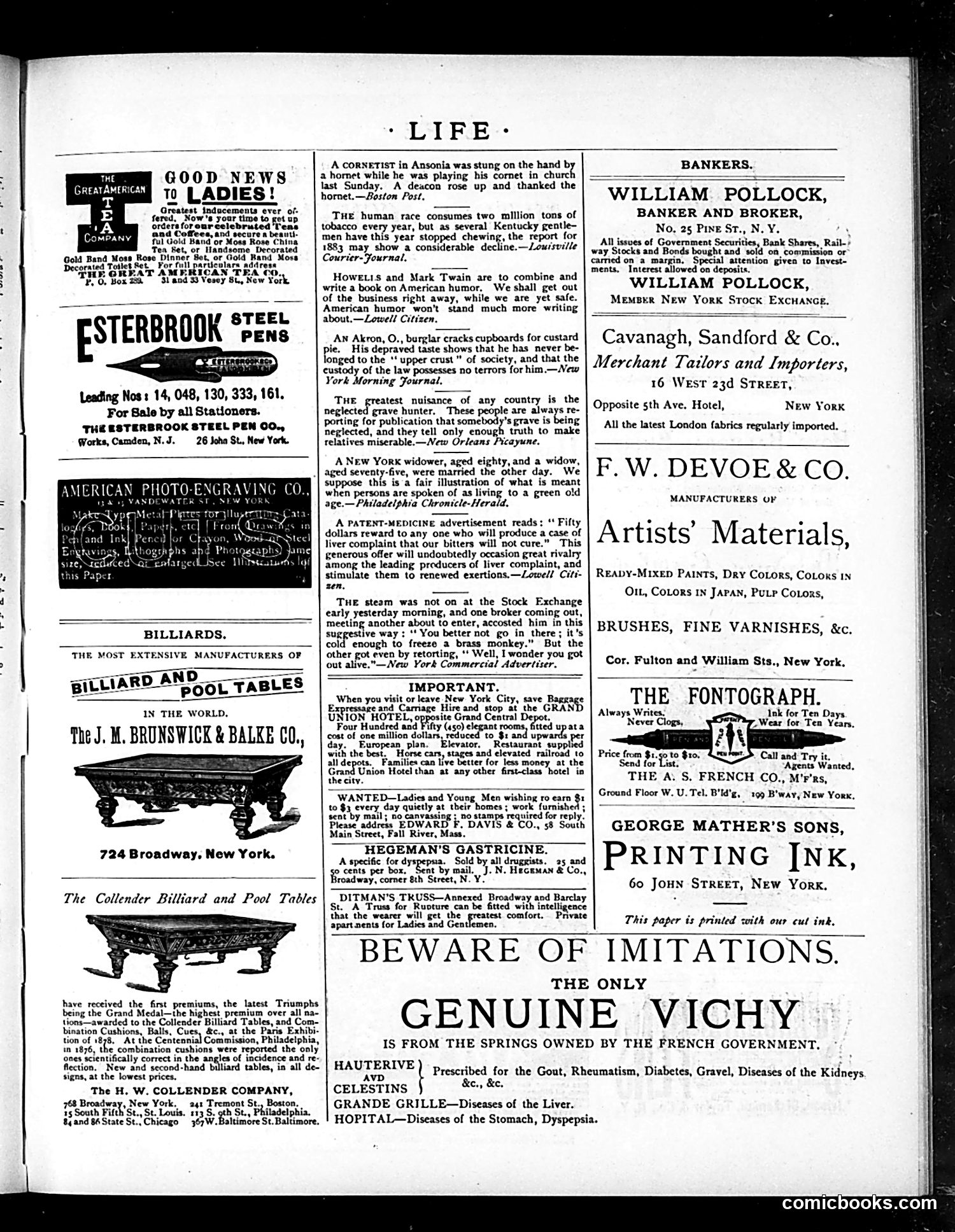
This is primarily an **advertising page** from Life magazine, with minimal editorial content. The page features **business advertisements** for prominent 1880s products and services: tea and coffee promotions, steel pens, billiard tables, banking services, artist materials, printing inks, and patent medicines. There are no political cartoons visible. The few **editorial items** scattered between ads are light satirical **newspaper excerpts** mocking contemporary issues: a cornetist stung by a hornet in church; rising tobacco consumption; Mark Twain and Howells writing a book on humor; a grave-robber stealing custard pies; abandoned cemetery maintenance complaints; an elderly couple's marriage; and stockbrokers making cynical jokes during cold mornings at the exchange. These brief jokes lack sophisticated political meaning—they're mild, domestic humor about everyday absurdities. The page layout exemplifies 19th-century magazine design where advertising dominated, with editorial filler squeezed between ads.
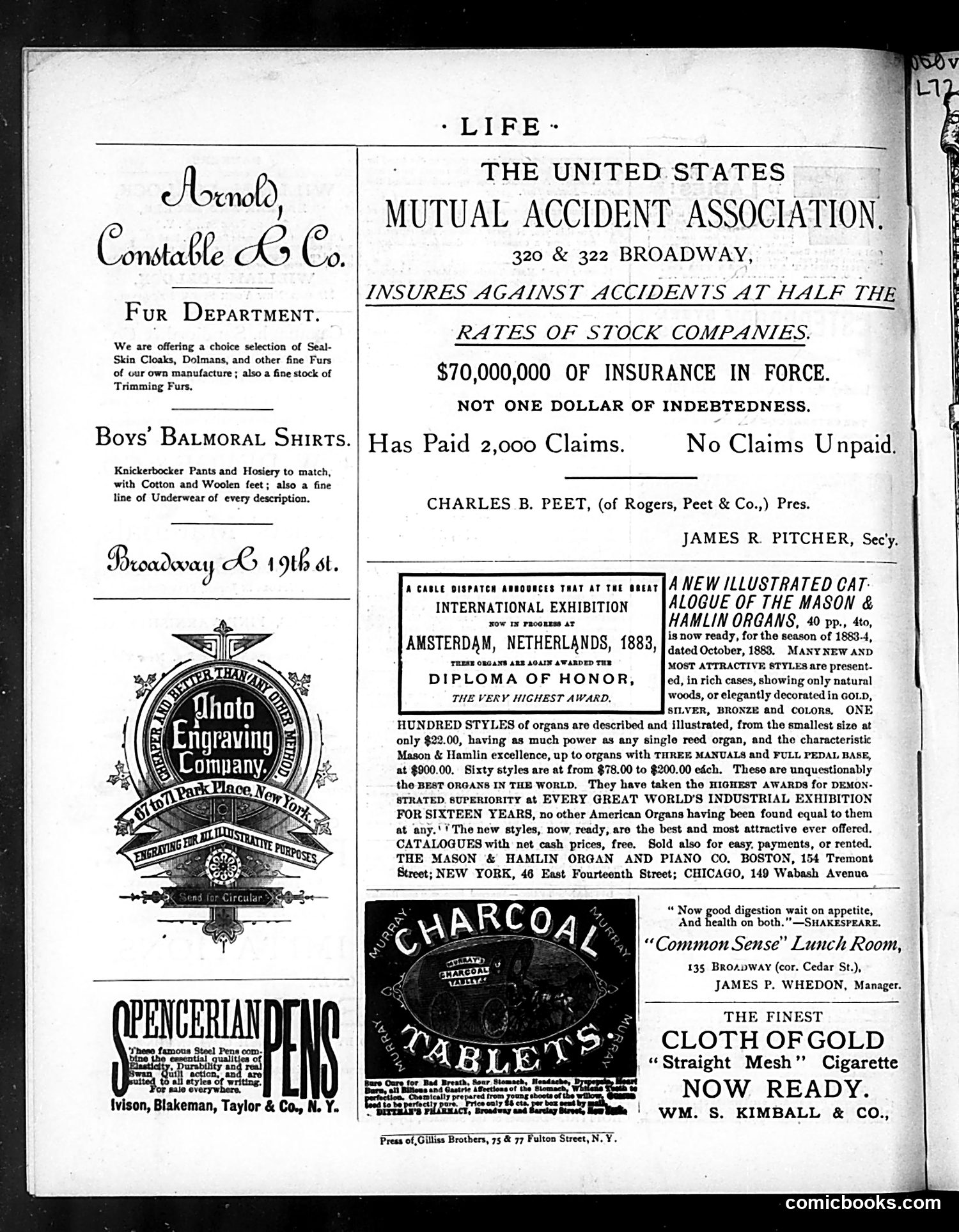
This is primarily an **advertising page** from Life magazine (circa 1883, based on the Amsterdam exhibition reference). There are no political cartoons or satirical content visible. The page features commercial advertisements for: - **Arnold, Constable & Co.** (fur coats and boys' clothing) - **Photo Engraving Company** (printing services) - **U.S. Mutual Accident Association** (insurance company claiming $70 million in force and 2,000 paid claims) - **Mason & Hamlin Organs** (musical instruments, advertising their award at an 1883 Amsterdam exhibition) - **Charcoal Tablets** (digestive product) - **"Common Sense" Lunch Room** (restaurant) - **Cloth of Gold Cigarettes** (tobacco product) The only visual element is the **Photo Engraving Company's decorative logo**—an ornate circular seal typical of late 19th-century business branding. For modern readers: This reflects 1880s consumer culture and advertising practices, before modern regulation of claims (note the insurance company's bold assertions without supporting detail).