
Life, 1883-10-25 · page 12 of 16
Life — October 25, 1883 — page 12: what you’re looking at
What you’re looking at
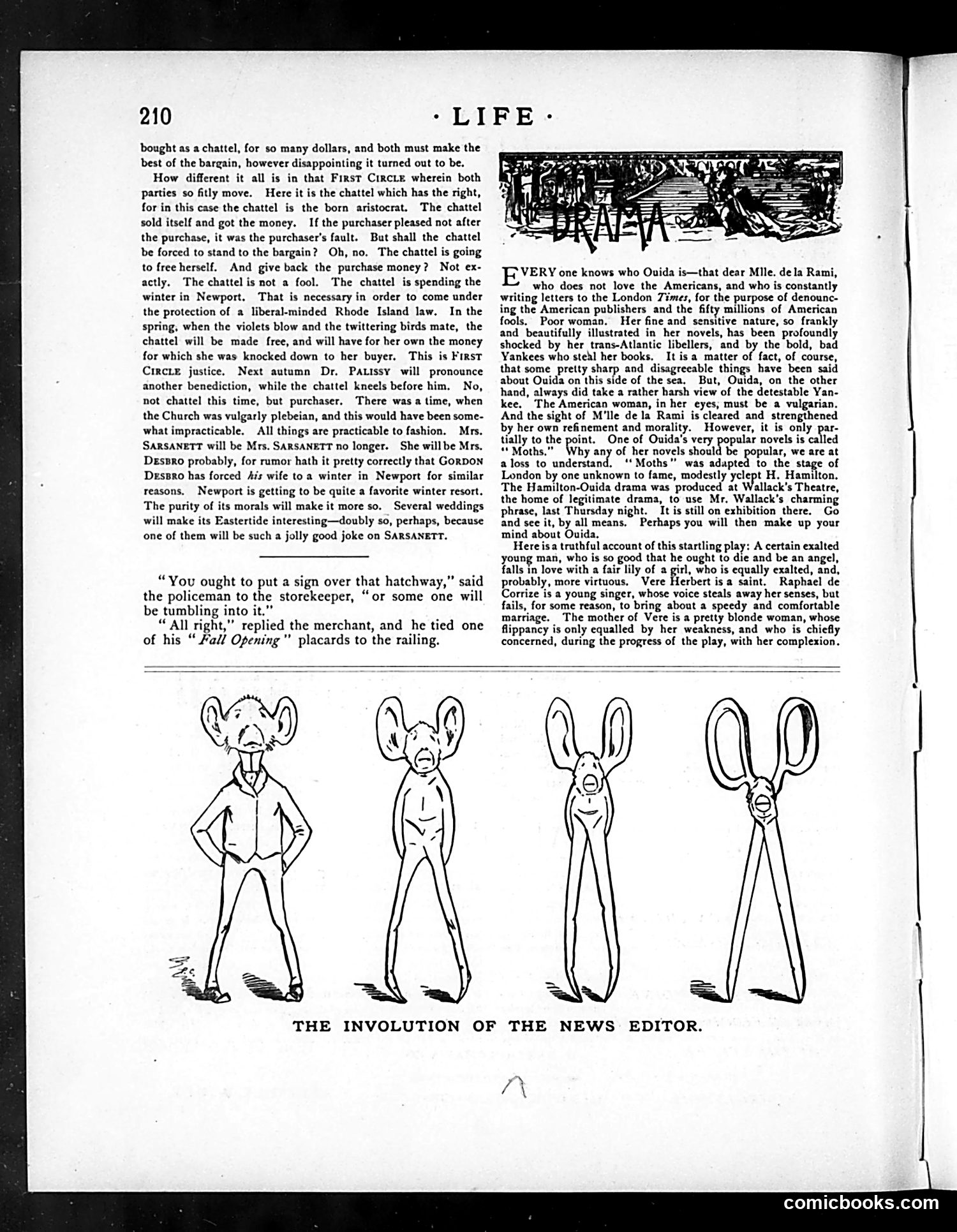
This Life magazine page (page 210) contains two distinct satirical pieces: **Upper section**: Social commentary on wealthy divorce and remarriage among New York's elite. The text mocks the "First Circle" (high society) where a woman can divorce her husband, keep his money, winter in Newport (Rhode Island's permissive divorce laws), and remarry—all while maintaining respectability. Named individuals like Mrs. Sarsanett and Gordon Dessro are gossiped about. The final joke warns storekeepers about unmarked hatches; a merchant responds by posting a "Fall Opening" sign instead of a safety warning—a pun on commercial greed overriding practical safety. **Lower section**: A cartoon titled "The Involution of the News Editor" shows four progressive stages of a figure with increasingly exaggerated, elongated ears—satirizing how editors become distorted or ridiculous through their work. **Right column**: A brief theater review attacking the British novelist Ouida (Marie Louise Ramé) for her anti-American sentiments while her novel "Moths" was adapted for Wallack's Theatre. Life mocks both Ouida's snobbery and the presumably terrible theatrical adaptation.
📄 Transcribed text from this page (OCR, searchable)
Machine-transcribed from the original scan — historical spelling and the odd misread are preserved.
210 bought as a chattel, for so many dollars, and both must make the best of the bargain, however disappointing it turned out to be. How different it all is in that First CrrcLe wherein both Parties so fitly move. Here it is the chattel which has the right, for in this case the chattel is the born aristocrat. The chattel sold itself and got the money. If the purchaser pleased not after the purchase, it was the purchaser's fault. But shall the chattel be forced to stand to the bargain? Oh, no. The chattel is going to free herself. And give back the purchase money? Not ex- actly, The chattel is not a fool. The chattel is spending the winter in Newport, That is necessary in order to come under the protection of a liberal-minded Rhode Island law. In the spring, when the violets blow and the twittering birds mate, the chattel will be made free, and will have for her own the money for which she was knocked down to her buyer. This is First Circe justice, Next autumn Dr. Patissy will pronounce another benediction, while the chattel kneels before him. No, not chattel this time, but purchaser, There was a time, when the Church was vulgarly plebeian, and this would have been some- what impracticable. All things are practicable to fashion. Mrs. SARSANETT will be Mrs. SARSANETT no longer. She will be Mrs. Dessro probably, for rumor hath it pretty correctly that GORDON Dessro has forced Ais wife to a winter in Newport for similar reasons. Newport is getting to be quite a favorite winter resort. The purity of its morals will make it more so. Several weddings will make its Eastertide interesting—doubly so, perhaps, because one of them will be such a jolly good joke on SARSANETT. “You ought to put a sign over that hatchway,” said the policeman to the storekeeper, “or some one will be tumbling into it.” “All right,” replied the merchant, and he tied one of his “ Kall Opening" placards to the railing. -*LIFE- VERY one knows who Ouida is—that dear Mile. dela Rami, who does not love the Americans, and who is constantly writing letters to the London 7imes, for the purpose of denounc- ing the American publishers and the fifty millions of American fools. Poor woman. Her fine and sensitive nature, so frankly and beautifully illustrated in her novels, has been profoundly shocked by her trans-Atlantic libellers, and by the bold, bad Yankees who steal her books. It is a matter of fact, of course, that some pretty sharp and disagreeable things have been said about Ouida on this side of the sea, But, Ouida, on the other hand, always did take a rather harsh view of the detestable Yan- kee, The American woman, in her eyes, must be a vulgarian. And the sight of M’lle de la Rami is cleared and strengthened by her own refinement and morality. However, it is only par- tially to the point. One of Ouida’s very popular novels is called “Moths.” Why any of her novels should be popular, we are at aloss to understand, ‘‘ Moths” was adapted to the stage of London by one unknown to fame, modestly yclept H. Hamilton. The Hamilton-Ouida drama was produced at Wallack's Theatre, the home of legitimate drama, to use Mr. Wallack’s charming phrase, last Thursday night. It is still on exhibition there. Go and see it, by all means, Perhaps you will then make up your mind about Ouida, Here isa truthful account of this startling play: A certain exalted young man, who is so good that he ought to die and be an angel, falls in love with a fair lily of a girl, who is equally exalted, and, probably, more virtuous. Vere Herbert isa saint. Raphael de Corrize is a young singer, whose voice steals away her senses, but fails, for some reason, to bring about a speedy and comfortable marriage. The mother of Vere is a pretty blonde woman, whose flippancy is only equalled by her weakness, and who is chiefly concerned, during the progress of the play, with her complexion. INVOLUTION OF THE NEWS EDITOR. 7X comicbooks.com