
A complete issue · 16 pages · 1883
Life — July 19, 1883
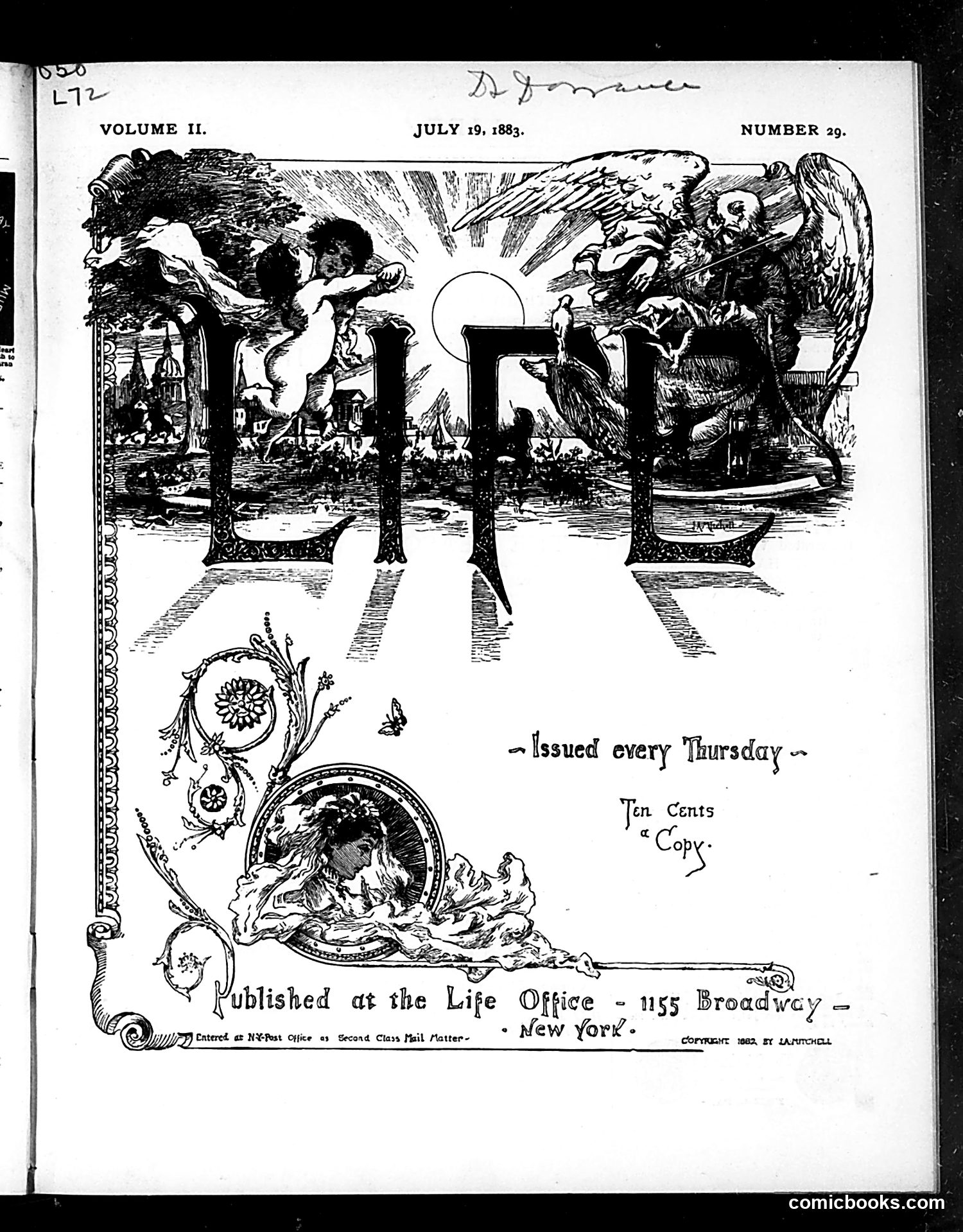
This is the cover of Life magazine's second volume, number 29. The large decorative letters "LIFE" dominate the center, filled with an intricate satirical illustration showing classical and allegorical figures in a fantastical landscape with a bright sun. The image appears to be a commentary on life, fate, and human existence using mythological or symbolic imagery—typical of Life magazine's satirical approach during this period. The ornamental design surrounding the masthead, including floral motifs and a cameo portrait of a woman, reflects the magazine's aesthetic sensibility. The publication details indicate it was issued weekly at ten cents per copy and published from the Life Office in New York. Without more specific context about 1883 events, the exact satirical target remains unclear.
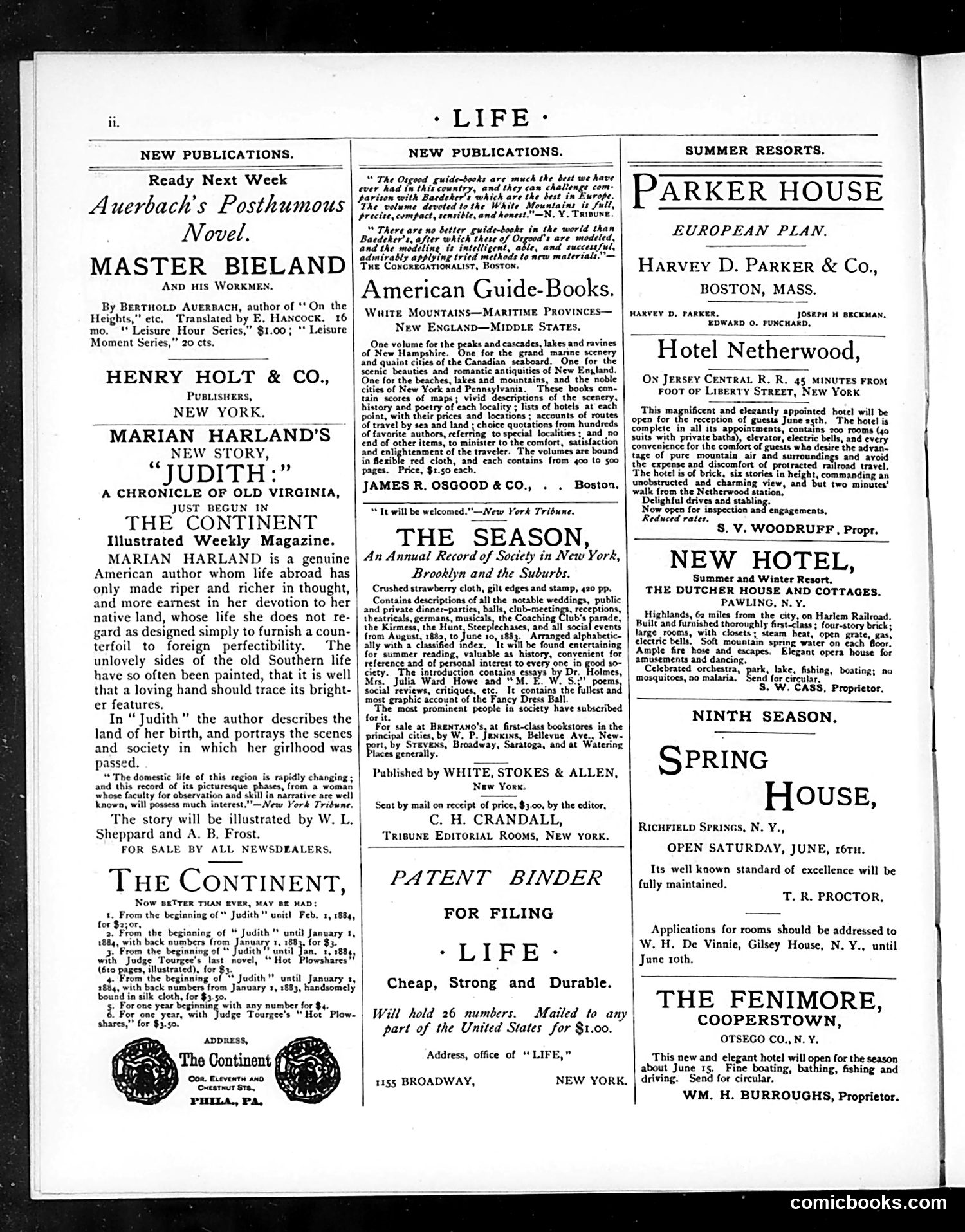
This page is **entirely advertising and editorial content** — no political cartoons or satirical illustrations are present. The advertisements promote: - Literary works (Auerbach's novel, Marian Harland's story "Judith") - *The Season*, an annual record of New York social events - A patent binder for filing documents - Summer resorts (Parker House in Boston, Hotel Netherwood in New Jersey, Spring House in Richfield Springs, and The Fenimore in Cooperstown) The editorial mentions focus on new publications and travel destinations. There is no satirical commentary, political figures, or caricatures to interpret. This appears to be a standard **commercial page from Life magazine**, likely from the 1880s-1890s based on typography and advertising style.
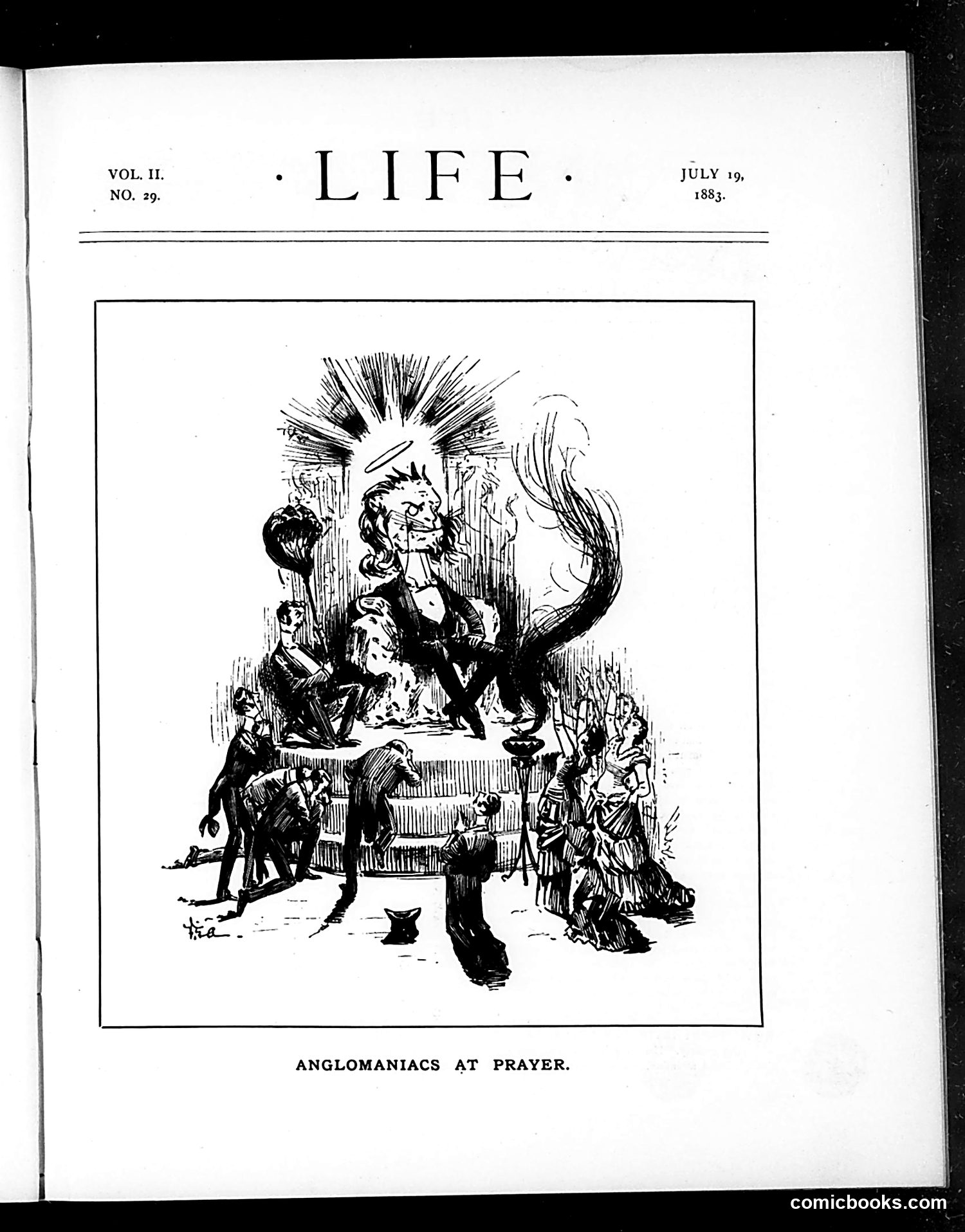
This satirical cartoon ridicules wealthy Americans who excessively imitate British customs and culture—a phenomenon called "Anglomania." The central figure, depicted as a caricatured gentleman in formal dress, appears elevated and sanctified (note the halo and radiating light), suggesting these Anglophiles treated British manners almost religiously. The surrounding figures in prayer-like poses represent admirers worshipping this idealized Anglophile. The satire mocks the pretentiousness of American society's obsession with British fashion, speech, and etiquette during the Gilded Age, when wealthy Americans often adopted British affectations as status symbols. This reflects late 19th-century American anxiety about cultural identity and class aspiration during rapid industrialization.
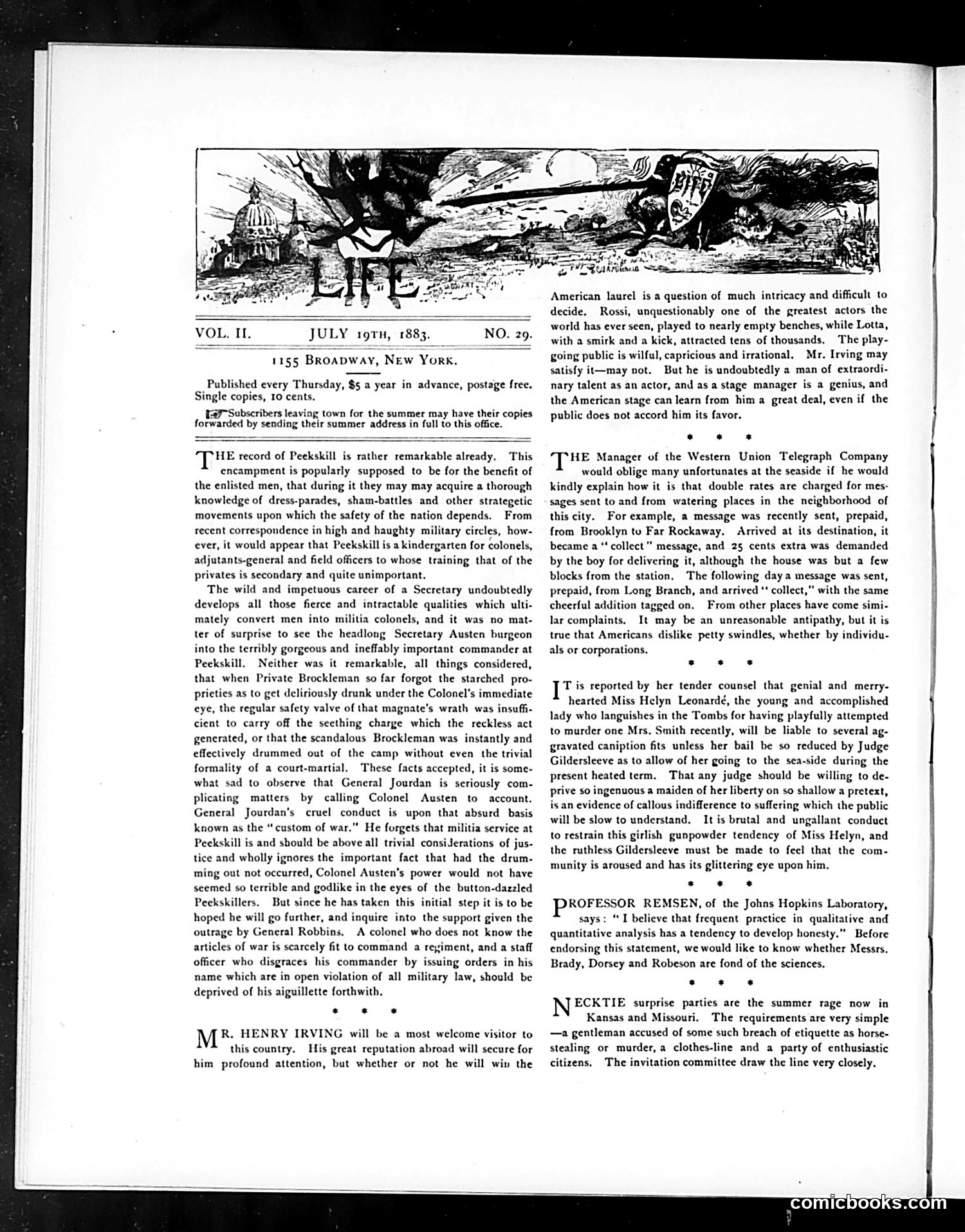
The masthead cartoon depicts a theatrical scene with classical elements—a domed building (likely representing a theater or capitol) and dramatic figures. The word "LIFE" is prominent, establishing this as the magazine's title treatment. The page contains no political cartoon per se, but rather several brief satirical news items and commentary. Notable items include criticism of General Jordon's conduct at Peekskill, commentary on Henry Irving's upcoming American visit, discussion of telegraph company inefficiencies, and a jab at Miss Helyn Leonardt regarding a legal case involving Mrs. Smith. The final item ridicules "necktie surprise parties" in Kansas and Missouri as a pretext for theft and violence disguised as social entertainment.
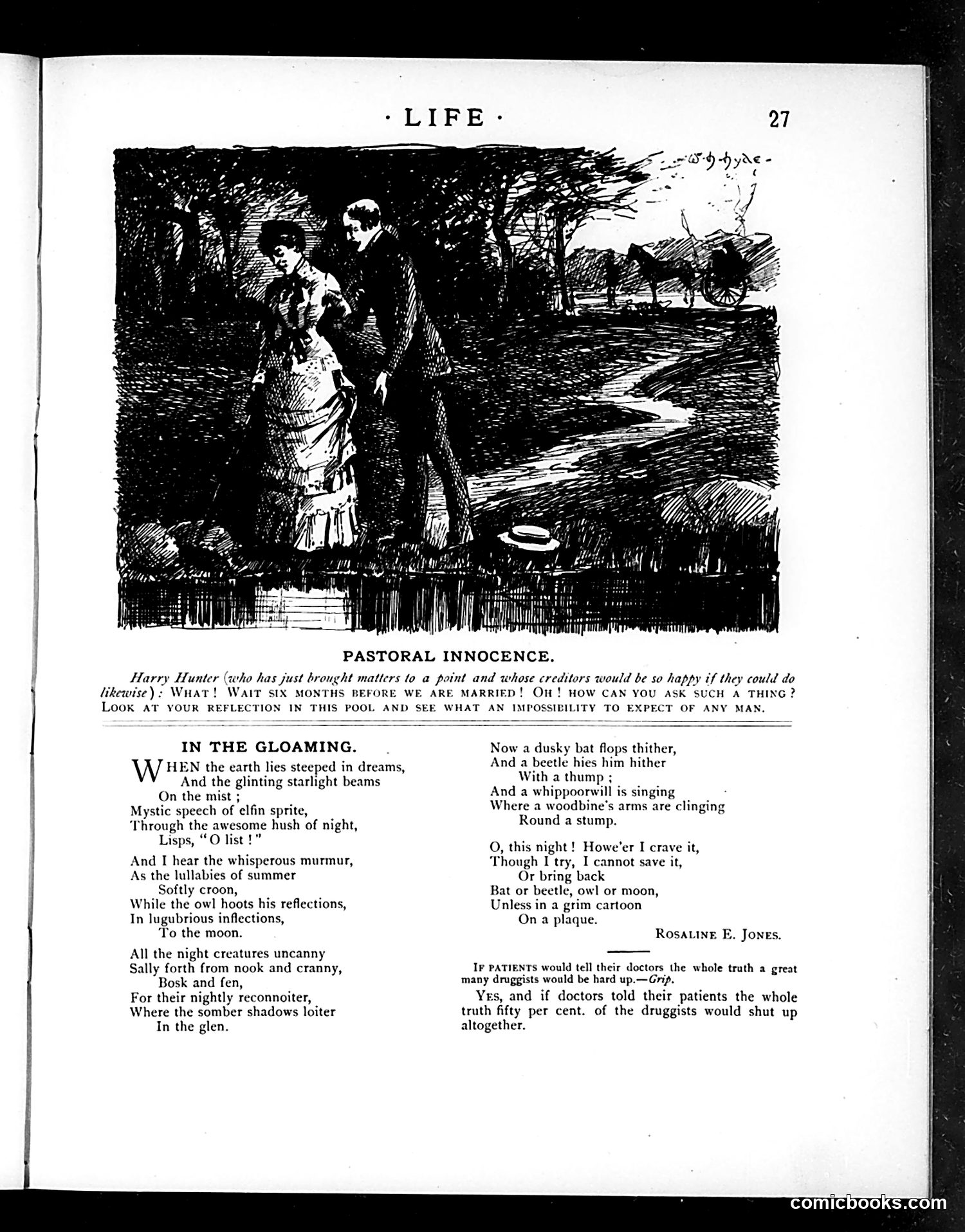
The cartoon depicts a couple in a rural setting with the caption "Pastoral Innocence." The accompanying text reveals the satire's target: a character named Harry Hunter who has financial troubles—he's "just brought matters to a point" where creditors would be satisfied if he married someone wealthy. The joke mocks the gap between romantic ideals and economic reality. The couple appears to gaze at their reflection in a pool, but the caption sarcastically suggests they should see "what an impossibility to expect of any man"—implying that marrying for love while in debt is naive or foolish. The cartoon satirizes both naive romanticism and the mercenary nature of marriage among the financially desperate in the era.
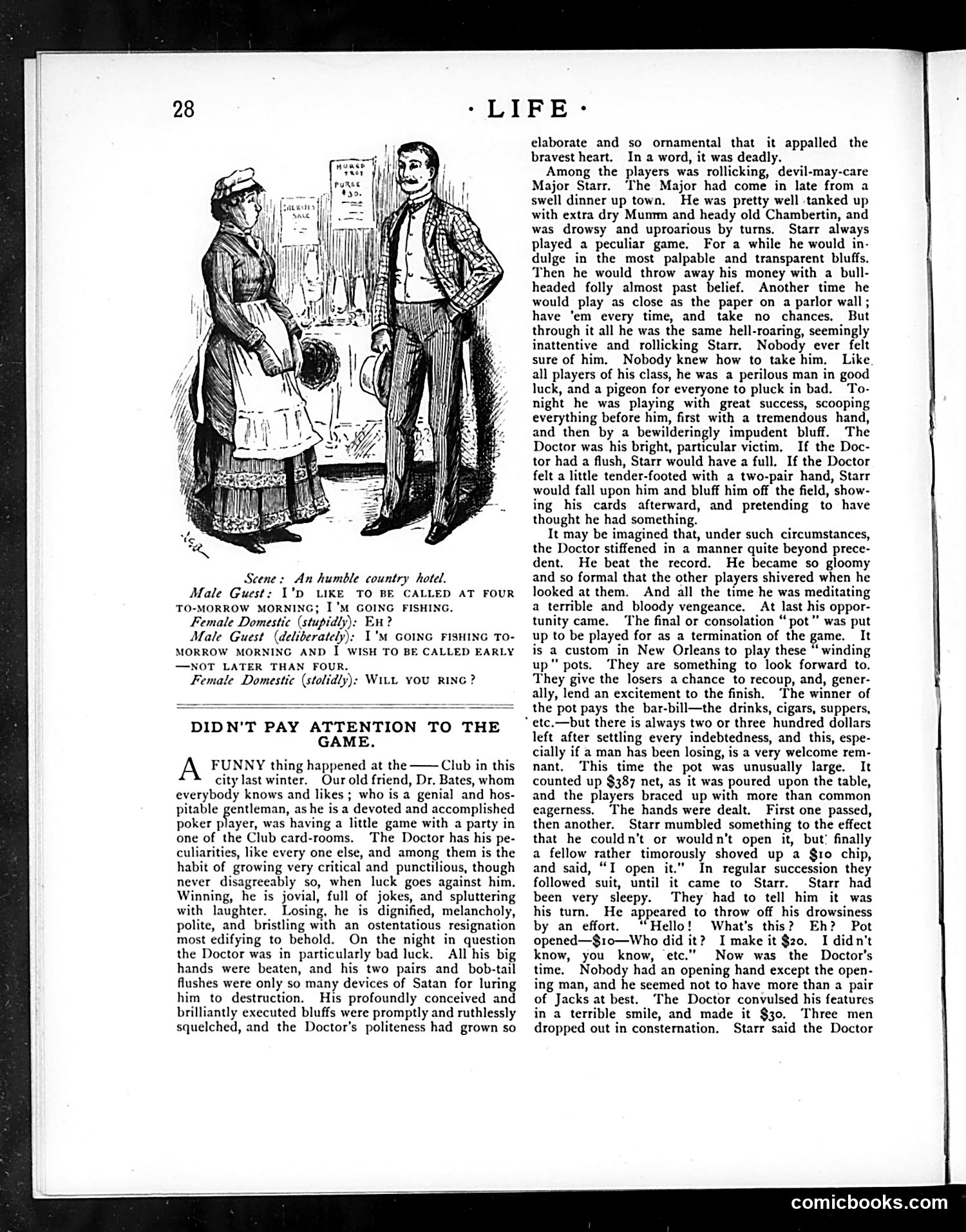
The page contains a brief satirical dialogue and a story titled "Didn't Pay Attention to the Game." **The Cartoon/Dialogue:** The illustration shows a country hotel scene with a male guest and female domestic. The joke turns on miscommunication: the male guest requests to be "called at four tomorrow morning" for fishing, while the female domestic mishears this as a social invitation ("I'm going fishing tomorrow morning and I wish to be called early—not later than four"). Her response—"Will you ring?"—suggests she's either confused or making a sarcastic comment about the implied impropriety. **The Story:** This humorous narrative describes a poker game where Major Starr, a wealthy but reckless player, loses significantly at cards in a New Orleans club. The satire mocks his transparent bluffing techniques and poor judgment, ultimately resulting in financial loss. Both pieces are genteel Victorian-era humor focused on social misunderstandings and gambling consequences.
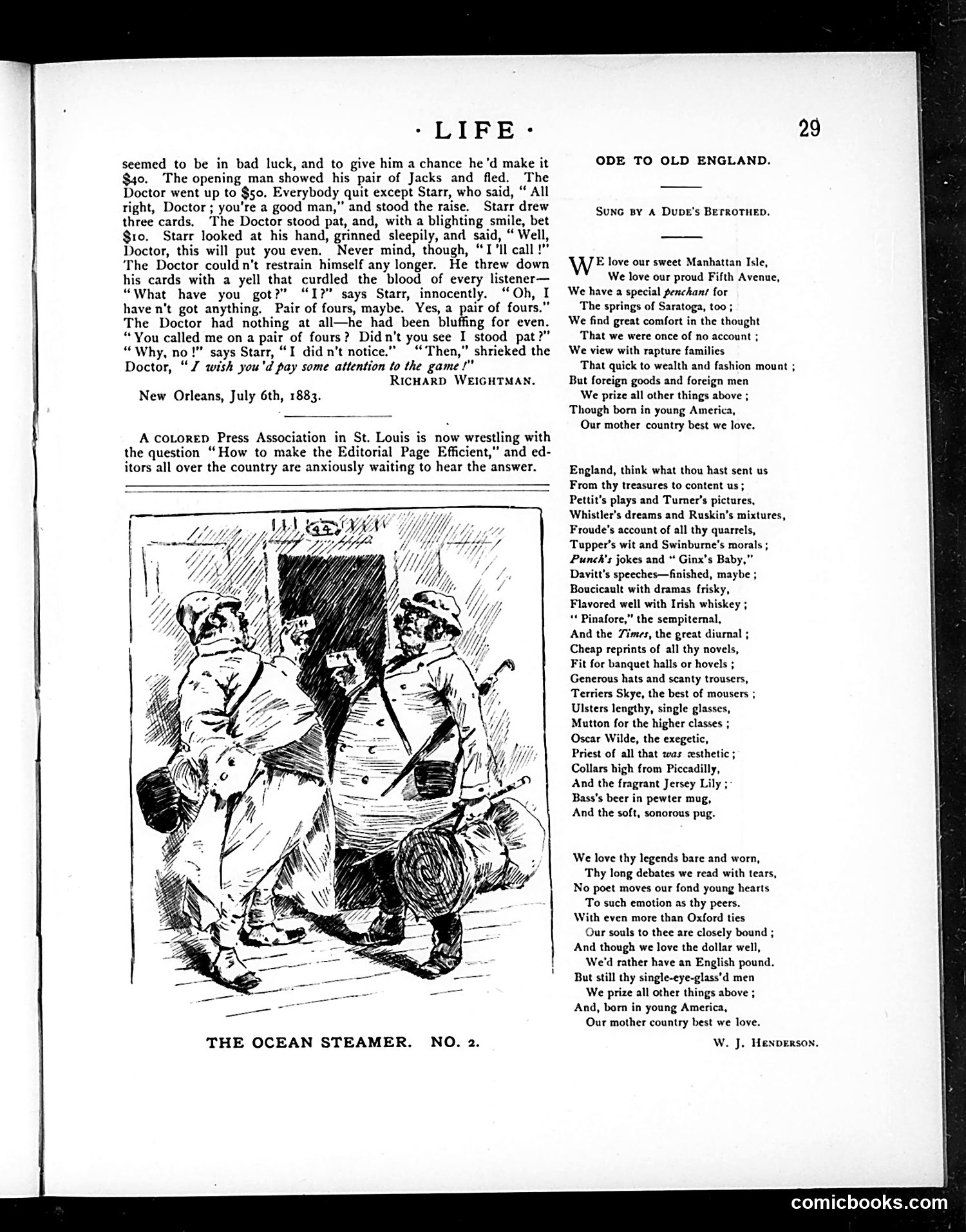
This cartoon satirizes a poker game aboard a ship, likely referencing common gambling among travelers. Two rotund men flank a central figure, appearing to play cards in close quarters. The sketch style emphasizes their corpulence and suggests comic desperation or intensity around the game. The accompanying story (by Richard Weightman, dated New Orleans, July 6th, 1883) depicts a card game where the "Doctor" character repeatedly loses, with other players mocking his misfortune. The joke centers on his insistence that luck will turn despite obvious failure—a common target of period satire about gullible gamblers. The cartoon likely mocks the folly of ocean-voyage gambling and male vanity around games of chance.
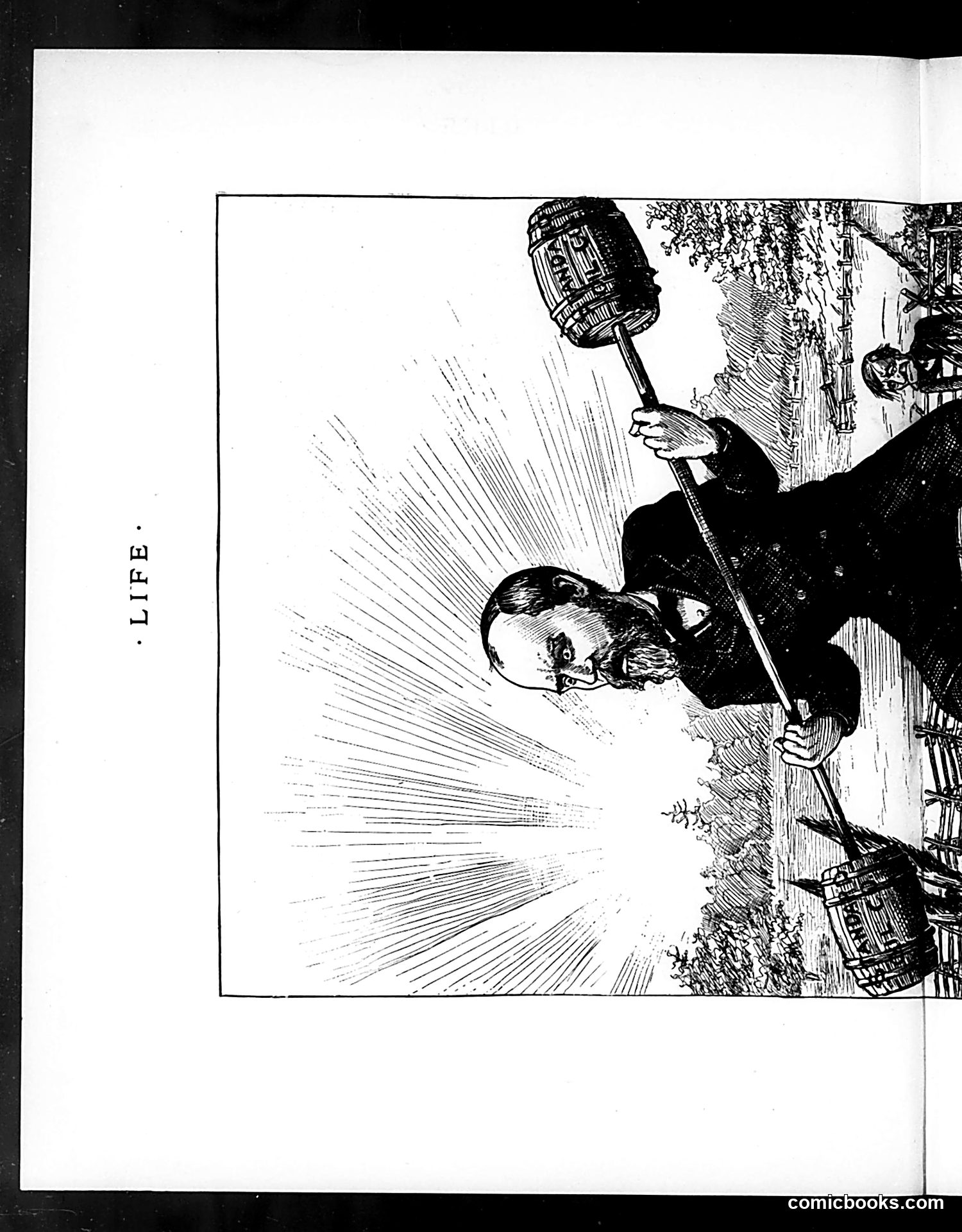
This page shows a single illustration labeled "LIFE" on the left margin. The image depicts a figure in formal attire (dark suit and hat) holding an ornate lantern or lamp aloft on a pole, with dramatic radiating light lines behind it suggesting illumination or revelation. The figure appears to be a caricatured person of importance, possibly a political or social leader, positioned as if searching or revealing something—a visual reference to the classical "Diogenes with his lamp" motif, which traditionally represents searching for truth or an honest person. Without additional context from the magazine's date or surrounding text, the specific target of this satire is unclear, though it likely critiques a public figure's claim to truthfulness, wisdom, or leadership during an era of political scrutiny.
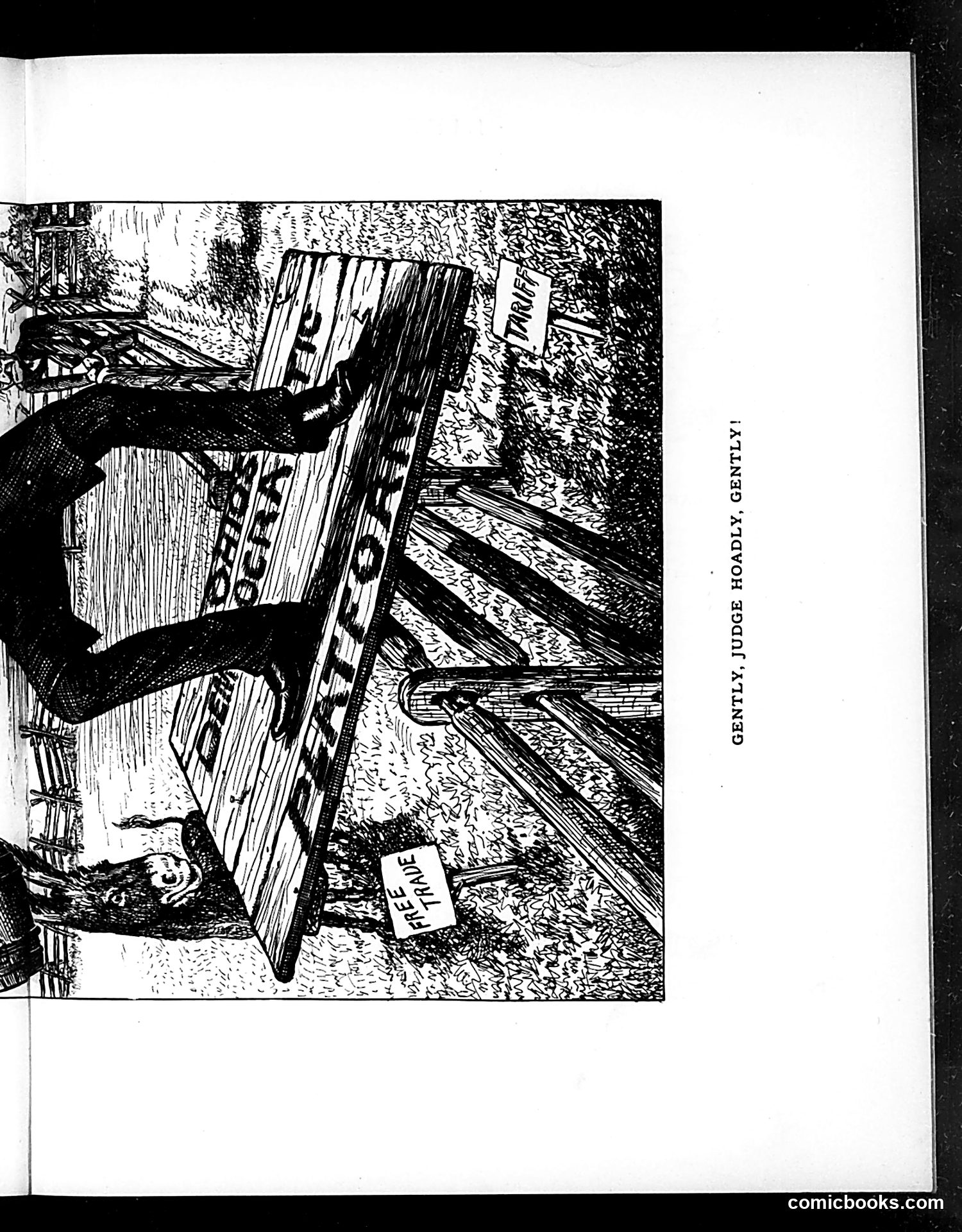
This page contains a black and white illustration captioned "GENTLY, JUDGE HODDLY, GENTLY!" The image shows what appears to be a judicial or legal figure (the judge referenced in the caption) handling objects marked with text that's difficult to read clearly in this reproduction, though "PRIME" appears visible on one item. The satire appears to critique how a judge or legal authority is dealing with sensitive matters—the caption's plea for gentleness suggests the cartoon warns against heavy-handed or overly aggressive judicial action. Without clearer visibility of the specific text on the objects being handled or more context about Judge Hoddly's contemporary notoriety, the precise political or social target remains unclear, though it likely referenced a specific legal controversy or judicial decision from Life magazine's publication period.
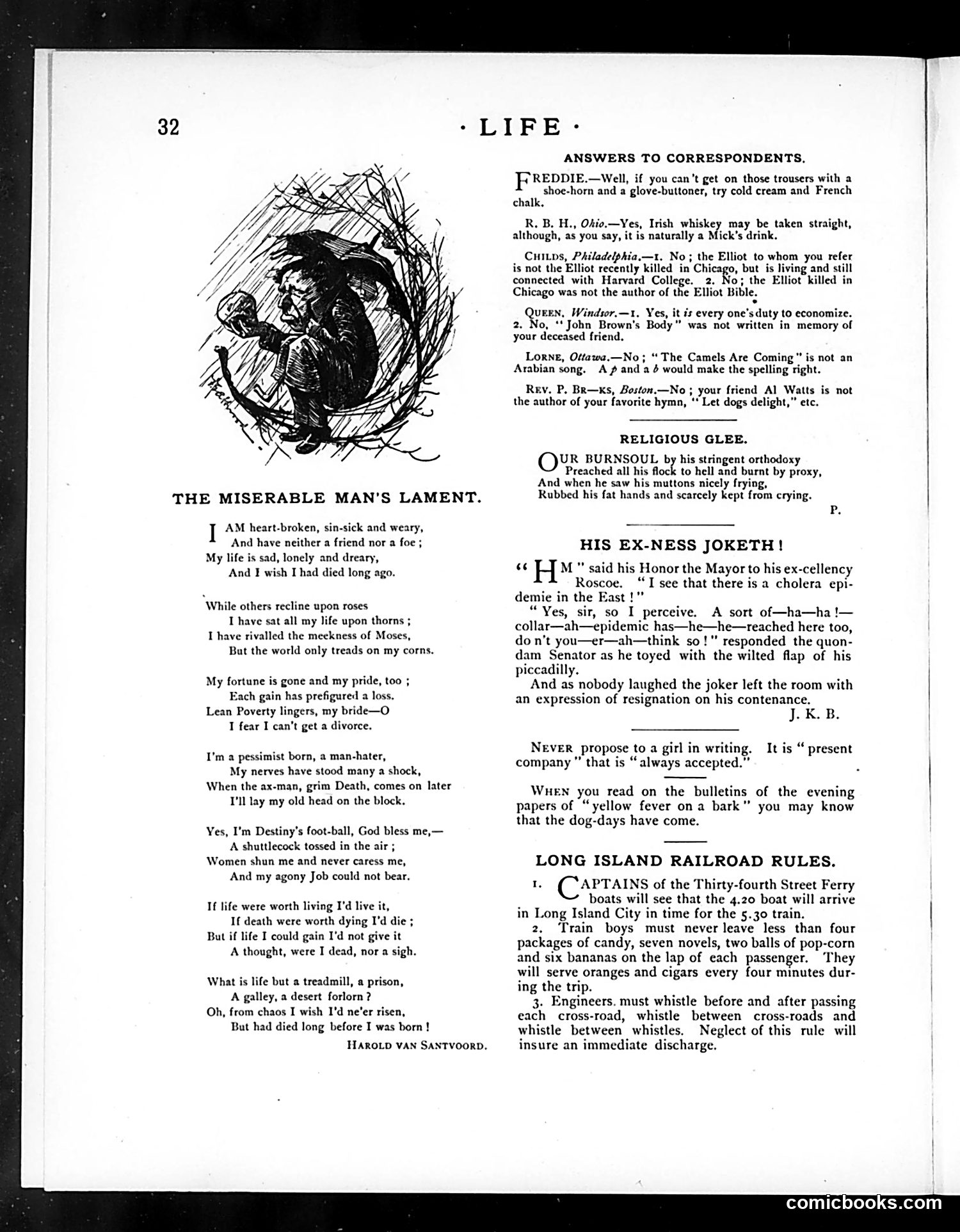
This page contains several satirical pieces typical of Life magazine's humor format: **"The Miserable Man's Lament"** (left) is a long comic poem by Harold Van Santvoord depicting an archetypal pessimist complaining about life's miseries—poverty, loneliness, failed romance, and existential despair. The crude illustration shows a hunched, distressed figure. The satire targets exaggerated self-pity and melodramatic fatalism. **"Religious Glee"** mocks hypocritical clergy, depicting a preacher ("Burnsoul") who sermonizes damnation to his congregation while finding dark humor in their spiritual suffering. **"His Ex-Ness Joketh"** satirizes a failed attempt at humor by a Mayor and former Senator making awkward puns about cholera reaching their city. The joke falls flat, and the joker leaves embarrassed—the satire targets forced, inappropriate humor. The remaining content includes brief advice column responses and absurdist "Long Island Railroad Rules" (obviously fictional), which mock bureaucratic inefficiency through impossible regulations about ferry schedules and train-boy candy distribution. Overall, the page exemplifies Life's mix of literary satire, social commentary, and absurdist humor.
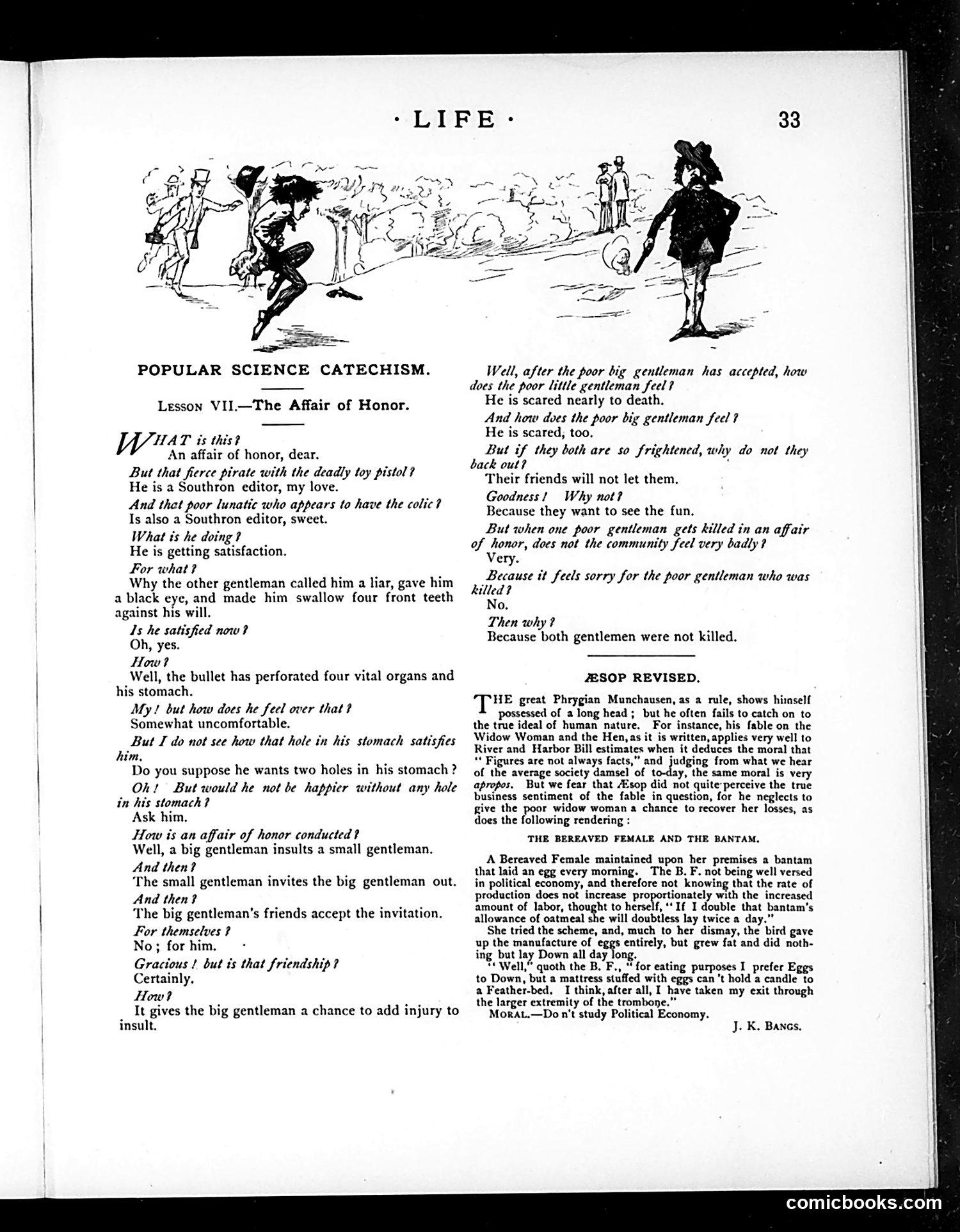
This page contains two satirical pieces mocking American social conventions, particularly Southern dueling culture. **"Popular Science Catechism: The Affair of Honor"** ridicules the Southern gentleman's code dueling. The cartoon depicts two frightened men shooting each other over an insult. The dialogue satirizes the absurdity: both men are terrified, friends force them to fight despite mutual fear, and the "satisfaction" gained is a bullet wound. The final joke—that the community only regrets *both* weren't killed—mocks the pointlessness of honor killings. This reflects Northern anti-Southern sentiment during the Reconstruction era, portraying Southern editors and gentlemen as violent and irrational. **"Aesop Revised"** parodies Aesop's fables by retelling "The Hen and the Widow Woman" as a critique of flawed economic reasoning. A widow feeds her bantam extra oatmeal expecting doubled egg production; instead, the bird stops laying and grows fat. The moral satirizes those who ignore economic principles—likely a dig at misguided government policies or individuals who ignore practical wisdom. Both pieces use humor to critique foolish pride, violent tradition, and economic ignorance.
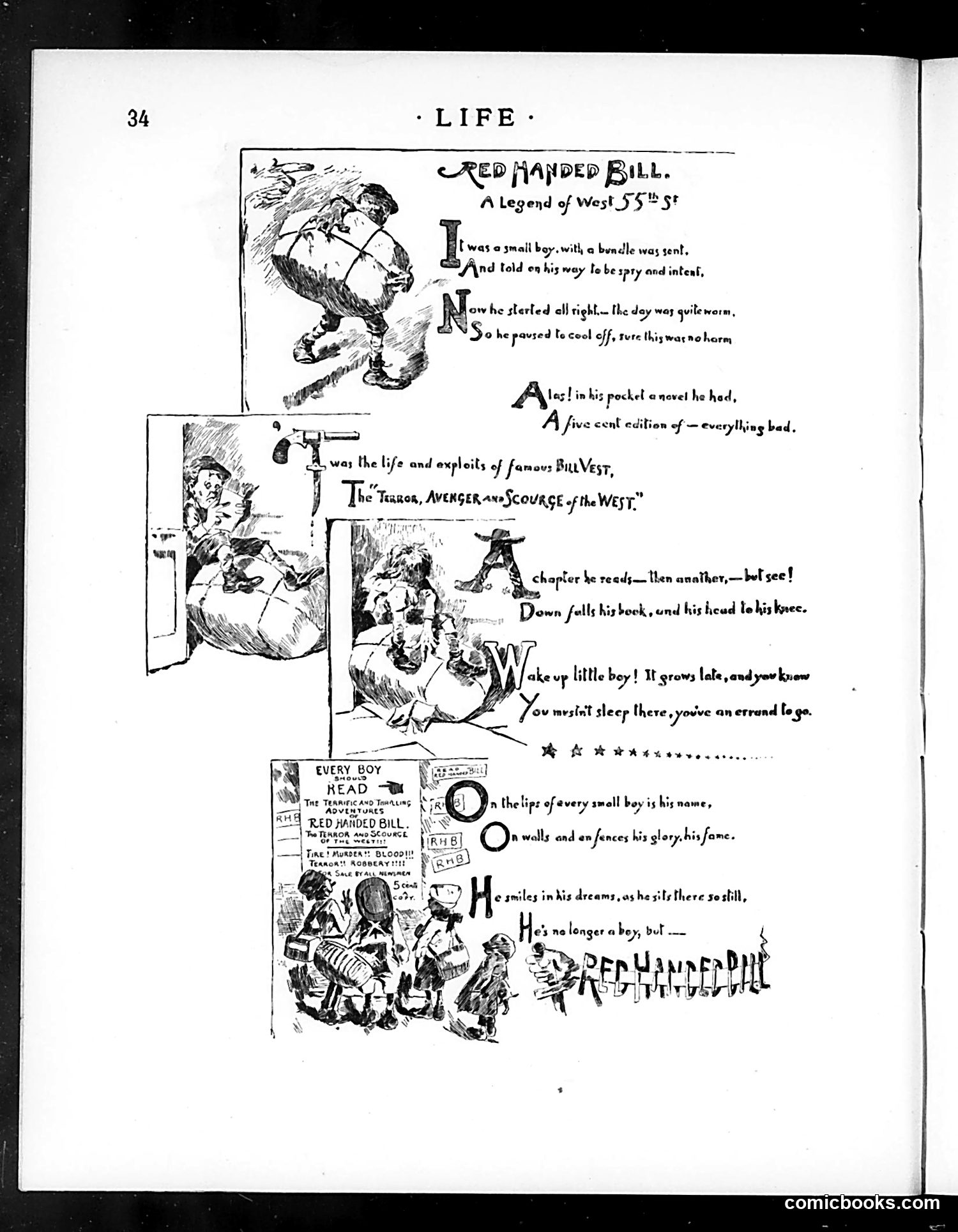
This satirical piece mocks the corrupting influence of cheap pulp fiction on urban youth. A working-class boy is sent on an errand but stops to read a five-cent dime novel about "Bill Vest, the Terror, Avenger and Scourge of the West"—likely a Buffalo Bill-type figure. The boy falls asleep dreaming of frontier exploits. The satire suggests that sensational Western adventure stories, widely available and affordable to poor children in early 20th-century cities, distracted them from responsibilities and filled their heads with fantasies of violence and lawlessness. The final image of the boy becoming "Red Handed Bill" implies the real danger: that such stories could inspire actual criminal behavior among impressionable urban youth rather than harmless frontier adventure. This reflects period concerns about mass-market literature's social effects.
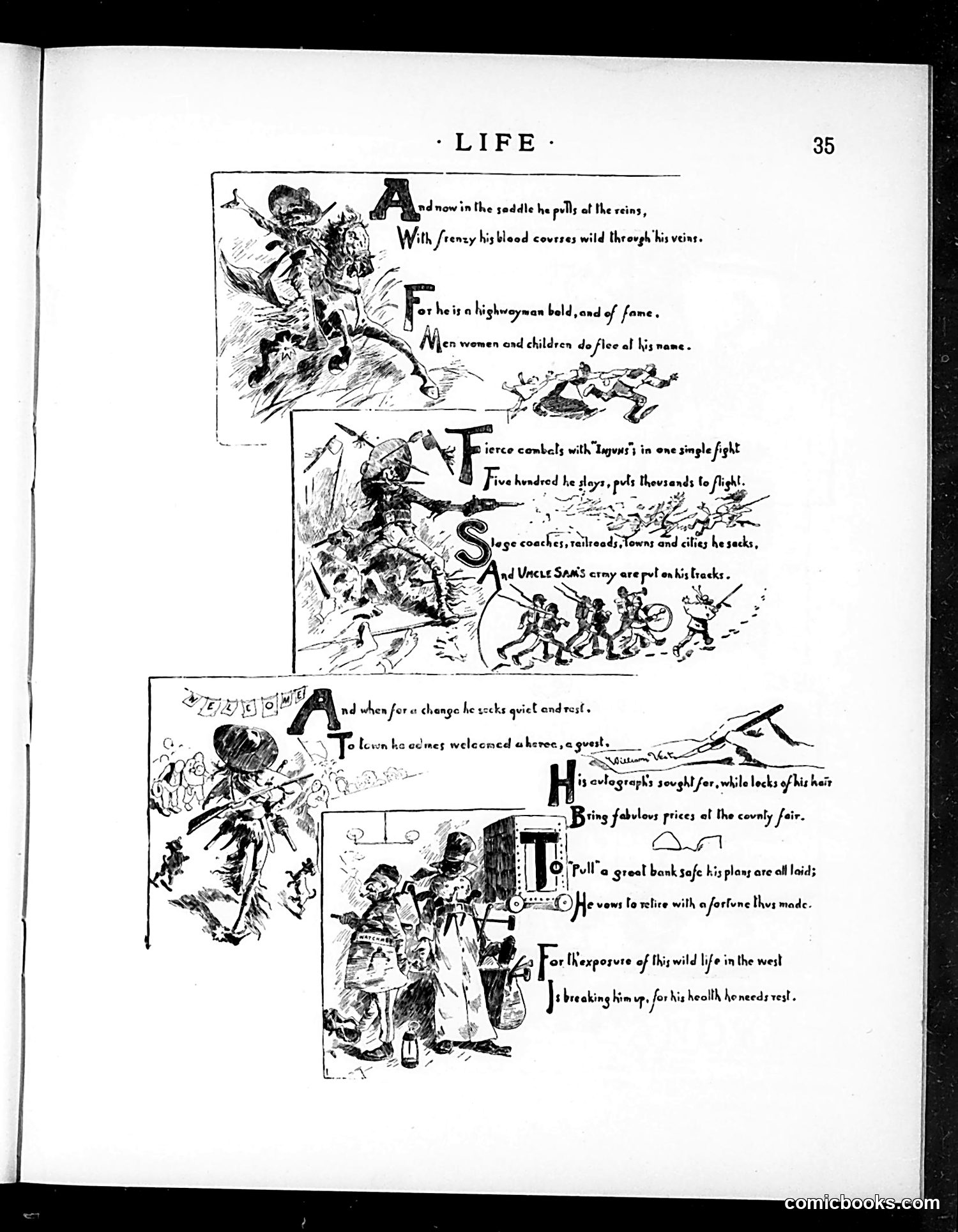
This page satirizes the popular mythology of Wild West outlaws, particularly the "highwayman bold" figure celebrated in contemporary culture. The cartoon mocks how dime novels and public imagination glorified violent criminals: The subject is depicted as a legendary bandit—engaged in fierce combat with Native Americans, robbing banks, and evading law enforcement. The satire highlights the absurd contrast between the romanticized image (depicted through dramatic illustrations showing heroic violence) and reality: the outlaw eventually tires, seeks to retire with stolen wealth, and requires forced "rest" to recover from the wear of his criminal lifestyle. The piece critiques how American popular culture transformed actual criminals into folk heroes, selling sensationalized "autographs" and merchandise at county fairs. The final lines suggest that exposure of this lifestyle's brutality was needed to discourage such glorification. The satire targets both the outlaw legend itself and the commercial exploitation of frontier mythology.
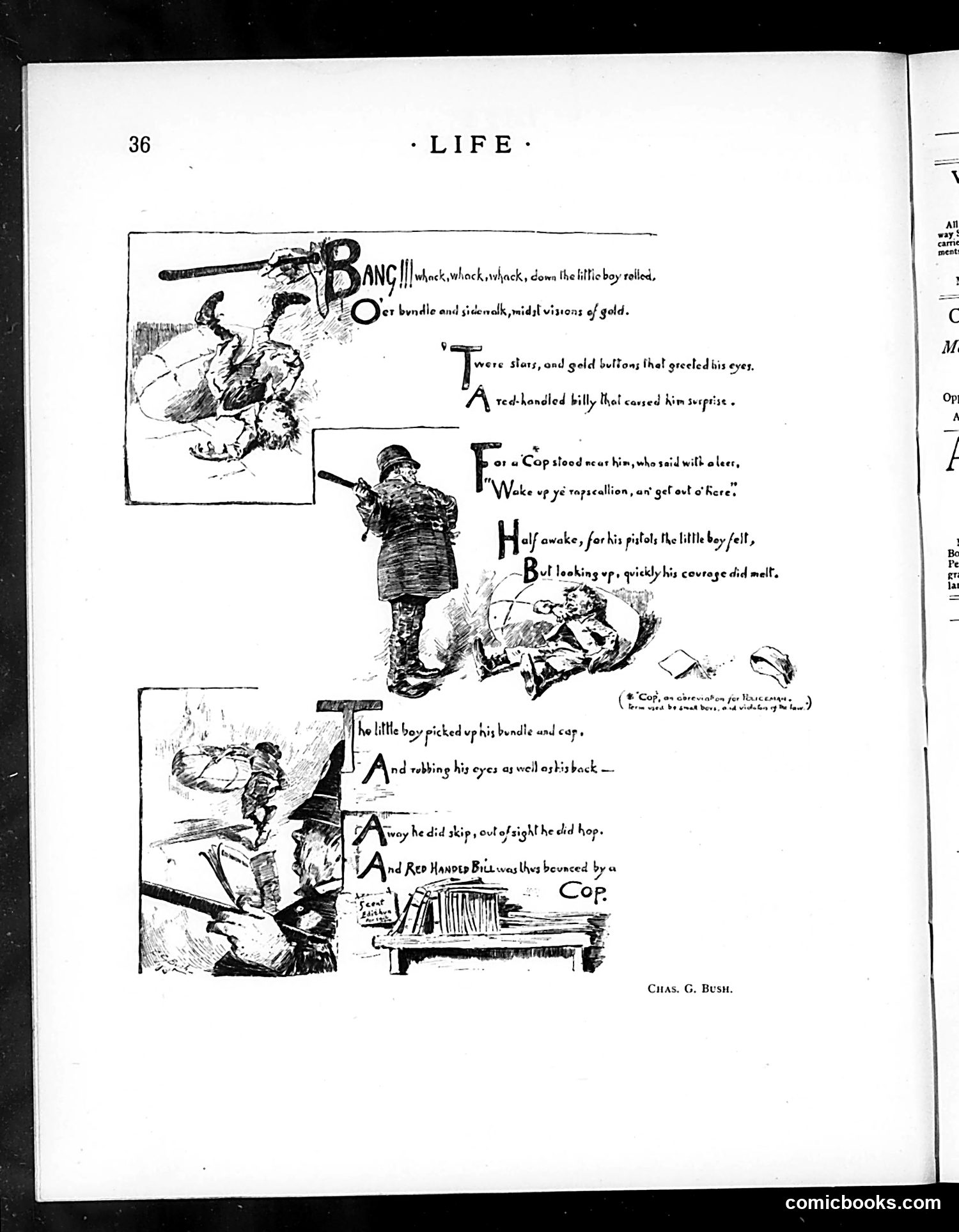
This is a narrative comic strip by Charles G. Bush depicting a street urchin's encounter with a police officer. The story follows a poor boy who dreams of wealth ("visions of gold," "stars, and gold buttons") but is rudely awakened by a cop wielding a billy club (nightstick), who orders him away with the command "Wake up ye rapscallion, ant get out o'here." The satire critiques the harsh treatment of homeless children and vagrants by police—the brutal reality behind romantic notions of street life. The cop's violence and dismissal represent institutional indifference to urban poverty. "Red-handed Billy" appears to reference the officer's readiness to use his club. The cartoon's dark humor lies in juxtaposing the boy's hopeful dreams with the brutal street reality, mocking both poverty and police brutality as facts of city life in what was likely the early 20th century.
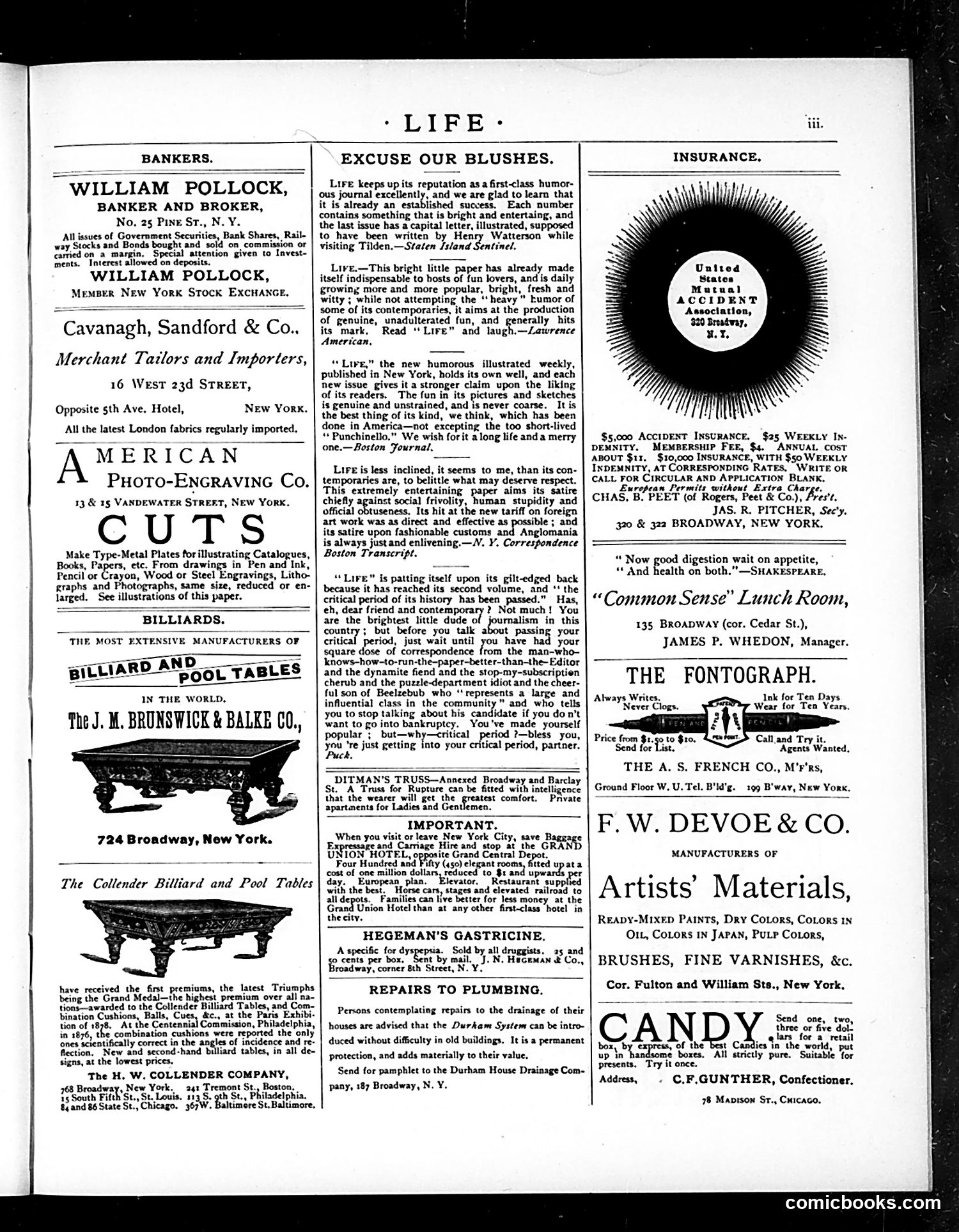
This is a **Life magazine advertorial page** (page iii) containing mostly paid advertisements for banks, tailors, billiard manufacturers, engraving services, and other businesses, interspersed with **self-promotional puffs** for Life itself. The "Excuse Our Blushes" section reprints favorable quotes from other newspapers praising Life as an entertaining humor magazine. These aren't cartoons or political satire—they're testimonials. Life boasts that it targets "social frivolity, human stupidity and official obtuseness" through satire rather than coarse humor, and congratulates itself for reaching its second volume. The page offers no substantive political commentary or identifiable caricatures. It's essentially a 19th-century advertiser's dream: the magazine using free space to quote positive press while surrounding itself with paying sponsors. The content reflects Life's self-image as sophisticated, genteel humor for respectable readers.
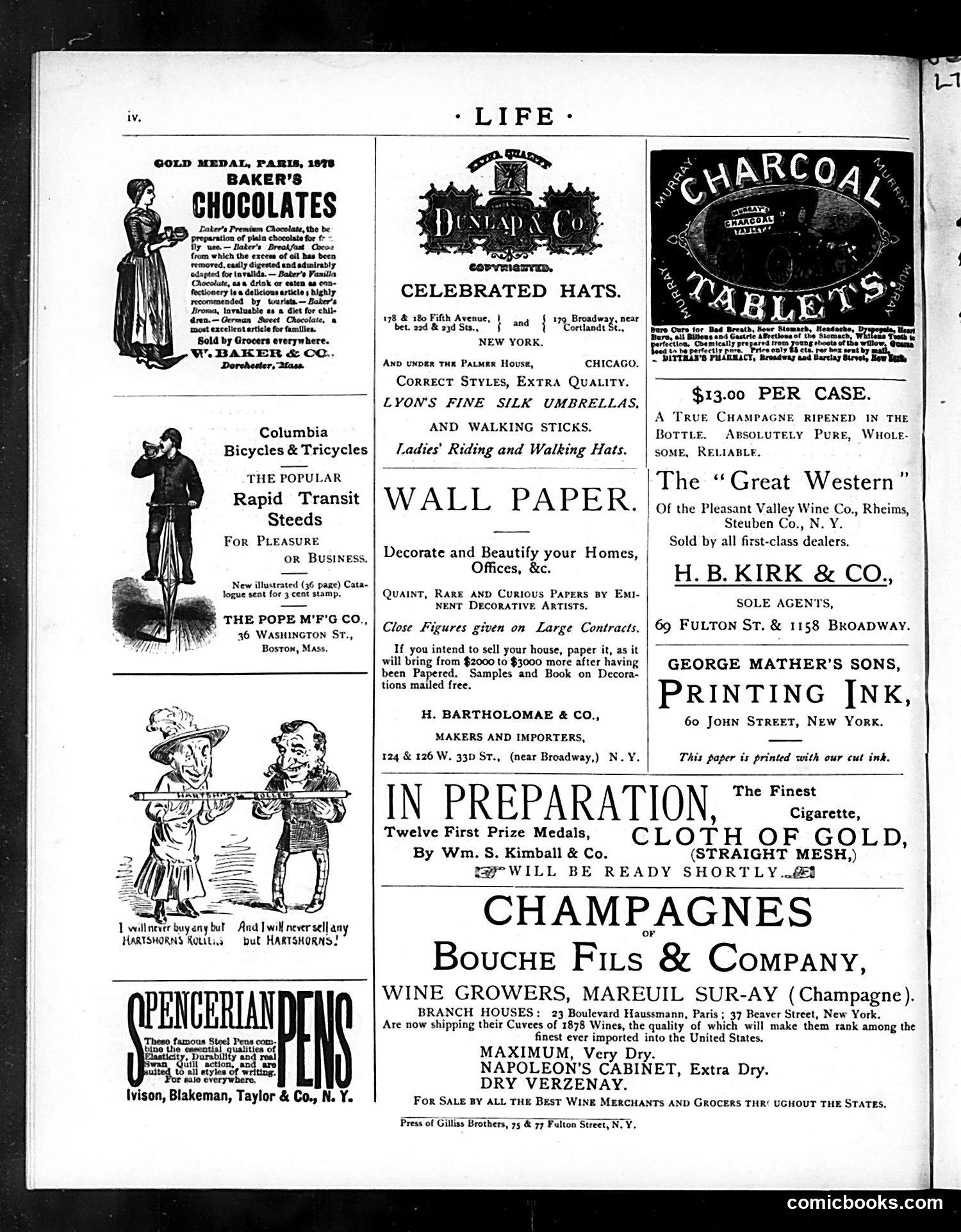
This is primarily an **advertising page**, not a satirical cartoon page. However, it includes one small visual joke: The **Hartshorns cartoon** (middle-left) shows two figures in a playful dispute over a product. The captions read: "I will never buy any but HARTSHORNS ROLLS" and "And I will never sell any but HARTSHORNS!" This appears to be **mock-serious brand loyalty humor**—the joke is that both buyer and seller are equally adamant about Hartshorns, treating a mundane household product (likely smelling salts or cleaning supplies) with exaggerated devotion. It's gentle, family-friendly advertising satire. The rest of the page consists of **late-1870s consumer advertisements**: chocolates, bicycles, hats, wallpaper, champagne, printing ink, and cigarettes. The ads reflect Gilded Age consumer culture and New York commercial enterprises. The OCR date discrepancy ("1978" vs. context suggesting 1870s-80s) appears to be an error.