
Life, 1883-07-19 · page 4 of 16
Life — July 19, 1883 — page 4: what you’re looking at
What you’re looking at
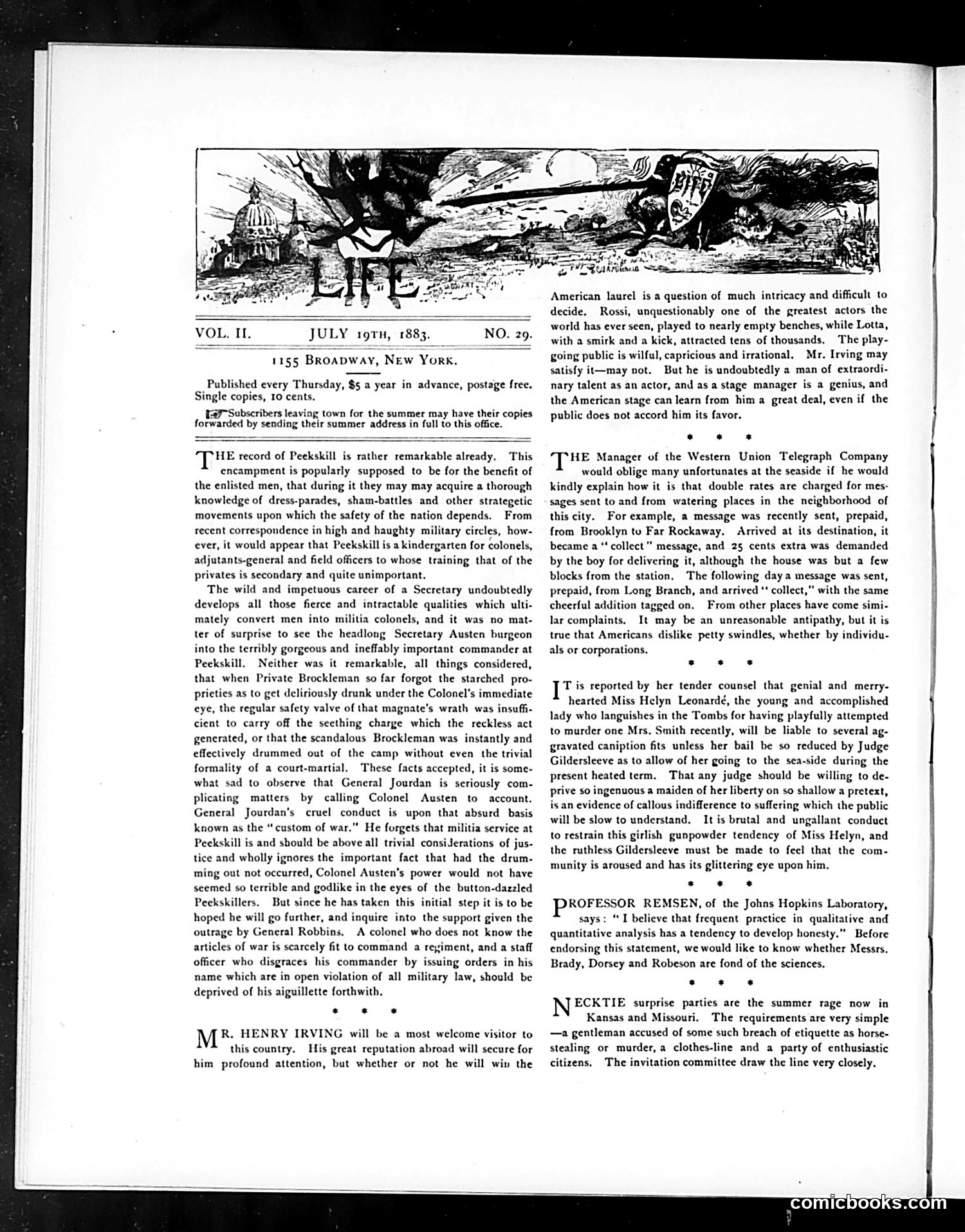
The masthead cartoon depicts a theatrical scene with classical elements—a domed building (likely representing a theater or capitol) and dramatic figures. The word "LIFE" is prominent, establishing this as the magazine's title treatment. The page contains no political cartoon per se, but rather several brief satirical news items and commentary. Notable items include criticism of General Jordon's conduct at Peekskill, commentary on Henry Irving's upcoming American visit, discussion of telegraph company inefficiencies, and a jab at Miss Helyn Leonardt regarding a legal case involving Mrs. Smith. The final item ridicules "necktie surprise parties" in Kansas and Missouri as a pretext for theft and violence disguised as social entertainment.
📄 Transcribed text from this page (OCR, searchable)
Machine-transcribed from the original scan — historical spelling and the odd misread are preserved.
JULY 197TH, 1883. 1155 Broapway, New York. Published every Thursday, $5 a year in advance, postage free. Single copies, 10 cents. [egySubscribers leaving town for the summer may have their copies forwarded by sending their summer address in full to this office. HE record of Peekskill is rather remarkable already. This encampment is popularly supposed to be for the benefit of the enlisted men, that during it they may may acquire a thorough knowledge of dress-parades, sham-battles and other strategetic movements upon which the safety of the nation depends. From recent correspondence in high and haughty military circles, how- ever, it would appear that Peekskill is a kindergarten for colonels, adjutants-general and field officers to whose training that of the privates is secondary and quite unimportant. The wild and impetuous career of a Secretary undoubtedly develops all those fierce and intractable qualities which ulti- mately convert men into militia colonels, and it was no mat- ter of surprise to sce the headlong Secretary Austen burgeon into the terribly gorgeous and ineffably important commander at Peekskill. Neither was it remarkable, all things considered, that when Private Brockleman so far forgot the starched pro- prieties as to get deliriously drunk under the Colonel's immediate eye, the regular safety valve of that magnate’s wrath was insuffi- cient to carry off the seething charge which the reckless act generated, or that the scandalous Brockleman was instantly and effectively drummed out of the camp without even the trivial formality of a court-martial. These facts accepted, it is some- what sad to observe that General Jourdan is seriously com- plicating matters by calling Colonel Austen to account. General Jourdan’s cruel conduct is upon that absurd basis known as the “custom of war.” He forgets that militia service at Peekskill is and should be above all trivial consiJerations of jus- tice and wholly ignores the important fact that had the drum. ming out not occurred, Colonel Austen's power would not have seemed so terrible and godlike in the eyes of the button-dazzled Peekskillers. But since he has taken this initial step it is to be hoped he will go further, and inquire into the support given the outrage by General Robbins. A colonel who does not know the articles of war is scarcely fit to command a reyiment, and a staff officer who disgraces his commander by issuing orders in his name which are in open violation of all military law, should be deprived of his aiguillette forthwith, se € @ R. HENRY IRVING will be a most welcome visitor to this country. His great reputation abroad will secure for him profound attention, but whether or not he will win the ike <a American laurel is a question of much intricacy and difficult to decide. Rossi, unquestionably one of the greatest actors the world has ever seen, played to nearly empty benches, while Lotta, with a smirk and a kick, attracted tens of thousands. The play- going public is wilful, capricious and irrational, Mr. Irving may satisfy it—may not. But he is undoubtedly a man of extraordi- nary talent as an actor, and as a stage manager is a genius, and the American stage can learn from him a great deal, even if the public does not accord him its favor, THE Manager of the Western Union Telegraph Company would oblige many unfortunates at the seaside if he would kindly explain how it is that double rates are charged for mes- sages sent to and from watering places in the neighborhood of this city. For example, a message was recently sent, prepaid, from Brooklyn tu Far Rockaway, Arrived at its destination, it became a ‘‘ collect” message, and 25 cents extra was demanded by the boy for delivering it, although the house was but a few blocks from the station. The following day a message was sent, prepaid, from Long Branch, and arrived “‘ collect,” with the same cheerful addition tagged on. From other places have come simi- lar complaints. It may be an unreasonable antipathy, but it is true that Americans dislike petty swindles, whether by individu- als or corporations. es 8 [Tis reported by her tender counsel that genial and merry- hearted Miss Helyn Leonardé, the young and accomplished lady who languishes in the Tombs for having playfully attempted to murder one Mrs, Smith recently, will be liable to several ag- gravated caniption fits unless her bail be so reduced by Judge Gildersleeve as to allow of her going to the sea-side during the present heated term. That any judge should be willing to de- prive so ingenuous a maiden of her liberty on so shallow a pretext, is an evidence of callous indifference to suffering which the public will be slow to understand, It is brutal and ungallant conduct to restrain this girlish gunpowder tendency of Miss Helyn, and the ruthless Gildersleeve must be made to feel that the com- munity is aroused and has its glittering eye upon him, s e¢ @ ROFESSOR REMSEN, of the Johns Hopkins Laboratory, says: “I believe that frequent practice in qualitative and quantitative analysis has a tendency to develop honesty.” Before endorsing this statement, we would like to know whether Messrs, Brady, Dorsey and Robeson are fond of the sciences, se 8 ¢@ N ECKTIE surprise parties are the summer rage now in Kansas and Missouri. The requirements are very simple —a gentleman accused of some such breach of etiquette as horse- stealing or murder, a clothes-line and a party of enthusiastic citizens, The invitation committee draw the line very closely,