
Life, 1883-07-19 · page 11 of 16
Life — July 19, 1883 — page 11: what you’re looking at
What you’re looking at
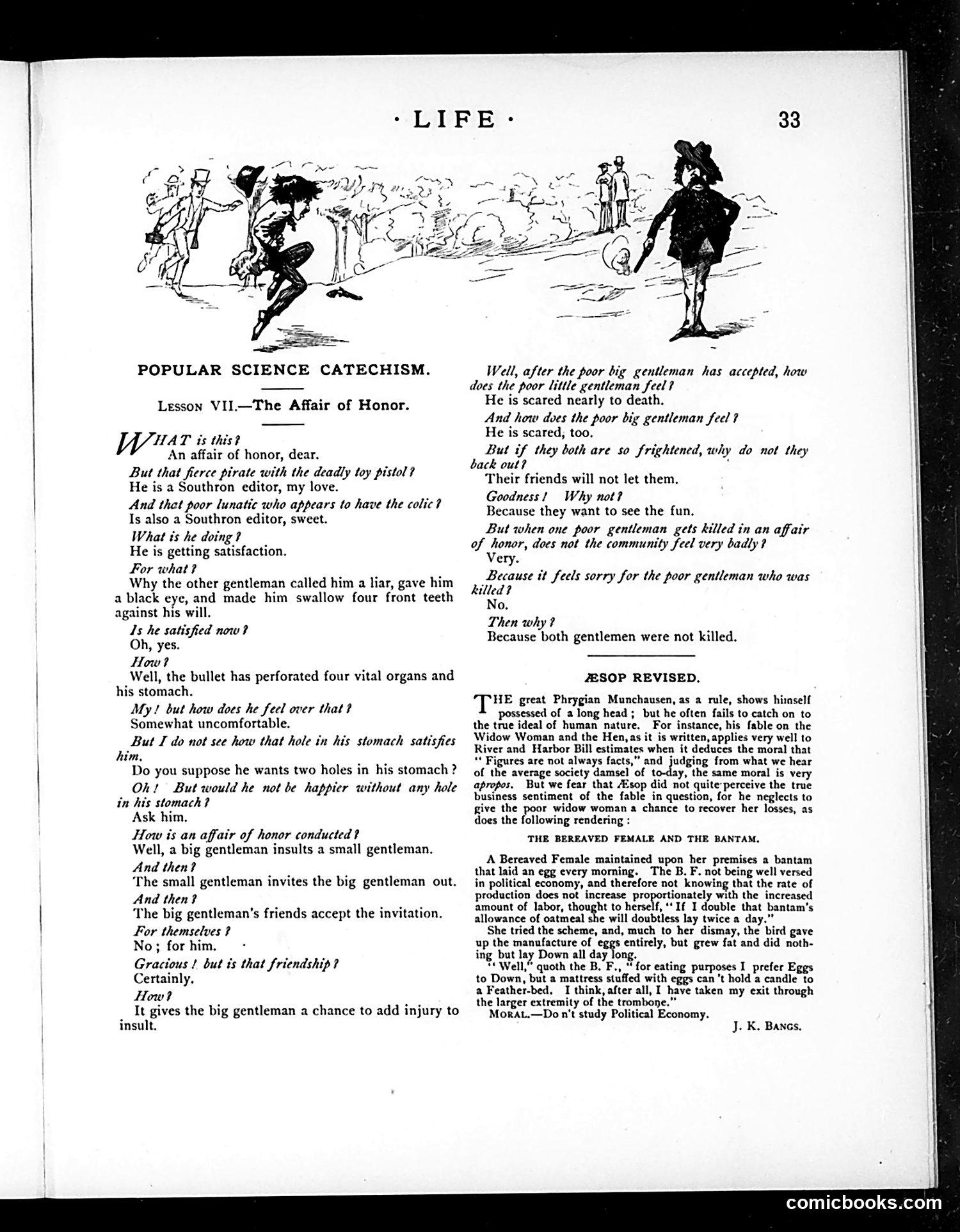
This page contains two satirical pieces mocking American social conventions, particularly Southern dueling culture. **"Popular Science Catechism: The Affair of Honor"** ridicules the Southern gentleman's code dueling. The cartoon depicts two frightened men shooting each other over an insult. The dialogue satirizes the absurdity: both men are terrified, friends force them to fight despite mutual fear, and the "satisfaction" gained is a bullet wound. The final joke—that the community only regrets *both* weren't killed—mocks the pointlessness of honor killings. This reflects Northern anti-Southern sentiment during the Reconstruction era, portraying Southern editors and gentlemen as violent and irrational. **"Aesop Revised"** parodies Aesop's fables by retelling "The Hen and the Widow Woman" as a critique of flawed economic reasoning. A widow feeds her bantam extra oatmeal expecting doubled egg production; instead, the bird stops laying and grows fat. The moral satirizes those who ignore economic principles—likely a dig at misguided government policies or individuals who ignore practical wisdom. Both pieces use humor to critique foolish pride, violent tradition, and economic ignorance.
📄 Transcribed text from this page (OCR, searchable)
Machine-transcribed from the original scan — historical spelling and the odd misread are preserved.
POPULAR SCIENCE CATECHISM. Lesson VII.—The Affair of Honor. HAT is this? An affair of honor, dear. But that fierce pirate with the deadly toy pistol? He is a Southron editor, my love. And thet poor lunatic who appears to have the colic? Is also a Southron editor, sweet. What is he doing? He is getting satisfaction. For what? . Why the other gentleman called him a liar, gave him a black eye, and made him swallow four front teeth against his will. ds he satisfied now? Oh, yes. How? . Well, the bullet has perforated four vital organs and his stomach. My! but how does he feel over that? Somewhat uncomfortable. But I do not see how that hole in his stomach satisfies him, Do you suppose he wants two holes in his stomach ? Oh! But would he not be happier without any hole in his stomach? Ask him. How is an affair of honor conducted? Well, a big gentleman insults a small gentleman. And then? ‘The small gentleman invites the big gentleman out. And then? The big gentleman's friends accept the invitation. For themselves ? No; for him. Gracious ! but is that friendship? Certainly. How? It gives the big gentleman a chance to add injury to insult. Well, after the poor big gentleman has accepted, how does the poor little gentleman feel? He is scared nearly to death. And how does the poor big gentleman feel? He is scared, too. But if they both are so frightened, why do not they back out? ‘ Their friends will not let them. Goodness! Why not? Because they want to see the fun. But when one poor gentleman gets killed in an affair of honor, does not the community feel very badly? Very. Because tt feels sorry for the poor gentleman who was killed? No. Then why? Because both gentlemen were not killed. #2SOP REVISED. THE great Phrygian Munchausen, as a rule, shows hiinself possessed of a long head; but he often fails to catch on to the true ideal of human nature. For instance, his fable on the Widow Woman and the Hen, as it is written, applies very well to River and Harbor Bill estimates when it deduces the moral that “+ Figures are not always facts,” and judging from what we hear of the average society damsel of to-day, the same moral is very apropos. But we fear that sop did not quite:perceive the true business sentiment of the fable in question, for he neglects to give the poor widow woman a chance to recover her losses, as does the following rendering : THE BEREAVED FEMALE AND THE BANTAM, A Bereaved Female maintained upon her premises a bantam that laid an egg every morning. The B, F. not being well versed in political economy, and therefore not knowing that the rate of production does not increase proportionately with the increased amount of labor, thought to herself, ‘If I double that bantam’s allowance of oatmeal she will doubtless lay twice a day.” She tried the scheme, and, much to her dismay, the bird gave up the manufacture of cogs entirely, but grew fat and did noth- ing but lay Down all day jong. *« Well,” quoth the B. F., “for eating purposes I prefer Eggs to Down, but a mattress stuffed with can't hold a candle to a Feather-bed. I think, after all, I have taken my exit through the larger extremity of the trombone.” MorAt.—Do n't study Political Economy. J. K. Bancs. comicbooks.com