
Life, 1883-07-19 · page 10 of 16
Life — July 19, 1883 — page 10: what you’re looking at
What you’re looking at
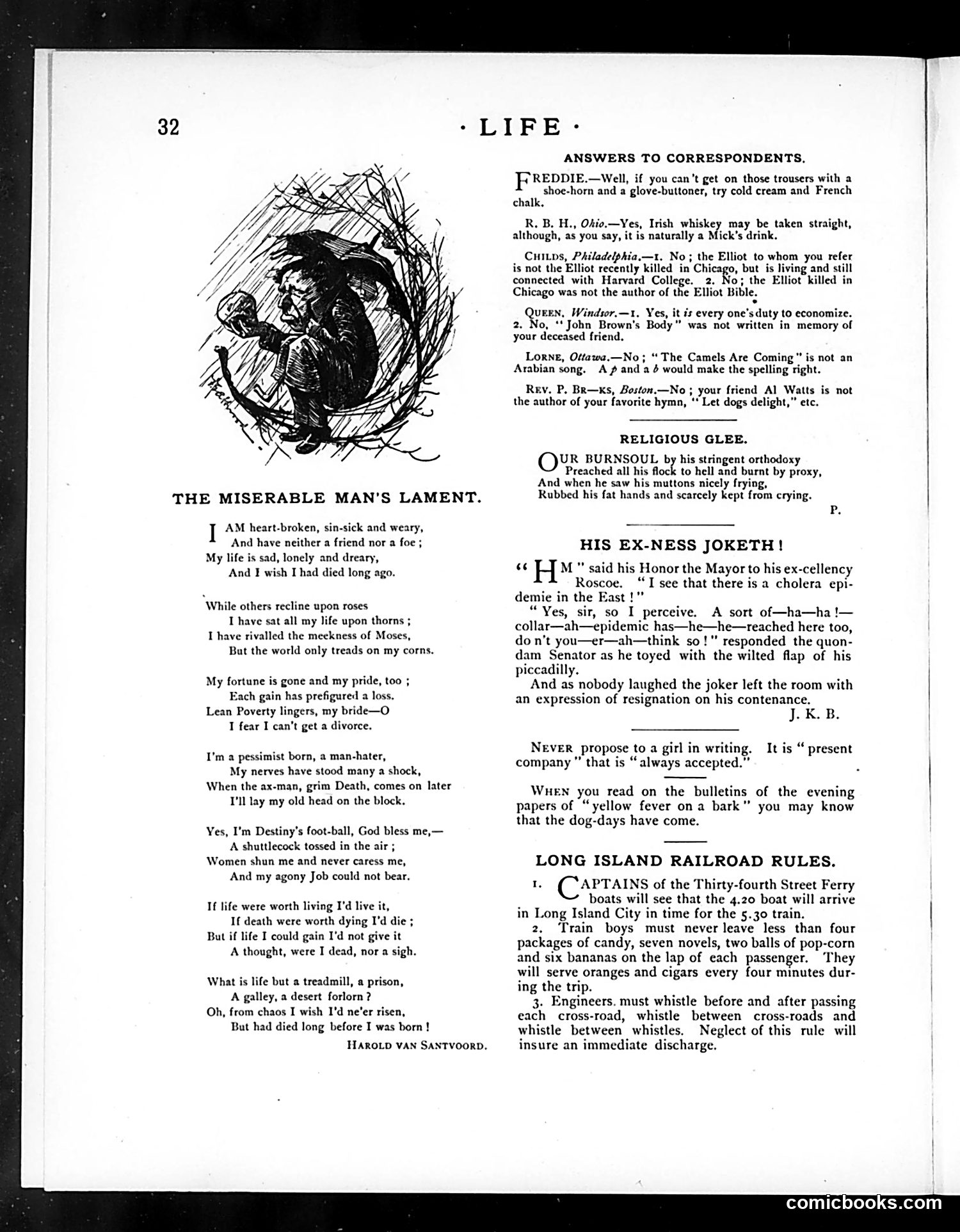
This page contains several satirical pieces typical of Life magazine's humor format: **"The Miserable Man's Lament"** (left) is a long comic poem by Harold Van Santvoord depicting an archetypal pessimist complaining about life's miseries—poverty, loneliness, failed romance, and existential despair. The crude illustration shows a hunched, distressed figure. The satire targets exaggerated self-pity and melodramatic fatalism. **"Religious Glee"** mocks hypocritical clergy, depicting a preacher ("Burnsoul") who sermonizes damnation to his congregation while finding dark humor in their spiritual suffering. **"His Ex-Ness Joketh"** satirizes a failed attempt at humor by a Mayor and former Senator making awkward puns about cholera reaching their city. The joke falls flat, and the joker leaves embarrassed—the satire targets forced, inappropriate humor. The remaining content includes brief advice column responses and absurdist "Long Island Railroad Rules" (obviously fictional), which mock bureaucratic inefficiency through impossible regulations about ferry schedules and train-boy candy distribution. Overall, the page exemplifies Life's mix of literary satire, social commentary, and absurdist humor.
📄 Transcribed text from this page (OCR, searchable)
Machine-transcribed from the original scan — historical spelling and the odd misread are preserved.
THE MISERABLE MAN'S LAMENT. J AM heart-broken, sin-sick and weary, And have neither a friend nor a foe ; My life is sad, lonely and dreary, And I wish I had died long ago. While others recline upon roses T have sat all my life upon thorns ; T have rivalled the meekness of Moses, But the world only treads on my corns. My fortune is gone and my pride, too ; Each gain has prefigured a loss, Lean Poverty lingers, my bride—O T fear I can't get a divorce. I’m a pessimist born, a man-hater, My nerves have stood many a shock, When the ax-man, grim Death, comes on later I'll lay my old head on the block. Yes, I'm Destiny's foot-ball, God bless me,— A shuttlecock tossed in the air ; Women shun me and never caress me, And my agony Job could not bear. If life were worth living I'd live it, If death were worth dying I'd die ; But if life I could gain I'd not give it A thought, were I dead, nor a sigh. What is life but a treadmill, a prison, A galley, a desert forlorn? Oh, from chaos I wish I'd ne'er risen, But had died long before I was born! HAROLD VAN SANTVOORD. - LIFE: ANSWERS TO CORRESPONDENTS. GS REDDIE.—Well, if you can't get on those trousers with a shoe-horn and a glove-buttoner, try cold cream and French chalk, R. B. H., Ohio.—Yes, Irish whiske: although, as you say, Cuiips, Philadelphia. is not the Elliot recently connected with Harvard College. 2. may be taken straight, s naturally a Mick’s drink, No; the Elliot to whom you refer din Chicago, but is living and still Yo; the Elliot killed in Chicago was not the author of the Elliot Bible. UEEN, Windsor.—1. Yes, it is every one’s duty to economize. 2. No, ‘John Brown's Body” was not written in memory of your deceased friend. Lorne, Ottawa.—No ; “The Camels Are Coming" is not an Arabian song. A? and a 4 would make the spelling right. Rev. P, Br—xks, Boston.—No ; your friend Al Watts is not the author of your favorite hymn, O “Let dogs delight,” etc. RELIGIOUS GLEE. UR BURNSOUL by his stringent orthodoxy Preached all his flock to hell and burnt by proxy, And when he saw his muttons nicely frying, Rubbed his fat hands and scarcely kept from crying. P. HIS EX-NESS JOKETH! “ H M " said his Honor the Mayor to his ex-cellency Roscoe. “I see that there is a cholera epi- demie in the East!" “Yes, sir, so I perceive. » Si, A sort of—ha—ha !— collar—ah—epidemic has—he—he—reached here too, do n’t you—er—ah—think so!" responded the quon- dam Senator as he toyed with the wilted flap of his piccadilly, And as nobody laughed the joker left the room with an expression of resignation on his contenance. NEVER propose to a girl in writing. J.K.B. It is “ present company ” that is “always accepted.” WHEN you read on the bulletins of the evening papers of “yellow fever ona bark" you may know that the dog-days have come. LONG ISLAND RAILROAD RULES. 1 CaAPtains of the Thirty-fourth Street Ferry boats will see that the 4.20 boat will arrive in Long Island City in time for the 5.30 train. 2. Train boys must never leave less than four packages of candy, seven novels, two balls of pop-corn and six bananas on the lap of each passenger. They will serve oranges and cigars every four minutes dur- ing the trip. 3. Engineers. must whistle before and after passing each whistle between whistles. cross-road, whistle between cross-roads and Neglect of this rule will insure an immediate discharge. comicbooks.com