
A complete issue · 16 pages · 1883
Life — May 17, 1883
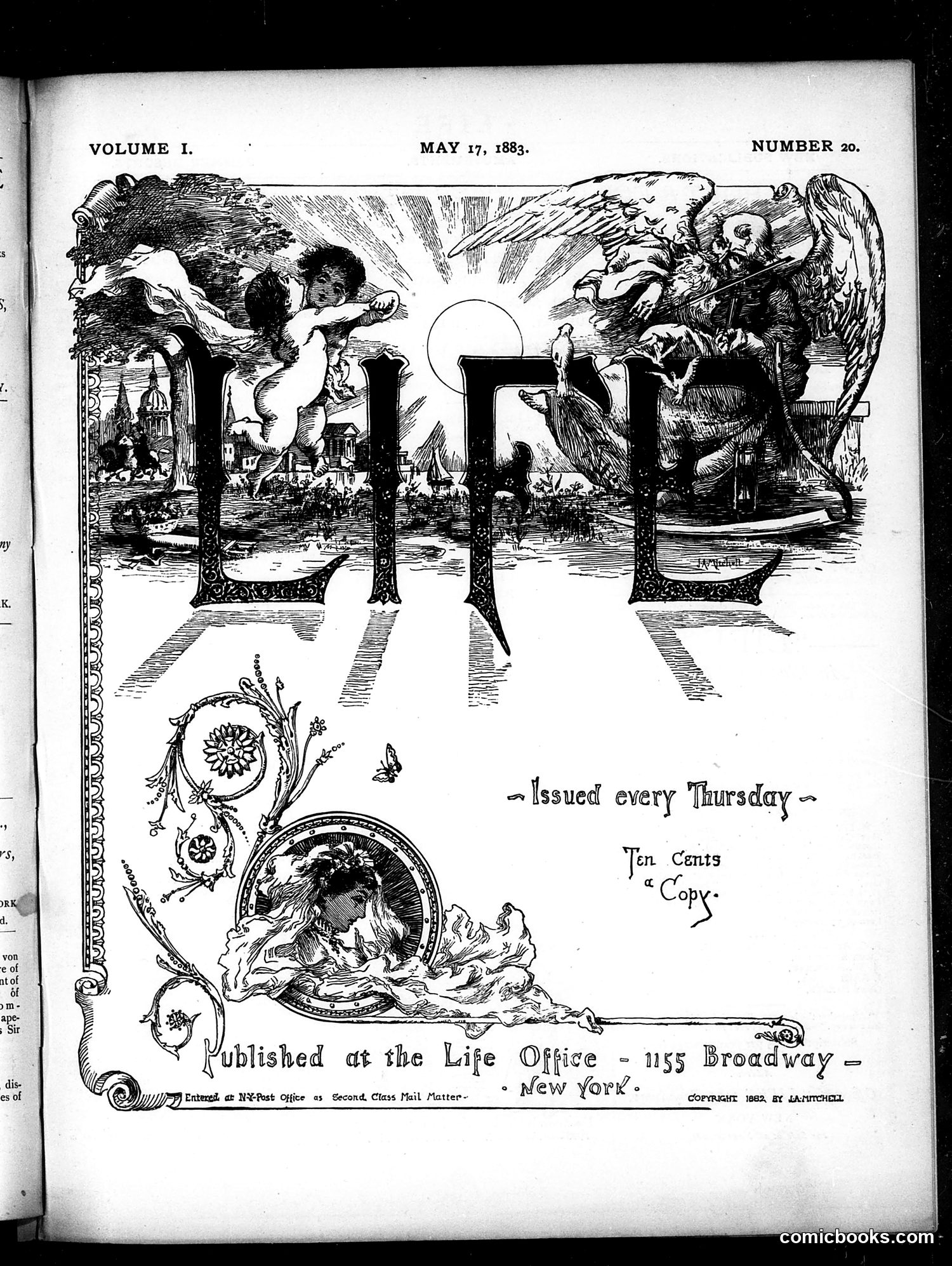
This is the cover of *Life* magazine's first volume, number 20, priced at ten cents. The elaborate title treatment features large decorative letters spelling "LIFE" with classical allegorical figures—cherubs and angels—positioned above a cityscape with a rising sun, suggesting dawn or new beginnings. The ornate border and floral medallion below exemplify Victorian design aesthetics popular in the 1880s. The magazine was published at 1155 Broadway in New York. The imagery emphasizes *Life*'s aspirations as a sophisticated publication combining artistic merit with satirical commentary on contemporary society. The classical, uplifting iconography suggests the magazine positioned itself as culturally refined and morally instructive—typical positioning for American satirical weeklies of the era.
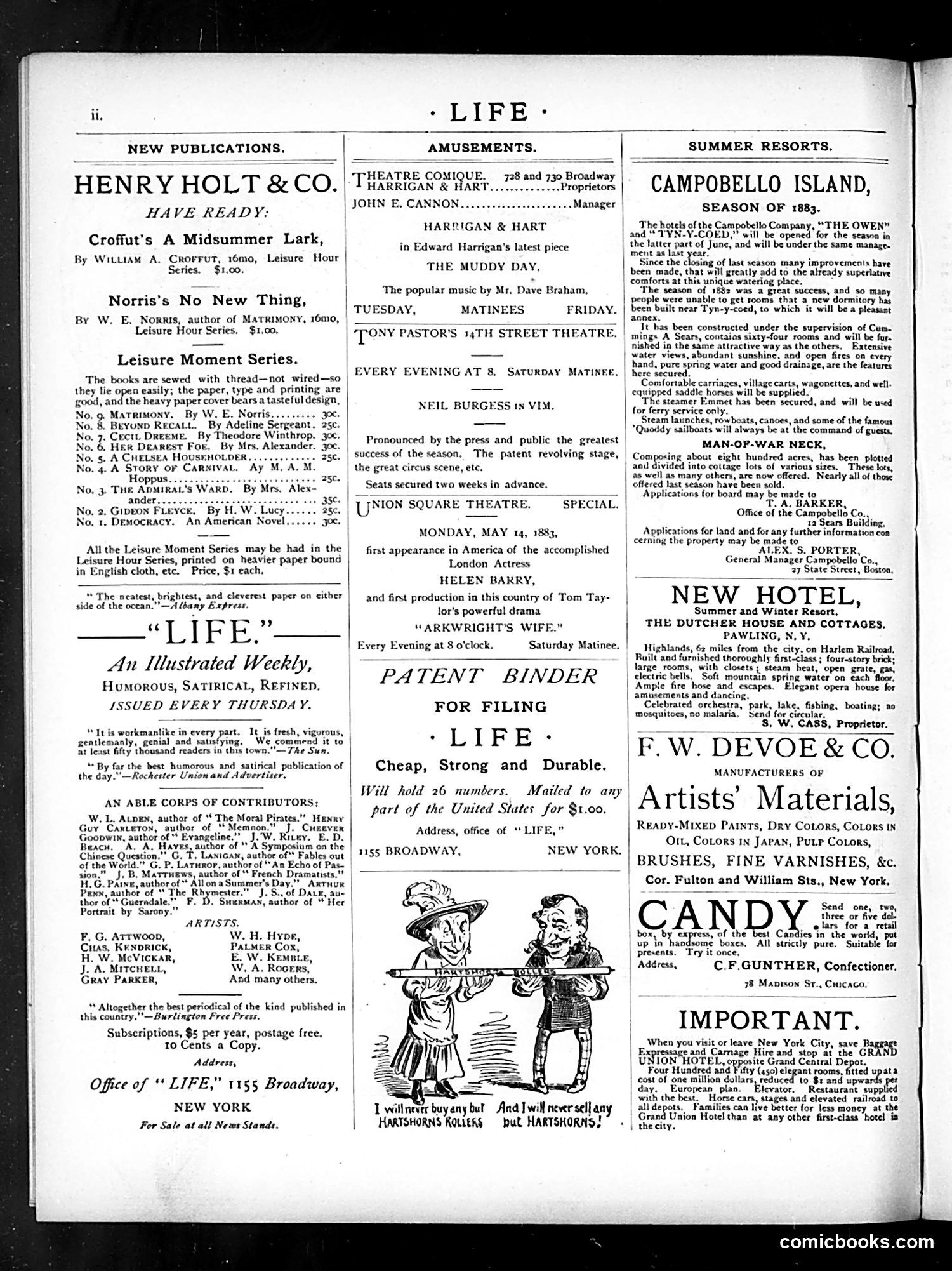
This page is primarily **advertising and business notices** for Life magazine and related commercial products (1883). The only cartoon appears at bottom center, depicting two figures labeled "HARTSHORNS ROLLERS" in a dialogue about buying and selling. This is a **product advertisement** for Hartshorn brand window shade rollers, using humor to promote the item's superiority. One figure claims "I will never buy any but HARTSHORNS ROLLERS" while the other responds "And I will never sell any but HARTSHORNS." The cartoon contains **no political satire or social commentary**—it's purely commercial humor aimed at consumers. The rest of the page features theater listings, resort advertisements, and announcements for Life's publishing operations.
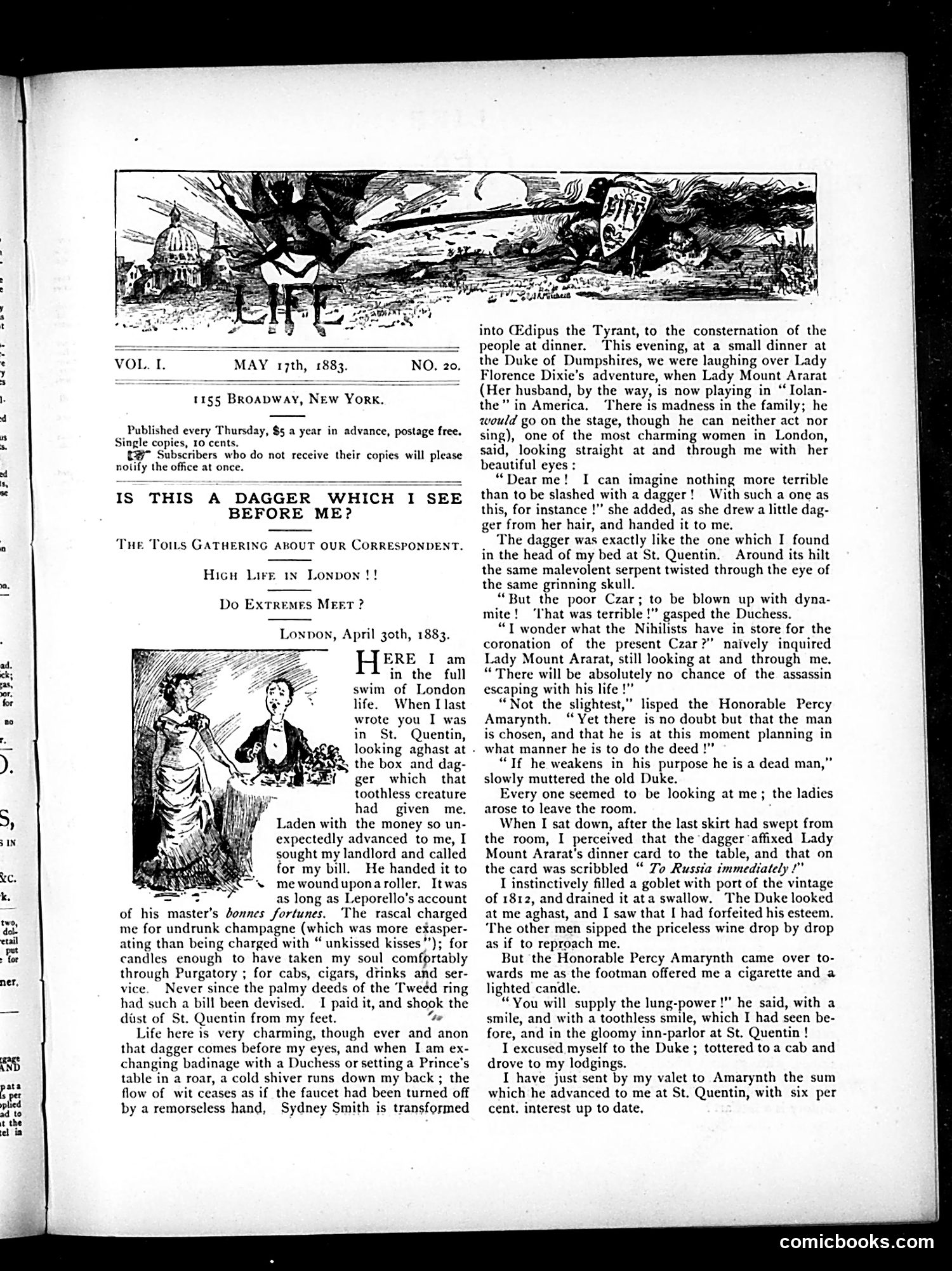
The page contains a serialized fictional letter from London dated April 30, 1883, titled "Is This a Dagger Which I See Before Me?" — a Macbeth reference signaling dramatic intrigue. The narrative describes high society gossip: a correspondent details scandal involving Lady Mount Ararat and assassination plots against the Russian Czar by Nihilists. The story references recent Russian revolutionary violence, a genuine historical concern in 1880s Europe. The satirical point appears to be mocking the breathless sensationalism of London's upper-class gossip culture—dramatizing trivial dinner-party talk about international terrorism and aristocratic scandals with Shakespearean flair. The accompanying illustration shows a fashionably dressed Victorian woman, likely depicting the gossiping correspondent or Lady Mount Ararat.
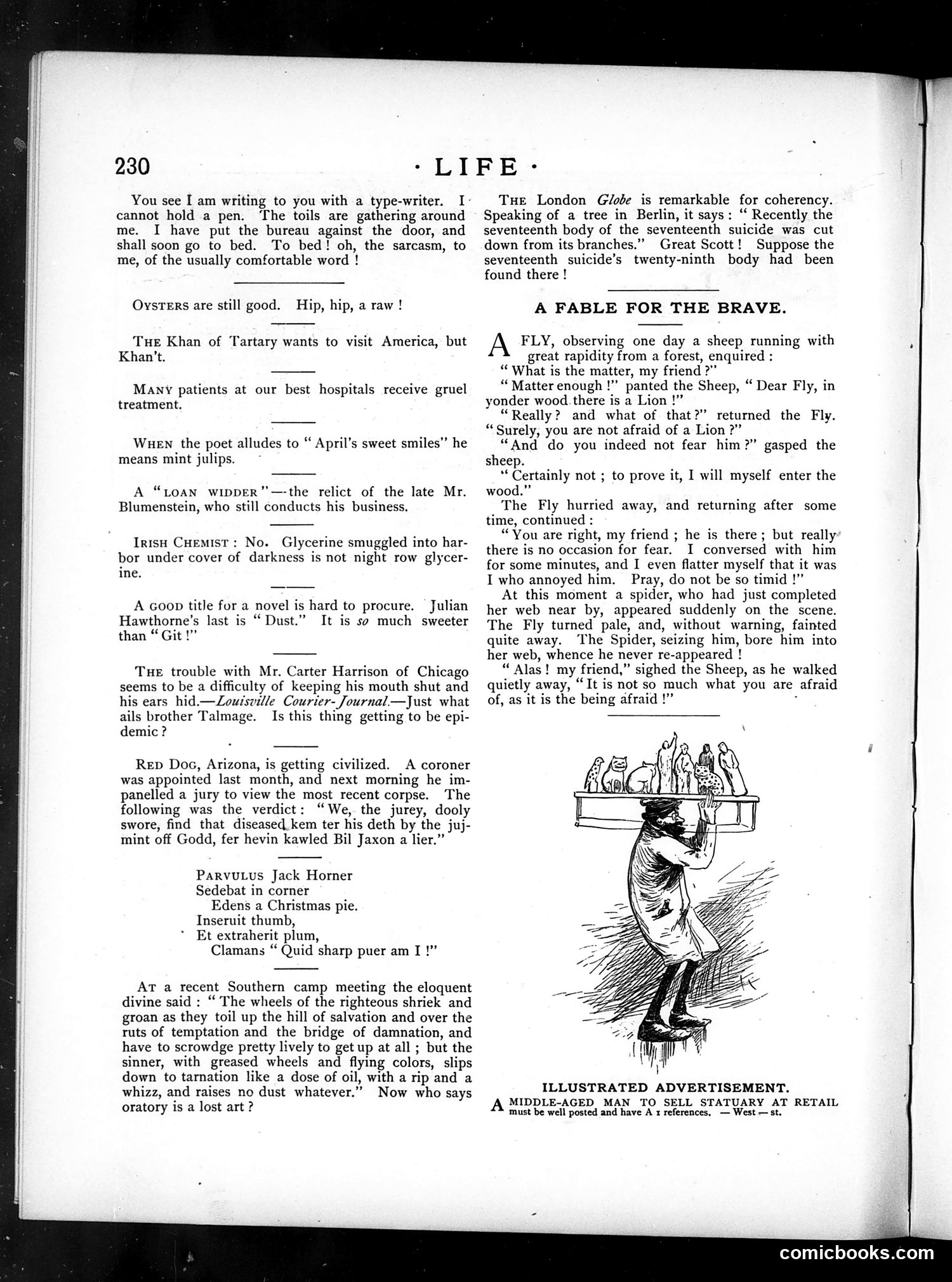
This page contains **"A Fable for the Brave,"** a moral tale about a fly encountering a sheep that claims a lion lives nearby. The fly initially flees but returns, discovering the sheep itself is the real threat—it eats the fly. The illustrated cartoon shows a figure holding aloft a basket of birds or creatures, likely depicting the moral: that real dangers often come from unexpected sources or from those we underestimate. The surrounding column contains brief satirical notes on various topics (hospital treatment, poetry references, business matters), typical of Life's humorous commentary style. The fable's broader point appears to be social commentary about misjudging threats—warning readers that obvious dangers may distract from subtler, more immediate ones.
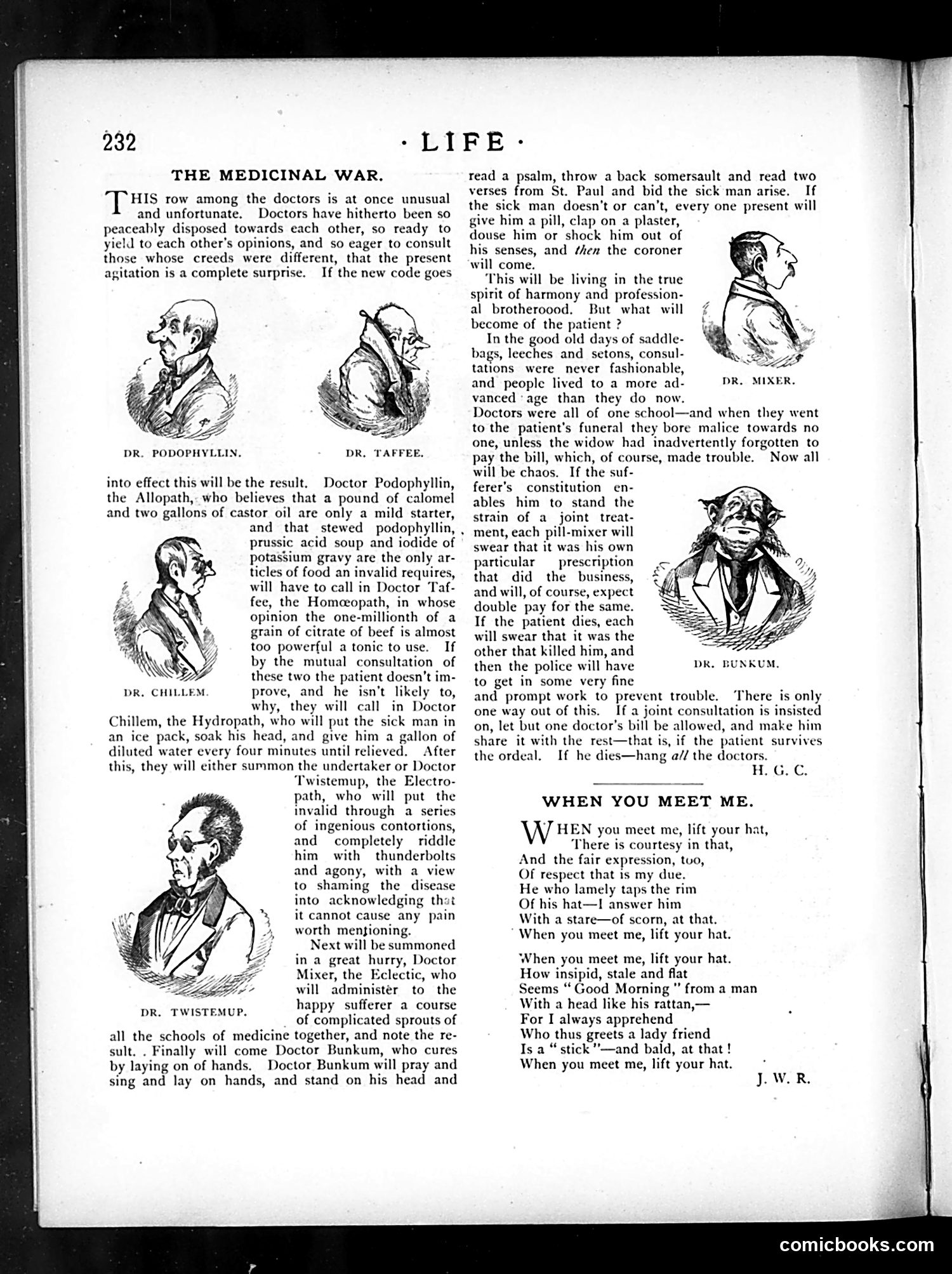
This satirical piece mocks professional rivalry among late-19th-century doctors by inventing absurd physicians representing different medical schools and treatments. The caricatured doctors (Podophyllin, Taffee, Chillem, Twistenum, Mixer, and Bunkum) each represent exaggerated medical theories or dubious remedies—from extreme purgatives to electropathy to faith healing. The satire critiques: - Doctors' mutual contempt and lack of unified standards - Bizarre, ineffective treatments presented as legitimate medicine - Physicians' financial incentives overriding patient welfare - Professional dishonesty (blaming each other if patients die) The cartoon attacks the chaotic state of American medicine before standardization, when competing schools operated without regulation. The humor targets both the absurd treatments and doctors' self-serving competitiveness at patients' expense.
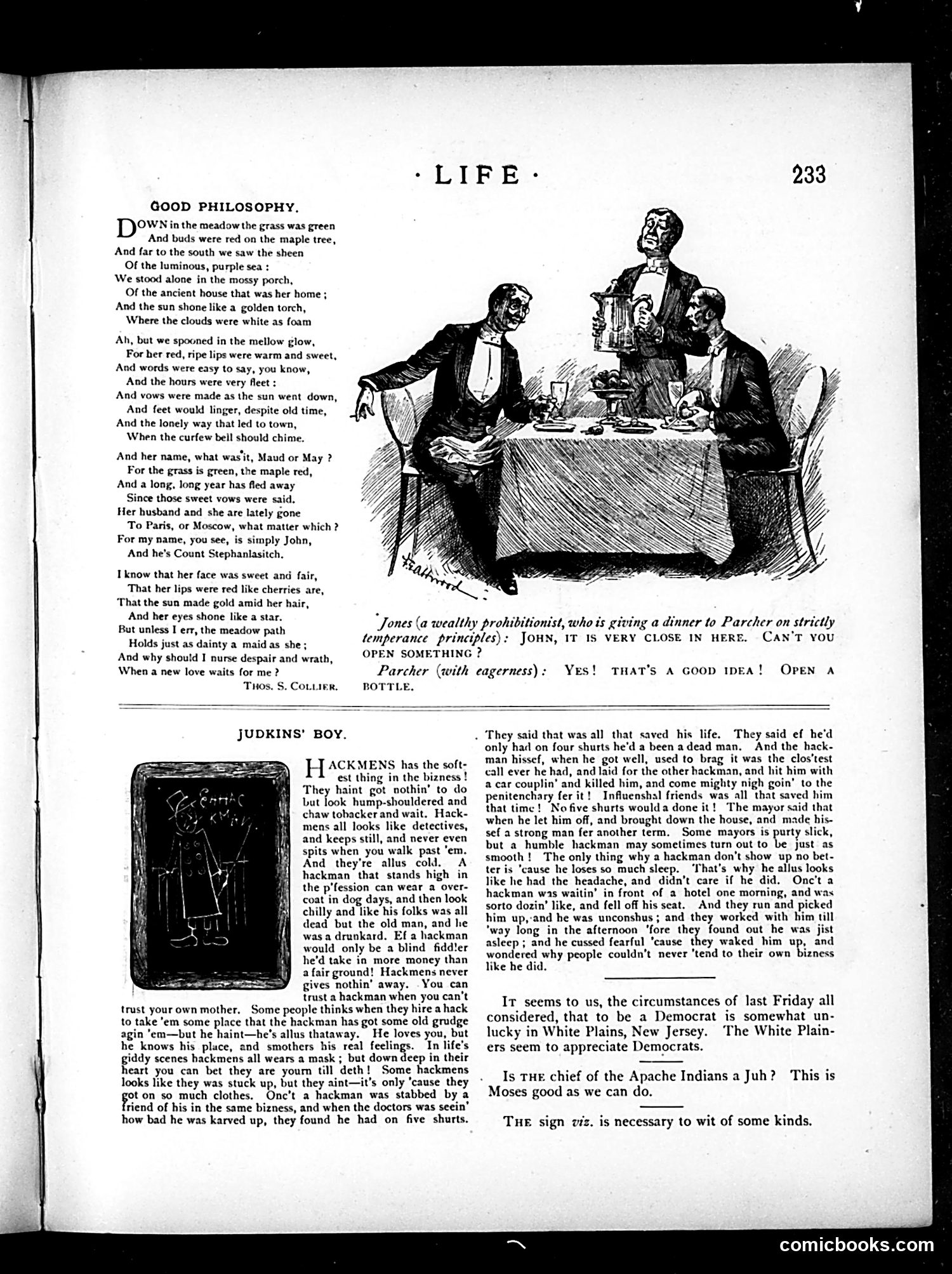
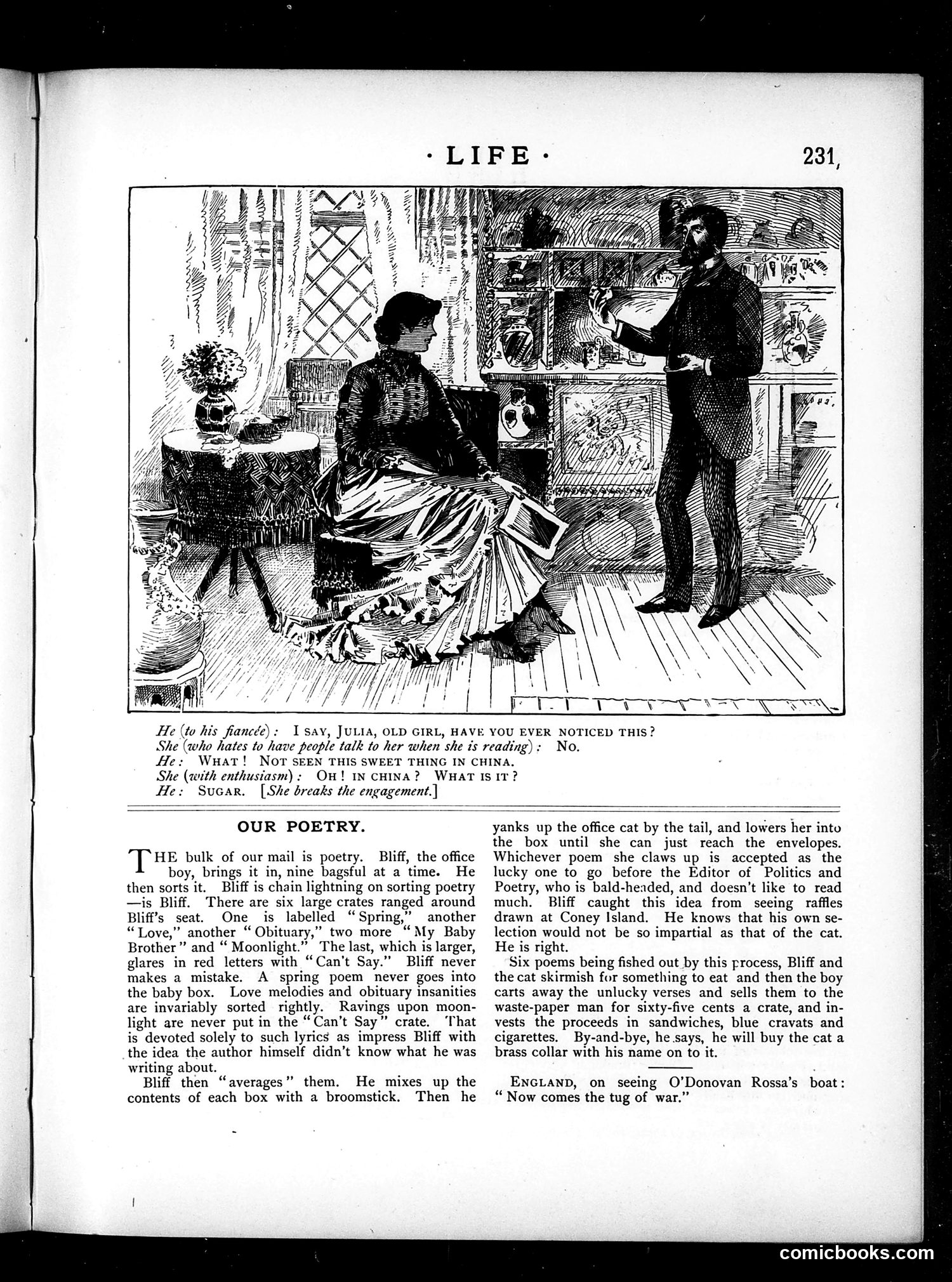
The top cartoon illustrates a poem about a couple reminiscing about their past. Two well-dressed men discuss a third person (apparently absent), with one explaining that the woman they knew has "lately gone / To Paris, or Moscow, what matter which?" The satire targets nostalgic romanticism—the speaker sentimentalizes a woman he knew while revealing he's forgotten even her name, reducing her to generic poetic clichés ("lips were red like cherries"). Below, "Judkins' Boy" mocks working-class men—specifically hackmen (cab drivers). The text humorously portrays them as rough but resourceful, comparing their toughness to survival stories. The piece appears to satirize both class stereotypes and sentimental narratives about working men's hardships and resilience. The brief political notes at bottom reference Democrats and Native Americans obliquely.
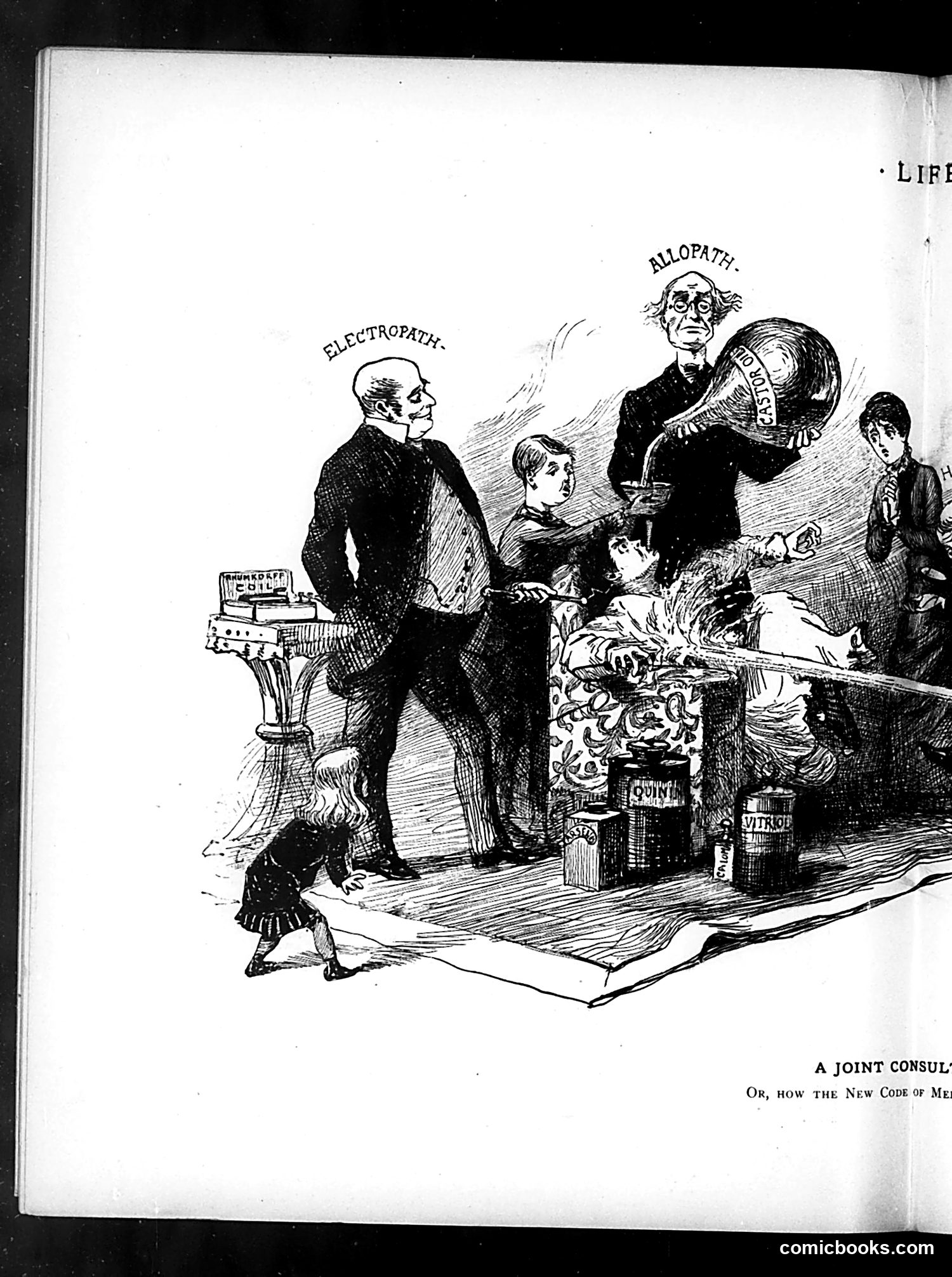
This satirical illustration depicts "A Joint Consul" regarding "the New Code of Medicine." The cartoon shows two practitioners of competing medical philosophies: **ELECTROPATH** (left) operates electrical medical apparatus, representing practitioners who used electricity as a purported cure-all in the 19th century. **ALLOPATH** (right) holds a large globe labeled "QUACKERY," representing conventional medicine, which homeopathic critics dismissively called allopathy. The satire mocks both medical systems as equally fraudulent. Children and patients surround them with various dubious remedies and bottles (labeled "QUININE" and "VITRIOL"). The cartoon suggests that competing medical schools of the era were all charlatans exploiting the sick through unproven treatments, neither deserving credibility over the other.
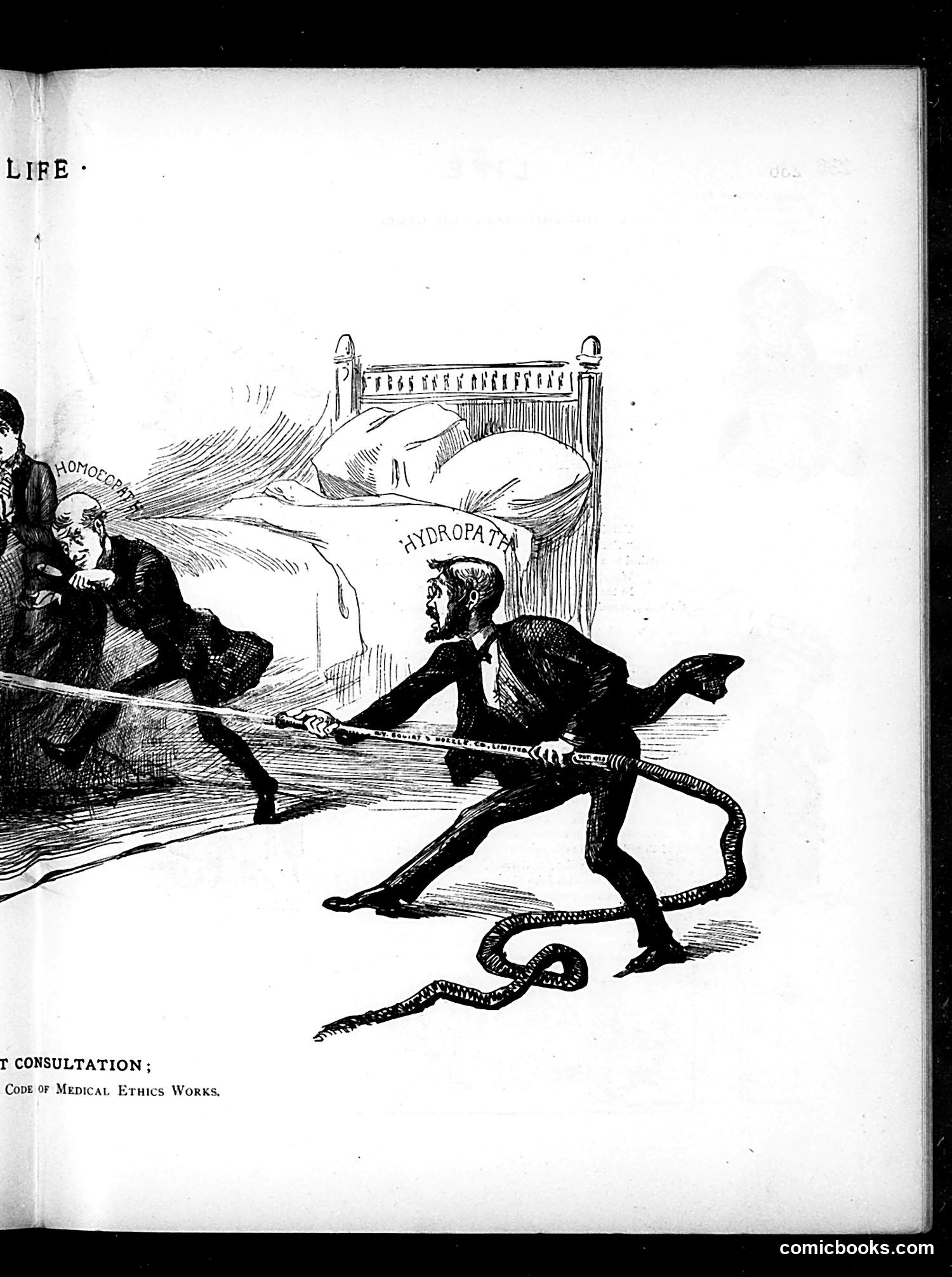
This satirical cartoon depicts a figure wrestling with a large snake labeled "HYDROPATHY" while a bed labeled with the same term is visible in the background. Two onlookers on the left appear to be doctors or medical professionals observing the struggle. The cartoon satirizes "hydropathy" (water-cure medicine), a popular but controversial 19th-century medical treatment. The snake metaphor suggests the practice was dangerous or deceptive—something to be wrestled with rather than trusted. The physicians' presence implies medical establishment skepticism toward this alternative therapy. The text references "Code of Medical Ethics Works," indicating this critiques unorthodox medical practitioners who violated professional standards. The cartoon mocks both the hydropathy movement and those promoting it as legitimate medicine.
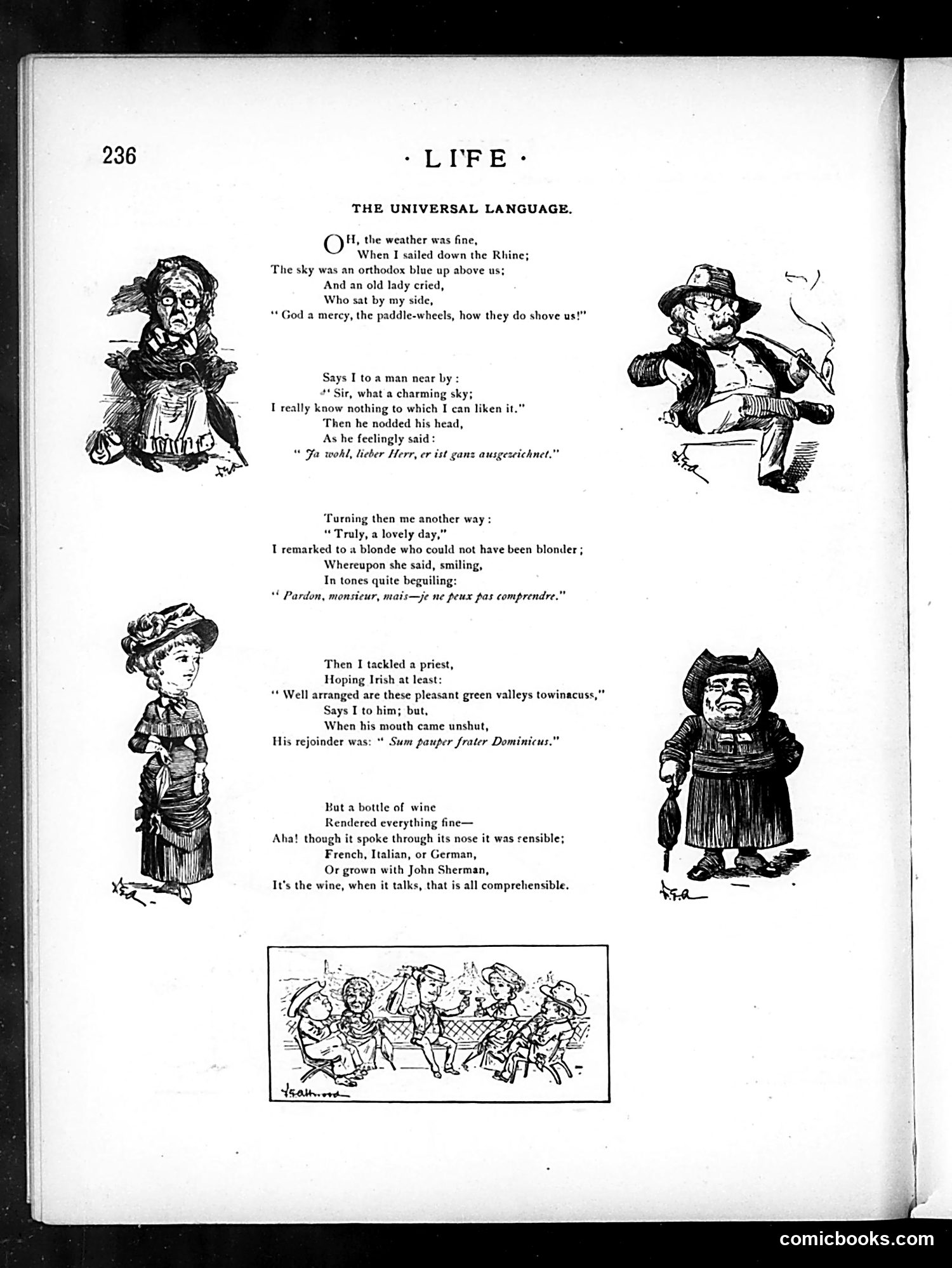
This page satirizes the difficulty of international communication through a traveler's Rhine River journey. The narrator attempts conversation with various Europeans—a German man, a French woman, an Irish priest—each responding in their native language, creating comic incomprehension. The caricatures represent national stereotypes: the German (formal, philosophical), the French woman (coquettish, unhelpful), the Irish priest (speaking Latin), and others. The joke culminates in the punchline that wine is the only truly "universal language"—transcending nationality and comprehensibility through alcohol's effects. The reference to "John Sherman" (likely the 19th-century American statesman) suggests American wine, adding nationalist humor. The multiple illustrated figures and bottom panel show various nationalities united in revelry, driving home the satirical point: humans cannot communicate across language barriers, but intoxication makes everything seem fine.
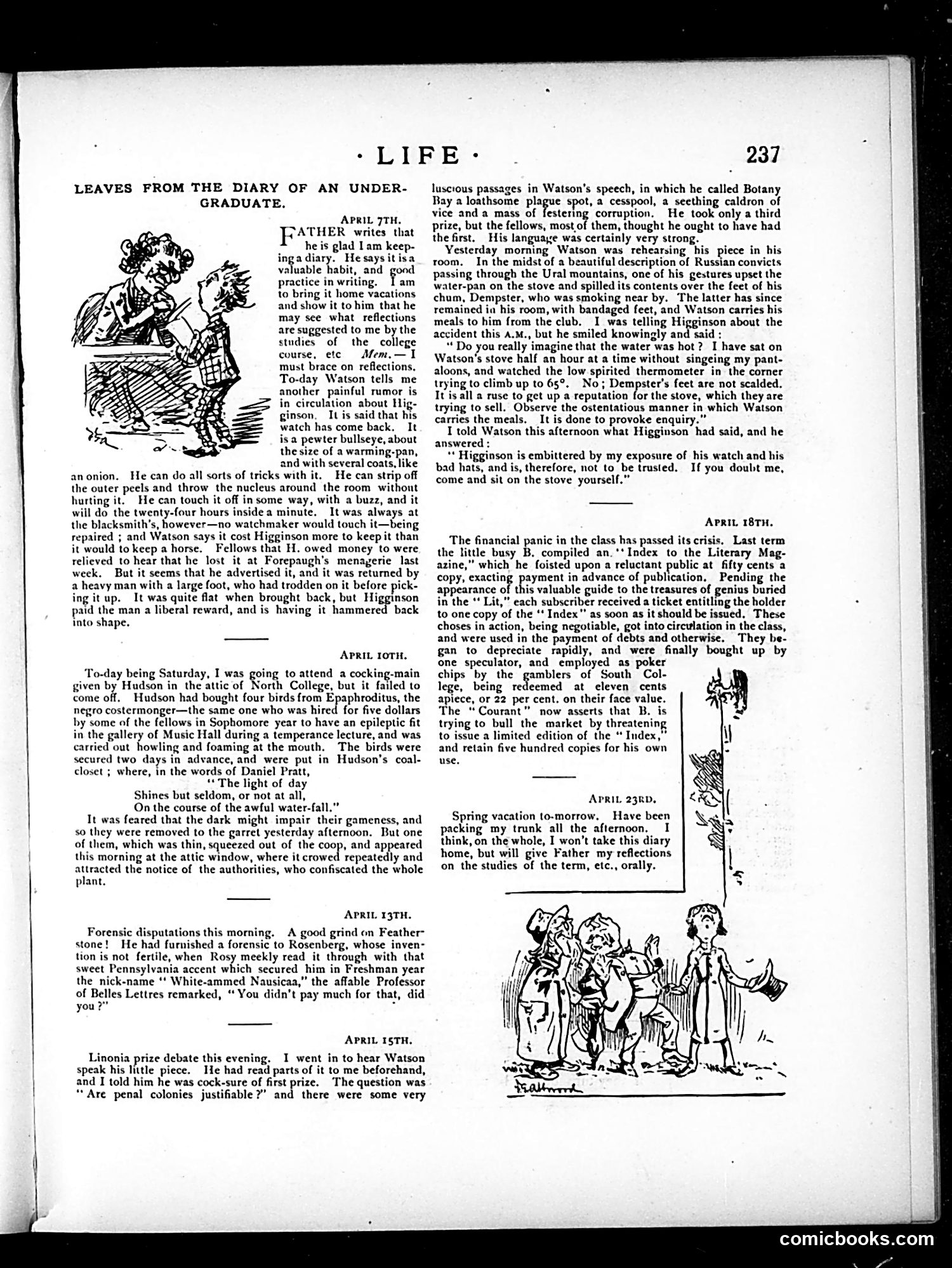
This page presents a satirical undergraduate diary mocking college life. The cartoons and entries ridicule student antics and pretensions. **Key satirical targets:** - **Higginson's watch**: A running joke about a comically enormous, perpetually broken timepiece that costs more to repair than a horse—mocking students with malfunctioning possessions they won't discard. - **The cockfighting incident**: Hudson's attempt to hold an illegal cockfight in the college attic, foiled when a bird escapes and attracts authorities—satirizing student rule-breaking and poor planning. - **Watson's debate speech**: Despite using purple, overwrought language ("loathsome plague spot, cesspool, seething caldron"), he only wins third prize—mocking grandiose student oratory that lacks substance. - **The diary itself**: The father's suggestion that keeping a diary teaches reflection is undermined by the diarist's accounts of meaningless, trivial college gossip. The illustrations depict students engaged in foolish behavior, reinforcing the magazine's satirical critique of undergraduate culture as petty, destructive, and fundamentally ridiculous.
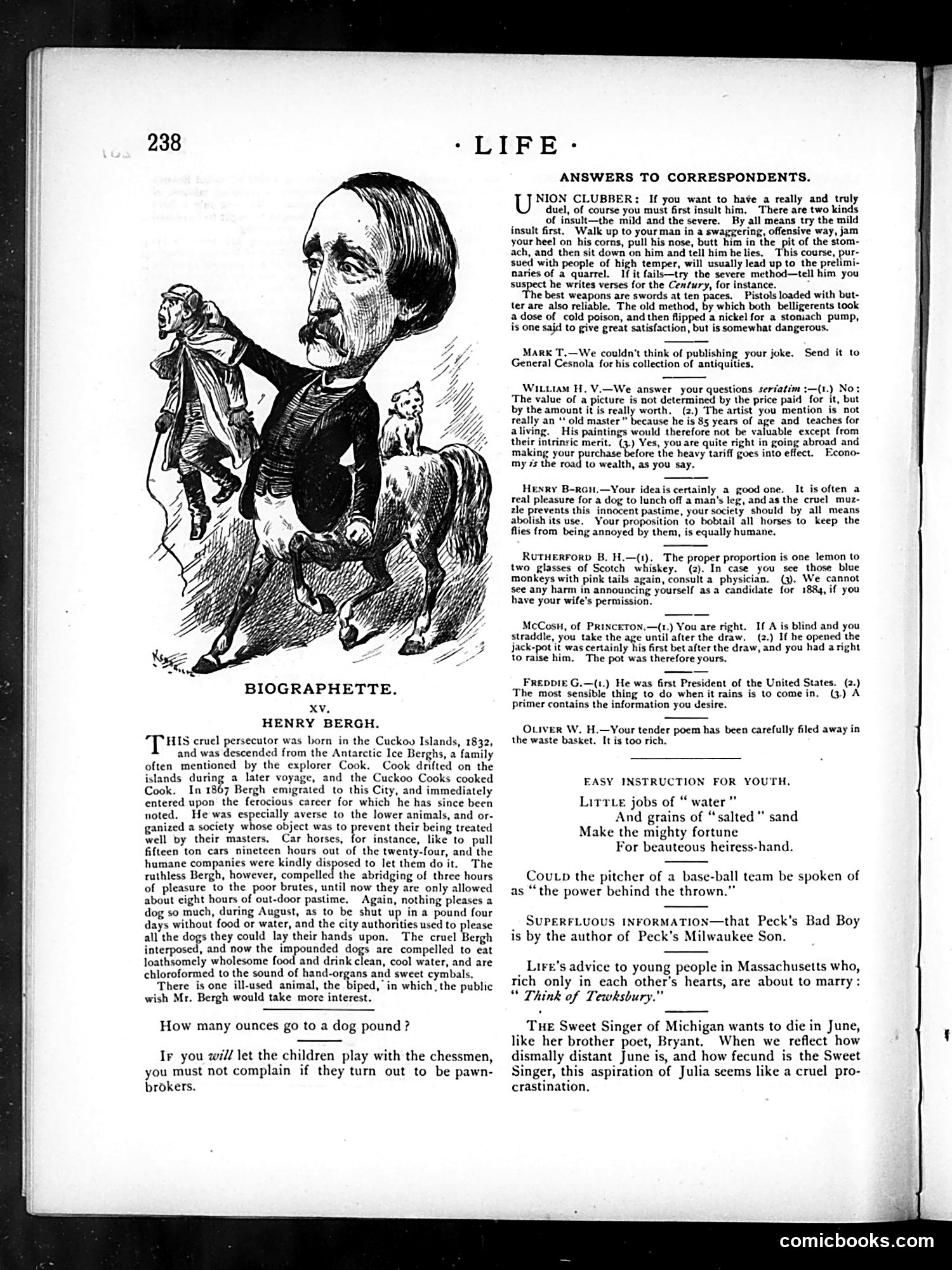
This page satirizes **Henry Bergh**, founder of the American Society for the Prevention of Cruelty to Animals (ASPCA). The caricature shows him as an absurdly self-righteous animal activist. Life's "biographette" mocks Bergh's animal-welfare campaigns through mockery: claiming he's ruined horses' pleasure by limiting their 19-hour workdays to 8 hours, and that he's torturing dogs by forcing them to eat "wholesome food" instead of starving in pounds. The joke is that the magazine sarcastically presents humane reforms as cruelty. The cartoon's absurdist genealogy (tracing Bergh to "Antarctic Ice Berghs") is pure parody. A concluding jab suggests Bergh should focus on human welfare ("the biped") instead. The "Answers to Correspondents" section continues this satire—one response mockingly congratulates Bergh's ideas, sarcastically calling muzzles on dogs "cruel" for preventing them from attacking people. This reflects **late-19th-century opposition to animal-welfare activism** as an excessive, misguided cause compared to human problems.
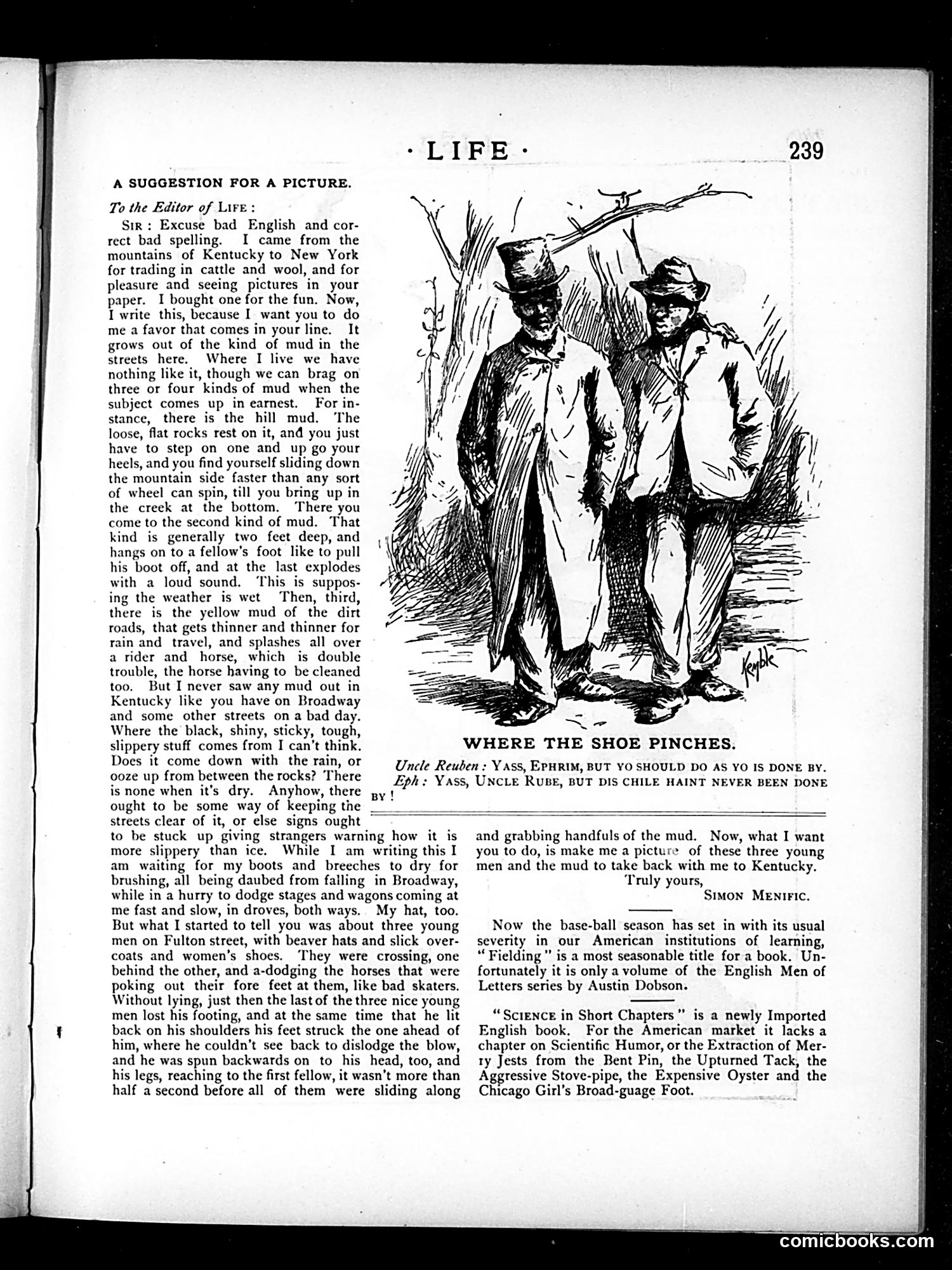
This page features a reader's letter-turned-cartoon premise about New York City street mud. A Kentucky cattleman contrasts the mud conditions in his home state (hill mud, creek mud, dirt-road mud) with Broadway's uniquely problematic "black, shiny, sticky" variety. He humorously recounts three well-dressed young men slipping and sliding together into the muck while crossing a street. The accompanying sketch, titled "Where the Shoe Pinches," depicts two figures—labeled "Uncle Reuben" and "Eph"—in dialect conversation about doing right by others. This appears to be period minstrelsy-style humor, common to Life magazine at this era. The satirical point: New York City's inadequate street maintenance embarrasses the metropolis before visiting provincials. The page also includes brief book reviews, mocking their inadequacy for American audiences.
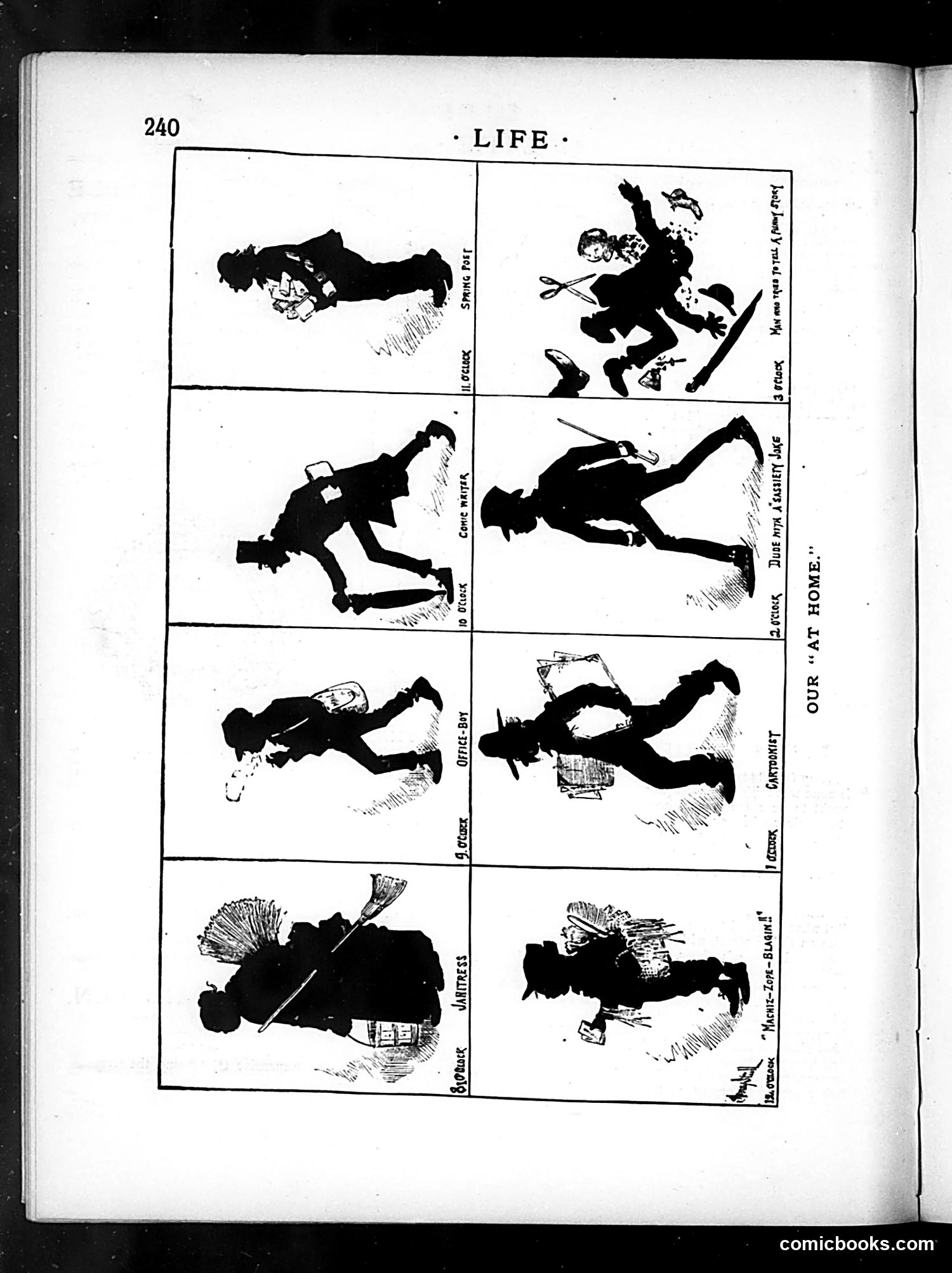
This appears to be a humorous comic strip titled "Our at Home," depicting various domestic mishaps and awkward situations within a household. The six panels show silhouetted figures experiencing everyday chaos: someone being struck or falling, children misbehaving, adults in compromising positions, domestic disorder with scattered items, and general household mayhem. The satire targets the gap between idealized domestic life and messy reality. Rather than the orderly, peaceful homes depicted in period advertising and social expectations, the cartoon shows the actual bedlam of family life—accidents, conflicts, and disorder. This type of humor was typical of early-20th-century *Life* magazine's social commentary, mocking middle-class pretensions about "proper" households while acknowledging the chaotic truth most families experienced daily.
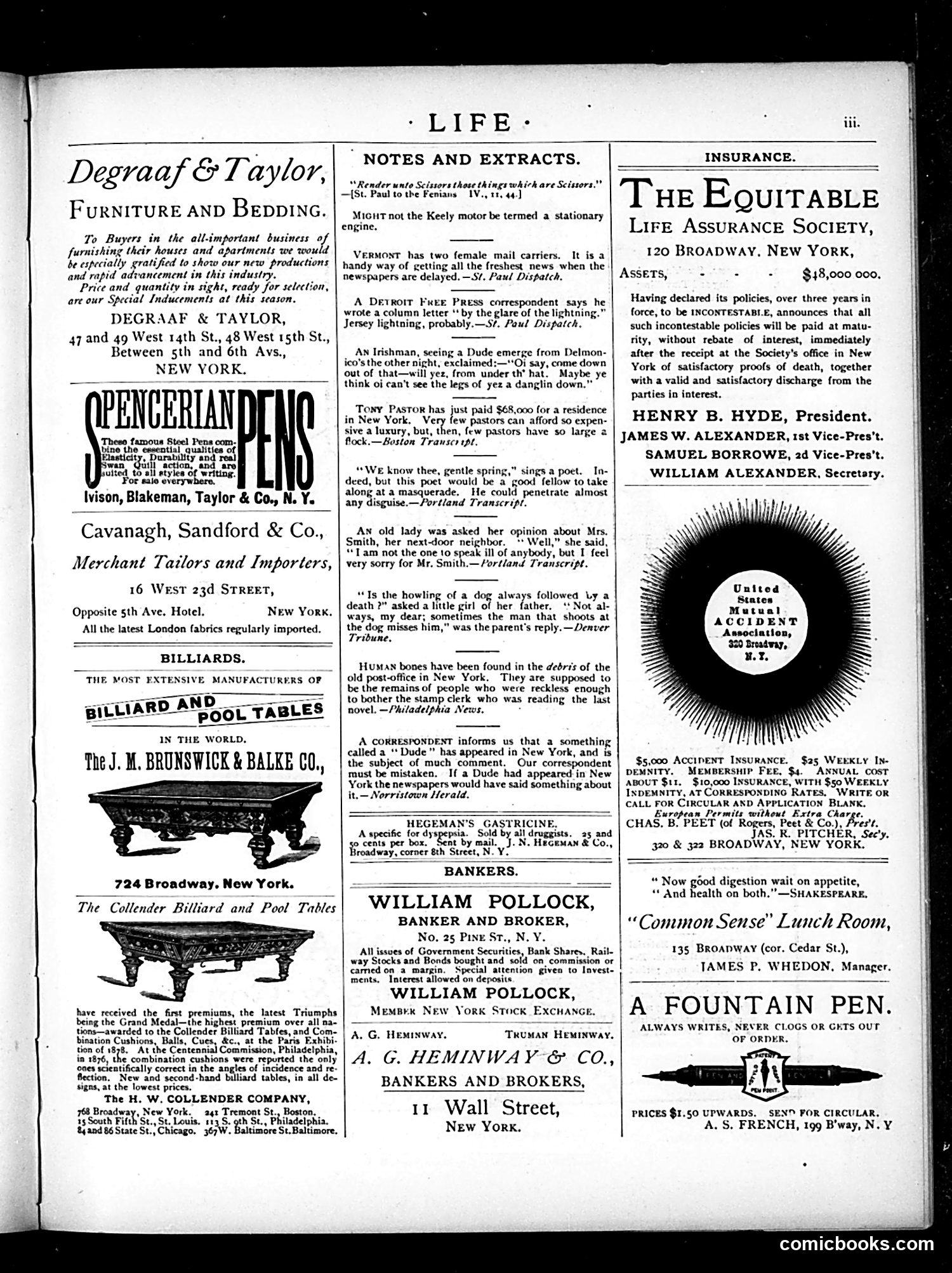
This is primarily an **advertising page** from Life magazine, circa 1870s-1880s, with limited satirical content. The page features commercial advertisements for furniture, billiards tables, tailoring, banking, and insurance services. The small "Notes and Extracts" section contains brief **humorous observations and puns** rather than political satire: - A joke about Vermont's female mail carriers delivering "fresh news" - Wordplay about the "Keely motor" as a "stationary engine" - A mock-biblical quote about scissors ("Render unto Scissors...") - An anecdote about an Irishman mocking a "Dude" (fashionably dressed young man) emerging from a fancy restaurant - A comment on Tory Pastor's expensive house purchase The humor is **gentle social commentary**: poking fun at pretentiousness, absurd fashions, and minor oddities of contemporary life. The repeated references to "Dudes" suggest this was a recognizable social type worthy of mockery during this era. No specific political figures or major events are caricatured. This appears to be filler content supporting the advertising revenue that sustained Life magazine.
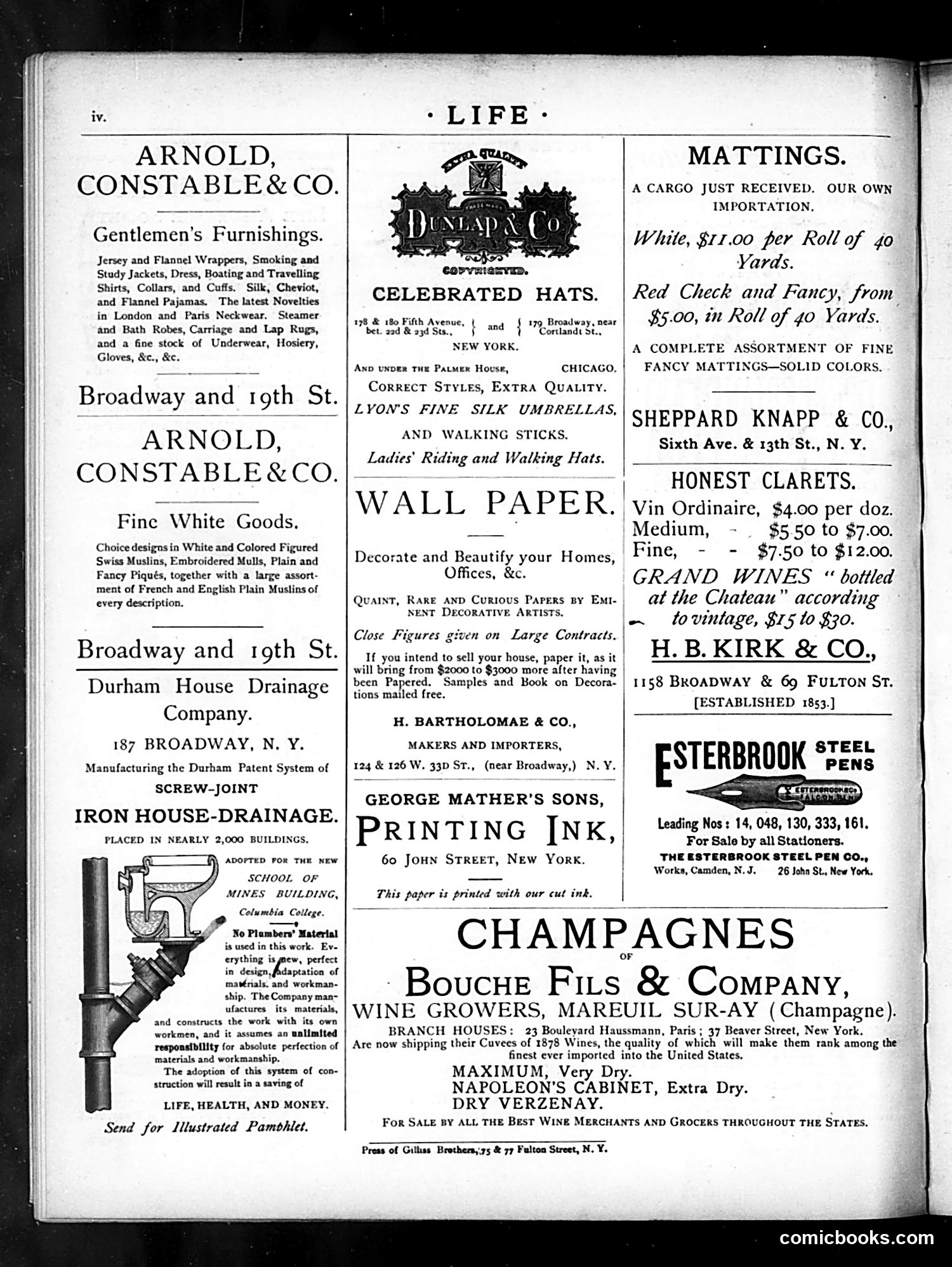
This is primarily an **advertising page**, not a satirical cartoon or editorial content. The page contains commercial advertisements from late 19th-century New York businesses, arranged in columns around a central drainage system diagram. The only illustrative element is a **technical diagram** for the "Durham House Drainage Company" showing their patented "screw-joint iron house-drainage" system—essentially plumbing infrastructure. The accompanying text emphasizes that this new system ensures "LIFE, HEALTH, AND MONEY" by avoiding traditional plumber's materials and guaranteeing perfection. The advertisements target affluent urban consumers: gentlemen's furnishings, fine fabrics, wall paper for home decoration, wines, printing supplies, and pens. Notable is the wall paper ad claiming that papering a house before sale will increase its value by $2,000-$3,000—suggesting real estate inflation concerns of the era. There is **no political satire or social commentary** on this page; it represents straightforward commercial promotion typical of *Life* magazine's revenue model during this period.