A complete issue · 16 pages · 1883
Life — April 26, 1883
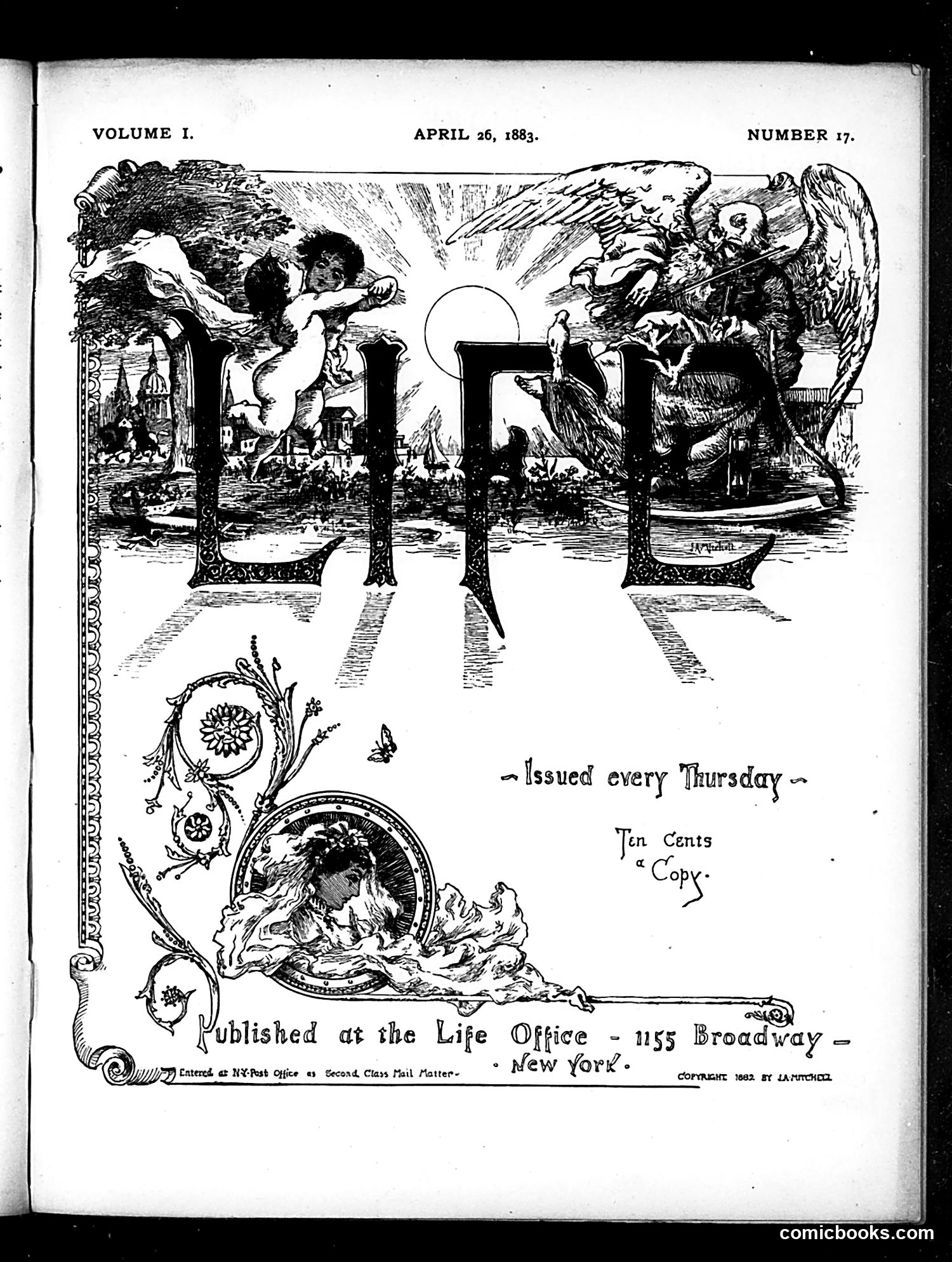
This is the cover/masthead of *Life* magazine, a satirical weekly published in New York. The ornate illustration depicts fantastical and mythological figures in a dreamlike scene—cherubs, winged creatures, and classical figures populate an elaborate landscape with a cityscape visible in the background. The imagery appears purely decorative and fantastical rather than political commentary. The elaborate Art Nouveau-style design with its ornate borders and allegorical figures was typical of *Life*'s aesthetic during this period. No specific contemporary political figures or events appear identifiable in this particular artwork. The publication details confirm this as Volume 1, Number 17, costing ten cents per copy, published Thursdays from the Life Office at 1155 Broadway, New York.
This page is primarily **advertising and publication notices** rather than political cartoons or satire. The content includes: - Book advertisements (works on U.S. constitutional history and mythology) - Promotion for *The Sanitarian*, a health/hygiene journal - Real estate advertisements for drainage work and housing - Business listings (architects, lunch rooms, candy) - An advertisement for Hartshorne's self-acting shade rollers The only visual element is a **product advertisement** (shade rollers), not editorial cartoon content. The page reflects late 19th/early 20th-century *Life* magazine's format: mixing satirical editorial content with paid advertisements. However, **this particular page contains no identifiable political satire, caricatures, or jokes** — it's a straightforward advertising section.
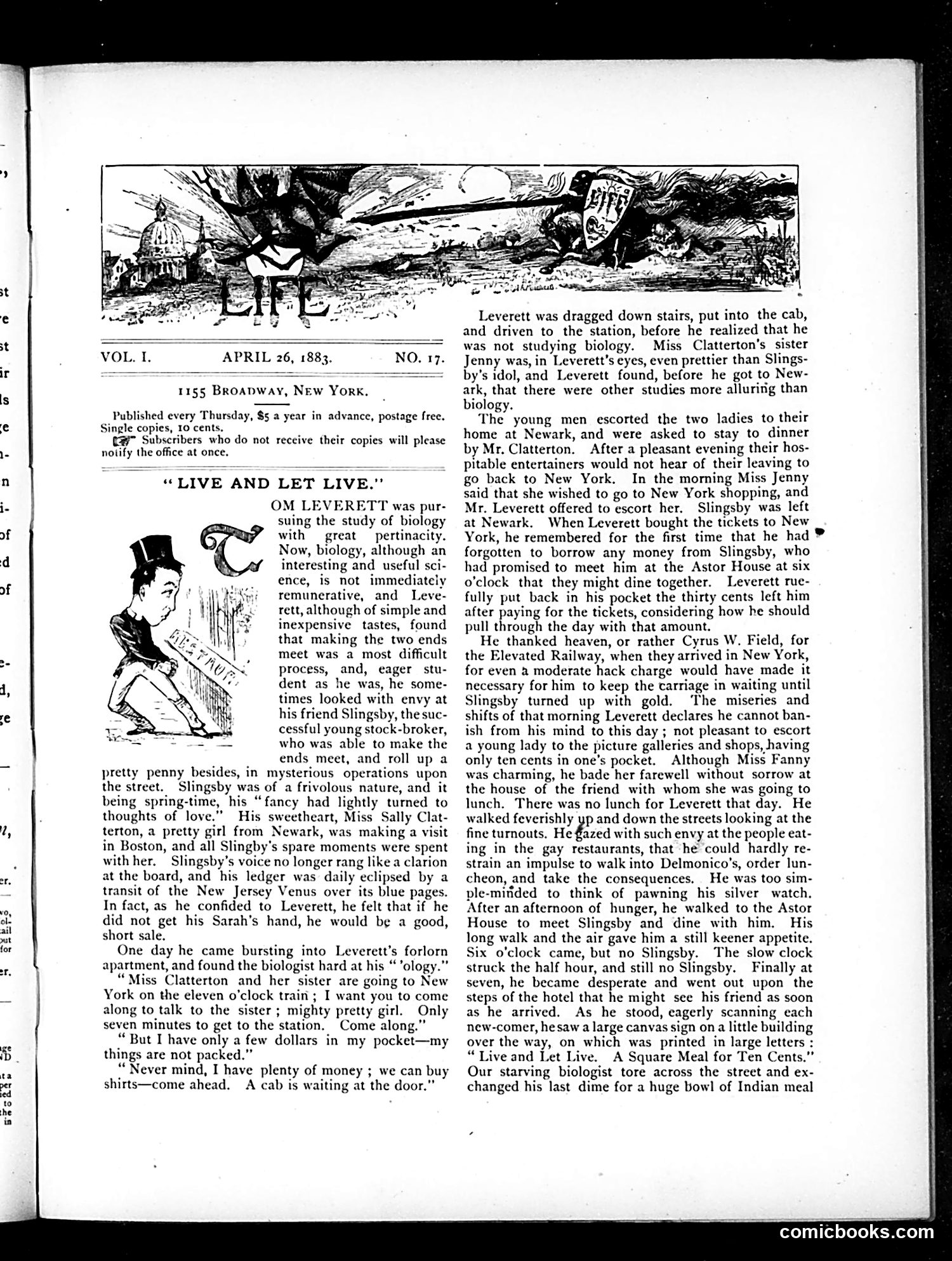
This page features a serialized story about Om Leverett, a young man pursuing biology studies in New York. The accompanying illustration shows a man in a top hat—likely Leverett—appearing somewhat dejected or contemplative. The narrative is satirical comedy: Leverett struggles financially while studying biology, a field the text suggests offers "simple and inexpensive tastes" but little financial reward. His friend Slingsby, a stock-broker, has money and leisure, creating comedic tension between the two lifestyles. The story pokes fun at impoverished scholars and their romantic complications, particularly involving two young women from Newark. The satire targets the contrast between aspirational intellectual pursuits and practical economic survival in Gilded Age America.
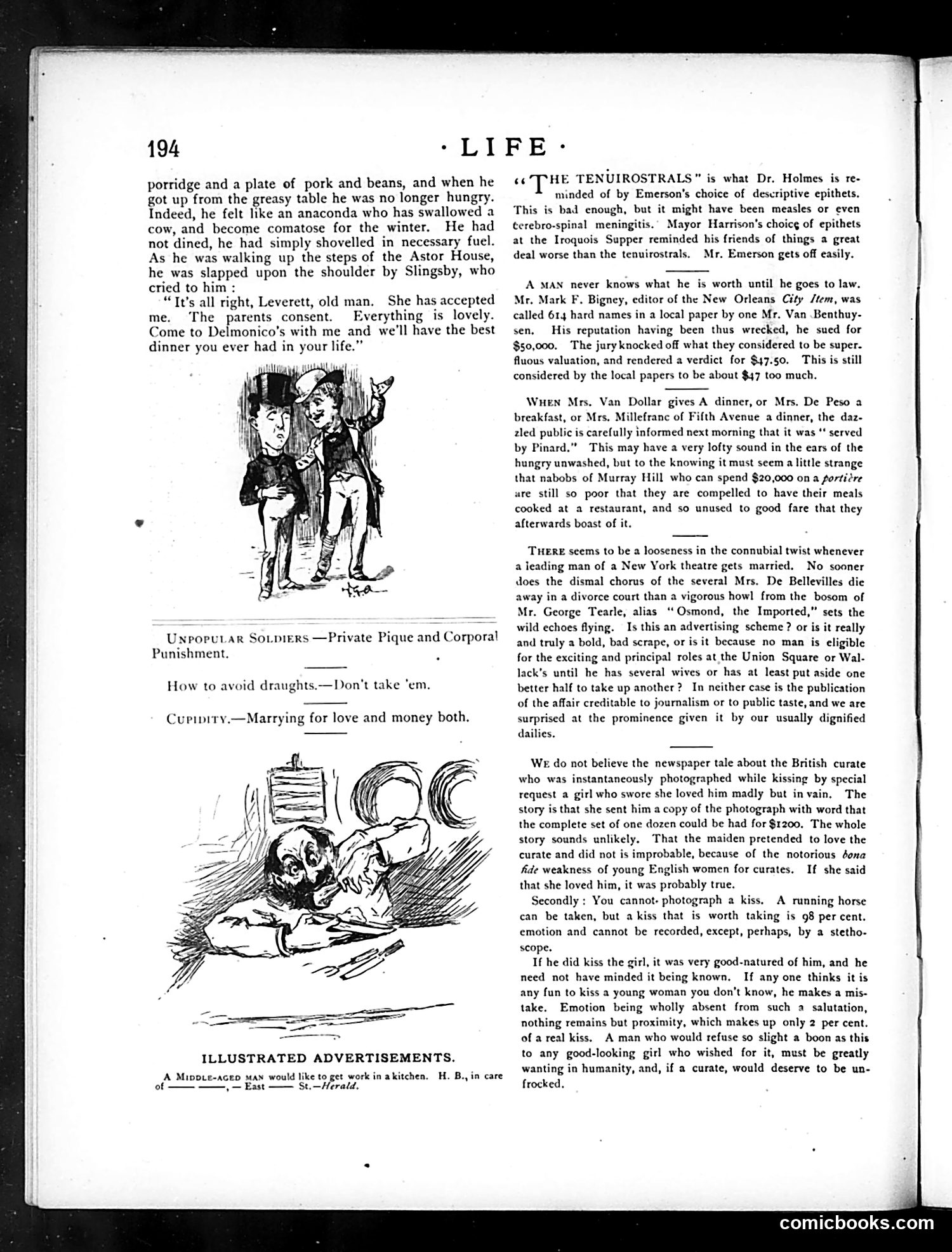
This page contains satirical commentary on marriage and social pretense rather than political cartoons. The text mocks: 1. **Theater marriages**: The author notes that leading New York theater men frequently marry and divorce, questioning whether this is deliberate publicity or simply that unmarried actors lack eligibility for principal roles. 2. **Social climbing through dining**: Several paragraphs ridicule wealthy New York women (Van Dollar, De Peso, Willefane) who announce elaborate dinners through newspapers, treating meals as status displays rather than genuine hospitality. 3. **A British curate scandal**: The text debunks a newspaper story about a curate photographed kissing a woman. The author argues the story is implausible—photographs cannot capture kisses, and the tale reveals prejudices about English women. The illustrations depict domestic scenes and poverty, accompanying humorous social commentary typical of Life's satirical approach to upper-class behavior.
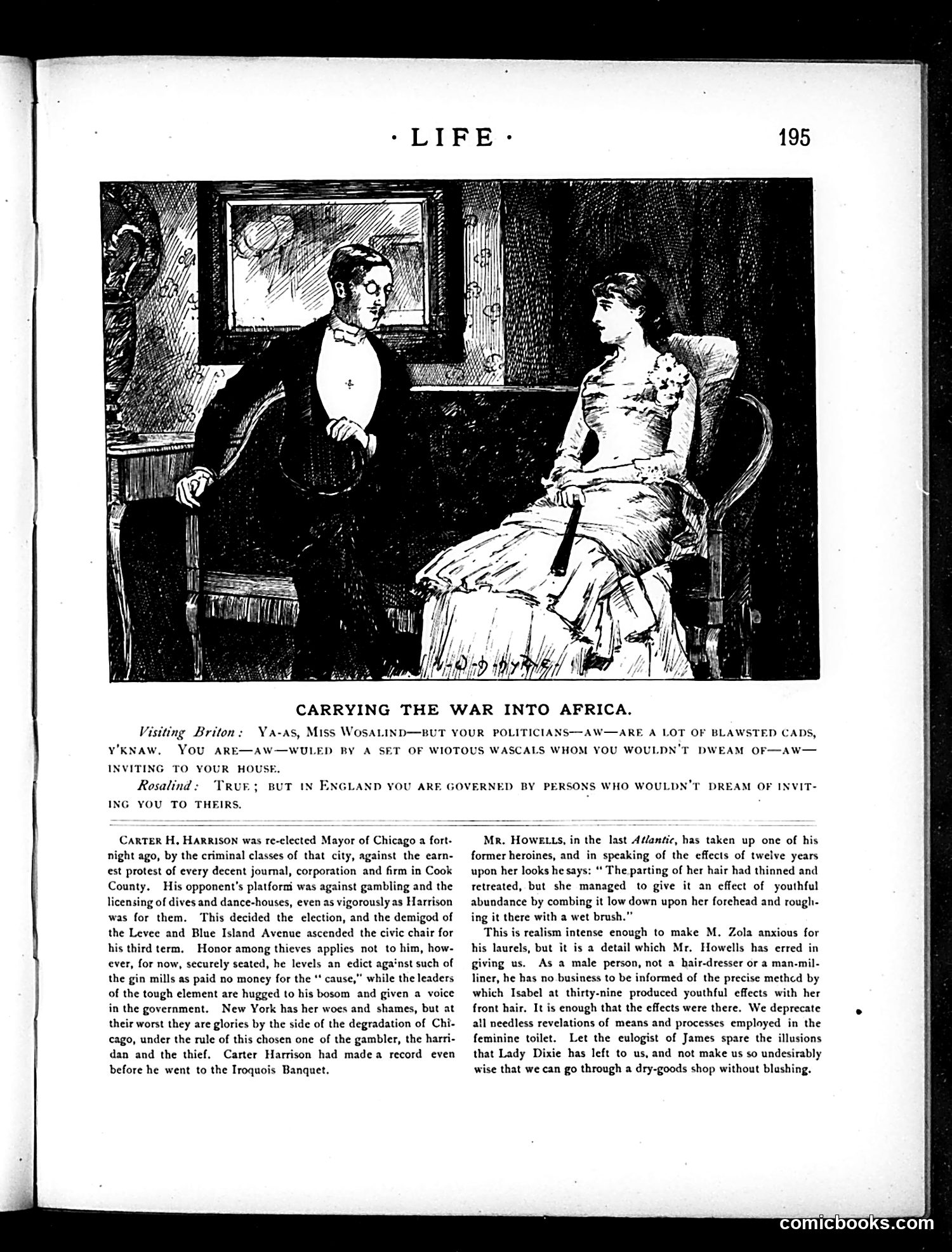
This cartoon satirizes British colonial politics. A visiting Briton complains to "Miss Wosalind" (likely a personification of America or a British woman) that American politicians are "blustered cads" and "wascals," while England is "governed by persons who wouldn't dream of inviting you to theirs." The joke targets hypocrisy: the Briton criticizes American political corruption while implying British politicians are equally unfit—just more socially refined about hiding it. The title "Carrying the War Into Africa" suggests this is political infighting rather than genuine international concern. The accompanying text discusses Chicago Mayor Carter Harrison's re-election amid corruption scandals, and critiques sensationalized reporting about a woman's beauty treatments—mocking both political corruption and tabloid excess.
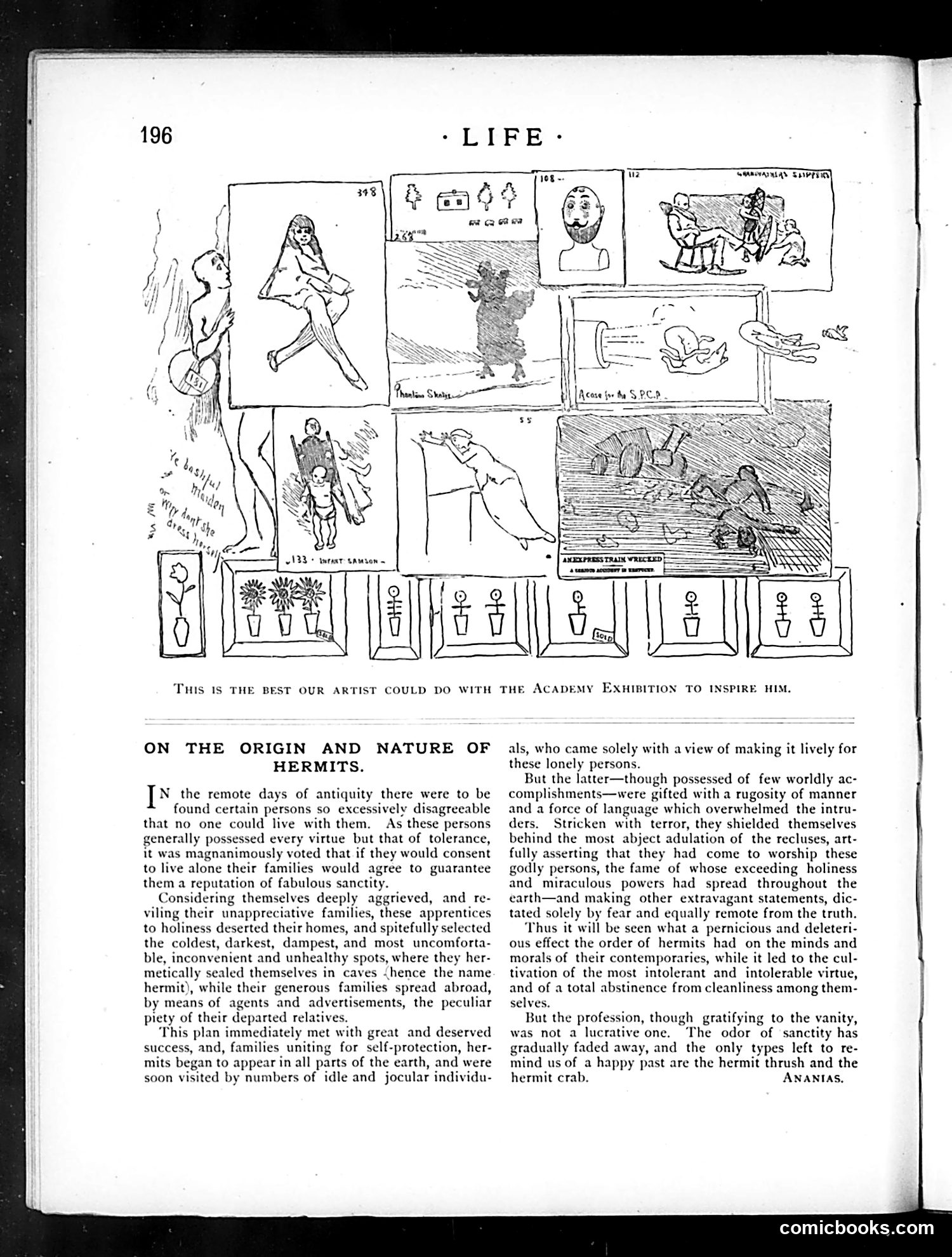
**The Cartoon:** The top illustration mocks the "Academy Exhibition" (likely the National Academy of Design, a prestigious art institution). The caption states this represents "the best our artist could do with the Academy Exhibition to inspire him." The comic panels satirize Academic art as repetitive and uninspired—featuring stick figures, crude drawings, and absurd scenes. This critiques how formal Academy standards supposedly stifled artistic creativity and produced derivative work rather than genuine inspiration. **The Article:** "On the Origin and Nature of Hermits" humorously traces hermits from antiquity to modern times, noting how hermits were originally respected holy figures but became degraded into objects of ridicule. The piece suggests only "hermit thrush" and "hermit crab" retain dignity—a tongue-in-cheek commentary on social decline.
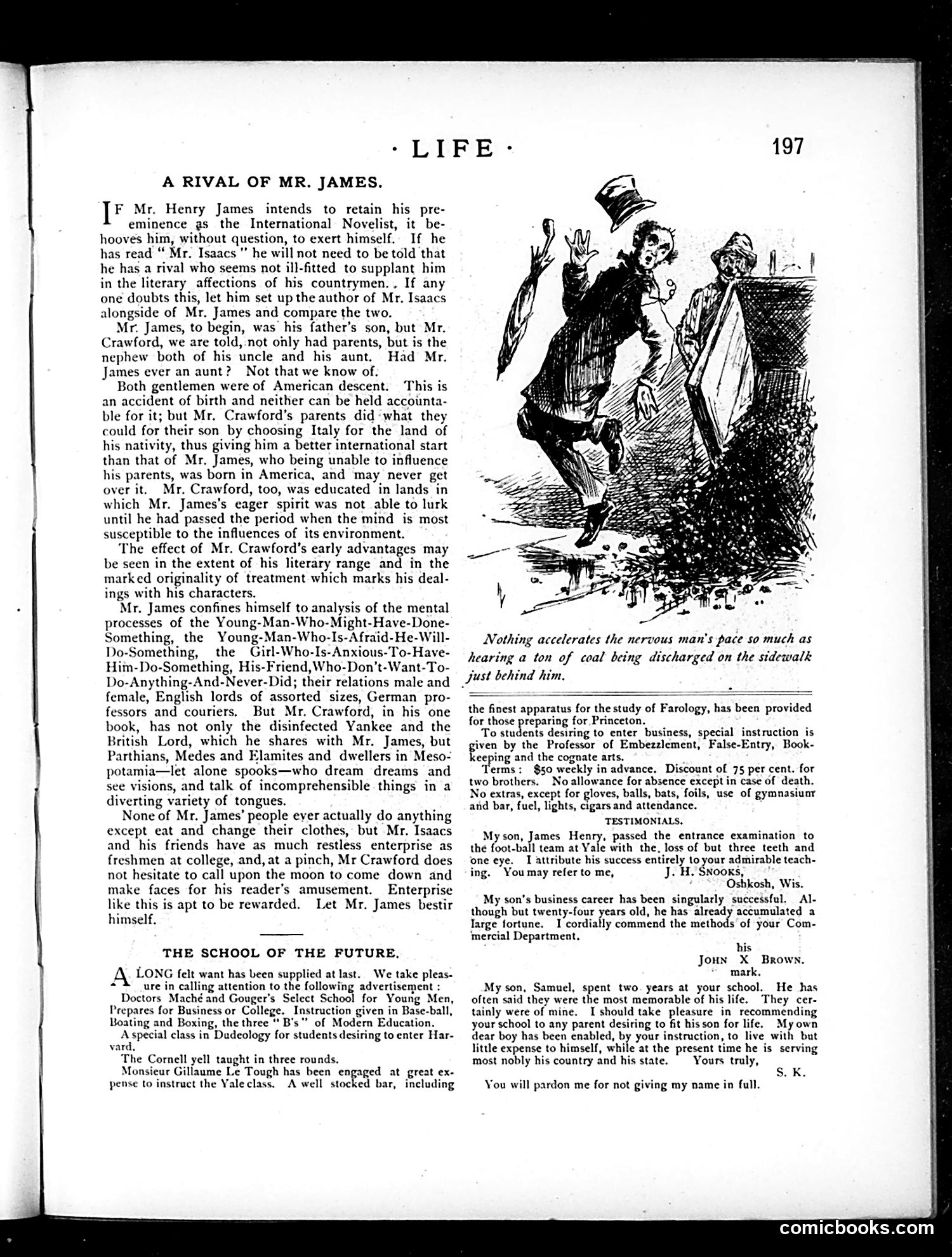
This page contains two distinct sections: a literary article and advertisements. The main illustration shows a man in a top hat reacting with alarm as a large object (appears to be coal) is dumped on a sidewalk behind him. The caption reads: "Nothing accelerates the nervous man's pace so much as hearing a ton of coal being discharged on the sidewalk just behind him." This is a simple visual joke about urban life—depicting the startled reaction of a pedestrian to the sudden noise and disturbance of coal delivery on city streets, a common occurrence in early 20th-century America. It's social humor rather than political satire, illustrating everyday anxieties of city living. The cartoon relates thematically to the accompanying article "A Rival of Mr. James," which discusses literary character analysis and American life.
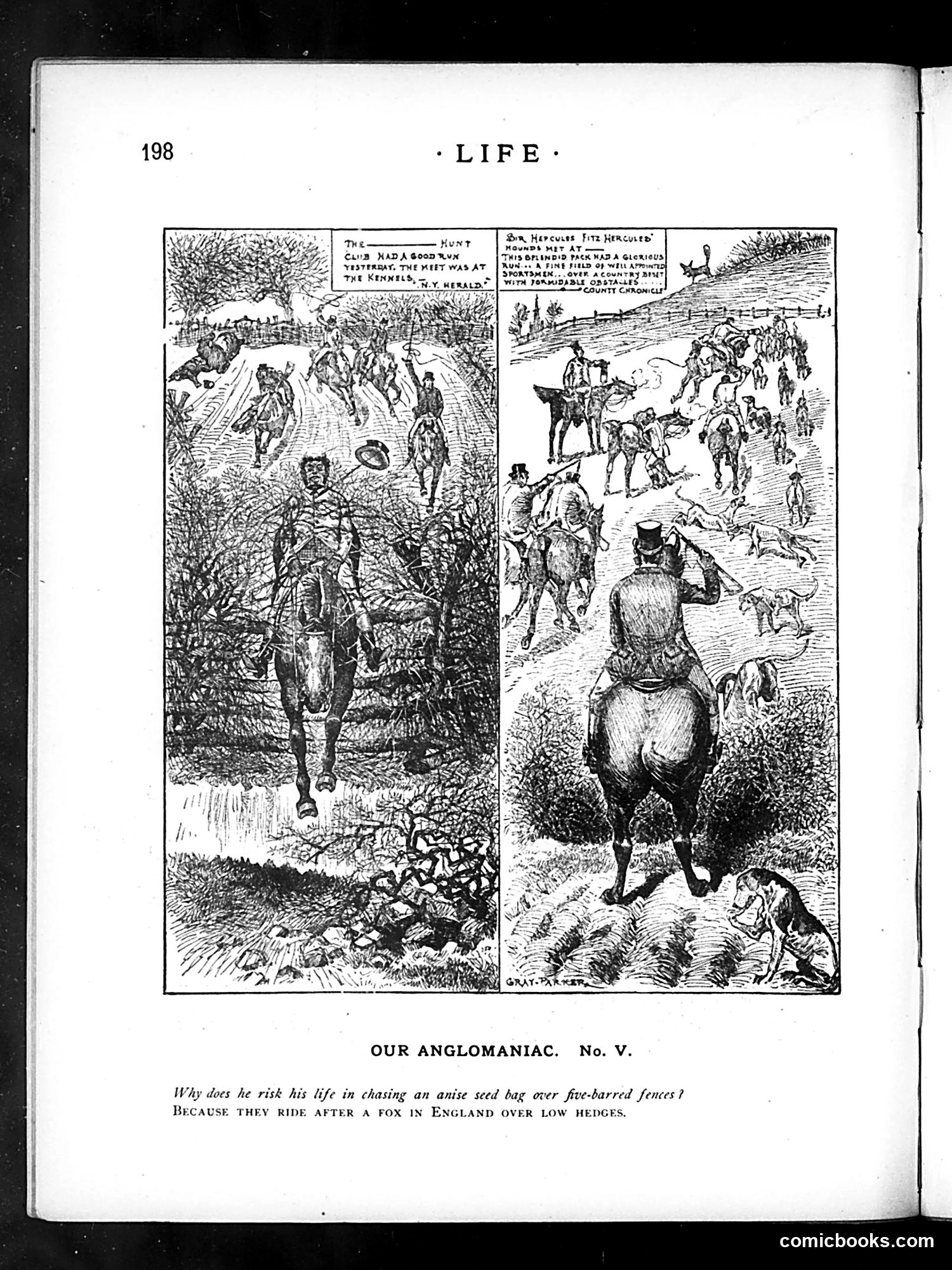
This satirical comic depicts English fox hunting culture, specifically mocking American enthusiasm for British aristocratic pastimes. The left panel shows a hunter in formal riding attire pursuing foxes through countryside. The right panel reveals the punchline: the same figure now rides among a gathering of English hunters and spectators. The caption reads: "Why does he risk his life chasing an anise seed bag over five-barred fences? Because they ride after a fox in England over low hedges." The satire criticizes wealthy Americans who adopt British upper-class customs—fox hunting, formal dress, country-estate lifestyle—as status symbols. The "anise seed bag" detail mocks the artificiality: the hunters chase a scent, not an actual fox, yet maintain the dangerous pretense of authentic aristocratic tradition. It's one installment ridiculing American "Anglomaniacs" who blindly ape English mannerisms.
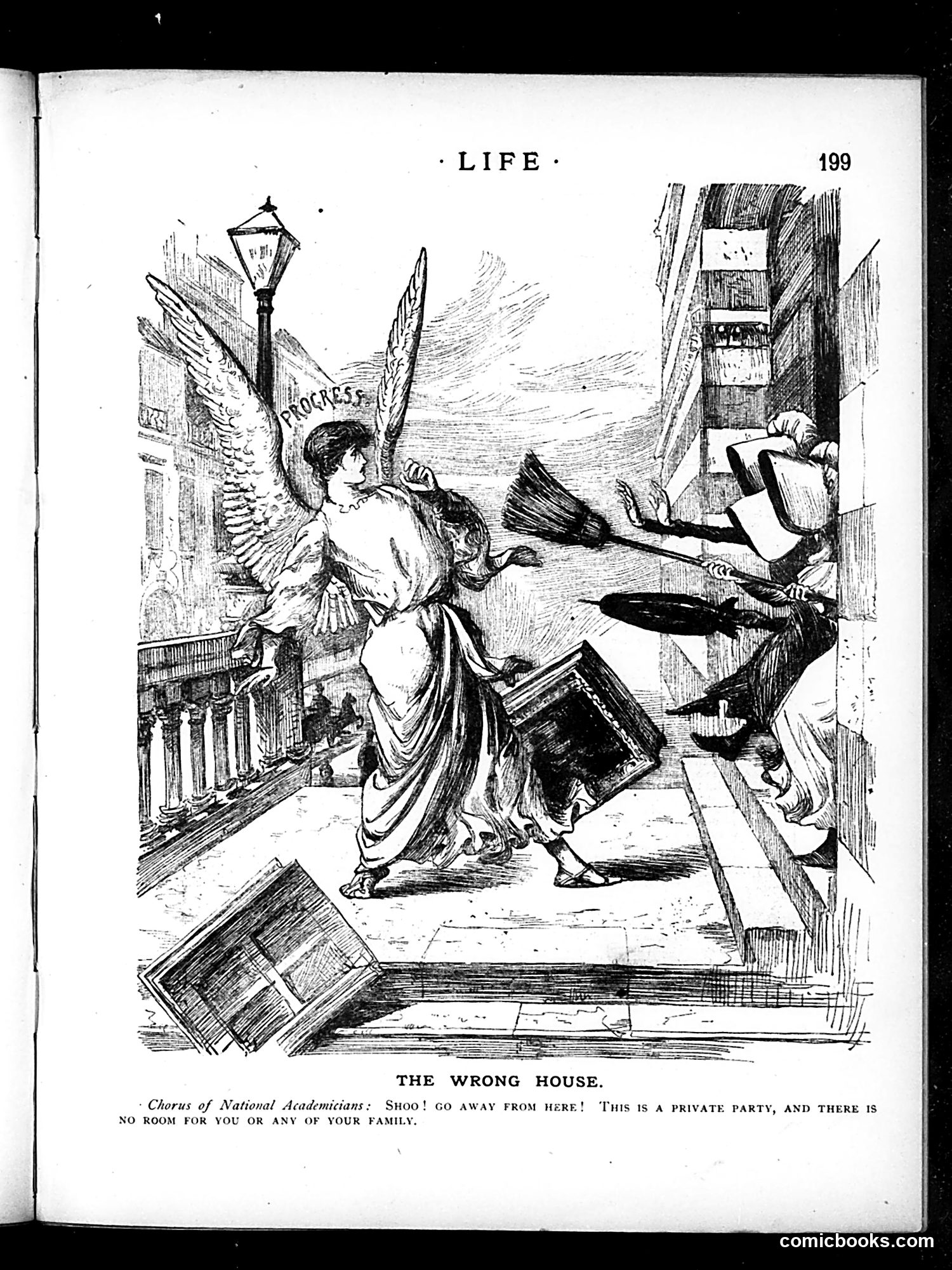
This satirical cartoon depicts **Progress** (the winged female figure, labeled on her wing) being forcibly ejected from a building by National Academicians—representing conservative, established institutions resistant to change. The satire critiques how entrenched academic and cultural authorities actively exclude progressive ideas and reform. The "private party" dialogue emphasizes exclusionary gatekeeping: there's "no room" for Progress or her "family" (presumably new ideas and innovations). The overturned furniture and chaos suggest the violent rejection of modernization. The cartoon likely reflects early-20th-century tensions between progressive reformers and conservative institutions that controlled American cultural and intellectual life, arguing that established authorities actively suppressed advancement rather than merely failing to embrace it.
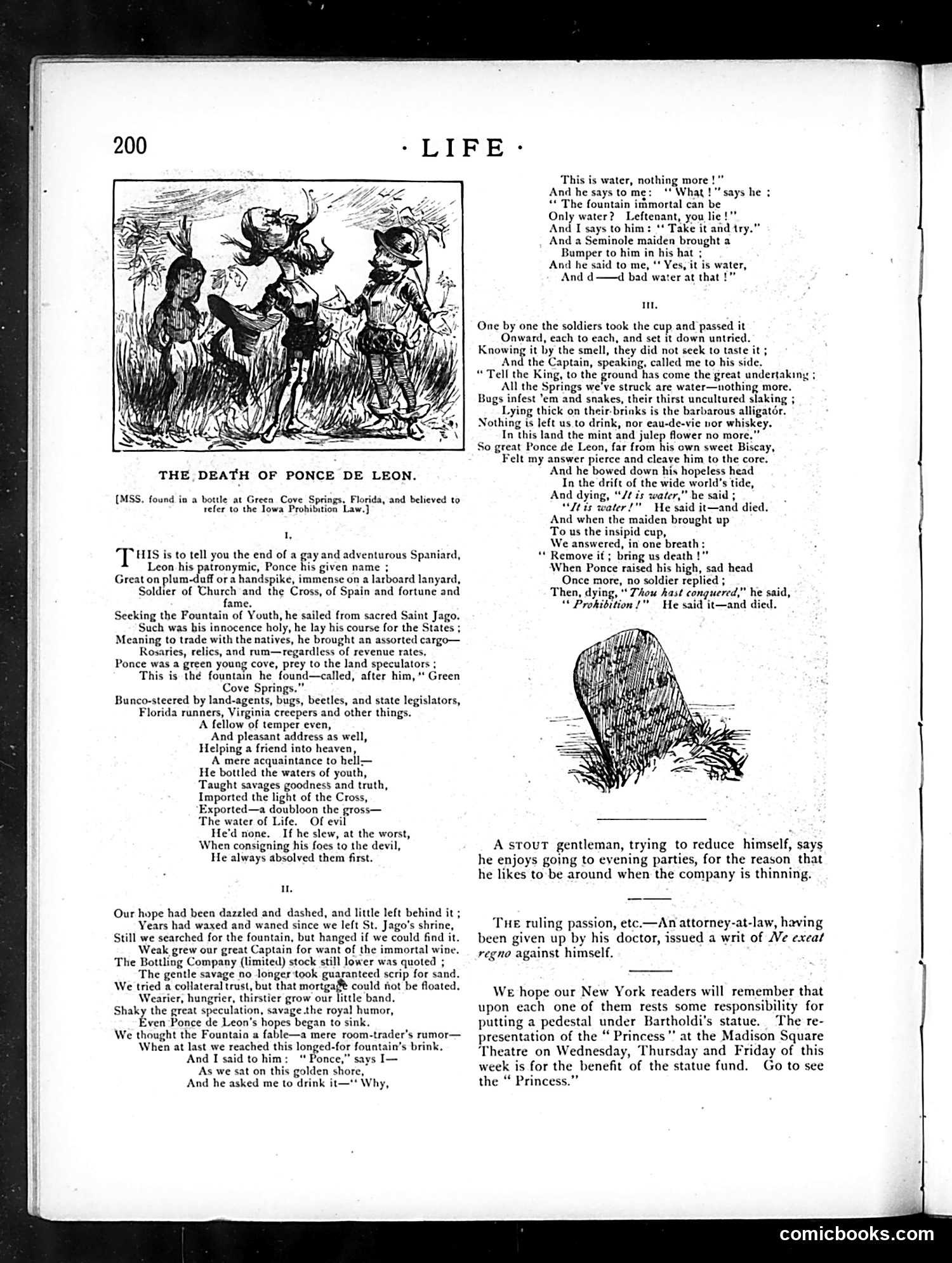
This is a satirical poem mocking the Iowa Prohibition Law through a fictionalized death of the Spanish explorer. The humor works by subverting the legend: Ponce de Leon seeks the mythical Fountain of Youth but instead finds only ordinary water in Florida's Green Cove Springs—a devastating anticlimax when he'd hoped for magical elixir. The satire targets Prohibition itself. The "fountain" represents promises of moral improvement through alcohol ban, while the disappointing reality is "nothing more" than water. When Ponce finally dies, it's to the cry of "Prohibition!"—portrayed as the true killer of joy and enterprise. The text sarcastically praises Ponce's rum-trading and moral flexibility, implicitly mocking Prohibition's crusading moralism. The "Bottling Company" and failed financial schemes suggest the absurdity of the venture. The joke: Prohibition promised transformation but delivered only disappointment—as empty as finding plain water where immortality was promised.
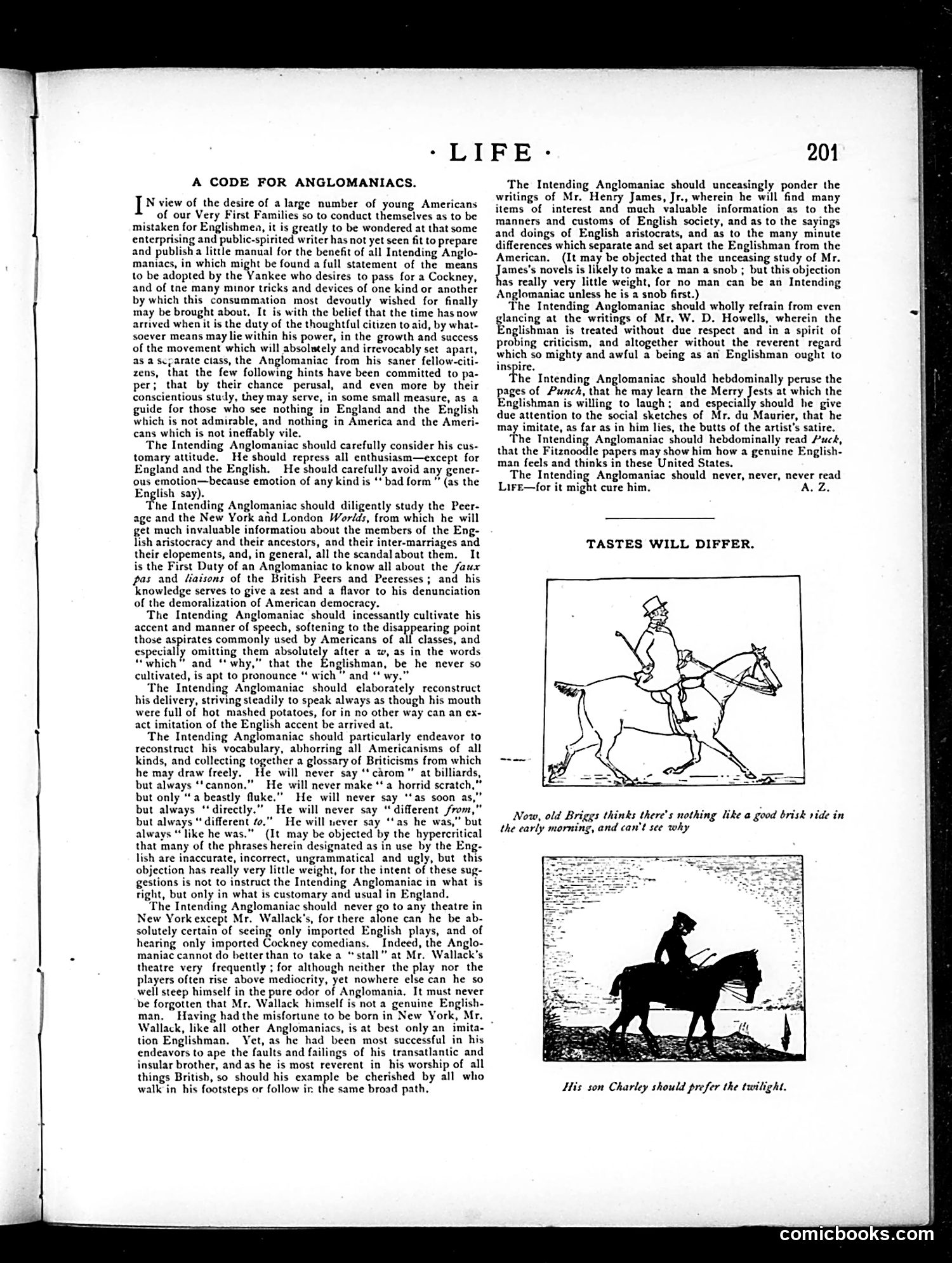
This page satirizes wealthy young Americans who affectedly imitate English manners and speech to appear sophisticated. The article mocks "Anglomaniacs"—wealthy Americans of prominent families who desperately want to be mistaken for English aristocrats. The satire targets specific pretensions: adopting a affected English accent (dropping h's, speaking as if "mouth were full of hot mashed potatoes"), studying British peerage gossip, replacing American slang with British terms ("cannon" instead of "carom," "beastly fluke" instead of "horrid scratch"), and affecting emotional detachment as "good form." The accompanying illustrations show gentlemen engaged in leisurely English pastimes (horseback riding, hunting). The humor lies in Life's mockery of American social climbers who reject American democracy as "ineffably vile" while fawning over English aristocracy, despite their own democratic origins. This reflects Gilded Age anxieties about class aspiration and cultural identity among the American wealthy.
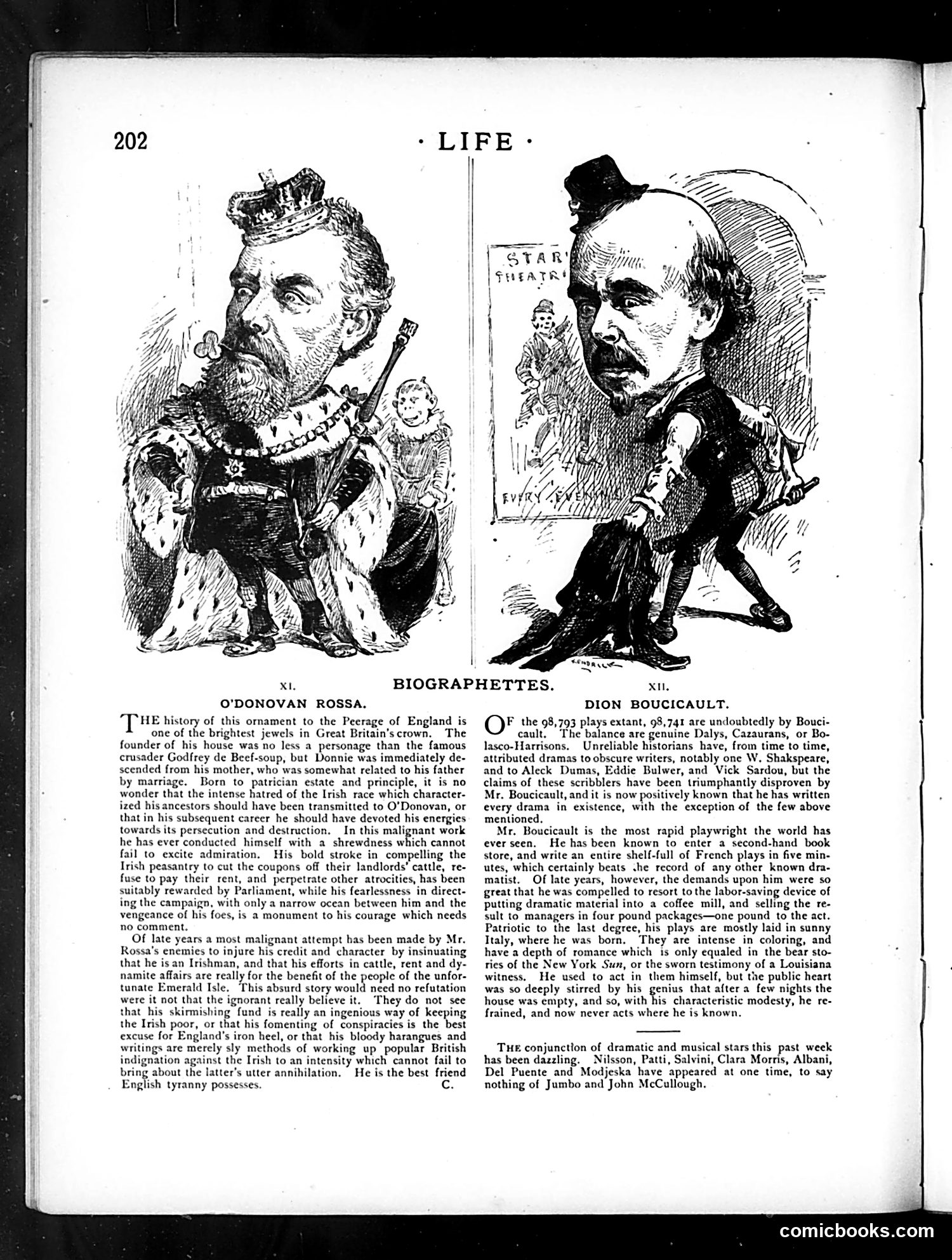
This page contains two satirical "biographettes" mocking public figures of the era. **O'Donovan Rossa** (left): The text sarcastically praises this Irish nationalist agitator while actually condemning him. The satire inverts his actions—presenting his real efforts to organize Irish resistance (rent strikes, cattle mutilation) as secretly benefiting English oppression. The joke is that Life's editors view Rossa as so counterproductive that he unwittingly serves British tyranny better than any English official could. **Dion Boucicault** (right): This famous playwright is mocked for supposed prolific output. The satire absurdly claims he wrote 98,741 of 98,793 extant plays, attributing works to Shakespeare, Dumas, and others as "disproven" by Boucicault himself. The joke culminates in describing his method: putting "dramatic material into a coffee mill" and selling results by the pound—suggesting his work is mechanical, mass-produced, and artistically worthless. The caricatures exaggerate facial features in period style.
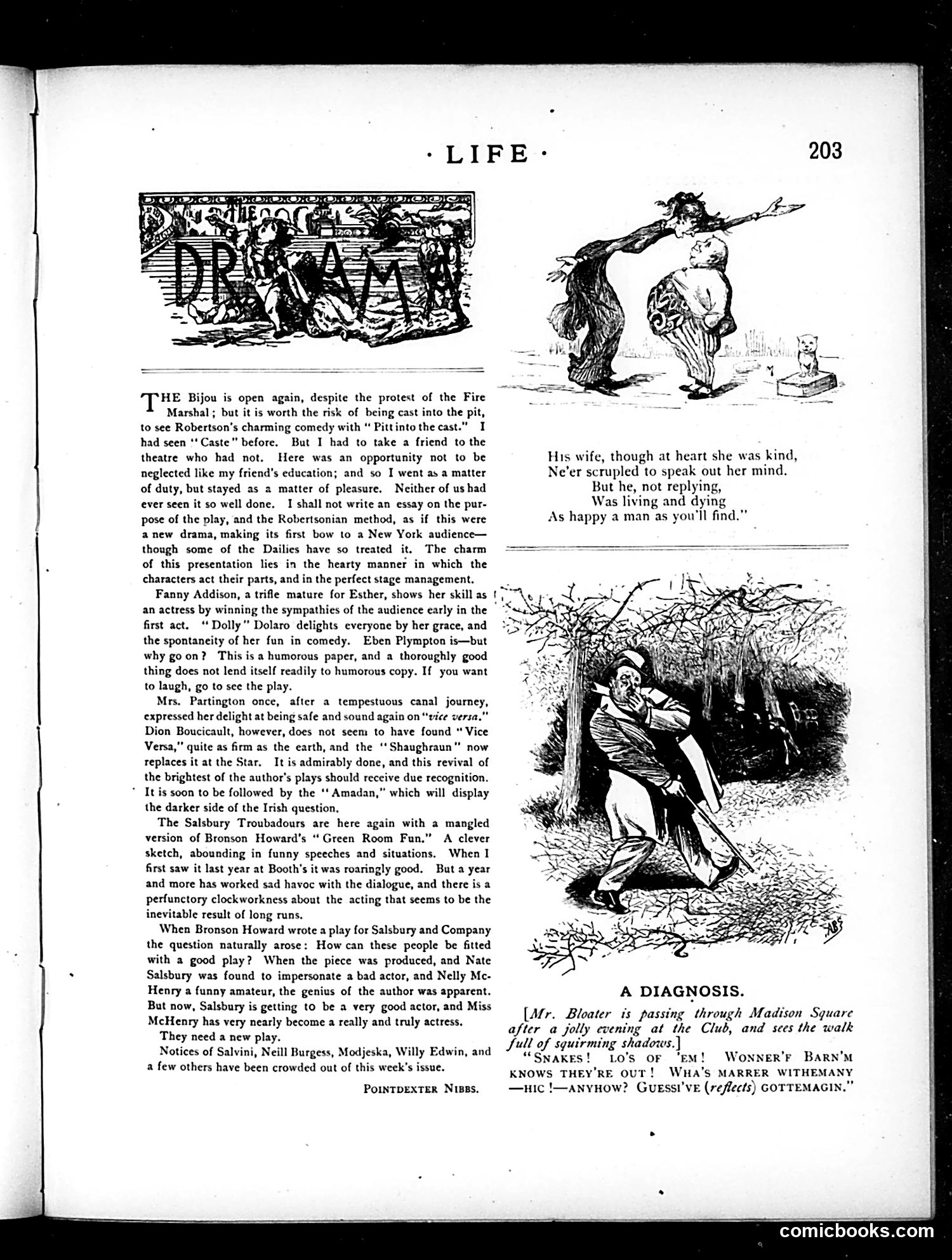
This *Life* magazine page contains theater reviews alongside two cartoons. The main review, by "Pointdexter Nibbs," discusses theatrical productions including Robertson's *Caste* and Dion Boucicault's *The Shaughraun*—popular 19th-century plays. The critic praises the acting quality while noting that repeated performances have degraded some productions' energy. The cartoons are social humor: "A Diagnosis" depicts a man named Bloater leaving an evening at his club, observing "squirming shadows" on the street (likely homeless people or vagrants in Madison Square Park). His oblivious response—wondering why there are so many snakes—satirizes wealthy men's indifference to urban poverty and social problems occurring literally at their feet. The second illustration and verse about a wife who "ne'er scrupled to speak out her mind" while her husband remains passively content appears to be gentle domestic humor, mocking marital dynamics of the era.
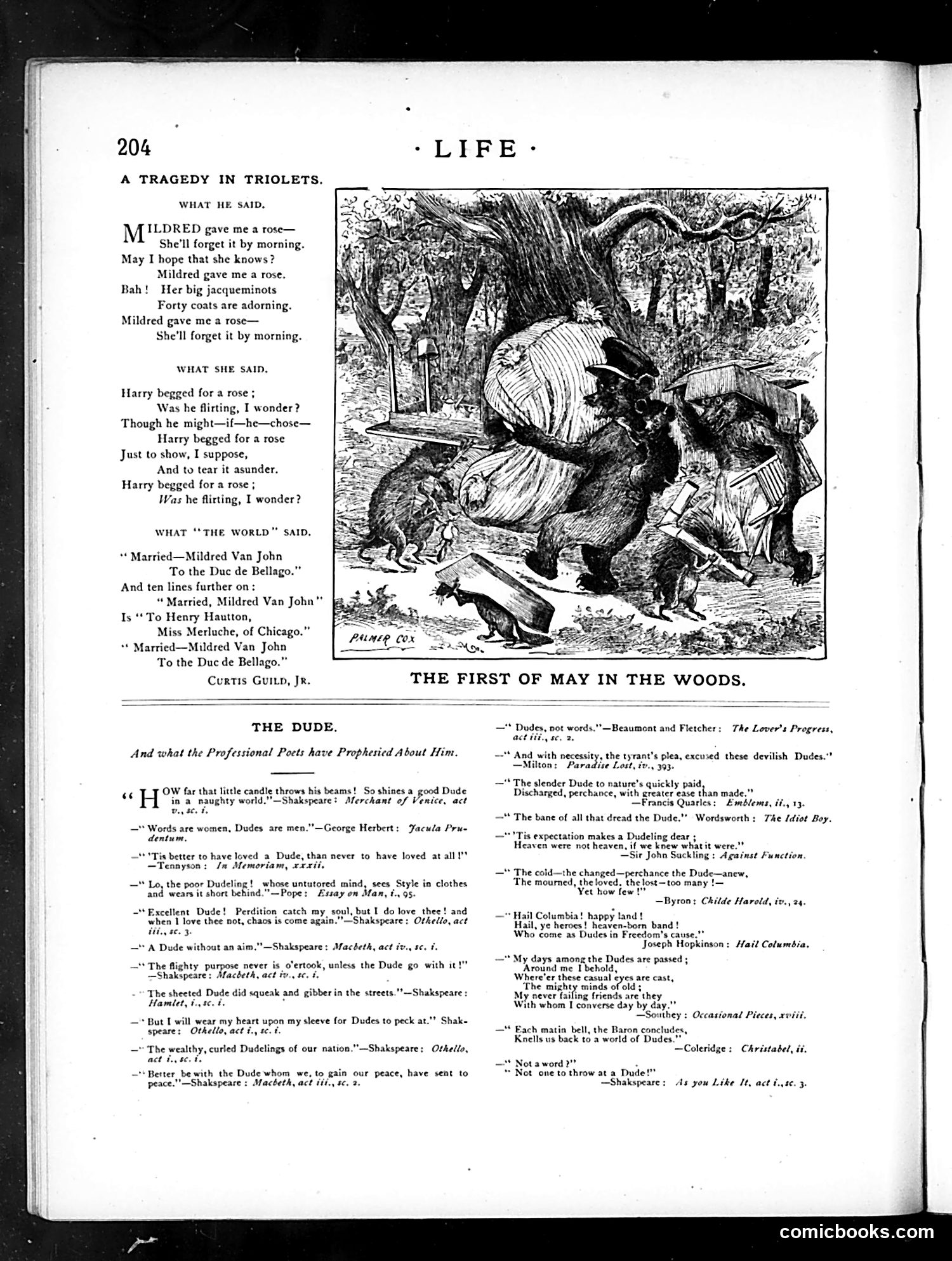
This page satirizes romantic misunderstandings and the fashionable "Dude"—a figure of fun in 1880s American culture. **"A Tragedy in Triolets"** presents three perspectives on a rose exchange between Mildred and Harry: his hopeful view, her skepticism about his sincerity, and society's shallow focus on her marriages (to various wealthy men). The joke is that while they debate the rose's meaning, the world only cares that she keeps marrying up. **"The Dude"** mocks the contemporary dandy archetype—a vain, fashionable man obsessed with appearance and style. The satire strings together famous literary quotations awkwardly rewritten to substitute "Dude" for the original subjects, making absurd comparisons ("Words are women, Dudes are men"). This undercuts the Dude's pretensions by showing how ridiculous he becomes when inserted into serious literature. The illustration shows rustic characters in nature—presumably contrasting natural simplicity with urban affectation the Dude represents.
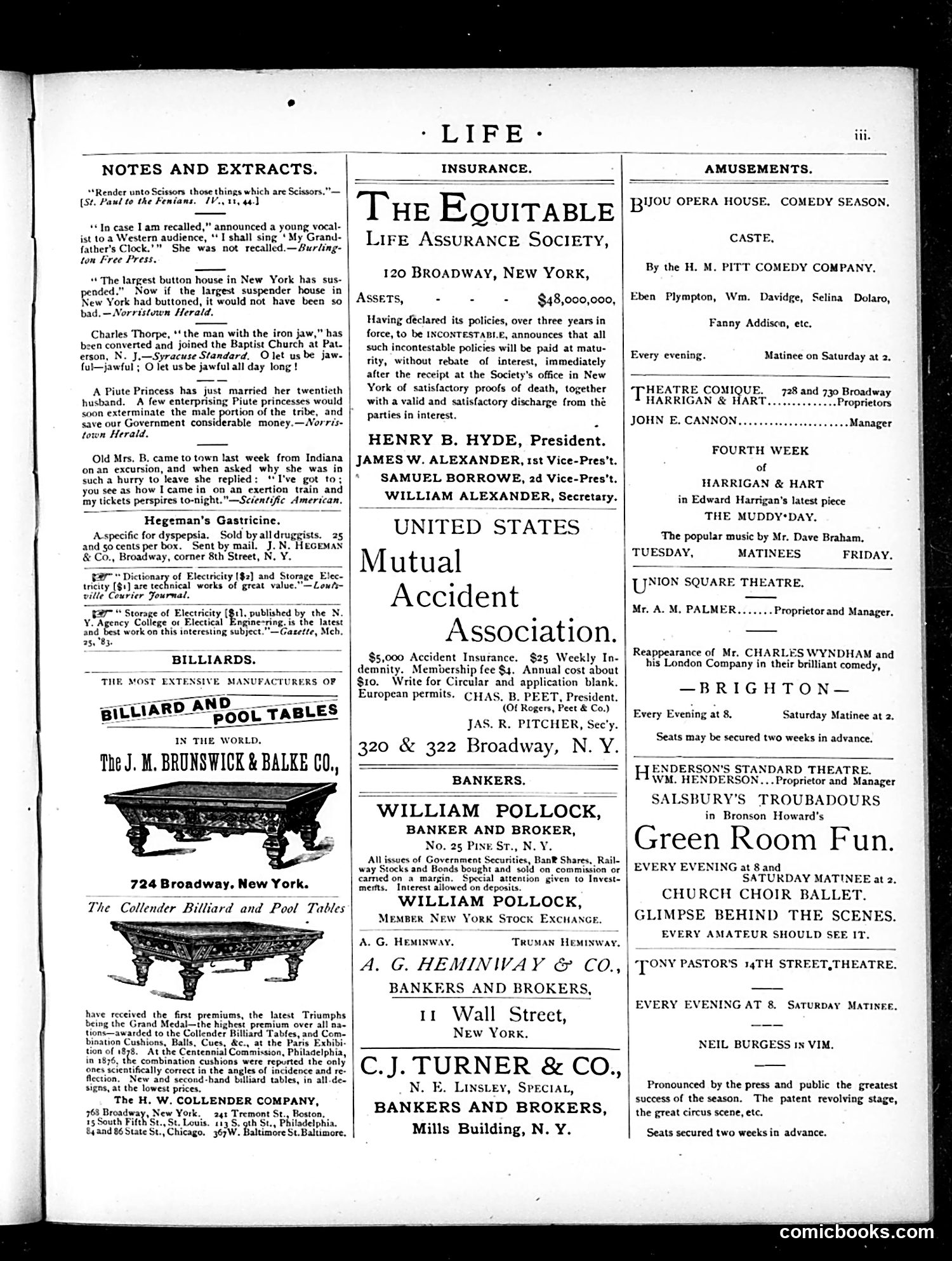
This page is primarily **advertising and notices**, not satirical content. The "Notes and Extracts" section collects brief humorous anecdotes from regional newspapers—jokes about linguistic confusion (a woman marrying repeatedly, a failed song request), social commentary (Piute women and government costs), and business oddities. The advertisements promote insurance companies (Equitable Life Assurance, Mutual Accident Association), banks and brokers (William Pollock, A.G. Heminway & Co.), and billiard/pool table manufacturers (J.M. Brunswick & Balke Co., Collender Company). The "Amusements" section lists New York theater offerings: the Bijou Opera House, Harrigan & Hart's productions, Union Square Theatre, and Henderson's Standard Theatre. There is **no political cartoon** visible—this is a standard page from *Life* magazine featuring short comedic clippings alongside commercial advertisements typical of late-19th-century publishing.