
Life, 1883-04-26 · page 11 of 16
Life — April 26, 1883 — page 11: what you’re looking at
What you’re looking at
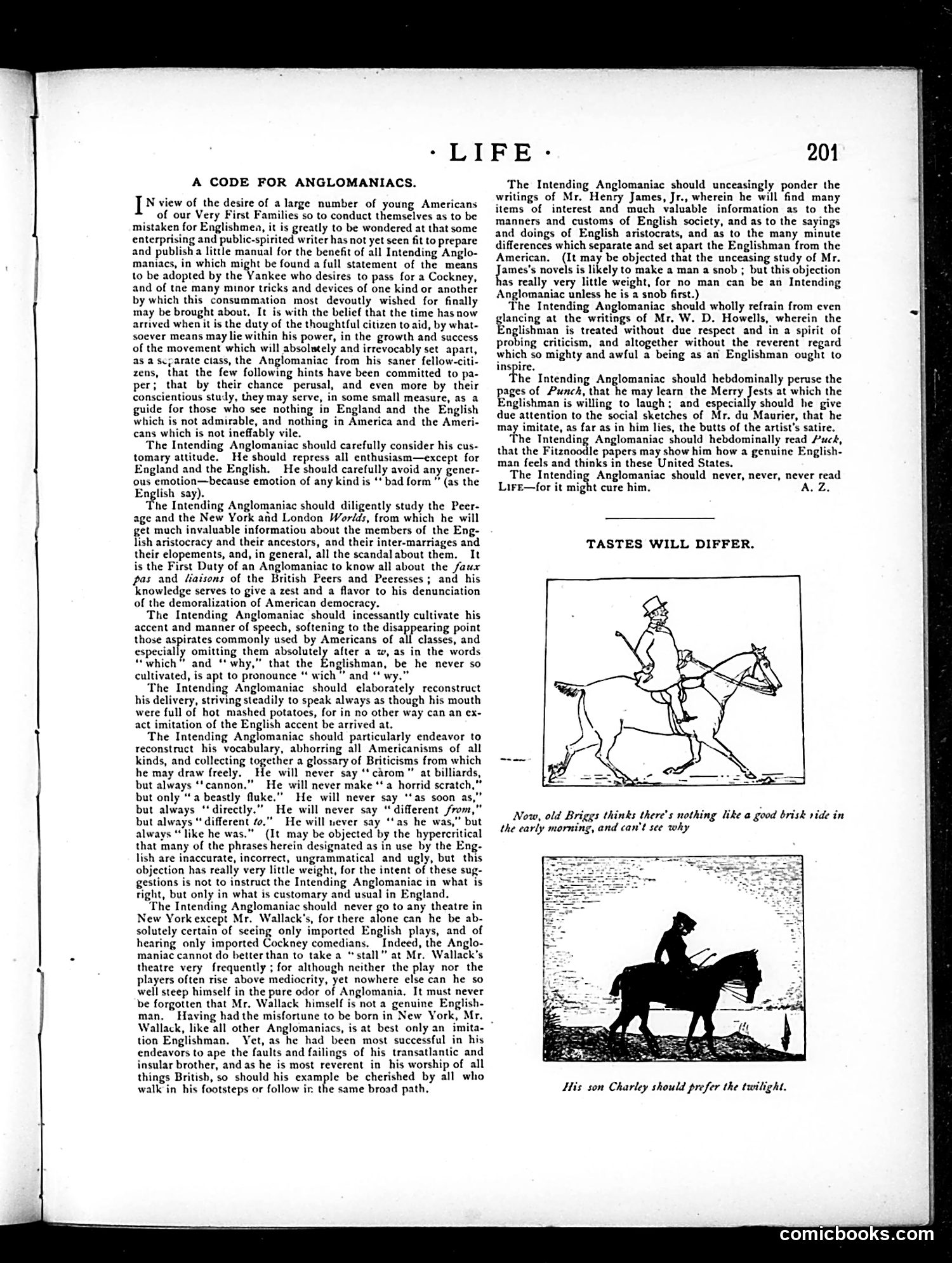
This page satirizes wealthy young Americans who affectedly imitate English manners and speech to appear sophisticated. The article mocks "Anglomaniacs"—wealthy Americans of prominent families who desperately want to be mistaken for English aristocrats. The satire targets specific pretensions: adopting a affected English accent (dropping h's, speaking as if "mouth were full of hot mashed potatoes"), studying British peerage gossip, replacing American slang with British terms ("cannon" instead of "carom," "beastly fluke" instead of "horrid scratch"), and affecting emotional detachment as "good form." The accompanying illustrations show gentlemen engaged in leisurely English pastimes (horseback riding, hunting). The humor lies in Life's mockery of American social climbers who reject American democracy as "ineffably vile" while fawning over English aristocracy, despite their own democratic origins. This reflects Gilded Age anxieties about class aspiration and cultural identity among the American wealthy.
📄 Transcribed text from this page (OCR, searchable)
Machine-transcribed from the original scan — historical spelling and the odd misread are preserved.
ee ss SS ne A CODE FOR ANGLOMANIACS. JN view of the desire of a large number of young Americans of our Very First Families so to conduct themselves as to be mistaken for Englishmen, it is greatly to be wondered at that some enterprising and public-spirited writer has not yet seen fit to prepare and publish a little manual for the benefit of all Intending Anglo- maniacs, in which might be found a full statement of the means to be adopted by the Yankee who desires to pass for a Cockney, and of tne many minor tricks and devices of one kind or another by which this consummation most devoutly wished for finally may be brought about, It is with the belief that the time has now arrived when it is the duty of the thoughtful citizen to aid, by what- soever means may lie within his power, in the growth and success of the movement which will absolwmtely and irrevocably set apart, as a separate class, the Anglomaniac from his saner fellow-citi- zens, that the few following hints have been committed to pa- per; that by their chance perusal, and even more by their conscientious study, they may serve, in some small measure, as a guide for those who see nothing in England and the English which is not admirable, and nothing in America and the Ameri- cans which is not ineffably vile. The Intending Anglomaniac should carefully consider his cus- tomary attitude. He should repress all enthusiasm—except for England and the English. He should carefully avoid any gener- ous emotion—because emotion of any kind is ‘* bad form " (as the English say). ‘he Intending Anglomaniac should diligently study the Peer- age and the New York and London Worlds, from which he will get much invaluable information about the members of the Eng- lish aristocracy and their ancestors, and their inter-marriages and their elopements, and, in general, all the scandalabout them. It is the First Duty of an Anglomaniac to know all about the faux pas and /iatsons of the British Peers and Peeresses; and his knowledge serves to give a zest and a flavor to his denunciation of the demoralization of American democracy. The Intending Anglomaniac should incessantly cultivate his accent and manner of speech, softening to the disappearing point those aspirates commonly used by Americans of all classes, and especially omitting them absolutely after a w, as in the words “which” and ‘‘ why,” that the Englishman, be he never so cultivated, is apt to pronounce “ wich ” and ‘ wy.” The Intending Anglomaniac should elaborately reconstruct his delivery, striving steadily to speak always as though his mouth were full of hot mashed potatoes, for in no other way can an ex- act imitation of the English accent be arrived at. The Intending Anglomaniac should particularly endeavor to reconstruct his vocabulary, abhorring all Americanisms of all kinds, and collecting together a glossary of Briticisms from which he may draw freely. He will never say ‘‘ carom” at billiards, but always ‘‘cannon.” He will never make ‘a horrid scratch,” but only “‘a beastly fluke.” He will never say ‘‘as soon as, but always “directly.” He will never say ‘different fron but always “different fo.” He will never say ‘‘as he was,” but always ‘like he was.” (It may be objected by the hypercritical that many of the phrases herein designated as in use by the Eng- lish are inaccurate, incorrect, ungrammatical and ugly, but this objection has really very little weight, for the intent of these sug- gestions is not to instruct the Intending Anglomaniac in what is right, but only in what is customary and usual in England. The Intending Anglomaniac should never go to any theatre in New York except Mr. Wallack’s, for there alone can he be ab- solutely certain of seeing only imported English plays, and of hearing only imported Cockney comedians. Indeed, the Anglo- maniac cannot do better than to take a “stall” at Mr. Wallack’s theatre very frequently ; for although neither the play nor the players often rise above mediocrity, yet nowhere else can he so well steep himself in the pure odor of Anglomania. It must never be forgotten that Mr. Wallack himself is not a genuine English- man. Having had the misfortune to be born in New York, Mr. Wallack, like all other Anglomaniacs, is at best only an imita- tion Englishman. Yet, as he had been most successful in his endeavors to ape the faults and failings of his transatlantic and insular brother, and as he is most reverent in his worship of all things British, so should his oaeiple be cherished by all who walk in his footsteps or follow ir: the same broad path, - LIFE: 201 The Intending Anglomaniac should unceasingly ponder the writings of Mr. Henry James, Jr., wherein he will find many items of interest and much valuable information as to the manners and customs of English society, and as to the sayings and doings of English aristocrats, and as to the many minute differences which separate and set apart the Englishman from the American. (It may be objected that the unceasing study of Mr. James's novels i likely to make a man a snob ; but this objection as really very little weight, for no man can be an Intending Anglomaniac unless he is a snob first.) The Intending Anglomaniac should wholly refrain from even glancing at the writings of Mr. W. D. Howells, wherein the Englishman is treated without due respect and in a spirit of probing criticism, and altogether without the reverent regard which so mighty and awful a being as an Englishman ought to inspire. The Intending Anglomaniac should hebdominally peruse the pages of Punch, that he may learn the Merry Fests at which the Englishman is willing to laugh; and especially should he give due attention to the social sketches of Mr. du Maurier, that he may imitate, as far as in him lies, the butts of the artist's satire. The Intending Anglomaniac should hebdominally read Puck, that the Fitznoodle papers may show him how a genuine English- man feels and thinks in these United States. The Intending Anglomaniac should never, never, never read Lire—for it might cure him. TASTES WILL DIFFER. Now, old Briggs thinks there's nothing like a good brisk side in the early morning, and can't see why His son Charley should prefer the twilight. comicbooks.com