
A complete issue · 16 pages · 1883
Life — April 5, 1883
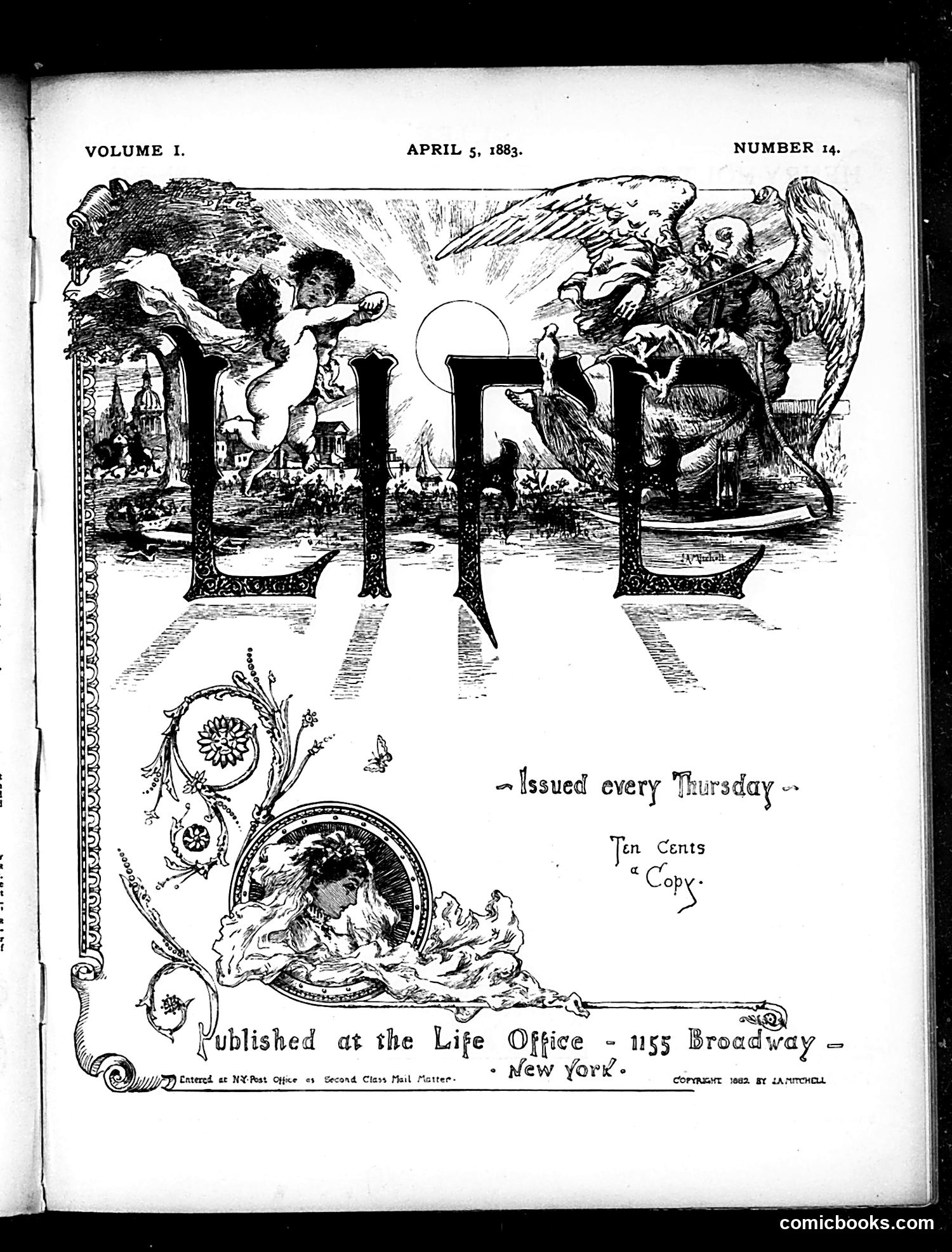
This is the cover of *Life* magazine (Volume 1, Number 14, April 5, 1883). The large decorative letters "LIFE" dominate the center, flanked by elaborate allegorical illustrations featuring classical and mythological figures. The imagery appears to depict personified concepts—on the left, what seems to be a cherub or cupid figure amid architectural elements and a cityscape; on the right, winged figures suggesting divine or supernatural forces. The ornamental border and classical styling were typical of 1880s aesthetic design. Without additional historical context visible on this page alone, the specific political or social satire referenced remains unclear. The cover emphasizes *Life*'s identity as a weekly satirical publication, priced at ten cents, published from the Life Office at 1155 Broadway, New York.
This page is primarily **advertising and promotional content** for various publications and services, not political cartoons. The main elements include: - Advertisements for *Life* magazine itself and *The Modern Age* publication - Endorsements of *The Sanitarian* journal with quotes praising its value - A advertisement for Hartshorn's Self-Acting Shade Rollers (a household product) - Business cards for bankers and brokers (William Pollock, A.G. Hemingway & Co.) - Advertisement for C.F. Guenther confectionery in Chicago - Promotional copy for the Grand Union Hotel There are **no political cartoons or satirical illustrations visible** on this page. It represents typical late 19th or early 20th-century magazine advertising and business listings rather than editorial satire content.
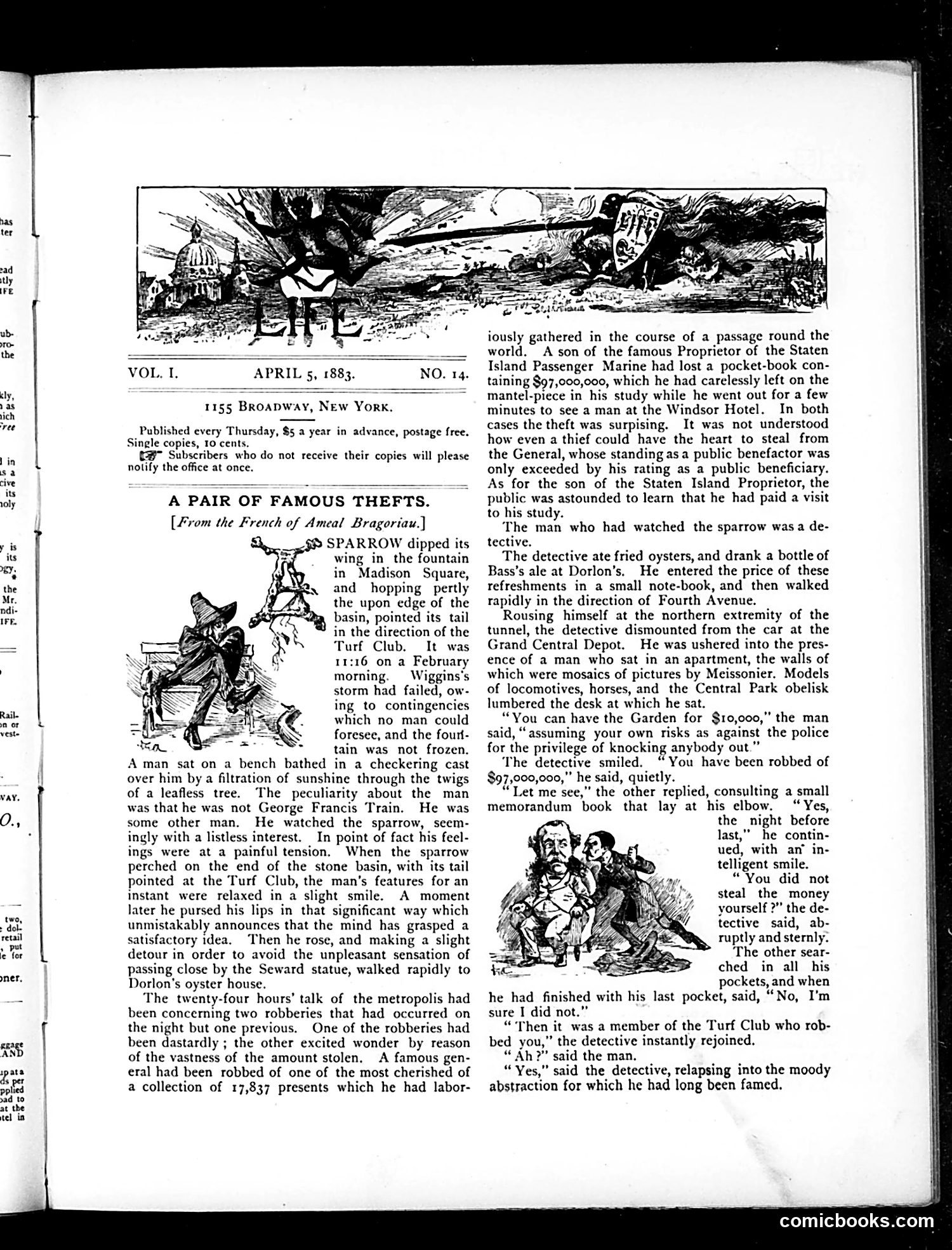
This satirical story describes two robberies involving prominent New York figures. The first involves a sparrow that steals a man's attention in Madison Square (likely a whimsical reference). The second, more substantive theft concerns a detective investigating a prominent gentleman who lost $97,000,000 from his collection of 17,837 presents. The satire targets wealth inequality and public corruption of the Gilded Age: a general and Staten Island property owner are depicted as "public benefactors" despite questionable ethics. The joke hinges on the detective's observation that this massive theft is somehow less surprising than smaller crimes, mocking how the wealthy operate above normal legal consequences. The cartoon illustrates this absurdist critique of 1880s New York society.
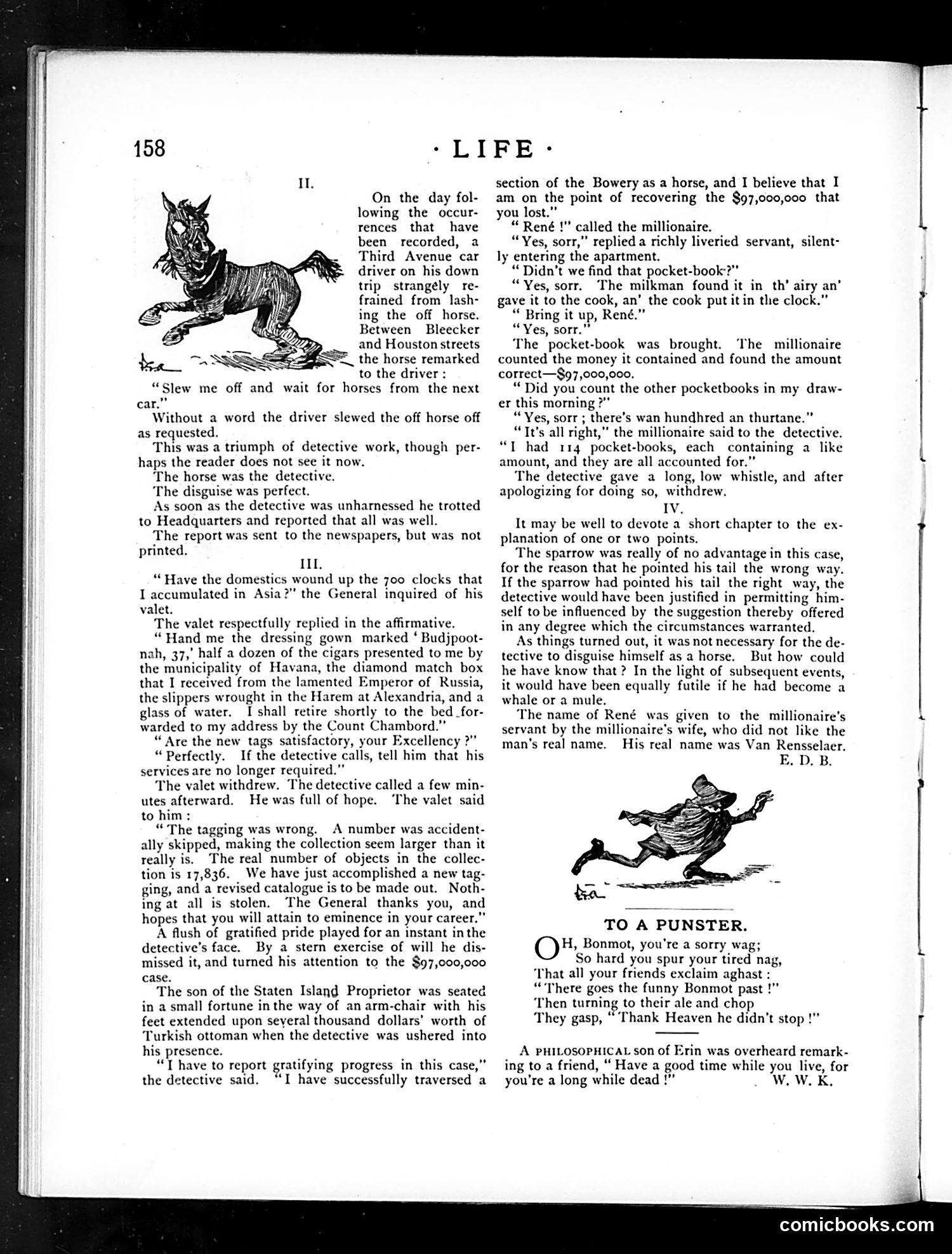
This page contains a humorous short story about a detective who recovers a millionaire's lost pocket-book containing $97,000,000. The narrative satirizes detective work and wealth through the ironic detail that the detective's disguise as a horse was unnecessary—a sparrow actually pointed the way. The two small illustrations show a horse and a falling figure, supporting the story's absurdist humor. Below the main story are two brief comic pieces: "To a Punster" mocking someone's failed joke about a horse ("Honnot"), and a philosophical quip about enjoying life while alive. These represent typical Life magazine content—light social satire relying on wordplay and gentle mockery of human foibles rather than specific political figures or events.
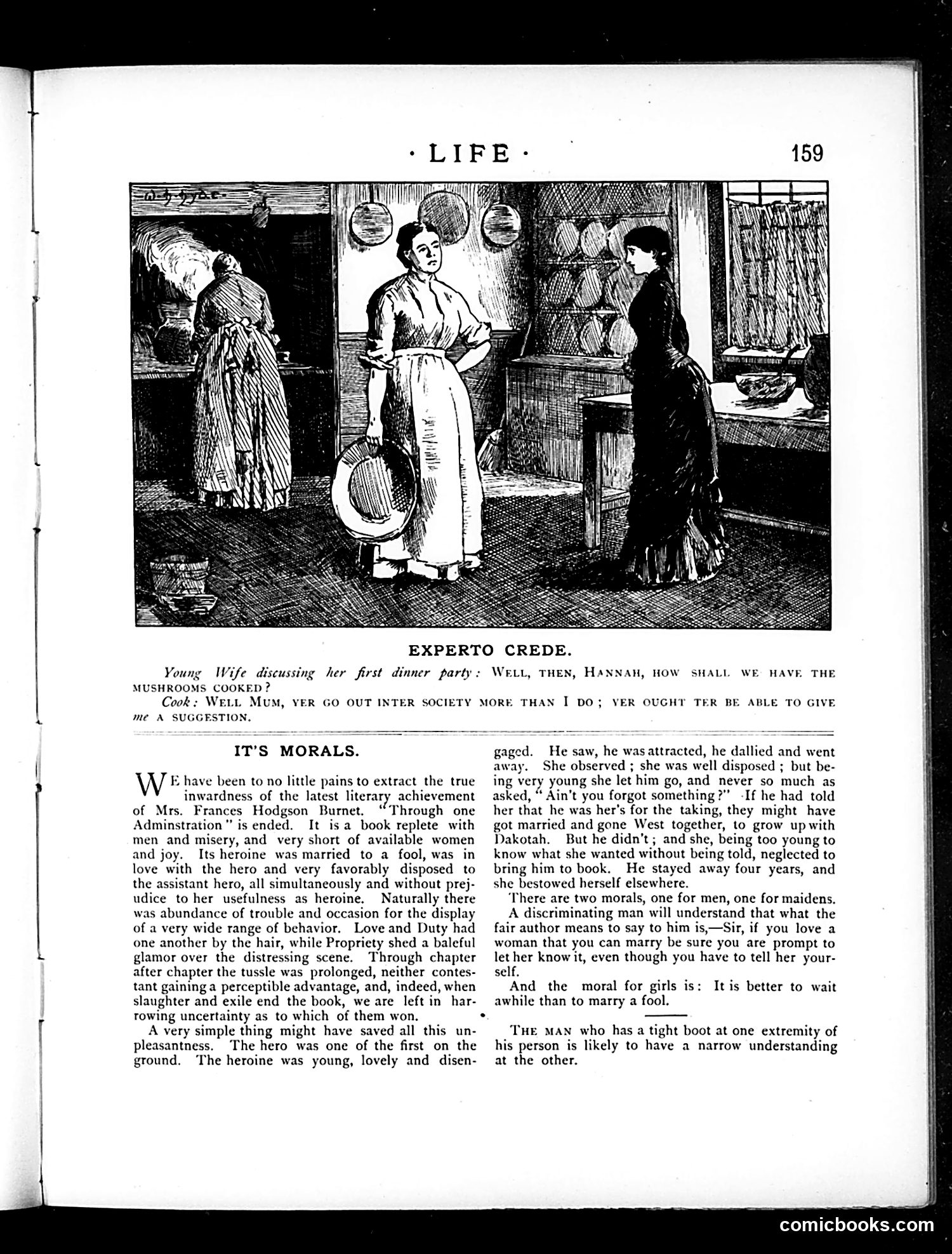
This illustration satirizes newlywed domestic life, depicting a young wife consulting her cook about preparing her first dinner party. The humor centers on the wife's admitted inexperience—she must ask the cook for suggestions rather than commanding the kitchen herself. The accompanying essay, "It's Morals," critiques the heroine from a popular novel (*Through one Administration*) for marrying without proper wifely skills. The text offers satirical "morals": men should openly declare their love, while women should "wait awhile than to marry a fool." The overall satire targets both young wives unprepared for household management and the romantic idealism that glosses over practical domestic incompetence—a common theme in late 19th-century American humor about marriage and gender roles.
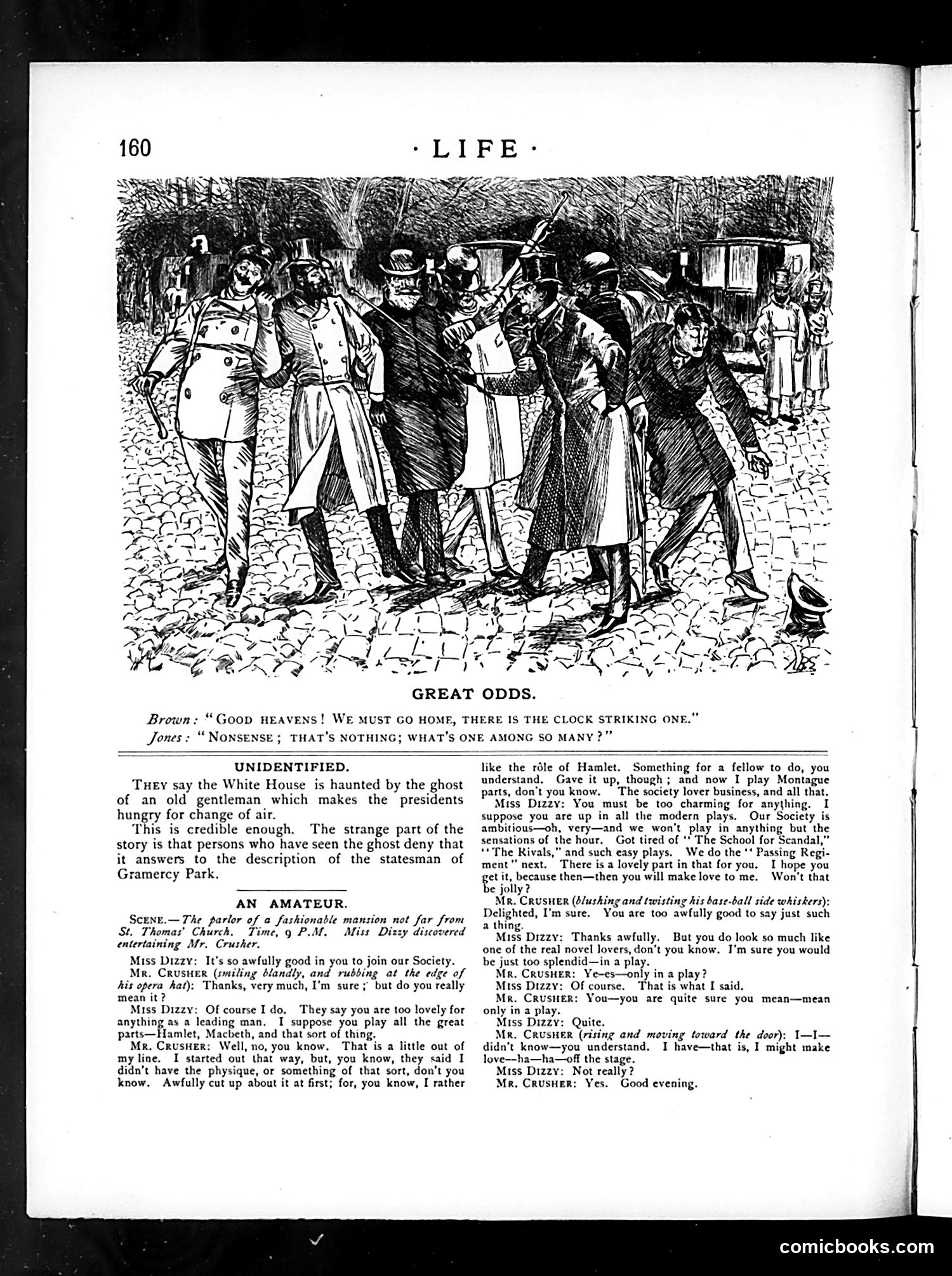
The page contains three separate satirical pieces from *Life* magazine: 1. **"Great Odds"** (top cartoon): Shows military officers and civilians on a cobblestone street. Brown remarks "We must go home, there is the clock striking one," while Jones responds "Nonsense; that's nothing; what's one among so many?" This appears to mock casual attitudes toward military casualties or losses during wartime—treating individual deaths as insignificant amid larger numbers. 2. **"Unidentified"**: A brief text piece joking about the White House being haunted by a "hungry" old gentleman's ghost, playing on folklore about presidential hauntings. 3. **"An Amateur"**: A comedic dialogue between Miss Dizzy and Mr. Crusher about amateur theatrical performances and society amateur-hour productions, poking fun at upper-class dilettantes attempting serious drama. The page satirizes military indifference, superstition, and amateur theatrics among the social elite.
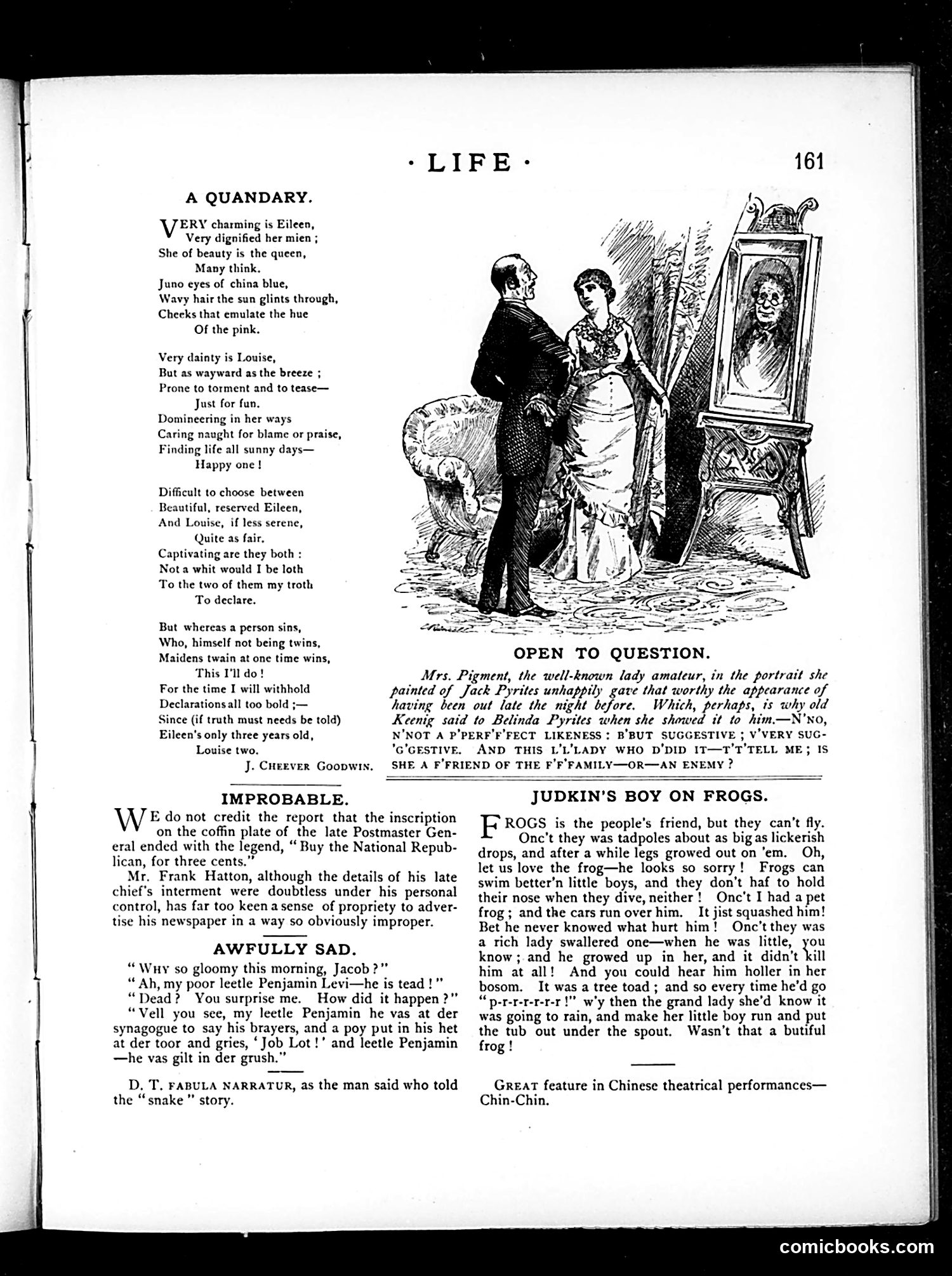
The main cartoon, titled "Open to Question," depicts a man and woman examining a portrait. The accompanying text references Mrs. Pigment, a "well-known lady amateur" painter, and suggests ambiguity about whether a portrait she painted resembles someone named Jack Pyrites or possibly Belinda Pyrites. The satire mocks amateur artists and portrait painting—specifically questioning whether Mrs. Pigment's work actually captures a likeness or merely suggests one. The joke appears to hinge on the portrait's poor quality or unflattering appearance, making it unclear whom it actually depicts. This critiques both pretentious amateur art and the social pretensions of wealthy dilettantes who dabble in painting.
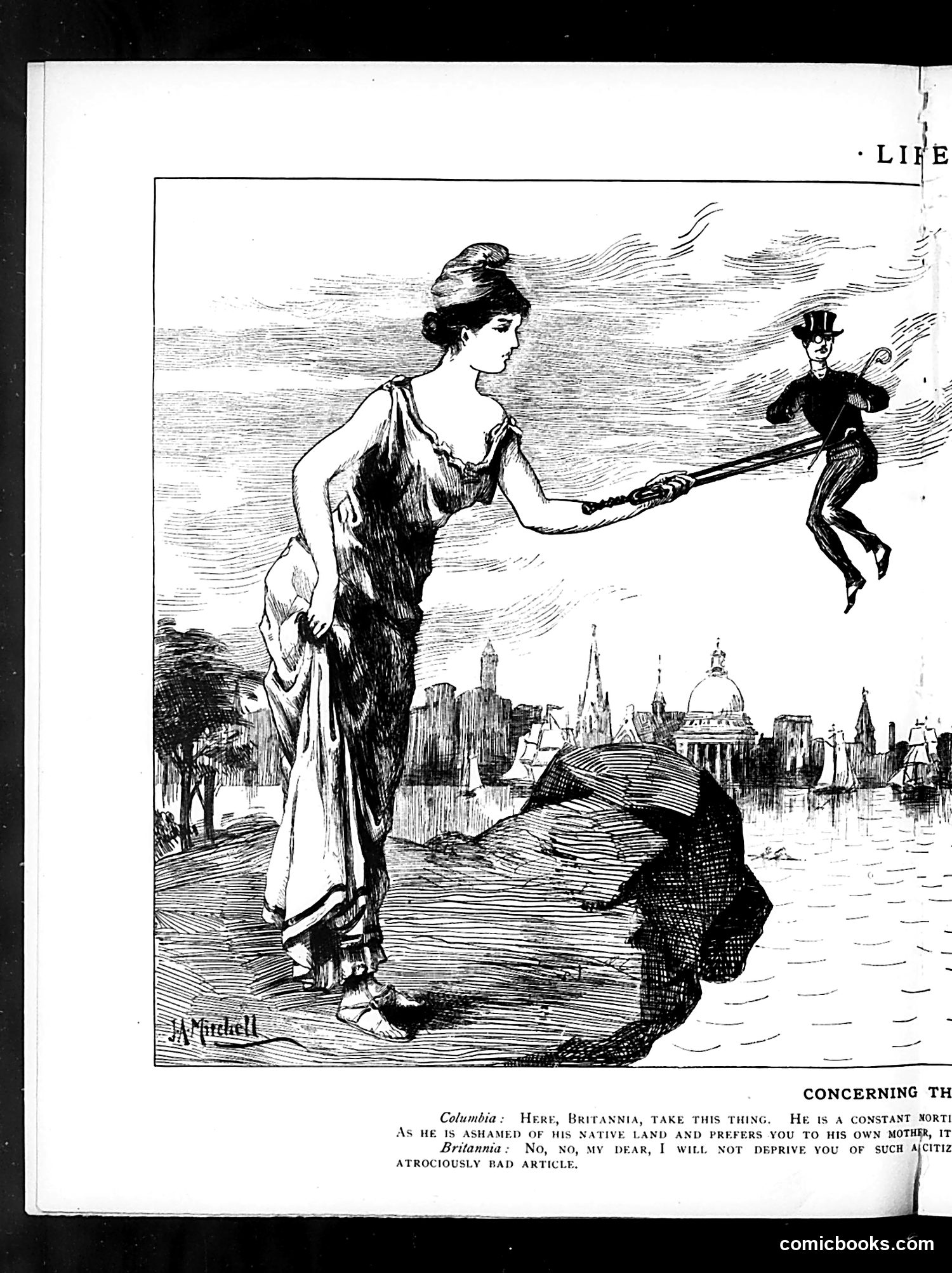
This satirical cartoon from *Life* magazine depicts **Columbia** (personified as Lady Liberty, representing the United States) offering a handkerchief to **Britannia** (representing Britain). A man in formal dress floats away on the right, while a crocodile emerges from the water below. The dialogue reveals the satire: Columbia offers the item because "he is a constant visitor of his native land and prefers you to his own mother." Britannia refuses, calling it "atrociously bad article." This appears to mock a prominent British-American figure who frequently travels between nations and shows preference for Britain—likely criticizing either his patriotic loyalties or his character. The crocodile suggests danger or deception. The specific historical figure remains unclear without additional context.
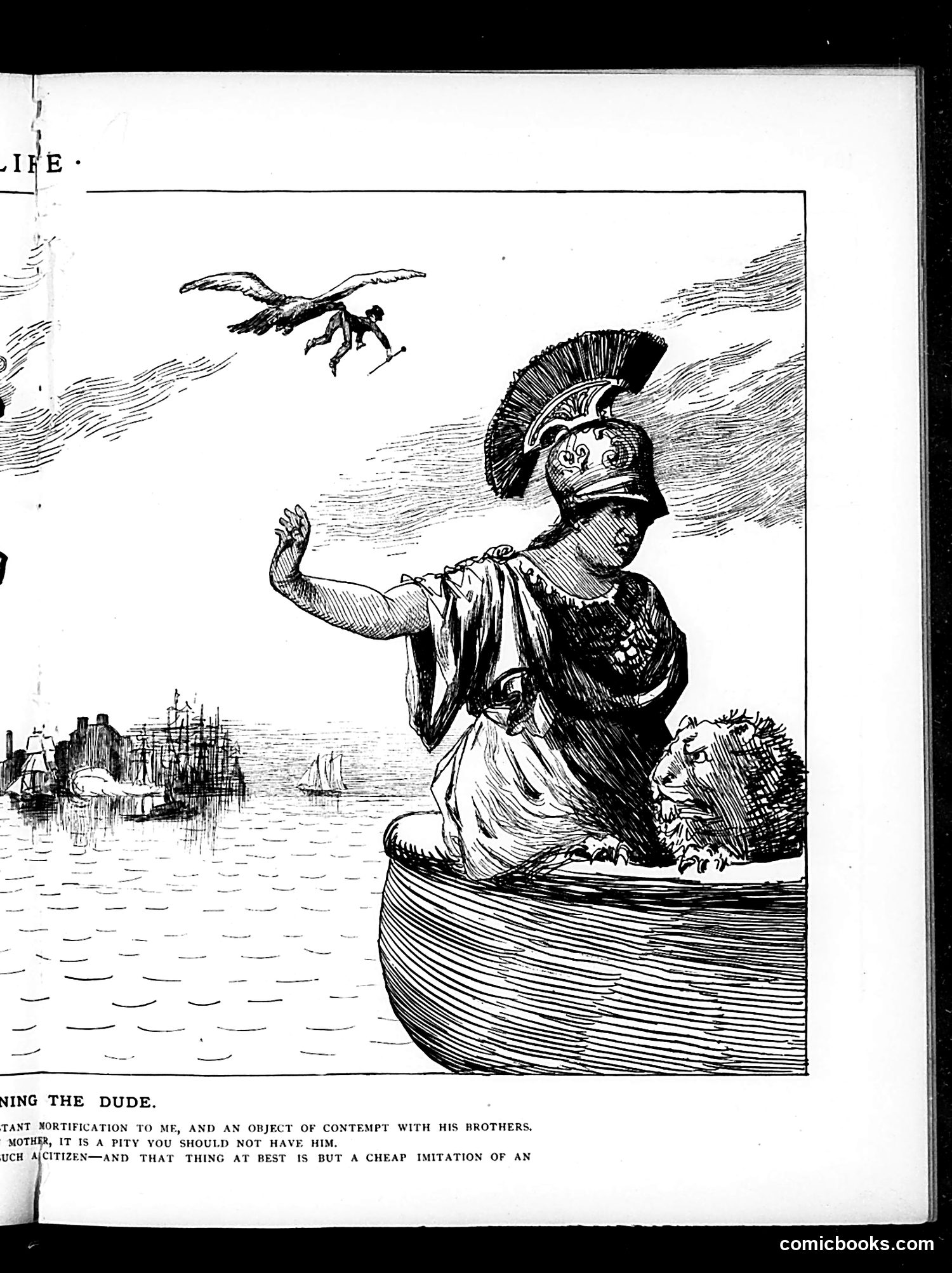
This cartoon depicts a classical warrior or military figure in a boat, gesturing dismissively at a winged figure flying overhead (likely representing frivolity or pretension). The accompanying text criticizes someone called "the Dude" as a "mortification" and "object of contempt," suggesting this person is unpatriotic and merely a "cheap imitation of an" [text cuts off]. The satire appears to target a wealthy, fashionable urban type—a "dude"—who the cartoonist views as un-American and contemptible. The classical imagery elevates the masculine warrior ideal against this figure. The exact political or social context remains unclear without additional pages, but the piece uses mockery to shame perceived dandyism or foreign affectation in American society.
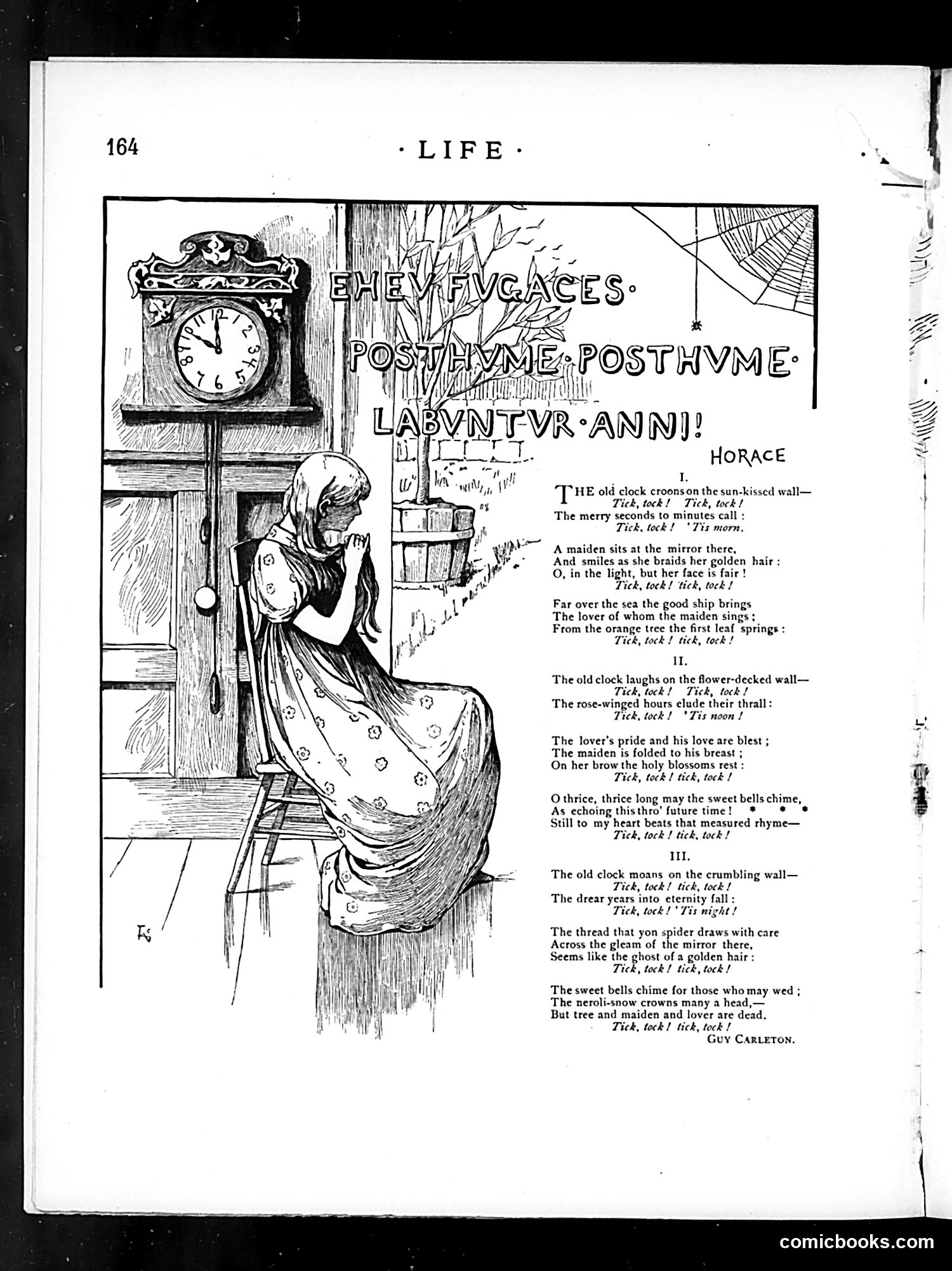
This page presents **"Eve Fugaces: Posthyme Posthume Labuntur Anni"** (Latin: "The fleeting hours slip away"), a sentimental poem by Guy Carleton with accompanying illustration. The image shows a young woman at a mirror, and the poem traces life's passage through three stages: youth (morning—maiden awaiting her lover's return), marriage (noon—their union blessed), and old age/death (night—both lovers dead). The ticking clock serves as the poem's central metaphor for time's relentless progression. The Latin title emphasizes this classical theme of *tempus fugit* (time flies). This is **not political satire** but rather Victorian-era sentimental verse—typical of Life magazine's literary content alongside humor. The melodramatic tone and memento mori theme (contemplation of death) reflect late 19th/early 20th-century artistic sensibilities. The ornate illustration style complements the romantic, elegiac mood.
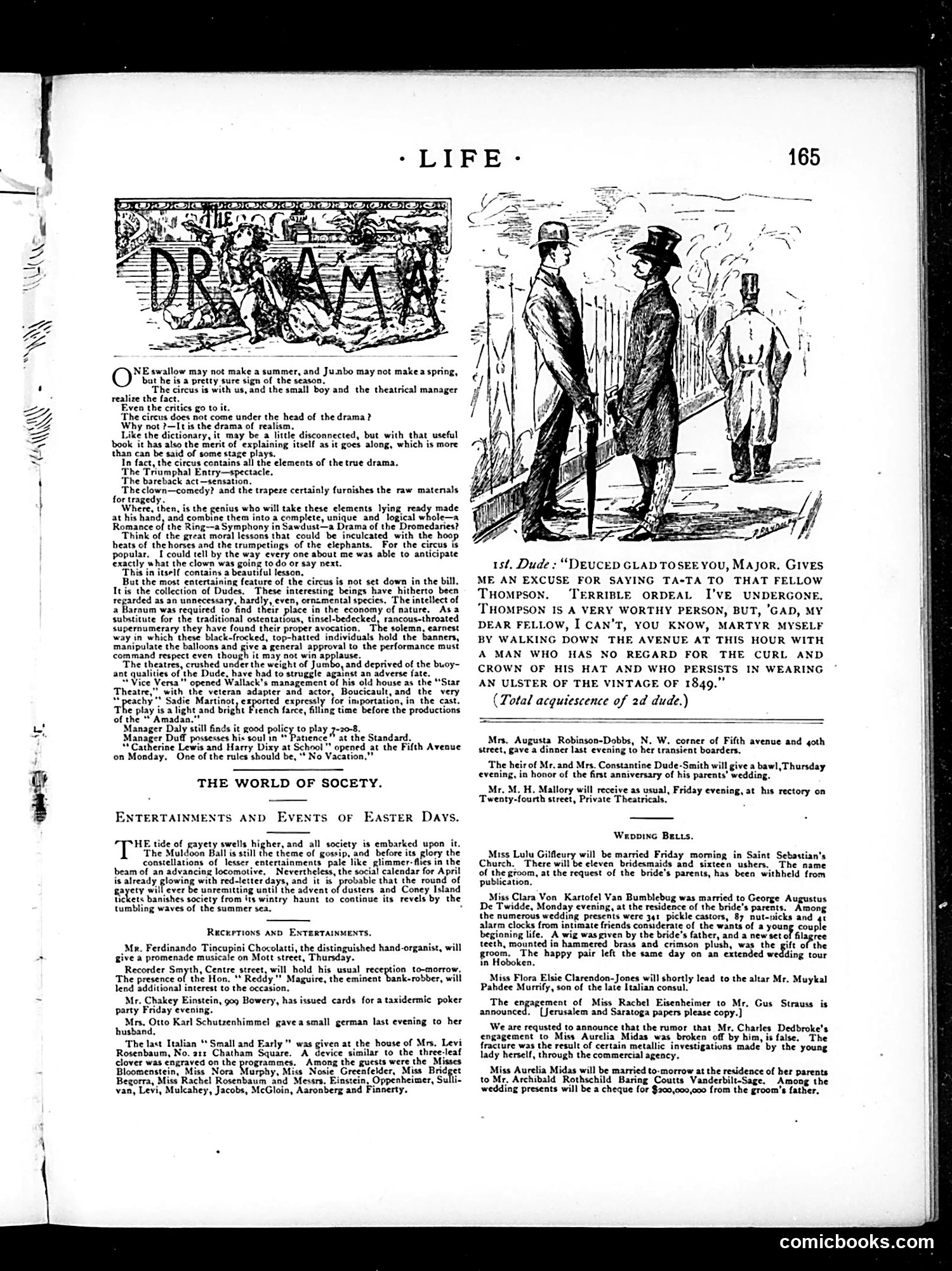
This page's main cartoon critiques the circus as superior entertainment to conventional theater. The accompanying illustration shows three fashionable "dudes"—wealthy men in top hats and formal dress—attending the circus, depicted as the season's fashionable event. The satire argues the circus embodies true drama through its spectacle, sensation, and comedy, while mocking theater critics who dismiss it. The real joke targets the "dudes" themselves: these ornamental society figures have found their "proper avocation" as circus attendants holding banners and manipulating balloons—essentially useless tasks suited to their emptiness. The text suggests that theaters, losing patrons to Jumbo the famous elephant and the fashionable dudes, now struggle while circus performances thrive. This reflects 1880s cultural anxieties about mass entertainment and changing tastes in urban society.
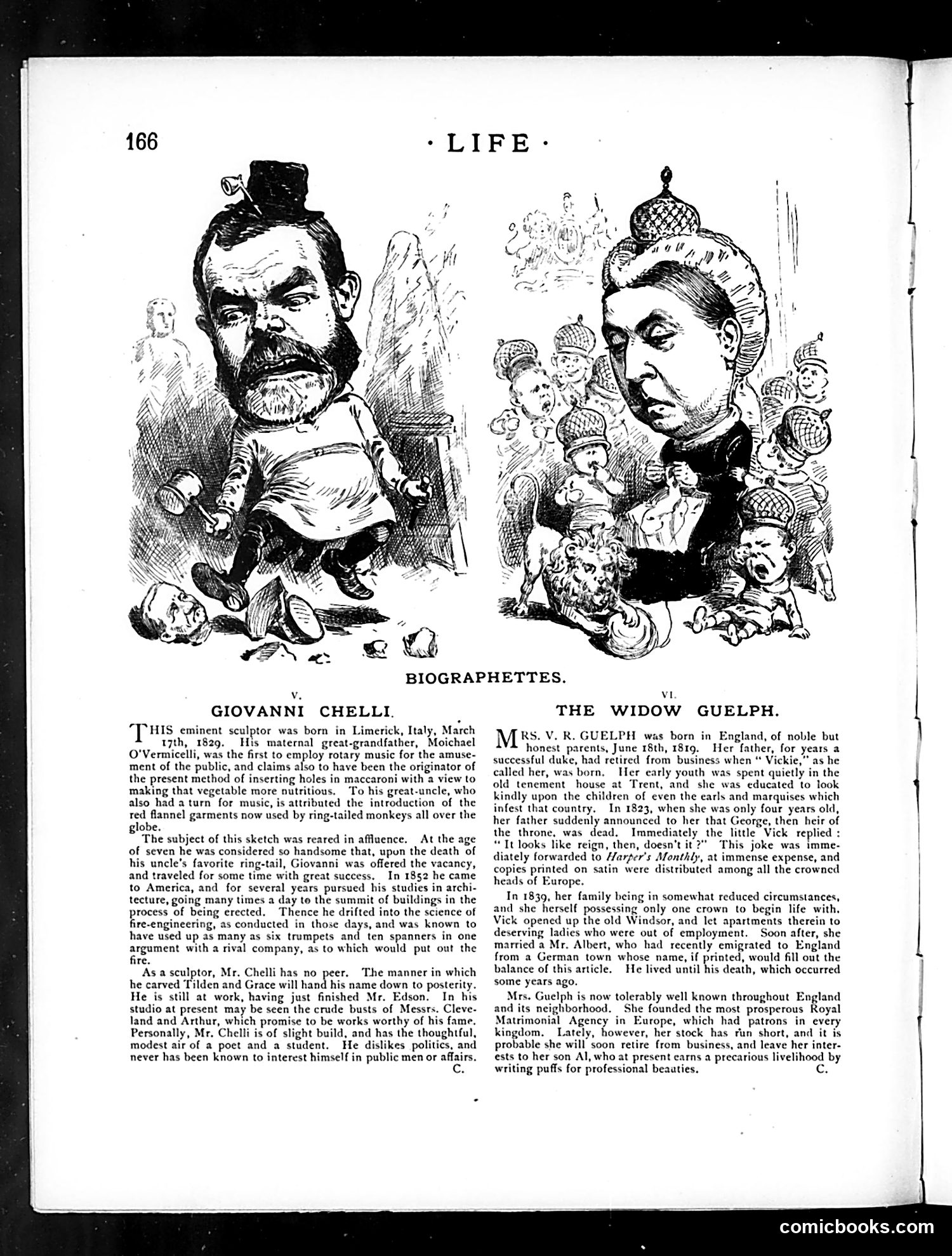
This page contains two biographical sketches that are entirely fabricated parodies, mocking the earnest biographical entries found in serious publications. **Giovanni Chelli**: Presented as an eminent Italian-American sculptor, but the biography is absurd nonsense—his ancestor allegedly invented both music boxes and pasta holes; he worked as a circus monkey; his fire-fighting career involved absurd violence with trumpets and spanners. The satire culminates by claiming he sculpted busts of contemporary politicians (Tilden, Grace, Edson, Cleveland, Arthur), mocking both pretentious artistic claims and these public figures. **The Widow Guelph**: A mock biography of an English woman, riddled with ridiculous jokes (a four-year-old's pun about "reign" distributed to European royalty on satin), suggesting she runs a matrimonial matchmaking service. The humor relies on outlandish fabrication presented in solemn biographical style. Both entries lampoon celebrity biographies and self-important public figures through deliberate absurdity and deadpan delivery—Life's characteristic satirical approach.
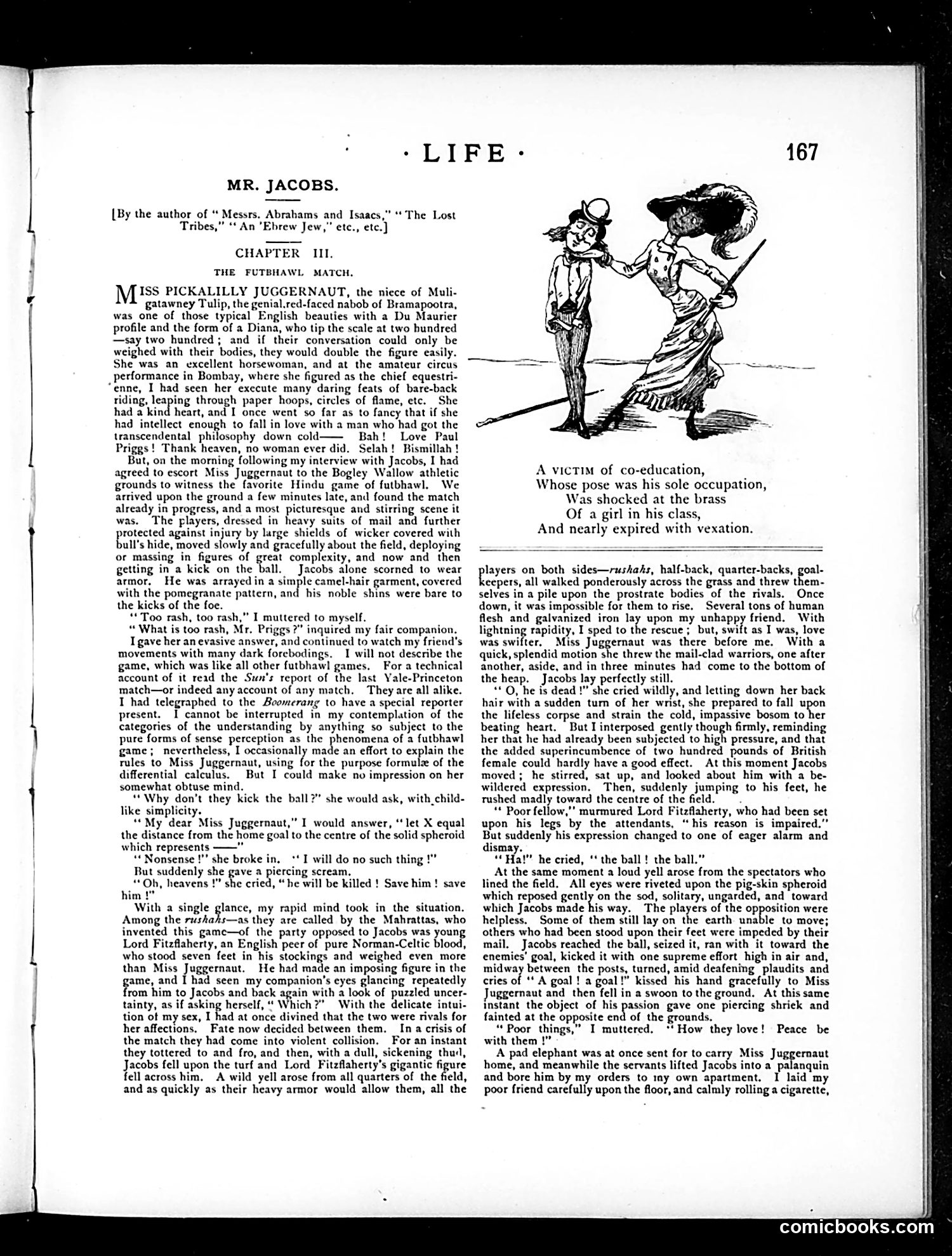
This is a satirical fictional story chapter titled "The Futbhawl Match," featuring a made-up sport played in colonial India with absurdly elaborate rules and armor. **The Satire:** The piece mocks several things simultaneously: 1. **Victorian literature conventions** — Overwrought, verbose narrative style with pretentious characters (the narrator Paul Priggs uses differential calculus to explain sports rules) 2. **Colonial India fantasies** — Fabricated "Hindu games" and orientalized settings (Miss Pickalilly Juggernaut, Mulligatawney Tulip) that parody British fiction about India 3. **Snobbish intellectualism** — The narrator's pompous philosophy and mathematical explanations contrasted with the simple question "Why don't they kick the ball?" 4. **Class/Gender tropes** — Beautiful but dim female characters; rivalry between upper-class rivals (Jacobs vs. Lord Fitzflaherty) The accompanying illustration shows a woman in fashionable dress watching players in combat. The satire works by creating an absurdly elaborate fictional world to ridicule both literary and social pretensions of the era.
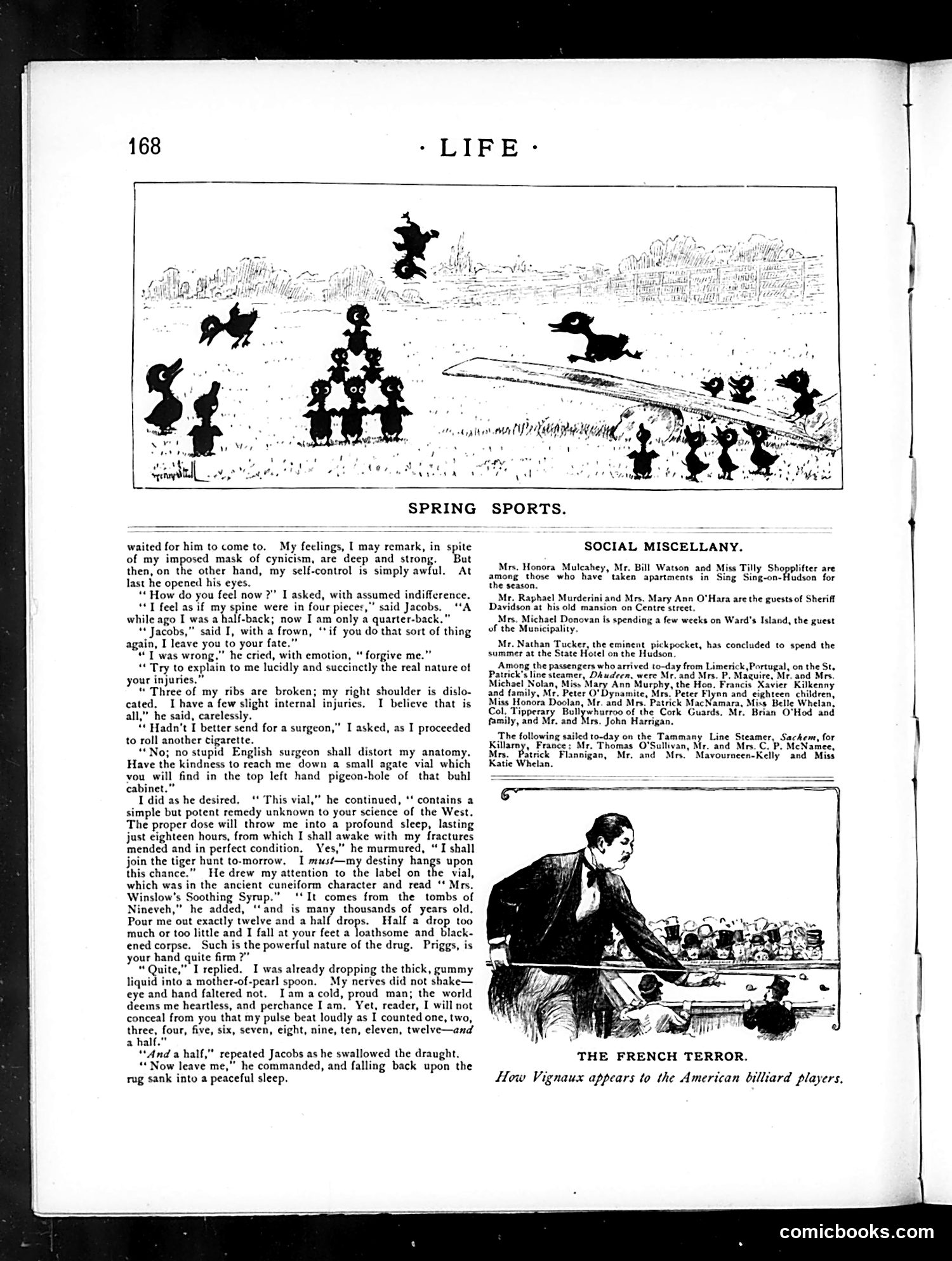
This *Life* page contains two distinct satirical pieces: **"Spring Sports"** (top): A silhouette cartoon showing ducks engaged in various recreational activities—likely mocking the genteel leisure pursuits of the wealthy during spring season. **Main story & "The French Terror"** (bottom): The narrative text describes a man (Jacobs) injured during sports who refuses English medical care, instead using an ancient "cuneiform" remedy supposedly from Nineveh tombs—which is hilariously revealed to be *Mrs. Winslow's Soothing Syrup*, a real patent medicine of the era. The satire mocks both pseudo-scientific "exotic" remedies and the credulity of people who believed in their miraculous powers. The accompanying illustration shows a man examining a miniature train set, captioned "The French Terror: How Vignaux appears to the American billiard players"—an inside reference to French billiards champion Maurice Vignaux's dominance over American players. Both pieces ridicule 19th-century gullibility regarding patent medicines and imported expertise.
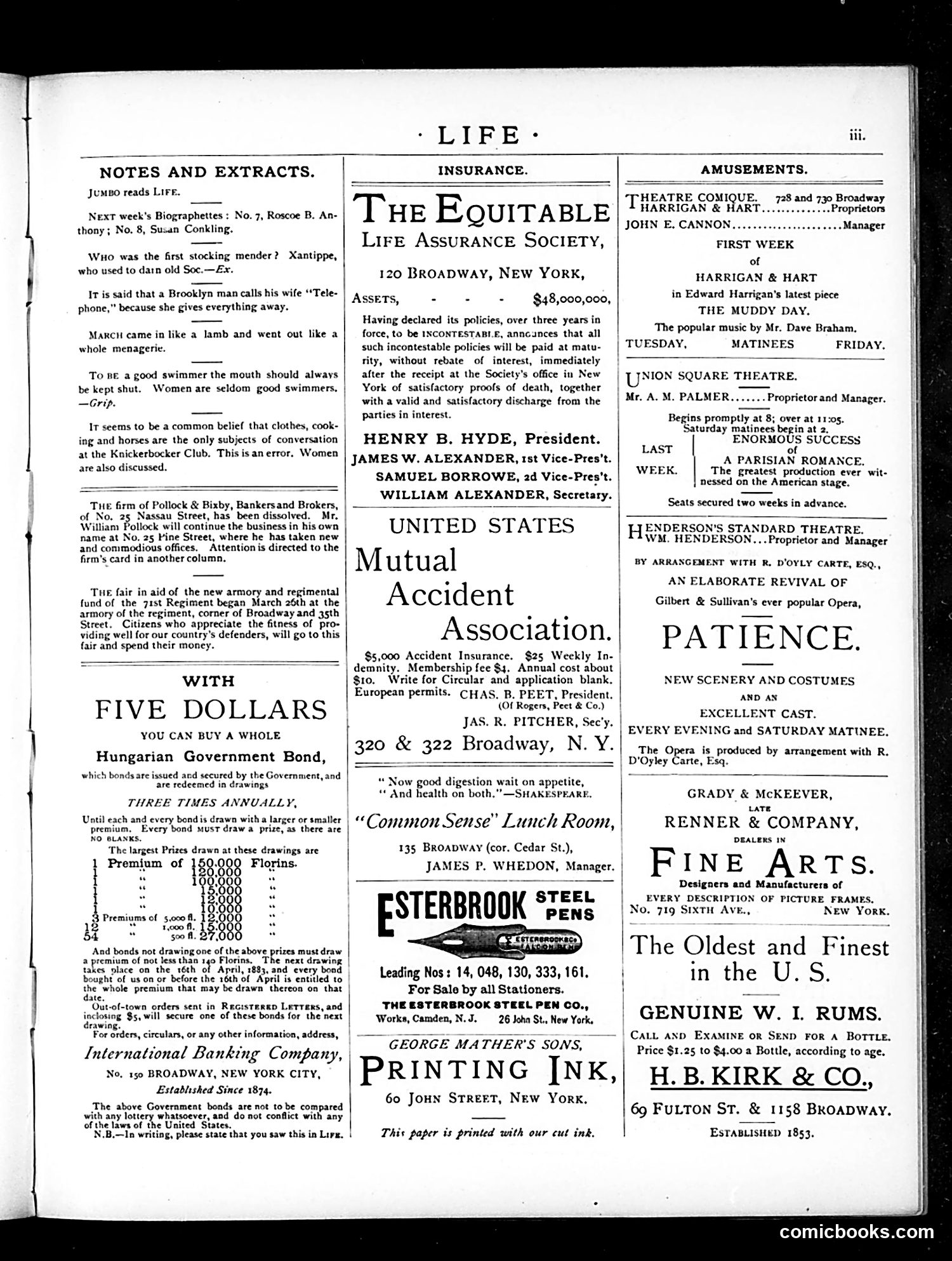
This page is primarily advertisements and notes, not a cartoon. It's a typical page from *Life* magazine circa 1883, featuring: **Main content:** Business announcements and classified ads for insurance companies (*Equitable Life*, *Mutual Accident Association*), a Hungarian government bond scheme, theaters, and commercial products (steel pens, printing ink, fine arts dealers). **Notable satirical elements:** Brief joke-like "Notes and Extracts" at top—quips about a Brooklyn man whose wife is called "Telephone" because she gives everything away, and a jab at women discussing trivial topics at the exclusive Knickerbocker Club. These reflect 19th-century gender stereotypes. **Historical context:** The Hungarian bond advertisement is notable—selling foreign government bonds for $5 as investment vehicles in America during this period. The page demonstrates *Life*'s dual nature: satirical publication mixed with commercial advertising to fund operations.
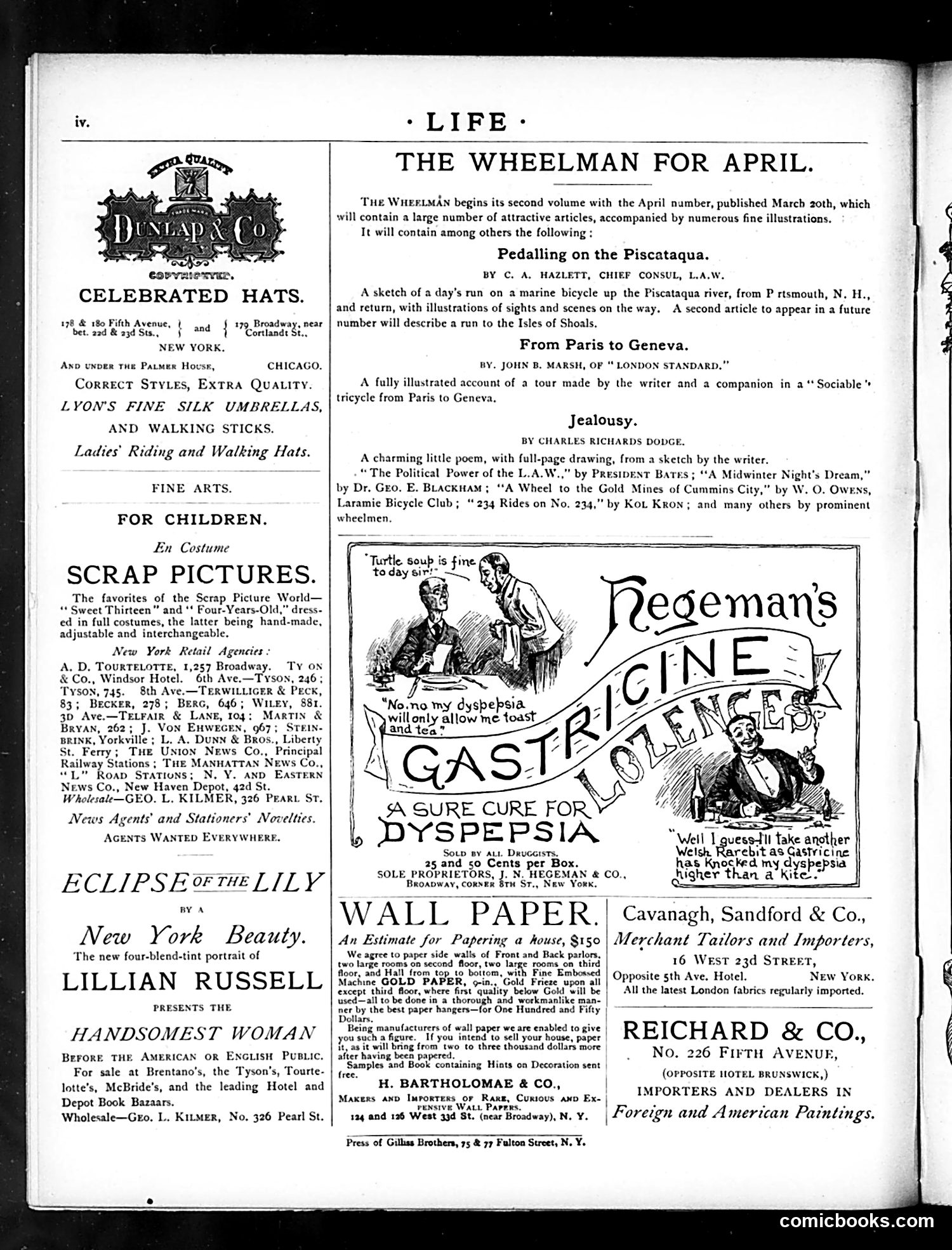
This page is primarily **advertising and magazine promotional content** from Life's April issue. The notable visual element is a **patent medicine ad for "Hegeman's Gastric-ine,"** depicted as a cure for dyspepsia (indigestion). The cartoon shows two figures at a dining table: one enthusiastically offers "Turtle soup," while the other refuses, claiming "my dyspepsia will only allow me toast and tea." This illustrates the common late-19th-century complaint of digestive troubles—a frequent subject of patent medicine marketing. The humor is gentle: the ad satirizes how people with digestive complaints severely restricted their diets, implying the product could restore normal eating. This reflects genuine anxiety about digestion that patent medicine companies exploited heavily during this era. The page also advertises The Wheelman cycling magazine, hats, umbrellas, and wallpaper services—typical of Life's mixed advertising/content model.