
Life, 1883-04-05 · page 5 of 16
Life — April 5, 1883 — page 5: what you’re looking at
What you’re looking at
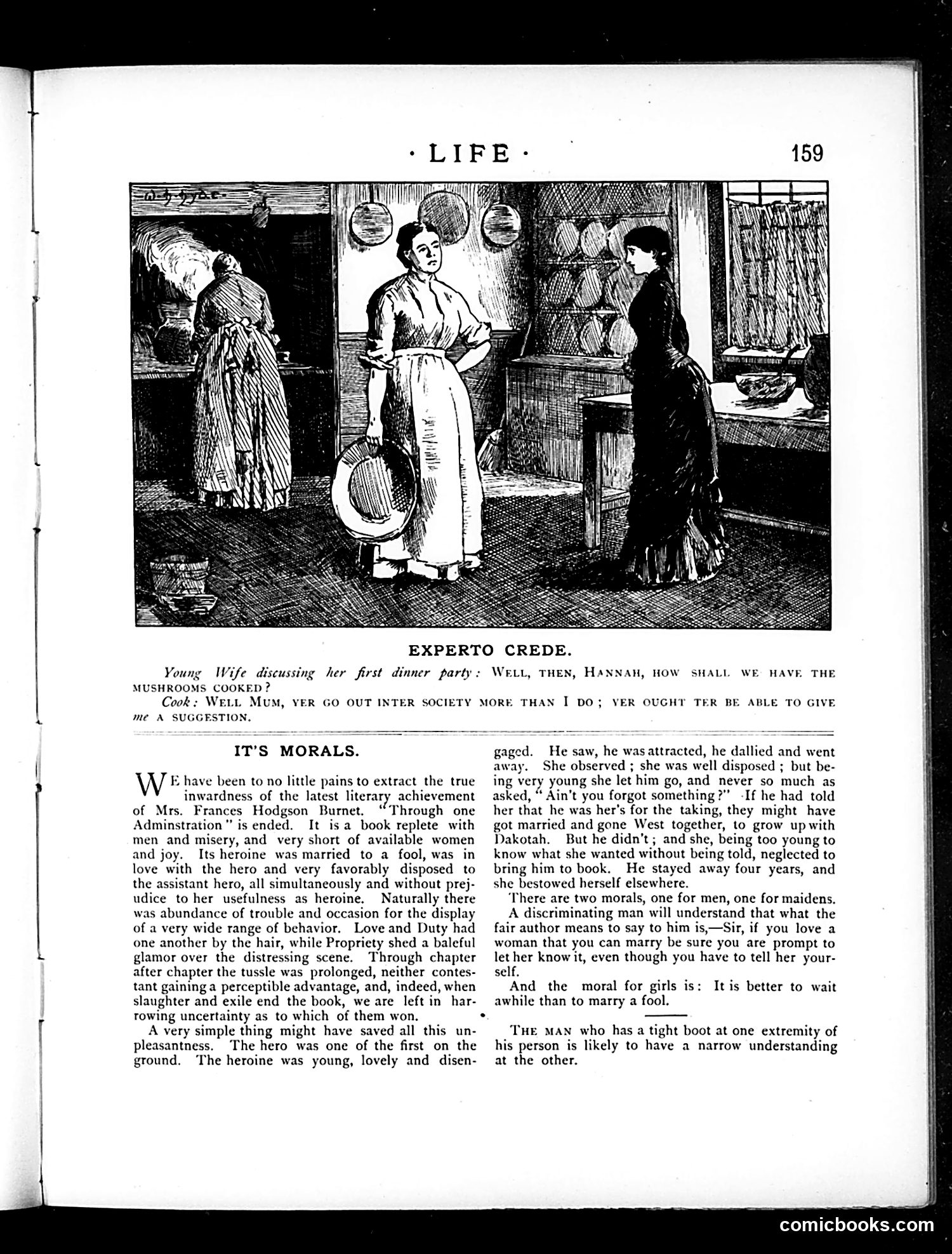
This illustration satirizes newlywed domestic life, depicting a young wife consulting her cook about preparing her first dinner party. The humor centers on the wife's admitted inexperience—she must ask the cook for suggestions rather than commanding the kitchen herself. The accompanying essay, "It's Morals," critiques the heroine from a popular novel (*Through one Administration*) for marrying without proper wifely skills. The text offers satirical "morals": men should openly declare their love, while women should "wait awhile than to marry a fool." The overall satire targets both young wives unprepared for household management and the romantic idealism that glosses over practical domestic incompetence—a common theme in late 19th-century American humor about marriage and gender roles.
📄 Transcribed text from this page (OCR, searchable)
Machine-transcribed from the original scan — historical spelling and the odd misread are preserved.
Young MUSHROOMS COOKED ? EXPERTO CREDE. Wife discussing her first dinner party: WetL, THEN, HANNAH, HOW SHALL WE HAVE THE Cook; Wr. MUM, YER GO OUT INTER SOCIETY MORE THAN I DO; YER OUGHT TER BE ABLE TO GIVE me A SUGGESTION, IT’S MORALS. W E have been to no little pains to extract the true inwardness of the latest literary achievement of Mrs. Frances Hodgson Burnet. “Through one Adminstration” is ended. It is a book replete with men and misery, and very short of available women and joy. Its heroine was married to a fool, was in love with the hero and very favorably disposed to the assistant hero, all simultaneously and without prej- udice to her usefulness as heroine. Naturally there was abundance of trouble and occasion for the display of a very wide range of behavior. Love and Duty had one another by the hair, while Propriety shed a baleful glamor over the distressing scene. Through chapter after chapter the tussle was prolonged, neither contes- tant gaining a perceptible advantage, and, indeed, when slaughter and exile end the book, we are left in har- towing uncertainty as to which of them won. A very simple thing might have saved all this un- pleasantness. The hero was one of the first on the ground. The heroine was young, lovely and disen- gaged. He saw, he wasattracted, he dallied and went away. She observed ; she was well disposed ; but be- ing very young she let him go, and never so much as asked, “ Ain't you forgot something?” -If he had told her that he was her's for the taking, they might have got married and gone West together, to grow up with Dakotah. But he didn’t ; and she, being too young to know what she wanted without being told, neglected to bring him to book. He stayed away four years, and she bestowed herself elsewhere. ‘There are two morals, one for men, one for maidens, A discriminating man will understand that what the fair author means to say to him is,—Sir, if you love a woman that you can marry be sure you are prompt to let her know it, even though you have to tell her your- self. And the moral for girls is: It is better to wait awhile than to marry a fool. THE MAN who has a tight boot at one extremity of his person is likely to have a narrow understanding at the other.