
Life, 1883-04-05 · page 3 of 16
Life — April 5, 1883 — page 3: what you’re looking at
What you’re looking at
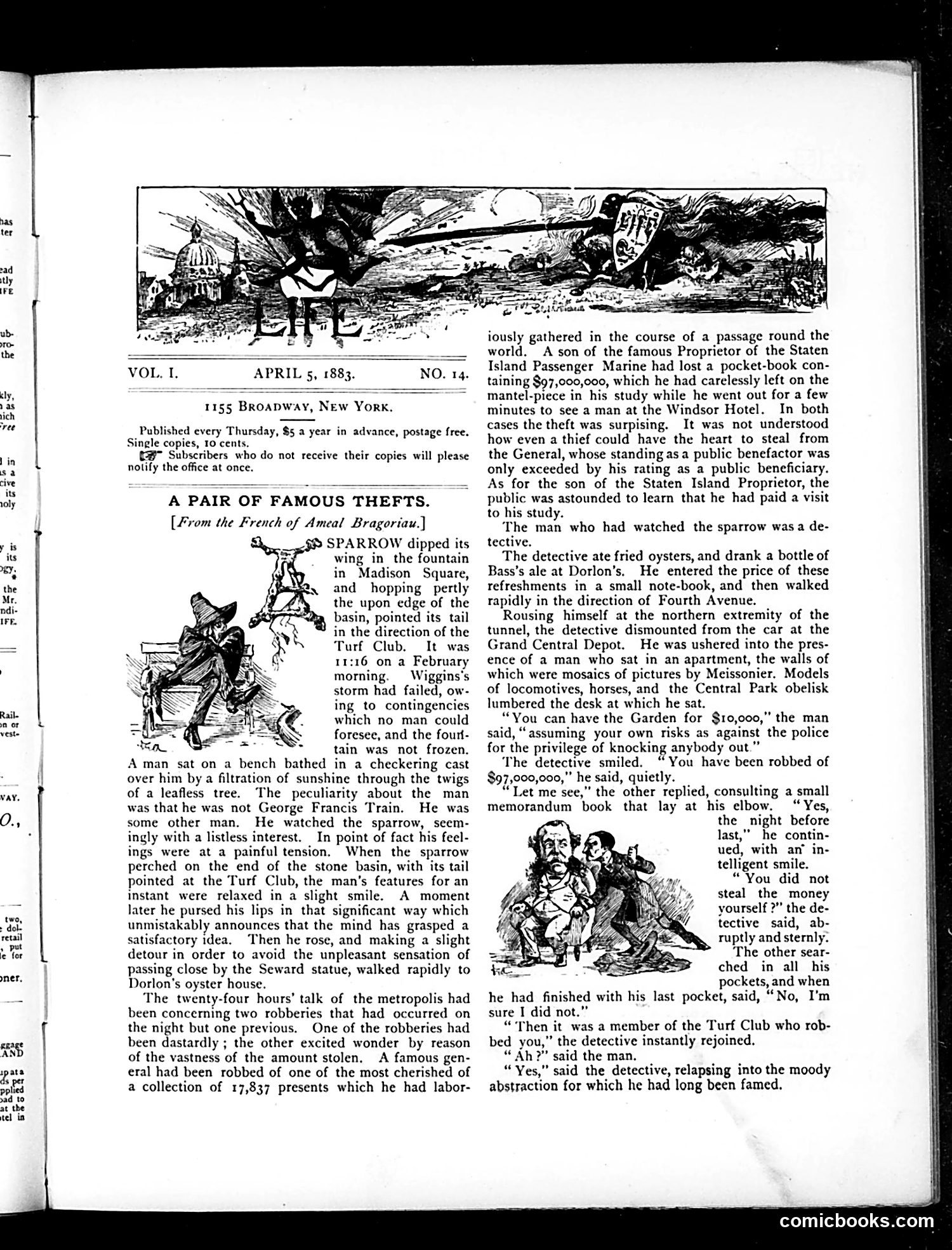
This satirical story describes two robberies involving prominent New York figures. The first involves a sparrow that steals a man's attention in Madison Square (likely a whimsical reference). The second, more substantive theft concerns a detective investigating a prominent gentleman who lost $97,000,000 from his collection of 17,837 presents. The satire targets wealth inequality and public corruption of the Gilded Age: a general and Staten Island property owner are depicted as "public benefactors" despite questionable ethics. The joke hinges on the detective's observation that this massive theft is somehow less surprising than smaller crimes, mocking how the wealthy operate above normal legal consequences. The cartoon illustrates this absurdist critique of 1880s New York society.
📄 Transcribed text from this page (OCR, searchable)
Machine-transcribed from the original scan — historical spelling and the odd misread are preserved.
TO- ly, Lich ree 1 in Sa cive oly y is its the Mr. ndi- IFE. Rail 0 oF veste VAY. two, retail je for ner. — vt VOL. I. APRIL 5, 1883. 1155 Broapway, New York. Published every Thursday, $5 a year in advance, postage free. Single copies, 10 cents. (2B Subscribers who do not receive their copies will please nolify the office at once. A PAIR OF FAMOUS THEFTS. [From the French of Ameal Bragoriau.] SPARROW dipped its wing in the fountain in Madison Square, and hopping pertly the upon edge of the basin, pointed its tail in the direction of the Turf Club. It was 11:16 on a February morning. Wiggins’s storm had failed, ow- ing to contingencies which no man could foresee, and the fourt- tain was not frozen. A man sat on a bench bathed in a checkering cast over him by a filtration of sunshine through the twigs of a leafless tree. The peculiarity about the man was that he was not George Francis Train. He was some other man. He watched the sparrow, seem- ingly with a listless interest. In point of fact his feel- ings were at a painful tension, When the sparrow perched on the end of the stone basin, with its tail pointed at the Turf Club, the man’s features for an instant were relaxed in a slight smile. A moment later he pursed his lips in that significant way which unmistakably announces that the mind has grasped a satisfactory idea. Then he rose, and making a slight detour in order to avoid the unpleasant sensation of passing close by the Seward statue, walked rapidly to Dorlon’s oyster house. The twenty-four hours’ talk of the metropolis had been concerning two robberies that had occurred on the night but one previous. One of the robberies had been dastardly ; the other excited wonder by reason of the vastness of the amount stolen. A famous gen- eral had been robbed of one of the most cherished of a collection of 17,837 presents which he had labor- iously gathered in the course of a passage round the world. A son of the famous Proprietor of the Staten Island Passenger Marine had lost a pocket-book con- taining $97,000,000, which he had carelessly left on the mantel-piece in his study while he went out for a few minutes to see a man at the Windsor Hotel. In both cases the theft was surpising. It was not understood how even a thief could have the heart to steal from the General, whose standing as a public benefactor was only exceeded by his rating as a public beneficiary. As for the son of the Staten Island Proprietor, the public was astounded to learn that he had paid a visit to his study. The man who had watched the sparrow was a de- tective. The detective ate fried oysters, and drank a bottle of Bass’s ale at Dorlon’s, He entered the price of these refreshments in a small note-book, and then walked rapidly in the direction of Fourth Avenue. Rousing himself at the northern extremity of the tunnel, the detective dismounted from the car at the Grand Central Depot. He was ushered into the pres- ence of a man who sat in an apartment, the walls of which were mosaics of pictures by Meissonier. Models of locomotives, horses, and the Central Park obelisk lumbered the desk at which he sat. “You can have the Garden for $10,000,” the man said, “assuming your own risks as against the police for the privilege of knocking anybody out.” The detective smiled. “You have been robbed of $97,000,000,” he said, quietly. “Let me see,” the other replied, consulting a small memorandum book that lay at his elbow. “Yes, the night before last," he contin- ued, with an’ in- telligent smile. “You did not steal the money yourself ?” the de- tective said, ab- . ruptly and sternly. = ~ The other sear- ki ched in all his pockets, and when he had finished with his last pocket, said, “No, I’m sure I did not.” “Then it was a member of the Turf Club who rob- bed you,” the detective instantly rejoined. “ Ah?” said the man. “Yes,” said the detective, relapsing into the moody abstraction for which he had long been famed. comicbooks.com