
A complete issue · 16 pages · 1883
Life — March 29, 1883
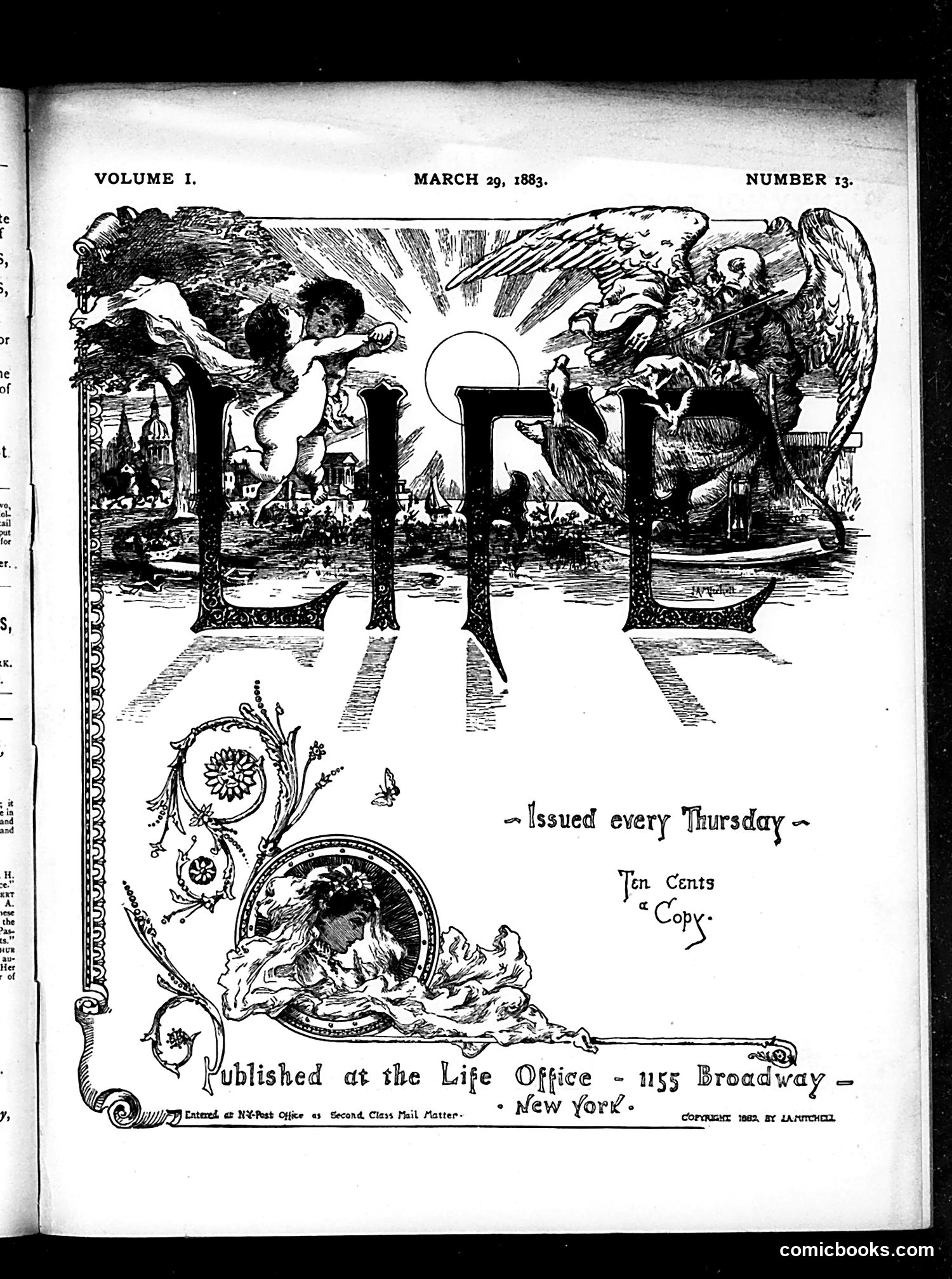
This is the cover of *Life* magazine, Volume 1, Number 13, dated March 29, 1883. The large decorative letters "LIFE" dominate the center, framed by an elaborate allegorical illustration featuring classical and mythological figures—including what appears to be cherubs, angels, and various fantastical creatures in a dreamlike landscape with a sun and distant cityscape. The imagery suggests themes of vitality, imagination, and artistic abundance rather than specific political satire. The ornate Art Nouveau-style design emphasizes aesthetic sophistication. The publication details indicate *Life* was issued weekly at ten cents per copy from the Life Office at 1155 Broadway, New York. This appears primarily a title page showcasing the magazine's artistic branding rather than containing topical commentary.
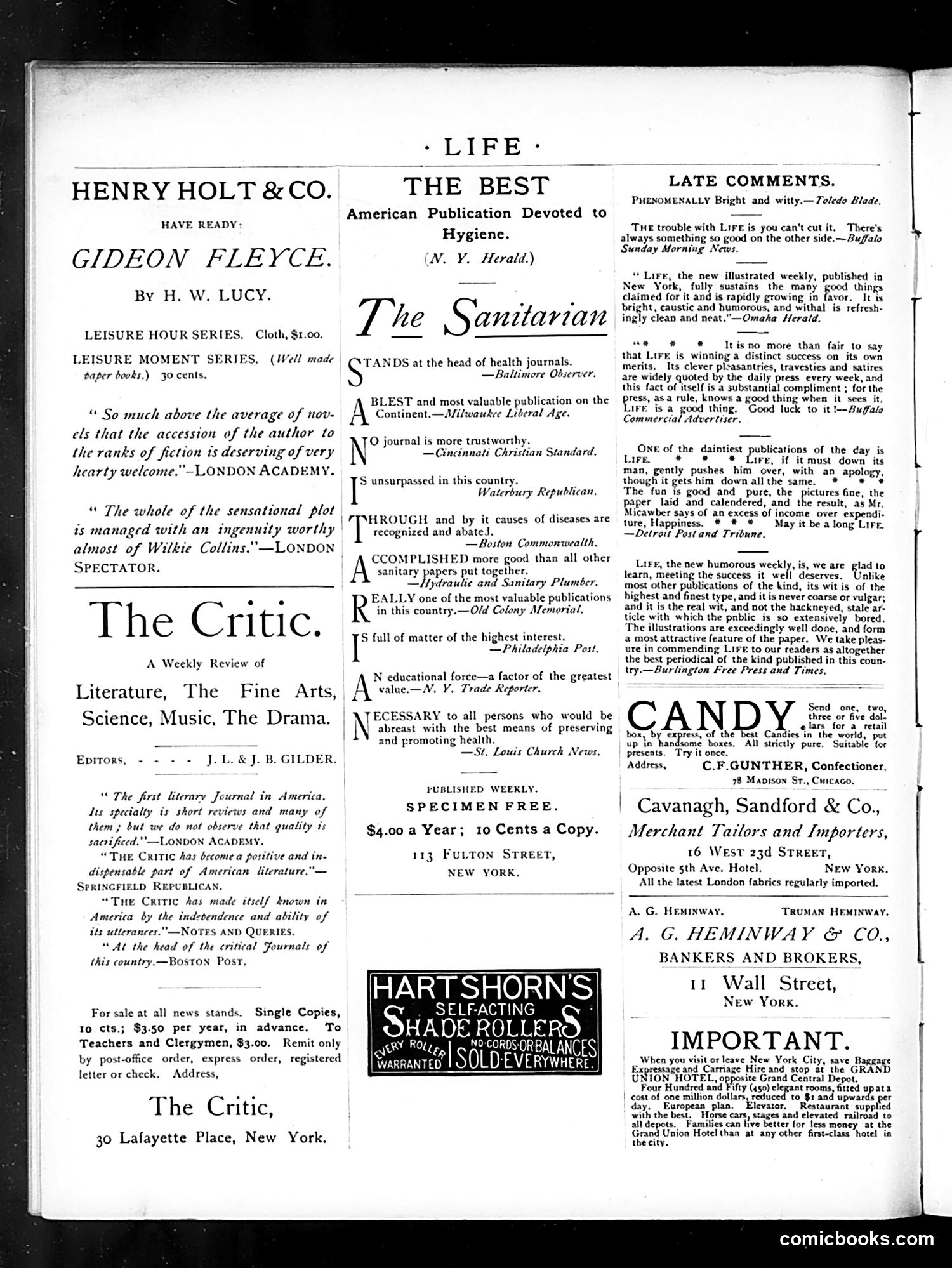
This page is primarily **advertising and editorial content** rather than political cartoons. The visible advertisements include: - **Henry Holt & Co.** promoting "Gideon Fleyce" by H.W. Lucy - **The Critic** literary journal - **The Sanitarian** health publication - **Life magazine itself** (the publisher's own promotion) - **Candy** and confectionery ads - **Hartshorn's Self-Acting Shoe Rollers** - Various merchant and banking services The layout reflects late 19th-century magazine format, mixing editorial matter with commercial announcements. The "Late Comments" section quotes positive reviews from other publications about Life's quality and humor. There are no visible political cartoons on this particular page—it functions as a business/circulation page advertising the magazine and related products to readers.
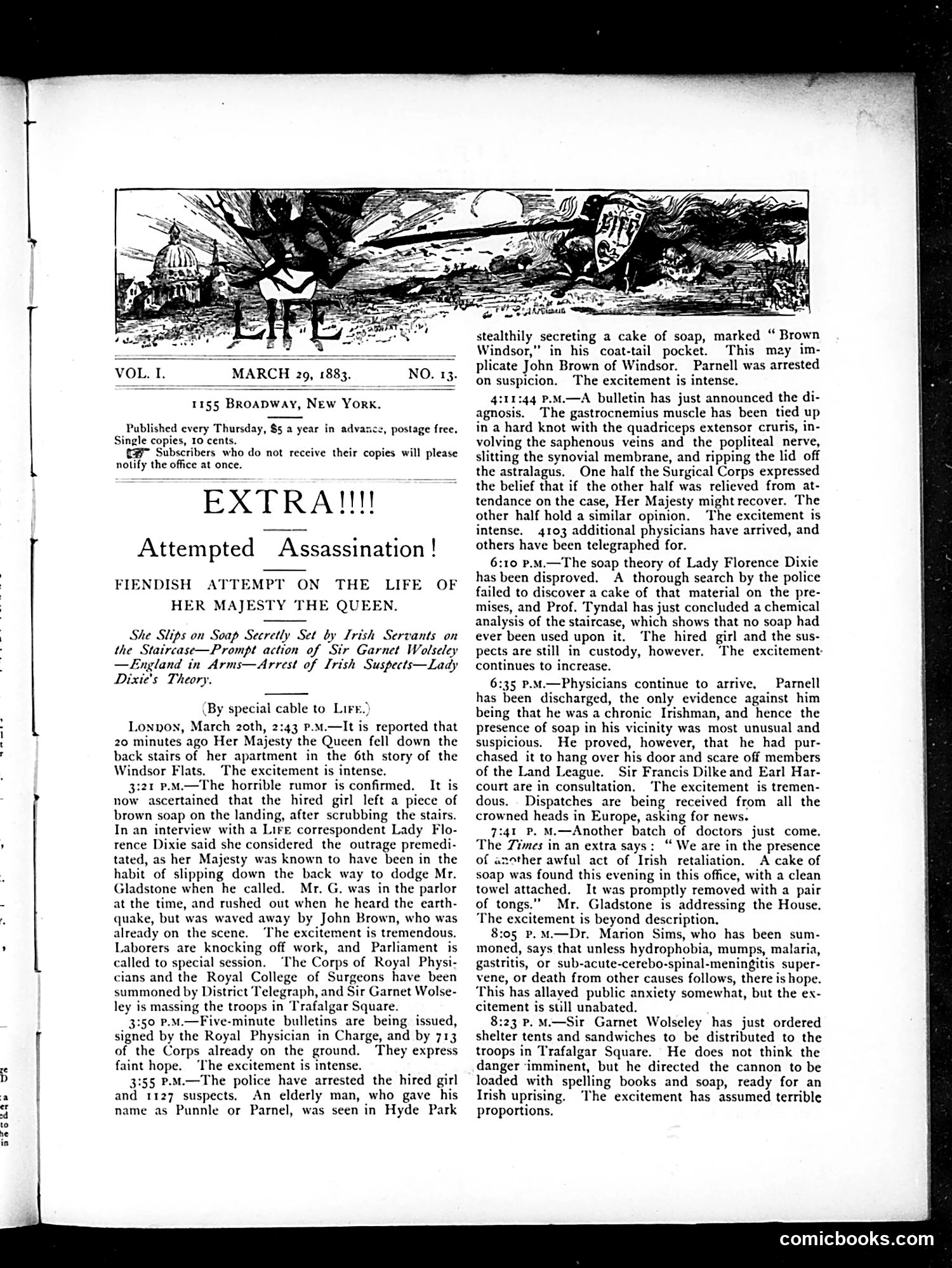
The masthead illustration appears to be a generic decorative header rather than a specific political cartoon. The main content is a satirical news article titled "EXTRA!!! Attempted Assassination!" reporting on an alleged plot against Queen Victoria. The "fiendish attempt" involves Irish servants allegedly placing soap on palace stairs to trip the Queen—a absurdist premise clearly meant as mockery. The article mocks contemporary anxieties about Irish nationalism and assassination plots (genuine concerns in 1880s Britain) by reducing the threat to an absurd soap-based prank. The escalating "emergency" responses—summoning physicians, Parliament, and Sir Garnet Wolseley—further satirize the overwrought panic surrounding Irish-related security fears during this period of genuine political tension.
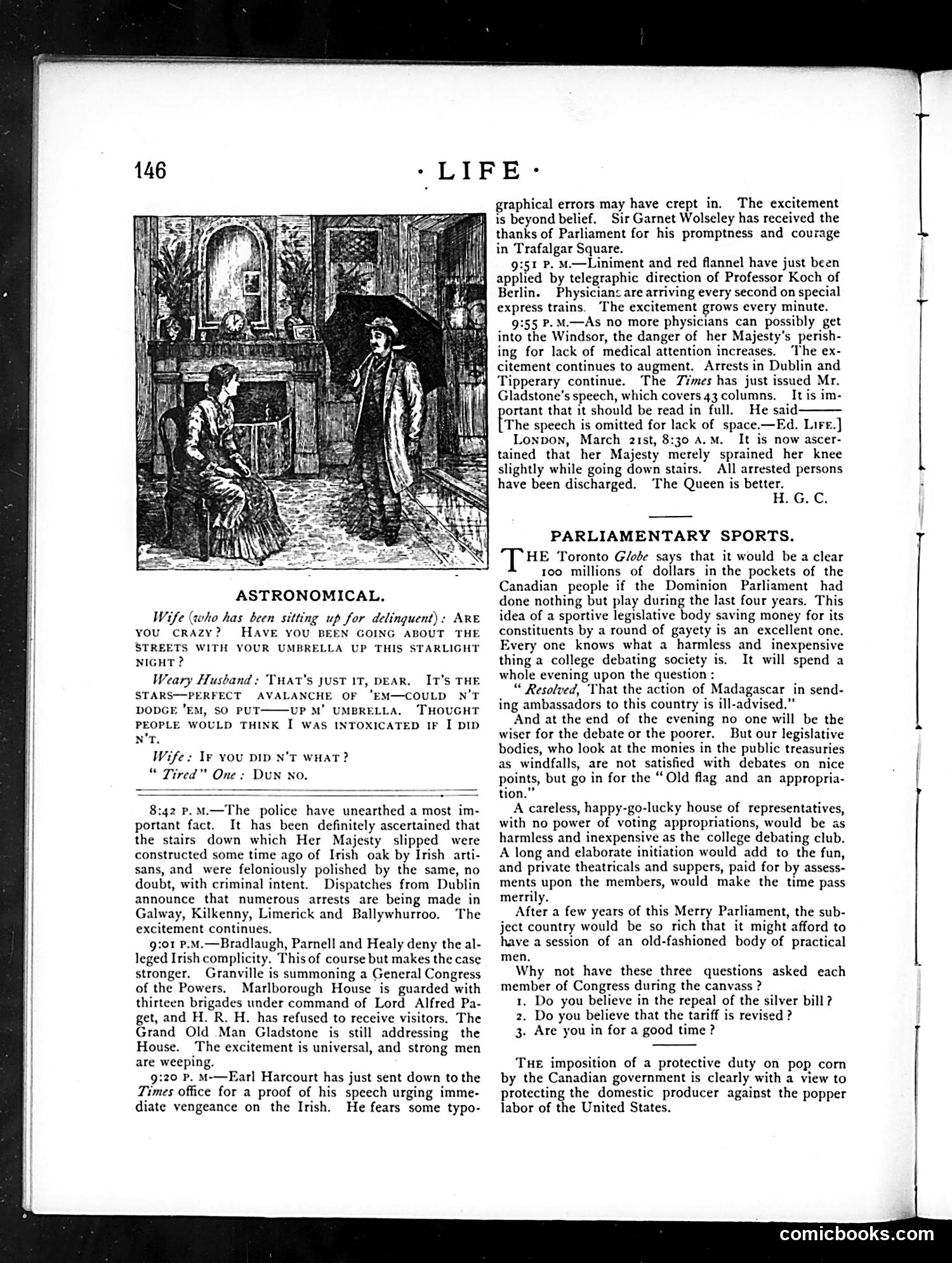
This single-panel cartoon satirizes marital discord over domestic finances. A wife confronts her husband about carrying an umbrella in starlight—an absurd excuse for being out late. The husband's stammering response ("That's just it, dear...") suggests he's fabricating explanations to hide his actual whereabouts or spending. The joke plays on the contrast between his ridiculous astronomical claim and her obvious skepticism. The cartoon mocks husbands' transparent lies to wives about money and time, a common domestic conflict theme in early 20th-century satirical magazines. The accompanying "Parliamentary Sports" article criticizes the Canadian Parliament for conducting trivial debates while ignoring serious legislation—comparing legislators to college debaters more interested in sport than substantive governance.
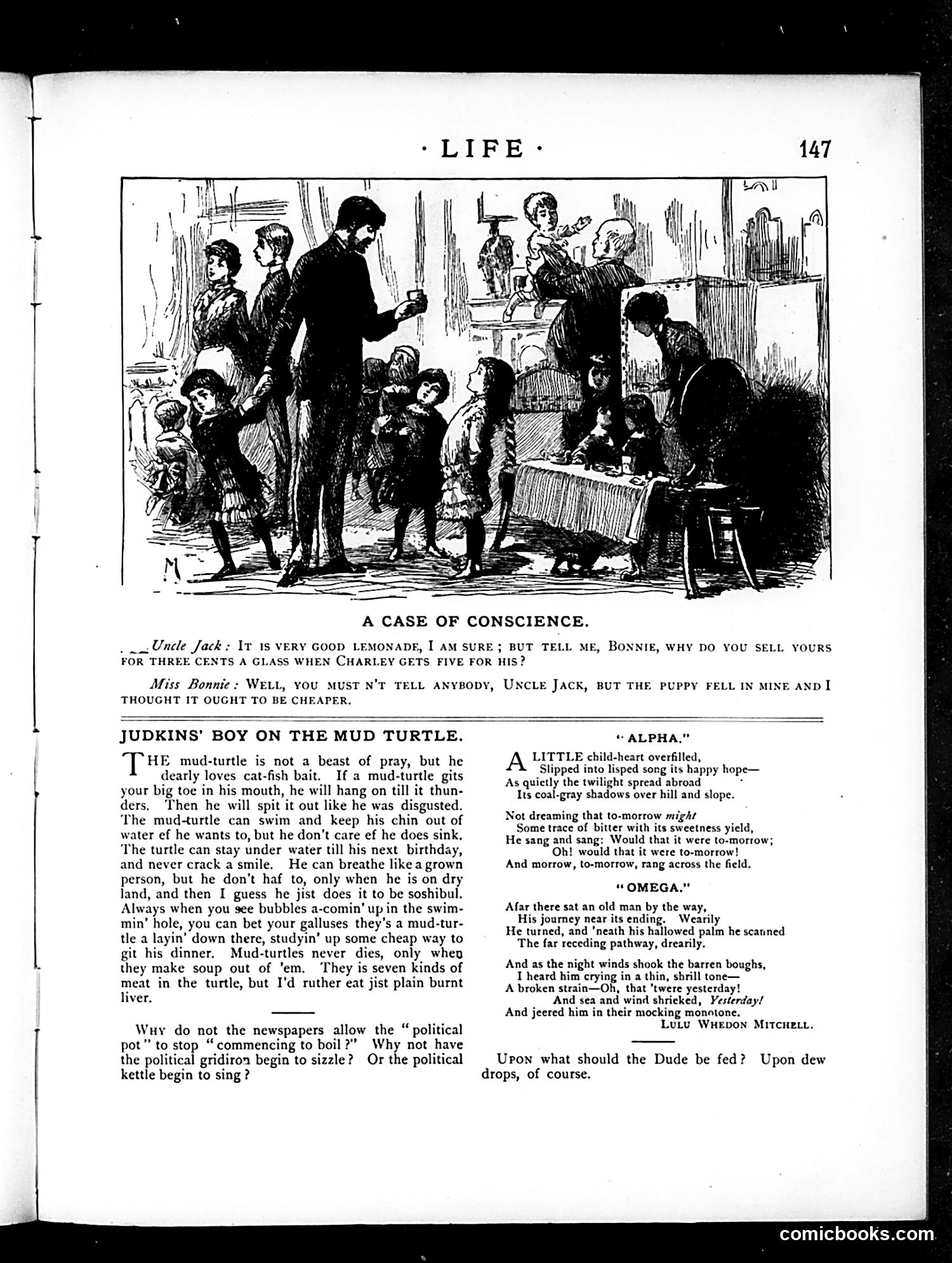
The cartoon depicts a moral lesson about childhood honesty. Uncle Jack questions Miss Bonnie about why she's selling lemonade for three cents when Charlie cuts his for five cents. Bonnie admits the puppy fell in her lemonade, so she's selling it cheaper—a transparent rationalization for watering down the product. The satire targets how children (and perhaps adults) justify dishonest practices through pseudo-moral reasoning. By claiming she's being "cheaper" rather than admitting to inferior quality, Bonnie exemplifies self-deception disguised as virtue. The scene shows Uncle Jack catching her in this contradiction, exposing how conscience can be twisted to excuse questionable behavior. The other poems on the page are unrelated literary pieces.
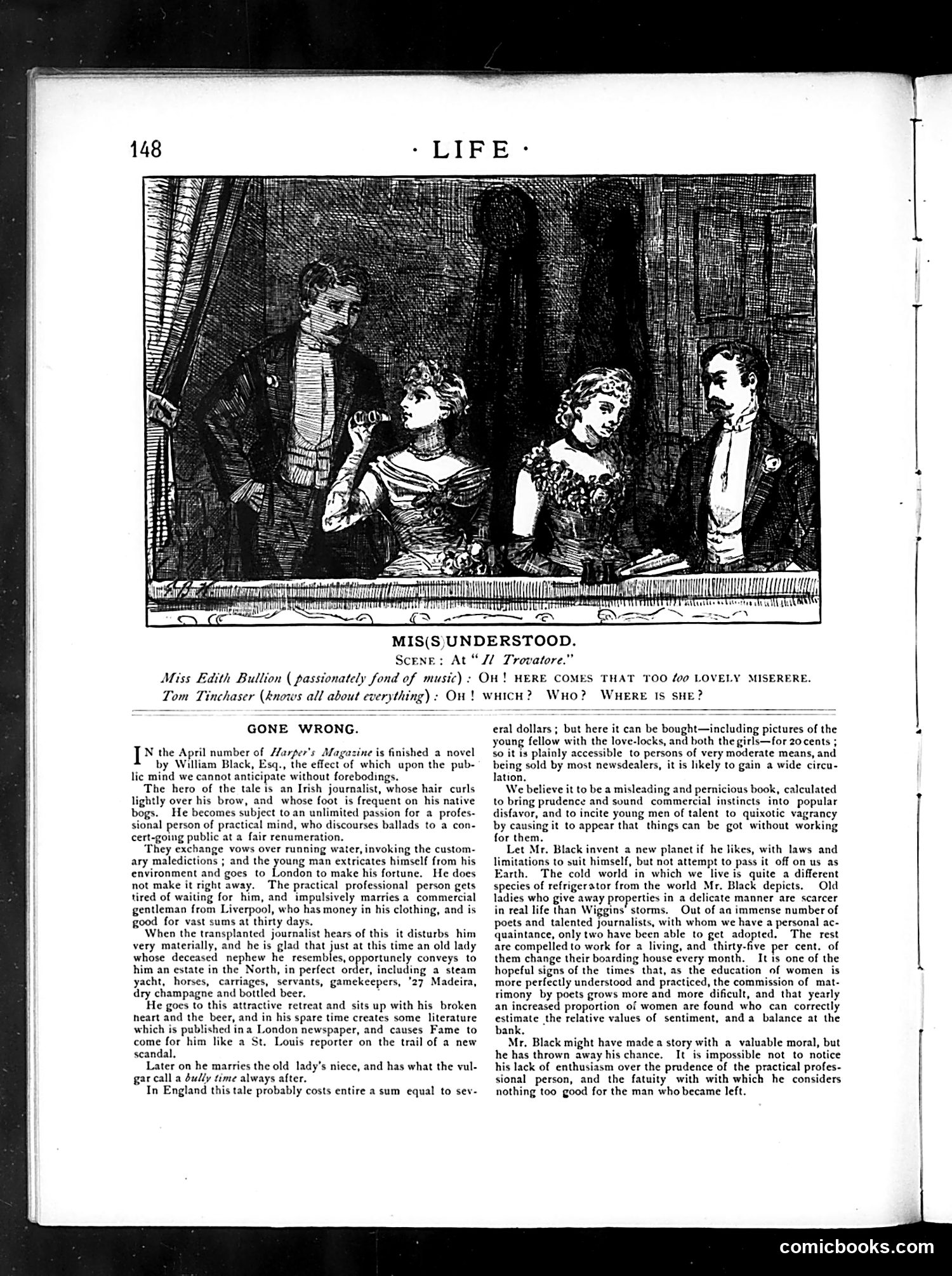
This page satirizes William Black's novel *Madcap*, critiquing what the reviewer calls a "misleading and pernicious book." The cartoon illustrates a scene from the plot: an Irish journalist protagonist becomes infatuated with a wealthy woman and impulsively marries a commercial gentleman from Liverpool instead—creating romantic chaos. The satire mocks Black's implausible storyline and his portrayal of female characters as incomprehensibly fickle. The reviewer argues the novel promotes "prudence" while actually glorifying "vagrant" behavior and poor decision-making. The title "Miss Understood" plays on the female characters' supposed inscrutability, suggesting the author fails to credibly depict women's motivations or psychology.
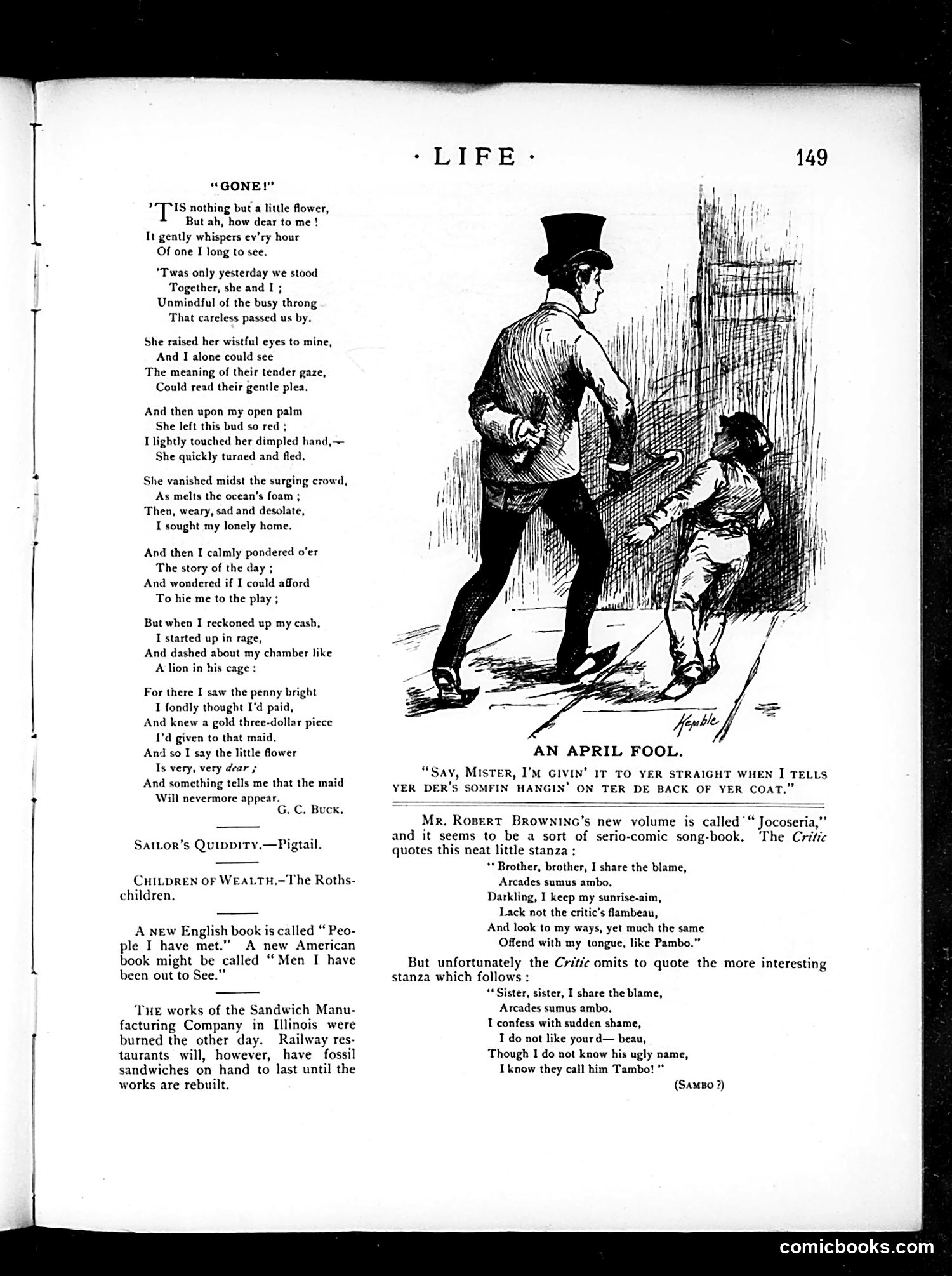
The cartoon depicts a well-dressed gentleman in a top hat encountering a street child. The caption quotes the child offering to reveal where "the der's somfin hangin' on ter de back of yer coat" — claiming something valuable is attached to his coat. This is a classic "April Fool" con: the child tricks the gentleman into believing he has something stuck to him, likely intending to pick his pocket while he's distracted checking his back. The satire targets the gullibility of wealthy, self-important men who can be easily fooled by street urchins using simple deception. The illustration emphasizes the class divide between the well-groomed, top-hatted gentleman and the ragged street child — a common social commentary theme in *Life* magazine's satirical work.
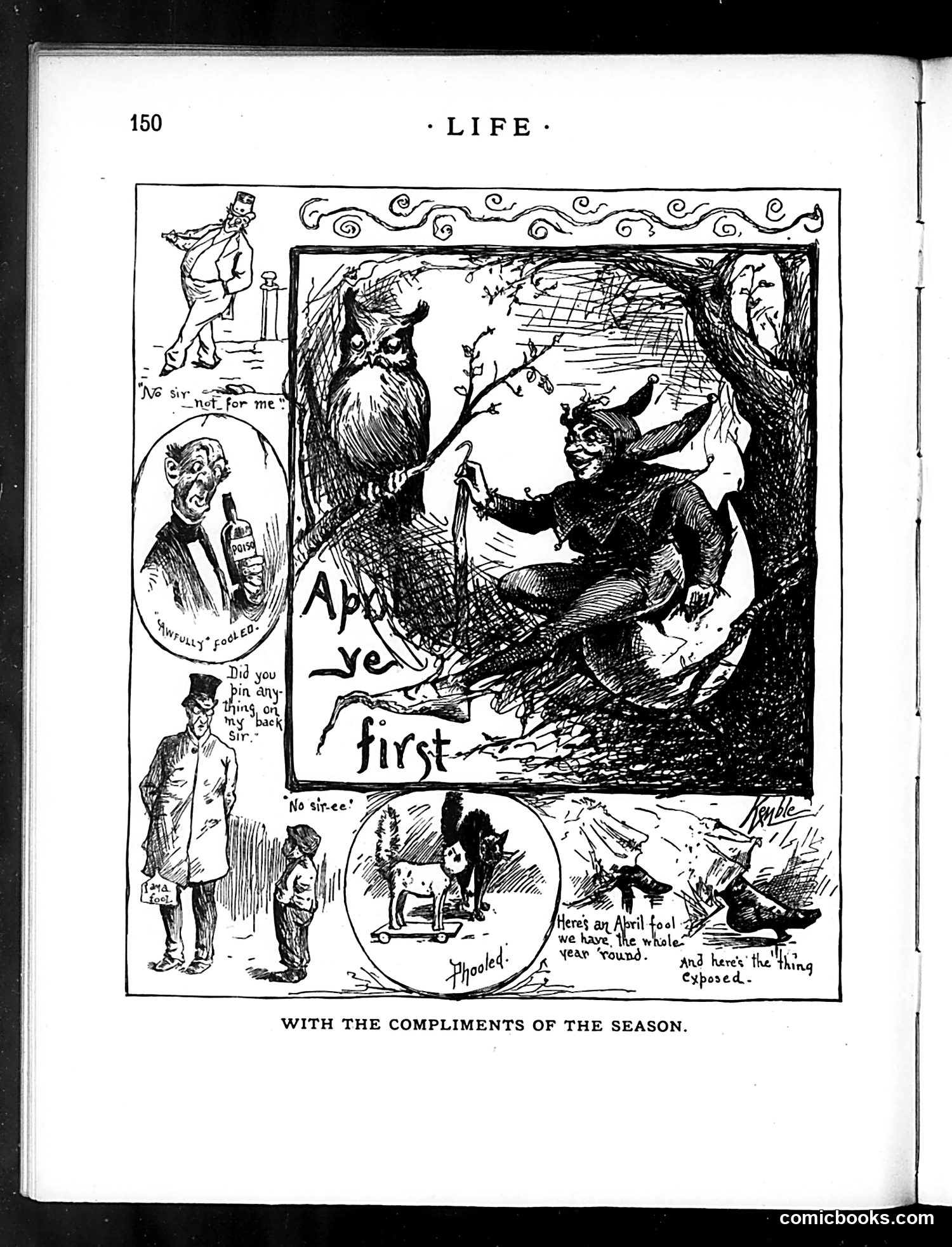
This April Fools' Day cartoon satirizes theatrical and social pretension. The central panel depicts a bearded figure (possibly representing a theatrical impresario or authority figure) gesturing toward a foolish character being duped by elaborate stage trickery—likely mocking gullible audiences or critics. The surrounding vignettes show various April Fools' pranks: people being told "Not for me," someone claiming innocence ("Did you pin anything on my back, sir?"), and a figure labeled "Hoaxed." The caption "With the Compliments of the Season" uses seasonal greeting language ironically to deliver pranks instead. The overall satire targets human foolishness, susceptibility to deception, and the theater world's elaborate humbug—suggesting both performers and audiences deserve mockery for their complicity in theatrical artifice.
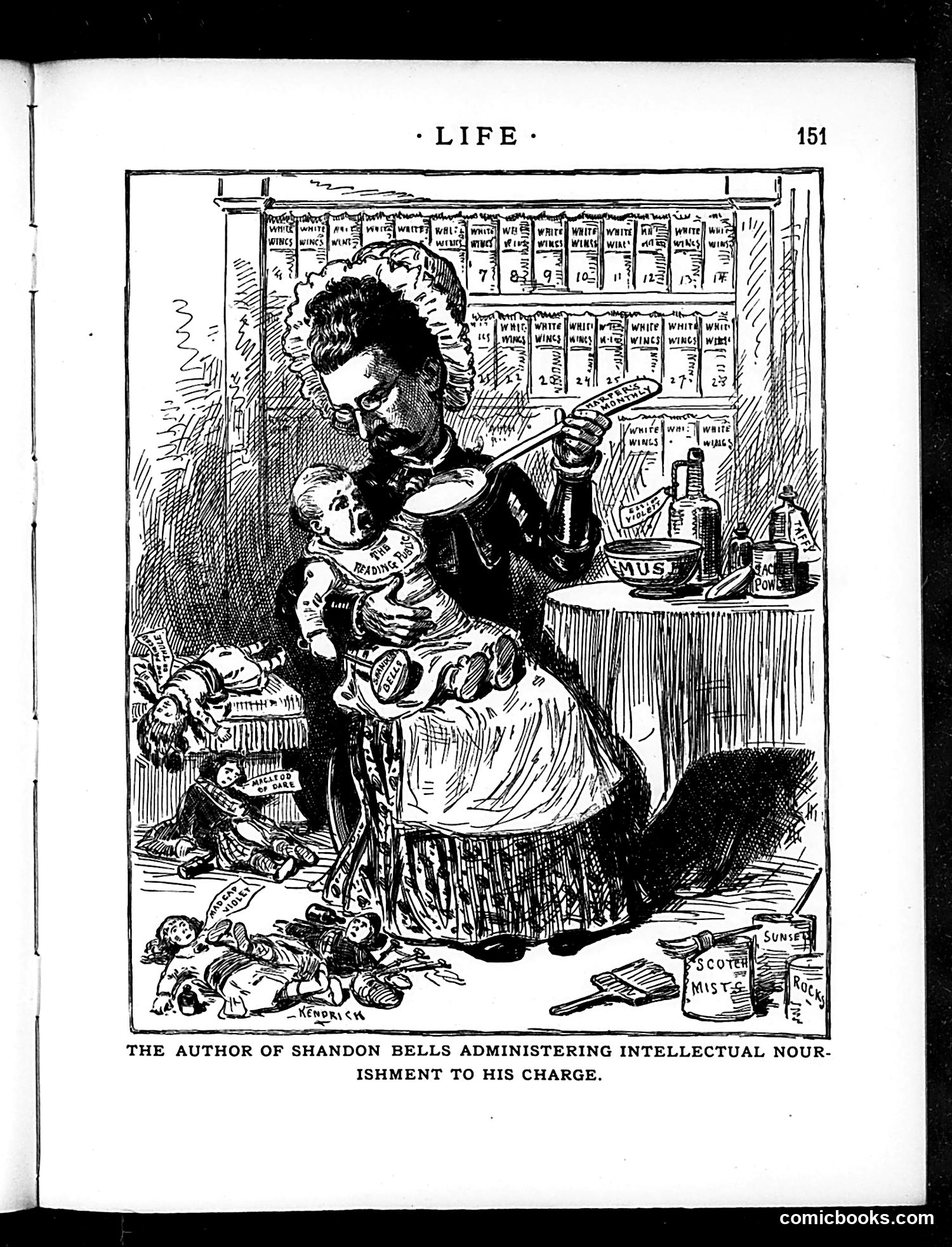
This satirical cartoon depicts a woman administering medicine to a child, captioned "The Author of Shandon Bells Administering Intellectual Nourishment to His Charge." The reference is to Laurence Sterne's novel *Tristram Shandy* (containing the famous "Sterne's Shandon Hall" passages). The cartoon satirizes Sterne as the "author" force-feeding a child intellectual or literary content—likely criticizing pretentious, overwrought writing presented as educational material. The cluttered apothecary/study setting with bottles labeled "Muse," "Scotch Mist," and various medicines suggests mixing literature with pseudointellectual remedies. The scattered toys and child's confusion indicate that complex, adult literary work is being inappropriately imposed on a young mind, mocking both the author's self-importance and misguided educational methods.
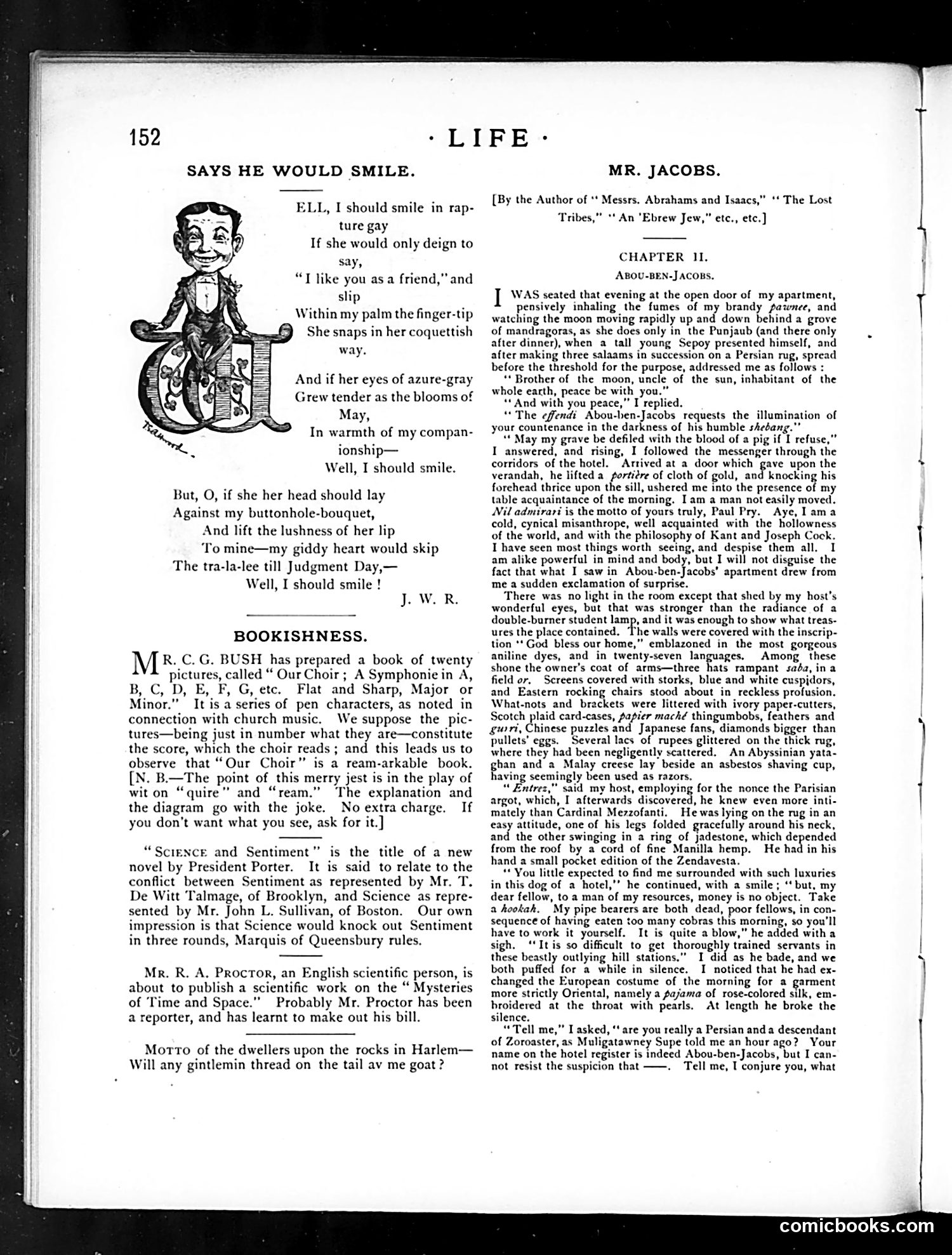
This page contains two distinct pieces of satirical content: **Left column - "Says He Would Smile"**: A humorous romantic poem (by J.W.R.) depicting an earnest suitor's escalating fantasies about a woman's affections. The cartoon shows a caricatured, grinning male figure. The satire mocks sentimental Victorian romance conventions—the poem progresses from hoping she'll merely acknowledge him as a friend to imagining a passionate kiss, with each scenario prompting his refrain "Well, I should smile!" **Right column - "Bookishness" and "Mr. Jacobs"**: Brief satirical book reviews and notices, including wordplay jokes (R.C.G. Bush's "Our Choir" pun on "quire" and "ream"). There's mockery of a fictional novel pitting religious sentiment against scientific materialism, with a cynical prediction science will "knock out" sentiment. The page also begins serialized fiction by "Mr. Jacobs," a parody of orientalist adventure tales with exaggerated mystical language and colonial-era stereotypes. Overall, the page satirizes sentimentalism, literary pretension, and contemporary cultural debates.
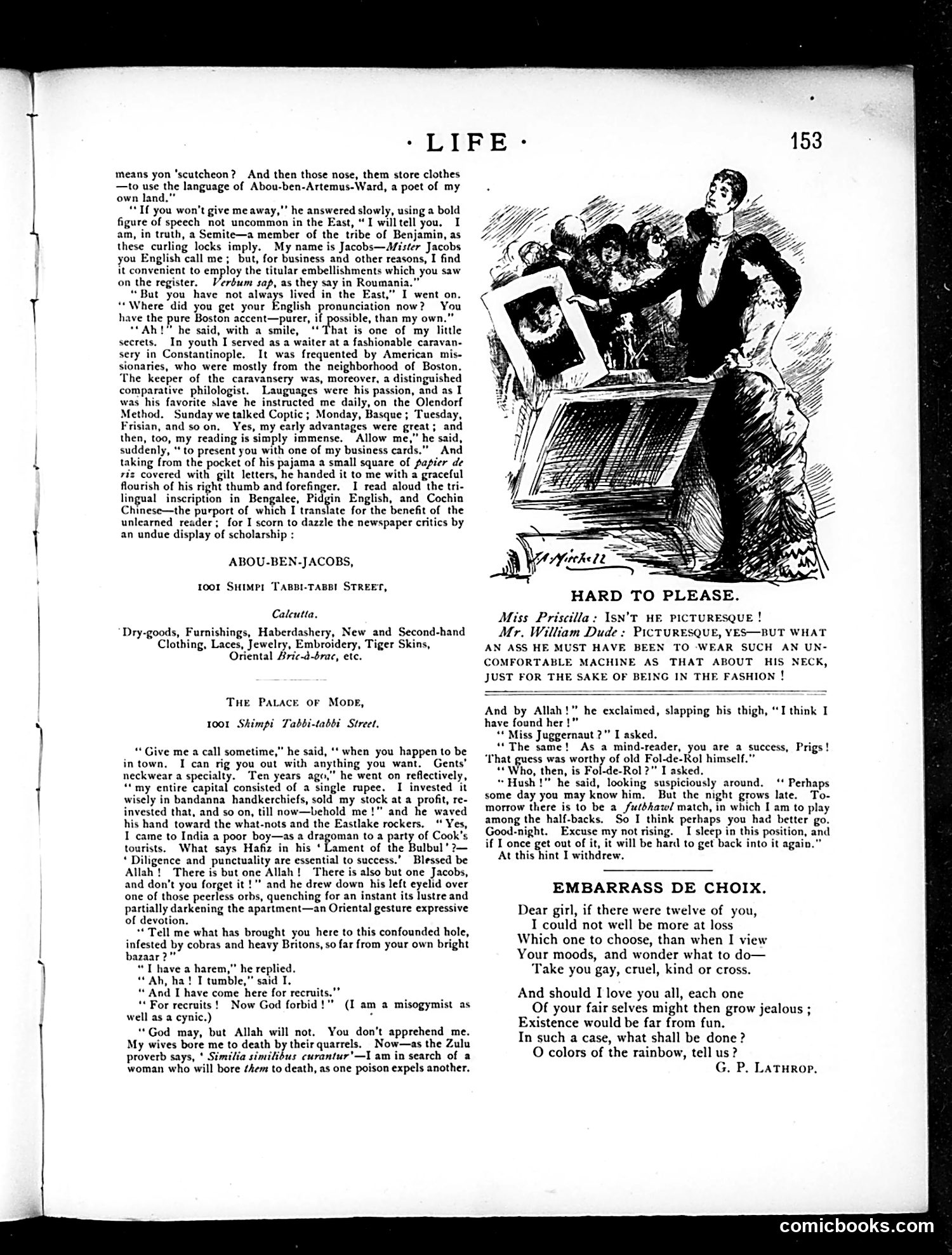
This page contains a short story featuring **Abou-Ben-Jacobs**, a merchant in Calcutta who adopts an elaborate "Oriental" persona despite being a Jewish man from Boston. The satire mocks him as a self-made businessman who affects exotic sophistication—claiming fluency in multiple languages, adopting grandiose titles, and surrounding himself with fashionable furniture. The accompanying cartoon (captioned "Hard to Please") shows the connection: it depicts a wealthy woman dismissing a man's compliments about her appearance, with Mr. William Dude sarcastically suggesting she's uncomfortable in fashionable dress—satirizing how some wealthy people affect dissatisfaction despite their material success. The joke targets **American pretension and social climbing**: Jacobs has genuinely succeeded financially but masks his origins under affectation, while the cartoon's woman similarly performs fashionable discontent. Both represent the Victorian anxiety about authenticity versus social performance among the newly wealthy.
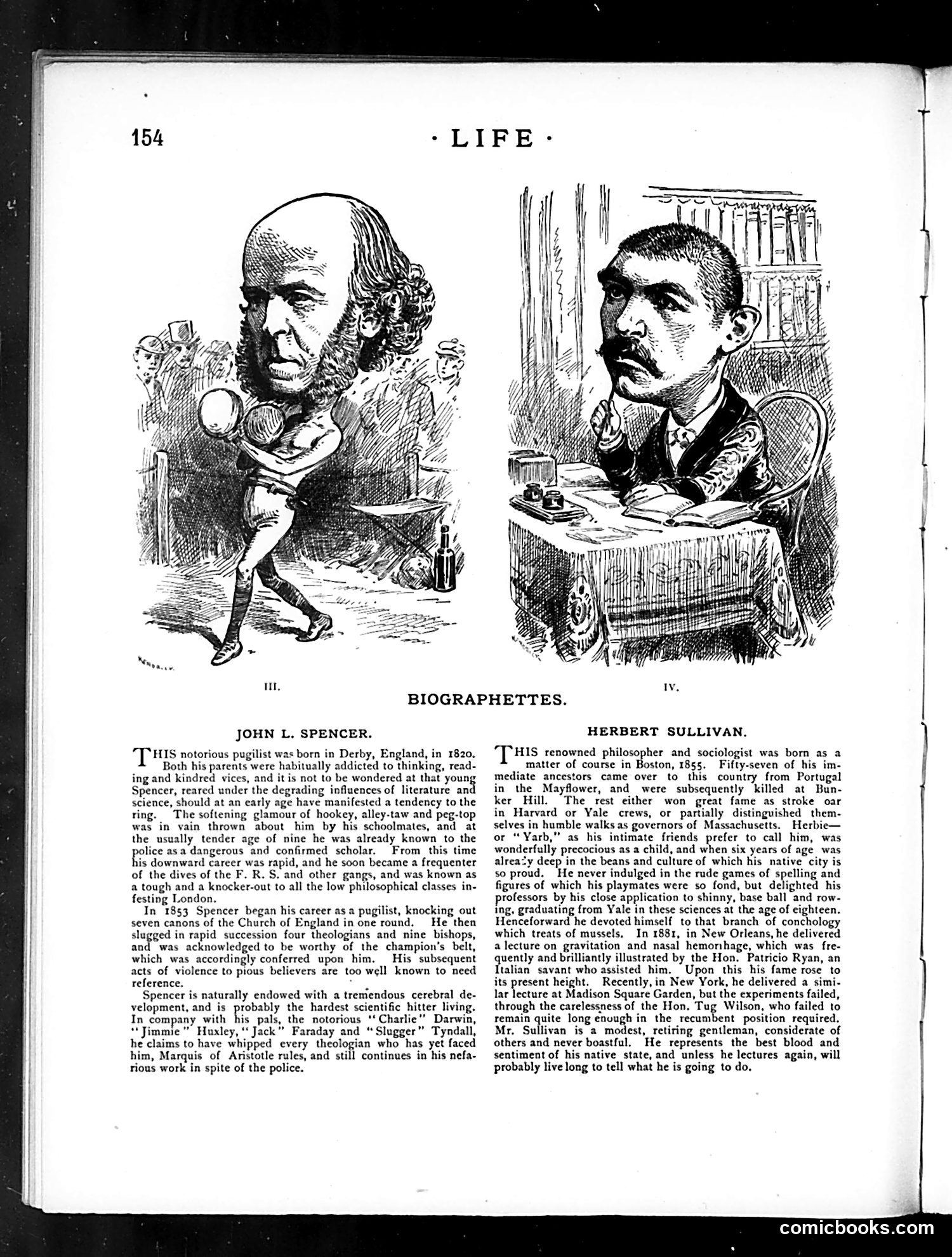
This page mocks prominent figures through mock-biographical sketches. **John L. Spencer** appears to be a fictional composite caricature satirizing violent "New Atheists" of the era. The satire inverts morality: Spencer's intellectual influences (reading, science) supposedly corrupted him into prizefighting, while his association with real scientists like Darwin, Huxley, Faraday, and Tyndall suggests these figures are portrayed as intellectual "thugs" who brutally attack religious believers. **Herbert Sullivan** ridicules pretentious Boston intellectuals and academic charlatans. Despite elite ancestry and Yale credentials, he lectures on absurd topics ("gravitation and nasal hemorrhage"), with experiments that fail comically. The satire highlights the gap between intellectual pretension and actual knowledge—he's celebrated despite delivering nonsense. Both sketches suggest *Life* magazine was attacking materialist scientists and smug Boston society as intellectually fraudulent and socially destructive, using exaggeration and inversion for comic effect. The caricatures emphasize grotesque physical features common to Victorian satirical illustration.
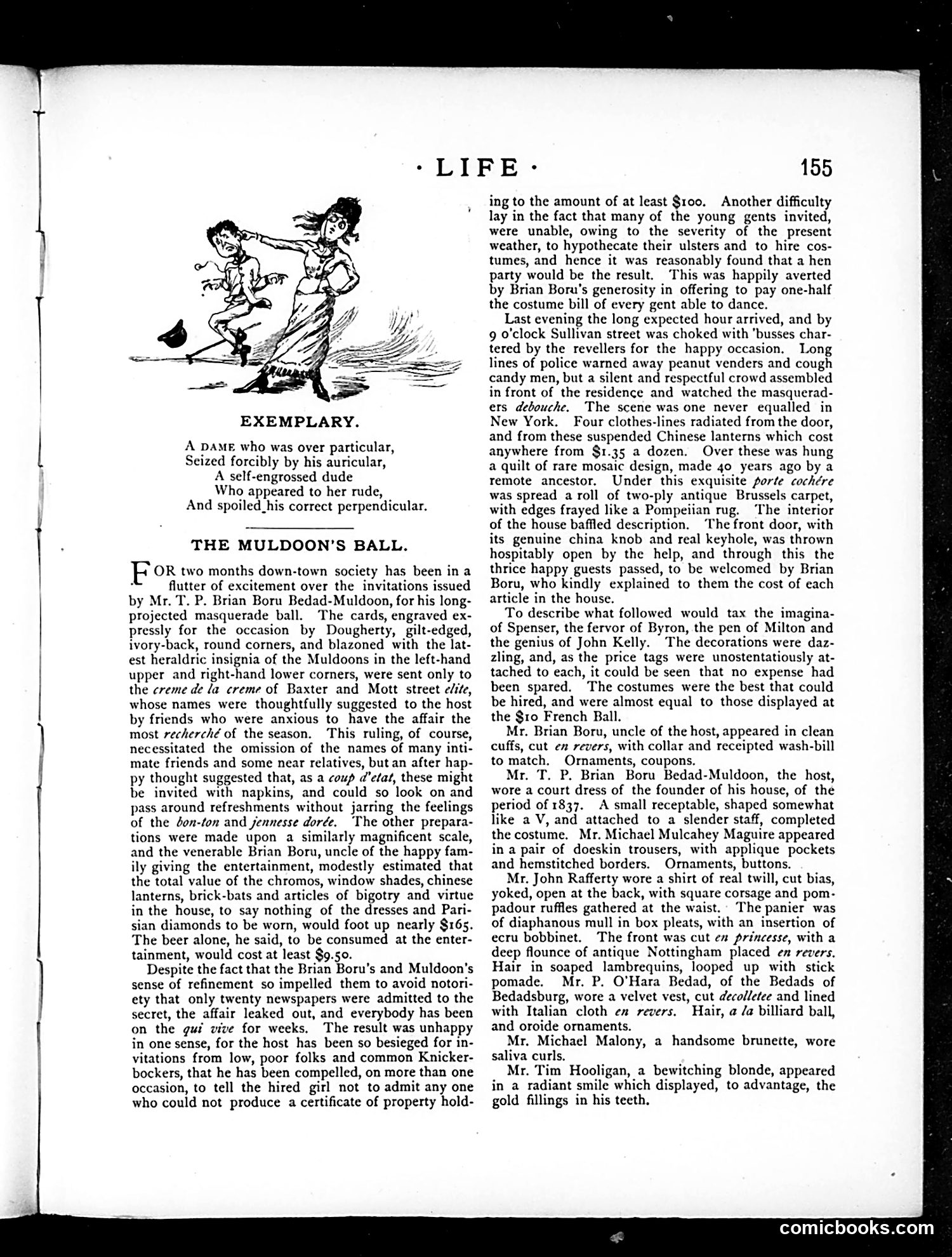
The cartoon and text mock the pretensions of newly wealthy Irish-American immigrants attempting to join New York's elite society. **The figures:** "Mr. T. P. Brian Boru Bedad-Muldoon" and his family represent Irish-Americans with stereotypical names (Brian Boru, Bedad) who've acquired money but lack genuine refinement. **The satire:** The Muldoons host an elaborate masquerade ball, obsessively emphasizing trivial details—gilt-edged invitations, Chinese lanterns costing $1.35 a dozen, a 40-year-old quilt as a "porte cochère"—while claiming exclusivity ("creme de la creme of Baxter and Mott street"). The contradiction is sharp: they simultaneously snub poor relatives yet nervously accept working-class guests lacking proper property certificates. **The joke:** Their desperation to appear refined ("recherché") through excessive decoration and social gatekeeping exposes their actual insecurity and vulgarity. The repetitive, overwrought description of cheap finery masquerading as luxury—a worn Brussels carpet, fake architectural pretense—reveals fundamental tastelessness. This reflects period attitudes toward Irish immigrants' economic advancement and their perceived inability to achieve "true" gentility.
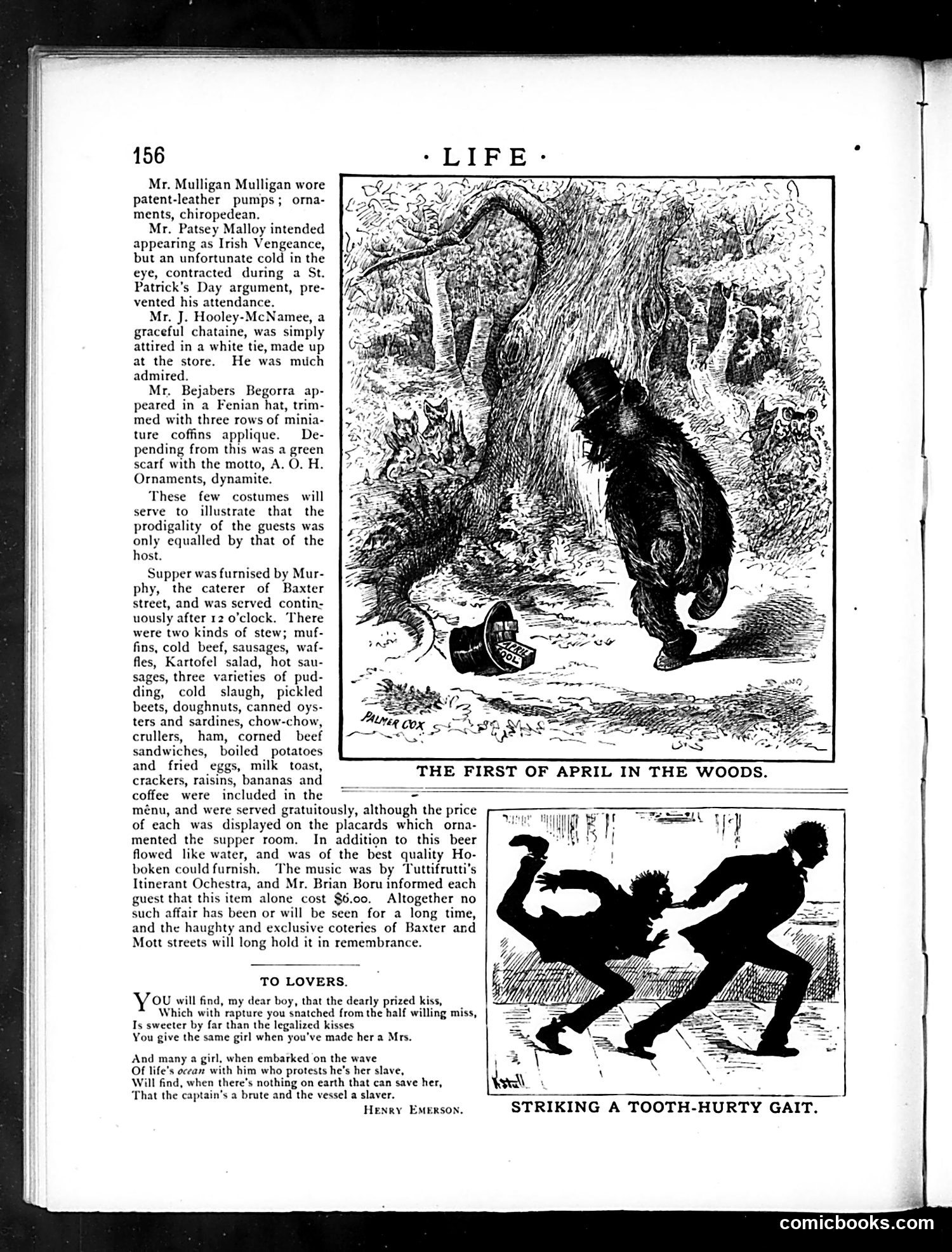
This page contains satirical commentary on Irish-American social life and customs. The text describes an elaborate party where Irish guests wore elaborate costumes—including references to "Fenian" imagery (Irish nationalism) and "A.O.H. Ornaments, dynamite," which darkly jokes about the Irish Republican movement's association with bombings. The two illustrated cartoons depict April Fools' pranks: the top shows forest creatures in a chaotic scene, while the bottom shows figures in an exaggerated running posture titled "Striking a Tooth-Hurty Gait"—likely depicting someone feigning injury as a prank. The "To Lovers" poem at bottom is unrelated satirical verse about marriage's disillusionment, written by Henry Emerson. The humor relies on stereotyping Irish-Americans as boisterous, prone to violence, and heavy drinkers—common prejudicial tropes in period satirical magazines.
This is primarily an advertisements and notes page from *Life* magazine (circa 1883, based on the insurance company assets listed). There are no cartoons visible. The page consists of: **Left column:** Brief satirical notes mocking contemporary topics—Congress reassembling, weather almanacs, women's education, and a politician named Robeson (likely referring to a real political figure, though unclear which). The jokes are short, topical jabs typical of *Life's* style. **Center and right columns:** Insurance company advertisements and theater listings for New York venues featuring popular entertainments like Harrigan & Hart's *McSorley's Inflation* and Gilbert & Sullivan's *Patience*. **Bottom:** Ads for pens, printing ink, and lunch rooms. The satirical content is mild—poking fun at government inefficiency, social pretension, and contemporary obsessions with clubs and digestion. This appears to be a filler/business page rather than the magazine's main satirical content.
This is primarily an **advertising page** with no political cartoons or satirical content. The page contains commercial advertisements typical of 1880s Life magazine. Notable ads include: - **The Equitable Life Assurance Society**: Insurance company advertisement emphasizing policy reliability - **Dunlap & Co. Celebrated Hats**: Luxury hat retailer with multiple New York locations - **Fairbanks Standard Scales**: Industrial/commercial weighing equipment - **Lillian Russell portrait**: Advertising a celebrity portrait of the famous actress/singer, called "Eclipse of the Lily by a New York Beauty"—likely a competitive jab at another popular beauty - **Hungarian Government Bonds**: Investment opportunity promising lottery-style drawings with guaranteed premiums The page reflects Gilded Age commercial culture: insurance, luxury goods, celebrity marketing, and speculative foreign investments were prominent advertising categories in Life magazine during this period.